This one is for 20 meters (no need for 75) and will go to the Dominican Republic.
6 crystal filter at 5.2 MHz. VFO from old Yaesu FT-101 Termination Insensitive IF amplifiers using boards from Mostly DIY RF No RF amp ahead of the mixer. First mixer is homebrew diode ring. Bandpass filter has 4 LC circuits. Steep skirts. Low insertion loss. Bal Mod/Product detector has two diodes (singly balanced) Carrier osc is crystal controlled and homebrew. Audio amp starts with a 2N3904 amplifier followed by an LM386 board. Transmitter portion will be done next.
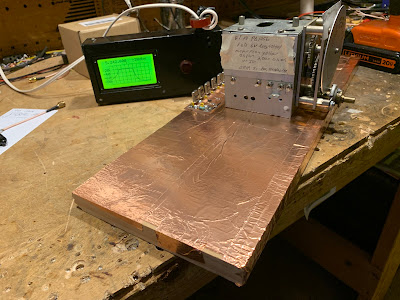
The crystal filter as seen on the Antuino

Filter on the blank board.

Bandpass filter (-20 db = 0)
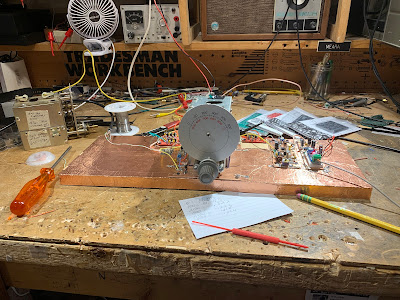
VFO box, carrier osc, Bal Mod/Product Detector, AF amps

The Antuino looks at the Crystal Filter
9Mhz VFO?? That’s running pretty high! Ed KC8SBV
Ed: It is kind of high in frequency. But it is very stable. I can’t really take credit for this — the credit goes to Yaesu. But I like the circuit because it is all analog and all discrete component. It even has a split stator temperature compensation variable cap! At Pete’s recommendation, I originally bought these boxes thinking that I’d just get the anti-backlash gears and the reduction drives. But the sellers always sent the entire VFO boxes. They even come with a “clarifier” circuit which I now use as an “up 5-10” feature that lets me work the DX-peditions on 20. 73 Bill
9 MHz VFO might seem high, but its not too difficult to achieve at least “100Hz/Hour after 10 Minute warm-up”* , through at least 30 Meters. Bill, where is a good source for the copper foil you use? Does it have a PSA backing or did you bond it some other way? Looks Spiffy–Thanks! 73, WN2A * There are several “VFO warm-up criteria” I have seen, but that one came out of an ARRL Handbook a while ago. Not too tough. There’s others.
Mike: More info on the Yaesu VFO is here: https://soldersmoke.blogspot.com/2021/07/mythbuster-video-3-using-vfo-from-yaesu.html As for the tape, I got mine from Amazon. It has conductive adhesive: https://www.amazon.com/gp/product/B07QQJ4MX1/ref=ppx_yo_dt_b_search_asin_title?ie=UTF8&psc=1 73 Bill
Nice project, Bill. The ladder filter looks very sharp. Great to see that beautiful BFO have another life
That’s a nice receiver, should be low noise, no digital noise, no OLED noise, minimal VFO phase noise, diode mixers, sharp filters, I bet it sounds sweet! Paul VK3HN.
Sorry I missed the video, it does sound sweet!