I thought you guys would like Peter Parker’s latest video. And in it, Dean KK4DAS might see a clue or two for his Halli restoration/repair project.
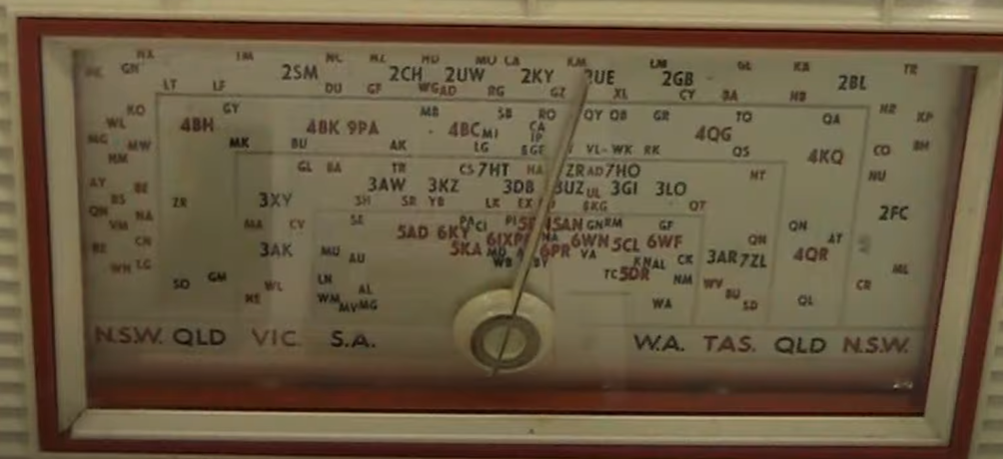
What really struck me was the dial markings on the Australian radios. They seem to be mostly oriented toward the reception of Australian AM or LW broadcasters — not many exotic DX locations are marked. Australia is big!
Looks like a lot of crystal detectors in glass tubes. At first I thought they might have been coherers, but I think they are crystal detectors.
Many variometers visible.
I saw one Geloso-Milano Communications 8 receiver. Va bene!
I also saw one “Tasma 780” Superhet. Cool name!
What is up with the “Green Theme”?
I have some of the headphones they showed.
Please note in the Comments section anything special that you noted in watching Peter’s FB video.
More on the coil winding machine here:
Hi Bill, Wonderful video. I was 1st intrigued by how similar the VK radios were- but upon close ups- quite different. Those honeycomb coils were pieces of art. I did indeed purchase from one of your links- the Apollo book. I have watched a fascinating video on the lunar lander computer: https://www.youtube.com/watch?v=B1J2RMorJXM&t=16s
Bring back the days when trannie referred to a pocket radio.
Thanks Dale: I am enjoying the book. It is just amazing that they this young (23!) fellow who had never written a line of code was given responsibility for the LEM software. Wow. I too was struck by the differences we see in the Australian radios. Peter Parker recently did a post about the coil winding machine that shows up in his video about the ‘fest: https://hackaday.com/2023/08/30/all-mechanical-coil-winder-is-a-scrap-bin-delight/#more-612604 73 Bill
Thanks for the link to that video Bill. While I watch most of Peter’s video’s, I may have missed that one. That green theme was new to me. I did a quick search and here’s a couple of snippets from an article in an Australian newspaper 2014. Vintage radio collector says ‘the most desirable radios are green’ VINTAGE valve radios’ are booming on the North Shore with one restorer collecting almost 200 radios that he’s now ready to part with. “The most desirable radios are green and if you have a 1936 AWA (green empire state radio) then you could get between $20,000 and $30,000 and only $1200 if you have a black one. Colour sets were difficult to sell in shops at the time and so very few sets were made, which has now made them both desirable and valuable,” Mr Meijer said.
russian escorts in dwarka expressway