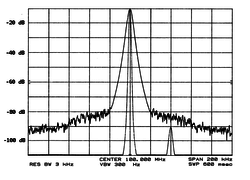
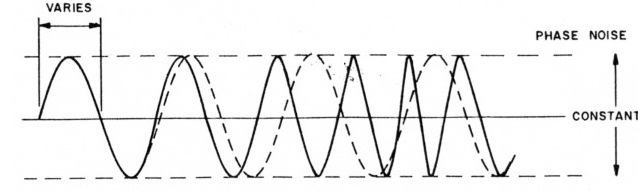
Phase noise is an undesired variation in the phase of the signal. In this case, an oscilloscope shows that the time between zero crossings of the signal varies over time when compared to the zero crossings of an ideal sine wave. An exaggerated example of phase noise is shown above.
Whenever a carrier is passed through a mixer, the phase noise of the oscillator driving that mixer is added to the carrier.
http://www.sherweng.com/documents/TermsExplainedSherwoodTableofReceiverPerformance-RevF.pdf
Phase Noise: Old radios (Collins, Drake, Hammarlund, National) used a VFO or PTO and crystal oscillators to tune the bands. Any noise in the local oscillator (LO) chain was minimal. When synthesized radios came along in the 70s, the LO had noise on it. It is caused by phase jitter in the circuit, and puts significant noise sidebands on the LO. This can mix with a strong signal outside the passband of the radio and put noise on top of the weak signal you are trying to copy. This is a significant problem in some cases: You have a neighboring ham close by, during Field Day when there are multiple transmitters at the same site, and certainly in a multi-multi contest station. You would like the number to be better that 130 dBc / Hz at 10 kHz. A non-synthesized radio, such as a Drake or Collins, has so little local oscillator noise the measurements were made closer-in between 2 and 5 kHz.
http://qrp-labs.com/qcxp/
————————————
DC4KU appears to be using the crystal filter method used by Hans:
https://dc4ku.darc.de/Transmitter-Sideband-Noise_DC4KU.pdf
————————————
Martien PA3AKE has done a lot of great work on this topic. See:
https://martein.home.
———————————–
This is an excellent and very-useful compendium. The content of the March and April 1988 QST article by KI6WX was included (apparently in full) in the 1992 ARRL Handbook, 10-24 through 10-30. That or similar material may have appeared in later editions. Additional material is also in Ulrich Rohde (N1UL), “All About Phase Noise in Oscillators,” QEX 12/93–2/94; and in Rohde and Whitaker, _Communications Receivers_ (3d ed.), Chapter 7, pp. 367-493. Rohde and Whitaker conclude that PLL frequency synthesis is inherently more phase-noisy than crystal oscillators, and those are noisier than LC oscillators. They note, though, that phase noise is much more of a problem for high-bit-rate psk or fsk modulation than it is for SSB, and that anyway “modern” PLL chips are pretty good (enough?).
Hi Bill. Great chatter on non-ideal oscillators. Please allow me to weigh in with some kludgey thoughts. Disclaimer – I am not bound to Amateur radio experiments only and study all things radio (and audio). Phase noise sidebands arise from random fluctuations in the phase of a signal. Most LO phase noise (PN) appears to comes from thermal and flicker (1/f) noises of the oscillator components including the tank & gain device, non-linear capacitors + includes both DC and AC currents. Close in spectra get degraded by 1/f flicker noise upconversion — the pumping oscillator upconverts this noise to the carrier frequency and its harmonics via AM FM and phase modulation. Other factors including noise sideband asymmetry — and various circuit non-linearities seem to contribute to low frequency noise modulation. External noise also may get injected into the oscillator. As most of your linked sources mention — AM is not too concerning and gets “limited” naturally in oscillators and buffer amps. Close in, phase noise tends to dominate over amplitude noise. Recent state‐of‐the‐art professional literature has well advanced of the knowledge of PN in receiver systems and the math gets crazy. Calculating and modeling oscillator phase noise in 5G and other digital systems that use 4 PSK is not for the faint of heart. Here LO PN matters, however controversy remains since older theories get challenged by new ideas, theories, and models. I think did Hans et al. did a great job with xtal filtration and direct spectrum analysis using modest gear, but good xtal filters. 1 vexing problem is the quieter your oscillator ( for example crystal or SAW resonator oscillators @ UHF) the more difficult it gets to accurately measure PN Modern theorists further break the phase noise spectra into 1/f 2 thermal phase noise, 1/f3 close-in phase noise and the 1/f3 corner frequency. I still make PLL synthesizers; mostly for UHF. This means a low noise xtal reference oscillator and running the loop filter bandwidth inside the 1/f3 PN corner frequency to try and keep the VCO quiet. Resonator Q ,or as I prefer to say, Vitamin Q proves harder to get as you move above 100 MHz and that’s about where PN becomes more important. It all boils down to the SNR you require in your receive system. PN in modern, fast digital circuits may cause loss of phase lock in phase tracking systems that use coherent PLLs, GPS systems, cell networks, delayed-lock loops (no oscillator). In futuristic 5G, “dream big – hope big” engineers strive for peak data rates of 10 Gbps. This will likely require going above 20 GHz — Here lowering PN matters! I think I once told you about my Ham neighbour 5 doors down with a legacy aka “noisy’ Yaesu transceiver running 1 KW on 40 meters who raised my noise floor during CW contest weekends. That’s a case where HF phase noise hurt. I guess that’s why I went on 15 meters on my breaks during the day time?
sorry this was Todd, VE7BPO.
Thanks Todd: Needless to say, I was pleased to hear that there is SOMETHING in which the old LC VFO is superior. 73 Bill
Thank you Vasily! I always learn so much from your comments. Thanks Todd. 73 Bill