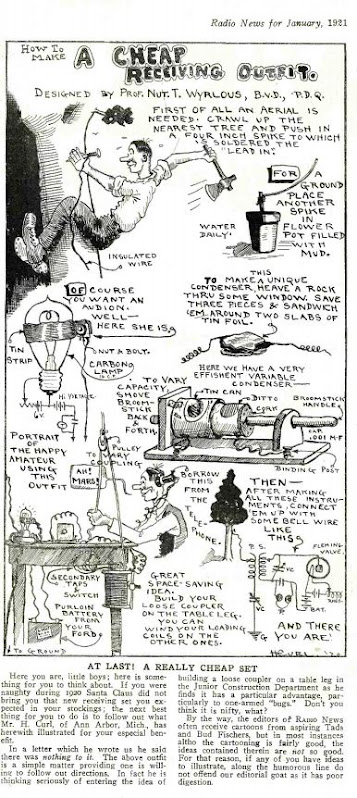
Wow, lots of ingenuity in this 1921 receiver.
— Has anyone actually made a diode out of a light bulb in the way described?
— The antenna coupler on the table leg is not much different from the tuner that I have attached to the wall of my car port.
— Note that when our hero finishes the receiver, he is able to pick up signals from Mars! FB OM.
Who will be the first to recreate this 1921 receiver?
Now, he has the knack!
The fact that H. Curl is from Ann Arbor MI is highly suspect. I know of no such local amateur here. A put-up job if I ever heard one. 🙂
Well, all of the coils, caps and other components should work as described and have in fact been homebrewed by amateurs. The only think I’m not sure about is the homebrew audion tube. But that appears to be do-able too. 73 Bill
it is not , nor a diode not even a triode, since it has no plate. if the tin strip is made positive to the filament perhaps will be a cloud of electrons near the glass area surrounded by the tin strip.the electrons can not cross throuh the glass. no currente at all . it is more like a CRT then a diode. 73 js88
it is not a Flemming valve but a light bulb. if only the Hero could get a modern car lamp with two independent filaments , burn one of them . then he would go the right way : a working filament and the internal physical support as a kind of plate…the next day our hero had an idea : to go buy a cheap true – factory made – triode . 73 js88
The website to get the cartoon https://worldradiohistory.com/hd2/IDX-Site-Early-Radio/Archive-Radio-News-IDX/IDX/20s/21/Radio-News-1921-01-R-OCR-Page-0046.pdf#search=%22a%20cheap%20receiving%20outfit%201921%22. I like to try the light bulb diode!
Do you guys really think that rig would work? I mean js888 made a very good point… that Fleming valve won’t really work is the glass doesn’t allow the electrons to flow, however their might be kinda microphonic effect where the carbon filament might oscillate with the audio? I dunno. Also, what is the little T parallel to the cap in the audio tube circuit on the left? And where is the variable cap at the antenna coupler – is this also implemented in the table leg? Anyhow, if this rig is intended to work than I am really intriguedby the seemingly “simple” components – and I am hooked 🙂
Andreas: I would like it to work! Parts of it clearly would work: The homemade variable capacitor, for example, is frequently used today. And of course the coils are easy to make. The audion is the hard part (and the hardest to believe part!). But if you used a crystal detector instead of that audion, you could get this thing to work, right? 73 Bill
perhaps that common light bulb could work as a cyclotron, putted inside a strong magnetic field – a horse shoe magnet ? – who knows. about the Fleming valve: https://en.wikipedia.org/wiki/Fleming_valve the first prototypes were really cool. the commercial ones not so much. thank you for your comments. 73 js88
something like this? https://onetuberadio.com/2014/11/15/emergency-1943-radio-receivers-including-converting-lightbulb-to-diode-tube/ BRs zef
Very interesting Zef. We will check this out. 73 Bill
Leading Australia Cigarette & Tobacco Retailer Leading Australia Cigarette & Tobacco Retailer Leading Australia Cigarette & Tobacco Retailer Leading Australia Cigarette & Tobacco Retailer Leading Australia Cigarette & Tobacco Retailer Leading Australia Cigarette & Tobacco Retailer Leading Australia Cigarette & Tobacco Retailer Leading Australia Cigarette & Tobacco Retailer Leading Australia Cigarette & Tobacco Retailer Leading Australia Cigarette & Tobacco Retailer Leading Australia Cigarette & Tobacco Retailer