
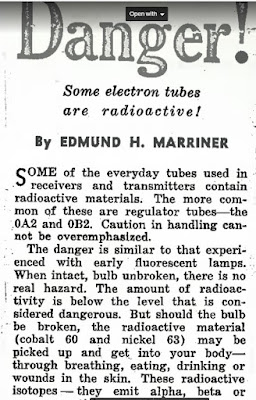
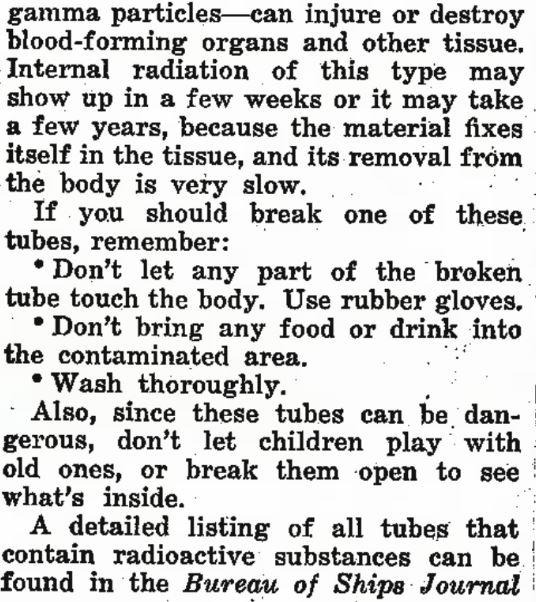
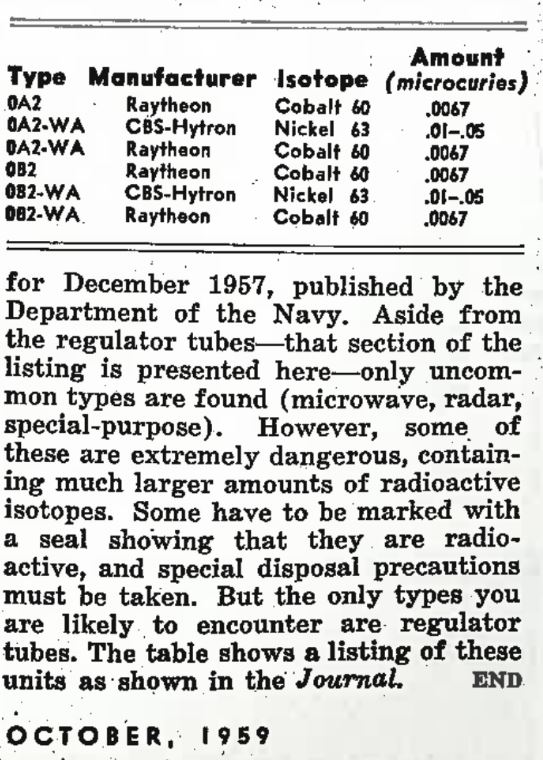
Pete found this amazing collection of articles by master homebrewer Ed Marriner W6BLZ. They were published in a West Coast radio newsletter during the 1950s and 60s. The above is from this collection.
I know that this kind of article upsets some people. They will write in saying that they have using OA2s for 50 years with no ill effects. Others will sarcastically say that we should just try to avoid eating the OA2s. I know. Don’t blame me. Don’t blame Pete. You can blame the Navy. And Raytheon. And Cobalt 60 and Nickle 63.
Now to find a lawyer! There has to be a class action lawsuit in here somewhere…
No danger in USE! Danger is from broken tubes. If you’ve got stocks, cushion them?
Dex – These tubes are not any more fragile or delicate than any other tube of similar size and shape. Yes. Any possible danger from broken tubes only. I have not seen anything on television or in the newspaper about someone dead as a result of radiation from a broken voltage regulator tube. Bruce KK0S
I think I’m right in remembering that rigs like the KW2000 series used a OA2 to regulate the VFO supply. American hams who have never seen a KW2000 should think “Collins” and marvel how quite by accident a UK company later came up with a similar design…. 🙂
Give me a break! Have you checked if the sky is still up there? California has demonstrated that you can find hazard in everything if you look. How many broken OA2s do I have to eat to have a problem? Really>?? Biggest danger is getting cut cleaning up the broken glass.
With a half-life 5.27 years for Cobalt 60, the radiation today is about 0.1% of what it was in 1967. Nickel 63 is much “hotter” as it has a half like of about 100 years. You may find the tubes with Cobalt are not working well in old gear and the Nickel 63 tubes may seem to be fine. Maybe this is a good reason to pursue some other technology for you radios.
THis is a well kept secret. If I can find 347 more OA2’s I can complete my bomb. Now everyone will want them.
Having built a HVPS with a 0A2 regulator recently, I encountered an issue that led to a neat article about the downside of the radioactive decay. Those Collins guys are on top of it. See the page 1 article in The Signal (2Q 2004) for details