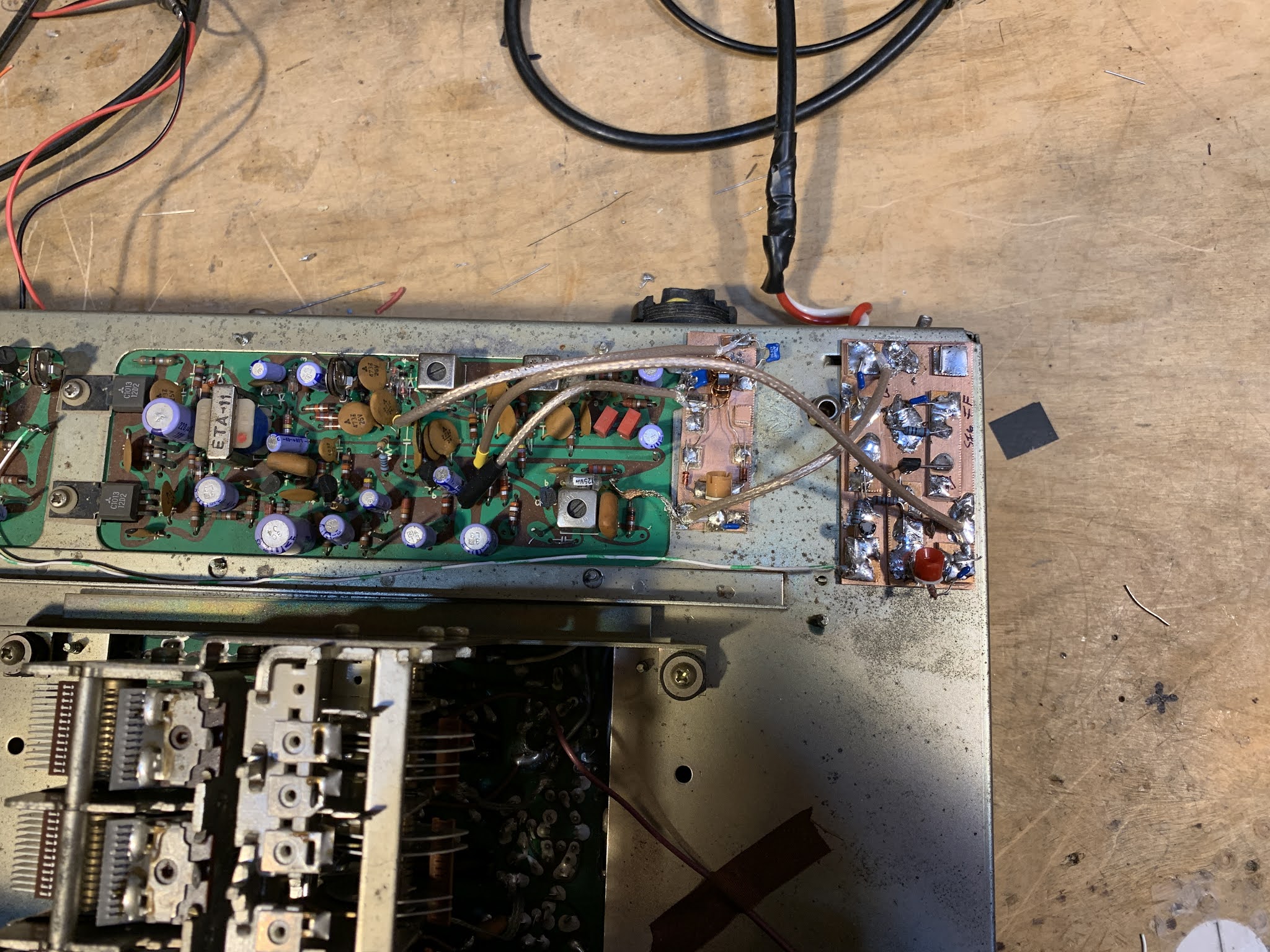
Steve N8NM built the HA-600A product detector both in LTSpice and in the real world. It worked fine in both versions. Steve even put the product detector into his S-38 receiver — he reported it worked well there.
I too built the thing in LTSpice. Then I went and rebuilt the circuit on a piece of PC board. I connected the new circuit to the HA-600A, using my external FeelTech sig generator as the BFO. IT STILL SOUNDED BAD ON SSB.
At this point I started Googling through the literature. I found a promising article by Robert Sherwood in December 1977 issue of Ham Radio magazine entitled “Present Day Receivers — Problems and Cures.” Sherwood wrote:
“Another area that could use additional work is the product detector. As the name implies, its output should be the product of the two input signals. If BFO injection is removed, output should go to zero. If this is not the case, as in the Heath HW series, envelope detection is also occurring, which causes audio distortion.”
I checked my circuit. When I removed the BFO signal from the product detector, envelope detection continued. In fact, with the receiver in SSB mode, and with the BFO disconnected, I could listen to the music of WRMI shortwave. It seemed that Sherwood was explaining well the problem I was having: Simultaneous envelope and product detection was making SSB sound very bad in my receiver. What I was hearing just seemed to SOUND like what you’d get with a mixture of product and envelope detection: “scratchy” sounding SSB. This also seemed to explain why SSB would sound fine when using the diode detector with loosely coupled BFO energy — in that case it would be envelope detection only, with no ugly mixture of both kinds of detection.
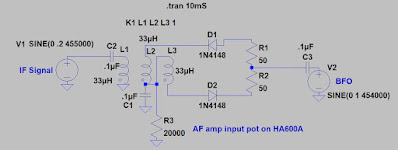
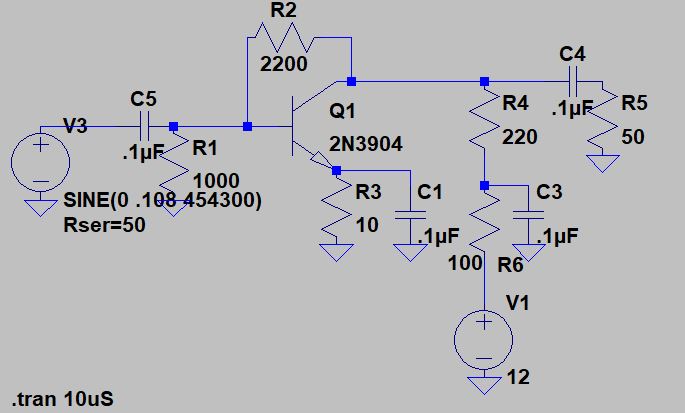
Finally, I needed to find a way to use the BFO in the HA-600A with the new product detector. Obviously I needed more BFO signal — I needed about 7 dbm, enough to turn on the diodes. I converted the outboard product detector board into a simple amplifier and put it between the HA-600A BFO and the BFO input port of the new product detector. This works fine.
A few issues remain:
1) The output from the HA-600A BFO through the above BFO amp (and across the 50 ohm resistor) is NOT a pretty 455 kc sine wave. But the peaks of the distorted wave appear to be enough to turn on the diodes, and when I look at the voltages across each diode (on my two channel ‘scope) I see mirror images — one is on when the other is off. Is this good enough?
2) Moving the BFO input from L1 to the junction of the two 50 ohm resistors (that is actually a 100 ohm pot) has big implications for how this mixer works. With the BFO energy going through the toroid, BOTH diodes are being alternately turned on and turned off. But both are on, and then BOTH are off. With the BFO energy going in through the other side, one diode turns on when the other is off. I think the mixing result is the same, with AF coming out of the output port, but the way the mixer works in this configuration is very different. Does this sound right?
After doing LTSpice simulation I do not believe it works different now then before. When the BFO comes from the right, it goes through one resistor, one diode, one part of the inductor and out the IF port.(some energy is coupled into the left part but is shunted by the source there) But if the BFO comes from the left, the energy is now coupled into the other windings. Steered by the diodes, it takes one of the two paths as described before.
I’m here to testify about what Dr. James did for me. I have been suffering from (GENITAL HERPES VIRUS) disease for the past 4 years and had constant pain and inching, especially in my private part. During the first year. This disease started circulating all over my body and I have used Oregano oil, Coconut oil, Acyclovir, Val acyclovir, Acyclovir, and some other products and it really helped during my outbreaks but I totally got cured! From my HSV with a strong and active herbal medicine ordered from Dr. James herbal mix and it completely fought the virus from my nervous system, and I was tested negative after 15 days of using Dr. James herbal mix medicine. I’m here to let you all know that the herpes virus has a complete cure, I got rid of mine with the help of Dr. James herbal medicine. I came across a testimony of Tasha, on the internet testifying about Dr. James, on how he cured Her of 7 years HSV 2. And she also gave the email address of the great Dr. James (GREATCUREMAN@GMAIL.COM…]…, advising anybody to contact him for help on any kind of diseases that he would be of help with, so I emailed him telling him about my (HSV 2) he told me not to worry that I’m going to be cured!! Well, I never doubted him. I have faith he can cure me too, Dr. James prepared and sent me his herbal mix medicine made of roots and herbs which I took. In the first one week, I started experiencing changes all over me, after 15 days I drank his herbal mix medicine, I was totally cured. No more inching, pain on me anymore as Dr. James assured me. After some time I went to my doctor to do another test. The result came out negative. So friends my advice is if you have such disease or know anyone who suffers from it or any other disease like Alzheimer’s Disease, Warts, Moles, Bipolar disorder, Shingles, HPV, HPV, HIV/AIDS, ALS, HBP, CANCER, NEPHROTIC SYNDROME HIV / AIDS, herpes cancer, Ovarian Cancer, Pancreatic cancers, bladder cancer, bladder cancer, prostate cancer, Glaucoma., Cataracts, Macular degeneration, Cardiovascular disease, Autism, Lung disease. Enlarged prostate, Osteoporosis. Alzheimer’s disease, psoriasis, Tach Diseases, Lupus, Backache, dementia. Kidney cancer, lung cancer, skin cancer, skin cancer and skin cancer. Testicular Cancer, LEUKEMIA, VIRUSES, HEPATITIS, INFERTILITY., etc. you can contact the great Dr. James directly on his…. [GREATCUREMAN@GMAIL.COM]… He is a good man, and He will help you.
Further spice analysis shows: your circuit as shown does not mix! It creates an AM at the beat frequency. To make it actually mix, you need to flip the connections on L3. To boost the mixed output, inject the BFO on the center tap and get the IF on the wiper of the potentiometer (not sure why tho).
Christian: I am really glad someone else in the world is interested in this product detector circuit! I think I have figured out how it works in my current configuration (BFO to L1, IF to pot wiper, audio out at junction L2 and L3). I will write this up in my next blog post (perhaps today). But one initial reaction to your comments: We just can’t put the 454 kc BFO on L1 AND put the 455 kc IF signal on the junction (center tap) of L2 and L3, because that center tap needs to be at ground for 455 kc. That is why we have a .1 uF capacitor to ground there (that I forgot to put in the diagram – sorry, I will fix this). That center tap needs to be at ground for 455 kc but not for audio. I will work on this today. Thanks and 73 Bill