There seems to be a bit of hysteria on the alleged phase noise problems of the Si5351 chip. The library yields some words of wisdom that help keep things in perspective:
ARRL Handbook (2002) page 14.5: “You would be excused for thinking that phase noise is a recent discovery, but all oscillators have always produced it.”
Experimental Methods in RF Design page 4.12 “At first glance, phase noise sounds like a esoteric detail that probably has little impact on practical communications. This is generally true.” (EMRFD does, however, go on to discuss the problems that arise on both receive and transmit from EXCESSIVE phase noise.)
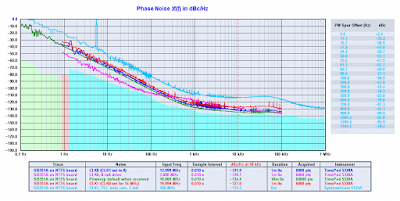
Our old (young!) friend Thomas LA3PNA e-mailed on this subject noting that the Si5351 chip produces less phase noise than many Hartley or Collpits oscillator designs. He provides a link to measurements (far better than mine!) of the noise from the Si5351:
http://nt7s.com/2014/11/si5351a-investigations-part-7/
NT7S puts it this way:
I believe that the plots speak for themselves fairly well. If you compare these results to the receivers in the Sherwood Engineering receiver table, I think you’ll see that the Si5351 acquits itself quite nicely for such an inexpensive part. Personally, I think the Si5351 is eminently usable for many receiver applications, except perhaps the most high-performance. Certainly for the price, it’s going to be extremely hard to beat. I hope this motivates those sitting on the fence to decide if the Si5351 will meet their needs.
Be careful in evaluating statements saying that the Si5351 phase noise is 3-6 db worse than an Si570. This makes it sound like there is a LOT of noise coming out! But again, it is important to keep things in perspective: The noise from one chip might be -156 dbc/Hz while the “worse” chip might be -150 dbc/Hz. That’s still not enough noise to make a lot of noise about.
The ARRL handbook recommended a very simple check for excessive phase noise: Set up a very strong signal in the band of your receiver. Then slowly tune to the signal, listening carefully for any build-up in noise as you approach the signal. I did this, and I didn’t hear any. As for transmit, well, as Pete points out, I think the spectrum police on 40 meters would let us know if our signals were broad or noisy! The ARRL Handbook notes that in a transmitter, “This radiated noise exists in the same proportion to the transmitter power as the phase noise is to the oscillator power…”
Our book: “SolderSmoke — Global Adventures in Wireless Electronics” http://soldersmoke.com/book.htm Our coffee mugs, T-Shirts, bumper stickers: http://www.cafepress.com/SolderSmoke Our Book Store: http://astore.amazon.com/contracross-20
Hi Bill, You know I am inclined to think of the whole issue from another perspective. We both have had practical applications of the Si5351 in our respective homebrew rigs. Then there is hard measurement data form Jason NT7S and others about phase noise. So if those two podcast individuals and others, want to hold on to their old wives tales, then so be it. As for me and others in the homebrew community, I think the Si5351 is an excellent choice for our projects. If you have $7 to 15K burning a hole in your pocket then there are commercial alternatives such as the FLEX, ICOM, KENWOOD and YAESU radios. But if you want the thrill of rolling your own then the Si5351 is a good choice. Pete N6QW
My measurements are here: http://k0wfs.com/2015/08/21/si5351-phase-noise-and-thd-tests-using-an-agilent-e4402b-spectrum-analyzer/ but a measure of -96.95 dBc/Hz was not bad; however the THD of over 40% lead me to apply a common-sense fix when you consider that square waves/pulses rely upon many harmonics to be that way. In practice, most clocks intended for digital systems are going to “square-ish” but not perfect. In the intended use of the Si5351 discussed in forums like this one, the low-pass filter mitigates the problem nicely. A simple and predictable fix really. Russ K0WFS
Hi Bill and group: Interesting discussion — A large body of science-informed publications cover phase noise measures, effects and also — context is everything. I think each builder needs to decide for themselves based upon some critical thinking. How will close-in phase noise impact the intended use(s) of my receiver? What can I afford? How will I benefit 1 choice when compared to another choice? Pros versus cons etc. How can I test my choice objectively? Applying logic, reasoning, experimental methods using peer-reviewed standards of measurement & evidence (as possible) seem the most consistently reliable way to understand radio electronics and help us choose our designs. Although aimed at microwave signal generators, the stated maxim ‘the right tool for the job’ rings true in this excellent link about signal generator phase noise: The truth about phase noise in signal generators by Paul Holes (RF and Microwave field applications engineer with Anritsu) http://www.newelectronics.co.uk/electronics-technology/the-truth-about-phase-noise-in-signal-generators/60664/ K16WX — Rob’s page linked below well describes some of the implications of phase noise to reception. Also, The ARRL Lab frequently comments about reciprocol mixing issues related to LO phase noise. Again, a builder might not care — and that’s OK. http://www.robkalmeijer.nl/techniek/electronica/radiotechniek/hambladen/qst/1988/03/page14/index.html For a modest quality, homebrew HF receiver, I think the chip is a reasonable choice. Amplifying it to 50 – 100 Watts power on Field Day, or during a contest might be another story. On my last Field Day experience, a couple of guys with DDS-based LO homebrew rigs driving bricks pretty much wrecked weak signal reception on 20 and 10 Meters for us. A Field Day related-link http://www.w0qe.com/Technical_Topics/phase_noise_and_overload_testing.html Best! http://qrp-popcorn.blogspot.ca/
Hi Bill and group Interesting discussion — A large body of science-informed publications cover phase noise measures, effects and also — context is everything. I think each builder needs to decide for themselves based upon some critical thinking. How will close-in phase noise impact the intended use(s) of my receiver? What can I afford? How will I benefit from 1 choice when compared to another choice and why? Pros versus cons etc. How can I test my choice objectively? Applying logic, reasoning, experimental methods using peer-reviewed standards of measurement & evidence (as possible) seem the most consistently reliable way to understand radio electronics and help us choose our designs. Although aimed at microwave signal generators, the stated maxim ‘the right tool for the job’ rings true in this excellent link about signal generator phase noise: The truth about phase noise in signal generators by Paul Holes (RF and Microwave field applications engineer with Anritsu) http://www.newelectronics.co.uk/electronics-technology/the-truth-about-phase-noise-in-signal-generators/60664/ K16WX — Rob’s page linked below well describes some of the implications of phase noise to reception. Also, The ARRL Lab frequently comments aboutreciprocol mixing issues related to LO phase noise. Again, a builder might not care — and that’s OK. http://www.robkalmeijer.nl/techniek/electronica/radiotechniek/hambladen/qst/1988/03/page14/index.html For a modest quality, homebrew HF receiver, I think the chip is a reasonable choice. Amplifying it to 50- 100 Watts power on Field Day, or during a contest might be another story. On my last Field Day experience, a couple of guys with DDS-based LO homebrew rigs driving bricks pretty much wrecked weak signal reception on 20 and 10 Meters for us. A Field Day related-link http://www.w0qe.com/Technical_Topics/phase_noise_and_overload_testing.html Best! http://qrp-popcorn.blogspot.ca/