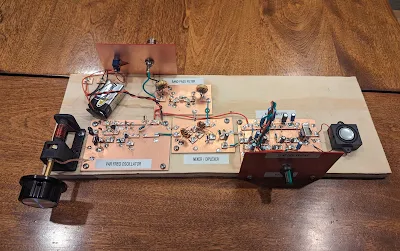
Dean KK4DAS’s TJ DC RX
The SolderSmoke challenge was to HOMEBREW the TJ DC RX. Not to just assemble a a kit. Homebrewing something really puts you in contact with the electronics. Kit building often just has you stuffing the boards. R16 into the R16 slot on the board. A distinguished G-QRP member likened kit building to “”painting by numbers.” Board stuffing is now done by pick and place machines. These machines don’t have to know ANYTHING about the circuitry. And, sadly, neither do many of the kit builders. (I say this as someone who has built a lot of kits.)
Parts acquisition is an important part of homebrewing. You learn a lot when you have to acquire the parts. You learn where and how to subsitute pats. Some of the parts may come from the junk boxes of friends — this adds soul to the new machine. In any case, through parts acquisition you build up a junk box that will help with future projects and with any necessary repair. If you need two, buy four!
Finally, I’m a bit mystified by the assertion (recently heard) that copper clad boards are somehow really, really dangerous. Jeez, this is the first time in 50 years that I have heard this. I am used to hearing that leaded solder is dangerous, and that super glue is dangerous, and that the fumes from the solder and the glue can kill you. We hear that voltage of almost any kind is dangerous — even 12 V DC! RF can burn you. Putting antenna wire in trees? Forget it! Way too dangerous. But I must admit that hearing about the dangers of copper clad board and Manhattan construction is a new one for the list.
All I can say is that homebrewing is not for the faint of heart. There is no guarantee of success. This is not plug-and-play radio.
Bottom line: Building a kit will NOT meet the SolderSmoke challenge. Homebrew it.
Sure, there are many ways to make this easier:
— Winding toroids? Too hard! A kit would take care of this.
— Making a diode ring? Too hard! Get an SBL-1 in the kit.
— PTO? Yuck! Put an Si5351 and an Arduino and the needed code in the kit.
— BP filter? Get one of those BP filter kits.
— AF amplifier? One LM386 in the kit bag should take care of this!
But we didn’t want to make this easy. We wanted builders to actually homebrew something.
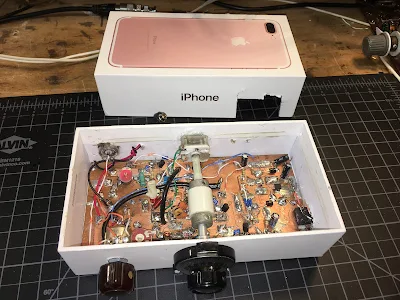
A DC receiver I built for my nephew
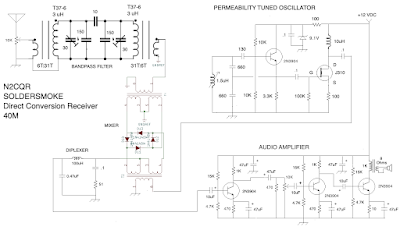
Walter KA4KXX’s Schematic
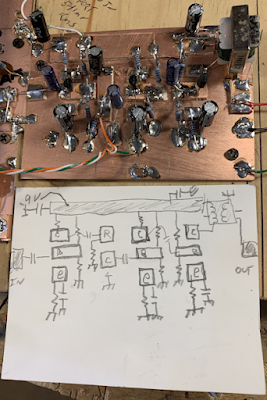
The AF amplifier