
Joh: I agree. Radio archaeology is interesting and useful.
Yes, while he was reading the IRE Journal, Anderson probably needed more practical literature. The Scozzari articles would have been very useful, but the timing is a bit off for them to have been one of Anderson’s main sources of info: Scozzari’s articles appeared in October and November of 1939. But the experimental station that Shep described went on the air in February 1939. Also, Anderson was born in July 1918, Shep in July 1921. The earliest that Anderson’s TV demonstration could have taken place was February 1939 when Anderson was 20 years old and Shep was 17. Anderson probably started building this receiver sometime in 1938. There were in that year a lot of TV articles in QST and other ham magazines. For example, from December 1937 to May 1938, QST ran a series of articles on TV construction by Marshall Wilder. In October 1938 we see another article in QST by Sherman on “Building Television Receivers with Standard Cathode Ray Tubes.” My guess is that Anderson got useful info not only from the more theoretical articles in the IRE Journal, but also from the QST articles of 1937 and 1938. The 1939 articles by Scozzari may have been too late to have been useful to Anderson.
One of the hazards and problems with this kind of project was that you’d be building a receiver for which there was still no transmitter! But Anderson would have known that an on-the-air TV signal was on its way to the Chicago area. In March 1938 there was a press report that Zenith was preparing to transmit 400 line TV from an experimental station in the Chicago area. That may have been enough to push Anderson to melt solder. The first transmissions took place in early February 1939.
73 Bill
On Saturday, April 16, 2022, 02:14:13 PM EDT, Johannes wrote:
Hi Bill,
sometimes even radio-archeology is good fun 🙂
Initially I was hoping for something practical (ie “how-to”) from the pages of IRE in the time period in question: late 38/early 39. But nitty-gritty just didn´t show there – Instead it´s all quite particular, special or highly theoretical. Plus – there seems to be quite a gap in terms of reference in this particular journal for the five years between.
I don´t think IRE was Andersons sole source – You are probably on the right path searching the more “popular” journals for a clue:
Even Anderson would have been thankfull for proven layouts and circuits – Something a complex, high voltage multi-tube circuit might oppose, is being built “al fresco”.
Without any illustration (journal, book or actual existing rig to lay hands or eyes on…) I don´t quite understand, how such a project is even triggered: One was obviously strictly banned to just receiving/not transmitting, as such confined to an unforgiving reception mode unlikely to solve the complex frequency/modulation scheme just by trial and error. There was no abundance or variety in stations/programs, and obviously not much help from your peers. –> There isn´t just enough benefit or resource – but Anderson must have been a curious, enduring and devoted character. For that, too, Shep remebered him!
73 Joh
Gesendet: Samstag, 16. April 2022 um 17:25 Uhr
Von: “solder smoke”
An: “Johannes
Betreff: Re: Aw: Re: experimental TV in 1938
Von: “solder smoke”
An: “Johannes
Betreff: Re: Aw: Re: experimental TV in 1938
Joh: I listened to Shep’s description of Anderson’s receiver again. It is very clear to me that Anderson built this receiver himself from scratch.
For me, an number of things that Shep mentions seem to confirm this:
— Shep’s description Anderson’s search in the surplus electronics shops for strange esoteric parts. Sounded real.
— The fact that Anderson spent 3-6 months secretly working on something. It would take a skilled builder about that long.
— It fact that Anderson had already built “a basement full of electronic gear.” He had a lot of experience.
— Shep’s mention of how they all had to be careful with money, and that some parts were expensive.
— The fact that Anderson was reading the IRE Journal (my guess is that he got it from the library – he would not have spent the money on a subscription).
— Shep’s physical description of the receiver chassis. Sounds to me that he built it his way, with the power supply on the chassis.
Thanks for the IRE publication. The 1933 issue you sent would have been useful to Anderson, but I think the later articles by Scozzari in Radio and Television would have been even more useful. The IRE articles from 1933 seemed more theoretical. Have you found any other TV articles in IRE Journal close to 1938-1939 that might have been more practical?
Listening to Shep’s description again was very enlightening and inspirational.
73 Bill
On Saturday, April 16, 2022, 10:41:15 AM EDT, Johannes Aucktor wrote:
Hi Bill
I´m fond to believe the essentials of Shep´s story are correct 🙂
What I love probably most about it, it´s not alone the description of Anderson´s technical achievement, but the melange of his proud decency and secrecy he´s dealing with his fellow hams.
This way Shep´s impression and amazement is most comprehensible to his listeners – then and now!
Based on these early articles in QST or Radio&Television, its perfectly clear amateur TV reception was on-going and would be esp. interesting to the experiment-oriented ham – with probably not many stations were around to watch and listen to back then.
Professional/commercial TV sets would be out of question, pride- and penny-wise 😉
(Just the other day I was reading about an “unobtainable” TV IF-strip, used in early British Radar:
www.dos4ever.com/EF50/EF50.html – EG Bowen´s first hand account on it, “Radar Days” is in my mail by now!)
I was stumbling over the QST-advertisment in the backpages casually, looking for a reference list to Sherman´s publication. We are talking just five years of particular design after some seminal publications in the IRE Journal mentioned by Shep:
I´ve glanced through the 1936-39 volumes of Proc. IRE, hoping to find corroborate on Anderson´s membership status, but -alas- to no result so far.
Anyhow – it is a great story by Shep for sure! Along with these of the ill-modulated Heising transformer, the Indiana blizzard, or the Kentucky diner hold-up; to name a few I thoroughly enjoyed lately!
Thank you, Bill – and 73 de Joh
Gesendet: Samstag, 16. April 2022 um 12:23 Uhr
Von: “solder smoke”
An: “Johannes
Betreff: Re: experimental TV in 1938
Von: “solder smoke”
An: “Johannes
Betreff: Re: experimental TV in 1938
Thanks Joh. That is really interesting. I had not seen that ad.
While there is the possibility that Anderson did not in fact homebrew his receiver, and instead used a kit or something built commercially, I think he did homebrew his receiver. Here’s why:
— Shep said Anderson built it. Shep would have spotted a commercial piece of gear or a kit. He was quite scornful of even Heathkits!
— Anderson was an accomplished homebrewer. He was using a nine tube superhet on the ham bands.
— Shep and his friends regularly scrounged for parts on Chicago’s radio row. Anderson could probably gotten what he needed there.
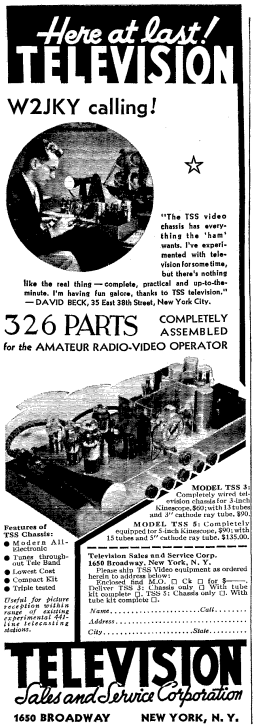
— Those TSS kits were EXPENSIVE. In today’s dollars $1,223 to $2,752. Teenagers in the Great Depression could never have afforded this.
— The ad you mention talks about a larger CRT — Shep said it was a 1 inch tube.
— Shep described a very large chassis: 25 inches by 28 inches. The TSS kit chassis looks smaller and more rectagular.
— Shep described the power transformer as being on a back corner — The TSS chassis has it on a front corner.
— Shep desctibes a lot of wires coming off the chassis — the Scorzzi receiver has those kids of wires, including dangerous plate connectors. The TSS does not.
As for the WBKB callsign, I think it is likely that the presenter just went ahead and used the callsign that he was familiar with and not the experimental call that the BKB station had been issued. or maybe Shep just knew that they were watching the WBKB station and remembered it that way.
One other possibility occurred to me. One of the newspaper clips from the period indicates that WBKB built several receivers for us in their initial tests and distributed them to scientists and others for the purpose of evaluating the system. Shep said Anderson was calling in with reports. But Shep also said that the station was soliciting reports from anyone capable of receiving the signal. Anderson could possibly have been given one of the sets built by WBKB. But I don’t think they would have used a cheap 1 inch oscilloscope tube. And I don’ think they would have loaned a receiver to a kid working in his parents’ basement. So again, I think Anderson did in fact — as Shep said — build it.
What do you think? Any ideas on how to get more info?
73 Bill
On Friday, April 15, 2022, 10:18:47 PM EDT, Johannes wrote:
Hi Bill,
I just enjoyed Shep´s great story on early TV and your research and findings.
Did you spot the ad, printed on page 94 in QST Oct 1938 ?
The TV set pictured there features the triangular bracket for the CRT as Shep described for Anderson´s rig.
Both commercial types work the 441-line picture format, which in 1939 was used in the Chicago area by W9XZV; W9XBK –> WBKB (Shep´s QSL) came some time later: cf. “KeithE4” post on
All the best & 73 de Joh DL6ID