Author: Peter Marks
The Revenge of Analog
Great Homebrew Interview on “QSO Today”
This week Eric 4Z1UG has a really nice interview with Jim Veatch WA2EUJ. Jim is the three time winner of the ARRL Homebrew Challenge. There is a very interesting discussion of Arduinos, SDR, the technology behind automatic antenna tuners, and even some Raspberry Pi. Jim’s first receiver was a Halli S38 and his first rig was a Heath HW-7.
Listen here:
http://www.qsotoday.com/podcasts/WA2EUJ
Thanks Jim. Thanks Eric.
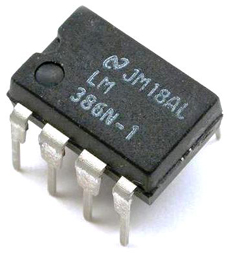
Great Hackaday Article on the Venerable LM386
I’m not crazy about chips, but I’ve come to like the LM386. It is not really a little black mystery box — as the article points out, the internal circuitry is simple and completely understandable. So you shouldn’t feel any appliance-op angst when you use one of these.
http://hackaday.com/2016/12/07/you-can-have-my-lm386s-when-you-pry-them-from-my-cold-dead-hands/
A Charming Detail About the BITX40 Module
Boxed-up and Looking Good: An End to “HRO Al Fresco”
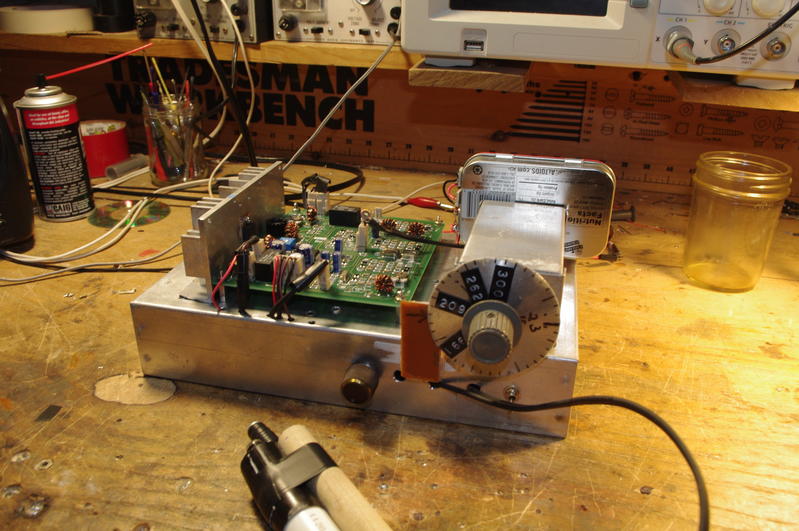
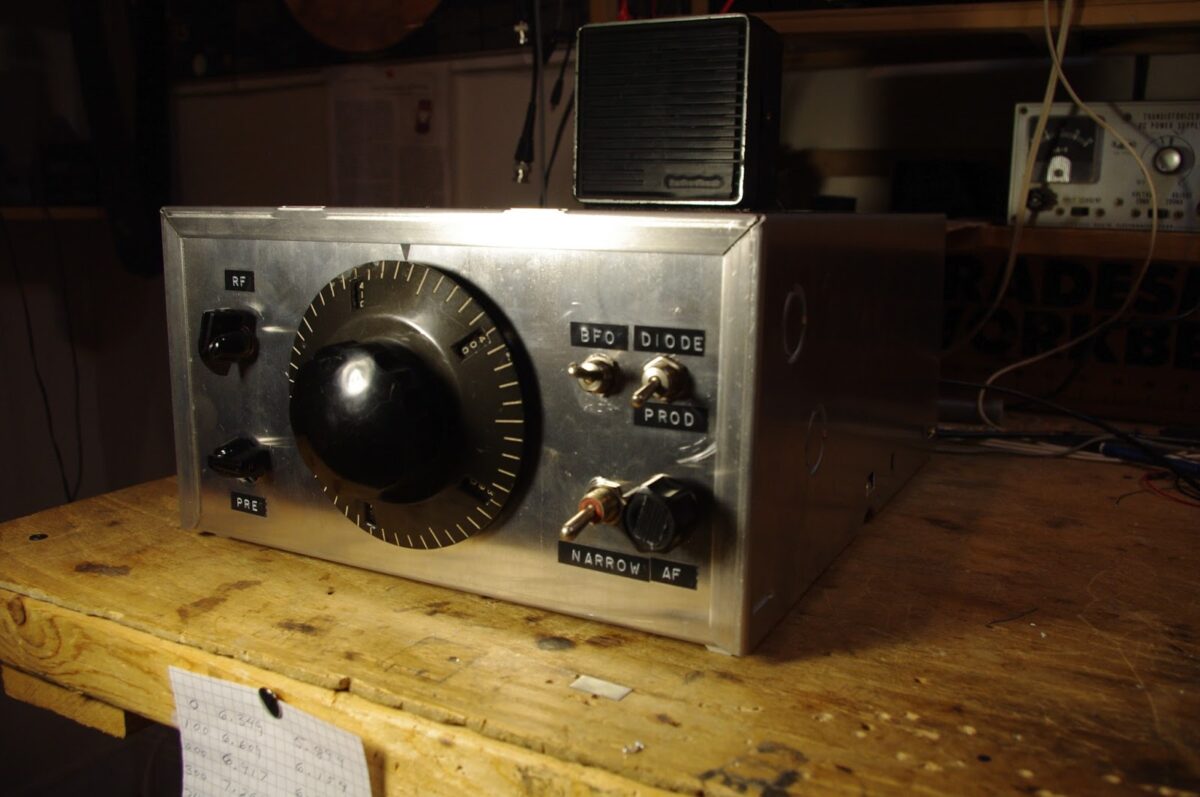
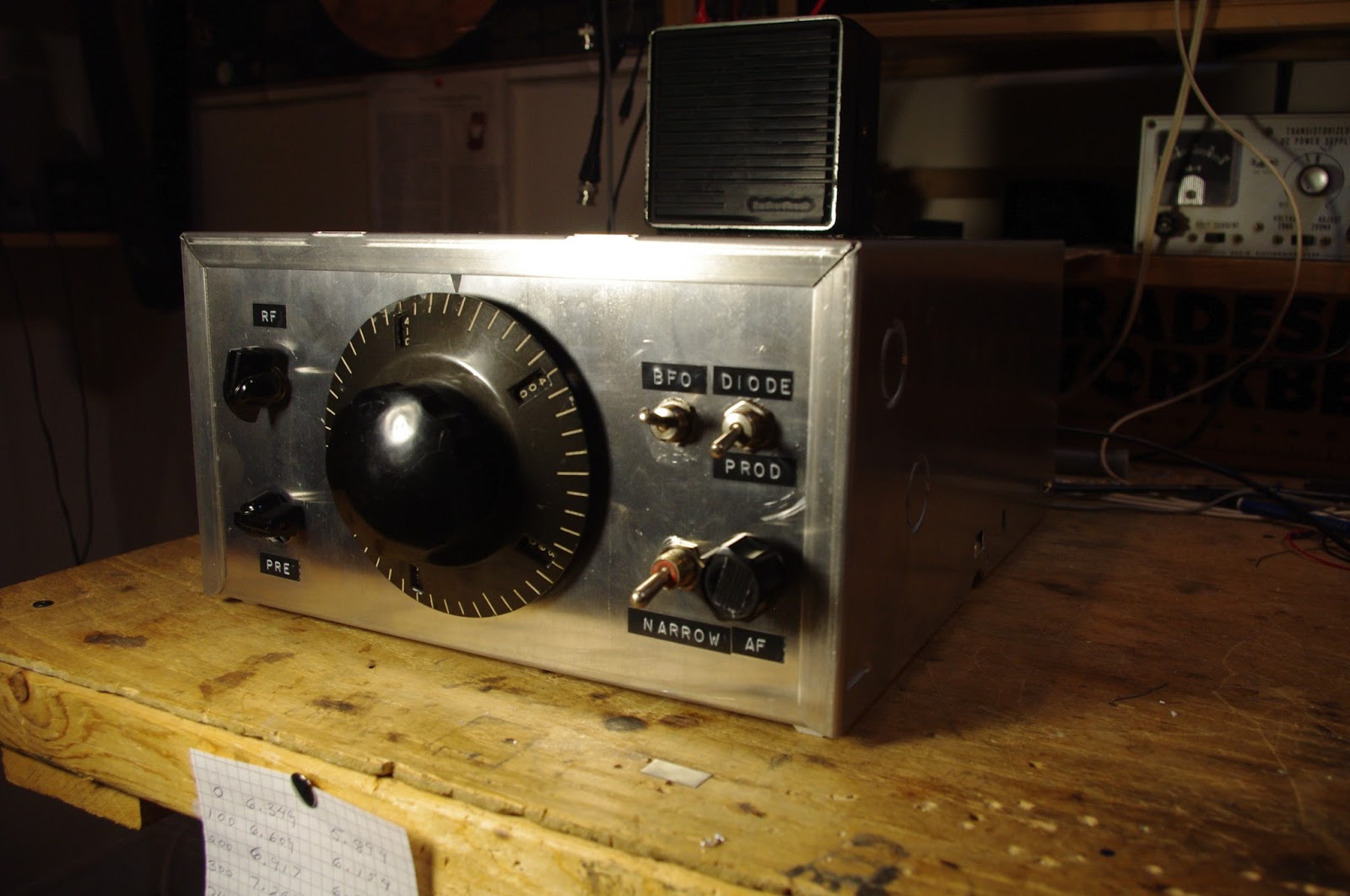
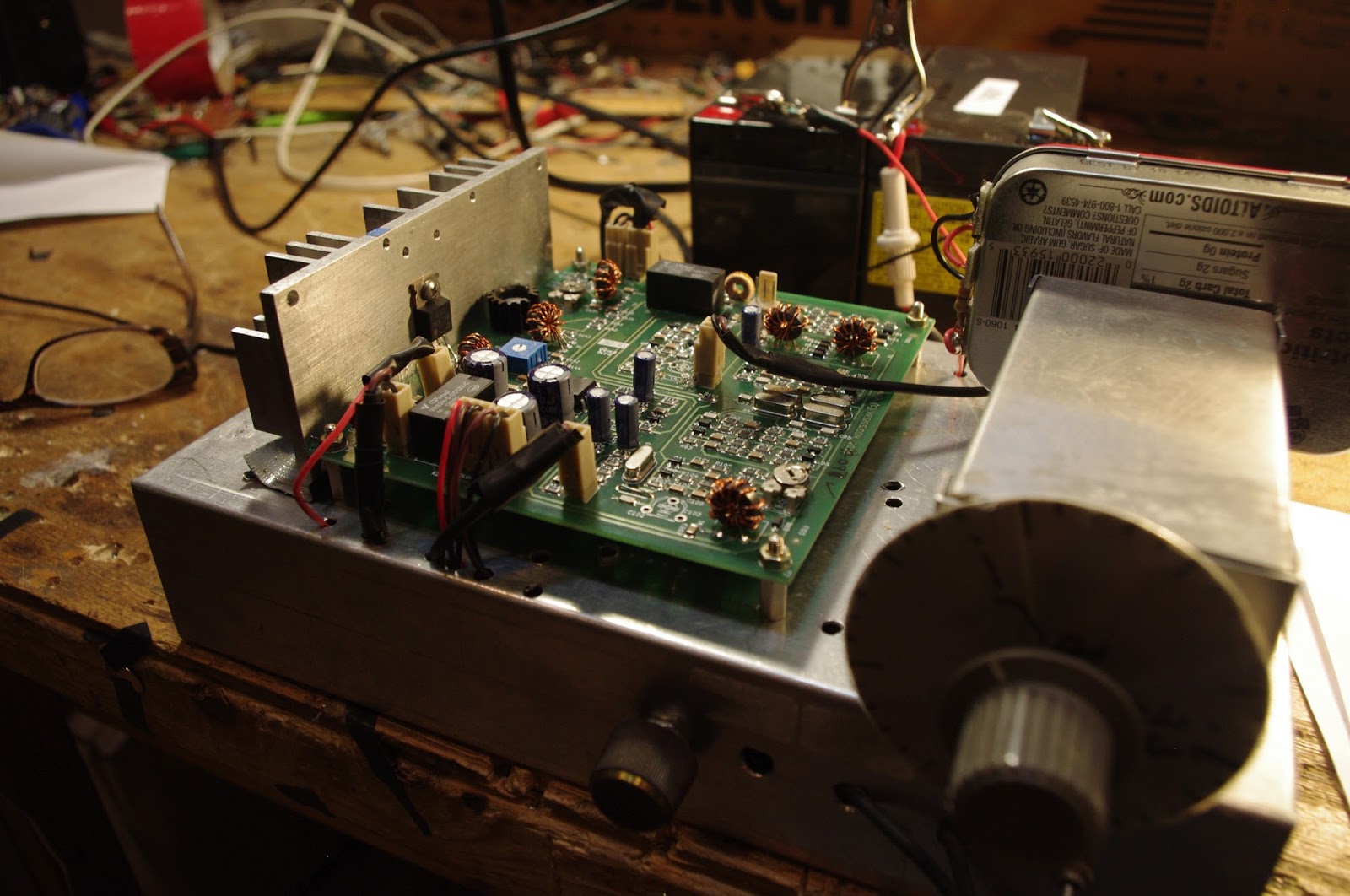
The “al fresco” phase has ended for my HRO receiver project. As has happened with homebrew projects around the world, this rig was literally pushed aside on the workbench to make room for BITX-40 Module Mania. I began to worry that the circuitry of the HRO receiver might suffer damage from the various kinds of electronic construction mayhem that take place on our workbenches. Also, I wanted to see what it would look like in the nice big metal box that Tim Sutton had sent me (thanks again Tim.) And I was hoping that the box would help with the AM broadcast breakthrough that I sometimes hear with this receiver. So, as you can see, I have good excuses for declaring Basta! on the HRO Al Fresco.
I think it looks great. Black on silver is very cool. It sounds great. I’m listening to 40 right now. Thanks to Armand WA1UQO for the very cool HRO dial that got this all started.
TRGHS! HB2HB! Homebrew Extravaganza on 40 Meters!
![]() |
|
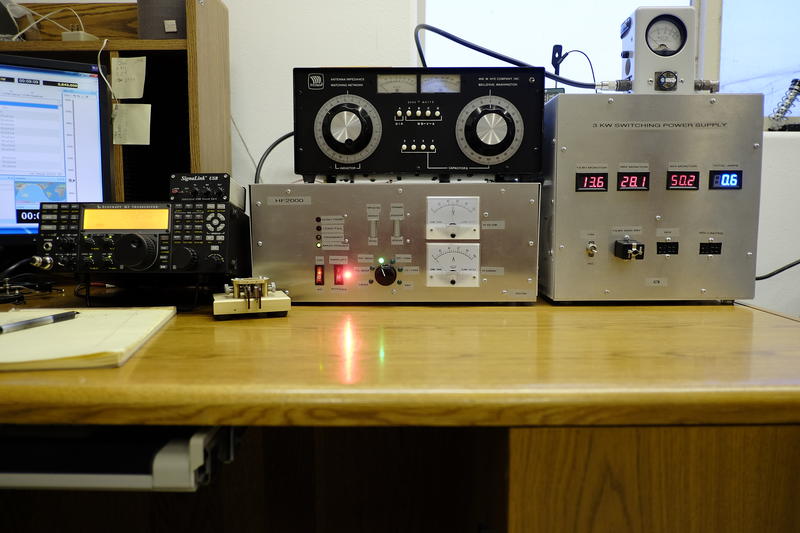
AC7M HB Amp and HB Power Supply
|
I called CQ with my BITX DIGI-TIA rig and was immediately answered by Doc AC7M in far-off Twin Peaks, Idaho. Doc was running a K3 to a homebrew solid state full gallon amp. And get this — Doc had also homebrewed the 3 kw switching power supply. I looked at my store-bought supply and felt like an appliance operator. I hang my head in shame.
As we discussed solid state amplifiers, we were joined by another builder of silicon after-burners: Don K9AQ, who called in from a beautiful cabin in rural Wisconsin. Don’s amp is based on the venerable EB-104 design.
Both Don and Doc talked about the work of W6PQL. He has a really amazing site devoted to homebrew solid stat amps, and he is selling lots of great boards and parts for this kind of project:
http://www.w6pql.com/
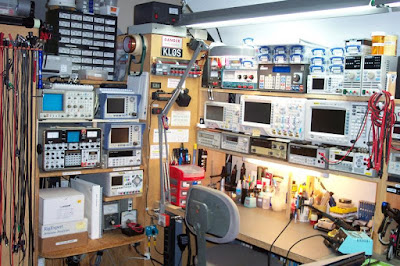
As I finishing up with Don and Doc, I got a very welcome call from an old friend from the SolderSmoke community: Dino KL0S. He as booming in from Williamsburg, Va. Dino has an amazing workshop. He is building a serious vertical antenna for 160 meters. Dino is going for the DX.
![]() |
| Dino’s Bench |
At this point Mike WA3O in Pittsburgh called in. And get this: Mike heard me on his new BITX 40 Module. The Radio Gods Have Spoken! (TRGHS!). We switched up to 7.285 MHz where I fired up my BITX 40 Module for a BITX40-BITX40 QSO (albeit not at QRP levels).
We should definitely make more use of 7.285 for BITX40 and other HB QRP SSB QSOs. 1930 EST (0030 Z) seems like a good time.
Finally, just when I was thinking that things couldn’t get any better, they did: Armand WA1UQO called in from Richmond. Armand and I collaborate on parts acquisition at Virginia hamfests. We specialize in the contents of the musty cardboard boxes found under the tables. We discussed the DISRUPTIVE influence of Farhan’s BITX 40: All around the world, other homebrew projects are being literally pushed aside on workbenches to make room for that fantastic little module from Hyderabad.
I was very pleased to hear that Armand is building an analog VFO for his module, using a coil in the 4 uH range, wound on a piece of cardboard tube from a coathanger. The inspiration for this kind of coil (which I now have in THREE rigs) came from Farhan, who used sipping straws from fast-food restaurants as coil forms in a sig generator that he built years ago. This week, seeing a Facebook picture of my daughter and me in a restaurant with drinking glasses in front of us, Farhan asked if I had brought home the straws.
Pete Juliano Adds Yet Another Great Word to the Homebrew Lexicon
We’ve talked many times about the pleasures associated with a rig that is still just a collection of parts and boards, all still spread out on the workbench, unboxed, perhaps held together by clip leads and bits of duct tape. They seem to sound better this way. This is the condition under which we experience that magical moment of “First Signals” (similar to First Light with a new telescope).
We haven’t had a concise way of describing this (note my long-winded description above). Well, this morning the Sage of Newbury Park has, on his amazing blog, provided us with the words that we have so long needed:
‘Tis the season… To Worry about Electrostatic Discharge
Read and heed, or you’ll be sorry. The cold weather causes us to spend more time in the shack and to work on new homebrew project. Some of these projects may involve sensitive, delicate, solid-state components that can be instantly wiped out by that little winter spark from your finger…
Take a look:
http://soldersmoke.blogspot.com/2016/01/an-electro-static-bandaid-to-protect.html
I have to be especially careful this year, because Northern Virginia is now officially in a drought. So that spark-friendly dry winter air is likely to be even dryer this year.
Moonbounce on 40
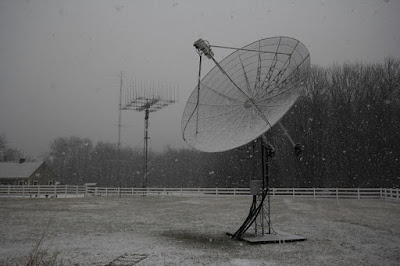
Well, we were talking about it on 40. This just proves that there is more to 40 meter SSB than the never-ending quest for audio “brilliance,” “presence,” “body” and “sparkle.” I was working at the bench yesterday when I heard Frank NC1I telling another fellow about his 35 years of experience with moonbounce. Wow, you don’t hear that kind of talk on 40 every day. Frank also said that the contact I was listening to was one of very few HF contacts that he has made in recent years. I just had to jump in to encourage him to get on 40 more regularly. He seemed impressed with my BITX40 Module (which I was using). I warned him of the buffoonery that can be found on the band, but told him not to be deterred by it — there are a lot of FB hams on 40.
Above you can see Frank’s amazing antenna farm. The dish is for 23 cm EME. Behind the you can see his 70 cm array. That is 48 (FORTY EIGHT!) end-mounted Yagis, aimed into space.
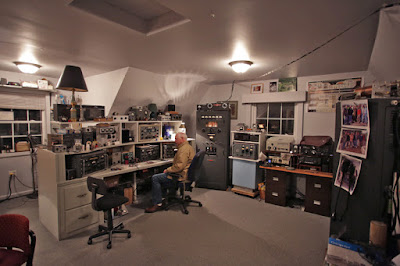
Check out Frank’s QRZ.com page: http://www.qrz.com/db/NC1I He has some great pictures of his shack. In case you are wondering why he has so many rotator control boxes, remember that the dish and the Yagi array need two each (azimuth AND elevation).
HB2HB: Butch K0BS with a KWM2 and a Hombrew 4-1000 Amp
https://www.qrz.com/db/K0BS
Happy Thanksgiving to all who are celebrating the holiday.
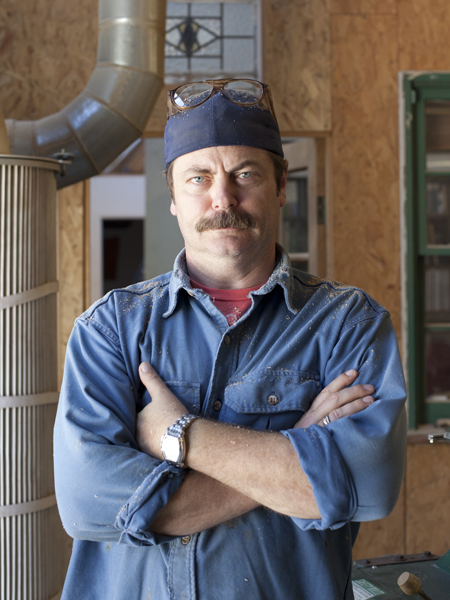
Ron Swanson (Nick Offerman) on Making Things and Making Mistakes
Driving home from work the other day I heard this NPR interview with the woodworking guy from the TV show “Parks and Recreation.” I’ve never seen the show, but I really liked the comments on the benefits of what we would call homebrewing:
MCEVERS: I feel like there are a lot of people out there listening who have spent exactly zero days being handy, like, their entire lives. Is there hope for people like this, and does your book provide it?
OFFERMAN: I think so. I mean, a lot of my own woodworking education comes from books and periodicals like Fine Woodworking and Popular Woodworking magazines. They’re great teachers, but they’re very somber. They’re very sober. So it was important to me for this book to be really friendly and gentle and fun to let you know that whether you’re getting into woodworking or making anything with your hands, it’s really important to know going in that you’re supposed to make mistakes. You’re supposed to screw it up.
And not only do I think this is a very friendly introduction to woodworking, but I really have become a little bit of an evangelist to encourage – find something to make. If you make stuff for your house or your loved ones, you’re curating your life in a way, saying, I don’t have to just limit my choices to what I can buy at Amazon. I can also choose to make a table myself. And even if it looks crappy, it’s still so much more charming because you’ve made that gesture.
You can listen to the 6 minute interview (it is funny) by clicking on the “PLAY” arrow in the upper left of this page:
http://www.npr.org/2016/11/17/502476216/nick-offerman-shares-his-love-of-woodworking-in-good-clean-fun
HB2HB! Pete Talks to Famed SSDRA Project Builder Jeff Damm WA7MLH
![]() |
| Jeff “Roadkill” Damm |
Homebrew Processor with Discrete Transistors and LEDs
I’ve been working with an Arduino today. Seeing this video makes me feel like such an APPLIANCE OPERATOR. FB OM! No store-bought mystery boxes for him!
Thanks to Steve N8NM for alerting us to the magnificent project.
More details here:
http://www.popsci.com/man-builds-huge-megaprocessor
Analog TO THE MAX! An Old School Readout for the BITX 40
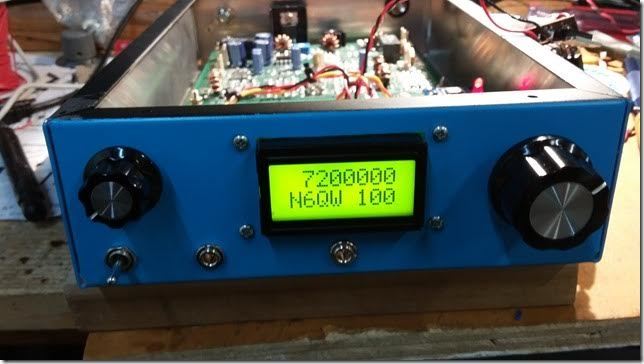
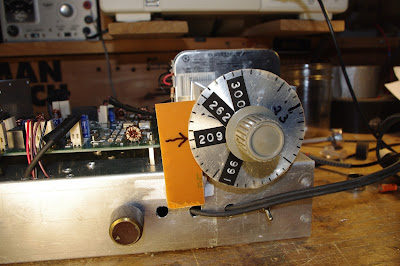
Perhaps this was a reaction to a frustrating morning spent trying to get a 20×4 digital display to work with an Si5351 and an Arduino Uno via an I2C bus (I feel my blood pressure rising just due to the typing of those words). After much digital fiddling, I declared a “BASTA!” and looked around the shack for an antidote for the digital frustration. There on the bench was my fully analog BITX40Module rig, with its homebrew L-C analog VFO. It needed a better frequency readout. And this morning, it got one.
The pointer is Sharpie ink on a bit of PC board. It is held in place by superglue, suspended by a piece of wood about 1/4 inch off the chassis (to reduce dial parallax). The numerals are in Dymo tape — there was not enough room for the “7” but I think I will be able to remember this.
Very therapeutic and satisfying.
25 Watts From a Single IRF510
http://hfsignals.blogspot.com/p/25-watt-linear-for-40-and-20.html
“Sideband Suzy” and the History of SSB
Farhan alerted us to a very interesting presentation on the history of single sideband: It was in episode 81 of Bob Heil’s “Ham Nation” show. It starts at minute 22:
https://www.youtube.com/watch?v=xSF0WBdK1IQ&feature=youtu.be
Two things really caught my attention:
— Note how OM Carson, way back in 1915, had figured out how to get rid of the carrier, but needed some way of eliminating the unnecessary sideband. He did it by using his antenna tuner as a filter. FB OM!
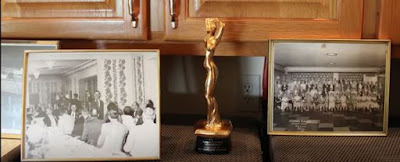
— In the early days of SSB, when it was an exciting new technology, hams had regular “sideband dinners.” At these events an award was presented. Kind of like an Oscar or an Emmy I guess. The award was the “Sideband Suzy” (see above). Kind of a classic figure… but half of Suzy was missing!
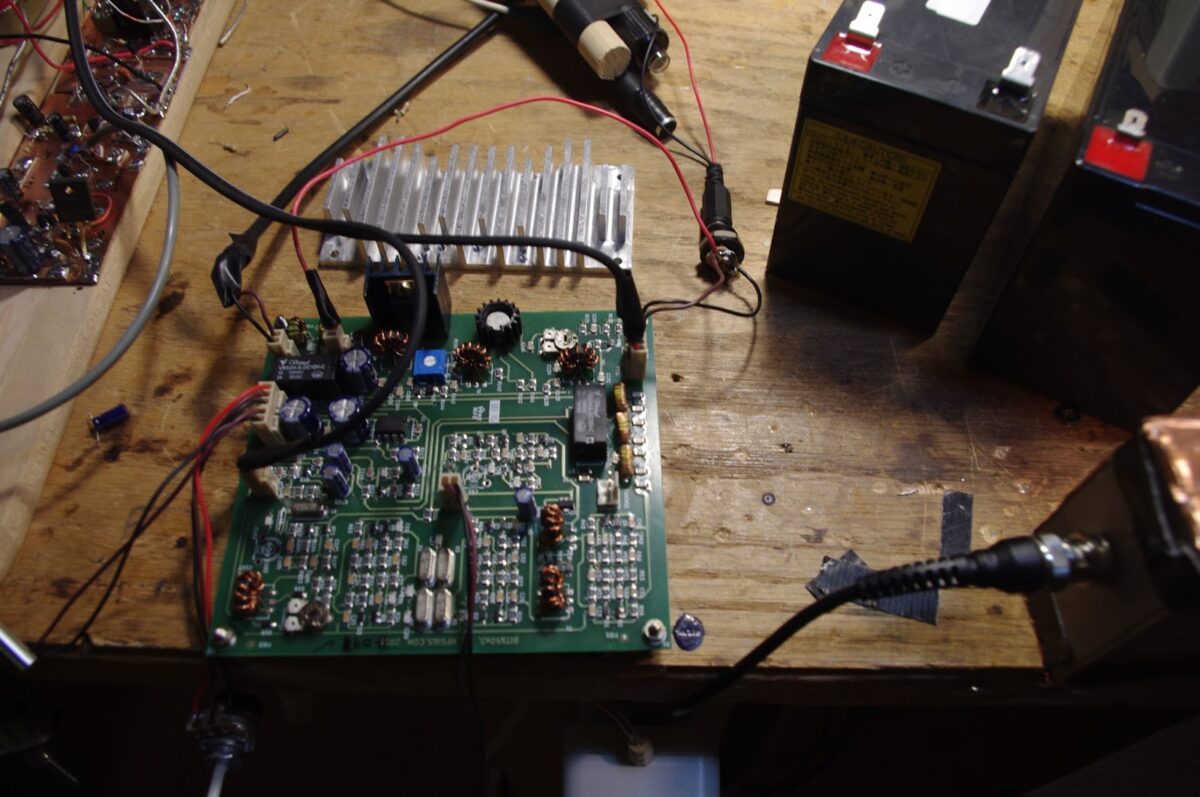
Putting a Heatsink on the BITX40 Module
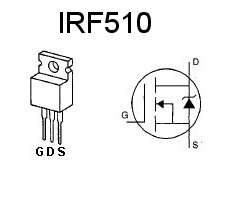
The fan that I installed yesterday was driving me nuts. It was noisy, both acoustically and electrically. And I would occasionally get my fingers in the blades. Not good. While it did seem to keep the IRF510 from getting too hot, I knew that a real heatsink would do better thermally.
But how was I going to attach the sink to the transistor? That tab on the IRF510 goes to the collector, so if it touches a grounded heat sink, you get a short. A nylon screw and some mylar between the transistor tab and the heat sink is one option. But I didn’t have a nylon screw. So I decided to just keep the heat sink electrically insulated from the chassis.
This project required me to refresh my memory on how to tap a 4-40 hole. I went back and watched the short video I made on the tribal knowledge that Pete had shared with me. Out came the Tap and Die gear and the machine oil. The process went very smoothly.
Here is what I did to get the heatsink in place:
1) After removing the original heatsink, I gently bent the leads on the IRF510 so that the transistors outer edge would be flush with the edge of the PC board.
2) I put a strip of thick tape (Gorilla Tape) along the lower side of the heat sink. This will keep the heat sink from shorting to the chassis.
3) I placed the heatsink where I wanted it, and carefully marked where the mounting screw (through the transistor’s tab) should go.
4) Drill! Tap! (see video) https://www.youtube.com/watch?v=LuqliWT1k5A
5) I applied some heat sink compound (or Desitin!) and then attached the transistor to the heatsink.
6) I put a few drops of glue between the heatsink and the board and the chassis, just to mechanically stabilize it a bit.
7) Bob’s your uncle.
It seems to work great. The MOSFET stays cool. even after long “old buzzard” transmissions. And I notice no stability problems. It was fun to put to use some tribal knowledge and refresh a mechanical skill.
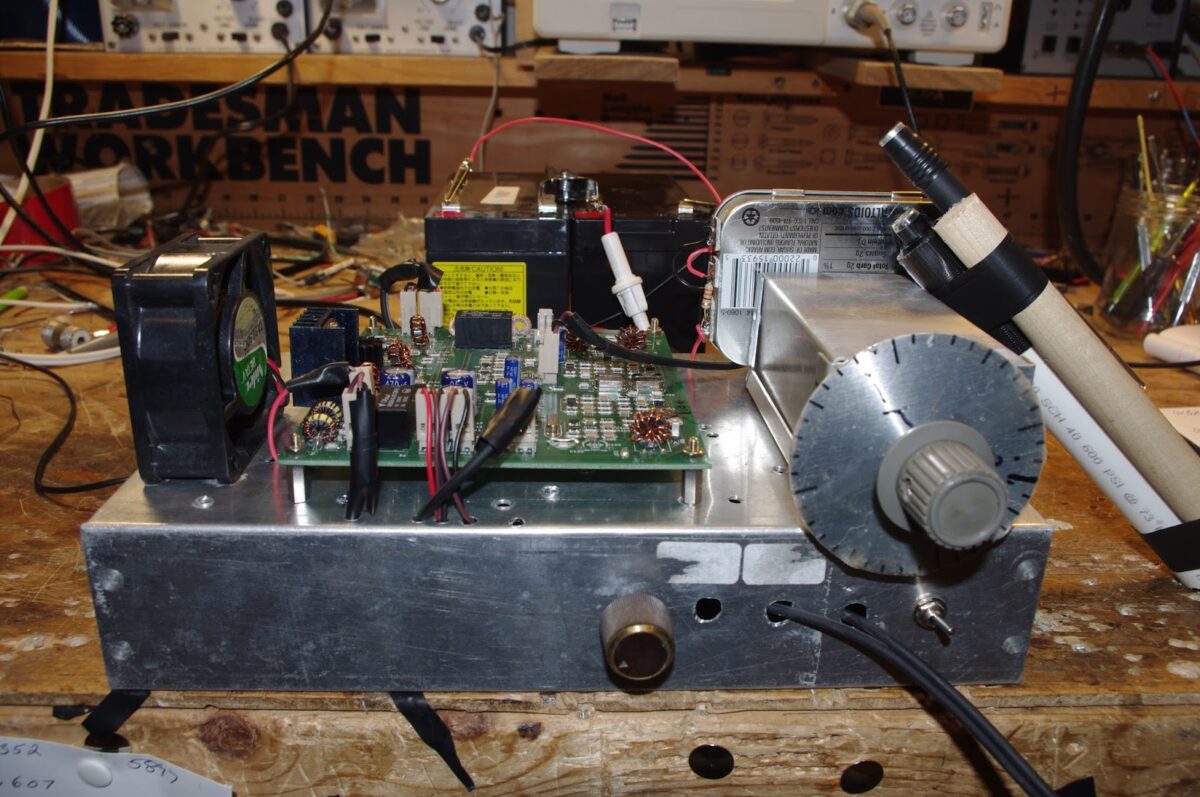
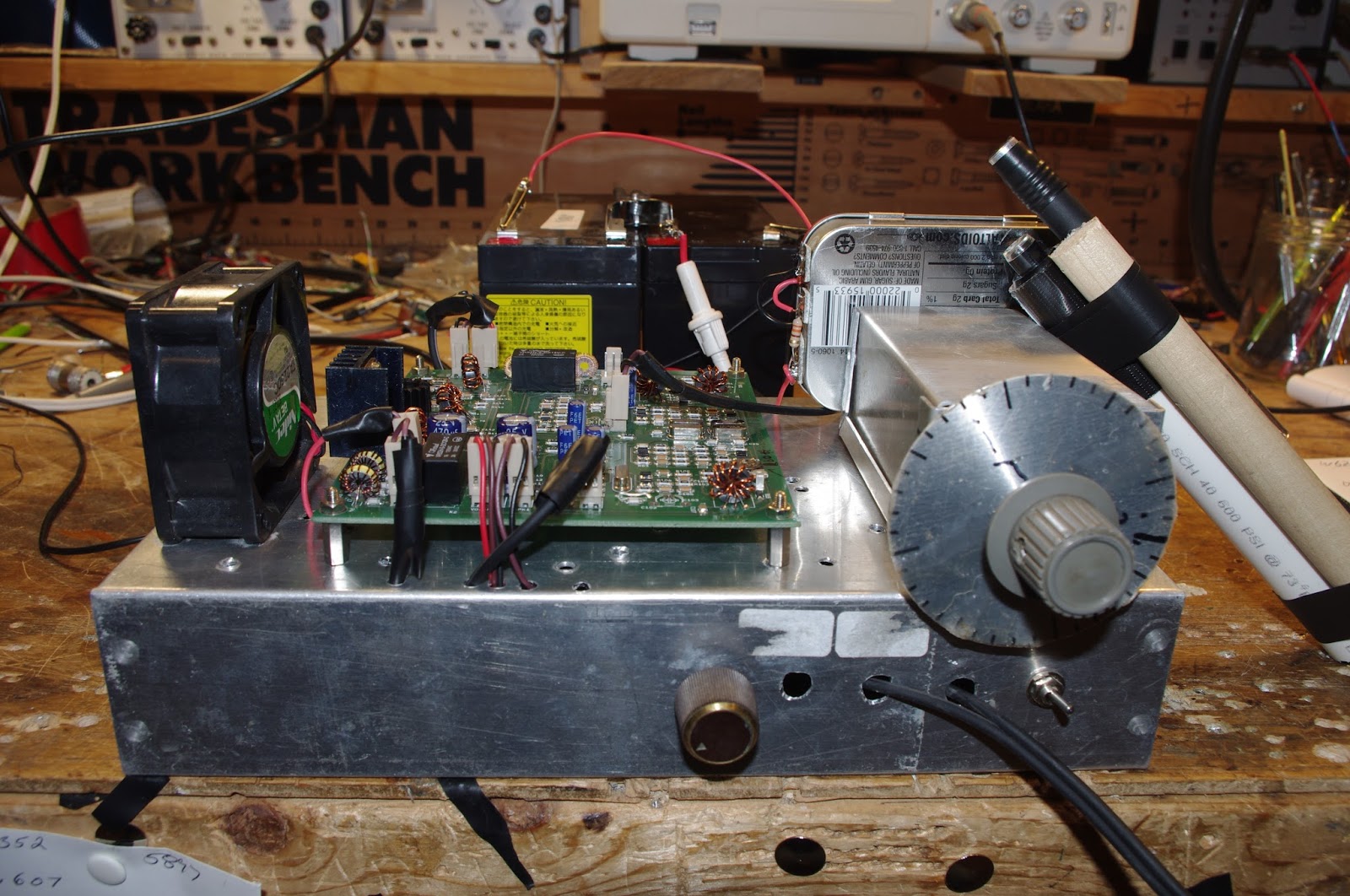
My Extroverted BITX40 — On (but not in) a Box
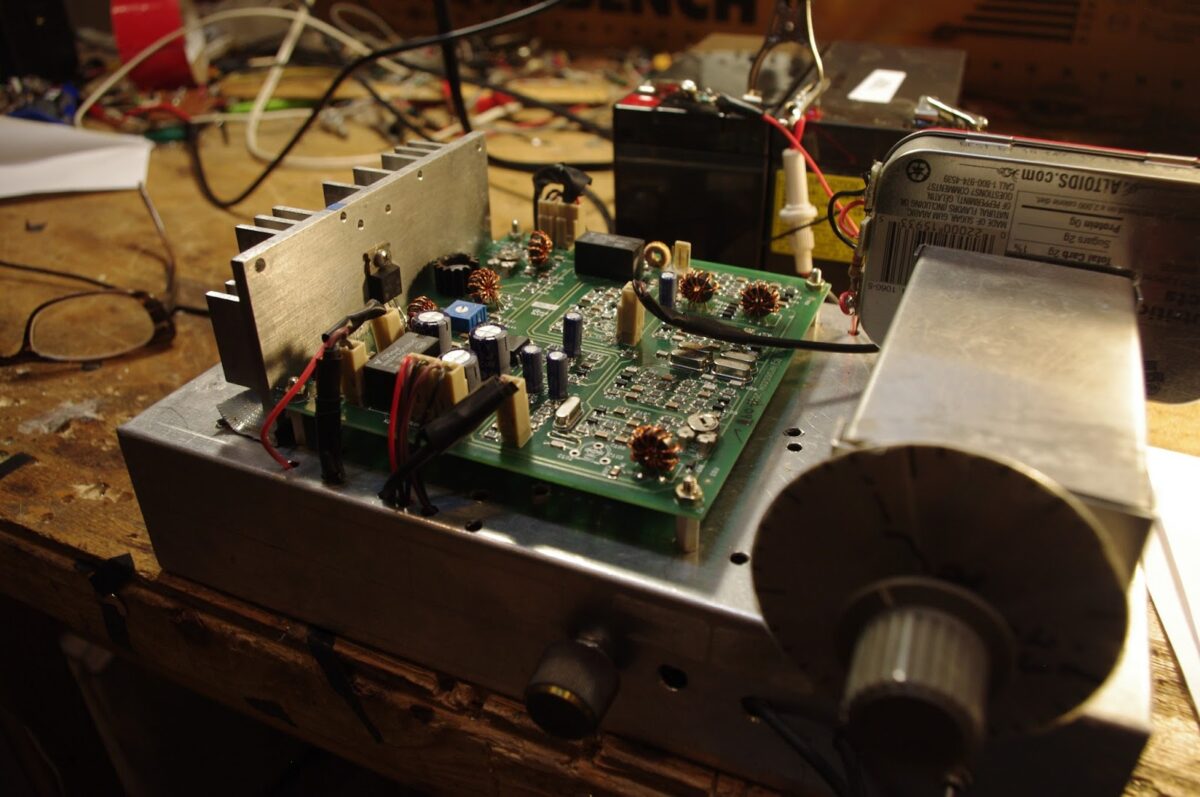
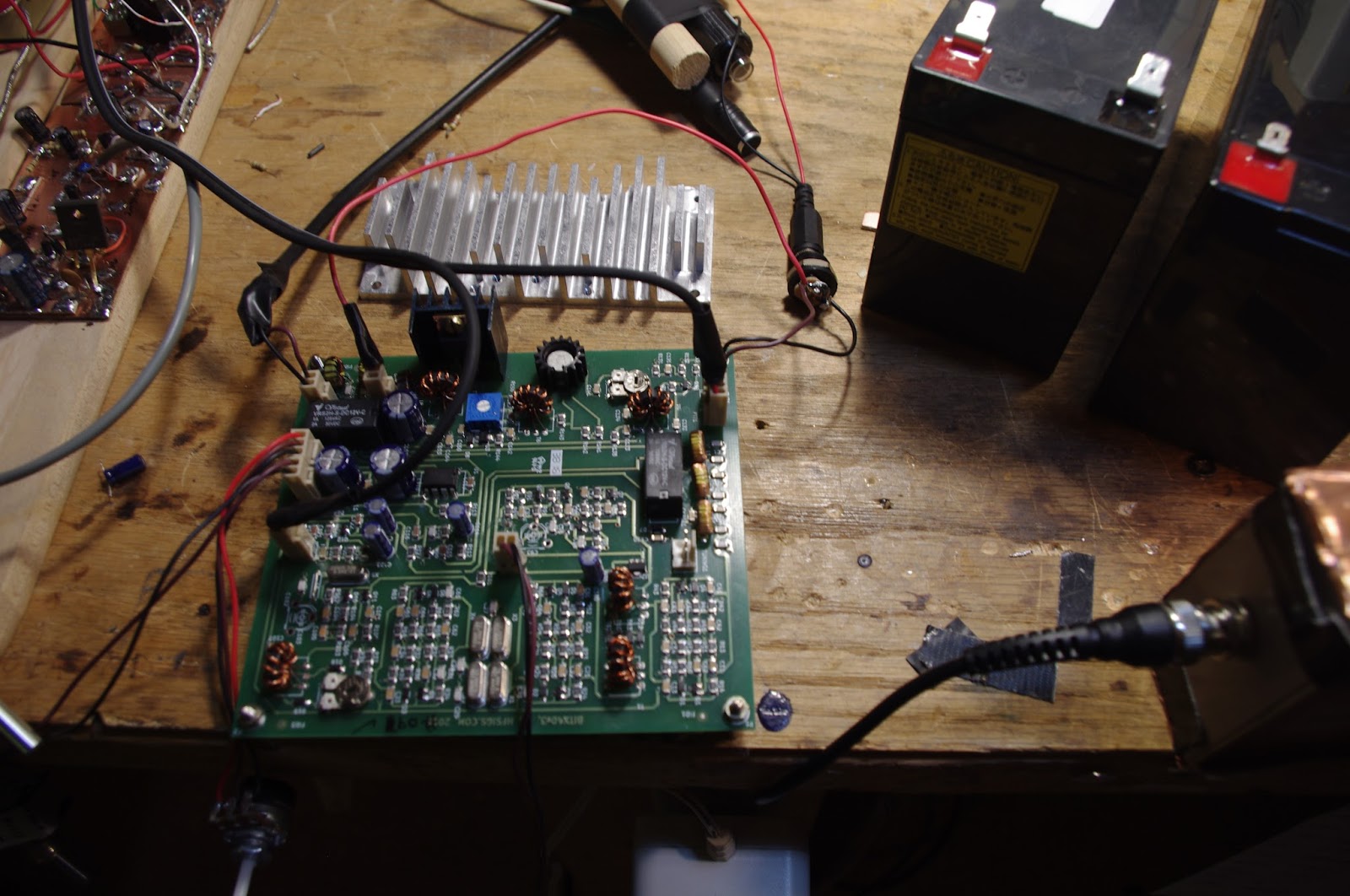
I was going to put the BITX40 Module in a box today, but I just couldn’t bring myself to do it. That board looks too good to be hidden inside a box. So I put it topside. That’s the analog VFO to the right. You can see a fan off to the left — that is perhaps temporarily in lieu of a large heat sink for the final. You can see the two Gel cells in the background. I am indeed running 24 volts to the final, and am putting out about 20 watts. I had three nice contacts today on 40: WB2RON up on Long Island said I was “20 over”. Later I worked W1SJ in N. Vermont — I was 5-9. Then — icing on the cake — DK1NO in Stuttgart. I was 5-8. TRGHS.
I kind of like this arrangement — it has the “three dimensional” feel of an old tube rig. This obviously wouldn’t be good for portable operations, but I am not planning on going portable. There is a lot of room under the chassis. I could put a digital VFO in there and put in a switch so that I can easily go from digital to analog.
Two Gel Cells and a Heat Sink — BITX40 Power Hack
I blame Pete for this. And Farhan. Pete has been leading us astray with all his talk of high power linear amplifiers (“Two 813s kid, that’s all you need!”). And Farhan practically pushed us beyond QRP limits by placing a separate DC power connector for the IRF510 final amplifier on his new BITX 40 Module board. Farhan writes:
There are jump-points from where you can add more modules like the DDS, more bands, better audio amplifier, etc. Imagination is your limit. You can separately increase the power amplifier’s supply voltage to 25 volts to be more than 20 watts of power : You will have to add a better heat sink. The mods are on the way! (from hfsigs.com)
A while back Chris KD4PBJ sent me some very nice heat sinks — one of those would fit quite nicely on the PA side of the BITX40 board. And I just happen to have two 12V Gel cell batteries. One will power the board and the two together will power the IRF510. With 20 watts out to my dipole I feel confident that I will WIN the upcoming ARRL Phone Sweepstakes (in my category: Homebrew VFO, Northern Virginia).