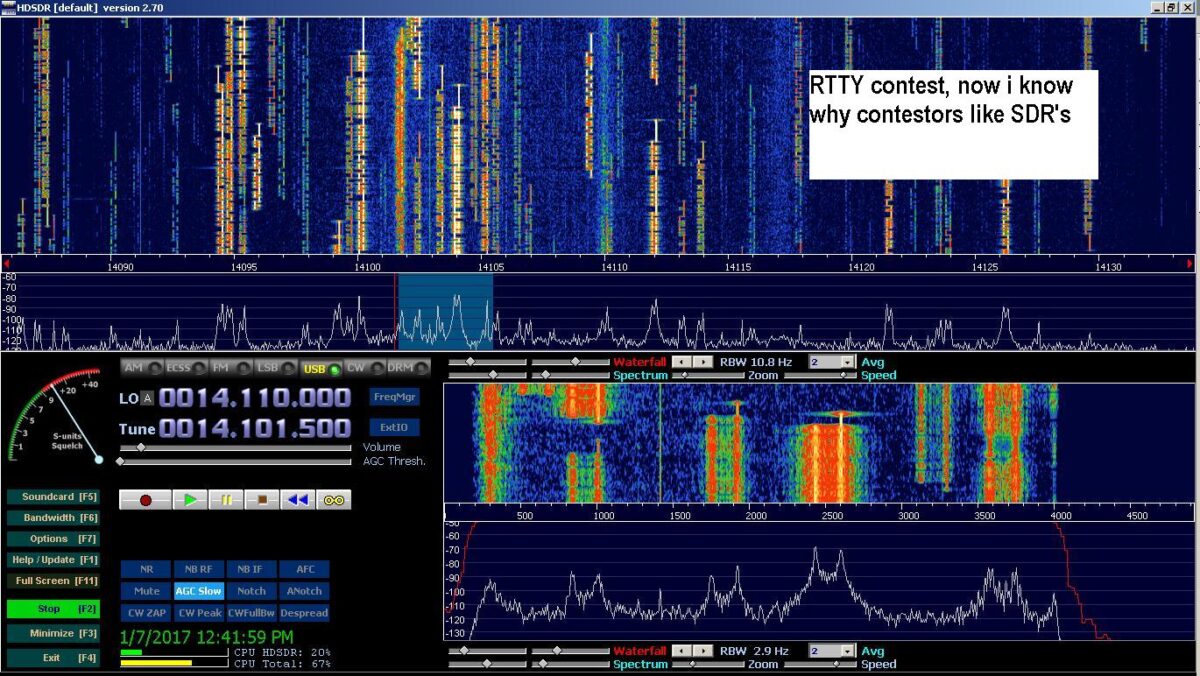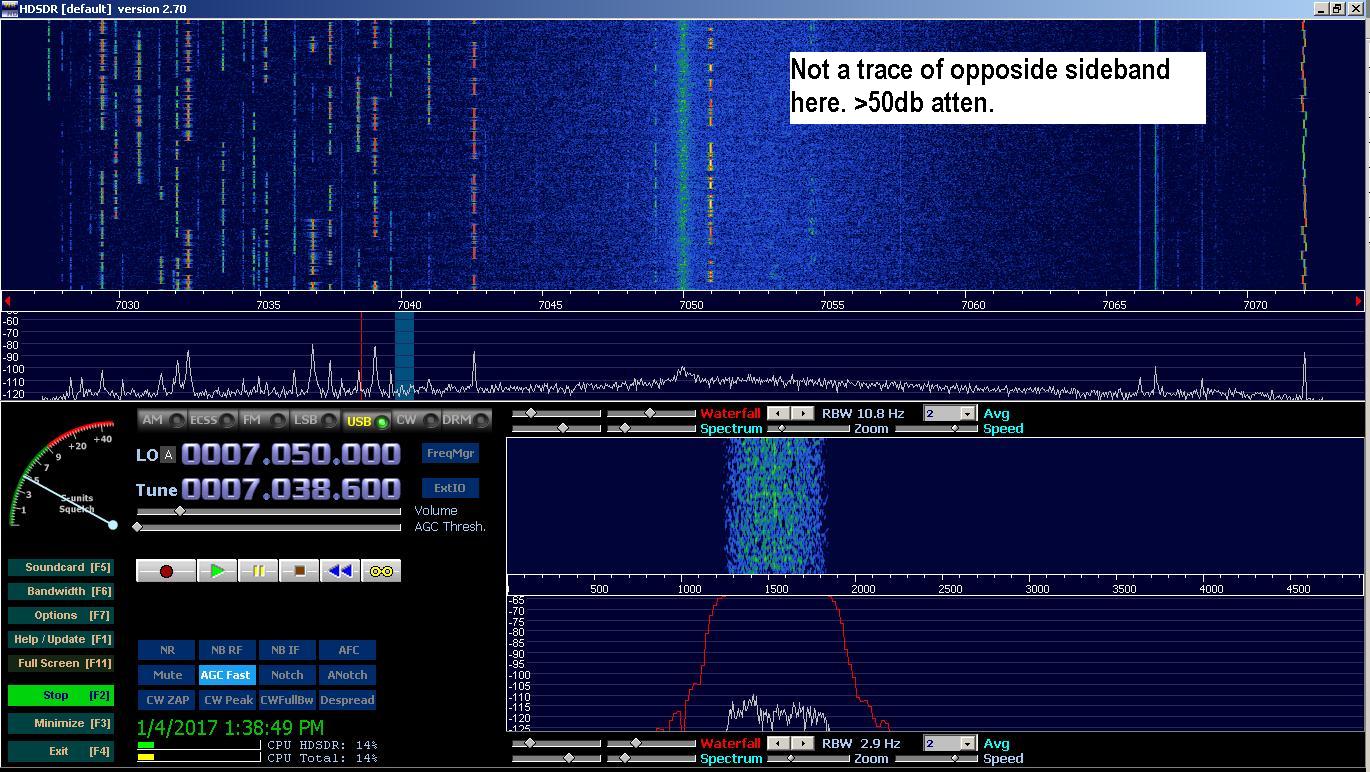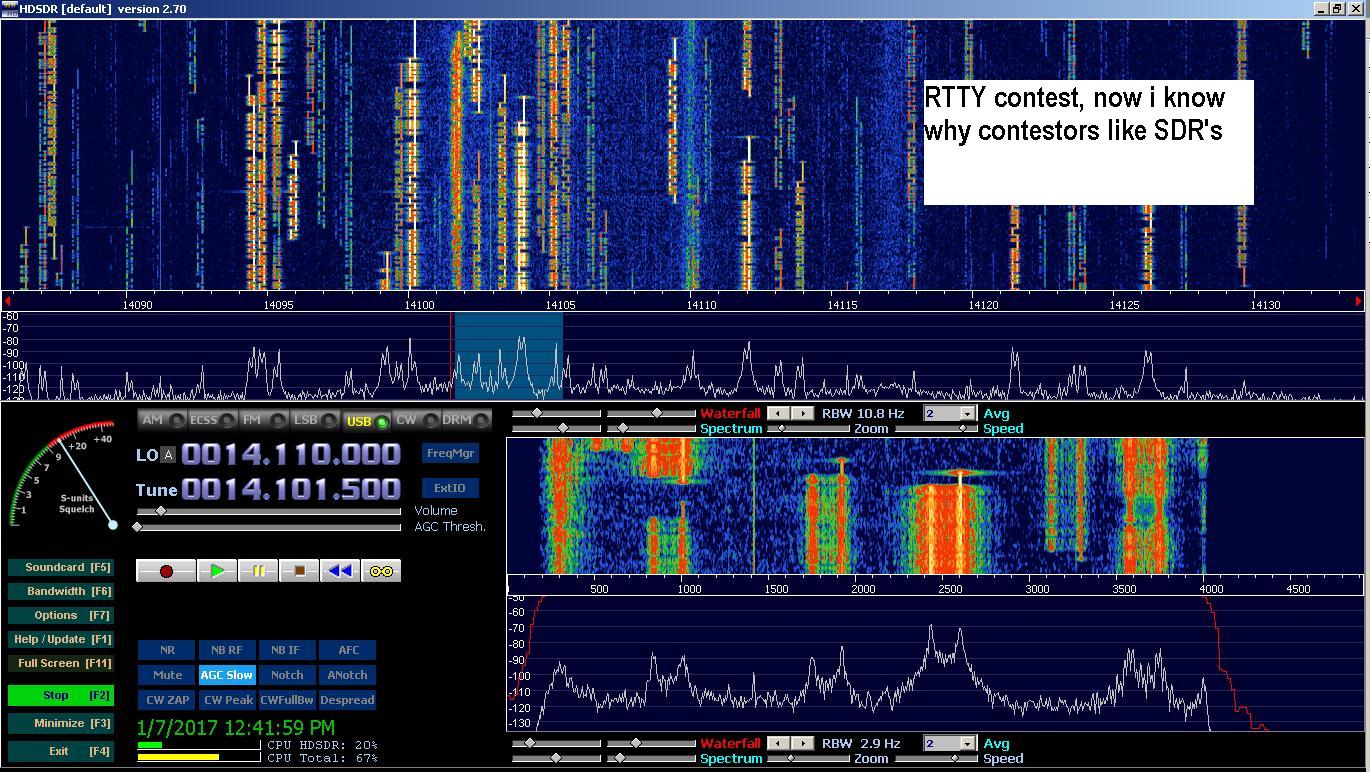
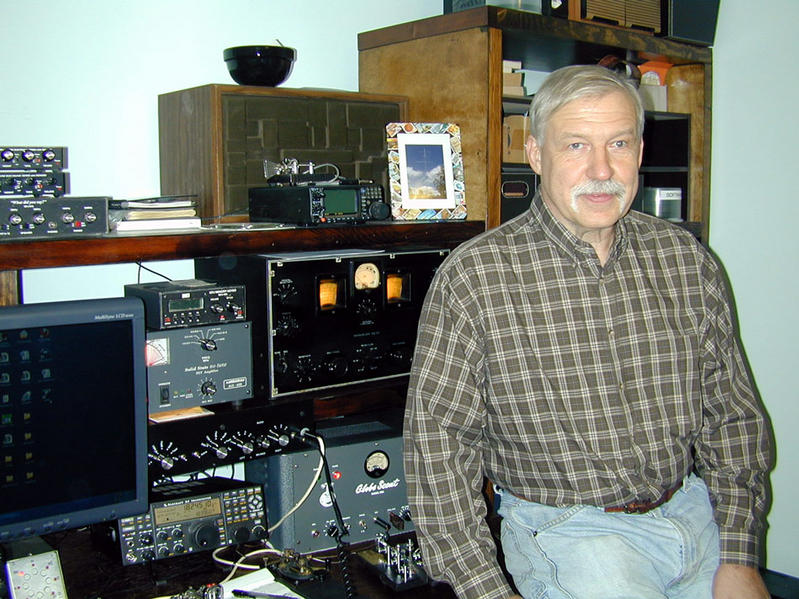
It happened again today. Conditions were good and I was BOOMING into the NYC area on 40 meters. 40 over. Everyone liked the signal and said it sounded great. Except for one anonymous grump who chimed in to say that I was “9 kc wide.” I imagine he was basing this on a quick look at his super-dooper SDR waterfall, without any consideration of signal strength or the characteristics of his own receiver. Sigh. The Waterfall Police had struck again.
OM W8JI gives a great description of the pitfalls of this kind of “you’re-too-wide-because-my waterfall-says-so” reasoning. Check it out. And keep it handy in preparation for your next encounter with the 40 meter Waterfall Police.
https://www.w8ji.com/checking_bandwidth_with_receiver.htm
Author: Peter Marks
Wonderful “QSO Today” Interview with Ian Keyser G3ROO
BITX40 to BITX40 In Australia — Both Rigs on the Beach, Video at Both Ends
There is so much great homebrewing going on down-under. It makes me jealous. And so much of it is for phone. FB.
I really like VK3YE’s sand graphic proclaiming to the world (or at least to the beach!) that a BITX40 to BITX40 contact had been made.
Looks like both rigs were using VK3YE’s ceramic resonator mod for the VFO.
Be sure to check out the BITX 40 Mods blog:
http://bitxhacks.blogspot.com
N6ORS’s Franken-SDR Superhet
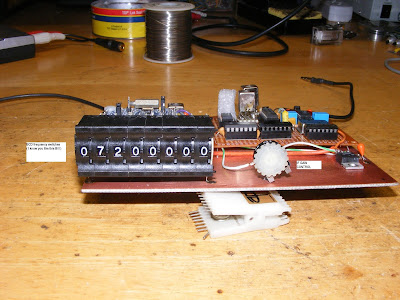
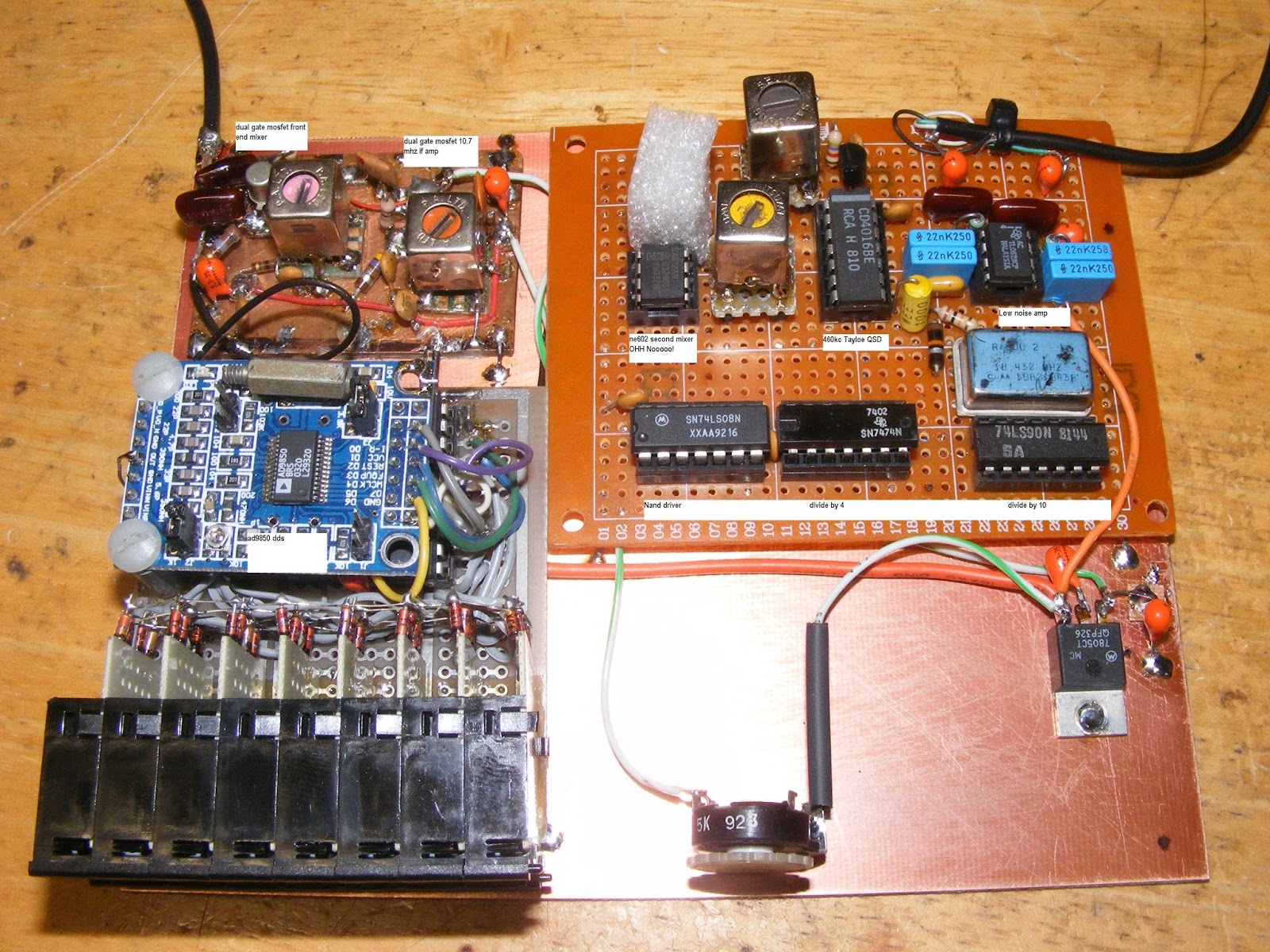
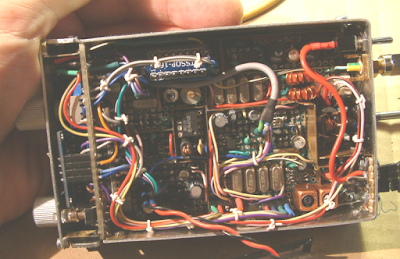
Of course, I love it. MOSFETS! NE602’s! 10.7 Mc IF cans! Cycles, not hertz! And a Tayloe Quadrature Sampling Detector made from junkbox parts from the Reagan administration. FB Keith. And the frequency display is icing on the cake.
Bill:
I thought the group might find my new Franken-SDR interesting.
It is an SDR with a superhet front end.
I wanted to play with an SDR but I didn’t want to get a kit or buy
parts, so I scrounged through he drawers and found a mux chip
cd-4016 circa-1980 some old 7400 logic that is probably per-1980.
This could make a QSD but only very low frequencies. Well I thought
how about at IF frequencies?
The frontend is a MOSFET mixer (1975) , the 10.7 IF is a dual gate MOSFET
(1975), the second mixer is a NE602, the IF cans are all stagger tuned to
give a bandwidth of 50kcs.
The only thing modern is the DDS but I old-time-ifyed it with BCD switches.
Keith N6ORS
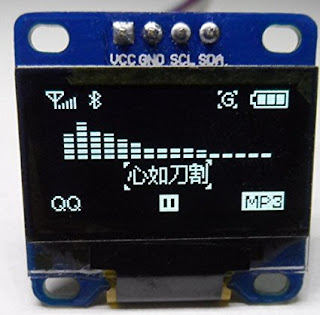
Understanding the “O” (organic) in OLED
That’s the one I’m using. Less than 1 inch on each side. No back light. 8 bucks shipped:
https://www.amazon.com/gp/product/B00KRZY7PW/ref=oh_aui_detailpage_o07_s00?ie=UTF8&psc=1
Here is a thorough description of the technology:
https://en.wikipedia.org/wiki/OLED
Boatanchors! HT-37 to HT-37 contact with W1ZB
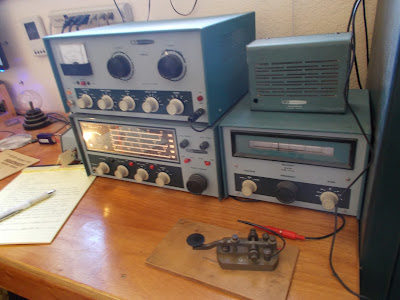
Jerry W1ZB and I met up on 40 a week or so ago. He was running a Hallicrafters HT-37. This spurred me to clear up the T/R problem that had knocked me out of the competition on Straight Key Night (I’m sure I would have won!). One spray of DeOxit D5 on the HT37 relay contacts was all it took. Jerry and I set up a schedule for this morning on 40 minutes. Above you can see a short video of the first part of our HT-37 to HT-37 contact.
Jerry has an amazing collection of beautiful old tube radios. Check out his QRZ.com page:
https://www.qrz.com/lookup/w1zb
BTW: Speaking of old rigs talking to identical old rigs: Last night on 40 I worked TI2NF in San Jose, Costa Rica. He was running a Collins KWM-2 to a Collins 30-L1. It was real nice to talk to somebody who was using an unusual rig. Right after we finished, VE3OCZ called TI2NF. VE3OCZ was ALSO running a KWM-2 to a 30-L1. TRGHS.
Great Interview with Farhan Re BITX 40 and BITX History
W5KUB has a really good interview with Farhan. There are several spots where the Skype connection gets quite choppy, but hang in there — it gets better. Farhan provides a lot of good info on the history of the BITX rigs, his design philosophy, and the importance of the EMRFD book. He also talks about how the BITX 40 Module is produced. And he talks a bit about possible future rigs. Great stuff.
I was very pleased to hear that Farhan is trying to eliminate the need for his FT-817 (he currently needs it for its general coverage receiver) so that he can have a completely homebrew hamshack. FB!
NE602 Si5351 OLED “Whole Foods” Receiver
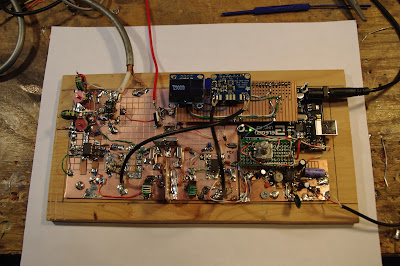
This is one of those projects that sort of just happened. First I built an Si5351/Arduino synthesizer with a small OLED I2C display (program by Thomas LA3PNA — thanks Thomas). Tom Hall AK2B up in New York helped me get the Si5351 VFO and BFO going — thanks Tom. Then, over the holidays I decided to build a rig of some sort around the Si5351. I started with a superhet receiver using an NE602 as the mixer and another as the product detector. I power the NE602 with an 8 volt regulator from W8NSA — thanks Jim. I made a 4 crystal 11 MHz Cohn filter using crystals left over from a BITX project. The software from AADE helped me design the matching networks to match the filter to the 1500 ohm impedances of the NE602s. I built the circuits on a milled board sent to me by Pete Juliano N6QW — thanks Pete! I put a dual tuned circuit at the front end, going into a MOSFET RF amplifier. For audio amp I have an LM386. The whole thing is screwed down to a barbeque grilling plank from Whole Foods — thanks Whole Foods! (This seems appropriate — the “O” in OLED is for “Organic”!)
It sounds nice. I may eventually try to put some relays in to switch the NE602s and the filter around to make this a transceiver.
Straight Key Night — Bandscan from WA6ARA (audio)
![]() |
| WA6ARA SKN Station |
Mike Herr WA6ARA was on 40 meters with old gear this Straight Key Night. Mike was receiving with a venerable Heath HR10B. One of his favorite QSOs was with Keith W6SIY; Keith was running Conar twins that had the kind of “swing” that stirs up the kind of memories that SKN is all about. FB. Mike made a bandscan recording of what 40 sounded like, and he made another of W6SIY’s beautiful signal.
You can listen by clicking on these links:
http://soldersmoke.com/SKNBANSCAN.mp3
http://soldersmoke.com/SKNQSO.mp3
My own SKN effort was cut short this year by technical difficulties. The HT-37’s relays stopped doing their thing. Probably the relay drive tube going soft. But I did manage to make two great contacts on 40:
WA6URY is in Los Angeles. This was a very timely contact — my wife and I went to see the movie “La La Land” on New Year’s eve — the film features a lot of beautiful LA scenery. Dan was running a kilowatt to a 2 element Yagi on 40. He too owns an HT-37 and a Drake 2B. He was on a straight key “with dirty contacts.” FB Dan, thanks.
And then I worked W1PID! Wow! Jim is well known for his operations from field locations and for his intrepid participation in many of the radio adventures of Michael Rainey AA1TJ. Jim was on the Maine sea coast expedition when Michael was attempting to cross the pond with his voice-powered radio. On SKN Jim was in New Hampshire running 35 watts to a Windom off-center fed dipole. His Morse key is a Kent. TRGHS. Thanks Jim.
Happy New Year!
![]() |
| W1PID Maritime Mobile |
Homebrew SSB in Germany: DK7IH
Pete WB9FLW alerted us to the work of Peter DK7IH, a very talented homebrewer who recently followed the lead of Pete N6QW in building some really small SSB transceivers. Here is his Micro QRP SSB rig:
You can see more of his fine work here:
https://radiotransmitter.wordpress.com/
https://www.qrz.com/db/DK7IH
Have you guys noticed how many Peters there are among homebrewers, especially among SSB homebrewers? Just from recent mentions on this blog:
Pete Juliano N6QW
Pete WB9FLW
Peter Parker VK3YE
Peter DL3PB
Peter W1UO
Peter GW4ZUA
Peter G6GNR
Peter VK2EMU
Peter VK2TPM
Peter HA5RXZ
Peter DL3JIN
Amateur Nuclear Fusion in Your Garage
We had some posts about this kid a few years ago. He is 21 now and was recently interviewed on the TED Radio Hour — the nine minute interview (above) is worth listening to. Just click on the arrow.
Philo Farnsworth would be pleased. An amateur creates a star in a jar.
From Mountaineer to the KX1 — N6KR on Trail-Friendly Rigs
This is from 2014, but I stumbled upon Wayne Burdick’s article just this morning. Great stuff. That picture of Wes had a big impact on many of us.
Wayne’s article:
http://www.elecraft.com/KX1/N6KR_KX1_History.html
Christmas Present! 4Z1UG’s Interview with Han Summers G0UPL
I found myself almost cheering out loud as I listened to this wonderful interview, especially at the point where Hans lets it be known that he has NO COMMERCIAL HAM GEAR in his shack! Yes! That’s the ticket! You can also hear the story of Hans and Farhan meeting up in Mumbai for dinner. The interview includes discussion of WSPR and QRSS and BITX and crystal ovens and, at the end, a special QSO TODAY overtime session in which Hans describes the little WSPR rigs that fly around the world, carried aloft by half-filled birthday party balloons.
Thanks to Eric 4Z1UG and Hans G0UPL for this very nice Christmas present.
Listen here:
http://www.qsotoday.com/podcasts/g0upl
A Nice History of BITX 40 Module: Production and Finance
Some fellow jumped into the BITX20 yahoo group this morning, casting aspersions on our friend Farhan. The fellow alleged that a lot of money was being made on the BITX 40. He seemed deeply unhappy about the shipping materials and found fault with the documentation that came with the boards.
Farhan came back with a very gentlemanly and detailed response. He was a lot more patient and temperate than I would have been. And when I think about how Pete would have responded, well, it would likely have involved — at the very least — a lot of colorful words from Southern Italy.
Anyway, below (unedited) is Farhan’s response. I think it provides a lot of very interesting background info on our beloved BITX 40 Module and on the place that these boards come from.
2.) Secondly, components and PCBs in the Indian market are generally available at a lower cost, sometimes much lower, than components purchased from prime US suppliers such as Mouser, Newark, etc. The US is one market, India is another. That’s the way it works. Components even cheaper than these: http://www.ebay.com/itm/Reel-O f-3000-MuRata-0-1uF-Multi-Laye r-Ceramic-Surface-Mount-Capaci tors-25V-X7R-/161765931843
What’s the current serial numbering up to as of December. Anyone know? It was #465 in early December. 465 units multiplied by $45 USD is about $21,000 USD. That converted to INR has the purchasing power in India of $70,000 USD here in the US. That’s a lot of bread.
What’s my point?
Seems like with that kind of wealth in play:
1.) The product could be double-boxed and well bubble-wrapped so it arrives undamaged after it’s 12,500+ km trip from Hyderabad. Old candy boxes or scraps of waste paper taped together just isn’t doing the job. Broken product means unhappy customers and a bad reputation.
2.) The single schematic that represents the functionality of the product could be up-to-date and error-free.
And for totally optional bonus points: A section by section Theory of Operation write-up that explains exactly how all the sections operate and how to troubleshoot. If a template is needed, look at vintage HP test instrument manuals or Heathkit ham radio transceiver manuals. Hint: Saying that, “It’s all been explained many times before on many forums, Google it.” does not get any points.
Big News! BITX 40 Module Gets Digi Side Car! Raduino!
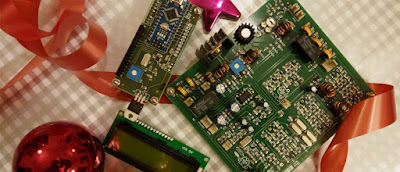
A very nice Christmas present from Farhan in Hyderabad! An Si5351/Arduino Nano VFO for the ALREADY AWESOME BITX 40 Module. I’m really glad Farhan kept the digital stuff on a separate board — it just seems like the right way to do it.
Details on http://hfsigs.com
Armstrong, obsessed
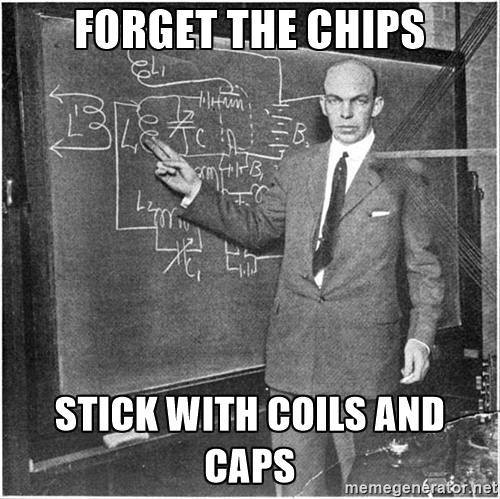
Jerry AA6KI sent me a nice website about radio hero E. Howard Armstrong. It contained an image that seemed to cry out for a meme. I couldn’t resist.
India’s Successful Mission to Mars (Video)
NPR’s “Science Friday” produced this very nice video on India’s successful mission to Mars. Really nice.
SolderSmoke Podcast #192 FPM Rig, BITX Module Madness, HRO Al Fresco, Boatanchor Day, Mailbag
SolderSmoke Podcast #192 is available:
http://soldersmoke.com/soldersmoke192.mp3
The Nauen Transmitter Station (Germany)
There is a lot of radio history in this shortwave transmitting station. I came across it tonight with my BITX DIGI-TIA rig. It was on 7.215 MHz transmitting in Indian (South Asian) languages. But alas, the signals were not from distant India (home of the BITX!). Instead — as often happens these days — the signals were from a relay station. In this case they came from relatively nearby Germany, from the Nauen transmitter site.
Check out the Wikipedia page:
https://en.wikipedia.org/wiki/Nauen_Transmitter_Station