Serving the worldwide community of radio-electronic homebrewers. Providing blog support to the SolderSmoke podcast: http://soldersmoke.com
https://soundcloud.com/radioromaniainternational/the-dx-mailbag-22062018
I had thought that the Cebik files were lost to us in some sort of legal copyright struggle. But in my effort to better understand the Moxon antenna, I found a real treasure trove of Cebik’s writing. These should all be saved somewhere safe.
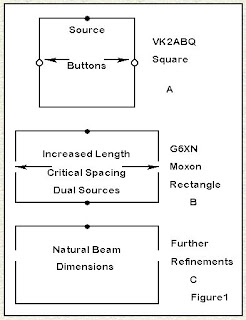
I especially liked his description of the evolution of the Moxon antenna. Les Moxon was apparently very unAmerican in his emphasis on reception (not transmit gain) as the main benefit of the beam antenna. He also sought to avoid superfluous luxuries like rotators, but Cebik hints that rotators have become an important part of our American way of life. Indeed.
Before I found these files I had been on the verge of giving up on efforts to replace my storm-damaged Moxon. After all, solar minimum is still ahead of us. But after reading OM Cebik’s articles I have decided to build a 20 meter version and place it above the center point of a 130 foot doublet. I will have the best of both worlds.
http://www.antentop.org/w4rnl.001/mu0.html
http://www.antentop.org/w4rnl.001/mu2a.html
L. A. Moxon, in his HF Antennas for All Locations, provides the essential clue: “the main benefit [of a beam] accrues from the reduction of interference during reception, though the 4 to 6 dB gain provided by typical amateur beams is an important bonus and probably the reason which carries the most weight with the majority of amateurs.”(2)Here is a theory of beam operation quite unAmerican is style: instead of gain, Moxon strives for front-to-back ratio as the most crucial aid to ham operation. His statement is an affirmation of the “good ears” theory of operation. Even more, it forms the basis for his rectangular improvement upon the VK2ABQ square.
…
Moxon prefers matched elements, tuning each of them to optimum performance remotely. That way, he can reverse the beam and do away with expensive and maintenance-intensive rotators. However, rotators are a way of life in the U.S. (a TV rotator will likely handle a 3-band Moxon beam), and there are many uses for portable beams that are hand-rotated or fixed in the field. Thus, I decided to continue the exercise in unequal element lengths.
http://www.antentop.org/w4rnl.001/mox20.html
Finally, a treasure trove of Cebik’s writing:
http://www.antentop.org/w4rnl.001/radio.html
Although Ram VU3XVR’s project is in the digital realm, his barebones approach to the bits and bytes is, for me, very appealing. He takes a Si5351 and runs it with ATtiny13 with only 1k of space. He makes intelligent use of every bit of that space. He reveals his overall approach to rigs when he states in the video that his VFO will NOT have the traditional glowing numeral frequency readout because those bright lights can be so annoying and distracting. I’m with your Ram! Well done OM. Simplicity is a virtue. No more trouble with the Arduino and its fickle IDE. No more agonizing visits to the Si5351 library.
I see lots of applications for this little circuit. Ram mentions beacon transmitters.
He provides details here:
https://vu3xvr.blogspot.com/2018/07/si5351-dds-clock-generator-using.html
Above you can watch a video showing the legendary John Dobson making a big telescope. Born in Beijing, Dobson is the former Hindu monk who left the monastery to show people how to make big telescopes out of shipping tubes and port-hole glass. Think of it as the BITX of amateur astronomy. Dobson is the founder of the “sidewalk astronomy” movement — that’s when you set up your ‘scope on an urban sidewalk and show the wonders of the universe (or at least the solar system) to passers-by. We did this in London with Saturn. (Some of the cynical Londoners couldn’t believe it was real — they thought I had a transparency in the scope tube.) Dobson developed a very simple and popular method of mounting telescope tubes — the “Dobsonian” method.
More on Dobson here: https://en.wikipedia.org/wiki/John_Dobson_(amateur_astronomer)
Below you can see a short update on Peter’s homebrew airplane.
Don’t let it be said that SolderSmoke made no contribution to Field Day! Here is the USMC Antenna Manual. Looks like there is lot of good info in there.
https://www.marines.mil/Portals/59/Publications/MCRP%208-10B.11.pdf?ver=2017-03-15-092827-423
June 23, 2018
SolderSmoke Podcast #205 is available:
http://soldersmoke.com/soldersmoke205.mp3
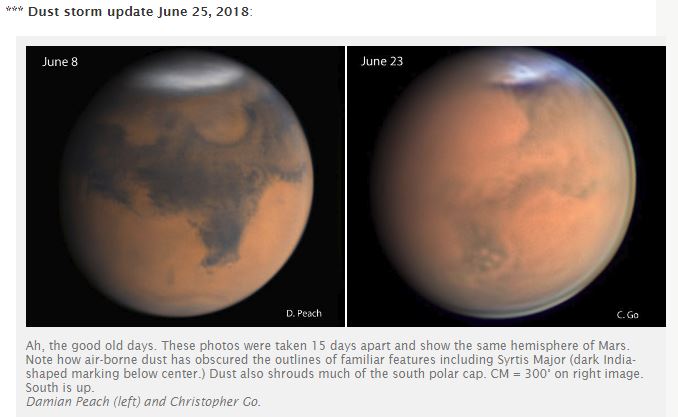
— Summer solstice. Mars Observations. Graduations. Internships. Fathers Day.
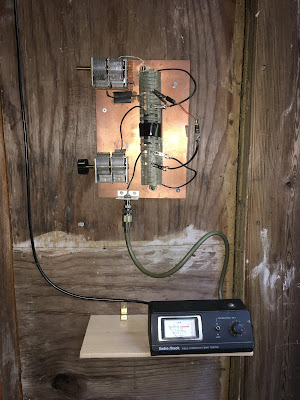
— Antenna Angst: Pete’s tribander and Bill’s Moxon. Insulation and resonance?
— Pete’s work on color displays.
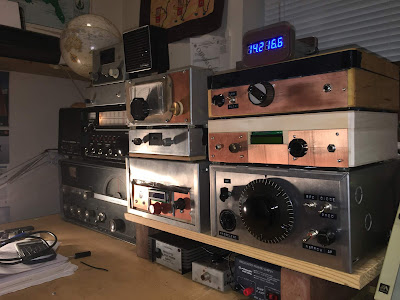
— Bill goes back to fix up older projects:
— Fixing the Frankenstein Phasing RX. Found an open choke!
— Tightening up the HRO Dial.
— Achieving Juliano Criteria stability on a BITX20 VFO.
— Lexicon additions: “Scratch Built” “Hardrock Radio”
https://english.stackexchange.com/questions/39551/where-does-the-saying-made-from-scratch-originate
— PastaPete: http://www.pastapete.com/
MAILBAG:
Bob Crane W8SX Corrspondent at FDIM
Ralph AB1OP Building LBS
Bruce KC1FSZ Digital Pot
Jason W5IPA uBITX in Juliano Blue
Rogier KJ6ETL ON THE AIR WITH A uBITX
Special thanks to Tim Walford for 25 years of Hot Iron.
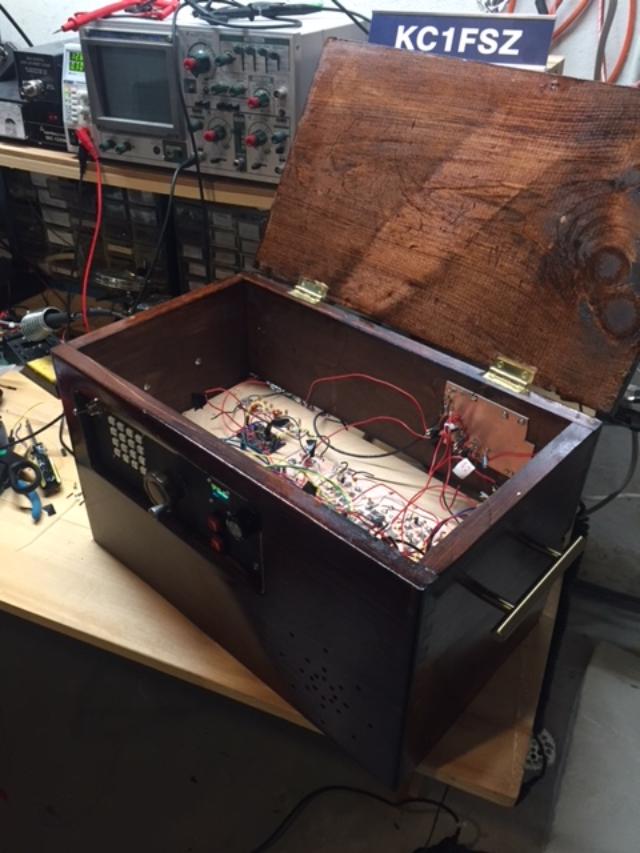
No, this is not some on-line mail order thing. Bruce KC1FSZ has done something that I find both amazing and horrifying: he using a “digital potentiometer” as the AF gain control in his BITX. Remember when pots were simple and pure, when they were just a metal wiper that ran across a crescent of carbon of increasing resistance? Well, those happy days are apparently behind us my friends. What now? Will we have endless discussions about where to find the driver for the 10k pot? Will Facebook or Amazon or Microsoft secretly seize control of the data on our AF gain, perhaps to sell us hearing aids? But enough of my ludism. Good going Bruce. AGC beckons.
Hi:
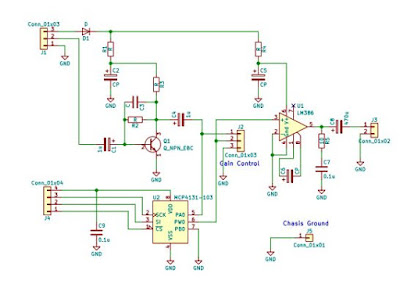
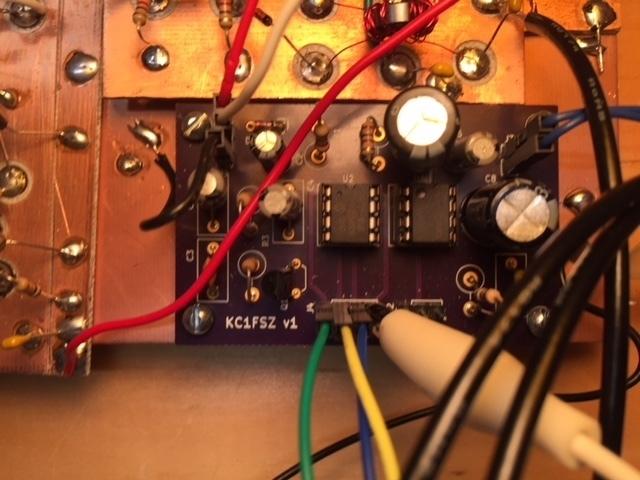
I’ve built a few BITX rigs from scratch now and I’m starting to move to a modular approach using fabricated PCBs to make it easier/faster to build/mix/match the stages. My audio amplifier module is based on the LM386. I know others have moved away from this chip, but it still works for me.
I’ve added one feature to my audio amp stage that opens up some good possibilities. Instead of the traditional potentiometer between the AF preamp and the LM386, I’ve inserted a digital potentiometer (MCP4131-103) that is controlled by three extra pins on the microcontroller. The digital pot lists for $0.81 on Mouser so it’s no more expensive than a physical pot and it’s way more versatile.
Why do this?
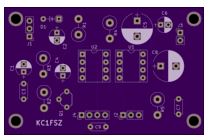
The board is shown below. This is one of my first forays into KiCAD/PCBs/etc. so it’s probably not as “tight” as it could be. Also, I’m using through-hole components so it’s old-school building. But the board only costs $7 on OSHPark and it’s pretty quick to wire up. Anyone who wants to order one from them drop me a line and I’ll send you the link.
Schematic below.
73s,
Bruce KC1FSZ
Again. Amazing. What a great workshop. Note his comments on the importance of DESIGNING FIRST, THEN BUILDING. Words to live by my friends, words to live by. Read and heed.
This factory is a LONG way from Manhattan — both from the island and from the technique.
How about some Juliano Blue PC Boards?
The machine that automatically checks for bad connections was especially amazing.
And the boards are made in 24 hours, with 3 day shipping to the U.S.
I think Ryan Gosling is a good choice to play Neil Armstrong. It looks like this movie will deal with the “right stuff,” a concept somewhat related to “the knack.”
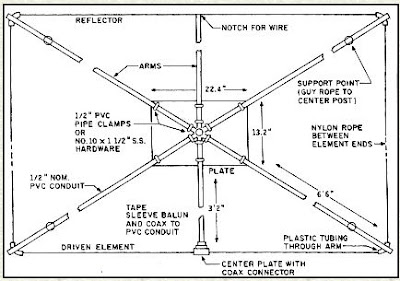
I am in the process of repairing my beloved 17 meter fishing-pole Moxon. It was taken out of service by the last Nor’easter of the winter. This repair has caused me to review the theory behind antenna directivity. I find there is a lot of “hand waving” in the explanations of how directivity happens: “You put a reflector element next to the antenna. And it REFLECTS!” You are left wondering how that reflection happens.
The Royal Canadian Air Force made a video that does a pretty good job of explaining how the reflector reflects. See above. Thanks Canada!
While we are talking about antennas, I wanted to alert readers to a really nice antenna modeling program that is available for free. It is called 4nec2. You can find it here:
http://www.qsl.net/4nec2/ There is a bit of a learning curve, and I am still climbing it, but I can see how this software would be very useful. It has an optimization feature that runs the antenna through many versions and tells you how to optimize for F/B, gain, SWR, or whatever you want to prioritize.
I have discovered that my Moxon was resonant below the 17 meter band. In other words, the antenna elements were too big. About 3.6% too big according to my calculations. This may be the result of my using insulated wire for the antenna elements. Apparently the MOXGEN software assumes the use of uninsulated wire. I’m thinking that an easy way to deal with this would be to use the frequency 3.6% above my target frequency and then use the dimensions given my the MOXGEN program. Any thoughts on this plan?
What a shame that Cebik’s web sites have all disappeared.

Pete, Brad WA8WDQ and I were recently e-mailing about our admiration for what Hans G0UPL has achieved with his QCX rig. I cc’d Hans — we got this nice and very informative e-mail. Be sure to click on the link provided by Hans, and from there go to the link to his FDIM proceedings article. I think that article is a real masterpiece — there is a lot of very valuable information in there. For a long time, getting quadrature output from the Si5351 seemed like an impossible dream. But Hans has obviously figured out how to do this, opening the door to much better and simpler single-signal phasing receivers. Thanks Hans!
Hi all
I’m not sure of the answer to the question about noise figure. Certainly radios such as QCX and the NC2030 which use the QSD architecture seem to have very high sensitivity without an RF amplifier ahead of them. This must indicate a low noise figure.