Thanks to all who offered advice and assistance. With help from you guys — and especially from Pete Juliano N6QW — I think I have this fixed.
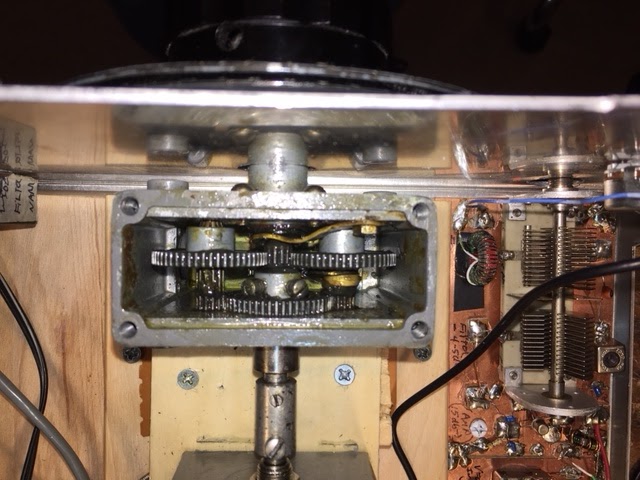
Pete was right — the problem was really with the variable capacitor. The one I was using was kind of stiff and irregular in its motion. I found another one in the junk box that was easier to turn (it has one set of ball bearings). This fixed most of the problem.
I also spent more time making sure the shaft of the cap lined up perfectly with the shaft of the gear box. This also helped a lot.
I realize now that some of the “stickiness” that I occasionally feel while tuning may be coming from the dial — not from the gear box. It looks like my dial took a hit that slightly bent one portion of it. It seems that the numbers have a bit of trouble clicking over on that portion of the dial. Some lubricant may help there. But I can live with it.
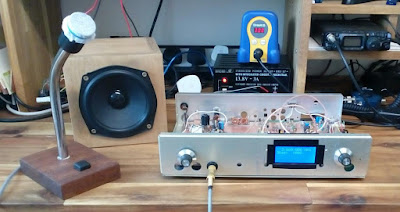
The receiver now tunes very smoothly and I can go right back to a frequency and find the signal exactly where I left it. There does seem to be a very slight difference depending on whether I “approach from above” or “approach from below” — but this is not a big deal.
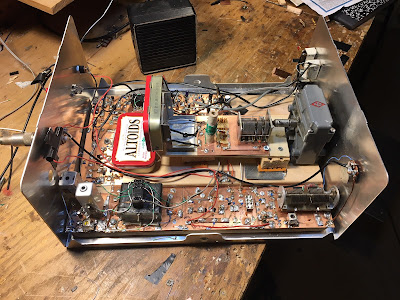
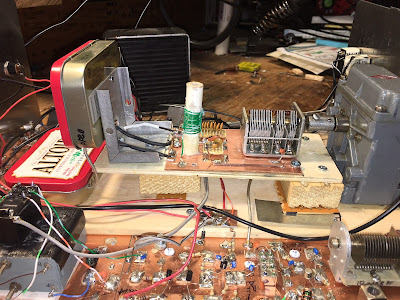
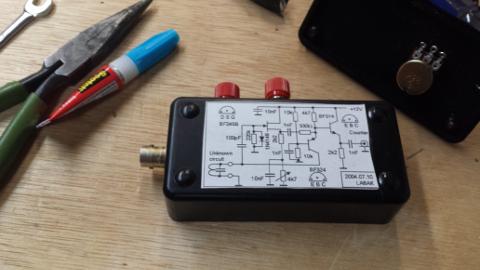
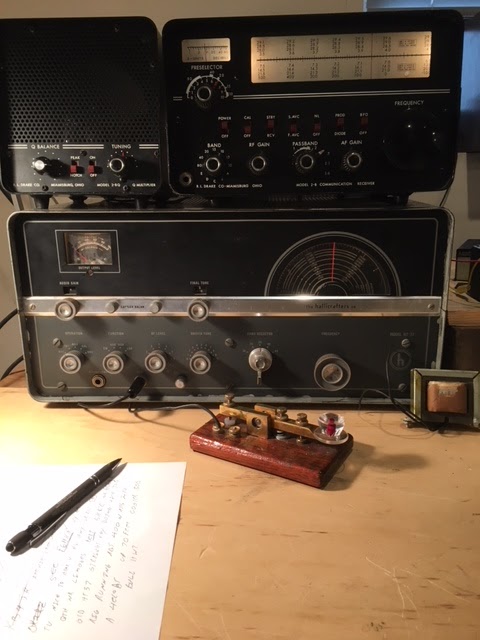
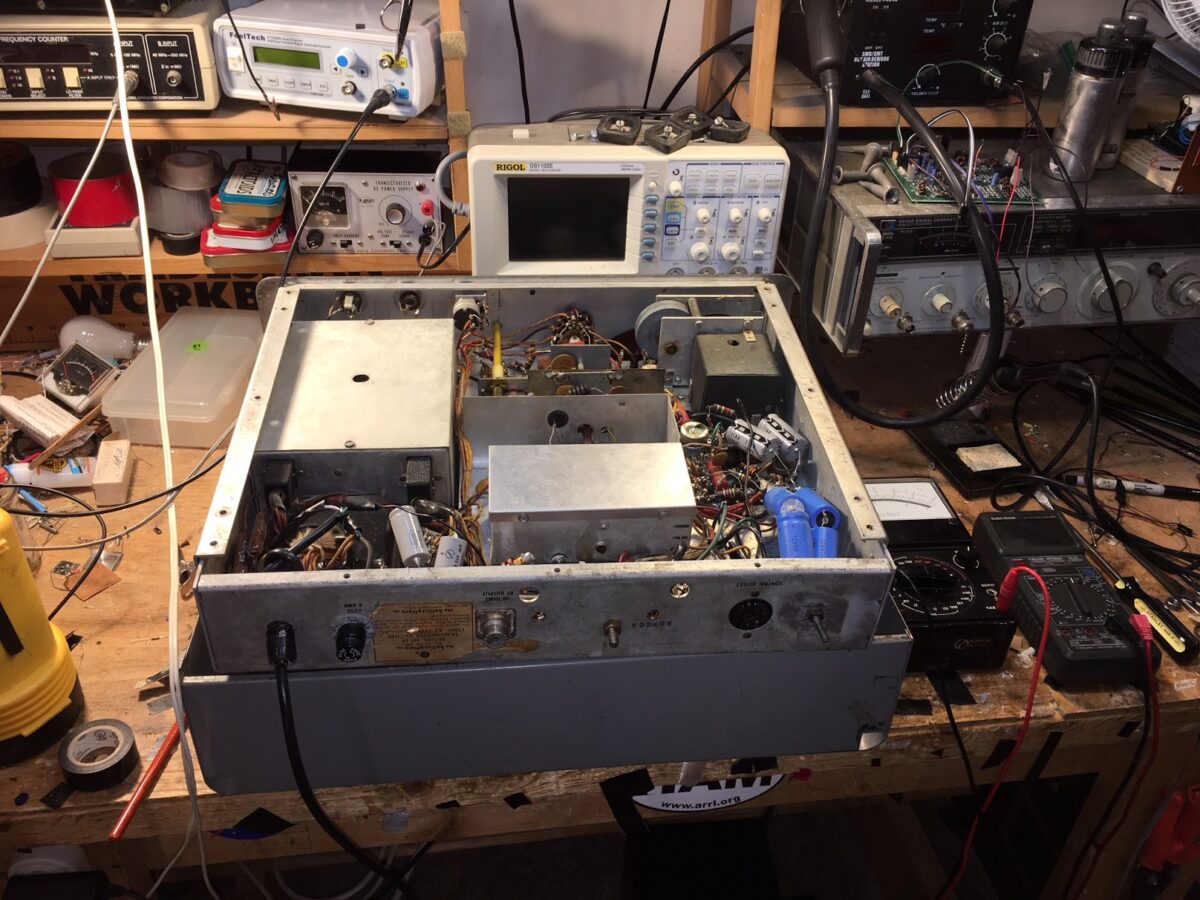
Check out the pictures of the receiver and the VFO. Note the “cardboard from a coat hanger” coil form. The winding is held in place with nail polish varnish. I had planned on having the variable cap, the coil , and the associated fixed caps all in a box for better thermal stability, but the VFO is very stable even without the box. I have the VFO running 455 kc ABOVE the signal frequency. It runs from about 7455 kc to about 7800 kc. I could have set it up to run 455 kc BELOW the signal freq. That would have made it a bit more stable (it is easier to attain VFO stability at lower frequencies) but VFO is so stable that I probably won’t mess with it. I followed DeMaw’s rules: Physical stability, NP0 caps. For the NP0 caps, put several of them in parallel to get the desired capacitance value. Keep heat-producing active components away from the coils and caps.
Thanks again to Armand WA1UQO for giving me this amazing piece of radio history. And thanks to Tim Sutton for the big box that holds this receiver.
James Millen knew what he was doing. See: http://www.isquare.com/millen/millen-page.htm
M0KOV’s Real Life Dilbert Moment — His Mom Took Him to the Doctor
![]() |
| M0KOV’s BITX |
Now, my true Dilbert moment. I remember being in the family doctors surgery and my mother was discussing my inability to get to sleep (a perfectly normal ailment for a 13 year old male). She was voicing her concern that it might be my obsession with electronics, and it was all going round in my head and keeping me awake. Funny, later in my life she never seemed to be bothered if the worry of studying or exams kept me awake.
SolderSmoke Podcast #209 SKN, Old Rigs, Movie Review, Safety Tips, Mail Bag
SolderSmoke Podcast #209 is Available:
13 January 2019
http://soldersmoke.com/soldersmoke209.mp3
An HT-37 “With Presence!” Even on CW! A Straight Key Night Story
Saving a much-loved HT-37
Drake 2-B Alignment
Tweaking the Mate for the Mighty Midget
Fixing a Deaf DC Receiver
A Wobbly National HRO-ish Gear Box
Minimum Discernible Signal Tests
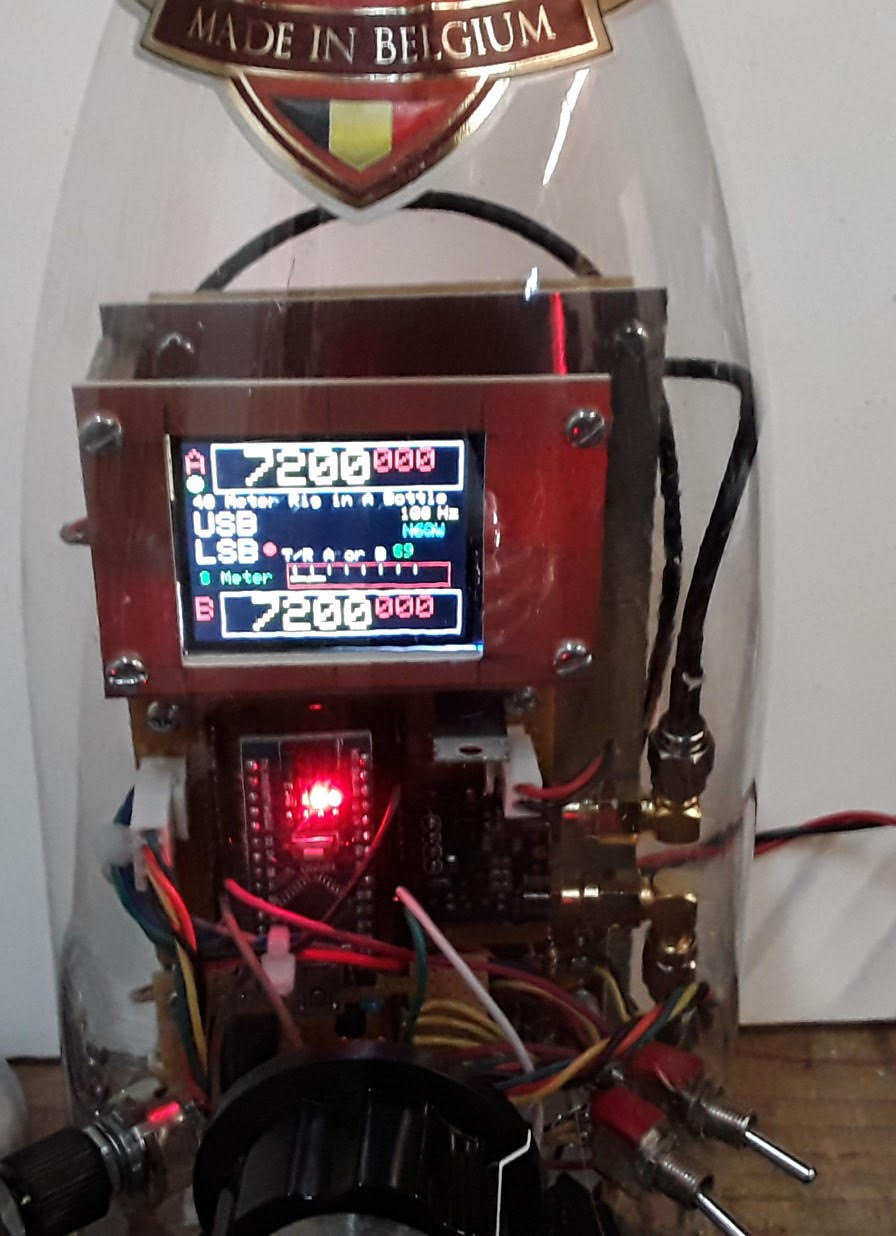
Pete’s Festive Holiday Transceiver in a Bottle
Movie Review: “First Man” Neil Armstrong goes to the moon.
Safety Tips for 2019: Fuses, Hard Drives, Flu Shots.
MAILBAG:
Dave G6AJW builds Pete’s Sudden Transceiver
Rogier KJ6ETL builds a new shack
Steve N8NM Helps save the HT-37
Jim AL7RV W8NSA builds Parasets
Dave AA7EE puts a beacon on the air — Please Listen!
Jan OM2ATC builds and documents an Si5351 VFO
Bruce KC1FSZ Homebrew’s a BITX
KB1GMX’s Tip on IRF-510 Oscillation Prevention
Ryan W7RLF Homebrews a DC Receiver
Listening to August K5HCT from the East and West Coasts on 40
Tim WA1HLR rebuilding his 1968 transmitter.
Old Station On-The-Air — A Transmitter Half as Old as Radio Itself
I’m biased, but I think it is “a thing of beauty.” With some unexpected free time available, today I followed up on my HT-37 work by cleaning and aligning the Drake 2B. I was assisted in this by one of the many great YouTube videos by Alan Wolke W2AEW.
The Drake 2B’s 50 kc and 405 kc oscillators were right were they were supposed to be — no adjustment required. And I don’t think they have been peaked since 1973. The 455 kc IF can was also very close to perfectly tuned.
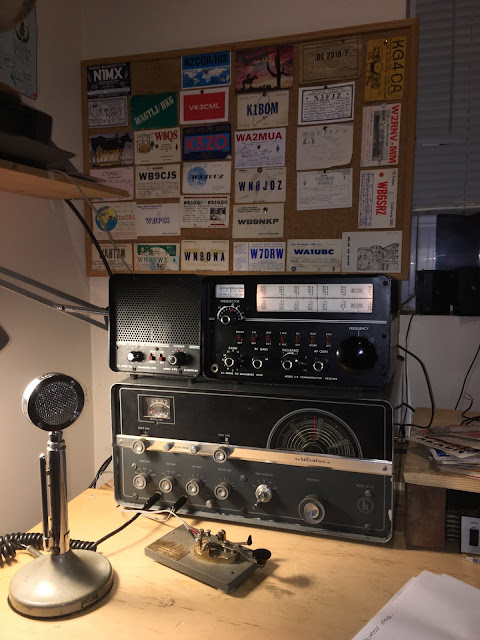
Since most stations from the mid-1960s had some QSL cards on the wall behind the rig, I pulled out some old ones and put them up. Many of these contacts were made by the rigs in the picture.
If we say that 1897 marked the first use of radio, and if we assume that this HT-37 was manufactured in 1959, that means that my old transmitter has been in operation for almost HALF of the history of radio.
The AL7RV (W8NSA) Paraset, Regens, Test Gear, and Schematics Varnished into Enclosures
I managed to cobble up some regen’s over the summer. Most fun was my version of Dave Richards, AA7EE Sproutie, it turned out so nice I have it on my bedside table. Yes, the Sproutie has displaced the trusty old Transoceanic, brings back memories of late night SWL’ing with my Space Spanner as a teen.
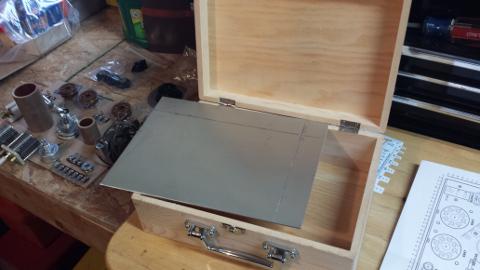
Many of the U.S. Paraset builders are using a wooden craft box from Hobby Lobby, It is just about the correct size and shape. You can see at the right side of the photo a detailed panel layout. Building the Paraset is not quite Heath Kit but with so many talented builders having made so much information available I feel so lucky to follow the effort.
I have always loved the way WW II equipment had the schematics varnished into the covers or cases. I try to do the same with most of the things I build.
Schematic reduced to fit, ink-jet printed. Using an old credit card I spread a very thin layer of E6000 clear adhesive on the case, apply the paper image, then using a clean credit card or the edge of piece of circuit board feather the schematic into the adhesive.
73, Jim W8NSA aka AL7RV
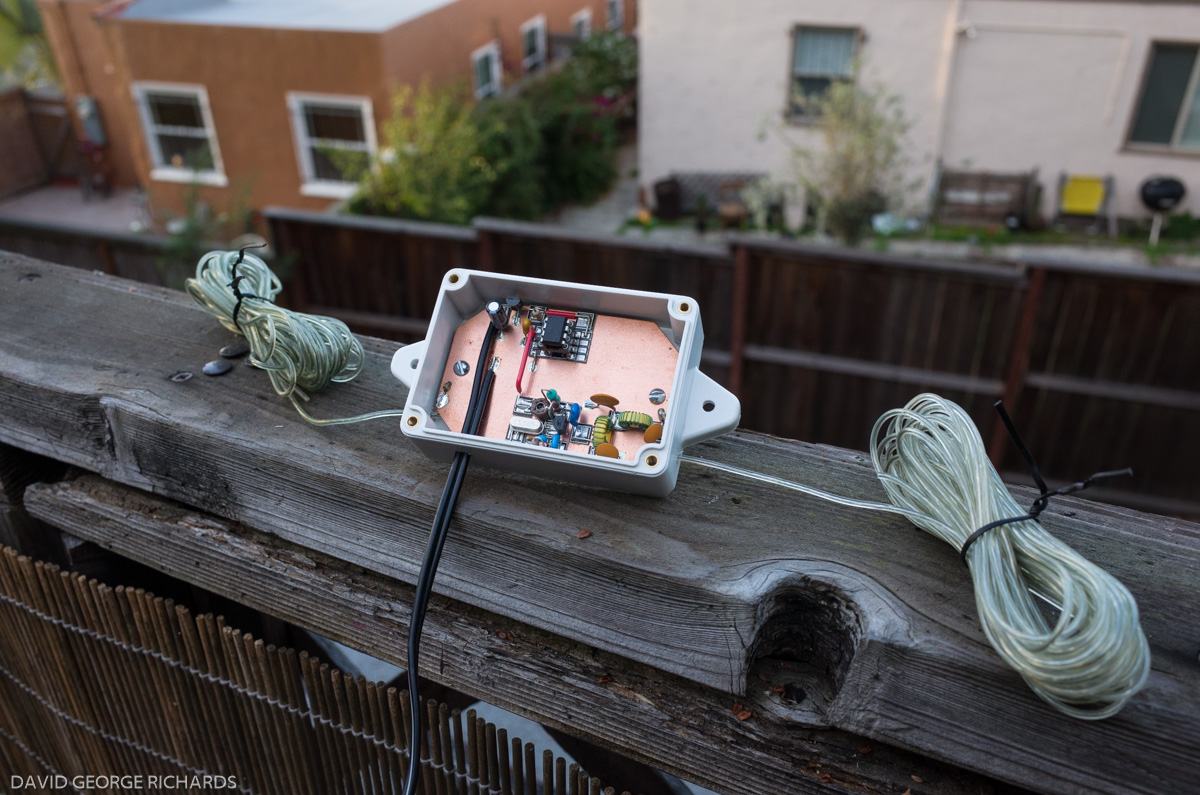
Jan’s Slovakian Si5351 VFO

Jan in Slovakia put together a very comprehensive web page on his Si5351 VFO project. Check it out:
https://janoc.rd-h.com/archives/649
Thanks Jans!
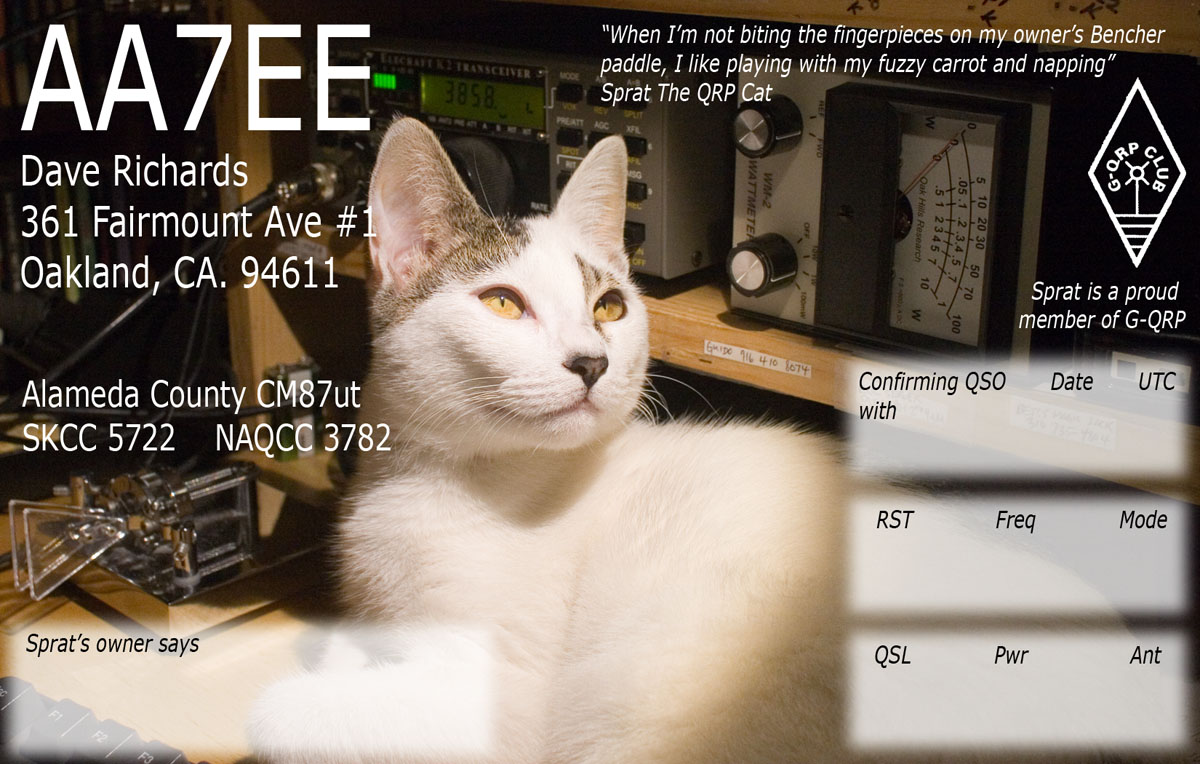
Please Listen for Dave AA7EE’s New “Boris Beacon”

https://aa7ee.wordpress.com/2019/01/03/putting-the-hifer-brs-boris-beacon-on-the-air-finally/
From Dave’s blog:
The beacon sends the letters “BRS” at 10wpm, with a break of 3 or 4 seconds between the end of one transmission and the beginning of the next, with a mighty power to the dipole of about 1mW. The frequency is a nominal 13556.9KHz (13.5569MHz), which varies either way by a few tens of Hz, depending on the outside ambient temperature. I will be overjoyed if anyone, anywhere hears it! There is no battery, so it transmits during daylight hours only. It comes on about half an hour after local sunrise, and goes off about half an hour before local sunset. I’ll update this with more accurate information, as I observe the on and off times over the next few days.
—————
AA7EE is in Oakland California. His cat is named SPRAT. Please send him a report (and if possible a recording) if you hear his beacon.
New Rock Video By Astrophysicist and Queen lead-guitarist Dr. Brian May
We don’t carry many music videos on this blog, but this one definitely belongs here. We’ve mentioned Brian May several times: Lead guitarist in the rock group Queen. PhD Astrophysicist.
I didn’t know that he went to work as a full member of the New Horizons (Pluto and beyond) mission.
The video is definitely for us — it features a lot of antennas. And it includes the computer-generated voice of Stephen Hawkings.
Read more about Brian’s careers and about his latest adventure here:
https://www.space.com/42875-brian-may-new-horizons-song-ultima-thule-flyby.html
HNY (Happy New Year), SKN (Straight Key Night) 2019, and an HT-37 with “presence” — even on CW
I got the HT-37 working just a few days before the New Year’s Eve/New Year’s Day Straight Key Night event. Looking at my older blog posts, I now see that the problems first surfaced in LAST YEAR’s SKN. Wow, it took me a long time to get to that problem. But I’m glad I fixed it in time for SKN.
For SKN I used the VU3XVR straight key from India that Farhan gave to me. See the picture above.
I started out on 80 meters on New Year’s eve. I rarely operate on that band — I thought it would be a good change of pace. Here is who I contacted on 80 CW:
In the warm-up period before the official start of SKN I worked John KU4AF. John was running a homebrew tube transmitter and a REGEN receiver. Respect, my friends. RESPECT!
N9EP Ed near Chicago was on a K3.
VE9XX Don was on a KX3.
NJ8D Tom in Ohio.
K4IA, Buck, down the road in Fredricksburg Va. Buck was running a Drake TR4C with a Begali key. FB Buck. He mentioned that he had had a Drake 2B — he said he regrets selling it. Indeed.
VE9WW Bill in Moncton NB. On a straight key.
AA8MI Gene (gosh, that name really sings in CW — try it!) in Ohio. Gene was running 5 watts from a K3. This added a needed QRP element to the festivities. Thanks Gene.
AI4SV Jack in Rockville Md. OH MY GOD! NOW I REALIZE WHO THIS WAS! Jack! Jack of Antanarivo Madagsascar! And now I understand what he said to me. He said in CW that my HT-37 has “Lots of presence.” Huh? What? I couldn’t figure out what he was talking about, but now I realize that he was joking about all our discussions mocking the poor audiophiles. Well, thanks Jack. I’m glad the rig has presence, EVEN ON CW! THIS QSO GETS MY VOTE FOR BEST SKN QSO.
I also listened for a while to W3GMS. His signal had a lot of character and personality. He was telling the other fellow that he suspected this was the result of a soft voltage regulator tube in his DX-60. I think he was also using a Drake 2-B. I didn’t get a chance to talk to Howard, but I’m sure it would have been fun.
On New Year’s morning I switched bands. First to 40 where I worked Greg NM2L near Atlanta. He said he fingers and wrist were out of condition, but I told him his fist was FB.
Then I went to 20 CW where I worked a bit of DX. First David F8CRS then Bert F6HKA. The contact with Bert reminded me of the charms of DX contacts using CW. “VY GM DR OM.” It was nice.
N7AQQ Mike in Montana.
So it was a good SKN for me. Working the French stations reminded me of the allure of listening to CW coming in from far away, and from a foreign culture. And it was great to hear from AI4SV that my HT-37 has “presence” even on CW.
73 and HNY to all.
HT-37 Choke Failure — Why did this happen? What is your diagnosis?
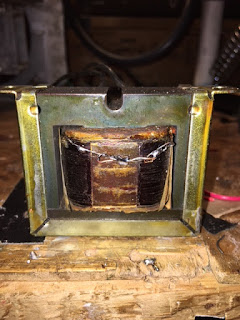
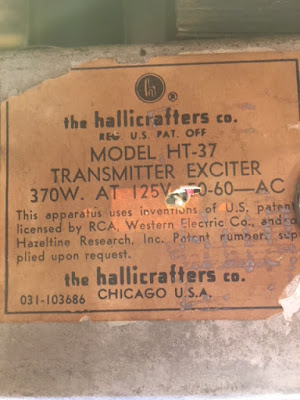
Look, it has been 60 years, so I’m not looking for my money back or anything, but having just repaired the LV power supply choke on my very venerable Hallicrafters HT-37, I started thinking about how and why it failed.
Clues:
— I found it with four of the windings broken, with the eight broken leads kind of sticking out of the winding wrap.
— The four broken leads were on the outside of the winding (thank God!) an were at the part of the winding closest to the chassis and the back of the cabinet. (See picture below.)
— There was evidence of burning on at least two of the leads.
— The choke is located in the extreme back corner of the chassis, near the back of the cabinet.
— The paper and cellophane wrapping around the windings was a bit deteriorated.
So, what is your diagnosis? What happened to cause the choke to go open?
KC1FSZ’s Peppermint III Homebrew BITX with Mods
Bruce KC1FSZ
HT-37 FIXED — Thanks for all the support
![]() |
| Don’t worry– I covered it with tape |
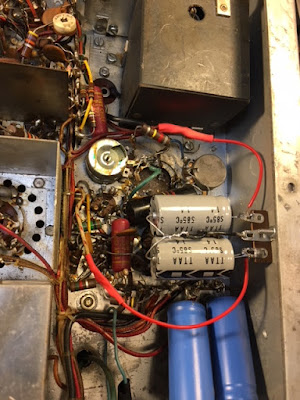
This week I found myself with some unexpected free-time, courtesy of the government shutdown. And of course, my thoughts turned to the HT-37. I started thinking about the open choke in the power supply. Four wires were sticking out of one side, four sticking out of the other. Figuring out which went to which would have driven me nuts. But it occurred to me that I could just wrap the four one on both sides together, and then just connect them with a piece of wire (see above). I’d end up sacrificing three windings, but that shouldn’t matter.
![]() |
| Terminal strip for newer caps. Repaired choke went to the two ends of the strip. |
W7RLF Homebrews a Receiver — FB!
Ryan W7RLF has joined the small and elite group of radio amateurs who have homebrewed a receiver. And it is a receiver filled with soul, juju and mojo; the project was inspired by Wes Hayward and Farhan, and used components from Hans Summers. Congratulations Ryan and thanks for all the work you did in documenting your experience.
Who will be the next intrepid ham to join the homebrew receiver club?
Hello Sirs!
Ghost Ship: Oscar 11 Tumbles Through Space
First — Happy Boxing Day to all our UK and Commonwealth friends.
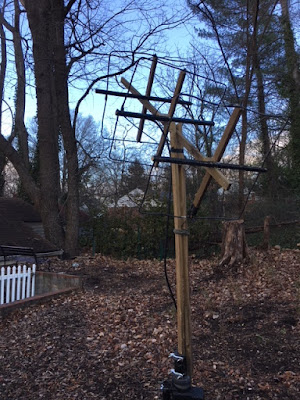
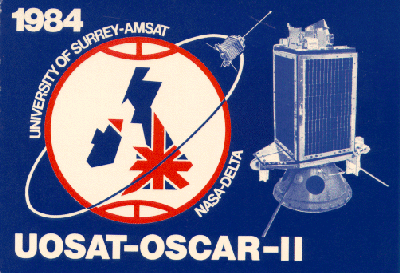
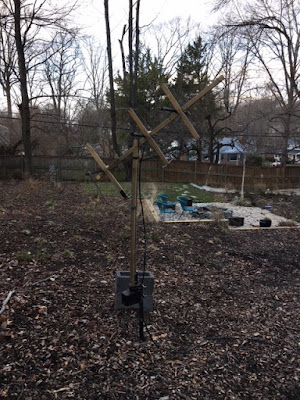
Oscar 11 is a UK-built amateur satellite launched in 1984. It has been dead (well, almost dead) for many years. But when the sun shines on the solar panels, it wakes up and transmits. I’ve been able to hear it and — more usefully — see it on my RTL-SDR HD-SDR receive system. My antenna is my re-born (from the Dominican Republic) three element homebrew 2 meter cubical quad (see pictures below).
I’m sorry the video is a bit out of focus, but you can clearly see the trace of the signal from the satellite. Realize that my HD-SDR software is about 10 kHz off calibration. You can see the Doppler shift, and you can see the signal fading in and out as the old satellite tumbles through space. Any ideas on what the other signals seen off to the side are? Is anyone else listening for Oscar 11?
https://amsat-uk.org/satellites/telemetry/uosat-2-oscar-11/
https://en.wikipedia.org/wiki/UoSAT-2
http://www.dk3wn.info/p/?cat=47

50th Anniversary of Apollo 8 (Great video!)
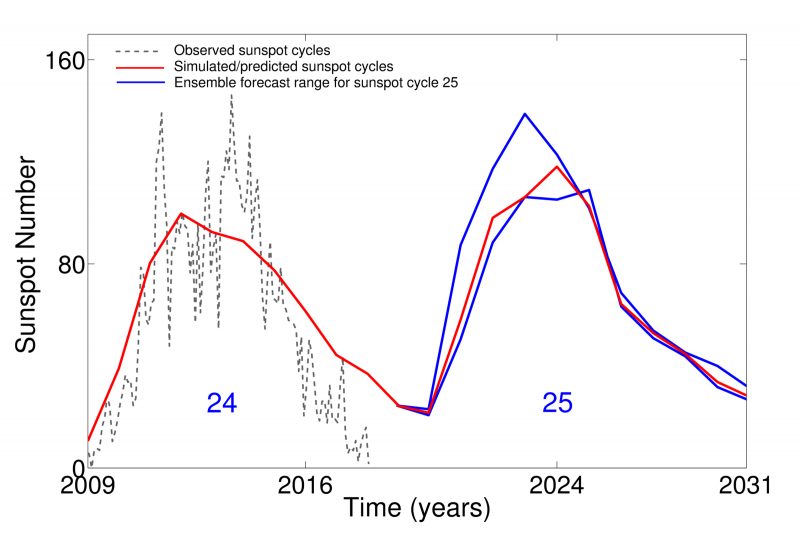
Indian Scientists Upbeat on Solar Cycle 25
All I want for Christmas is… an HT-37 L25 Choke– 9 Henries at 135 ma
Following my own advice to prepare for Straight Key Night, I tried to fire up my venerable Hallicrafters HT-37 transmitter. It didn’t work. I quickly determined that none of the oscillators were working, so my troubleshooting focused on the power supply. Sure enough, the choke in the low voltage power supply is open. That’s bad.
I briefly considered giving up on this old rig. I don’t really like working with tubes anymore. And this thing is very heavy — a real beast. DX-100-like in its heaviness. It can be hazardous to your health just moving this thing around. Opening up the case is not easy. And there are nasty voltages in there….
But I have had this transmitter since 1973 or 1974. I have fixed it many times, in several countries. I got it from a member of the Crystal Radio Club when I was a kid. There are parts given to me by Pericles, HI8P in the Dominican Republic. I used it to transmit through Russian satellites. That transmitter is like an old friend. I just can’t give up on it.
So I need to replace or repair the choke. Is there anyone out there who has a junker out in the garage or some other source of L25? Or does anyone know of a business that could rewind the choke. Please let me know. I have decided to leave the rig on the bench until I get this thing fixed (it is too heavy to move multiple times!)
It it Hallicrafters Part Number 056-300259. L25 — 9 Henries at 135 ma. Help!
SolderSmoke Podcast #208

SolderSmoke Podcast #208 is available:
http://soldersmoke.com/soldersmoke208.mp3
15 December 2018
Pete and the California fires
Bill goes to Brooklyn
2 meter simplex
A return of the trivial electric motor
Audio from Mars
HF Conditions — a real mixed bag
Pete looks back at 2018 — The Year of the SSB Transceiver — Lessons Learned
Hans Summers, the QSX and the virtues of SDR
W7ZOI’s DC Receiver Retrospective
The 1972 Solar Flare and the Vietnam War
SHAMELESS COMMERCE: Buy your gifts through the Amazon link to the upper right.
Consider SolderSmoke the book as a gift. Visit Pasta Pete’s for cooking ideas.
Don’t Build It! Sage — but unexpected — advice from Pete.
Straight Key Night approaches.
Book Reviews:
–“What is Real?” (Quantum Physics)
— RHdb by K6LHA.
Movies
“Bohemian Rhapsody”
“First Man” (Not yet!)
MAILBAG:
Steve G0FUW
Ed KC8SBV
Free Book! RHdb — The Radio Hobbyist’s Designbook by K6LHA
Another AMAZING Homebrew Vacuum Tube (Valve)
I feel a moral obligation to put these projects on the blog every time I see one. It just seems like the right thing to do. Great work on the Pilotron. Great workshop video also.