WANTED: MEPT Grabbers in S. America, Africa, Asia

Dear Bill,

It Hurts!!…. You have abandoned us visual Beacon Anarchists for the Instant gratification of the WSPR crowd.

Hey, To refresh your memory, Your the one that got me started in this Visual MEPT World. I listened to your podcast and ordered some 10.140 Mhz Crystals and built my Model 1 MEPT transmitter. After that I was hooked. It has gone on to a model 2 and Now started on a DDS driven Model 3 which is all band and right now is crying out for someone to see it at 160 mW. It has made it last week to VK7ZL in Tasmania 8455 miles and ZL2IK in New Zealand 6917 miles. So, as you can see, I have been busy. One of the really extarodinary things is that we are doing this on 40 meters at 7,104,800 Hz. What would really help is to enlist some more monitoring stations with ARGO Spectrum Analyzers on their computers LISTENING. They are sorely needed in South America, Africa, India and the Far East. I have the belief that my signal at 160mW on 7,104,800Hz can be copied in all of those areas at different times of the day, almost every day. The reason it isn’t is there is nobody listening and my little FSKCW signal
just keeps looking for a receiver to hear it.

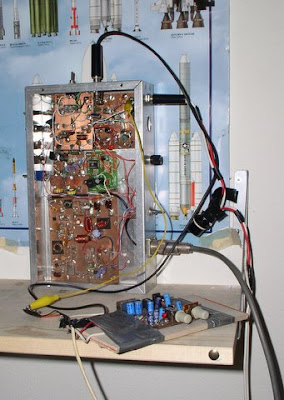
My model 3 transmitter is a thing of beauty. It can work all bands from 160 to 10 meters. It is completely under the control of an Ardunio processor (A great product of Italy). It controls the frequency, the amount of frequency shift, and the CW keying. It is not quite ready for prime time yet. But work is being done on the controlling software and one of these days, It will be done. Then the visual guys will not be chained by a crystal to determine their frequency. They will merely command their Ardunio to control their Direct Digital Synthesizer to the desired frequency, select the desired mode of transmission and hook up the antenna.

So, Please Mr Bill, Don’t abandon us visual MEPT beacon guys. We really need your voice and talents to keep the airways of our 100 Hz of spectrum alive and vibrant. You could hang an extra wire out the window and do both!

73 Dave
David R. Hassall WA5DJJ
Website: http://www.zianet.com/dhassall/
Back to WSPRing

Mark, K6HX, and Roger, G3XBM, are responsible for me going back to WSPR mode. Both have been blogging about the fun they are having with this mode. It was too hot in Rome to go out this afternoon, so, after a morning visit to the Trastevere flea market (where I got a US Robotics dial-up modem for my soon-to-be functional Satellite Pro computer (thanks Jeff!), I ensconced myself in the shack, and did the changeover from visual MEPT to WSPR. This mode provides instant gratification: almost immediately I was being picked up and reported by EI7GL.

Micro-watt WSPRing by Gene, W3PM

Hi Bill,

As you know by your experience using 20 milliwatts, Weak Signal Propagation Reporting (WSPR) is an excellent mode to experiment with low power. A QRPp experimenter can received near instantaneous automated reports over the internet from hundreds of stations throughout the globe.

During the last few days, I have been experimenting on 30 meters with output powers as low as 20 microwatts. No one has spotted my 0.00002 watt signal yet, but K8CXM has spotted my 50 microwatt signal at a distance of 553 KM at 2332UTC, 05 AUG 09.

I used a 100 mW GPS timed beacon with a step attenuator to an indoor doublet for all the tests. All equipment is homebrew and the output power is verified with a HP-432A Power Meter. If you look in the WSPR on-line database the power is reported as 0.100 watt because it was too difficult to pull out and reprogram the beacon’s PIC controller chip for each change of power. In any case, there are no provisions to report power levels below 1 milliwatt to the WSPR database.

Other noteworthy spots:
100 uW – K8CXM, 2252UTC, 05 AUG 09, 553 KM
200 uW – AI4SA, 0530 UTC, 02 AUG 09, 333 KM
500 uW – NJ0U, multiple spots 31 JUL & 01 AUG 09, 716 KM
500 uW – K1JT, 1440 UTC, 31 JUL 09, 1215 KM
500 uW – W3HH, 1240 UTC, 31 JUL 09, 764 KM
5 mW – VK6DI, 2232 UTC, 05 DEC 08, 17,858 KM

A 6.5 meter auto tuned vertical with 50 ground radials was used for the VK6DI report. The vertical is disguised as a birdhouse support because I live in an antenna restricted neighborhood.

Of course all the credit goes to the receiving stations that no doubt live in a very quiet RF environment. The reports do not represent any records, but they may be of interest to other QRPp experimenters. .

Gene W3PM

Seeing my WSPR signal

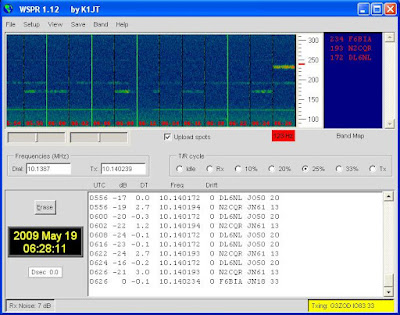
Graham, G3ZOD, sent me this WSPR screen-shot. He writes:

Hi Bill. Thought you might be interested in a screen grab of yourself. You’re the near continuous signal along the centre of the waterfall just below 200 on the vertical axis.Not DX from Italy to England, but I’m using an indoor wire antenna and I usually receive you for short periods only – never seen such a consistent signal before. By the way: I think your computer clock may be a couple of seconds off according to the DT values; I have mine resync every 6 hours and my clock is generally within 150 milliseconds.
73 de Graham G3ZOD

Thanks Graham! The consistency of my signal is no doubt due to the fact that I have no receive system here yet, so on the WSPR software, in the “T/R Cycle” box I had “TX” checked. So I was “key down” most of the time. Your screen shot made me realize that this might not be the most neighborly thing to do — someone else on the same freq might be QRMd by my 20 mW DSB sig. So I think I’ll ratchet down the T/R cycle here.
My computer clock is erratic. I have to tweak it each day. I know there is a program out there that automates this — haven’t gotten to that yet. 73 From Rome

W3PM Hears the WSPR Rig he Inspired

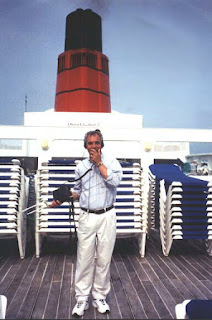
I got a nice e-mail from Gene, W3PM. Gene’s simple homebrew SSB rig for WSPR provided the inspiration that got me into the WSPR mode. We’d been exchanging e-mails a while back, then he mentioned that he would be away… Turns out, he ended up within range of my 20mW WSPR sig. (The picture shows Gene doing some maritime mobile satellite operating from the QEII in 2002.)

Hi Bill, I just wanted to let you know that I hear your 20 mW WSPR signal each morning around 0500 to 0700 UTC. Your signal strength varies between -21 and -26 dBm.

I am currently on vacation in Fettercairn (GM4YRE, IO86ru), Scotland which is located about 30 miles SW of Aberdeen in the northeastern part of Scotland. I have very limited internet access; therefore, I cannot report WSPR spots in real time. My WSPR transmitter is active most days on 30 meters until we leave Scotland… I run one watt to a low doublet antenna.

73/72 Gene W3PM GM4YRE

K1JT Spots My DSB QRPp WSPR Signal

2009-05-03 16:42 N2CQR -29 K1JT 7035 4371
2009-05-03 16:38 N2CQR -24 K1JT 7035 4371

I got into WSPR because I wanted the gratification that comes from seeing a map readout indicating that my QRP signal has crossed various oceans. Well, yesterday I crossed the pond for a second time, but this time the receiving station heard the signal more than once, so the rx station callsign appeared on the display (if the signal is heard only once, you get the line showing the path, but NOT the rx station call). And what a fine callsign it was: K1JT, Joe Taylor, Nobel Prize winner and the inventor of WSPR.

In the last SolderSmoke I got Joe’s name wrong (I called him John). It must have been too early in the morning here. Anyway, I was gently corrected by Wes, W7ZOI, and I promissed to make ammends. Sorry Joe! (Thanks Wes).

WSPRing Across the Mighty Atlantic

You have to look carefully, but in the picture above you can see a little green line stretching from Rome to Maine. That’s my 20 milliwatt WSPR signal crossing the Atlantic. W1CDO’s receiver picked me up at 0452 UTC yesterday.


Date Call SNR W
by loc km mi
2009-04-29 4:52 N2CQR -22 0.020 W1CDO FN43ou 6541 4064

The day/night terminator was in the mid-Atlantic at that time, so I think I had a bit of a tailwind from the gray line! But still, not bad for 20 mw in Maunder Minimum II. K1JT’s software and W1CDO’s receive system did the heavy lifting. Antenna here is just an end-fed wire among the buildings of central Rome.

On to the Canary Islands

Got up this morning, walked into the shack and saw on my computer screen a thin green line from Rome to the Canary Islands. I knew that my little WSPR station had reached out to new territory, and had established a new distance record (for me). Life is good!
As I’ve been doing, I decided to see who was at the other end of that line. It was Luis, EA8AY (pictured above). Luis’s station picked up my 18 milliwatt signal at 2106 UTC on April 24. The distance was 1871 miles (3011 kilometers). I was 23 db below the noise.
Luis has a very nice web page: http://www.ea8ay.com/index.html (Warning: This site will likely cause feelings of extreme jealousy: Luis is living in a fantastic location, with a beautiful family AND he is the owner of an Argonaut 509!)
On his site, Luis has a nice video that will give you a sense of what WSPR is like:


wspr with 100 mw from luis on Vimeo.

Crossing a small bit of the pond…

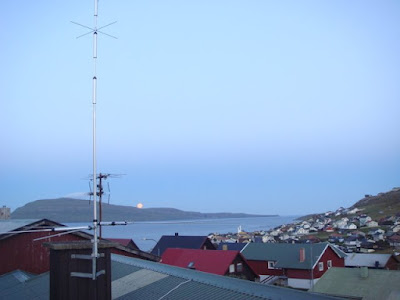
I got into WSPR because I wanted to one day walk into my shack and be greeted by a Google map with big long lines showing my milliwatt signal stretching bravely across various oceans. That hasn’t really happened yet, but I got a taste of it this morning courtesy of OY3JE’s WSPR station. Jan lives in the Faroe islands, about 1600 miles from me. Last night at around 2300 UTC my 18 mw WSPR signal made it to Jan’s location. I was 29 db below the noise. Thanks Jan!
(The images above and below are of Jan’s locations in the Faroe islands (from his site).

WSPRing along at 27 db below the noise….

WSPR is fun. I haven’t crossed any ponds yet, but the real- time displays of the reception reports are very addictive:
http://wsprnet.org/drupal/wsprnet/spots
Be sure to click on the map display also.

I was intrigued by the Signal to Noise ratio column, and wondered what the reference bandwidth for the noise was. K1JT’s pages show the reference bandwidth is 2500 Hz, and that WSPR can decode signals that are as much as 27 db below that noise.

That’s great. I guess I don’t have to worry about the lower sideband of my 30 mw signal causing anyone any trouble. It will be very far down in the noise.

WSPR Double Sideband Success!

Oh, how sweet it is. Today I finally got my WSPR station working. Before departing for Sicily, I installed a diode ring mixer (supplied by Jim, AL7RV) between my MEPT oscillator and my two stage 50 mw power amplifier. I thought I might have enough audio coming out of my sound card to modulate the transmitter, but I soon found out that I needed more AF. Lazy after a week on the road in sunny and snowy Sicily, I reached into the junkbox and pulled out the guts of an old computer speaker amplifier. Some really ugly jerry-rigging ensued. The amp is now sitting near the TX, powered by its own 9V battery. Looks like I’m getting about 25 mw out, but that’s from both sidebands. So I’m guessing I’m at around 10 mw.

Following guidance from Gene, W3PM (whose FB SSB rig inspired this effort), I set my oscillator at 10138700. That puts the upper sideband in the middle of the WSPR band.

Here’s my first set of reports:

Reported Distance
Date Call SNR by km mi
2009-04-19 18:32 N2CQR -18 DL0TUH 1353 841
2009-04-19 18:32 N2CQR -24 PA1GSJ 1343 835
2009-04-19 18:30 N2CQR -19 DL0TUH 1353 841
2009-04-19 18:26 N2CQR -22 DL0ODX 977 607
2009-04-19 18:26 N2CQR -30 G8BKE 1519 944
2009-04-19 18:26 N2CQR -26 PA1GSJ 1343 835
2009-04-19 18:24 N2CQR -23 PA1GSJ 1343 835
2009-04-19 14:24 N2CQR -22 M0WQR 1601 995

Hey, is this a first? Has anyone else run WSPR DSB?

Homebrew WSPR from W3PM

Recently I’ve been reading with envy the WSPR reports from K6HX. Mark tells how he walks into his shack each morning and is greeted with signal reports from around the world. Beautiful maps are presented, with lines arcing from Southern California to distant islands in the South Pacific. I burn with envy. I want to WSPR too! But I have no SSB gear for 30 meters, and unlike our beloved visual MEPT QRSS, WSPR requires SSB gear.

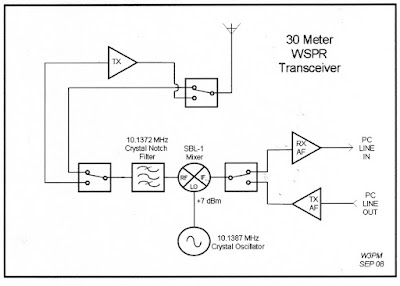
I had mentioned all this on SolderSmoke, and this morning Gene, W3PM, came to the rescue. He sent info on a really interesting and very simple SSB transceiver. Take a look at the block diagram. On transmit it is essentially a DSB rig with a filter at the operating frequency to knock down the unwanted sideband. On receive it is a Direct Conversion receiver preceded by a narrow filter that allows the WSPR frequencies through. It uses the familiar SBL-1 mixer. The filter has only one crystal. And –icing on the cake — Gene built his version in modular form, with each module in an Altoids tin. Clearly, this is the WSPR rig for us!

Gene provides a very nice write up on his project here:
http://www.knology.net/~gmarcus/WSPR/wspr2.pdf

The QRSS Knight with the Nobel Prize


We are in some very distinguished company on the QRSS “Knights” mailing list. Joe Taylor, K1JT, is active in the group. Joe won the Nobel Prize in Physics in 1993. His biography includes references to ham radio that will warm the hearts of all Knack sufferers: K1JT’s bio

This year, Joe created a new piece of software that is being used by many of the Knights. It has a name that will appeal to QRP’ers. Here is a description:

WSPR is the name of a computer program.
It is pronounced "whisper",and stands
for "Weak Signal Propagation Reporter";
it implements transmitting and receiving
functions for a digital soundcard mode
called "MEPT_JT", which stands for
"Manned Experimental Propagation
Tests, by K1JT".

WSPR generates and receives signals
using structured messages, strong
forward error correction,
and narrow-band 4-FSK modulation. Its
principal design goal is reliable
copy at very low signal levels. In
practice it works well at
signal-to-noise ratios down to -27 dB in a
reference bandwidth of 2500 Hz.

Joe recently released a new version of WSPR, so if you are going to give this a try, make sure you do so with the most recent release. You can download WSPR 1.0 (r972) from

http://physics.princeton.edu/pulsar/K1JT/WSPR100.EXE