Category: wolke — Alan
How to Measure Output Impedance (video)
Thanks to Tony Fishpool G4WIF for alerting us to this very useful video by Alan Wolke W2AEW.
Alan’s video channel is a real treasure-trove for homebrewers.
It was very cool to see “AEW” inscribed on the function generator that Alan built 30 years ago.
Be sure to stay to the end of this video for some electronics humor from Alan. (Steve Silverman: Take note — we might want to add this to the lexicon.)
Now I’m going to search Alan’s YouTube channel for a video on how to measure input impedance.
DIY Waterfall — A Quick and Easy Panadaptor Using a Sig Gen and O’scope (video)
I’ve been getting waterfall envy. The panoramic frequency display is the one thing that could lure me to the dark side (SDR). Heck, they now have 3D waterfalls! What next? Holographic waterfalls? Virtual reality waterfalls? This is almost too much.
Anyway, in an effort to counteract all of this waterfall seduction and to show that us analog HDR guys can go panoramic too, I decided to try to create my own panoramic display without resort to SDR.
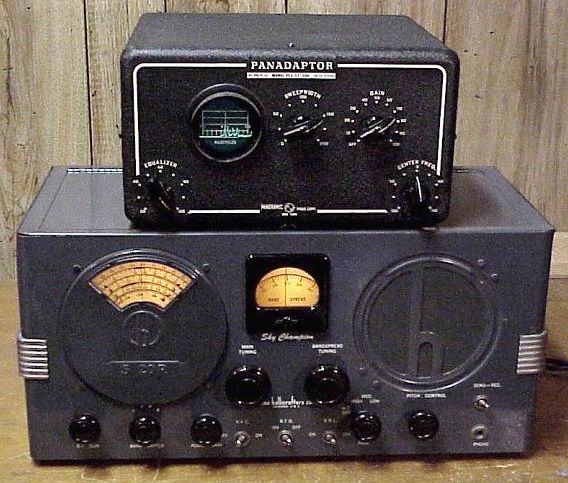
Of course, this is a very old technique. It was invented in the 1930s by Marcel Wallace, F3HM. He was the inventor of the Panadaptor which was the forerunner of today’s waterfall. Panoramic reception was used by the armed forces during WWII. In 1946 Hallicrafters marketed a Panadaptor for its ham radio receivers (see below).
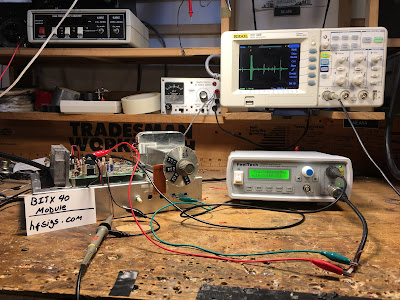
In figuring out how to do this, I thought back to my use of my Feeltech signal generator to scan the response of a crystal filter. The Feeltech has a very handy sweep feature.
In this case I set up the Feeltech to sweep from 4.85 MHz to 4.75 MHz in one second. With the 12 MHz IF of the BITX40 module, this would result in a sweep from 7.150 to 7.250 MHz.
The sweeping Feeltech just replaced the VFO on my BITX. I hooked up the Rigol oscilloscope to the audio output of the BITX. I set the horizontal scan rate at 100 ms per cm. This would have the trace go across the whole screen in 1.2 seconds.
After a bit of fiddling, I could see signals on the 40 meter phone band. But my display would kind of drift along the screen making it hard to know the frequency of the signals I was seeing.
Alan Wolke W2AEW provided the solution. He advised me to put a big stable signal at 7.150 MHz near the input of the BITX, then use this strong signal to trigger the ‘scope scan. The HP8640B signal generator that Steve Silverman gave me (and that Dave W2DAB picked up for me in NYC) provided the triggering signal.
I put a piece of tape across the bottom of the scope display to calibrate the display. See video above.
It works! It is not as cool as the SDR waterfalls, and it does not convey nearly as much information, but it was a fun project.
Old Station On-The-Air — A Transmitter Half as Old as Radio Itself
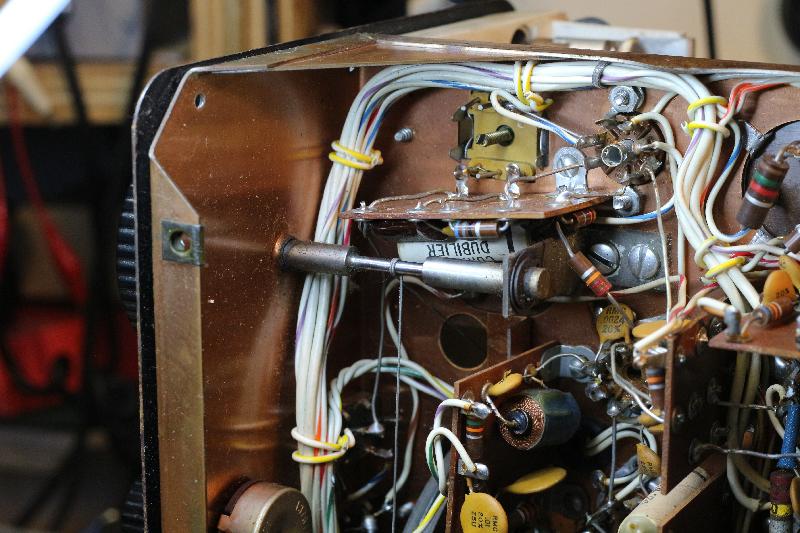
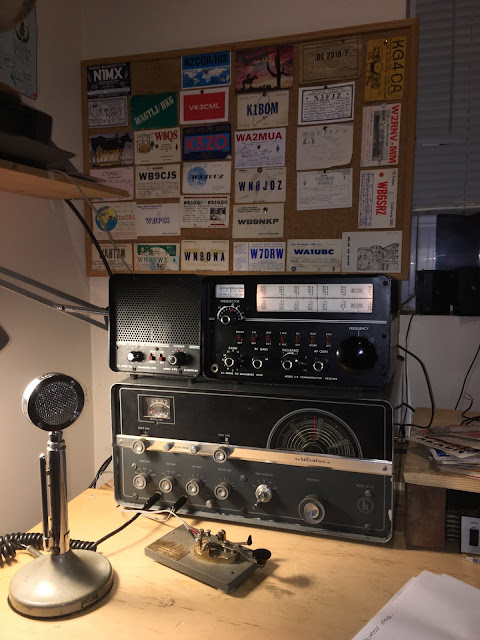
I’m biased, but I think it is “a thing of beauty.” With some unexpected free time available, today I followed up on my HT-37 work by cleaning and aligning the Drake 2B. I was assisted in this by one of the many great YouTube videos by Alan Wolke W2AEW.
The Drake 2B’s 50 kc and 405 kc oscillators were right were they were supposed to be — no adjustment required. And I don’t think they have been peaked since 1973. The 455 kc IF can was also very close to perfectly tuned.
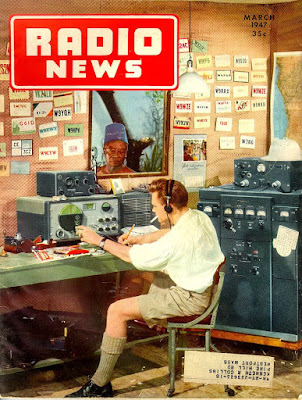
Since most stations from the mid-1960s had some QSL cards on the wall behind the rig, I pulled out some old ones and put them up. Many of these contacts were made by the rigs in the picture.
If we say that 1897 marked the first use of radio, and if we assume that this HT-37 was manufactured in 1959, that means that my old transmitter has been in operation for almost HALF of the history of radio.
Farhan gives me a Spectrum Analyzer and W2AEW Provides the Tutorial (Video)
At Dayton, Farhan very kindly bought me a Tektronix Spectrum Analyzer. (I joked during his visit that this device might help me stay in the good graces of the FCC.) This morning I decided to learn more about this device. I Googled “Tek 1401A” and was immediately directed to a YouTube tutorial. I was pleased to see that it was from our old friend Alan Wolke W2AEW. I knew that the Tek analyzer and I were in good hands. TRGHS. Alan expertly laid out the functions of the device. I am confident that I will soon be analyzing the spectrum of my homebrew rigs, and that they will all be found COMPLETELY FREE of spurious emissions.
Alan’s tutorial is instructive for all those getting started with spectrum analyzers.
I need to find a manual and schematic for the 1410A.
Thanks Farhan. Thanks Alan. And three cheers for Beaverton, Oregon!
Alan Wolke Talks ‘scopes on “The Workbench” Podcast
George KJ6VU is a long-time supporter of the SolderSmoke podcast. He has recently teamed up with another ham and launched a podcast called “The Workbench.” This morning I listened to Part I of their interview with the legendary Alan Wolke W2AEW. It was great. As I was listening to Alan I was soldering together a crystal filter for my new receiver, and using my RIGOL ‘scope to check the results.
I liked Alan’s description of how they made images of ‘scope patterns in the days before the advent of Digital Storage Scopes (Polaroid!). I also liked Alan’s scorn for those who use the “Auto” switch on the ‘scopes. The host’s reaction to Alan’s description of a $300,000 Tektronix ‘scope was also fun: “For that price I want to be able to drive a car into it and put a swing set behind it!” Indeed.
Recommended listening:
http://hamradio360.com/index.php/2016/08/30/ham-radio-workbench-5-oscilloscopes-part-1/
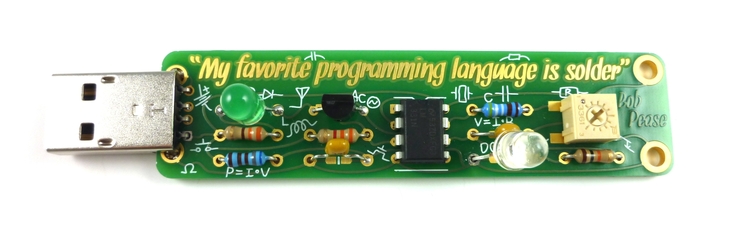
“My Favorite Programming Language is Solder” — Boldport Kits
Look closely at the inscription on that USB stick. Obviously I sympathize. The folks at Boldport have some very interesting ideas and projects. And they operate from a very cool location, just south of the river Thames, not far from my old home in London.
Here is their main site: http://www.boldport.com/blog/2016/2/21/boldport-club-project-1
Here is where you can subscribe to receive a monthly project (with parts!) from them:
https://boldport.cratejoy.com/
As for the solder quote from Bob Pease, this was discussed before on this blog, back in 2011. We were talking about an intereview that had been done with Alan Wolke W2AEW:
I also liked Alan’s response to the question about his favorite software tool: “Gee, solder is soft, can we consider that software? I use a lot of that!” This is very reminiscent of a quote from the legendary Bob Pease (colleague of Jim Williams): “My favorite programming language is solder.” (That quote was sent to me by Steve WA0PWK. Thanks Steve.)
Alan Wolke W2AEW Builds a Michigan Mighty Mite (Video)
We are honored to induct Alan Wolke W2AEW into the Colorburst Liberation Army. And for his valiant effort to build and explain a MMM Low-Pass filter, he is immediately promoted to the rank of CBLA Two Star General. Congratulations General Wolke.
As is the case with all of his videos, this one has already had an impact far and wide. Ian writes from far-off Western Australia:
It made me appreciate the benefits of an LPF more fully. It’s always been clear to me that the harmonics would get rolled off, but in my head I hadn’t made the connection between that and the improvement to the beautiful smooth sine wave that we are working towards.
Anyway, I thought you, and your mate Steve “Snort Rosin” Smith may be interested.
73,
Ian VK6MIBSeriously, there is a lot to be learned from the lowly Mighty Mite especially regarding impedance matching; not to mention LC circuits, link coupling, amplifiers, oscillators, etc. . What fun!
73…….SR
Alan Wolke W2AEW Moonbounce with Project Diana
Alan mentioned this in his interview with Eric on the QSO Today podcast. I really liked Alan’s video of the Project Diana moonbounce commemoration. That HUGE display showing outgoing signals and then the echoes off the moon was really cool. EME is on my to-do (someday) list.
Alan Wolke W2AEW Interviewed on QSO Today! And it is GREAT!

Alan W2AEW Hears me on 40 AM with his Drake 2B
Alan W2AEW
Alan Wolke in the Dinosaur Den (Video)
Very cool. But it makes me sad that my Tek 465 broke (and I can’t fix it!).
Alan Re-Caps His Drake 2-B
That Drake 2-B is a beautiful thing. Every time I look at an older tube rig I’m reminded of the three dimensionality of these old machines. Solid-state rigs are in Flatland, but tube rigs are in three dimensions.
Alan makes a very cool use of the I-pad in this repair. And I’m jealous of his Hayseed Hamfest Electrolytic (I opted for the multiple caps hanging below the chassis). Excellent management of the solder-sucker by Alan. And I was impressed by the disciplined way he pulls solder from the reel — he has the reel right next tot he rig and dispenses it directly. I tend to hack off small lengths of solder and end up with lots of little bits of solder on the bench.
Glad to hear that the other caps on the Drake are standing the test of time. I wish the same could be said for all the caps in my Heath HW-101.
One thing caught my eye in Alan’s video: The dial cord. You know you have become a true 2-B aficionado when you have actually gotten good at replacing the dial cord. It is something of a rite of passage. Perhaps this will serve as the basis for a future video by W2AEW,
Thanks Alan! And congrats on passing 4 MILLION YouTube views. People watch because your videos are so good.
Our book: “SolderSmoke — Global Adventures in Wireless Electronics” http://soldersmoke.com/book.htm Our coffee mugs, T-Shirts, bumper stickers: http://www.cafepress.com/SolderSmoke Our Book Store: http://astore.amazon.com/contracross-20
Alan Wolke’s Drake 2-B (video)
Alan’s video inspired me to do a little work with my Drake 2-B. Nothing major — I was just making sure that the passband knob is in the right setting. I’ve complained that the Drake 2-B doesn’t sound great on AM. I recently noticed that my BITX40 DIGI-TIA sounds surprisingly good with AM signals — I just treat them as SSB signals and zero-beat the carrier with my Si5351 VFO. I wanted to try doing the same thing with the 2-B, and then make some comparisons. I only heard a few AM signals this morning, so I will try again later today and will report results here.
Our book: “SolderSmoke — Global Adventures in Wireless Electronics” http://soldersmoke.com/book.htm Our coffee mugs, T-Shirts, bumper stickers: http://www.cafepress.com/SolderSmoke Our Book Store: http://astore.amazon.com/contracross-20
Alan Wolke Looks at Diode Ring Mixers
Alan: Thanks. Great stuff. Yea, I’ve been looking at the innards of mixers for a long time. In my book, I try to explain how I have come to understand the physics of the mixing action — how the use of a non-linear element causes two signals to “multiply” and how this “multiplication” results in sum and difference frequencies. I tried to go beyond the trig functions because for me the trig didn’t really explain anything.
Our book: “SolderSmoke — Global Adventures in Wireless Electronics” http://soldersmoke.com/book.htm Our coffee mugs, T-Shirts, bumper stickers: http://www.cafepress.com/SolderSmoke Our Book Store: http://astore.amazon.com/contracross-20
Alan Wolke Explains Varactor Diodes
As always, a very illuminating presentation by Alan. I wish my oscillators were that stable!
And I couldn’t help thinking how much simpler this circuit is in comparison to the DDS devices we’ve been talking about.
Alan Wolke’s GREAT Video on Transmission Line Termination
An outSTANDING Wave video from Alan! Check out the comments from new hams on the YouTube page: Alan has a real knack (!) for explaining technical material, and for imparting real understanding.
Our book: “SolderSmoke — Global Adventures in Wireless Electronics” http://soldersmoke.com/book.htm Our coffee mugs, T-Shirts, bumper stickers: http://www.cafepress.com/SolderSmoke Our Book Store: http://astore.amazon.com/contracross-20
BITX (and W2AEW) on Hack-A-Day

The guys over on Hack-A-Day ran a little follow-up article on the BITX-17. Check it out:
http://hackaday.com/2013/11/13/bitx-a-return-to-hackers-paradise/#comments
They also had an article about Tek-Wizard Alan Wolke earlier in the week:
http://hackaday.com/2013/11/11/diagnose-and-repair-a-yaesu-ft-7800-ham-radio/
Our book: “SolderSmoke — Global Adventures in Wireless Electronics” http://soldersmoke.com/book.htm Our coffee mugs, T-Shirts, bumper stickers: http://www.cafepress.com/SolderSmoke Our Book Store: http://astore.amazon.com/contracross-20
SolderSmoke Podcast #155 BITX17, TEK465
Podcast # 155 is available for download (or you can listen by clicking on the button above):
http://soldersmoke.com/soldersmoke155.mp3
October 14, 2013 (Delayed Back-to-School edition)
Topics covered:
— BITX Beauty — Building a BITX17
— VFO woes, and the wisdom of Doug DeMaw’s love for crystals
— Why does a 55 year old man NEED clear nail polish varnish?
— How the VFO KILLED the Tek 465
— Trying to fix the Tek 465 (not for the faint of heart)
— New products: Justin Beiber Duct Tape, bifocal safety glasses,
magnetic reading glasses, Ward Silver’s new book
— Backwards British Bike Brakes
— MAILBAG
Our book: “SolderSmoke — Global Adventures in Wireless Electronics” http://soldersmoke.com/book.htm Our coffee mugs, T-Shirts, bumper stickers: http://www.cafepress.com/SolderSmoke Our Book Store: http://astore.amazon.com/contracross-20
Tek Troubleshooting Triumph
Our book: “SolderSmoke — Global Adventures in Wireless Electronics” http://soldersmoke.com/book.htm Our coffee mugs, T-Shirts, bumper stickers: http://www.cafepress.com/SolderSmoke Our Book Store: http://astore.amazon.com/contracross-20