For more information on how you too can build the receiver:
Join the discussion – SolderSmoke Discord Server:
Documentation on Hackaday:
https://hackaday.io/project/
SolderSmoke YouTube channel:
SolderSmoke Daily News — Ham Radio Blog
Serving the worldwide community of radio-electronic homebrewers. Providing blog support to the SolderSmoke podcast: http://soldersmoke.com
For more information on how you too can build the receiver:
Join the discussion – SolderSmoke Discord Server:
Documentation on Hackaday:
https://hackaday.io/project/
SolderSmoke YouTube channel:
For more information on how you too can build the receiver:
Join the discussion – SolderSmoke Discord Server:
Documentation on Hackaday:
https://hackaday.io/project/
SolderSmoke YouTube channel:
— Behind the MXM there is a nice box marked “Diode Detector” I opened it up and there is just a solid state diode and a 50 ohm resistor to ground. Box may be useful.
— I got a couple of books: “Weekend Projects” 1979 from ARRL, and “A History of QST — Volume 1 Amateur Radio Technology 1915 – 2013” 2013 from ARRL.
— On top of the Weekend Projects book you see a “Crystal Holder” from Gross Radio of New York City. W1UJR has some good history on this company: https://w1ujr.com/written-word/gross-radio-company-circa-1931/ This device seem to be intended to hold in place a raw piece of quartz! Cool.
— To the right of the books there is a serious-looking VFO. One dollar! Deal! It is a CB VFO, but the markings say it puts out 5.44 to 5.99 MHz. So it should be useful. The dual speed dial is very nice.
— Above the VFO is a nice step attenuator from the “Arrow Antenna” company of Loveland Colorado.
— Further to the right are some Electric Radio and Antique Wireless Association magazines that Armand WA1UQO gave me. Really nice. The AWA mags have a very thoughtful piece (warts and all) on Jean Shepherd. And the ER pile has an article by Scott WA9WFA that mentions my work on the Mate for the Mighty Midget receiver. Thanks again Armand!
— I also got some ADE6+ surface mount mixers. The price was right!
Thanks to VWS for putting on this great hamfest!
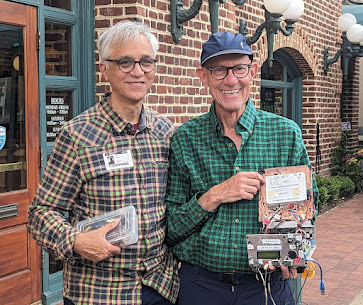
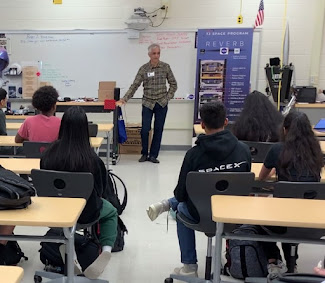
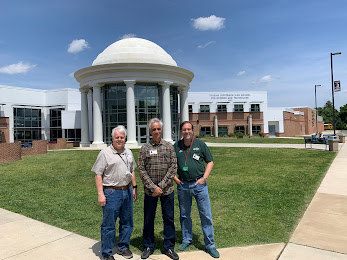
Farhan VU2ESE was in Northern Virginia this week, on his way to the Four Days in May Event at the Dayton Hamvention. We had a great visit with Farhan. We took him out to the Thomas Jefferson High School for Science and Technology where he shared with the students tribal wisdom about building CubeSats and about building simple direct conversion receivers. Farhan’s use of direct conversion receivers to teach homebrewing to students in Hyderabad inspired our efforts in Northern Virginia. We often referred to Farhan when speaking to the students here, so it was really great to give them a chance to talk to him directly.
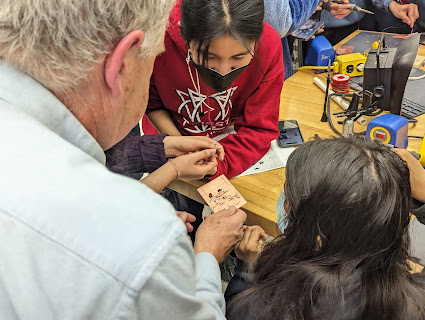
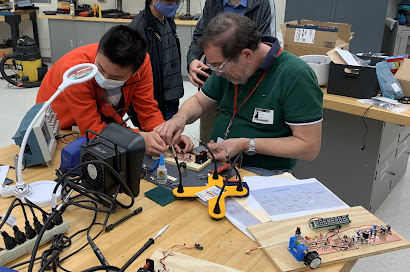
Dean KK4DAS and I were at the high school on Thursday and Friday of this week for the construction (by the students) of the variable frequency oscillator stage of their analog, discrete, direct-conversion receivers for 40 meters. Most of the students have already obtained their Technician Class licenses, so they are already radio amateurs. Both the licensing classes and the receiver build are being done with the assistance of the Vienna Wireless Society.
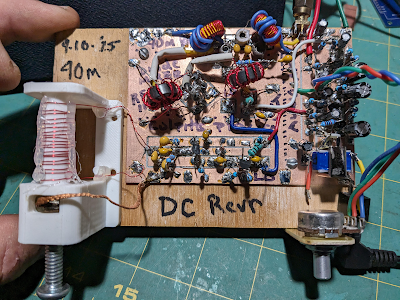
A week earlier Dean and I had demonstrated how to build the oscillator stage using the Manhattan technique (isolation pads super-glued to copper clad boards), but this week was the first time these students were actually building anything like this themselves.
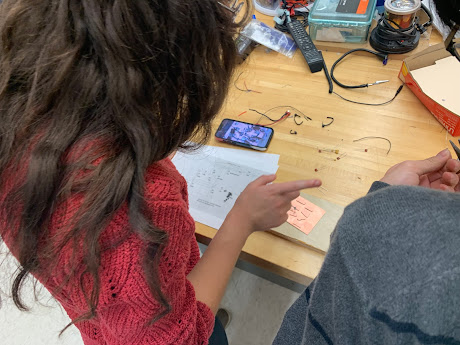
We deliberately did not “spoon feed” the students. We told them that while we would be on-hand to help, THEY would have to do the building. They would have to layout the pads on the PC board, select the parts (from a table set up by Dean), and do the gluing and soldering. We did not hand the students bags of parts, or prepared PC boards. This was not going to be a kit building session. We wanted this to be real homebrewing.
We had parts for 15 receivers. But on the first day there were more than 60 students. So four students per project. On the first day we actually ran out of soldering stations.
We cautioned the students against dawdling. We told them to get on with it, and to “make haste slowly.” We also injected an element of competition into the build by announcing that the first team to achieve oscillation would win. (Prize still TBD).
By the end of the Thursday session, many boards had been built but there were not yet any oscillations. We reconvened on Friday afternoon — Dean and I set up support/troubleshooting stations.
Right off the bat, one of the students came up with a board that he wanted to test. After one quick correction (enamel still on the oscillator coil leads), my frequency counter showed that it was oscillating. I fired up my DX-390 receiver and we heard the loud tone. We had a winner!
In the following hour or so, Dean and I did troubleshooting on about 10 more boards. We found some of the problems that we would all expect (because we have all made these mistakes ourselves!):
— There were cold soldering joints. We showed the students how to properly solder — usually they just had to re-heat some cold-looking connections.
— A few of the Zener diodes and transistors were wired in backwards (been there, done that).
— A few of the feedback capacitors were of the wrong values. Dean and I had brought some good caps, so the students were able to quickly swap out the parts. This was another good lesson.
— There were a few wiring errors — these were quickly corrected.
It was exciting. One-by-one we would hear the whoop-whoop as the DX-390 confirmed that another oscillator was OSCILLATING! The students really liked to HEAR the oscillations that they had created. We reminded them at the beginning that they would be taking DC from a little square 9 volt battery and turning it into RF that could (if connected to an antenna) be heard around the world, or in our case be used to receive signals from around the world.
We got eight of the oscillators going. We think the students will be able — without much help from us — to get the remaining seven oscillators going.
They learned a lot. They learned about the ease, flexibility, and usefulness of the Manhattan technique, and we think they could see how this represents a basic kind of PC board design. Their soldering skills improved a lot. And they learned how to troubleshoot: Is the layout correct? Are any parts wired in backwards. Is the soldering OK? Are any of the parts bad (or of incorrect values)? Most importantly, they learned that they CAN build circuits themselves, and actually get them working.
The real payoff came each time oscillation was achieved. The students were really amazed and pleased. I could tell that some of them weren’t really sure their little device was actually creating the signal they were hearing. So while we listened to the DX-390, I asked them to disconnect and reconnect the battery. Confirmed. Oscillation! Smiles. It was really great.
Soon, after finishing up some PTO odds and ends, we will move on to the other stages. We’ll probably do the bandpass filter or the mixer next. Then the AF amp. Then put it all together into a full receiver. We think each stage will get easier and easier to build as the students learn and improve their homebrewing skills and their self-confidence.
February 10, 2023
SolderSmoke Podcast #224 is available.
http://soldersmoke.com/soldersmoke243.mp3
Video here: (32) SolderSmoke Podcast 243 (video) Hi7/N2CQR, uBITX, Success with High School Receiver Project – YouTube
Pete N6QW had technical difficulties this morning. He insisted that the show must go on. Pete will be back for the next episode.
Travelogue:
Bill in the Dominican Republic for all of January.
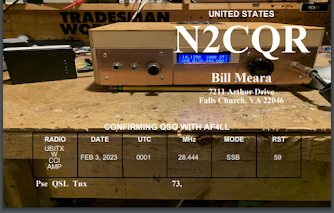
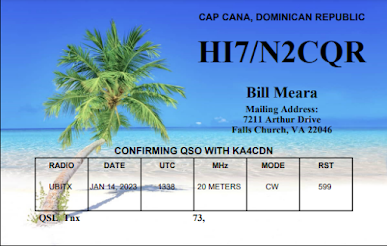
HI7/N2CQR Eastern tip of the island. uBITX and dipoles.
20, 17, 10. CW and SSB. SSB was tough and I had reports of RF getting into the signal.
Went to CW.
Worked VWS Mike KA4CDN, and Walter KA4KXX on 20CW.
Finally moved up to 10 CW. Lots of contacts. Even though uBITX very QRP on ten.
I am modifying the uBITX now.
Copper tape shielding to keep RF out.
Low power out not the fault of the IRF-510s. The problem is the 2N3904s.
Will replace with 2N2222 in To-18 cans.
Dean KK4DAS putting KD8CEC software into Arduino. I gave up.
Who sent me this orphan uBITX?
SolderSmoke Shack South in final phase of construction.
SHAMELESS COMMERCE DIVISION:
Patreon!
Bezos Shopping!
DC Receiver Project
Local High School radio club.
Simple: Like Herring Aid 5 and Wes’s original.
Farhan’s four stages:
BP Filter, Diode Ring, PTO, AF amp.
Simple Colpitts PTO SURPRISINGLY STABLE.
Simple and easy. No chips. No complicated circuits.
Guys have helped test out the design: Rick N3FJZ, Walter KA4KXX,
Daniel VE5DLD, Stephen VK2BLQ and others.
First session last night: We demonstrated build of the PTOs.
They worked (thank God).
Open Circuits book.
Envelope Detection Controversy
Save the Antenna – Book “Losing the Nobel Prize” K1JT
MAILBAG
–Dean KK4DAS 10 meter DSB! Tiny SA ULTRA! FB
–John AC2RL on Elmer W3PHL DSB guy
–AC3K reports inventor of Fender Stratocaster guitar was a ham: W6DOE
–AF8E was doing POTA. I worked him. He said my rig had presence. FB
–Alain F4IET FB DSB rig with mic in Cigar can!
–Daryl N0DP worked him on SSB. He is homebrewing
–Steve N8NM was in for repairs but is on the mend.
–Rick G6AKG working with sub-harmonic mixers and logic chips
–Paul HS0ZLQ Built DC receiver but looking for something else to build. No DSB!
–Steve AB4I – Coherer, Jagadish Chandra Bose, and Marconi
–Eldon KC5U Worked VK5QD right after me and mentioned SolderSmoke FB
–Todd K7TFC is building the DC RX.
–Tony G4WIF and Ian G3ROO using automotive relays for antenna switching. FB.
–Dave WA1LBP Great to hear from my fellow Hambassador (Okinawa)
Older post comments:
–Scott VO1DR was also in CF Rockey’s class! (Blog comment)
–Aurora Aug 4, 1972: Twelve people shared memories. (Blog comment)
–Will WN1SLG Googled novice call and was led to my Novice log.(Blog comment)
Jack Welch AI4SV has been an important member of the SolderSmoke community for many years. I remember fondly our Straight Key Night CW contact in which he told me that my HT-37 had “presence” even on CW. His thoughtful (!) piece on time crystals was also quite memorable. Jack has finally settled down (a bit) after a string of foreign assignments. He has landed happily in France, in a villa, on a vineyard, surrounded by wild boar and hunters. FB OM.
Hi Bill & Pete,
I’ve packed up the shack and moved from Cyprus to France, so no more 5B4APL. To obtain a French callsign, you have to submit proof that you’ve lived in France for three months, so I’m F/AI4SV until December and then we’ll see.
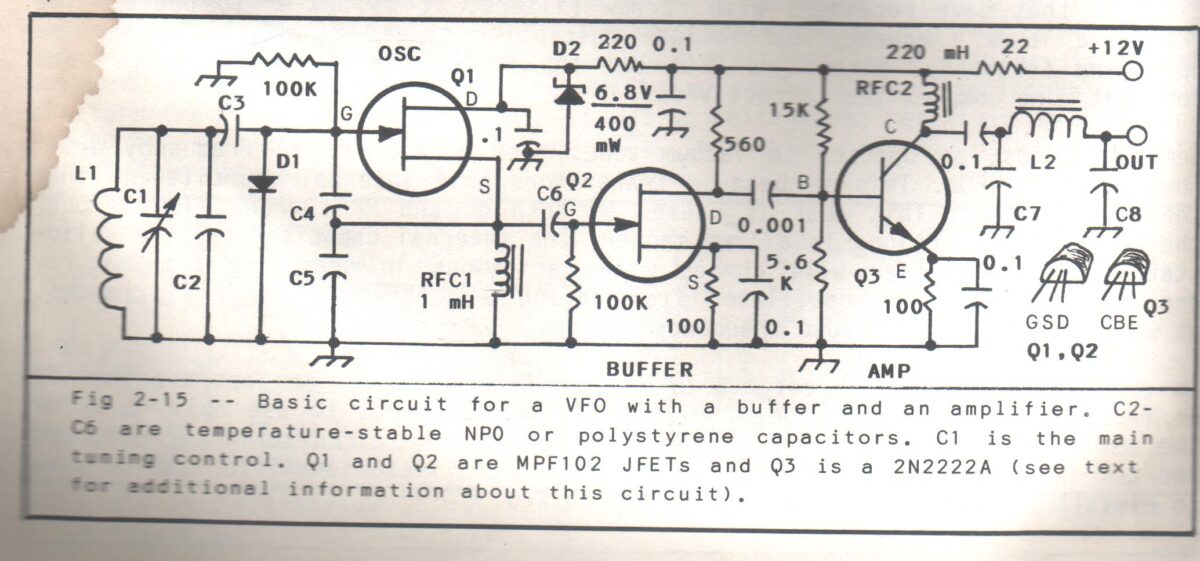
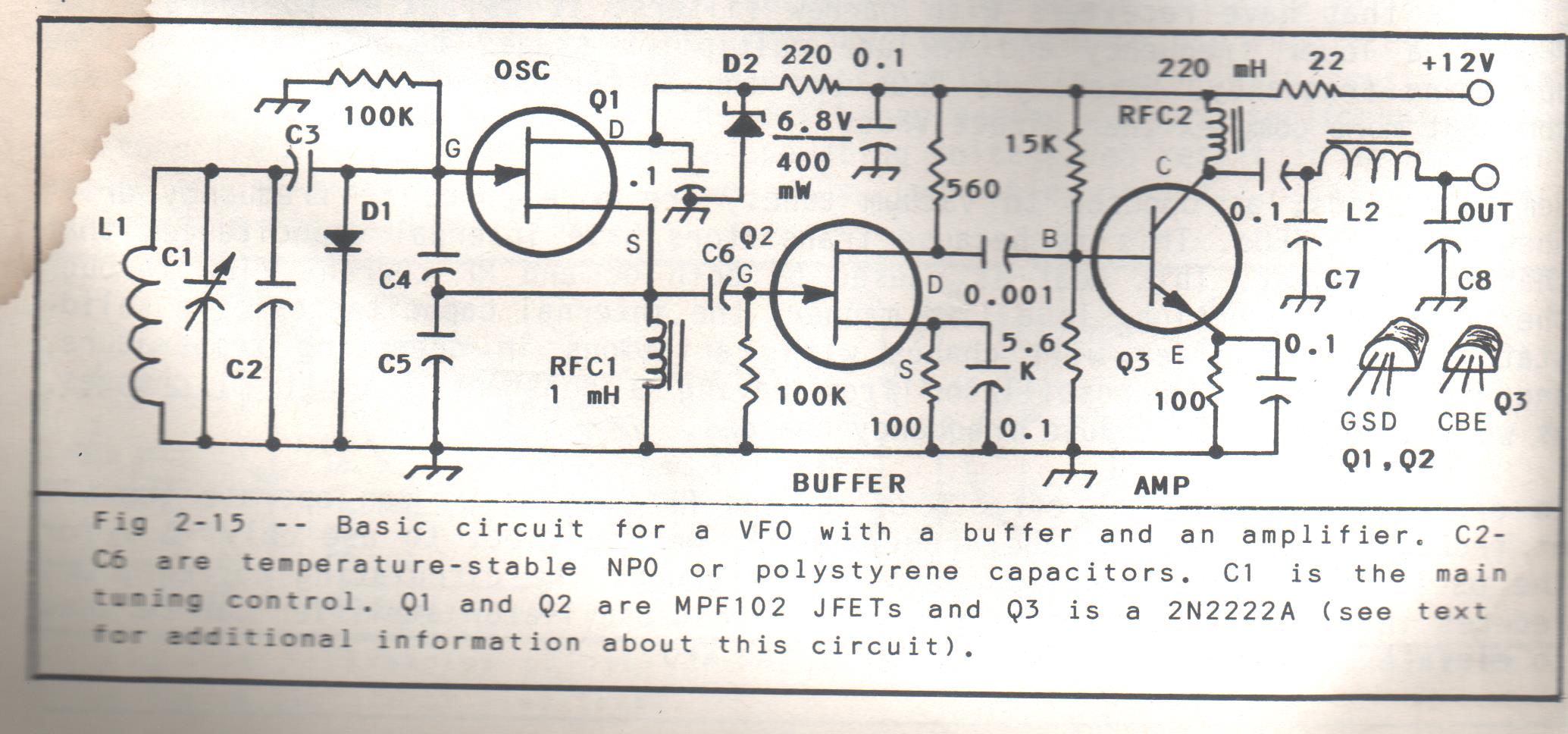
The VFO circuit comes largely from W1FB’s Design Notebook page 36. I followed most of the conventional tribal wisdom on VFOs: NP0 caps, often many of them in parallel. Air core coil (in my case wound on a cardboard coat hanger tube).