Wow, this is a really inspiring video about being inventive, overcoming obstacles, using what you find and putting junk to good use. I thought you guys would like this (ESPECIALLY ROBERTO!).
Billy alerted me to this TED Talk presentation on an MIT Media Labs project that used new “femto photography” techniques that allow us to watch — in VERY slow motion — a light beam pass through a bottle. Amazing. Makes me think about Einstein’s old thought experiment about running alongside a light wave (but of course here they are slowing down time…)
Thanks to Allan, WA9IRS, for sending us this inspiring video. Just the right touch for Thanksgiving. This kid is definitely one of us. Let’s try to think of ways to help him. Parts box? Radio books?
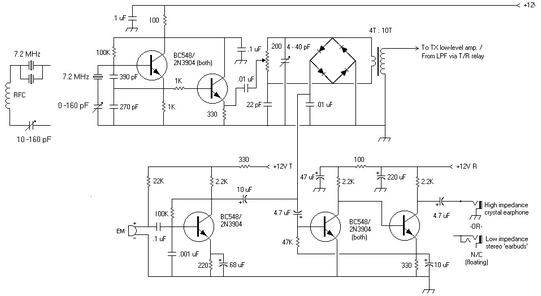
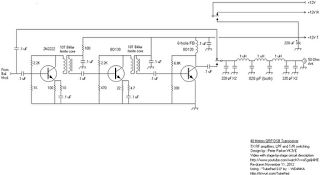
Peter Parker’s amazing 8 transistor DSB rig (featured in an equally amazing YouTube video — see earlier blog post) has sparked a worldwide resurgence of QRP minimalism. There is now a lot more activity on the “Minimalist QRP Transceivers” Yahoo group (be there or be square). Steve “Snort Rosin” Smith WB6TNL is minimalist mentoring to the max — with his help it looks like more VK3YE transceivers will soon be on the air. Steve was kind enough to take the info from Peter’s video and turn it into a .pdf schematic (see above). It is in the file section at the Minimalist QRP Transceivers group. I was, of course, pleased to see the inclusion of a robust 7 element low pass filter. Michigan Mighty Mites are also tickling the ether. I may pull out my single MPF-102 Yingling 80 meter rig. You can join the Minimalist group here: http://groups.yahoo.com/group/Minimalist_QRP_Transceivers/
I don’t think they will be that interested in my $50 Tasco 4.5 inch reflector, but I am thinking about sending in a proposal for a 1.2 million dollar series of upgrades for the old ‘scope!
The stop-action film Frankenweenie is hitting the theaters here. Its mad scientist/workshop theme seems to have some Knack relevance. This morning I found this five minute film called “The Maker.” I thought you guys would like it. I also liked the video (below) about some of the homebrew gear that they used to make The Maker.
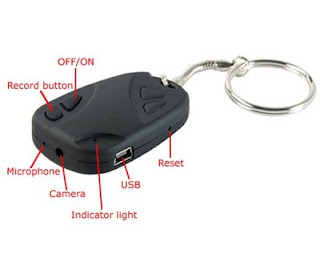
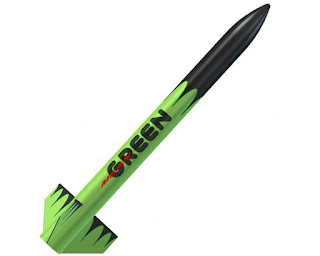
Our plan is to strap a key-chain video camera to the center of gravity on this mean green machine. Using Duct Tape (of course). Kind of like this guy did:
John N. Shive rocks the universe with his 1959 wave machine. We saw this device some time ago in a video in which Dr. Shive explained standing waves. Thanks to Armand WA1UQO for alerting us to this gem.
Ah, those were the days! The bands were in good shape and hams built their own gear. Don’t let the language barrier deter you — this German language video is really a lot of fun and worth watching. It provides a nice look at the hobby as it was 60 years ago. Thanks to Stephen and Michael for alerting me to this.
Bunnie Huang has The Knack. This was confirmed when, with obvious delight, he said that he’d found in China a book of schematic diagrams of a wide variety of laptops. He then studied said schematics and endeavored to understand the role played by one transistor in the LED display of one of the computers. KNACK CONFIRMED! Somebody get Bunnie a ham license! Cool video.
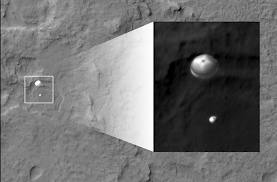
Maybe it’s because I’ve done some parachuting myself… I was really blown away by this picture. Taken by the Mars Orbiter as Curiosity descended. And here is the initial low-res video from the rover itself. Very cool.
Podcast listeners will recall that George, KJ6VU, of Sierra Radio Systems, was a sponsor of SolderSmoke. When I was running George’s announcements, I felt kind of bad about the fact that I really didn’t have a good feel for the product, or how I might use it. I’ve also felt guilty about the fact that I haven’t yet put to use the HamStack starter kit that George sent me.
I feel that the time is coming for me to redeem myself. The radio gods are pushing me in the direction of microcontrollers:
1) Billy is getting into them.
2) This weekend, for no apparent reason, I started working on my old N3ZI Digital Dial (a gift from Jerry, NR5A). It is built around a microprocessor.
3) I need a new frequency generator.
4) I came across George’s video (above)
In the video, George does a great job of explaining how microcontrollers can be used in ham radio. In answering the last question from the audience, he explains the differences between microcontrollers and the new Raspberry Pi boards.
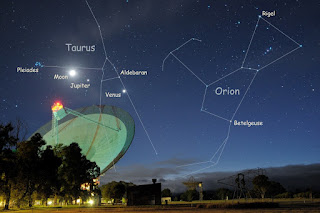
July 20/21 seemed like a good day to point to the beautiful shot of the Parkes Radio Telescope Dish, the magnificent Australian antenna that brought us the video from the Apollo 11 moon walk. Like many of you, I was watching. Three cheers for The Dish! Three cheers for Apollo 11!
Billy’s Arduino Uno board arrived yesterday and he has been working on getting the LED to blink. (We bought the board with funds generated by people who have been entering Amazon through the SolderSmoke blog site — thanks.) We really like the little Italian board. On it you will find a map of Italy, including Sardinia and Sicily. And there is a notation on the board noting that its production was carbon neutral. Bravi!
The video above shows one of the cooler applications of the Arduino board.
I liked Banzi’s presentation and I think you guys will like it too. Arduino and the open source movement seems to have something in common with of the old ham radio tradition of helping fellow amateurs. Bravo Massimo!