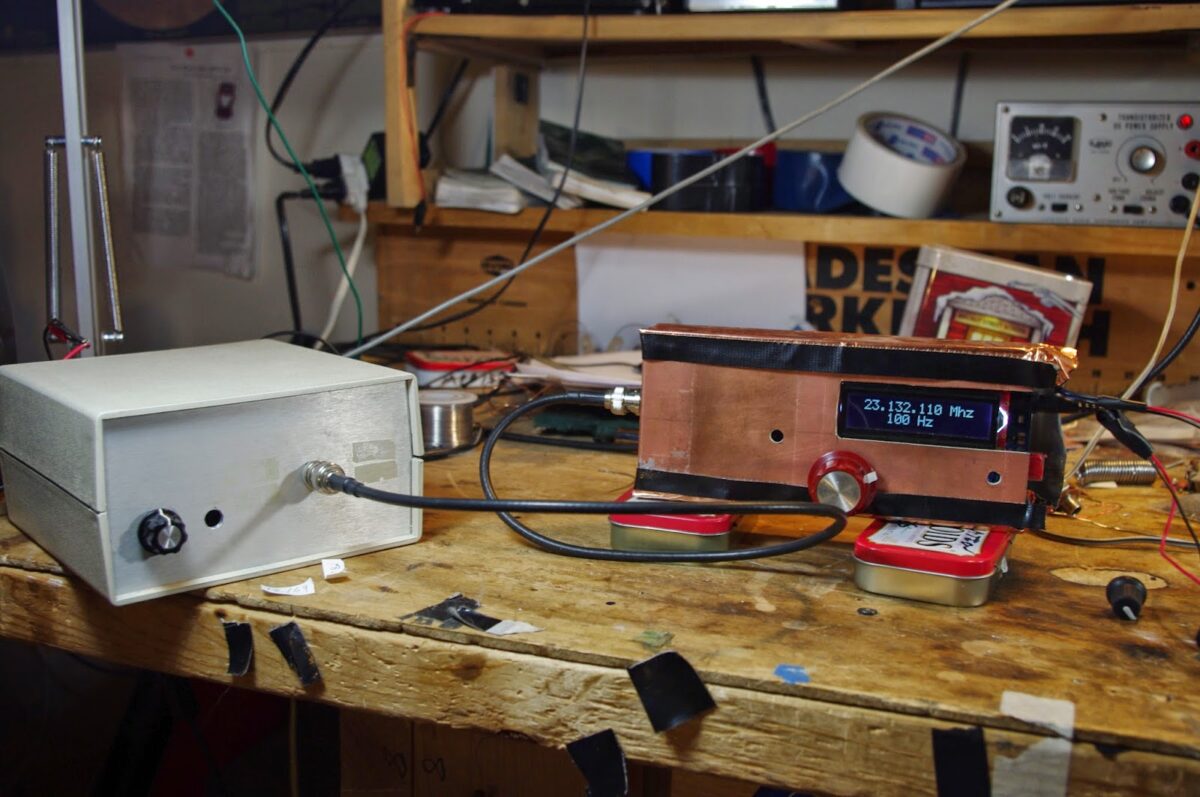
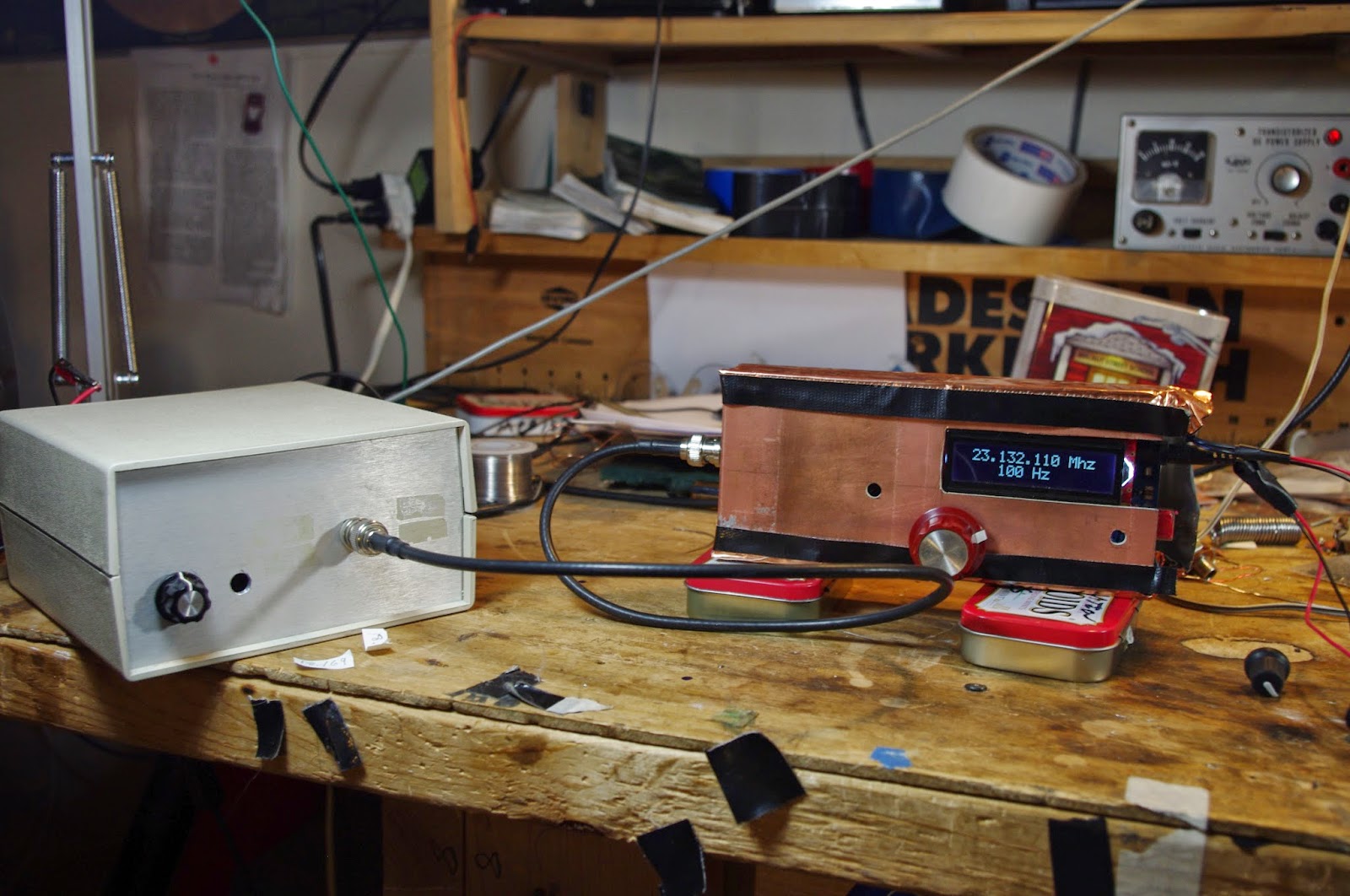
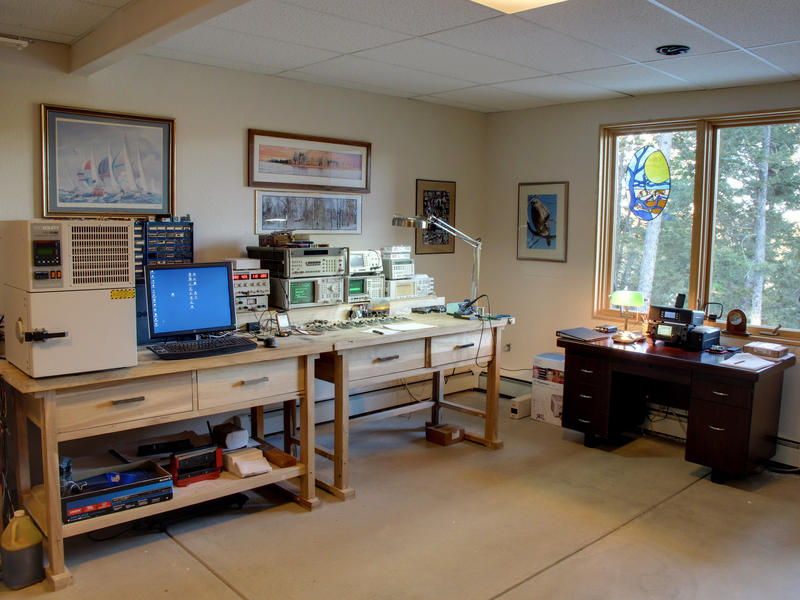
These little frequency counters from China have a lot of potential. And they add a dash of digital color to an otherwise bland analog hamshack. I got mine on e-bay. My BITX17 has now been “accessorized” with 1) A rotatable Moxon antenna (big improvment!) 2) A 120 watt Communications Concepts Linear amplifier (another big improvement) and 3) This digital frequency readout. What next?
I am fairly certain that Pete Juliano will take pride in N2HTT’s success on this project, and will attempt to attribute it, in part, to the Italian ancestry that they share. The Tarantella background music will definitely encourage that kind of thinking. In presenting this nice video, we continue with our “rigs not yet in a box” theme. There is something especially nice about the sound of receivers that are not yet boxed up. Mike has some great information on the construction of this receiver (and other projects) on his blog: http://n2htt.net/
I love this video. Colin finished his BITX a week or so ago and has been waiting for an opportunity to test it. Over the weekend he braved the winter of Northern England and, with his son, set up his new rig out in his snow-covered garden. Appropriately for a first contact with scratch-built rig, the circuitry was unencumbered by any kind of case or box. That’s the way it should be done! Well done Colin! You are well and truly a member of the International Brotherhood of Electronic Wizards, and the diagnosis of “The Knack” has been confirmed (a severe case, it appears).
Hi Pete and Bill,
It’s been a lovely fine day here in West Yorkshire, so I took a table out into the garden and set up my BITX circuit on it. I set up my SOTA dipole on a 9m fishing pole.
I heard a strong German station calling CQ, so I gave him a call and hoped for the best!
How amazing to contact someone in another country using a rig and mic you’ve made yourself! Do I qualify as a REAL radio ham now? Do I have a confirmed case of the knack? 🙂
Although I may appear underwhelmed in the video, (besides the air punches!), I did really get a kick out of the QSO.
73 and huge thanks to both of you for the encouragement and support.
To: “soldersmoke@yahoo.com” Sent: Thursday, January 22, 2015 9:22 AM Subject: Cheap, open source Arduino SDR project
Bill
First, thanks for Soldersmoke and all you do for us QRP hackers around the world. I’m a big fan!
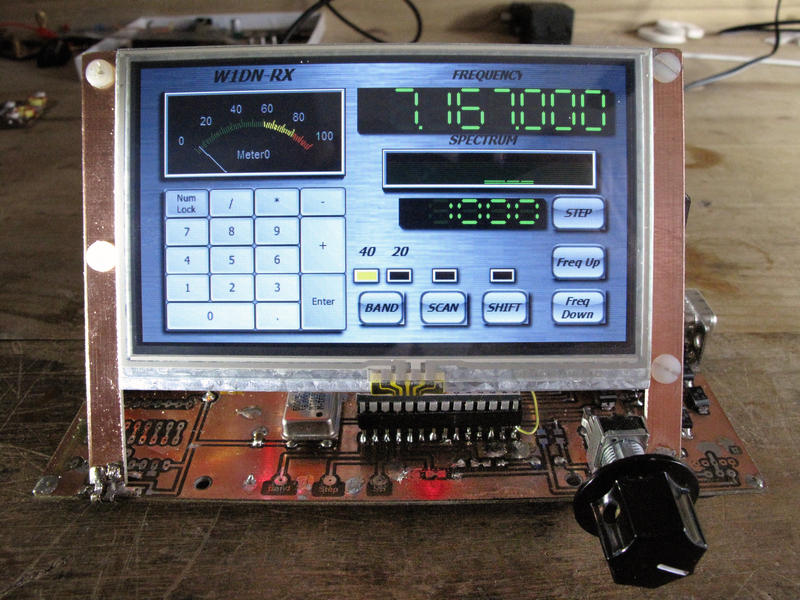
I’ve detected you are getting sucked into the world of microcontrollers of late. I know you are not really that excited about SDR but this is a radio that combines Arduino, the currently popular SI5351 and a Softrock to make a very functional SDR. I started this project last year which uses the fabulous Teensy 3.1 and companion audio shield. I recently packaged it all up and it looks like a QRP radio now. Still doesn’t transmit but as I like to say thats “just a small matter of software”.
There are several posts about it on my blog. The most recent:
Subject: Re: Cheap, open source Arduino SDR project
Wow Rich that is really beautiful. Amazing! I am also sending this to Pete Juliano, but I was at first hesitant about this because I feared that your combination of Si5351 and TFT display might be TOO exciting for him. Deep breaths Pete…
73 and Thanks, Bill
From: jessystems@verizon.net To: soldersmoke@yahoo.com; Subject: Re: Cheap, open source Arduino SDR project Date: Fri, 23 Jan 2015 06:03:40 -0800
Hi Rich & Bill,
Wow –really exciting project Rich! Congratulations and Bravo!
This is so exciting, for all hams, as this just shows the power of the available low cost technology that is now on the market. Your project is really tempting as I have a V6.2 15M softrock sitting in a box (somewhere). I was somewhat put off with the Power SDR as the opposite sideband rejection is not too good –it is clear you have cracked that nut.
Thanks for sharing Rich and yes Bill I am taking very deep breaths.
73’s
Pete N6QW
Jan 23 at 9:27 AM
Pete Juliano
me
Thanks guys! When I saw the Teensy 3.1 with the companion audio codec board the first thing that came to mind was a portable SDR. Since its Arduino compatible I am able to leverage the SI5351 library, encoder library etc so its mostly just putting software blocks together. The digital filter design is a bit tricky but Loftur VE2LJX did quite a bit of work on that and now it works really well.
I hope to add CW decoding and PSK31 at some point. I’ve used less than half the flash on the Teensy so lots of room for new features. I’m hoping if the word gets out I won’t have to do this all myself!
Pete – too bad you missed the Black Friday sale – Teensy 3.1 and the audio shield for $18. Deep breaths…
I did this for Pete. And I did it to start out the new year with something different. And because I needed the crystal for my beloved BITX and didn’t want to buy more crystals. After successfully broadening the filter in my Barebones Barbados Superhet (originally built by Dale Parfiit W4OP) I decided to replace the VXO with an outboard Arduino/DDS device. Nothing new in that (I was playing with this back in October), but in what I think is a symbolically significant twist, I pulled out the tuning cap for the VXO and, in the hole left by the tuning control, replaced the knob with a BNC connector. That connector now carries DDS signals into the receiver. The crystal was at around 23.125 MHz — that’s why the LCD display is showing 23 MHz. It works great. I was listening to the DX station in Iran this morning. Here is a video of the October 2014 experiments:
After watching all Pete’s work with the smaller Arduinos, that Uno R3 board seems HUGE. That’s what I should stick with. Great idea using those robust terminal strips. Thanks Pete.
Back in March 2013 we ran a blog post linking to a video of a beautiful superhet receiver built by Lee Snook, W1DN (that’s his shop). Then the video disappeared. Today Peter Parker, VK3YE, alerted us to the reappearance of the video. Some Googling led me to Lee’s YouTube channel and many other videos of some truly amazing homebrew projects. Here is his YouTube Channel: https://www.youtube.com/user/swradios/featured And here are all his videos: https://www.youtube.com/user/swradios/videos
Congrats to Pete for his amazingly fast development of a 40 meter superhet receiver using a single Adafruit Si5351 paired with an Arduino Nano for ALL of the frequency generation. No more VFOs, no more crystals. It sounds great! Amazing stuff.
Who needs LM386 ICs? Pete goes discrete! Love the MePads. And I knew Pete was going to test it with his finger! He’s just taking stray hum from the power lines and coupling it to the input through that Exacto knife. Seems to me like these boards is getting close to actually receiving signals.
Another beautiful piece of cinema from Giovanni Manzoni’s Newbury Park Studios. Bravo Giovanni! Pete is obviously a doubly balanced kind of guy. I liked his use of the W1REX MePads and the breadboard. Also, the balance pot and the un-balance switch are very handy innovations. Most of all I like the way Pete’s video takes you from schematic to actual circuit. Thanks Pete!
I got the Communications Concepts Inc. EB-63A amplifier working today. Yea! Kind of ironic that the highest power amp I have ever built gave me the LEAST trouble. This just goes to show that circuit layout is very important. This amp is a proven design, with a proven layout and board. That’s why it didn’t turn into a 140 watt solid state oscillator!
Sometimes it is good to take a break from the electronics and look at how people are making other things. I’ve been working on the heat sink for a 140 watt solid state amplifier, so this fellow’s comments about working with metal kind of resonated with me.
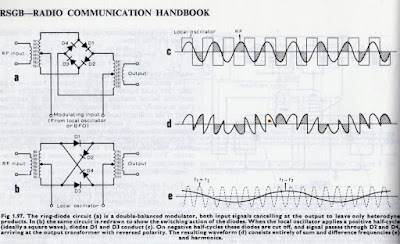
Another great video from the famed Italian Director Giovanni Manzoni! Bravo Giovanni! Pete’s discussion of double balanced mixers and the associated toroids has made me feel uneasy about my efforts in this area. I wonder if my diodes were completely matched. And I KNOW that my toroids are not as well done as Pete’s. I recently put an SBL-1 into my old, long-evolving 20 meter ceramic resonator DSB rig. Careful with those nice little boxes! A bit too much juice and you can fry the little internal toroids (as I have done!). A while back I found in an RSGB Handbook a nice diagram showing how the diode ring mixer does its thing:
Bil Herd of Hackaday did a very nice video on Sine Waves, Square Waves and FFTs. This is, of course, an important part of understanding how mixers mix. I look forward to his upcoming video on Direct Digital Synthesis.