OOPS! Why the AD9850 DDS Boards are So Inexpensive

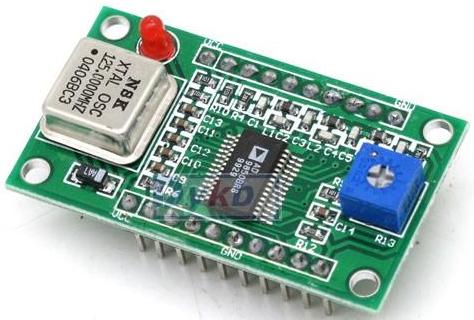
N3ZI has a very plausible explanation for the low price (about 9 bucks!):

My guess is that this is a liquidation due to a design build error, since they are being sold for a price of about 1/2 the price of the DDS chip alone. The modules are assembled and tested. The design error I noticed is that the wrong output filter is used. These boards use the 9850 running at 125MHz. A 125MHz DDS should have a 50MHz LPF, but it seems that these modules have the 75MHz LPF the chip maker recommends for the AD9851 running at 180MHz. My guess is, someone just copied the wrong filter from the wrong data sheet, and it wasn’t caught until they went into production.
But for amateur radio applications they work fine up to about 40MHz. You can push them to 50MHz by adding a correcting filter, which is included in my controller PCB, but the output level is low in the 40-50MHz range.

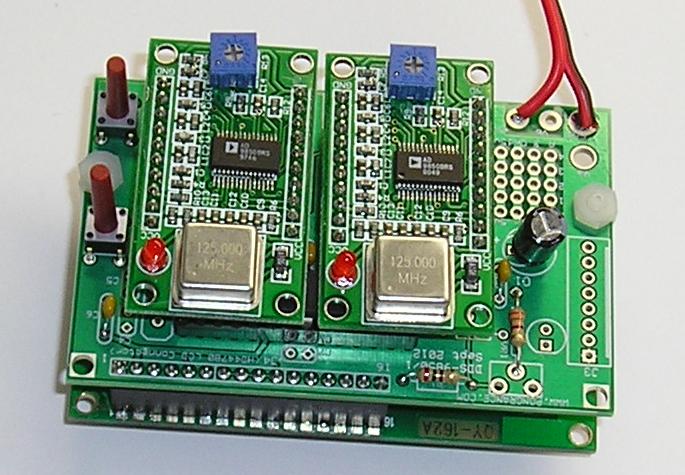
N3ZI continues to offer some really interesting microcontroller products. He has a controller board that allows you to simultaneously control TWO AD9850 boards. This might be exactly what we need when we have a separate receiver and transmitter with different intermediate frequencies: Set up one board with the VFO freq for the receiver and the other for the transmitter with the resulting operating freq displayed on the LCD. Viola! No more “Spot” or “net” and zero-beat by ear! (But I may be one of the last people on the planet still doing this!)

N3ZI’s site: http://www.pongrance.com/

Our book: “SolderSmoke — Global Adventures in Wireless Electronics” http://soldersmoke.com/book.htm Our coffee mugs, T-Shirts, bumper stickers: http://www.cafepress.com/SolderSmoke Our Book Store: http://astore.amazon.com/contracross-20
Save 20% on Knack Books

Save 20% on your next order by using code GLOW at checkout. Offer ends June 7 at 11:59 PM PDT
Codeword: GLOW. Very appropriate for Grayson’s Thermatron book:

http://www.lulu.com/shop/grayson-evans/hollow-state-design/paperback/product-20987562.html

And also for mine (tubes, QRP fireflies and all that):

http://www.lulu.com/spotlight/soldersmoke

Our book: “SolderSmoke — Global Adventures in Wireless Electronics” http://soldersmoke.com/book.htm Our coffee mugs, T-Shirts, bumper stickers: http://www.cafepress.com/SolderSmoke Our Book Store: http://astore.amazon.com/contracross-20
Good time to Buy Book: 20% off at Lulu

http://www.lulu.com/spotlight/soldersmoke

Use Coupon Code VERNUM through March 31 and get 20% off.

Our book: “SolderSmoke — Global Adventures in Wireless Electronics” http://soldersmoke.com/book.htm Our coffee mugs, T-Shirts, bumper stickers: http://www.cafepress.com/SolderSmoke Our Book Store: http://astore.amazon.com/contracross-20

Kludge: Rube-Goldberg Heath-Robinson Ad-Hockery

Wow! “Ad-hockery… verging on being a crock.” That sounds like my building technique! I thank Kevin for sending this, but I admit to now being more confused than ever.

Bill:

A snippet from my kluge research. This was a word I learned from my dad who told me he had heard it first used in the 1930s. Here is where I find a divergent meaning with the new word kludge which I have often heard pronounced as rhyming with sludge. I was asked why I pronounced it with the d as silent. I asked why I should pronounce a letter which was not even in the word. Thus my introduction to the new word kludge which means something very different than what I had learned from my father. While a kluge is something clever a kludge is an ad hoc and usually buggy hack.
I found a little supporting evidence for the etymological timeline. To whit:

Source: The Free On-line Dictionary of Computing (2003-OCT-10)

kluge

/klooj/, /kluhj/ (From German “klug” /kloog/ – clever
and Scottish “kludge“) 1. A Rube Goldberg (or Heath
Robinson) device, whether in hardware or software.
The spelling “kluge” (as opposed to “kludge”) was used in
connection with computers as far back as the mid-1950s and, at
that time, was used exclusively of *hardware* kluges.
2. A clever programming trick intended to solve
a particular nasty case in an expedient, if not clear, manner.
Often used to repair bugs. Often involves ad-hockery and
verges on being a crock. In fact, the TMRC Dictionary
defined “kludge” as “a crock that works”.
3. Something that works for the wrong reason.

4. (WPI) A feature that is implemented in a rude manner.
In 1947, the “New York Folklore Quarterly” reported a classic
shaggy-dog story “Murgatroyd the Kluge Maker” then current in
the Armed Forces, in which a “kluge” was a complex and
puzzling artifact with a trivial function. Other sources
report that “kluge” was common Navy slang in the WWII era for
any piece of electronics that worked well on shore but
consistently failed at sea.
However, there is reason to believe this slang use may be a
decade older. Several respondents have connected it to the
brand name of a device called a “Kluge paper feeder” dating
back at least to 1935, an adjunct to mechanical printing
presses. The Kluge feeder was designed before small, cheap
electric motors and control electronics; it relied on a
fiendishly complex assortment of cams, belts, and linkages to
both power and synchronise all its operations from one motive
driveshaft. It was accordingly tempermental, subject to
frequent breakdowns, and devilishly difficult to repair – but
oh, so clever! One traditional folk etymology of “klugen”
makes it the name of a design engineer; in fact, “Kluge” is a
surname in German, and the designer of the Kluge feeder may
well have been the man behind this myth.

TMRC and the MIT hacker culture of the early 1960s seems to
have developed in a milieu that remembered and still used some
WWII military slang (see also foobar). It seems likely that
“kluge” came to MIT via alumni of the many military
electronics projects run in Cambridge during the war (many in
MIT’s venerable Building 20, which housed TMRC until the
building was demolished in 1999).

Source: Jargon File (4.3.1, 29 Jun 2001)

kluge /klooj/ [from the German `klug’, clever; poss. related to Polish
‘klucz’ (a key, a hint, a main point)] 1. n. A Rube Goldberg (or Heath
Robinson) device, whether in hardware or software. 2. n. A clever
programming trick intended to solve a particular nasty case in an
expedient, if not clear, manner. Often used to repair bugs. Often
involves ad-hockery and verges on being a crock. 3. n. Something
that works for the wrong reason. 4. vt. To insert a kluge into a
program. “I’ve kluged this routine to get around that weird bug, but
there’s probably a better way.” 5. [WPI] n. A feature that is
implemented in a rude manner.

Nowadays this term is often encountered in the variant spelling
`kludge’. Reports from old farts are consistent that `kluge’ was the
original spelling, reported around computers as far back as the
mid-1950s and, at that time, used exclusively of _hardware_ kluges. In
1947, the “New York Folklore Quarterly” reported a classic shaggy-dog
story `Murgatroyd the Kluge Maker’ then current in the Armed Forces, in
which a `kluge’ was a complex and puzzling artifact with a trivial
function. Other sources report that `kluge’ was common Navy slang in the
WWII era for any piece of electronics that worked well on shore but
consistently failed at sea.

However, there is reason to believe this slang use may be a decade
older. Several respondents have connected it to the brand name of a
device called a “Kluge paper feeder”, an adjunct to mechanical printing
presses. Legend has it that the Kluge feeder was designed before small,
cheap electric motors and control electronics; it relied on a fiendishly
complex assortment of cams, belts, and linkages to both power and
synchronize all its operations from one motive driveshaft. It was
accordingly temperamental, subject to frequent breakdowns, and
devilishly difficult to repair — but oh, so clever! People who tell
this story also aver that `Kluge’ was the name of a design engineer.

There is in fact a Brandtjen & Kluge Inc., an old family business that
manufactures printing equipment – interestingly, their name is
pronounced /kloo’gee/! Henry Brandtjen, president of the firm, told me
(ESR, 1994) that his company was co-founded by his father and an
engineer named Kluge /kloo’gee/, who built and co-designed the original
Kluge automatic feeder in 1919. Mr. Brandtjen claims, however, that this
was a _simple_ device (with only four cams); he says he has no idea how
the myth of its complexity took hold. Other correspondents differ with
Mr. Brandtjen’s history of the device and his allegation that it was a
simple rather than complex one, but agree that the Kluge automatic
feeder was the most likely source of the folklore.

TMRC and the MIT hacker culture of the early ’60s seems to have
developed in a milieu that remembered and still used some WWII military
slang (see also foobar). It seems likely that `kluge’ came to MIT via
alumni of the many military electronics projects that had been located
in Cambridge (many in MIT’s venerable Building 20, in which TMRC is
also located) during the war.

The variant `kludge’ was apparently popularized by the Datamation
article mentioned above; it was titled “How to Design a Kludge”
(February 1962, pp. 30, 31). This spelling was probably imported from
Great Britain, where kludge has an independent history (though this
fact was largely unknown to hackers on either side of the Atlantic
before a mid-1993 debate in the Usenet group alt.folklore.computers over
the First and Second Edition versions of this entry; everybody used to
think kludge was just a mutation of kluge). It now appears that the
British, having forgotten the etymology of their own `kludge’ when
`kluge’ crossed the Atlantic, repaid the U.S. by lobbing the `kludge’
orthography in the other direction and confusing their American cousins’
spelling!

The result of this history is a tangle. Many younger U.S. hackers
pronounce the word as /klooj/ but spell it, incorrectly for its meaning
and pronunciation, as `kludge’. (Phonetically, consider huge, refuge,
centrifuge, and deluge as opposed to sludge, judge, budge, and fudge.

Whatever its failings in other areas, English spelling is perfectly
consistent about this distinction.) British hackers mostly learned
/kluhj/ orally, use it in a restricted negative sense and are at least
consistent. European hackers have mostly learned the word from written
American sources and tend to pronounce it /kluhj/ but use the wider
American meaning!

Some observers consider this mess appropriate in view of the word’s
meaning.

I hope this further muddies the definitional waters for you 🙂

73,

Kevin. KD5ONS


Our book: “SolderSmoke — Global Adventures in Wireless Electronics” http://soldersmoke.com/book.htm Our coffee mugs, T-Shirts, bumper stickers: http://www.cafepress.com/SolderSmoke Our Book Store: http://astore.amazon.com/contracross-20

SolderSmoke Podcast #150

SolderSmoke Podcast #150 is now available:

http://soldersmoke.com/soldersmoke150.mp3

March 6, 2013

— SolderSnow!
— Winterfest Hamfest report
— N2CQR WINS ARRL INTERNATIONAL DX DSB CONTEST!!!!
— Homebrew Direct Conversion RX meets PSK-31 and FLDIGI
— Kludge Controversy II
— More Q Killing
— Fixing up old cassettes
— Pat Hawker, G3VA, SK
— Mailbag


Our book: “SolderSmoke — Global Adventures in Wireless Electronics” http://soldersmoke.com/book.htm Our coffee mugs, T-Shirts, bumper stickers: http://www.cafepress.com/SolderSmoke Our Book Store: http://astore.amazon.com/contracross-20

SolderSmoke Blog in Gujarati, Arabic, Chinese (and many others)!

SolderSmoke الأخبار اليومية

خدمة المجتمع في جميع أنحاء العالم من الراديو الإلكترونية من يقومون بذلك. تقديم الدعم إلى بلوق بودكاست

Pretty cool, don’t you think? This morning I added a little Google Translate button to the SolderSmoke Daily News. It is in the upper right. This makes the blog available in many, many languages. I made a quick check of the translation to Italian and Spanish — not bad. Not perfect, but not bad.

Please spread the word, especially to Knack victims who may have been struggling with English. (Use the little e-mail button at the bottom of this post.)

Our book: “SolderSmoke — Global Adventures in Wireless Electronics” http://soldersmoke.com/book.htm Our coffee mugs, T-Shirts, bumper stickers: http://www.cafepress.com/SolderSmoke Our Book Store: http://astore.amazon.com/contracross-20

C.F. Rockey, W9SCH, Homebrew Hero, SK

In podcast # 148 I recounted how I had turned to one of his articles, “Prolegomena for QRP Transmitters” for inspiration. Just Monday Brian, N1FIY, e-mailed asking for info on how to find the article. Today, Mikey, WB8ICN, let me know that on December 23, 2012, QRP Hall of Famer C.F. Rockey, W9SCH, had become a Silent Key.

I’ve been a big fan of Rockey’s writing and projects for a long time. I was sad to hear that he had passed away, but I know that through his writing his influence will be felt in workshops and on the airwaves for a long time to come.

Here’s a sample of Rockey’s writing: http://n4trb.com/AmateurRadio/QRPp_Vol01_No03.pdf

Here’s Rockey’s obit:

Charles Franklin “Rock” Rockey, Jr.,
Whitewater, WI (1918 – 2012)
June 21, 1918 – December 23,2012
Charles Franklin Rockey, Jr., known as “Rock”, age 94, of Whitewater, died on Sunday,
Dec. 23, 2012, at Fairhaven in Whitewater. Rock was born in Oak Park, IL, on June 21,
1918, the son of Dr. Charles F. and Ada (Nichols) Rockey. At an early age, he became
interested in ham radio, earning his amateur radio license at age 16. Operating as W9SCH
for more than seventy years, he made contact with ham radio operators all around the world. In 1996, he
was inducted into the QRP Hall of Fame. Rock graduated from Oak Park-River Forest High School in
1937. He enrolled in Elmhurst College, but interrupted his studies in 1942 by enlisting in the U. S.
Navy. He served as an aviation electronic technician in Port Lyautey, French Morocco, and in Naples,
Italy. After World War II, he returned to Elmhurst College, graduating in 1947.
Rock worked at Walhenius Institute instructing brew masters, then in the early 1950’s, taught at
Milwaukee School of Engineering. From 1955-1979, he taught chemistry, physics and electronics at
New Trier High School in Wilmette, IL. He was also the faculty sponsor of the student radio station
WNTH.
On retirement, Rock and his wife (the late Frances) moved from Deerfield, IL, to Albany WI. Rock
became friends with the local farmers in Green County as a milk tester for the Wisconsin Dairy Herd
Improvement Association. In addition to contributing many articles to radio and scientific magazines,
Rock wrote two books: “Electrons, Atoms, and the World: Chemistry for the Young in Heart” and
“Secrets of Homebuilt Regenerative Receivers.” He greatly enjoyed playing polkas on the accordion.
Rock is survived by his son, Joseph (Jane) of Highwood, IL; and two grandsons, Jonathan (Meghan) of
New York City, and William (Alexandria) of Esparto, CA.
A Memorial Service was held at Fairhaven in Whitewater. Memorial contributions are requested to
Fairhaven Senior Community, 435 Starin Road, Whitewater, WI 53190.

Our book: “SolderSmoke — Global Adventures in Wireless Electronics” http://soldersmoke.com/book.htm Our coffee mugs, T-Shirts, bumper stickers: http://www.cafepress.com/SolderSmoke Our Book Store: http://astore.amazon.com/contracross-20
But Why Did Swamping Resistors Cure JBOT Oscillations?

OK, so as I mentioned in SolderSmoke 148 (apprently with screeching in the background — sorry) I managed to tame a bad JBOT oscillation problem by placing 680 ohm resistors across the primaries of the broadband transfomers in the JBOT. Now I’m wondering how/why this worked, and what we could do to make this kludge unnecessary.


Am I correct in suspecting that at the problematic frequency of 250 kHz, the one or more of the tranformers are self resonant, and that the resistors just bring down the Q of the — in effect — tuned circuit? This lowering of Q makes feedback and oscillation more difficult, right?

Here is the background. Read from the bottom up.


There is an old saying in Spanish: “No hay mal que por bien no venga.” More or less this is the same idea as: “Every dark cloud has a silver lining.” Well, the dark cloud was my techno-agony with the parasitic oscillations (see my plea for h elp from yesterday). The silver lining was the e-mail from Edgardo, LU1AR, in Buenos Aires that helped me get rid of them. Edgardo advised putting a resistor across the primaries of the JBOT amplifier stages. This is an old “lower the Q” trick, the idea being that lowering the Q might help prevent the amp from self-oscillating. I used 680 ohm resistors. First I put one across the primary of Q1. No joy. Then Q2. No luck. Then I put one right across the primary of that big output transformer. That did it! The parasitics disappeared. And I still get a nice 4 watts of output. Thanks Edgardo. I hope to make a contact with this rig today.

The real silver lining in this story comes, however, in the form of Edgardo’s blog site. Wow, what an inspiring example of Argentinian Knack. Radios, telescopes, auto-giros. This guy is also into homebrew DSB rigs. Wonderful stuff. Check it out. (Google will translate it for you, if necessary, but even if you don’t read Spanish, the pictures tell most of the story.)
I put this URL blog up on the SolderSmoke blog.
Thanks to all who sent advice and encouragement. Merry Christmas!


— On Sun, 12/23/12, lu1ar wrote:


From: lu1ar
Subject: [BITX20] Re: JBOT taking off at 250 kHz
To: BITX20@yahoogroups.com
Date: Sunday, December 23, 2012, 9:56 PM


First. You must secure the RF decoupling of +B line. Use a bunch of small capacitors in paralell 1n and 100 nF with 22 uF electrolitic.
Second: Use 1Kohm resistor in paralell with primary of the transformers. Begin with the driver, then the 1st amplifier and then the output transformer.
Let us know results.
Regards.
Edgardo Maffia LU1AR
Buenos Aires – Argentina

— In BITX20@yahoogroups.com, “iam74@…” wrote:
>
>
>
> — In BITX20@yahoogroups.com, Bill Meara wrote:
> >
> > I’m building my FOURTH JBOT and this one is giving me more trouble than all the others combined. I seek the help of the group.
> > Here are the details of my tale of woe:
> > 20 meter rig. Double Sideband. The JBOT is fed by a simple two-diode, trifilar toroid singly balanced modulator. NO DIPLEXER TO SPEAK OF. At the output of the balanced modulator there is a 1000 uH choke to ground and a .001 uF cap to the input of the JBOT. AF amp is an LM-386. VXO is a very simple MPF-102 one stage ceramic resonator VXO with no buffer stage. 7 element low pass filter (three coils, four caps).
> > All the transformers are wound on FT-37-43 cores. T3 is four such cores stacked 2X2.
> >
> > The arrangement works beautifully into a 50 ohm dummy load. But as soon as I connect it to an antenna (a dipole out in the yard, fed with 50 ohm coax) the output signal gets ugly.
> > Looking at it on the scope, instead of the nice figure eight pattern (similar to the two tone test pattern of SSB) I get ugly fuzzy outcroppings from the peaks. Looking at the signal more closely I can see that in addition to the 14.2 Mhz signal, there is another LF oscillation at around 250 kHz.
> > I’ve been struggling with this. I can’t get rid of the LF oscillations. The leads are all short and the inputs are far from the outputs. I’ve beefed up shielding, and decoupling. I’ve sacrificed a chicken to Papa Legba. Nothing seems to help.
> > I THINK the feedback/oscillation is taking place in the JBOT itself — not through the
> > audio amp or the balanced modulator or the VXO.
> > I watch the RF and the AF inputs to the balanced modulator to see if there is any difference between the stable situation (with the 50 ohm dummy load) and the unstable situation (with the antenna), I don’t see any differences.
> > I even put an antenna tuner between the final and the antenna anb made sure that the antenna looks like 50 ohms non reactive. This seems to help a bit, but the ugly instability is still there.
> > Help me!
> > 73 Bill N2CQR
> >
>

Our book: “SolderSmoke — Global Adventures in Wireless Electronics” http://soldersmoke.com/book.htm Our coffee mugs, T-Shirts, bumper stickers: http://www.cafepress.com/SolderSmoke Our Book Store: http://astore.amazon.com/contracross-20
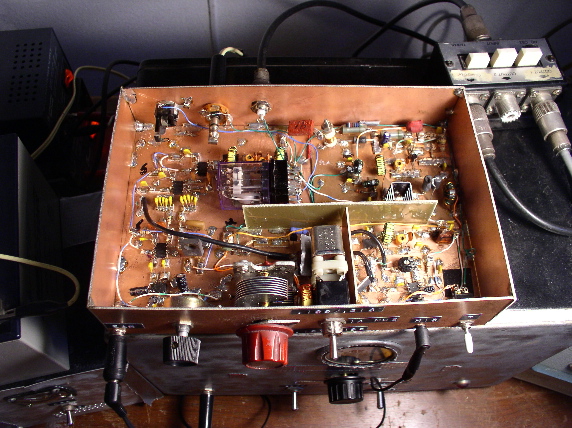
But Why Did Swamping Resistors Cure JBOT Oscillations?

OK, so as I mentioned in SolderSmoke 148 (apprently with screeching in the background — sorry) I managed to tame a bad JBOT oscillation problem by placing 680 ohm resistors across the primaries of the broadband transfomers in the JBOT. Now I’m wondering how/why this worked, and what we could do to make this kludge unnecessary.


Am I correct in suspecting that at the problematic frequency of 250 kHz, the one or more of the tranformers are self resonant, and that the resistors just bring down the Q of the — in effect — tuned circuit? This lowering of Q makes feedback and oscillation more difficult, right?

Here is the background. Read from the bottom up.


There is an old saying in Spanish: “No hay mal que por bien no venga.” More or less this is the same idea as: “Every dark cloud has a silver lining.” Well, the dark cloud was my techno-agony with the parasitic oscillations (see my plea for h elp from yesterday). The silver lining was the e-mail from Edgardo, LU1AR, in Buenos Aires that helped me get rid of them. Edgardo advised putting a resistor across the primaries of the JBOT amplifier stages. This is an old “lower the Q” trick, the idea being that lowering the Q might help prevent the amp from self-oscillating. I used 680 ohm resistors. First I put one across the primary of Q1. No joy. Then Q2. No luck. Then I put one right across the primary of that big output transformer. That did it! The parasitics disappeared. And I still get a nice 4 watts of output. Thanks Edgardo. I hope to make a contact with this rig today.

The real silver lining in this story comes, however, in the form of Edgardo’s blog site. Wow, what an inspiring example of Argentinian Knack. Radios, telescopes, auto-giros. This guy is also into homebrew DSB rigs. Wonderful stuff. Check it out. (Google will translate it for you, if necessary, but even if you don’t read Spanish, the pictures tell most of the story.)
I put this URL blog up on the SolderSmoke blog.
Thanks to all who sent advice and encouragement. Merry Christmas!


— On Sun, 12/23/12, lu1ar wrote:


From: lu1ar
Subject: [BITX20] Re: JBOT taking off at 250 kHz
To: BITX20@yahoogroups.com
Date: Sunday, December 23, 2012, 9:56 PM


First. You must secure the RF decoupling of +B line. Use a bunch of small capacitors in paralell 1n and 100 nF with 22 uF electrolitic.
Second: Use 1Kohm resistor in paralell with primary of the transformers. Begin with the driver, then the 1st amplifier and then the output transformer.
Let us know results.
Regards.
Edgardo Maffia LU1AR
Buenos Aires – Argentina

— In BITX20@yahoogroups.com, “iam74@…” wrote:
>
>
>
> — In BITX20@yahoogroups.com, Bill Meara wrote:
> >
> > I’m building my FOURTH JBOT and this one is giving me more trouble than all the others combined. I seek the help of the group.
> > Here are the details of my tale of woe:
> > 20 meter rig. Double Sideband. The JBOT is fed by a simple two-diode, trifilar toroid singly balanced modulator. NO DIPLEXER TO SPEAK OF. At the output of the balanced modulator there is a 1000 uH choke to ground and a .001 uF cap to the input of the JBOT. AF amp is an LM-386. VXO is a very simple MPF-102 one stage ceramic resonator VXO with no buffer stage. 7 element low pass filter (three coils, four caps).
> > All the transformers are wound on FT-37-43 cores. T3 is four such cores stacked 2X2.
> >
> > The arrangement works beautifully into a 50 ohm dummy load. But as soon as I connect it to an antenna (a dipole out in the yard, fed with 50 ohm coax) the output signal gets ugly.
> > Looking at it on the scope, instead of the nice figure eight pattern (similar to the two tone test pattern of SSB) I get ugly fuzzy outcroppings from the peaks. Looking at the signal more closely I can see that in addition to the 14.2 Mhz signal, there is another LF oscillation at around 250 kHz.
> > I’ve been struggling with this. I can’t get rid of the LF oscillations. The leads are all short and the inputs are far from the outputs. I’ve beefed up shielding, and decoupling. I’ve sacrificed a chicken to Papa Legba. Nothing seems to help.
> > I THINK the feedback/oscillation is taking place in the JBOT itself — not through the
> > audio amp or the balanced modulator or the VXO.
> > I watch the RF and the AF inputs to the balanced modulator to see if there is any difference between the stable situation (with the 50 ohm dummy load) and the unstable situation (with the antenna), I don’t see any differences.
> > I even put an antenna tuner between the final and the antenna anb made sure that the antenna looks like 50 ohms non reactive. This seems to help a bit, but the ugly instability is still there.
> > Help me!
> > 73 Bill N2CQR
> >
>

Our book: “SolderSmoke — Global Adventures in Wireless Electronics” http://soldersmoke.com/book.htm Our coffee mugs, T-Shirts, bumper stickers: http://www.cafepress.com/SolderSmoke Our Book Store: http://astore.amazon.com/contracross-20
He Should Have Used a Low Pass Filter!

http://www.sun-sentinel.com/news/broward/hollywood/fl-pirate-radio-hollywood-20121229,0,5142922.story

Our book: “SolderSmoke — Global Adventures in Wireless Electronics” http://soldersmoke.com/book.htm Our coffee mugs, T-Shirts, bumper stickers: http://www.cafepress.com/SolderSmoke Our Book Store: http://astore.amazon.com/contracross-20
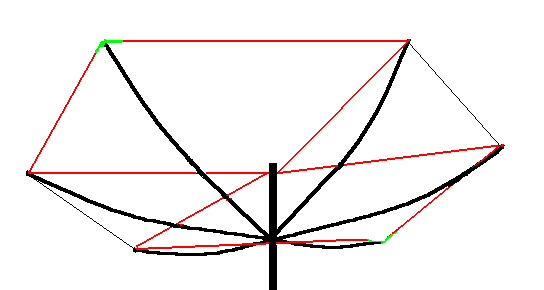
All OK at SolderSmoke HQ

Hurricane Sandy went through here yesterday. We had a lot of water and wind. Power went out at about 7 pm, giving me the opportunity to display my technological prowess by deploying my 1.1 kilowatt DC/AC inverter. It worked very well — we had lights and TV, and were the envy of the neighborhood. We all went to sleep on the ground floor — trees are the real hazard here. We were very pleased to be awakened by the lights coming back on at 1:20 am. Three cheers for Dominion Power! I hope listeners in the storm’s path had it as easy as we did.

Podcast #147 will be a special Hurricane Sandy edition. I should have it out in a day or so.

Our book: “SolderSmoke — Global Adventures in Wireless Electronics” http://soldersmoke.com/book.htm Our coffee mugs, T-Shirts, bumper stickers: http://www.cafepress.com/SolderSmoke Our Book Store: http://astore.amazon.com/contracross-20
The Salvage Super

I can remember a time in the United States when it was not unusual to hear someone described as “a great humanitarian” or as having “a great love for mankind.” The plaque we left on the moon says “We came in peace for all mankind.” You don’t hear much of that talk anymore. Our discourse has grown more nationalistic, and today it seems the best thing we can say about somebody was that he or she has “a great love or country.I can remember a time in the United States when it was not unusual to hear someone described as “a great humanitarian” or as having “a great love for mankind.” The plaque we left on the moon says “We came in peace for all mankind.” You don’t hear much of that talk anymore. Our discourse has grown more nationalistic, and today it seems the best thing we can say about somebody was that he or she has “a great love or country.

Our book: “SolderSmoke — Global Adventures in Wireless Electronics” http://soldersmoke.com/book.htm Our coffee mugs, T-Shirts, bumper stickers: http://www.cafepress.com/SolderSmoke Our Book Store: http://astore.amazon.com/contracross-20

AA1TJ: In the Vanguard

Wahoo…Dale, you amazing!

You are my first QSO with the Vanguard 1 reproduction satellite beacon transmitter. My circuit is a fairly close copy of the one shown on the lower left-hand corner of the attached 1959 CQ Magazine article (notice the output signal pick-off shown in this schematic is incorrect, or at least incomplete). My circuit uses link-coupled output impedance matching, which is similar to the only other documentation that I was able to dig up. The attached image “Early_Microlock_Bcn.jpg” was snipped from an original NASA report on the transmitter used in early airborne and sub-orbital tests leading up to the Vanguard flights.

Yes, you heard correctly. I’m using a Philco 2N504 surface-barrier transistor, but please let me back up a bit.

Roger Easton (a native Vermonter…and still resides here!) was at the helm of the communications development for the Vanguard/Minitrack project. Of the Vanguard “grapefruit” satellite beacon transmitters, he wrote in the May 2008 issue of High Frontier magazine

“We tried subminiature tube transmitters first. They worked marginally. Finally, Bell Telephone/Western Electric developed a very nice transistor for the task, and the problem was solved.”

However, that leaves out a small detail. They first tried Philco surface-barrier transistors, which worked fine on the bench, however two problems were discovered. They were found to be too temperature sensitive; the RF output power from the one-stage transmitter dropped excessively at elevated temps. Secondly, there was some issue with the packaging that produced erratic operation when the transistor was rotated positionally. The Western Electric devices proved better on both counts.

The WE transistor appears to be “unobtainium” these days. That, plus the fact that my circuit won’t be flying up to space anytime soon, prompted me to settle on a Philco 2N504. Although my device was manufactured in September of 1959 (Vanguard TV-4 – re-Christened “Vanguard 1” – first orbited on March 17, 1958), the 2N504 was an off-the-shelf item on the launch-date.

The only other obvious difference is the Vanguard 1 beacon circuit operated on 108MHz, whereas mine is presently working on 14.0596MHz. I recently had it running as a beacon on 10m for 48 hours but I had no luck given present band conditions.

The receiver is a simple, 0-V-0 regenerative set using a single Raytheon QF721 (fabricated in February 1953). I heard little activity on 20m when I started up my auto-keyer this morning. I had it looping 3X1 CQs whilst I worked on another project. To make matters more difficult, the exhaust fan was running in my shop and it happened to be raining heavily when you called. Worse yet, the receiver had drifted off my calling frequency by the time you called. I barely discerned a high-pitched CW “1” or “J”…which prompted me to quickly switch off the fan and re-tune. You were subsequently a solid 579.

Of course my heart jumped when I heard you calling me…how I love that feeling! And it was a fabulous QSO so far as I’m concerned. Following our contact I opened my metal index card file box and pulled out the QSL that you sent to me following our “Code Talker” QSO. To think I now have another happy memory to add to that one! Thank you once again, Dale. It figures you’d be the one to pick-off my unannounced presence on the 20m QRP calling frequency with 25mW. Well done, OM.

BTW, here is a nice PPT overview of the Vanguard project.

Also, you might enjoy this video of the actual launch, including some interesting control room audio banter. It may be found here. The way at least one of them nervously repeats, “Keep going baby!” gives some indication of the pressure these guys were under…having failed so spectacularly on two previous occasions.

FYI, I’ve included various bits of documentation that I’ve collected on this project; some of which I found on the NASA technical document server. I found the descriptions of the Minitrack system particularly interesting.

I’ll take some photos of my setup this afternoon. The pix plus a schematic of my build will follow within the week.

All the best,
Mike, AA1TJ


On Mon, Jun 25, 2012 at 11:51 AM, Dale Parfitt <parinc1@frontier.com> wrote:

Hi Michael,
That was fun!
I first heard you on my SG-2020 rig, but did not have a paddle handy, so I fired up the K3. I don’t ever recall having QRN on 20M, but it was bad. Without it, you were 579 and even with it, 569 towards the end of the QSO.
I just happened to be QRV on 060 listening when I heard your CQ’s. Not bad for a 25mW signal from (I think you said) a Philco transistor.
73,
Dale W4OP

Our book: “SolderSmoke — Global Adventures in Wireless Electronics”http://soldersmoke.com/book.htmOur coffee mugs, T-Shirts, bumper stickers: http://www.cafepress.com/SolderSmokeOur Book Store: http://astore.amazon.com/contracross-20

Hit By Storm

On Friday night the Washington DC area was hit hard by a very powerful line of thunderstorms. It brought down trees and powerlines all around the area. Fortunately, my dipoles were spared. But we were “off the grid” for about 48 hours. Let me tell you, it is no fun at all. I am now in the market for a generator and would appreciate recommendations (gasoline? natural gas?) I was re-introduced to the joys of 2 meter FM. I thought my smart phone would keep us connected to the net, but AT&T apparently lost some of its towers in our area, so for a while, the only way we could have called for help would have been via 2 meter FM.

Our book: “SolderSmoke — Global Adventures in Wireless Electronics” http://soldersmoke.com/book.htm Our coffee mugs, T-Shirts, bumper stickers: http://www.cafepress.com/SolderSmoke Our Book Store: http://astore.amazon.com/contracross-20