Just like in “How’s DX?”
SolderSmoke Daily News — Ham Radio Blog
Serving the worldwide community of radio-electronic homebrewers. Providing blog support to the SolderSmoke podcast: http://soldersmoke.com
Just like in “How’s DX?”
I wrapped up my Samana HI9 operation yesterday morning. I found a very friendly Spanish-language round table – they were all willing to try to pull my QRP DSB sigs out of the noise. Within a few minutes I worked KI4PZE, CO8OT,WA4RME,and CO8KB. So that made a total of 18 solid contacts with 3 more that might not qualify as full-fledged QSOs.
We have moved on to very urban Santo Domingo – no room for antennas here!
Our book: “SolderSmoke — Global Adventures in Wireless Electronics” http://soldersmoke.com/book.htm Our coffee mugs, T-Shirts, bumper stickers: http://www.cafepress.com/SolderSmoke Our Book Store: http://astore.amazon.com/contracross-20
Having a lot of fun with my old Azores 20 meter DSB rig here in the Dominican Republic. So far 11 solid contacts. People are amazed when I tell them the power source is 10 AA batteries! I feel I am redeeming myself as a QRPer after transgressing with the 120 watt amp project. We leave Samana and go to Santo Domingo on Sunday. 73 Bill
Sent from my iPhone
Current portable ops in Samana!
YouTube video!
http://www.youtube.com/watch?v=eBCg3-feSrc&sns=em
Also. Today is Pete Juliano’s birthday! Send him greetings!
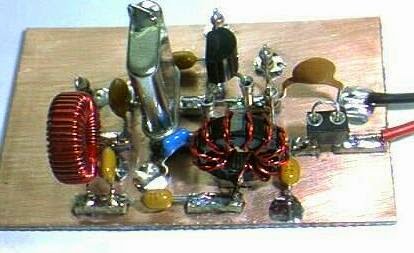
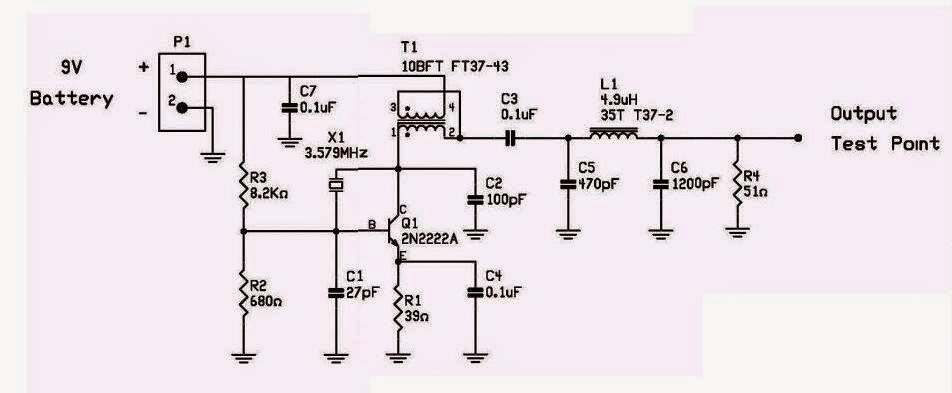
Back in 2000, the NJQRP club came up with a nice little transmitter called the SNAP. It was designed by Chuck Adams K7QO. Dave K5YFO alerted us to it and suggested it as an alternative to the Mighty Midget. One advantage over the MMM is that the SNAP needs no variable capacitor. But it does need a couple of coils wound on toroids. The SNAP design includes a low pass filter, something that has to be added on to the MMM. Check it out. Even if you’ve already built the MMM, you could easily take the crystal and use it in a SNAP build.
More info on the SNAP here:
http://www.njqrp.org/atlanticon/atlanticon%202000/snap.html
Our book: “SolderSmoke — Global Adventures in Wireless Electronics” http://soldersmoke.com/book.htm Our coffee mugs, T-Shirts, bumper stickers: http://www.cafepress.com/SolderSmoke Our Book Store: http://astore.amazon.com/contracross-20

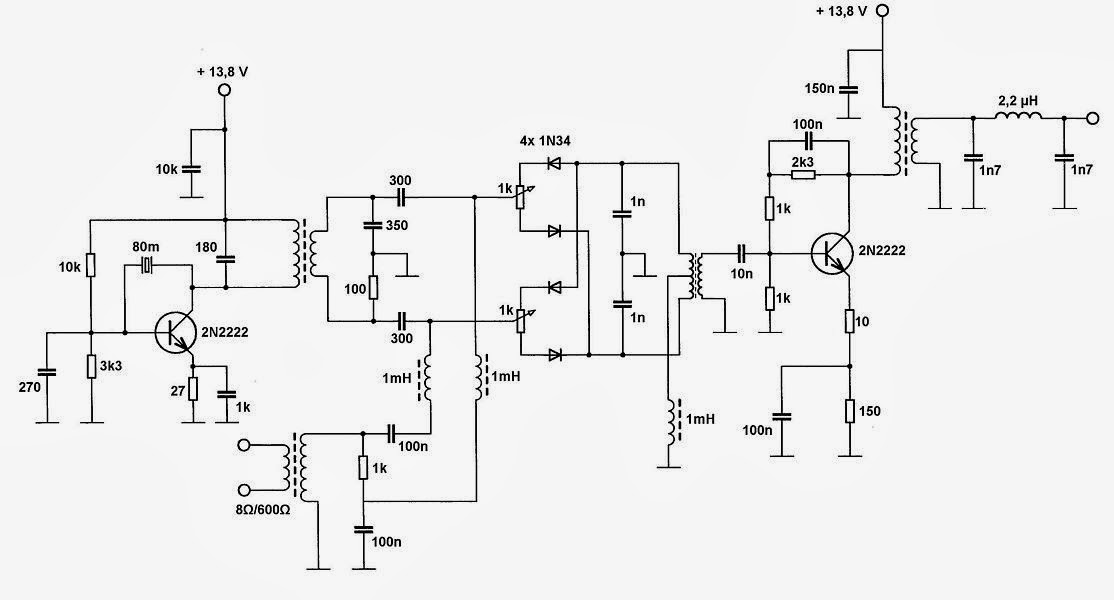
http://hackaday.com/2014/05/08/testing-the-efficiency-of-pcb-etchants/
This is great. We can add this to the list of kitchen and household products useful in our kind of projects! Desitin for heatsink compound! Breadboards for breadboards! Now this!
Our book: “SolderSmoke — Global Adventures in Wireless Electronics” http://soldersmoke.com/book.htm Our coffee mugs, T-Shirts, bumper stickers: http://www.cafepress.com/SolderSmoke Our Book Store: http://astore.amazon.com/contracross-20
Our book: “SolderSmoke — Global Adventures in Wireless Electronics” http://soldersmoke.com/book.htm Our coffee mugs, T-Shirts, bumper stickers: http://www.cafepress.com/SolderSmoke Our Book Store: http://astore.amazon.com/contracross-20
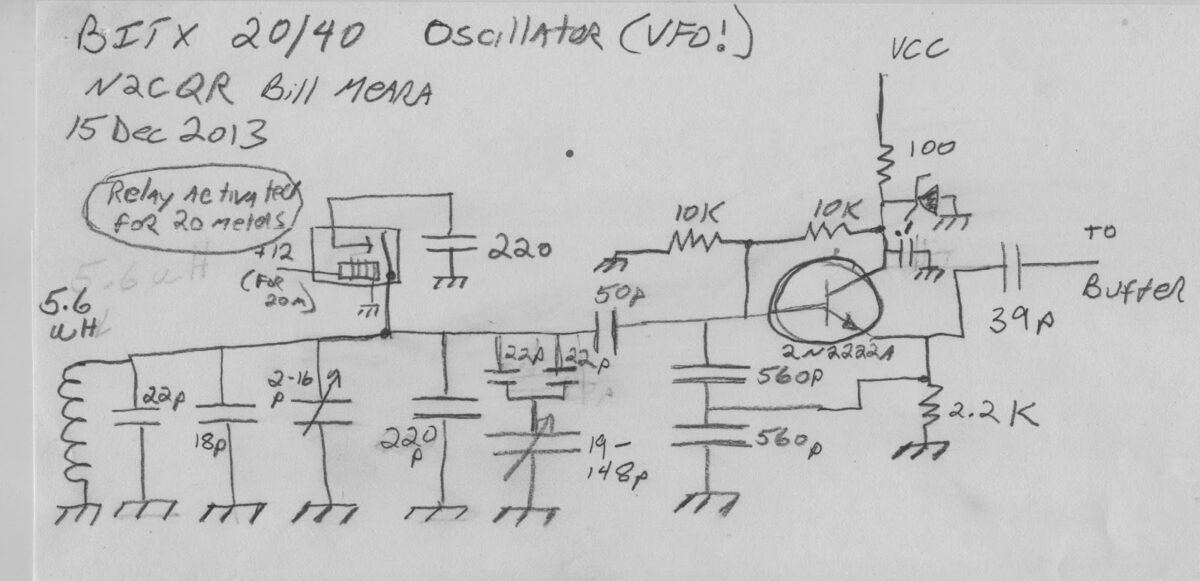
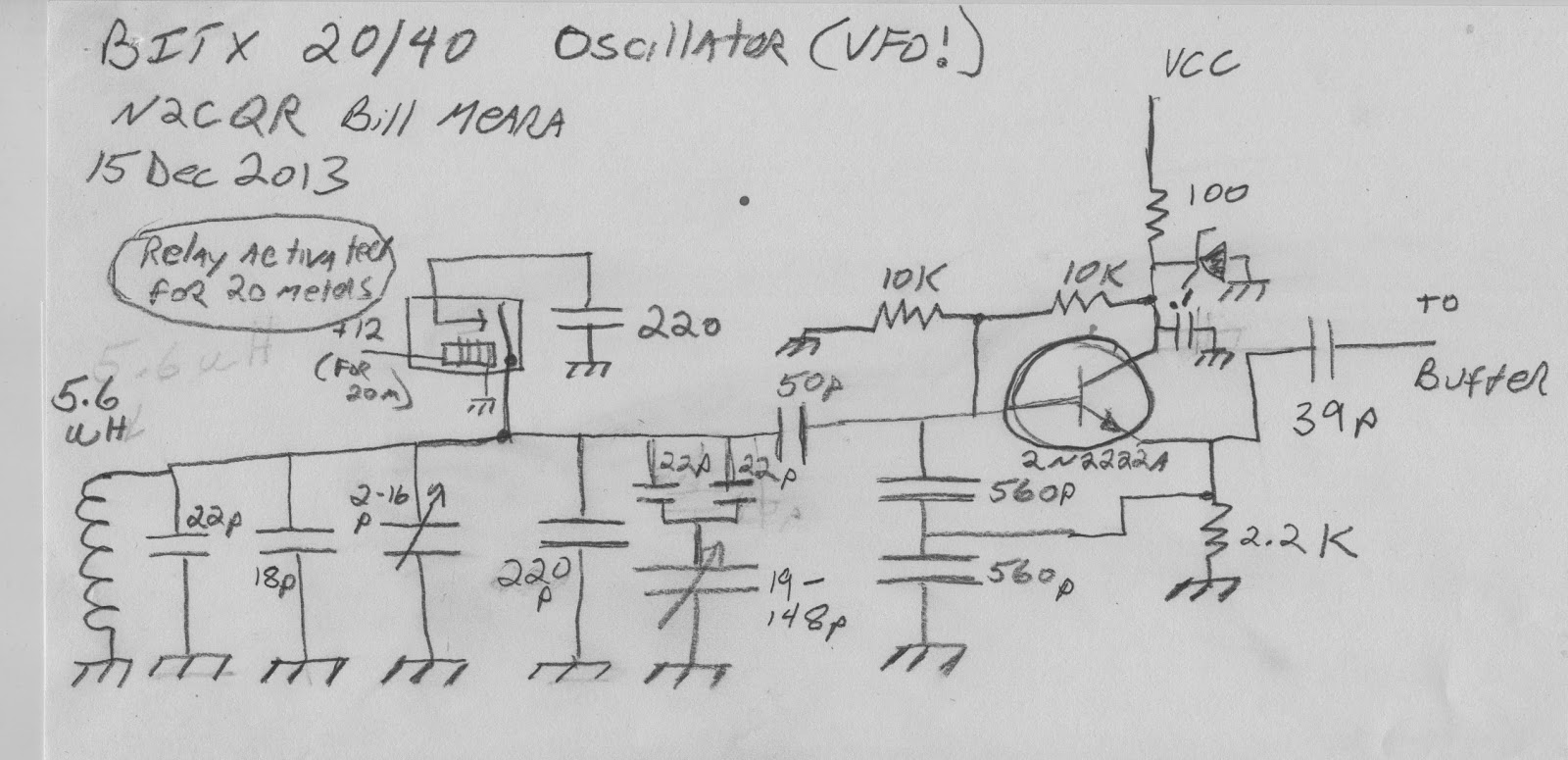
I continue to tweak the capacitors in my new BITX 20/40 VFO (scroll down to see it). On Sunday I added a little relay that will switch in some additional capacitance to move the VFO about 500 kHz. Without the additional cap, the VFO will be on frequencies suitable for 40 meters — with the additional cap it will be on frequencies needed for tuning 20 meters.
I calculated that I’d need an additional 220 pf to make this shift ( I later went with 100 pf). In went the needed cap and relay. It worked. But there was a problem: On 40 I had the desired 175 kHz frequency range. But I found that with this arrangement on 20 I could only cover 95 kHz. Obviously my variable air cap with 44 pf in series was being “diluted” by the additional 220 pf being switched in by the relay — with the additional capacitance, the change in total capacitance produced by the variable cap (with series cap) was smaller in the 20 meter range than it was in the 40 meter range.
Clearly, one solution was to play with the value of the cap that I had in series with the variable cap — increasing it would increase the freq spread (both on 40 and 20). But how much should I increase it?
By this point I was getting tired of all the manual calculations. Time for a spreadsheet! I created one, and threw in the values of all the caps and of the coil, and the resonant frequency formula. I set it up to display and the resulting freq coverage.
The freq ranges in the actual ham bands is a bit off — there may be some stray capacitance and inductance in the circuit that is not being captured in my numbers. But the important thing was the spread. The spreadsheet allowed me to see that with a 100 pf cap switched in by the relay and a 74 pf cap in series with the variable, I could cover 180 kHz on 40 and 123 kHz on 20. That’s OK. This little exercise shows the usefulness of spreadsheets in dealing with this kind of calculation.
You can see my spreadsheet here:
https://docs.google.com/spreadsheet/ccc?key=0Ak4BJL1-oWiJdElieDY5Y2xVWUtSNDl0anRYLVBBeGc&usp=drive_web#gid=0
Our book: “SolderSmoke — Global Adventures in Wireless Electronics” http://soldersmoke.com/book.htm Our coffee mugs, T-Shirts, bumper stickers: http://www.cafepress.com/SolderSmoke Our Book Store: http://astore.amazon.com/contracross-20
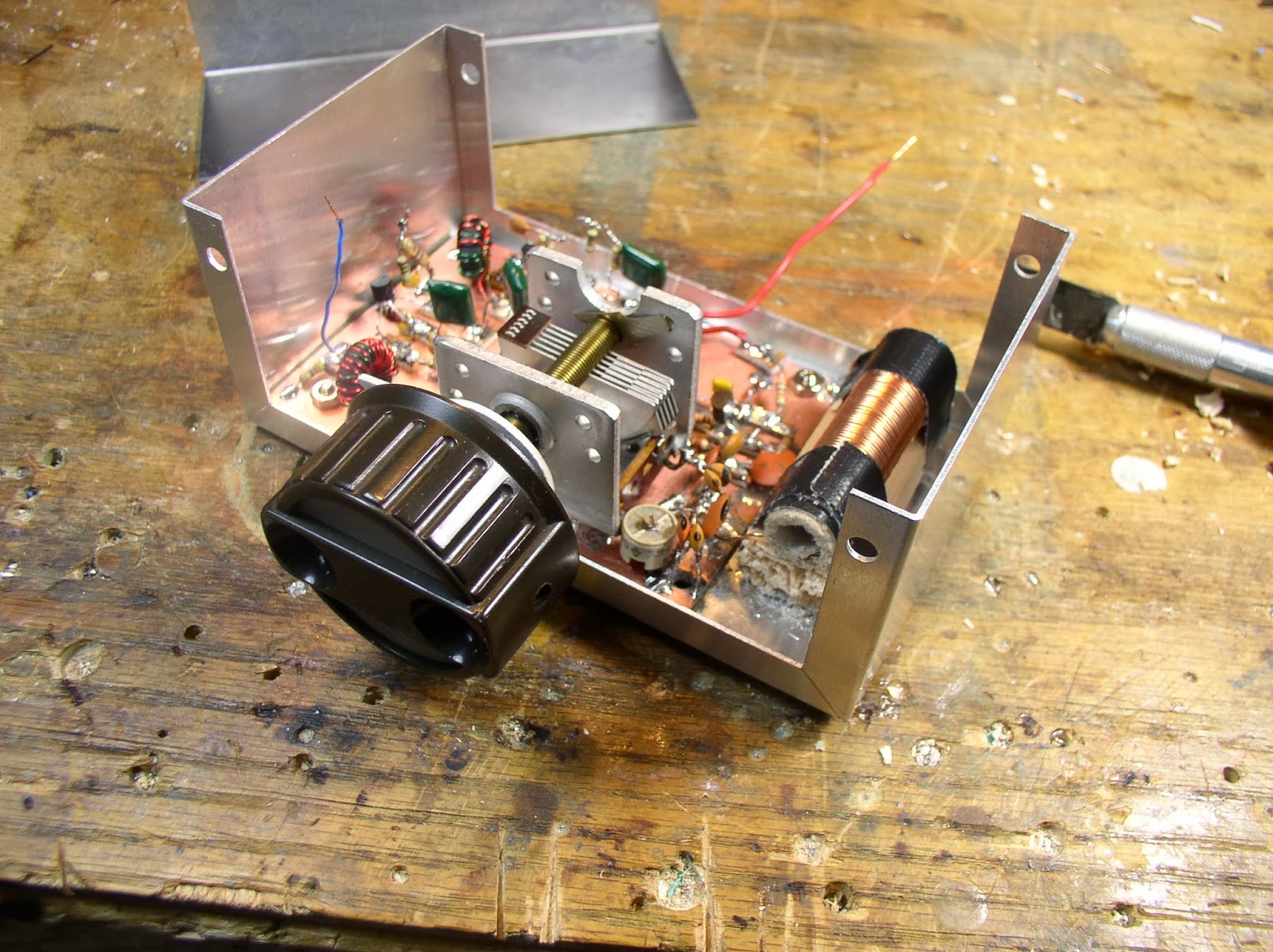
I’ve started construction on my second BITX transceiver, this one for 20 and 40 meters. As with the previous rig, I decided to take the VFO first, but this time I pledged not to surrender, not to wimp out with a VXO or (worse!) a DDS. No, this time it would be a real LC VFO.
I took seriously all the admonitions in the tech literature about the fickle permeability of ferrite and iron powder, so this time I used an old-fashioned air-core coil. It is wound around a cardboard tube. The tube was previously the bottom portion of a coat-hanger from the dry cleaner. I wound 40 or so turns on this core, then measured the inductance: 5.6 uH — that looked about right.
For the oscillator stage I used a Colpitts circuit very similar to the one in the original BITX schematic (but I am hoping I won’t need the varactor diode fine tune mechanism). I had on hand a nice Heathkit 19-146 pf variable cap with an internal 4:1 reduction drive. Not wanting to pluck rotor places out of this beautiful part, I had to calculate the series capacitance that would yield a frequency spread of about 175 kHz. It turned out to be 40 pf. Then I had to figure out how much capacitance to put in parallel with the variable. Well, it all ended up like this:
http://www.1728.org/resfreq.htm
I found that the VFO is more stable if I reduce the voltage from 12 volts down to about 8. Also, I found that when evaluating the stability, it is better (psychologically!) just to use a stable superhet receiver instead of the frequency counter. The counter may appear to be jumping around a lot, especially if the signal you are monitoring is not very strong. Just listening to it at zero beat on the superhet is very reassuring.
I followed the Colpitts oscillator with the FET buffer and two stage BJT amplifiers from page 50 of Doug DeMaw’s QRP Notebook (page 50). I now have the requisite 7 dbm signal. And it appears to be quite stable.
I plan using this with an 11 MHz IF, with the VFO running at around 3.875–3.700 for 40 meters and 3.175 — 3.355 for 20. I plan to use a small relay to switch in some additional capacitance to move the VFO down to the range for 20 meters.
Our book: “SolderSmoke — Global Adventures in Wireless Electronics” http://soldersmoke.com/book.htm Our coffee mugs, T-Shirts, bumper stickers: http://www.cafepress.com/SolderSmoke Our Book Store: http://astore.amazon.com/contracross-20
Our book: “SolderSmoke — Global Adventures in Wireless Electronics” http://soldersmoke.com/book.htm Our coffee mugs, T-Shirts, bumper stickers: http://www.cafepress.com/SolderSmoke Our Book Store: http://astore.amazon.com/contracross-20
|
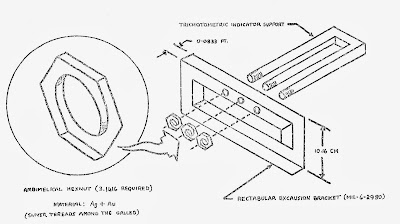
DRAWN BY
|
FRED SPOON
|
SCALE ¼”=1 MILE
|
|
NO. 43906
|
FILE – BAR NONE
|
|
Our book: “SolderSmoke — Global Adventures in Wireless Electronics” http://soldersmoke.com/book.htm Our coffee mugs, T-Shirts, bumper stickers: http://www.cafepress.com/SolderSmoke Our Book Store: http://astore.amazon.com/contracross-20
 |
Our book: “SolderSmoke — Global Adventures in Wireless Electronics” http://soldersmoke.com/book.htm Our coffee mugs, T-Shirts, bumper stickers: http://www.cafepress.com/SolderSmoke Our Book Store: http://astore.amazon.com/contracross-20

Our book: “SolderSmoke — Global Adventures in Wireless Electronics” http://soldersmoke.com/book.htm Our coffee mugs, T-Shirts, bumper stickers: http://www.cafepress.com/SolderSmoke Our Book Store: http://astore.amazon.com/contracross-20
Our book: “SolderSmoke — Global Adventures in Wireless Electronics” http://soldersmoke.com/book.htm Our coffee mugs, T-Shirts, bumper stickers: http://www.cafepress.com/SolderSmoke Our Book Store: http://astore.amazon.com/contracross-20
And on all Lulu books.
Just use the coupon code FALLSALE40 at checkout.
http://www.lulu.com/spotlight/soldersmoke
Our book: “SolderSmoke — Global Adventures in Wireless Electronics” http://soldersmoke.com/book.htm Our coffee mugs, T-Shirts, bumper stickers: http://www.cafepress.com/SolderSmoke Our Book Store: http://astore.amazon.com/contracross-20
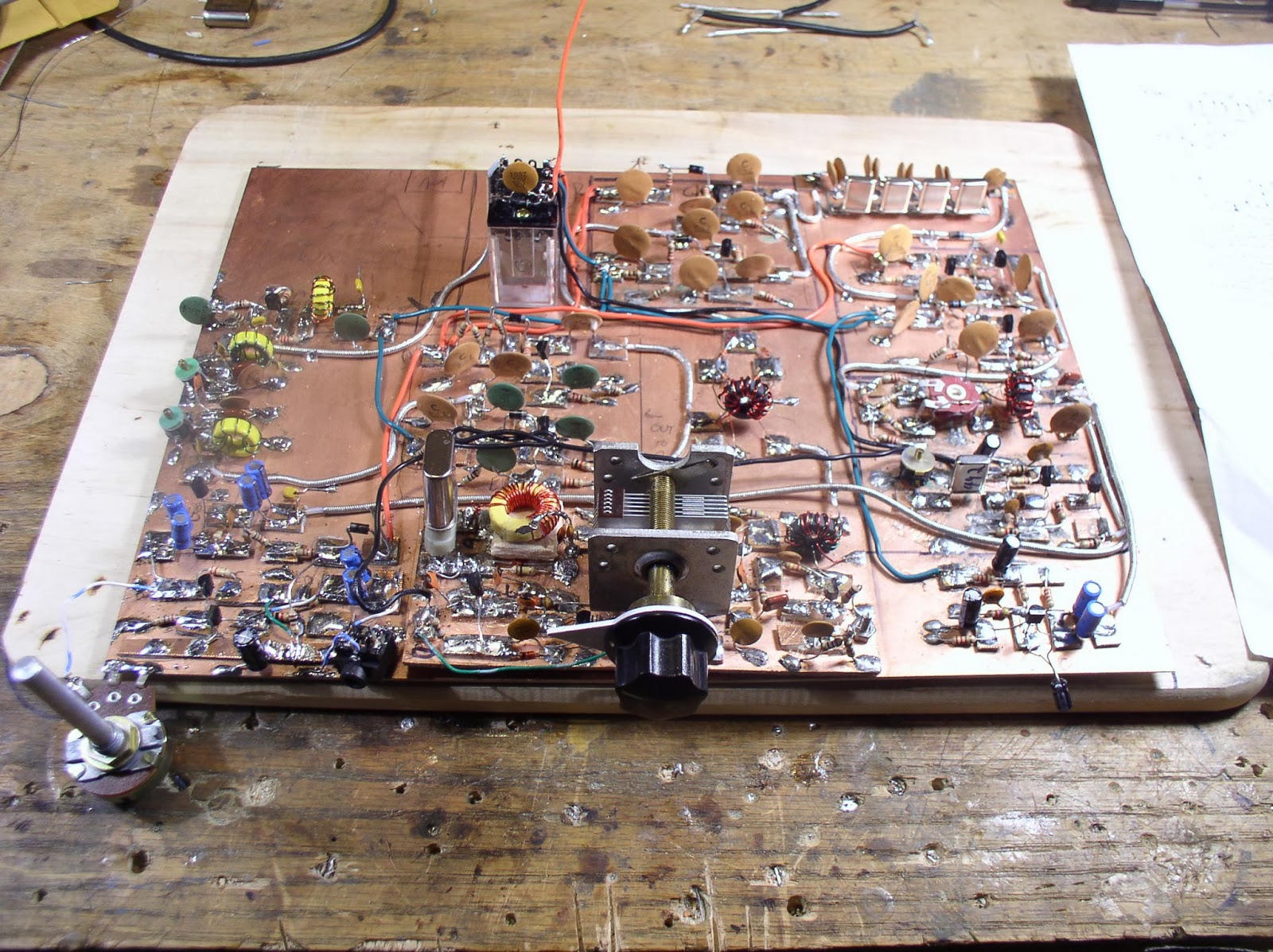
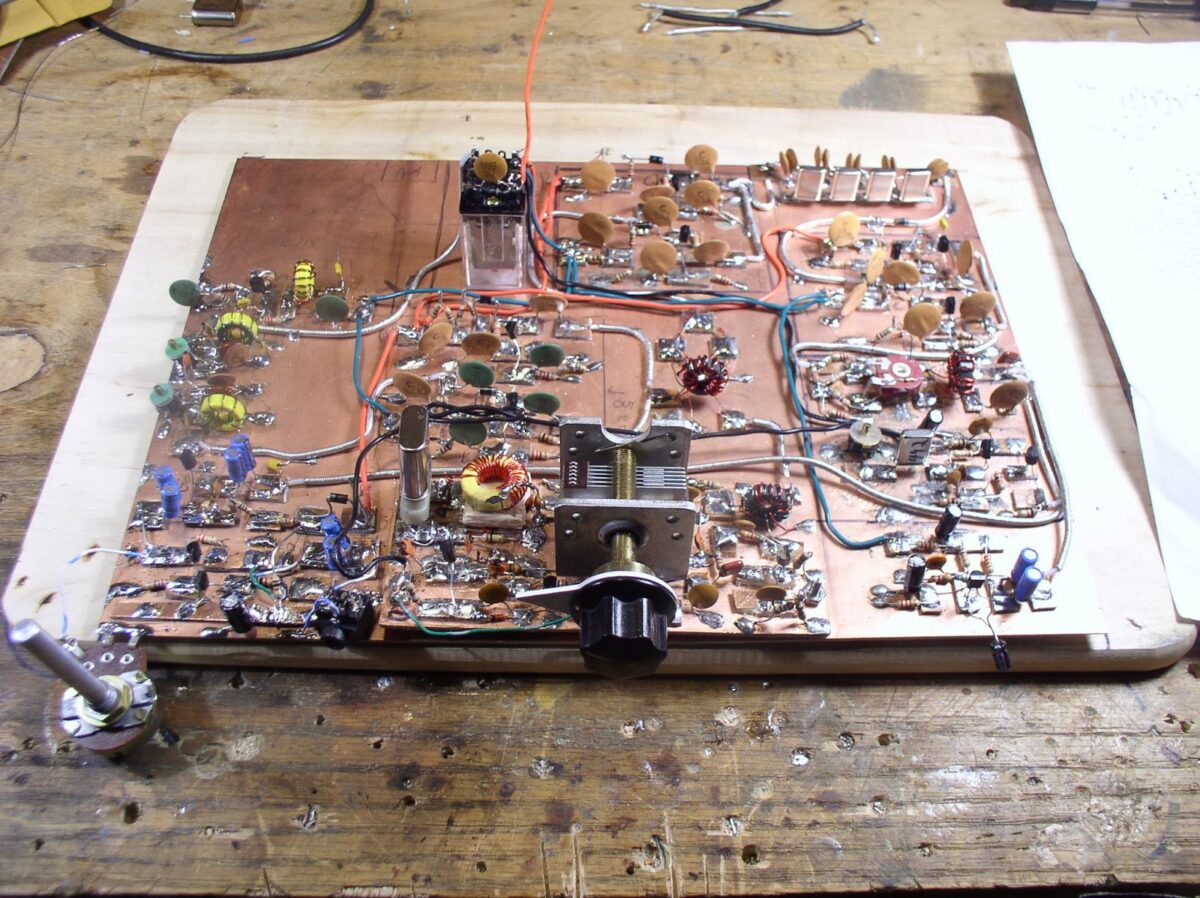
As you can see, the board is starting to fill up. I really like it. It seems (to me) like the canvas of a painting approaching completion. This morning I put in the T/R relay. That space in the upper left is reserved for the driver and the IRF510 Power Amplifier.
I got some help from the Chief Designer this week. As noted in an earlier post, Farhan advised me to check the mixers. I knew that I had them wired correctly and that they were in fact mixing, but when Farhan advises you to check something, YOU CHECK IT. Farhan was right (see earlier post).
It really sounds great. I know that the filter still has significant ripple in it, but the receiver sounds so good I’m reluctant to mess with it. Should I de-ripple it?
On the train yesterday I was thinking about this rig, and it occurred to me that my 23.1 MHz VXO/ 5 MHz IF arrangement means that this 17 meter transceiver could also generate signals on the 10 meter band. Of course, I’d have to build a second bandpass filter, but the radio gods guided my hand and caused me to leave space on the board for just such a filter (see above). I realize the IRF510 PA wouldn’t be too good up at those frequencies, but when the radio gods speak, you have to listen.
Our book: “SolderSmoke — Global Adventures in Wireless Electronics” http://soldersmoke.com/book.htm Our coffee mugs, T-Shirts, bumper stickers: http://www.cafepress.com/SolderSmoke Our Book Store: http://astore.amazon.com/contracross-20
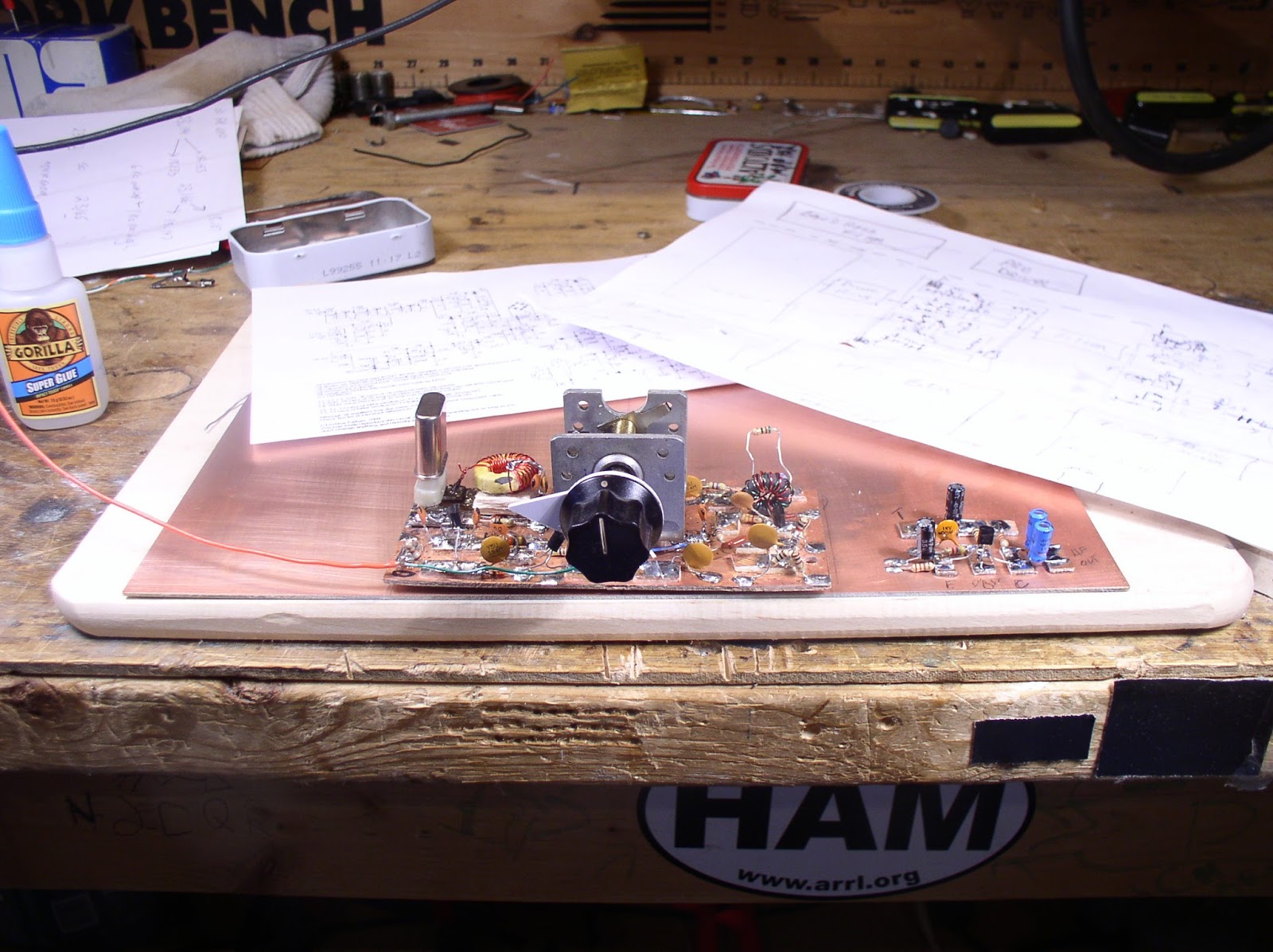
Our book: “SolderSmoke — Global Adventures in Wireless Electronics” http://soldersmoke.com/book.htm Our coffee mugs, T-Shirts, bumper stickers: http://www.cafepress.com/SolderSmoke Our Book Store: http://astore.amazon.com/contracross-20

This coupon will get you the SolderSmoke book for around $16. Valid through August 9.
http://www.lulu.com/spotlight/soldersmoke
Our book: “SolderSmoke — Global Adventures in Wireless Electronics” http://soldersmoke.com/book.htm Our coffee mugs, T-Shirts, bumper stickers: http://www.cafepress.com/SolderSmoke Our Book Store: http://astore.amazon.com/contracross-20
Thanks to those who sent me the review. Got it.
I heard the August qst has a review of the soldersmoke book. I’m away
from home. Could someone email me the review? Thanks 73
Our book: “SolderSmoke — Global Adventures in Wireless Electronics” http://soldersmoke.com/book.htm Our coffee mugs, T-Shirts, bumper stickers: http://www.cafepress.com/SolderSmoke Our Book Store: http://astore.amazon.com/contracross-20