Category: Uncategorised
Caption (or meme) Contest!

Please supply a caption for this picture. Or turn it into a meme.
Place submissions in the comments section below (or e-mail them in)
Feel free to use the hosts of the SolderSmoke podcast.
Fast Radio Burst — Source Identified
Need Some Trans-Atlantic Support — “The Impoverished Radio Experimenter”
A friend in the UK writes:
I’m looking for volumes 2 and 4 of the “The Impoverished Radio Experimenter” pamphlets. I’ve searched in the UK for them – they are available but at silly money (nigh on £25.00 each). No sign of any pdf downloads, either. pdf downloads (preferred!) or purchasing at £10 and under would do me fine, if you know any sources?
Any ideas? Thanks, Bill
Life in Appliance Land
“Sexiest Radio!” Hmmmm.
“It’s the bomb.”
https://www.facebook.com/DXEngineering/videos/815962828760101/
The 3D waterfall is kind of cool. As is the big screen on the wall.
Understanding Digital Radios
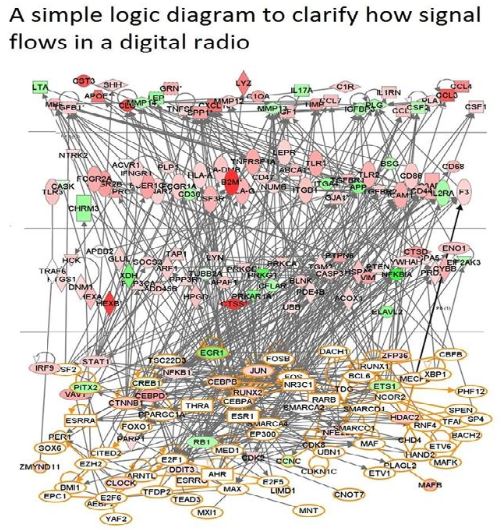
Alan WA9IRS writes:
Hi Bill,
Thought I would drop you a brief note. I have been catching up on my listening to past issues of Soldersmoke podcasts and was particularly interested in the discussion between you and Pete concerning the simplicity associated with non-digital, integrated circuits and microprocessors and all of the rest of the very small miniaturized circuit elements. You rightly pointed out that you desired (along with a lot of the rest of us) to fully understand what was going on in a circuit and for that reason desired to maintain the simplicity of transistor and discrete components in your design and build projects.
I agree with you completely but offer the alternative to the simple circuits in the form of the attached simple diagram of the signal flow path in a digital radio. I found this some time ago in a digital electronics magazine and thought you and Pete would find it interesting. Perhaps this might be something to spring on Pete on 4-1-2018.
Take care and thanks to both of you for many pleasant and thoughtful hours of enjoyment listening to Soldersmoke!
All for now, 73,
Allan, WA9IRS
My response:
Thanks Allan, Very illuminating. It is all clear to me now. I feel so much better. FB OM. 73 Bill
Malicious Code in the Si5351 — Pete quitting podcast
Those of you who have been reading Pete N6QW’s blog (and all of you should be reading it!) will have seen a recent post about his efforts to modernize (digitize) the VFO in an old tube-type Ten Tec Triton IV model 544. Pete complained that –oddly — in spite of replacing the old analog tube-type VFO, the rig with a modern, rock-stable Si5351 VFO, the old rig CONTINUED TO DRIFT. That had Pete and a number of us scratching our heads. How could that be?
Pete then completely removed the Si5351 VFO from the old boatanchor. Sitting on his bench, all by itself, THE DAMN THING EXHIBITED ALL THE CHARACTERISTICS OF ANALOG VFO THERMAL DRIFT. Wow! Why? Pete was really pulling his hair out on this one.
We immediately began to see if others were getting the same results. Nope. None of our Si5351 VFOs were doing this. This was REALLY strange.
At this point we had to turn to a real Arduino expert, a guy who I had met during my time in Italy: Luigi Bugiardo from the Arduino research center in Bocalupo, Calabria. Pete gave him remote access to his computer and he began to poke around.
It didn’t take long. Luigi quickly found the problem: He found several lines of malicious code “embedded in the Si5351.h and si5351.cpp files –sort of lurking out there and not easy to spot.”
Pete then removed this code and — BINGO — no more drift.
Now I know some of you guys are thinking that this was just a bit of harmless fun. But Pete is really angry about this. He feels like he has been played for a sucker by some ham who was pretending to collaborate with him. Pete sees this as yet another violation of the unwritten ham code of conduct. To him this is another intrusion of computer/hacker noob hazing into the ham radio world. And worst yet, he thinks this malicious code came to him because of this involvement in the podcast and his blog — that participation resulted in the widespread exposure that got him into this mess.
Pete is so upset that he has vowed to drop out of the podcast and shut down his blog.
So come on fellows. It is time to ‘fess up. If you did this, or if you think you know who did this, please send an e-mail to me at soldersmoke@yahoo.com I think being able to pinpoint the prankster will help Pete deal with this whole thing, and hopefully get him back into the SolderSmoke…
Listen to our Podcast while wearing a beret!


This is the official headgear of the Color-Burst Liberation Army.
For a mere 16 dollars, you can wear the kind of beret worn by Pete Juliano, N6QW.
Here at SolderSmoke, we are all about style, panache, savoirfair, je ne se qua…
If you send us a picture of yourself wearing a beret while either operating or building a rig, you will win FOR FREE a one year subscription to the SolderSmoke on-line podcast. ACT NOW! Please tell them that SolderSmoke sent you.
Putting the QCX on SSB
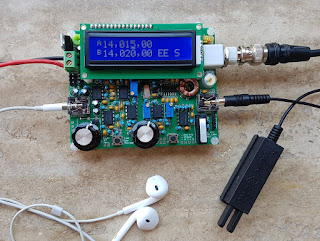
Here is a very cool mod to Hans Summers’ amazing QCX CW phasing transceiver. This rig seemed to have been crying out for an SSB mod. Guido has come up with a very clever way to put this rig on phone.
Guido PE1NNZ wrote:
Jan 28 2019
Over Christmas I have been playing around with a simple modification that transforms the QCX into a Class-E driven SSB transceiver. With this setup I have been able to make several SSB contacts and FT8 exchanges across Europe and so far this experiment is working reasonable well. It can be fully-continuous tuned through bands 160m-10m in the LSB/USB-modes with a 2200Hz bandwidth, provides up to 5W PEP SSB output and has a software-based full Break-In VOX for fast RX/TX switching in voice and digital operations.
The SSB transmit-stage is implemented in a completely digital and software-based manner: at the heart the ATMEGA328 is sampling the input-audio and reconstructing a SSB-signal by controlling the SI5351 PLL phase (through tiny frequency changes over 800kbit/s I2C) and controlling the PA Power (through PWM on the key-shaping circuit). In this way a highly power-efficient class-E driven SSB-signal can be realized; a PWM driven class-E design keeps the SSB transceiver simple, tiny, cool, power-efficient and low-cost (ie. no need for power-inefficient and complex linear amplifier with bulky heat-sink as often is seen in SSB transceivers).
An Open Source Arduino sketch is used as the basis for the firmware, a hardware modification bypasses the QCX CW filter and provides a microphone input in-place of the DVM-circuit; the mod is easy to apply and consist of four wires and four component changes and after applying the transceiver remains compatible with the original QCX (CW) firmware.
This experiment is created to try out what can be done with minimal hardware; a simple ATMEGA processor, a QCX and a bit of signal processing to make SSB in an artificial manner. It would be nice to add more features to the sketch, and see if the QCX design can be further simplified e.g. by implementing parts of the receiver stage in software. Feel free to experiment with this modification and let me know your thoughts or contribute here: https://github.com/threeme3/QCX-SSB
73, Guido
PE1NNZ
Indian Scientists Upbeat on Solar Cycle 25

Falcon 9 Cubesat Launch Now Set for Wednesday
It looks like the Falcon 9 with Farhan’s CubeSat is not scheduled to launch this Wednesday between 1030 and 1100 West Coast time. Above you can see a similar launch.
https://www.sanluisobispo.com/news/local/article222135690.html
Arduino Gets Command Line Interface
Will this make it easier to put programs into the the Arduino? Will this resolve the problems we’ve had when using an updated Arduino IDE with code developed in an earlier version of the IDE?
https://hackaday.com/2018/08/26/arduino-gets-command-line-interface-tools-that-let-you-skip-the-ide/
Mailbags and Party-lines
https://soundcloud.com/radioromaniainternational/the-dx-mailbag-22062018
Humanity Star
The Three Body Problem by Cixin Liu
Strongly recommend this sci fi book. Lots of physics
Some e!ectronics. And even a bit of Morse. Ask Santa.
Jeff Murray’s Grumpy Audio Guy from 40 meters
I’ve talked to this guy several times. He usually waits until I’m testing a new rig.
https://www.facebook.com/6sj7jeff/videos/10208309648978285/
I’m sure Pete has worked him too.
VE3BOF’s Regens and DC Receivers
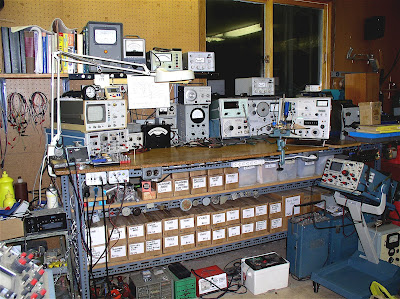 |
| VE3BOF BENCH |
Hi Bill:
This is Clark, VE3BOF, in Hensall, Ontario, Canada.
Hensall is located in southwestern Ontario, north of London and a 2
hour drive west of Toronto.
Last Sunday night, 2017-10-01, I tuned in to 7277 kHz to listen to
the BitX40 net. I heard you and 2 or 3 others.
Your signal was 5-7, perfectly readable.
The receiver I was using is a modified version of the WBR receiver.
It is still on the piece of chipboard that I mounted all the modules
onto. It’s an excellent little regenerative receiver.
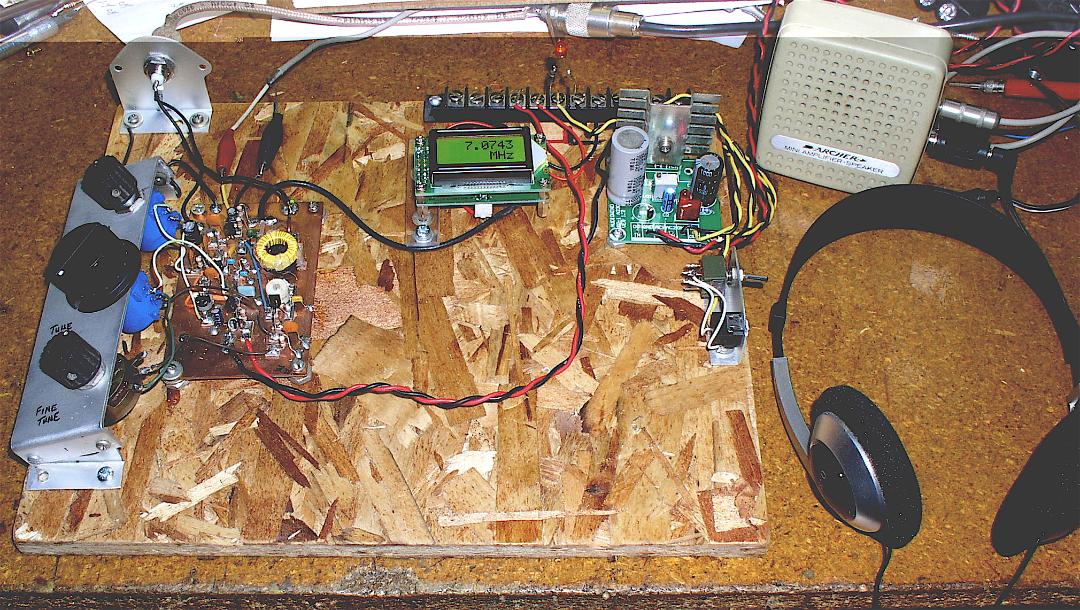
In the same state of incompleteness, is a modified version of the
Easy Receiver (QRP Kits) direct-conversion receiver,
I use this receiver for the CW end of the 40M band.
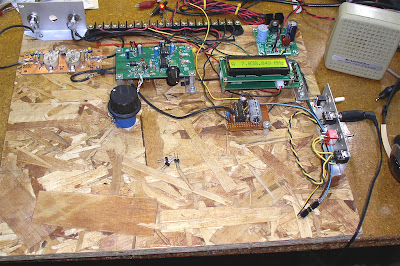
Both receivers have been fitted with 10-turn pots for easy tuning,
and also lcd frequency counters for displays.
I’m a former Motorola Communications tech, and used to maintain the
radio systems of District 6 of the Ontario Provincial Police and our Ministry
of Health emergency services radio system.
Being retired now, I have more time to check Soldersmoke every day
and listen to your
conversations with Pete, N6QW.
Thank you for very interesting and worthwhile QRP information and
programming.
Clark Forrest, VE3BOF
Einstein’s Knack (for Refrigeration)
Smoke Test Failure!

This is why you need fuses! And reverse polarity protection! Yikes!
Stay Thirsty My Friends — A Very Inspirational Article

There is no real connection to radio here, other than the fact that some of us are in this guy’s age group, and that we have had a few Dos Equis Guy memes on the blog. But do yourself a favor and spend a few minutes with this article. You will be glad you did.
Thanks to Larry K8MU for alerting us to this.
Stay thirsty my friends.