Preserving Vanguard 1


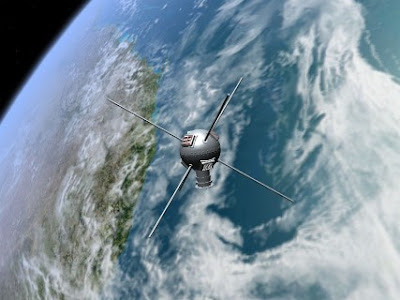
Ira Flatow of “Science Friday” was recently talking about how best to preserve important bits of the history of mankind’s exploration of space. Our old friend Vanguard 1 was mentioned several times. It is now the oldest satellite still in space.

You can listen to the Science Friday show here:

http://www.sciencefriday.com/segments/protecting-the-historic-human-record-in-space/

They also have a transcript of the show on the same page.

SolderSmoke fans will remember the Vanguard adventures of Mike Rainey AA1TJ:

http://soldersmoke.blogspot.com/search?q=Vanguard

This seems to be the month for Vanguard: just a couple of weeks ago, on 40 meters I spoke to Dale Parfitt W4OP. Dale was one of the first people to pick up Mike Rainey’s Vanguard replica signals (see link above).

AND…

The Vanguard reproduction project came up during Eric Guth 4Z1UG’s “QSO Today” interview with Graham Firth G3MFJ of the G-QRP Club:

http://www.qsotoday.com/podcasts/g3mfj

(Graham has such a great voice. He definitely SHOULD build a phone rig!)

VIVA VANGUARD!

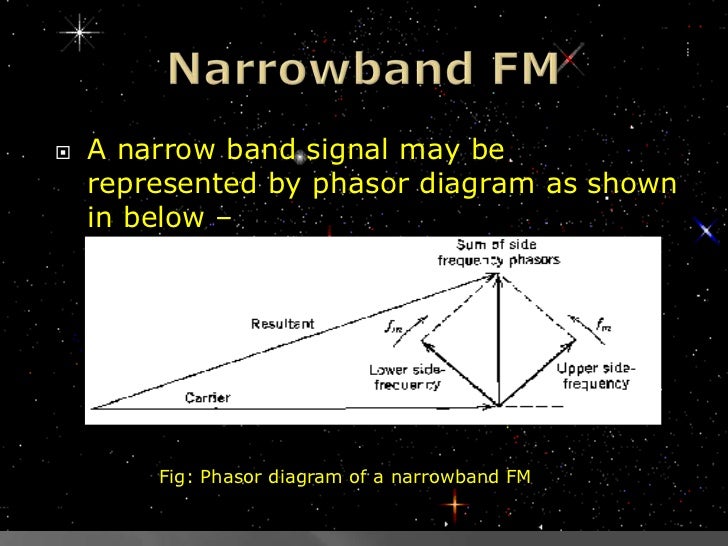
Narrow Band FM on 160 Meters? Using SSB phasing rigs?

On the G-QRP mailing list our British cousins are discussing the use of Narrow Band FM on Top Band. 160 meters has long been used for day-time local “chin wags” in the UK. Noise, of course, is a factor to consider on 160. FM would take care of the noise problem.

I was wondering if this would be legal in the USA. This is the kind of question that seems to provoke passionate, sometimes angry reactions. I think the answer depends on the resulting bandwidth of the signal.

There was an interesting discussion of this here:

http://www.eham.net/ehamforum/smf/index.php?action=printpage;topic=65481.0

Especially intriguing to me was Tom’s comment about the link between Narrow Band FM and the early SSB phasing rigs. I hadn’t heard about that:


Title: RE: Narrow Band FM is it legal below 30 MHZ.
Post by: N5EG on January 22, 2010, 11:10:43 AM


Hi Tim,

Yes – NBFM is legal. This is actually a hold over from long ago equipment. Back in the olden days phasing SSB exciters could also be adjusted to produce NBFM.

It’s a little different than modern FM, in that the signal looks just like an AM signal, except the phase of one of the sidebands is 180 degrees reversed compared to the AM equivalent (doesn’t matter which sideband). This gives an angle-modulated signal with +/- 45 degrees phase variation, but also 3 dB of amplitude variation.

While we don’t normally like amplitude variation on an FM signal, it has the effect of preventing the generation of the higher order sidebands that true FM produces. A receiver than has a limiter stage doesn’t care that much.

The result is that the old phasing exciters could produce this different kind of Narrow Band FM (probably the true meaning of NBFM long ago) that had the same channel width as AM, and a modulation index that’s well below 1. Such a signal is compliant with current FCC regulations on HF bands.

— Tom, N5EG

Movie Review: “The Man Who Knew Infinity” FIVE SOLDERING IRONS

My wife and I went to see this flick about the mathematician Srinivasa Ramanujan. It was filmed at Trinity College, Cambridge — if you look at the dedication to “SolderSmoke — Global Adventures in Wireless Electronics” you will see a picture of my kids at Cambridge. Alas, that picture was taken at Kings College, not Trinity; nonetheless, the Cambridge connection got us interested. Then there was the Indian aspect of the story, which is very intriguing. There was also the “amateur makes good” angle that all of us should, I think, find very encouraging.

The movie did not disappoint. We really liked it. The presentation of the cultural clash was very well done. Elisa told me that as she watched Ramanujan struggle with England, she found herself wanting to tell him, “You are just going through culture shock. Be patient! I’ve been through this many times!” They included just enough math to give the viewer a sense of what Ramanujan was working on.

I got a real kick out of one scene in which old Professor Hardy, seeking to motivate young Ramanujan, took him into the Wren Library and showed him the manuscript of Newton’s Principia. I had seen the same manuscript in the library of the Royal Society in London — they had take it out on the occasion of the visit to the library of Stephen Hawking and NASA Director Mike Griffin. They also had on the table the reflecting telescope that Newton himself had made. That was quite a day.

Great movie. I give it the coveted rating of five soldering irons.

More about Ramanujan here:
https://en.wikipedia.org/wiki/Srinivasa_Ramanujan

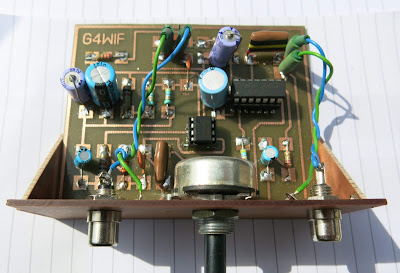
Putting Junk Mail to Excellent Use: Tony G4WIF’s Proto-boards


Tony’s Version of Audio Section of N6QW’s LBS Receiver

Tony Fishpool, G4WIF writes:

I’ve been intrigued by Pete’s matrix pad method. Of course, few of us have the machinery to mill them as Pete does, but etching is a possibility. Now some of Pete’s boards clearly have a lot of noodling behind them. His boards are quite big with little areas of pads and space between. The layout for the whole project has clearly been considered in advance.
I wanted a board that I could make modular, take little time to etch and adapt for the circumstances. These “proto-boards” are the result.

The project is Farhan’s “sweeperino” and one board is for the Si570, and the other the AD8307.
The Si570 board is now complete and working:


The PCB method is pure Chuck Adams. His videos on YouTube describe the toner transfer method better than I could.

The only difference for me is that my glossy paper comes free from travel agent brochures.
Just express a passing interest in Viking River Cruises and you will never pay for PCB paper ever again!
There is a free printing only version of the software I use, so if SolderSmoke listeners want to use the proto-board design, I will happily email them the files.


Kind regards
Tony G4WIF

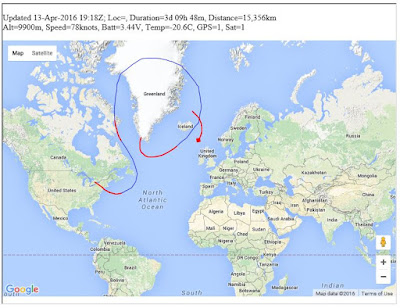
VE3KCL Balloon makes “several loops around Greenland”

Oh, I really want to do this. We had a bunch of balloons for my daughter’s birthday and I found myself trying to guestimate how much they could lift. There is a balloon store that sells the metalized party balloons used here. They have a helium tank. I hate to be a party pooper (!) but wouldn’t the antenna represent a bit of a hazard? If it came down in power lines, that wouldn’t be good right?
In any case, three cheers for Dave VE3KCL and for Hans, G0UPL, the wizard who makes the QRSS/WSPR transmitter that is currently flying over Iceland.

Hi all


Some of you must have seen this already – but the rest of you may find it interesting. Dave VE3KCL launched his S-9 balloon 4 days ago (2 standard party-balloons, hydrogen-filled) with modified QRP Labs Ultimate3S QRSS/WSPR transmitter onboard.

We are using WSPR messages for tracking – one normal WSPR message and one with a special data protocol to provide altitude, speed, Maidenhead 5/6th characters, battery voltage, temperature and GPS/satellite status. The transmitter has about 16mW power output, on 30m band. It is sending CW and JT9 as well. Altitude is a little over 10,000m. So far it has traveled in several loops around Greenland and the North Atlantic. Currently it is near the Faroe islands. See live tracking at QRP Labs website http://qrp-labs.com/ultimate3/ve3kcl-balloons/ve3kcl-s9.html

G-landers, don’t get too excited that it appears to be heading your way – the wind prediction shows it likely to head back West almost as far as Newfoundland, before turning back East towards Spain!

73 Hans G0UPL

The Wizard of Wimbledon writes of Emperor Hadrian’s QTH, HMS Belfast, JFK and QRP

Dear Bill

I write this to you from my shack in Wimbledon, south west London, with the crackle of the bands slowly waking up across Europe, having just devoured the final few pages of your excellent Soldersmoke book; an intriguing and entertaining tale to which many of us can relate, a highly-accessible technical primer which certainly helped me to clarify a few niggling “Yes, but why?” questions, and a compendium of handy tricks to try during future projects – thank you for sharing your story.

I was amused to read that GB2RN, on HMS Belfast in London, where I am now one of the “new boy” volunteers, was an inaugural contact for your Azorean 17m DSB rig. As it turns out, 12000 tonnes of British warship seems to play an crucial role in testing QRP radios:


Enjoying a peaceful hilltop picnic in December 2014 with my girlfriend, gazing out over the idyllic Italian countryside above Frascati, it occurred to me that what the situation really called for was a 40m QRP CW transceiver (I was possibly alone in this thought). Soon after returning home I set about researching small, reliable kits which could slip into my jacket pocket but still tune across the band.

The EGV-40 (in memory of Miguel EA3EGV, EA-QRP co-founder) seemed ideal: a “tutti frutti” architecture of well-proven designs, based around a VXO for high stability.
My construction schedule was leisurely, paced for enjoyment and attention to detail. At all times I looked to maximise reliability, crucial when operating from a hilltop, far from a workbench. To pre-harmonise the radio with an outdoor life, on sunnier occasions I often found myself soldering in the garden. For a personal touch, I made sure to instill plenty of “soul”, reminiscent of my electronics journey so far: my late grandfather’s tools and solder were used throughout, alongside my own, together with reclaimed parts from old school projects and my elmer’s junk box; finally, in a shameless attempt at appeasement, my remarkably understanding girlfriend even helped to solder the final capacitor… and may be invited to recommend the paint colour!

In mid-December 2015 we once again flew out to Rome for our pre-Christmas break. Our first day was spent exploring the stunning Villa D’Este (stunning to behold, an ideal high radio QTH but far too beautiful for my wires to pollute the scenery without getting into trouble…) and Villa Adriana, near Tivoli. It was only right at the end of the afternoon, and annoyingly lower down towards the plains, when I stopped for a few minutes for an attempted sked with GB2RN.

Lesson 1: trees with lots of branches and twigs are a real pain for throwing wires through! I had guessed this already, but it truly is an exponential problem.

After conquering a geometric puzzle, I had my EFHW strung so that the point of maximum radiation was about 4m in the air – not exactly ideal for DX but theoretically reasonable for a nice high angle of radiation, like I needed. The feed point (fortunately a current null) was at roughly half this… time to get on the air!

Lesson 2: when operating outdoors – beware of the locals!

Rather than a comfortable bench I resorted to operating whilst sitting cross-legged on the grass, balancing my ex-German military miniature key on my thigh as I tapped it with my finger and attempted to steady it with my left hand.

The ambient sound of the 40m band seemed very different in I-land – that was the busiest I’d heard it outside of contests, riddled with deafening Eastern-bloc calls but not a single station from any of the British nations, which I presume must have largely been in the shade of the skip; apart from booming GB2RN beaconing to me high on the band 🙂

The Villa closes at 1700 and from past experience the wardens come around at 1630 to chase stragglers out from the far corners. Annoyingly one such woman decided that my guy wire and its supporting tent peg looked highly out of place and must be interfered with. My Italian is woefully incompetent at the best of times, so I resorted to gesticulating at her wildly with my left hand as my right attempted to stay faithful to sending clear CW.

Perhaps it was for the best; had she understood that I was “Making a scheduled contact with a British warship via Morse code using home-built equipment which I had smuggled into the country by air last night”, the tale might have taken an entirely different twist…

Cold hands, fading light and a dead leg from sitting in an awkward cross-legged position which is frankly impractical for anybody beyond the age of 8, but I was utterly thrilled to have enjoyed my first QSO from overseas, and particularly so since it was with my Elmer on the ship using a station which I had diligently put together myself over a number of months.

The first wisps of solder smoke have already left my iron this morning as I embark on the next stage of my QRP apprenticeship – to make the jump from a kit operator to a scratch-built home brew. All my life I have yearned to understand from first principles, and our remarkable hobby offers us a unique privilege to do so whilst sharing experience along the way.

Our objectives are decidedly more modest in scale, but I’m often reminded of President Kennedy’s famous quote: “We choose to go to the Moon in this decade and do the other things, not because they are easy, but because they are hard”.

72/3

Jonathan
M0JGH

PS Should you or any of the Soldersmoke brotherhood ever be in London and wish to operate from GB2RN, please don’t hesitate to contact me.


A Major Change For SolderSmoke: Introducing the WireWrapRap Podcast!

A New Direction for SolderSmoke

Introducing Our New Podcast: “WireWrapRap”


Attentive listeners have probably noticed that for some time now the podcast has been drifting in a new direction. Some have been concerned by this change. I myself, as you know, have shared in many of these misgivings. But I have become convinced that it is time for a major change in direction. We’ve been doing this for more than ten years — we are one of the oldest ham radio podcasts. It is time for a change.
A number of people have encouraged me to make to this change. My co-host Pete Juliano N6QW is clearly the main influence. Pete has made me see the errors of my Ludite ways. He taught me that it is time to put away the Dymo tape and get with it with glowing numerals. Whenever I started getting enthused about VXOs or about Permeability Tuned Oscillators using brass screws moving through hand-wound coils, Pete was there to remind me of the beauty, simplicity, and efficiency of Arduino Microcontrollers and Si5351 chips. Paul Darlington M0XPD contributed an element of old world legitimacy to this push for modernity. Tom Hall AK2B was another influence — whenever I was on the verge of quitting, he’d Skype in from the Big Apple and get me back on the digital track. And we can’t forget Farhan over in India – as soon as he started putting Arduinos and Si570s in his Minima, I knew this was really, as the kids say, “a thing.”
So anyway, it is time for a change. I know many of you may find this shocking, so it is probably best for me to just go ahead and say it: We are changing the name of the podcast and we are changing its focus.
n Instead of SolderSmoke, the new name will be “WireWrapRap.” Wire wrap is the solder-less wiring technique often used in computer circuitry. We hope that the “Rap” thing will be especially helpful in attracting young people – especially those Maker Millennials — to the show. And, you know, soldering just seems so 20th century.
n Instead of traditional homebrew radio, the show will be focused on Mini Computers (especially the Raspberry Pi), Software Defined Radio, Digital Signal Processing, Microcontrollers (especially the Arduino), and the use of smart phones in ham radio
n Obviously this implies a move away from minimalist radio and QRP. So yes, we are going maximalist and we are going QRO. And we are getting more involved in contesting (see below).
Now I know what some of you are thinking – that this must be part of our long-standing quest for sponsorship and that this is all about money. But that’s only part of it. Yes, we have secured a lucrative sponsorship arrangement with a company involved in microcontrollers, small computers and smart phones that is focused on the millennial market. But we’re really doing this for the good of our listeners.
Don’t worry, you will find many of your favorite parts of SolderSmoke in the new show. They will be the same, only different. For example, instead of the “Bandsweep” segments that we used to do, now we are going to have “Codesweep” (and it’s not about Morse). Where we used to have SolderSmoke Mailbag, well, don’t worry — we are going to continue to have a segment that will allow for listener input. We going to call it “Pi Hole.” We’ll only be accepting listener input via TEXT messages or Tweets – we are, after all, trying to be modern. Along the same lines, we will be distributing the podcast exclusively via Soundcloud. So get with it gentlemen! Get into the cloud!
In the new and improved podcast we want to explore the new and exciting digital modes. We plan segments on all the new ones: PSK-99, Opera, WSPR, SNICKR, Throb, Thor, Piccolo, Oreo, Oregano, you know, all those weird sounds you’ve been hearing near what used to be considered the CW portion of the band. It will be such fun! I can’t wait to decode some Oregano!
Smart phones, are, of course, the future of ham radio, and we intend to be fully into those little magic boxes. I don’t know if you guys realize it, but all of that ugly dusty junk in your shack can be replaced by a few lines of code from the App Store. That room you used to call “the shack” can be converted into the Yoga studio or knitting room that your wife has been longing for! Now you can carry your station with you wherever you go and autonomously participate in contests from stations around the world. Imagine the thrill of learning that while you were playing golf or bowling, you were also WINNING a major DX contest from a “station” in Ulan Bator. And that ALL of your reports were 59! It’s like owning your own ham radio drone! Congrats old man. YOU WON! Welcome to the 21st century! That’s the kind of operation we are going to explore on WireWrapRap!
For those of you who are worrying that we might be abandoning our microphones, have no fear my friends, Pete and I remain committed phone operators. Only now, it will be DIGITAL VOICE. We’ll be squeezing our dulcet tones into a mere 800 Hz of bandwidth. This way we both sound exactly the same. Heck with this new technology everybody will sounds the same. How cool is that! We’ll all sound like a mix of Stephen Hawking’s synthesizer, Apple’s Siri, and MTV’s Max Headroom. The AM guys and the Enhanced SSB crew may need some time to get used to this, but c’mon fellas, it is time to get with it! There will be no more need to tweak all those menus for “presence” and “brightness” and “mid-range.” Heck no, we’ll all sound the same! Progress my friends, PROGRESS!
As I said, I had my doubts about this. But over the weekend I walked into the TV room and Elisa happened to be watching one of those “inspirational self-help” speakers on Direct TV, and you know what? He made a lot of sense. Change IS good! We have to EMBRACE the future! Impossible = “I’m possible!” Yea! So thank you Deepak Chopra! Thank you Pete Juliano! And welcome — all of you — to the WireWrapRap!
VA2NM’s Michigan Mighty Mite (with Tuna Tin LPF!) (video)

Another Lightwave Communication Knack Story from the UK


Hi Bill,

I’ve been following your podcast since you started and enjoy every episode. I’ve been licensed here in Scotland since 1970 as GM8EUG.

I thought you/others might be interested in how I got into radio/electronics and how I feel I may have the ‘Knack’.

The above reference reminded me of some experiments I carried out in 1967 as a schoolboy. There were no ready sources of parts locally for me.. I lived in a rural area so the nearest electronics parts shop was 50 miles away so it was all done by letter and mail order.

My first audio link was driven by a tube broadcast receiver with a 3 volt torch bulb connected instead of the loudspeaker. (I hadn’t heard of impedance matching!) This flickered nicely on speech/music peaks. The bulb was positioned at the focal point of a parabolic car headlamp reflector from a scrap car. I now had a beam of light with audio on it.
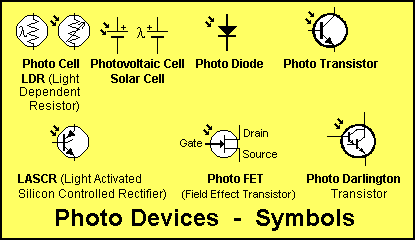
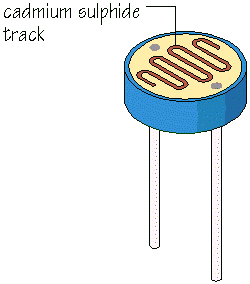
Next step was the receive side…I didnt have access to a photo cell but had a Cadmium Sulphide photo resistor. Connecting a pair of low impedance headphone in series with this cell and a 1.5 volt battery gave me recognisable audio when the cell was in the beam…no amplifier needed!

Next step was greater range…this was achieved with a 6 inch shaving mirror to focus the beam onto the photo resistor. This gave me the length of the street (100 yards when it was dark outside )with the flickering beam shone out of my schoolboy bedroom window resulting in puzzled looks from passers by.

Next problem was the frequency response.. all bass and no treble. Some research indicated that the photo resistor had a slow response so that was part of the problem but I had a hunch… How fast does a filament bulb react to audio? Biasing the bulb with a 1.5 volt cell so that it glowed dimly with no audio improved the audio response greatly.

So what got me into radio…my father was a Chief Radio Officer in the Merchant Navy during WWII and my schoolboy bedtime reading (the only technical stuff I could find ) was his textbook …the 1939 edition of the Admiralty Handbook of Wireless Telegraphy. Capacitors were called condensers and they were measured in ‘jars’!

That was the start of a career. I’ve now moved through testing international telephone exchanges, installing 2 way radio for the whole of Scotland for British Rail (paid for my hobby!) and finally 32 years in IBM writing manufacturing test software from the original IBM PC to Thinkpads.
Now retired I am active on WSPR and am writing Android apps to keep my brain in gear.

I just can’t leave this stuff alone!

Hope this of interest/amusement.

73s

Neil Roberson GM8EUG


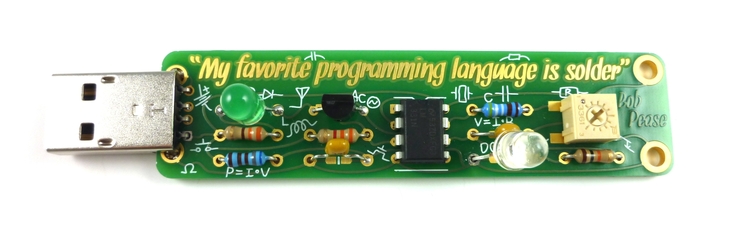
“My Favorite Programming Language is Solder” — Boldport Kits

Look closely at the inscription on that USB stick. Obviously I sympathize. The folks at Boldport have some very interesting ideas and projects. And they operate from a very cool location, just south of the river Thames, not far from my old home in London.

Here is their main site: http://www.boldport.com/blog/2016/2/21/boldport-club-project-1

Here is where you can subscribe to receive a monthly project (with parts!) from them:
https://boldport.cratejoy.com/

As for the solder quote from Bob Pease, this was discussed before on this blog, back in 2011. We were talking about an intereview that had been done with Alan Wolke W2AEW:

I also liked Alan’s response to the question about his favorite software tool: “Gee, solder is soft, can we consider that software? I use a lot of that!” This is very reminiscent of a quote from the legendary Bob Pease (colleague of Jim Williams): “My favorite programming language is solder.” (That quote was sent to me by Steve WA0PWK. Thanks Steve.)

From Paul Darlington M0XPD: A Book!


Our friend Paul Darlington M0XPD is a member in good standing of the International Brotherhood of Electronic Wizards. His AD9850 Arduino shield propelled me into the world of I and Q. His “Shack Nasties” blog is a valuable resource for all of us. And now he has written a book. Paul was kind enough to let me read it before it was published — I enjoyed it very much. It is the story of a very personal journey. At one level it is about Paul’s trip to the Dayton Hamvention. But the trip goes much further than Dayton, both geographically and personally. I especially enjoyed Paul’s observations on the United States — our British cousins often see things we ourselves overlook. I’m really pleased that George Dobbs wrote the foreword — he is the ideal person to do this for Paul’s very philosophical book.

We give “Getting There” our highest review: the coveted FIVE SOLDERING IRONS. And we are nominating Paul for a Brass Figlagee with Bronze Oak Leaf Palm.

Read Paul’s description of the book here:

Buy the book here:
Congratulations Paul!

“Hot Iron” New Issue, Great Articles

I was very pleased to find Tim Walford’s “Hot Iron” journal in my e-mail this morning. Lots of great articles in this edition, including one by a fellow we know: Pete Juliano! Pete writes about our esteemed dual gate MOSFETS. All hail the 40673! There is also a nice article about superhet receivers using a 6 MHz IF and a very convenient analog LC (yea!) oscillator arrangement. Another discusses how to use Huff and Puff stabilizers to take care of VFO drift. N4HAY describes his initial foray into the world of homebrewing and how EMRFD helped him.

Hot Iron is free. Tim writes:

“Hot Iron is published by Tim Walford G3PCJ of Walford Electronics Ltd. for members of the Construction Club. It is a quarterly newsletter, distributed by e mail, and is free to those who have asked for it. Just let me know you would like it by e mailing me at electronics@walfords.net

Thanks Tim!

The Secret Life of Machines — The Radio (Video)

Thanks to Rick N3FJZ for sending this to us. In 25 minutes these fellows manage to capture and explain much of the “magic” of radio. Great shots of Marconi, and of Hertz’s first rig. Amazing how they built their own spark transmitter and coherer receiver, launched a kite antenna and sent a signal across the harbor. Great stuff. Lots of history. We’ve met Mr. Wells before — he was “jailed for having the Knack!”

Modulated Michigan Mighty Mite?


This suggestion from across the pond is a bit “out there.” In fact, for me it brought to mind the famous line from the Noel Coward song about who goes out in the mid-day sun… This does seem like an endeavor for our stoic British cousins. You’ll need a very stiff upper lip to AM modulate a Michigan Mighty Mite! Peter’s observation about the “SSB kilowatt nerds” resonated with me and reminded me of the reaction I got when I tried to put a DSB rig on the air in London. But hey, go for it Peter! Please let us know the results. For those who are rock-bound in the CW portion of the band (like 3579) this might be something fun to try using a dummy load — just to see if you can send an AM Mighty Mite signal across the shack.

Hi Bill,

Your recent Soldersmoke thoughts re. MMMites have been niggling my imagination; I think radio should be fun, educational, simple and cheap, to encourage young folks to get a license and “appliance users” to melt some solder.

Mike Rainey (AA1TJ) and Jim Kearman (KR1S) have done superb work in reducing RF circuits to a functional minimum… so egged on by a certain Mr. Bill Meara, I’m looking at modulating a MMMite Tx on 80m and building the simple Rx to go with it. I chose 3615kHz as it’s a frequency UK VMARS (Vintage Military Amat Rad Soc) use for A.M. – the SSB kilowatt nerds who think the sky will fall down if A.M. corrupts the ionosphere have accepted a few enthusiasts firing a watt or ten of A.M. skywards. I blame you want to say thanks for setting my mind in this direction.

See how this sounds: modulate a MMM by inserting an electret mic capsule (2 terminal type) between the transistor base and ground, not forgetting the RF choke from the electret capsule output to the base bias 10k resistor, to avoid the xtal feedback signal being absorbed in the electret…

Yep, that’s it: job done, the MMM now produces A.M. as the base current, fed by 10k from the +ve rail in the original MMM, is now partially shunted to ground by the electret capsule. I’ll adjust the base bias resistor to get 50% “no speech” carrier and good mod. depth. I’m trying to avoid a mic amp stage; keeps it simple & sweet. If I can get 500mW in total, that’s ~ 100mW in each sideband – on a good day with a following wind, on 80m that should go a mile or twenty.

Which leaves a drop dead simple Rx to design – somebody has done similar, HERE, You got it: an LM386 audio amp as a regen Rx. I had considered the ZN414 TRF Rx, or it’s modern equivalents, but they are nowhere near as common as an LM386, or as cheap. IF it works on 80m…! Or, I could try an xtal controlled regen Rx, as per Mike / Jim’s designs. Either which way, I’m sure I can find a cheap, simple and effective Rx – but if you know of any…..?

Cheers Bill, TTFN!

Peter Thornton G6NGR

The Pleasures of AM, and The 807 (Truly a Bottle Worthy of the Gods)

Sometimes a message posted in the comments section of the blog is so good that it needs to be raised up and converted into a posting all its own. Such is the case with a message that Rupert G6HVY sent us last month about AM and old rigs. 60 meters eh? Hmmm…


Rupert wrote:

It’s always a pleasure to listen to AM QSOs, which hereabouts seem to be mostly on 80 and 60. I bought an FM board for my FT-101ZD with the intention of getting some 10m action, but now I think I’ll leave the AM board in (you can’t have both) for when I get the beast out of storage. AM, even AM that hasn’t been optimised for beautiful audio, sounds so much nicer than SSB.

The other side of AM is to get old military rigs up and running, which is quite the opposite to the golden voice crowd. Another project waiting for time and energy here is an RCA-built Wireless Sets Number 19, which can put out ten watts or so of AM from its 807 (truly a bottle worthy of the gods) – and of course, there are infinite numbers of 50s and 60s vintage thermionic projects in the contemporary magazines. It would be particularly satisfying to find the original PSU for that, as it has two Dynamotors to convert the 24V DC supply to HT, with the transmitter one cutting in when the PTT (sorry, pressel switch) is hit. I say cutting, it actually runs up to speed over a couple of seconds, giving an original 19 Set a very distinctive slow fade-in at the start of an over. Hearing one of those crackling away on 5 MHz is utterly delicious.

Rupert, G6HVY

Colchester Mighty Mite

GM Bill,

So, I got round to making my Michigan Mighty Mite!

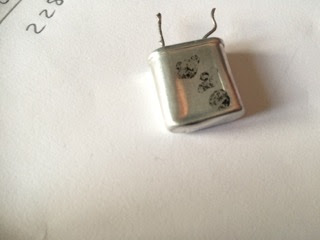
The crystal arrived almost safe and sound, thanks to the USPS’ mail crusher. Perhaps they think that because email and packets can be compressed they can do the same with parcels? (the photo really doesn’t do it justice – the orange area is a large dent…):


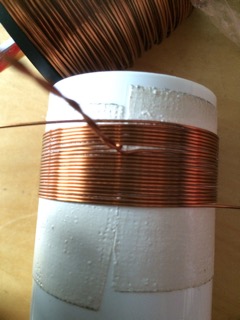
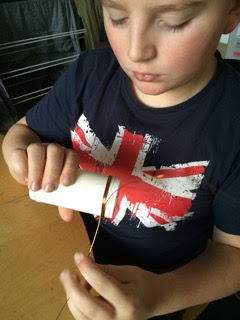
No 2 son, Cameron (12), got involved – The extremely neat tank coil is his handywork :


And so to the video: Not only does it oscillate on the correct frequency as shown here, it also has the added bonuses of oscillating around 21.5Mhz (which is the number my frequency counter gives – which caused a great deal of head-scratching on first smoke), and muting the FM broadcast receiver on 96.1MHz on the shelf 3 feet away!. The dummy load is the 3w metal film resistor suspended in mid air.


You might notice more resistors in the circuit itself than the diagram calls for. I chose to have 2 x 20K resistors in parallel to produce a single 10K resistance that could handle .6W. And the poor old 27R .3W resistor got really hot and discoloured before rapidly increasing its resistance ( !! ), so I used 4 (2 serial pairs in parallel) to handle the current. They still get hot, but survive. And the 2N2222a has a bulldog clip heatsink.

Please excuse the uncorrected error at the end of the CQ call!!

This is the second transmitter I have ever built – the other one is a 30m Hans Summers QRSS kit which you also get the ‘blame’ for 🙂

Thank-you, Bill. Keep up the good work.

73’s de G7TAT, Colchester, England.


More on Light Beam Telephony

Hi Bill,

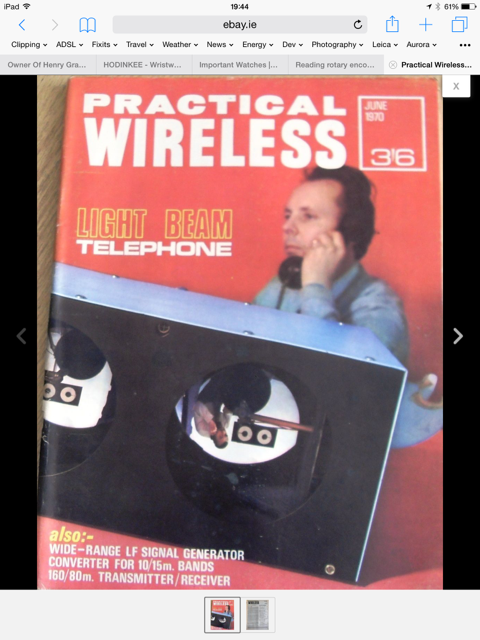
Reading about the Photophone and modulating the Sun experiments by G3ZPF reminded me of my own schooldays when as a final year physics project I think in 1970, I and another pupil built a light modulated telephone based on a design published in Practical Wireless of June 1970 by J. Thornton Lawrence. For the optical system it used a pair of spherical mirrors from old projection televisions. The detector was the expensive (for a school kid) OCP71 photo transistor, though we did also try ordinary less expensive OC71 transistors with the black paint scraped off with less success.
As David G3ZPF noted the problem with filament bulbs was the thermal inertia, and as I found it was also possible for the filament to mechanically resonate in the wooden box and start to howl. As we had never heard of, nor could have afforded an LED, we tried a Neon bulb run from an HT battery and modulated with a transformer in series with it. I recall coupling up a broadcast radio as the audio source playing “My Sweet Lord” by George Harrison and receiving it at the other end of the physics corridor very loud and clear on the audio amplifier on our light telephone receiver, much to the consternation and annoyance of the other teachers in the adjacent classrooms.

I found my black and white photo of the light telephone gear, complete with carbon telephone microphone that we used. It did work a fairly good distance in daylight outside across the school playground, not just the couple of feet shown. Also attached are photos of the original magazine cover and index, but regrettably not the article itself.

This was all before I got my ham ticket, but I already was a SWL and had been exposed to a wonderful ham, Tom GM3OWI (Oh Wild Indians) who visited the school and demonstrated all sorts of neat stuff like lighting a bulb from the output of a transmitter, and also voice modulating a klystron 3cm transmitter that the school had for doing electromagnetic radiation experiments, like polarisation, reflection etc.

Come to think of it, we got to play with a lot of stuff at school in those days which would never be allowed now, mercury, radioactive sources, alpha, beta and gamma, X-Ray and UV. The museum in Edinburgh also had a science area with similar stuff you could play with, and get great shocks from the Van der Graff generator if you put your hand on the glass cabinet and touched the adjacent metal radiator!

Happy days!

73 David Anderson GM4JJJ

Photophone! Modulating the Sun by G3ZPF (and Alexander Graham Bell, and Mr. A.C. Brown of London)

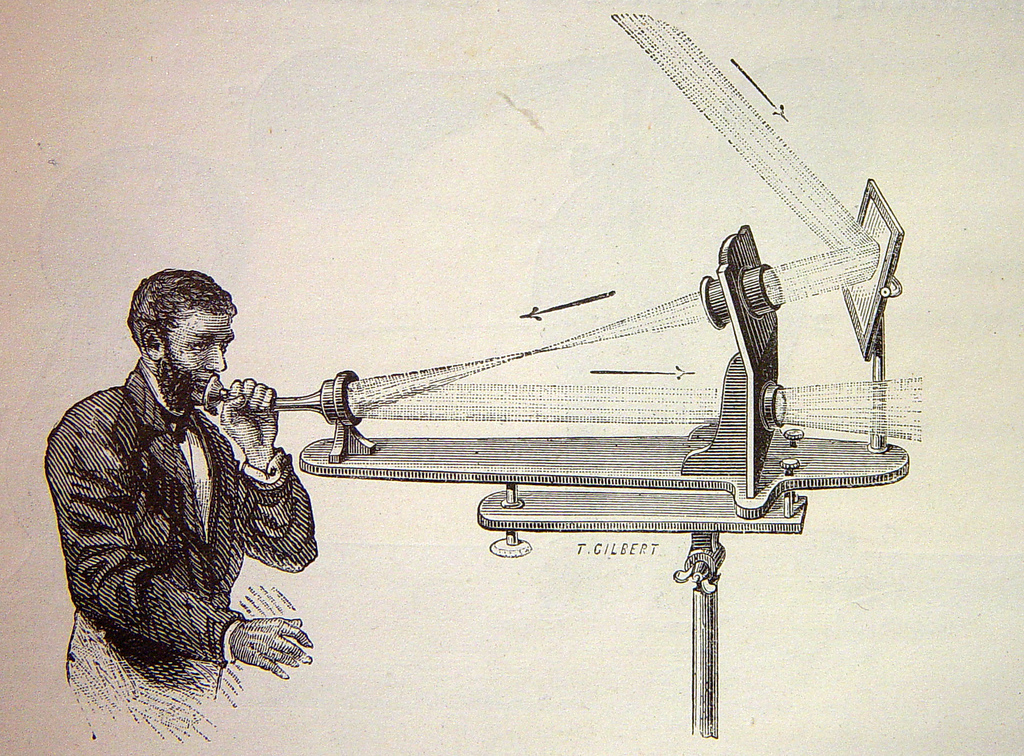
Yesterday David G3ZPF sent us another very interesting e-mail, this one about some very creative sunlight communication experimenting that he and his brother did many years ago. It appears to me that David — on his own — came up with a version of Alexander Graham Bell’s Photophone (pictured above).

Wikipedia says that Bell’s invention was the first ever wireless telephony device. Bell credited Mr. A.C. Brown of London for the first demonstration of speech transmission by light (in 1878).

Here is the Wikipedia article: https://en.wikipedia.org/wiki/Photophone

I think young David’s placement of the small mirror on the cone of the AF amplifier’s loudspeaker was brilliant!


Hello again Bill,

Just (literally) finished the book and a couple of surprises awaited me in the final chapters

SSDRA = $200 on Ebay
My flabber has never been so ghasted….and I have a lot of flabber. I will treat my copy with even more reverence now. Srtangely I hadn’t heard about EMRFD so I’ll need to look into that

Modulating light
Your story about using a laser pen in a receiver reminded me of my method of modulating light which I’ve never seen anyone else mention.

In the mid 60’s my brother had an electronics constructor set for his birthday. After the initial fascination I probably played with it more than him. I remember reading about modulated light transmitters and (because this was before I was anywhere near getting a licence) I decided to build one. My brother was sufficiently curious to help.

We started with the receiver. I purchased an OCP71 and managed to find an old 12″ headlight reflector from somewhere. The cork from a wine bottle fitted nicely into the hole at the centre, and the cork was easily drilled out to accommodate the photo-transistor.

My brother constructed the “high gain audio amplifier” project from his constructor kit and we put two legs of the photo transistor across the mic input. We were rewarded by a buzzing sound so loud our parents yelled at us from the other room. It took us a few seconds to realise we were ‘receiving’ the 50Hz signal off the ceiling light (the house lights were on). Waving the headlight reflector around confirmed this. I still recall the excitement we felt at our ‘discovery’.

So far, so ordinary, but the TX side is where I wandered off into the outfield. Normally people modulated an incandescent bulb but this required a many watts of audio power & the ‘inertia’ of the filament could be a problem.

I cannot remember what prompted me to do this, but next day I pulled the speaker grill off my tiny little medium wave transistor radio and glued a small mirror (from my mothers old ‘compact’) to the cone of the loudspeaker.

Then we went outside into a field near our house. My brother went to the far end and I set up the lil radio on a camping stool. Moving it around until the sunlight reflected off the mirror hit the headlight reflector about 200 yards away.

Then I turned on the radio. Instantly my brother started jumping up and down excitedly. It worked. My 200mW AF amp was modulating the *SUN* !

All those guys on 160m with their 10w of AM…pah. I had GIGAwatts of power under my control 🙂

Looking from the receive end it was possible to see the light from the mirror flickering & I guess the movement of the speaker cone did not move the mirror exactly in the plane of the reflected beam. The ‘wobble’ fooled the phototransistor into seeing an amplitude modulated beam.

The beauty of this was that only a tiny audio amp was needed. This made me wonder about such a system being used in undeveloped countries (ones with more sunshine) as a comms system, with batteries recharged by the sun.

For the UK I thought about using a slide projector to provide the illumination, instead of the sun. Again a very low power audio amp was all that was needed, and there were no ‘inertia’ issues to worry about it.

But I was soon to suffer a setback. A few days later the headlamp reflector, sitting on a desk in my bedroom, managed to find itself in a position to focus the suns rays onto the cork holding the photo-transistor. Cooking the transistor & setting fire to the cork. Luckily my mother smelt the burning cork before any collateral damage was caused but I had a face-chewing when I came home from school.

I’d long since forgotten about all this until reading the later chapters of your book.

regards

David G3ZPF


M1GWZ’s Knack Story: From Crystal Sets to BITXs

M1GWZ writes: “Just to establish my DIY radio credibility, here is a photo of my contest-winning crystal radio. Unpowered, it has logged commercial stations from Ireland to Russia, and from Northern Norway to Algeria. Excuse the mess in the background – the workshop is being re-organized!”

Carissimo Bill (I don’t speak Italian. I’m just showing that I have read the book).

One of the benefits of early retirement after ten years in the electronics industry and twenty-five as a University academic is that one gets the chance to research one’s interests and also have time to experiment with them. You correctly comment that you doubt you will have trouble occupying yourself in retirement – this is true, but be prepared for the frustration of not making as much progress as you would hope for! Chores still steal your time from you – and you have no excuse for avoiding them when you’re retired.
I was recently alerted to the availability of your book via Kindle, but have only just got around to reading it (retirement…). It has been both a joy and a curse. Congratulations! It made fine reading in a couldn’t-put-it-down way, but has also added several more items to my already-arm-length retirement project list. This, of course, is the price one pays for education and for evading the curse of boredom. As a radio ham friend of mine says with a sigh, “So many projects, so few lifetimes.” As a result of reading your book, I am now pursuing satellite communication with my Yaesu handheld, and will put together a dedicated homebrew Yagi-plus-transceiver system in the New Year. The Baofeng two-bander handheld can now be had for £18 in the UK, so I can afford to dedicate one to the system permanently. Cheap technology to talk via satellites! So far, I have just been listening in – for the last three days.
I have been building radios and short wave listening since I was about nine years old. If it wasn’t for a schoolfriend’s father and a crystal set, I might not be e-mailing you now. (They are still talking about killing off MW AM transmissions in the UK. Sad for kids building simple radios, but good news for European DX! Swings and roundabouts. I’d like to give the Xtal Set Society www.midnightscience.com a mention – virtually all the recent crystal radio technology involved was discussed and developed on their forum. ) Upon graduating in 1980, I found a life without exams strange, so I took and passed my amateur radio licence exams as a way of learning more about electronics. Then life intervened (work, romance, microcomputers, marriage, job changes, son) and it was twenty years before I actually took out the licence. No Morse test so I was initially VHF / UHF only, but later the rules changed and I had a full (phone) licence. However, I only wanted to tinker about with handhelds when visiting friends in the USA (met via crystal radio forums on the internet), so my station consists only of a Yaesu VX-7R and a VX-2R (purchased at Dayton Hamvention) as a backup. I’ve never wanted to fork out the grand or so for an HF transceiver (although now I’m retired…), but I would like to reach out on 20 metres. Now, curse you, I realize that I have all the electronic parts to build a BITX SSB transceiver – and may have to do so. Another item on the project list…
Apart from amateur radio and DIY discrete-level DIY electronics, it turns out that we might have a couple more things in common. Through visiting the Dayton Hamvention, I now have many friends via the AMRAD club around Washington DC and have met quite a few hams from the Vienna and Loudon groups. I have attended Dayton for about the last fourteen years but circumstances change and we might now decamp to February’s Hamcation in Orlando. Meanwhile, I live about four miles away from Kempton Park and have attended most of the rallies there, so there is a good chance that we two may at least have occupied the same room, albeit without actually meeting, on at least one occasion. It’s a small, beautiful world.
Anyway, you’re a busy man and I’m a verbose retiree, so I just wanted to thank you for the book and the inspiration it has given me to do more in ham radio. I also build DIY audio projects including (music) synthesizers, but at least I can use up a few more junkbox components before they’re used to weigh down my coffin.

Regards,

Philip Miller Tate M1GWZ

G3ZPF’s Knack Story: Debunking Tech Fairy Tales, Surviving Nixie Tubes and Ferric Oxide

Bill:

I‘m finding the book very entertaining, and am currently about halfway
through it. Like you there were a few electronic ‘fairy tales’ that I
was suckered into and I was pleased to see your debunking of them. My
professional training was structural engineering so anything electronic
I picked up along the road, and was thus an easy mark for misdirection.

I still remember the first time I realized that teachers sometimes don’t
understand what they’re teaching, but just repeating what they were
told. At age 11 we were using a thin tube with a slug of mercury and was
told that at -273c the air under the mercury would have zero volume. I
knew it was BS, but was too young to know why. A decade later I worked
it out for myself, by accident really, and I still feel slightly
resentful about being misled. Turns out that -273c is a ‘convenience’
(aka a fudge factor) which makes the combined gas law work :-p

The first electronic fairy tale I encountered was “the feed impedance of
a half-wave dipole is 72 ohms”. Taught to me while studying for the UK
radio exam, and trotted out repeatedly in the RSGB magazine.

This magically mutated into 50 ohms when the Japanese rigs started to appear,
which made me a tad suspicious, and when my very young self finally
scraped enough cash together for the ARRL handbook I spotted the graph
showing variation of feed impedance with height.

I was devastated. I remember wondering why all the old guys at the club
(who I spent most Sunday mornings listening to on 160m AM as an SWL)
didn’t know this.

In that instant I saw that all my hours of climbing up & down ladders;
cutting and pruning my very low dipoles to get 50ohms (bear in mind how
changeable and usually awful the UK weather is) had been utterly pointless.

From that point on I used doublets + open wire feeder. Up the ladders
just once and all tuning done in the shack in a comfy chair with a coffee
in one hand using a PROPER balanced ATU, not some shonky single ended
thing with a balun on the back.

Of course I found out about saturating balun cores the painful way (a
T200 core stays very hot for a very long time), and accidentally
discovered the current balun (which I called the idle-mans balun) at a
time when nobody distinguished between a voltage balun and a current one.

I took my inspiration from the ‘coax round a ferrite ring’ method of
stopping TV coax braid from conducting my RF into the TV. Fast forward
20 years and current baluns are the way to go. Its tough being a visionary.

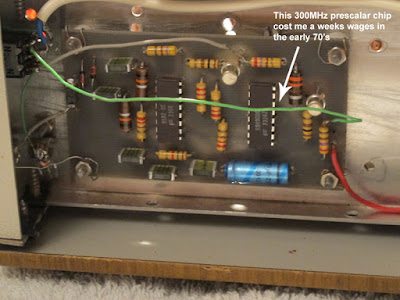
I remember spending a weeks wages (back in the 70’s) on a Fairchild
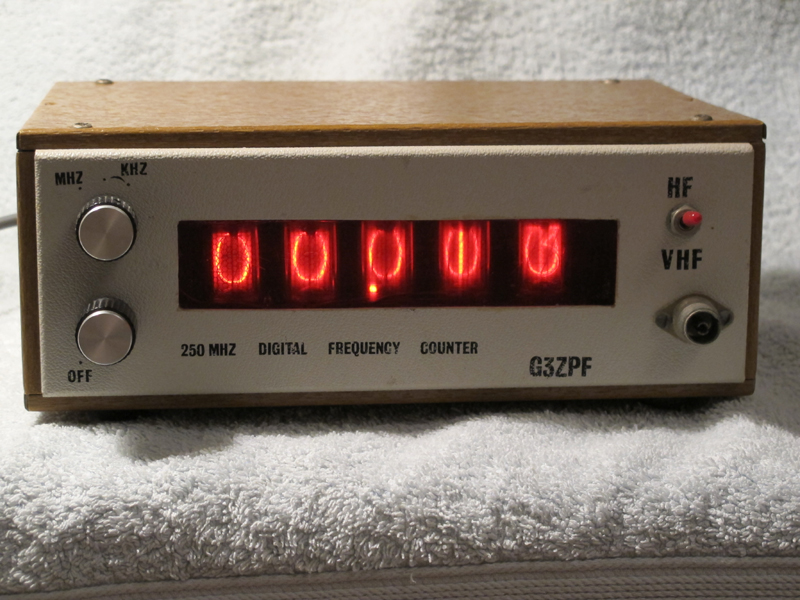
9H59DO prescaler chip for my TTL freq counter. Like you I hate chassis
bashing and the counter only went in a box after I’d had so many jolts
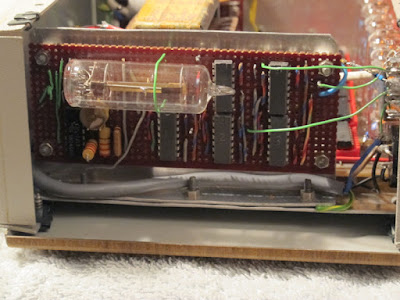
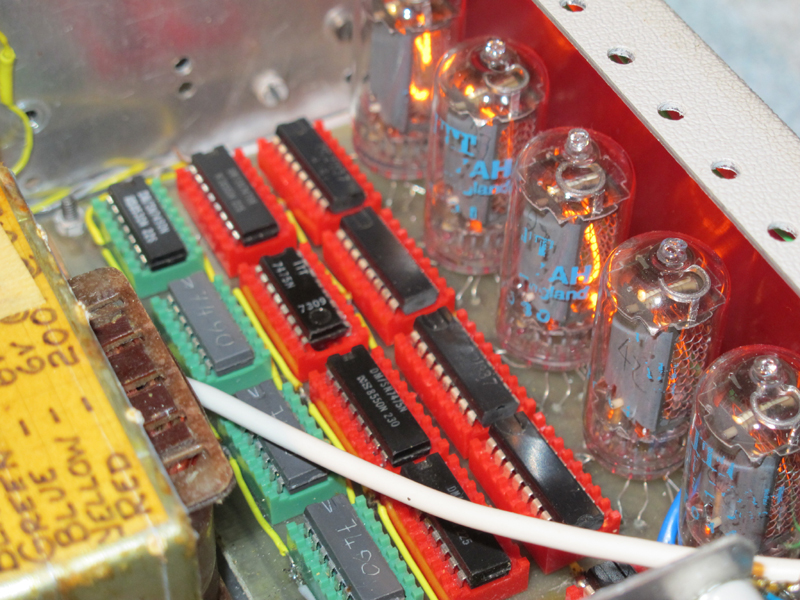
off the 150v rail to the nixie tubes I figured it was box-it or die 🙂

The circuit of the counter was ‘designed’ by me lifting the simplest
version of each part of the circuit from dozens of peoples designs &
just hoping it worked. By the time I’d finished I had learned enough to
know I was lucky it did work….and what a mess spilled Ferric oxide
makes on a pale grey bedroom carpet.


When GQRP first started up a bunch of us locals used to have a 10m net.
Primarily for ragchews but also to give the newly licensed types at the
club their first ever CW QSO on air. We were all sufficiently enthused
to build a 2w xtal controlled 10m CW TX. Using a 2n3819 in the PA & 2w
meant the matching was easy to 50 ohms.

We were all within a few miles of each other so 599+, so one guy built a
half-watt version. Still 599.

I decided to go for it. Grabbed my sig genny off the shelf. It had a 50
ohm output. Lightbulb moment. Set it to 1microvolt outputans keyed the
aerial with it. 539 all round, albeit with some chirp and drift. Well, it
was a valve sig genny.

1uV across 50ohms is qrpppppp. Thats when I realised the million miles
per watt is no challenge at all when radiating extremely low powers over
short distances.

Might be harder today though. Back then we could hear the receiver
noise floor on 10m. Not much chance of that now.

But I confess I was always far more interested in operating than
building. Never had the luxury of a workshop. Always tucked into the
corner of a bedroom. If I couldn’t hold it in one hand and drill it with
the other it couldn’t happen.

I remember hearing that Kennedy had been shot at the instant it
happened. I was on 20m listening to a pair of USA hams rag-chewing and
they both had the TV on. I rushed downstairs to tell my parents who told
me I was talking nonsense “or it would have been on the news”. Took a
couple of hours for it to appear on our TV news.

I used to love chatting to the USA novices on 15m CW back in the late
70’s. Some of those guys were real pros. You could hear them coming back
to your CQ while screwing the trimmers on their xtals to get co-channel.

I still treasure a letter I have from one youngster. It was his first
QSO outside the USA. He tells how his mom got so excited she ran into
the road telling all the neighbours her lad was talking to England.
…..yes the one in Europe 🙂

Life seems a lot more cynical these days.

Even to this day I find the concept of my voice turning into electrons
which throw themselves into space and sometimes hit another piece of wire
in another country and reproduce my voice genuinely ‘magical’. Sadly my
grandkids don’t ‘get it’. They’re happy with Skype, facetime, and TXT.

The closest they came to interest was the eldest grandson (at age 10)
saying “grandad, can I have that telegraph key when you’re dead?”.
Sensing my surprise he added “I’m not interested in morse, but it looks
kinda cool”. Now he’s 20. Bought his first apartment, and his first BMW.
Making his way in the world and glued to his iPhone.

It would be kinda nice to get back onto 160m AM, but sadly the
electrical ‘crud’ levels in the UK are S9+ down there 🙁

I spent 30 years in front of a TS930, which was able to produce proper
AM because where most rigs had one xtal filter it had pairs of them. You
slide the filters over one another to get narrower passbands for CW and
if you slide them past each other you can gget DSB or AM.

Thanks for taking the time to write your book. You’ve lived a very
varied and interesting life. I wrote a SciFi novel back in 1980 but at
that time there was only one scifi agent in the UK and she didnt like
it. Maybe I’ll get it onto kindle one day.

I was expecting a lot of free time in retirement, but between the 3
grandkids and my 94 yr old mom I have less time than when I was working.
But despite the dodgy knees and eyesight its the best job ever 🙂

Regards,

David G3ZPF
www.g3zpf.raota.org
www.raota.org