Barrie Gilbert and Tinkering, Surplus, and the Visceral Experience of Electronics

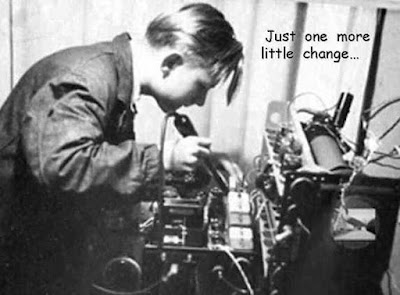
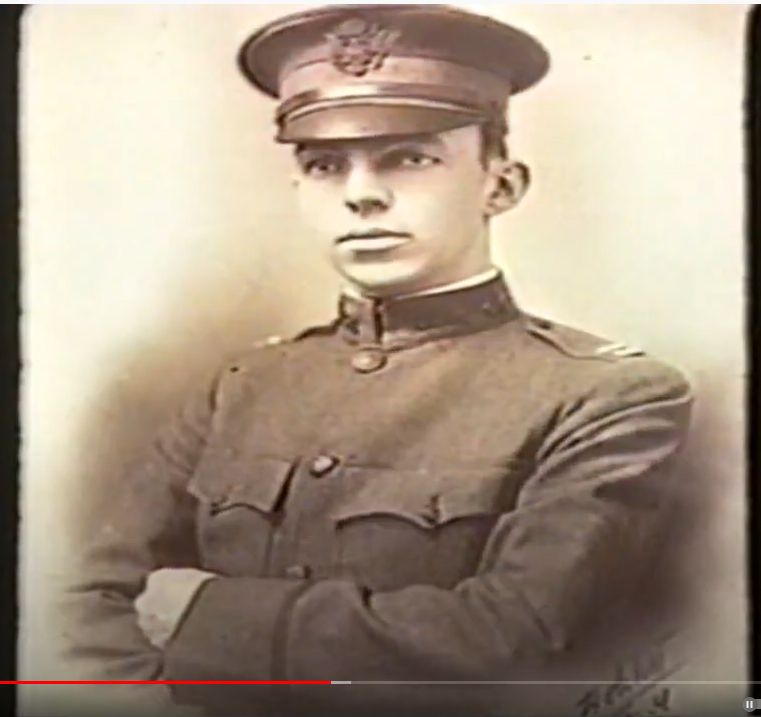
Barrie Gilbert, 1951

From https://www.edn.com/analog-back-to-the-future-part-two/ :

“Gilbert believes that childhood hardships—including at age three losing his father in World War II, leaving his mother and three other children penniless—force one to be resourceful. Before and during his teenage years, he had access to a plethora of inexpensive military surplus gear which greatly helped to make him inventive. Gilbert laments that today’s aspiring engineers are lacking the visceral experience of handling and hefting large coils and tuning capacitors, transformers and vacuum tubes, and such. Today’s surplus circuit boards are all but useless as a source of inspiration, or even “spare parts” to tinker with.”

—————————–

A really wonderful autobiography by Barrie Gilbert starts on page 7 of this page: https://hephaestusaudio.com/media/2009/06/the-gears-of-genius.pdf

Barrie Gilbert and Tinkering, Surplus, and the Visceral Experience of Electronics

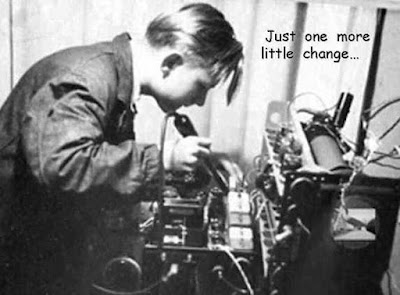
Barrie Gilbert, 1951

From https://www.edn.com/analog-back-to-the-future-part-two/ :

“Gilbert believes that childhood hardships—including at age three losing his father in World War II, leaving his mother and three other children penniless—force one to be resourceful. Before and during his teenage years, he had access to a plethora of inexpensive military surplus gear which greatly helped to make him inventive. Gilbert laments that today’s aspiring engineers are lacking the visceral experience of handling and hefting large coils and tuning capacitors, transformers and vacuum tubes, and such. Today’s surplus circuit boards are all but useless as a source of inspiration, or even “spare parts” to tinker with.”

—————————–

A really wonderful autobiography by Barrie Gilbert starts on page 7 of this page: https://hephaestusaudio.com/media/2009/06/the-gears-of-genius.pdf

Save $2970! Build this $30 DIY Microphone!

There are a number of good ideas in this video. We’ve known for a long time that many expensive mics are really simple, cheap mic capsules in fancy packaging. This video takes a $12 mic capsule (which looks a bit like the ones we are using for the podcast), adds come amplification, a USB interface, and some really cool looking bronze packaging to come up with a very nice microphone.

I liked his use of solder wick as a shield for the DIY mic cable. Who knew the wick was hollow! I also like the cooking torch for use in soldering the brass. I need one of those. The little Murata DC voltage booster with positive and negative output seems useful.

It seems that anyone working on this kind of project quickly gets pulled into the use of “audio speak.” Late in the video Matt says his mic has nice low-end “presence.” A quick look at the comments section shows one person saying that one or the other of the mics sounds a bit “moist.”
There are many other similarly interesting projects on Matt’s YouTube channel:

Save $2970! Build this $30 DIY Microphone!

There are a number of good ideas in this video. We’ve known for a long time that many expensive mics are really simple, cheap mic capsules in fancy packaging. This video takes a $12 mic capsule (which looks a bit like the ones we are using for the podcast), adds come amplification, a USB interface, and some really cool looking bronze packaging to come up with a very nice microphone.

I liked his use of solder wick as a shield for the DIY mic cable. Who knew the wick was hollow! I also like the cooking torch for use in soldering the brass. I need one of those. The little Murata DC voltage booster with positive and negative output seems useful.

It seems that anyone working on this kind of project quickly gets pulled into the use of “audio speak.” Late in the video Matt says his mic has nice low-end “presence.” A quick look at the comments section shows one person saying that one or the other of the mics sounds a bit “moist.”
There are many other similarly interesting projects on Matt’s YouTube channel:

Farhan’s Amazing Knack Story: From a Boyhood SW Receiver to the Design of the sBITX SDR

The presentation starts at about the 4 minute point.

I think if I were only allowed to watch one YouTube video in the next year, I’d make it this one.

In this amazing RSGB video, Ashhar Farhan VU2ESE takes us back to his earliest days as a radio amateur. He tells us about his very early desire to build radios, his early projects, and his personal evolution as a designer and builder, from a simple DC receiver, to the BITX, the Minima, the uBITX and now the hybrid HDR/SDR sBITX.

There is a lot of homebrew wisdom and tribal knowledge in this video. And we learn so many hitherto unknown details about the rigs that have become so important to us:

— Farhan had the EMRFD book with him on the famous flight from Sweden to India during which the BITX was designed.

— We learn about the origins of the BITX oscillator circuits, and that the VFO and BFO are essentially the same.

— I was really pleased that Farhan included a picture of my HB BITX17 rig in his presentation.

— Farhan discusses the difficulties he faced in obtaining needed parts in India.

— We actually see the nylon washers that Farhan used in the original BITX.

— Farhan discusses his early system for measuring coil inductance.

— In addition the huge contribution of EMRFD, Farhan talks about how he was helped by Pat Hawker G3VA’s writing, and the ARRL’s SSB Handbook.

— Farhkan talks about his Tex 465 ‘scope and his building of a Spectrum Analyzer.

— We see his evolution to dual conversion. We see the conceptual birth of the Minima and the birth (thanks Wes!) of the TIA amps. I didn’t know about the HF-1. Then Farhan designed the uBITX and now the sBITX.

— Farhan talks about his practice of taking the pictures of new rigs with the new rig sitting atop the book that was most important in its design and construction. FB.

— I was really blown away by Farhan’s presentation of how the uBITX advertisement was inspired by and in many ways based on the Heathkit ad for an HW-101. Amazing.

— I learned a lot from Farhan’s discussion of SDR theory. I pledge to spend more time with this. I really like Farhan’s hybrid HDR/SDR approach.

— But I have a question: Farhan seems to say that we’d need a big expensive GOOGL computer to do the direct sampling HF SDR. But doesn’t the little RTL-SDR do just that? Without a GOOGL?

— Great to see Wes’s AFTIA being used in the sBITX.

— Really cool that Farhan has his mind on VHF transverters when designing the sBITX. I liked use of the TCXO module to free up one of the Si5351 clock outputs. FB. And great to include an idea from Hans in this rig.

Thanks very much to Farhan (who stayed up until 3 am to do this!) and to the RSGB for hosting.

2 Meter Homebrew: The Fredbox (Video)

I predict a rebirth of interest in 2 meter homebrew. This will probably hit around Christmas time. The impetus will come out of Hyderabad, India. At this point, I can say no more.

I was thinking about all of this today. I remembered “The Fredbox.” G3XBM’s report on this fantastic rig was carried on this blog before it was even a blog. And the Fredbox goes back much further in time — back to the mid-1970s. It must have been great fun to have QSOs with this rig in Cambridge England back in the day. G3XBM actually crossed the English channel with this 10 mW rig. FB.

When I was in London (2003-2007), G3XBM’s post on the Fredbox got me interested in 2 Meter AM. I had a down-converter that let me listen, and I went as far as modifying a Benton Harbor Lunchbox for the proper AM transmit frequency. I don’t think I made any contacts, but I still have the bits and bobs of this rig, so if anyone in the Northern Virginia area wants to get on, please let me know — I will blow the dust off this project and will build a 2 meter antenna.

Here are more details from G3XBM on The Fredbox:
Hans G0UPL got into the Fredbox in 2009 and 2016:

Kintsugi — A Japanese Philosophy for the Owners of Imperfect Rigs

On Sun, Aug 29, 2021 at 4:05 PM Bob Scott wrote:

Hi Bill:

After listening to the latest Soldersmoke I thought you might find the Japanese concept of “kintsugi” (literally “golden joinery”) interesting.


As a philosophy, kintsugi is similar to the Japanese philosophy of wabi-sabi, an embracing of the flawed or imperfect.[11][12] Japanese aesthetics values marks of wear from the use of an object. This can be seen as a rationale for keeping an object around even after it has broken and as a justification of kintsugi itself, highlighting the cracks and repairs as simply an event in the life of an object rather than allowing its service to end at the time of its damage or breakage, and can be seen as a variant of the adage “Waste not, want not”.[13]

Kintsugi can relate to the Japanese philosophy of mushin (無心, “no mind”), which encompasses the concepts of non-attachment, acceptance of change, and fate as aspects of human life.[14]

Not only is there no attempt to hide the damage, but the repair is literally illuminated… a kind of physical expression of the spirit of mushin….Mushin is often literally translated as “no mind,” but carries connotations of fully existing within the moment, of non-attachment, of equanimity amid changing conditions. …The vicissitudes of existence over time, to which all humans are susceptible, could not be clearer than in the breaks, the knocks, and the shattering to which ceramic ware too is subject. This poignancy or aesthetic of existence has been known in Japan as mono no aware, a compassionate sensitivity, or perhaps identification with, [things] outside oneself.

— Christy Bartlett, Flickwerk: The Aesthetics of Mended Japanese Ceramics


73,
Bob KD4EBM

——————————————–

I shared Bob’s Kintsugi message with David, WA1LBP. David was one of the few radio amateurs in the ranks of the Foreign Service. He was in Okinawa during the early 1990s, when I was in Santo Domingo. For a time we both wrote columns in the “73 International” section of Wayne Green’s magazine — this made us “Hambassadors.” David is a real scholar of difficult Asian languages. During my last years in government service I would sometimes cross paths with David at lunch time on the National Mall in Washington — he’d be out there with a colleague, studying ancient Chinese poetry.

Here are David’s thoughts on this:

Thanks, Hambassador Bill.


In Buddhism, muxin (in Chinese wuxin) is about freeing oneself from troubling thoughts, distractions, and selfishness and so attaining a calmness that is very aware of all that goes on at the same time. I suppose once free from distractions one can be more alert. So maybe not literally no mind but no-selfish-obsessed-mind

Amazing what one can find online. A distraction too I suppose!


Chan embraced this account of nonduality and Buddha-nature, but distinctively used it to qualify the meaning of Buddhist practice and the personal ideal of the bodhisattva. In the Platform Sutra attributed to Huineng, he insists that

meditation is the embodiment (ti) of wisdom, and wisdom is the functioning (yong) of meditation.

The point of Chan is to see one’s own “original nature” (benxing, 本性) and realize “authentic heartmind” (zhenxin, 眞心), and in doing so the dualities of thought and reality, of passion and enlightenment, and of the impure and pure all dissolve. Then,

true suchness (zhenru, 真如) is the embodied structure (ti) of thinking, while thinking is the functioning (yong) of true suchness. (Platform Sutra, 13–17)

To see our own original nature is to see that true suchness and thinking are as intimately related as the bodily structure of a horse and its customary activities. Just as the bodily structure of the horse establishes the conditions of possibility for grazing and galloping, it is only the proven evolutionary advantage of grazing and galloping in horse-like ways that have made this bodily structure possible. True suchness or ultimate reality is not a preexistent something “out there” that can be grasped intellectually or accessed through some mystical vision; it can only be enacted.

Huangbo Yixun (d. 850) describes this as demonstrating no-“mind” (wuxin, 無心) or freedom from conceptual impositions that would define or limit reality. But this is not a lapse into mental blankness or indiscriminate presence. Realizing no-“mind” restores our originally whole mind (yixin, 一心) that Huangbo qualifies as the “silent bond” (moqi, 默契) of “conducting oneself as all Buddhas have” (in Taishō shinshō daizūkyu, Vol.48, 2012.380b to 383c). Significantly, the term “qi” originally referred to notches or tally marks on a strip of bamboo that record the terms of a trade agreement and the bonding that Huangbo invokes is thus one of mutually entrusted obligation and responsibility. True suchness consists in the personification of the bodhisattva ideal of realizing liberating forms of relationality. Ultimate reality consists in enacting the morally-inflected nonduality of wisdom and compassion.

David

—————————————————–

I remember that it was George Dobbs, G3RJV who introduced us to the concept of Wabi sabi:

https://soldersmoke.blogspot.com/2010/04/homebrew-hero-george-dobbs-g3rjv.html

This philosophical embrace of imperfection and repair is very appealing to me. I am surrounded by old radios that bear the marks of wear, tear and repair. My homebrew radios are filled with imperfections (especially in the cabinetry). But Kintsugi tells me this is all OK. I accept it.

Thanks Bob. Thanks Hambassador David. And thanks to George Dobbs.

Video: E. Howard Armstrong and Early Radio

This is a really wonderful video. It might seem slow to those accustomed to faster-paced YouTube videos, but the information content is very high — it contains a lot of pictures I hadn’t seen before and audio of Howard Armstrong.

I never knew that the name of the radio company Zenith was derived from the early callsign “9ZN.”

As a Northern Virginian, I like the reference to NAA Arlington.

I used to live near Yonkers, N.Y. I remember Warburton Ave. What a fine shack young Howard had up in that cupola attic.

The photo of Armstrong’s breadboard was very nice. My Mythbuster is in good company.

QRPers will get a kick out of the newspaper headline “New Radio Marvel Revealed!” (They cut the power out from 20kW to 5 watts!)

Thanks again to Dave Bamford W2DAB for sending me the book about Armstrong, “Man of High Fidelity” by Lawrence Lessing.

Finally, I remember talking to Bruce Kelley W2ICE at hamfests. He was a great radio amateur:

Be sure to check out the Antique Wireless Museum’s YouTube Channel. Lots of good stuff there:
We have the famous photo of Major Armstrong,
but this is the first one I’ve seen of a slightly younger Captain E. Howard Armstrong.


More Info on Tom’s Amazing Junkbox 20 meter Receiver (using FPGAs)

Back in June we had a post about an amazing junkbox receiver project carried out by Tom in SW England:


This was a receiver built around SBL-1 mixers and 10.7 MHz filters salvaged from an old satellite receiver. It was also the first radio receiver project undertaken by Tom. His use of FPGA technology is especially interesting.

We asked Tom for more info and he kindly provided it:

Tom also sent me Firmware sourcecode that may be reusable for STM8 users, and the FPGA design file (for Quartus users). If anyone has a GitHub or similar site that can host these files, please let me know and we will send them to you.

M0NTV’s Latest Breadbox Rig — The Radio Gods Have Spoken (TRGHS)!

Tony G4WIF sent me this video from Nick M0NTV. It presents Nick’s latest Bread Bin project — “The Optimizer.”

— I really like the Bread Box enclosures. And leaving the b and the d on the box is just brilliant. These letters now stand for BiDirectional! They even appear symmetrical. TRGHS!

— The switch for a tuning tone is a great idea. I still have to plug my Maplin AF sig gen into the mic jack to do this. FB.

— I too have the connector on the back for keying the outboard linear amplifier. (Shhh! Don’t tell G-QRP!)

— As for the bidirectional TIA amps. I’m really glad that someone else is using these circuits. Wes’s article came out in 2009 and concluded with a call for someone to build a complete rig with these circuits. I wonder how many rigs like this have been made. It is a great circuit. One thing I would suggest for Nick: Wes’s article points out that you CAN have higher gain in one direction than you have in the other. Just use resistor values in the chart provided in the 2009 article. You could have an amp with 15 db in the transmit direction and 24 db in the receive direction. BTW: I have been getting a lot of help from Alan W2AEW and Farhan VU2ESE on how to use the NanoVNA to confirm the input and output impedances on solid state amplifiers.

— For many years I had the same map of the Moon in my shack. I hope that map makes it to the new house Nick.

— Finally, I was really surprised to hear EI0CL calling CQ during Nick’s demo of the receiver. That is Michael Higgins out in Galway. Michael was one of my regular contacts when I was out in the Azores. He is a truly amazing guy. He is mentioned frequently in my “SolderSmoke — Global Adventures in Wireless Electronics” book. TRGHS.

M0NTV’s Latest FB SSB Transceiver

Wow, Nick has a really wonderful rig and has made this great video to explain it.

Elements that I really liked:

— The simple mic and compression. Very nice.
— Termination Insensitive Amps. TIAs Rule!
— Grey Altoid-like boxes.
— Diplexers! Yes!
— Doug DeMaw S-meter.
— No AGC.
— Pentium CPU cooling fan.
— References to EI9GQ (I must get his book!)
— Al Fresco! Good luck with boxing it up Nick.

Tom’s Receiver — A 20 Meter Superhet Built From the Junkbox

Wow, this is really an amazing project. It is so good that I’d like to believe that it is really “all our fault,” but the credit obviously goes to Tom, the very intrepid builder. In a more just world, Tom would be given a ham radio license solely on the basis of this project. Great work Tom. We look forward to more Solder Defined Radios from your workbench.

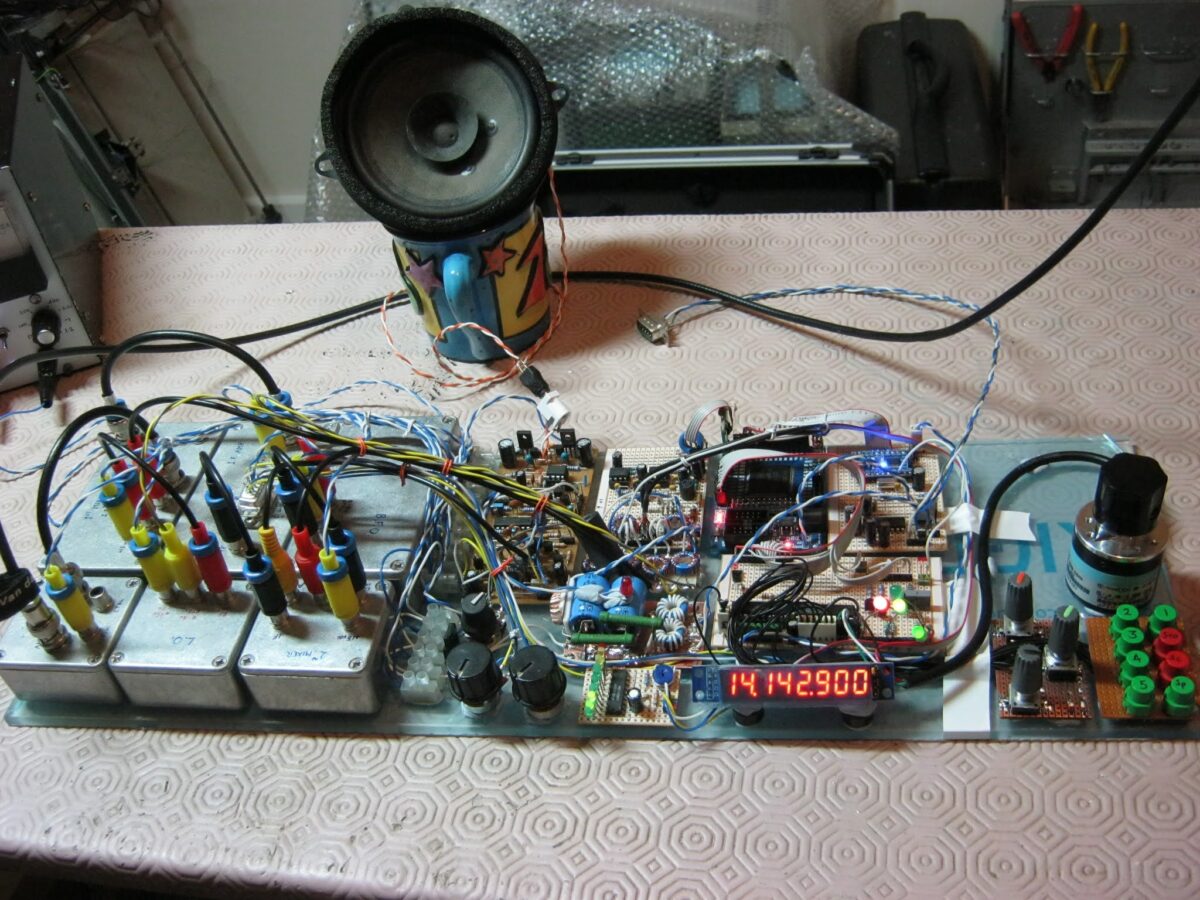
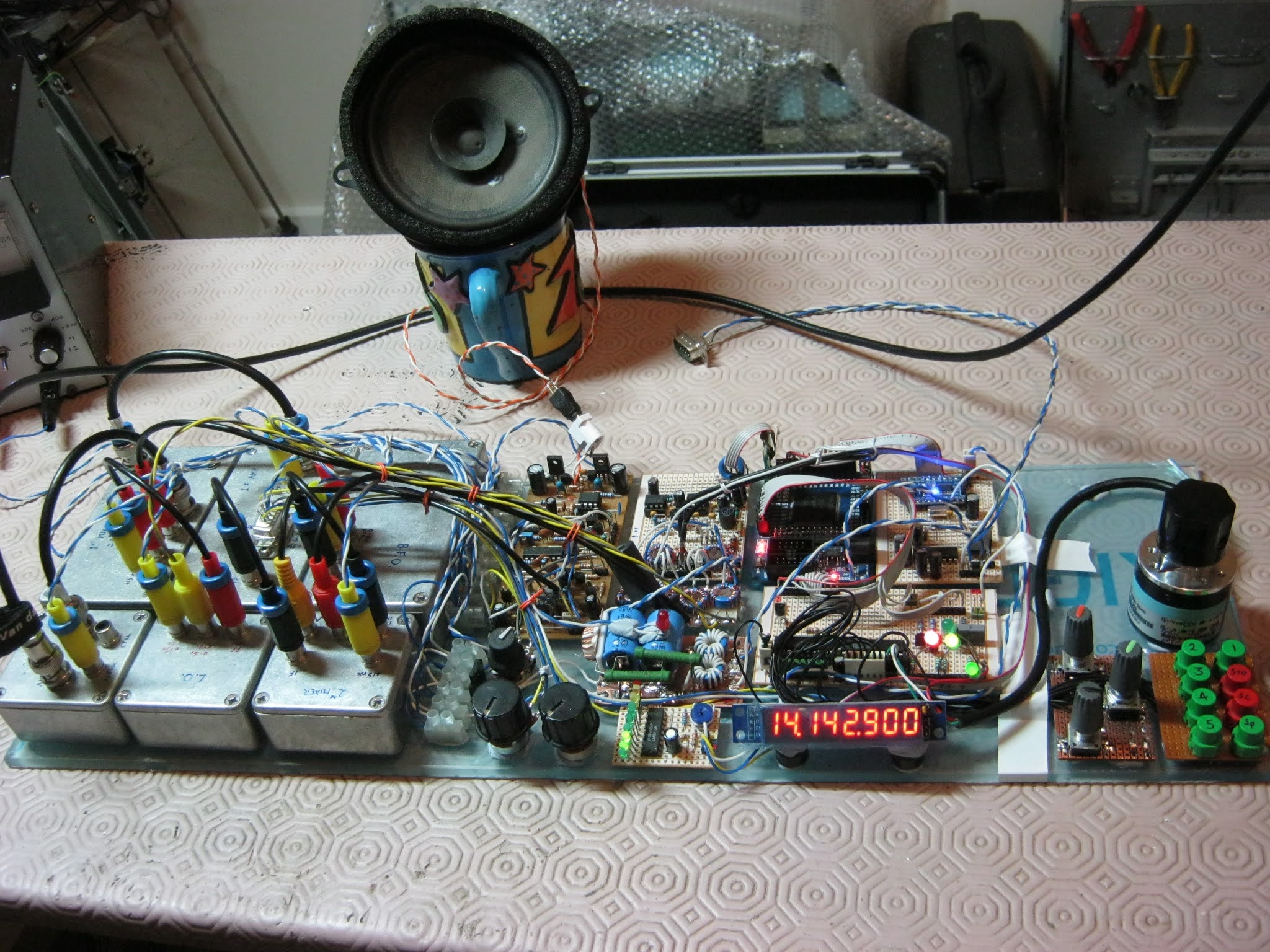
Dear Bill and Pete,

I stumbled across your podcast a few years ago. I had no interest in
amateur radio, I was just looking for an electronics podcast that
actually discussed electronics (naming no names here, obviously).
Well, the inevitable happened, and some of your enthusiasm rubbed off
on me. I now find myself humbly enclosing a photograph of my first
homebrew receiver for 20m.

The project was one of those “spontaneous construction” affairs,
triggered mainly by breaking up an old satellite receiver (I’ve
honestly no idea what it was for) which yielded up several SBL1s and a
10.7MHz crystal filter – these form the key elements of the new
receiver. It’s a full SDR (solder defined radio) of a conventional
single-conversion superhet arrangement. The chief abnormality is that,
because the IF filter is as wide as the proverbial barn door, I only
use “one edge” – the other half of the passband being provided after
conversion to baseband. Of course, that only works if there are no
massively strong stations in the 6kHz above where you’re listening,
but it seems to be ok most of the time. It does give me the advantage
of being able to adjust the lowpass point of the AF signal by
adjusting the BFO, which is nice.

You’ll notice there’s a lot of “digital nonsense” in the picture, for
what’s supposed to be an analogue radio. This “supervises” the two
VCOs: There is an FPGA which implements a pair of frequency meters and
an STM8 microcontroller which is in charge of adjusting the control
voltages to keep the VCOs where they should be. It’s all slightly
roundabout because I wasn’t clever enough to design a PLL which would
give the required resolution (and I wanted to do something “more RF”
than throw down a DDS chip).
This gives me stability as well as fancy bells and whistles, like
numeric readout, tuning info via RS232, automatic scanning and
frequency presets. I’ve used a (cheap) industrial/automation style
encoder for the tuning control, which gives a lovely analogue-like
action.

Despite my best efforts (and a lot of ferrite in strategic places) I
wasn’t able to keep all the digital spurs out of the receiver. So I
devised a dirty hack by way of a button which will shift the MCU an
DAC clocks to a different frequency. I can’t remove the spurs, but now
I can hide them!

So far I’ve played with a “long” wire and a little shielded loop for
antennas – I’m in a first floor flat with a lot of noise locally, and
my plan is to get a loop up in the loft space (so the next project
might be a rotator!). I fancy maybe seeing if I’ve space for an
inverted V, too.

You’ll notice that I’ve not attempted a transmitter. That, of course,
is because I’m not yet a licenced ham! However, I’m intending to put
that right sometime later in the year. Then – who knows – I might make
a contact!

Thanks for reading (although really it’s the least you could do given
that this *is* all your fault) and I hope you’ve enjoyed hearing about
all the trouble your little podcast has got me into.

Keep up the good work gentlemen,
73 from South-West England.
Tom.

PS. I also have a copy of Bill’s book, which I’ve very much enjoyed.
Remastered! The Secret Life of Radio — With Updated Comments from Tim Hunkin

Thanks to Stephen 2E0FXZ for alerting us to this important video.
We first posted about the original many years ago. We were delighted to learn that they have remastered the video and added 10 minutes of retrospective commentary from Tim Hunkin.

Here are some of my reactions after watching the updated version:
— The Marconi videos were amazing. I actually met Elettra at a diplomatic reception in Rome.
— I was pleased to learn that Marconi was trying to “call up” Mars. FB OM.
— My son Billy and I sat in that same Royal Institution auditorium where, 100 years before, Oliver Lodge had demonstrated spark gap technology.
— Tim’s comment on the connection to supernatural beliefs was right on the mark. We found out that the house we lived in in London was a center for occult beliefs and practices.
— Those square lantern batteries brought back fond childhood memories. My first power supplies.
— The Rexophone — used by Rex.
— Very cool of Tim to homebrew a coherer. Extra credit for that.
— One of the capacitors looks familiar. EF Johnson?
— I agree with Tim — crystal radios are a must-build for true radio hams. And do it with galena and a cats whisker.
— Finally, the RCA ad introduces a term we might want to surreptitiously enter into the Enhanced SSB lexicon: That “Golden Throat” sound.

Mending vs. Ending — The Fight Against Planned Obsolescence

We don’t get a lot of mail from Darwin, Australia, so the message coming in from Phil VK8MC immediately got our attention. When I looked into the details I realized that it was very SolderSmoke-relevant. The Guardian article that Phil cited even mentions hobbyists tinkering with electronic devices in their sheds (that would be us!). Phil points to the connection between our repair efforts and the struggle to save the planet: “It’s not just a hobby, it’s an ethical position which contributes to the well being of the planet. A higher calling indeed!”

Here is the article Phil pointed us to:

https://www.theguardian.com/commentisfree/2021/mar/17/ending-over-mending-planned-obsolescence-is-killing-the-planet?CMP=Share_AndroidApp_ProtonMail

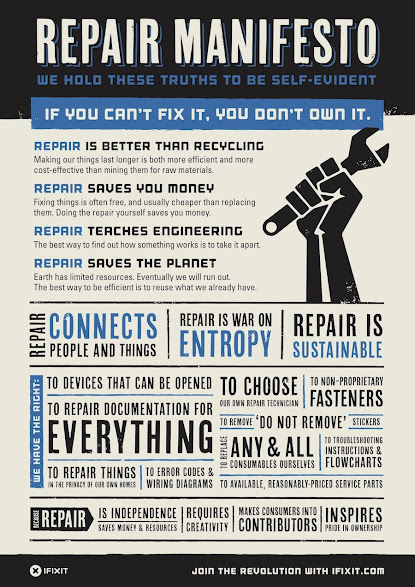
The poster above (which hangs above my workbench) is from https://www.ifixit.com/Manifesto.

The Secret Life of LEDs — A new Tim Hunkins Video

Thanks to Tony G4WIF for alerting us to this really nice video from the fellow who made all those great “Secret Life of Machines” videos. This video on LED’s makes me want to improve the lighting in my work shop. And I think I need some more high wattage resistors. I’m really glad Tim Hunkins is making more videos. His look at the Secret Life of Radio was a real masterpiece.

AA7EE Casually Kills a Direct Conversion Receiver, then Coldly Discards a Diode Ring Mixer

I was really glad to see that Dave AA7EE has — after a long absence — posted another article on his blog. The article has some great personal reminiscences about his involvement with direct conversion receivers. Here is one passage:

I spent many happy hours tuning around and listening on 80M with the DSB80. It was this first experience that cemented my affinity for direct conversion receivers built with commercially available diode ring mixer packages. It just seemed so simple – you squirt RF into one port, a VFO into the other, and (after passing the result through a diplexer) amplify the heck out of the result. The seeming simplicity of the process of converting RF directly to baseband audio has held great appeal for me ever since. Unfortunately, that project didn’t survive. One day, in later adulthood, in my apartment in Hollywood, I reversed the polarity of the 12V DC supply and, discouraged at it’s subsequent refusal to work, tossed the whole thing away. Now, I cannot quite believe that I did that, but it was during a long period of inactivity on the ham bands, and complete lack of interest. If only I could go back, and not have thrown it into the dumpster of my apartment building! Hollywood is ridden with recent notable history. My little double sideband transceiver met it’s unfortunate end just 100 feet from the spot where Bobby Fuller, of The Bobby Fuller Four, was found dead in his car, in 1966, the subject of a still unsolved mystery to this day. The death of my little DSB rig was a lot less mysterious. To think that I heartlessly tossed an SBL-1 mixer into a dumpster, is a mark of how far I had strayed from my homebrewing roots, forged in a little village in England. Now, a few years later, in a city known for it’s sin and excess, I had cruelly ended the life of a stout and honest diode ring mixer. I suppose I should spare a thought for the polyvaricon but, well, you know – it was a polyvaricon!

https://aa7ee.wordpress.com/2021/03/04/the-ve7bpo-direct-conversion-receiver-mainframe/

Update from the Wizard of Wimbledon — “Always listen to Pete”

In a recent podcast, Pete mentioned that Leo Sampson (the young Brit who is rebuilding the sailing yacht “Tally Ho”) should seal the deal with his girlfriend. Well, it seems that “life coach” should be added to Pete’s already impressive list of abilities (homebrew hero, pasta chef, guitar player, etc.) A while back Pete gave similar advice to Jonathan, M0JGH. This morning, Jonathan reported in, confirming that Pete’s advice was completely correct. A “mixing product” arrived early in the lockdown. Congratulations to Jonathan and his remarkably radio-tolerant wife. It seems Leo should be shopping for a ring.

————————–

Dear Bill and Pete

I hope that you and your families are staying very well during these extraordinary times.

I wanted to thank you both for the reminiscent shout-out during the last podcast, whilst you were suggesting that Leo Sampson of sailing yacht Tally Ho should “seal the deal” with his girlfriend. If our case study is indicative of his future prospects, he absolutely should do! Not only are we happily married but we welcomed a bubbly baby girl into our family at the start of lockdown. (I note that hams refer to children as “harmonics”, but wouldn’t mixer products be a more appropriate metaphor?)

Apologies for my radio silence of late. Circumstances have allowed me the rare and special opportunity to take more of a lead with parenting, and so my soldering iron has only been wielded for maintenance purposes rather. Your discussion about the intrigue of distant voices emerging from homebrew rigs has whetted this CW addict’s appetite to build something for SSB or even DSB, and likely for one of the higher bands…

I feel that I should briefly stick up for the art of CW, though. As a keen amateur musician the ability to communicate through rhythm will always hold a special charm, particularly when you consider that many of my regular EU chums on 40 and 80 are easily identifiable by their “distinctive fists”. I recall a true WW2 spy story in which a double agent, I forget which, was rather unwell but still had to be carried into the radio tent to send his CW whilst lying on a stretcher, otherwise the Germans might notice the absence of this distinctive fist and realize that the game is up!

73 from Wimbledon

Jonathan
M0JGH

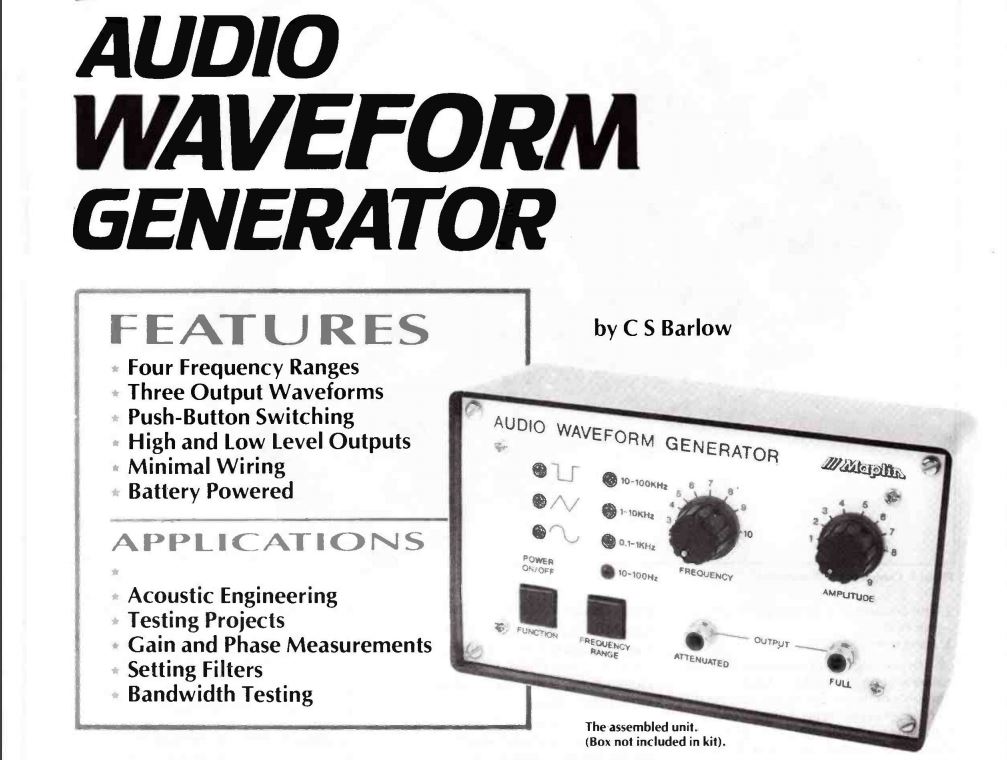
Repairing My Maplin Audio Waveform Generator

I picked this generator at the Kempton Park rally in London many years ago. I use it quite a bit, not only for circuit testing but also as an easy way to get my homebrew BITX rigs to send a signal so that I can adjust my antenna. I just plug this thing into the mic jack, crank in a small amount of 1 kHz audio, and I am ready to minimize SWR.


It never gave me any real problems until last week. I opened it up and examined the circuitry for the first time. Lots of mystery chips in there. Fortunately they are all socketed. Thank you Maplin.

Even without really knowing how each of the ICs work, it was easy to troubleshoot. See the schematic in the article that begins on page 21 in this .pdf:


My Rigol scope showed a good signal going into and coming out of IC8, the LF351 op-amp. From there the signal goes to IC5 a 4066BE. But nothing was coming out of IC5. Thus IC5 was my lead suspect. I put in a quick order to Digikey. A couple of days and a few bucks later the chips (as always, I ordered several) were on my doorstep. Within a few minutes IC5 was replaced and the generator was as good as new.

One annoying problem with this generator is that it has no automatic shut-off circuitry. So if I forget to turn it off, I soon have to buy two 9V batteries. Tony G4WIF suggested a simple timer circuit. I may do that soon. Or, given that we are already on the IC dark side with this project, there is this: https://www.youtube.com/watch?v=C4C2H_3BU3o&feature=youtu.be

I recently find myself replacing a lot of chips in various rigs and devices in my shack. It seems that chips go bad more frequently than discrete transistors or even tubes. But maybe I’m just using older gear with older, more fragile chips. What do you folks think?