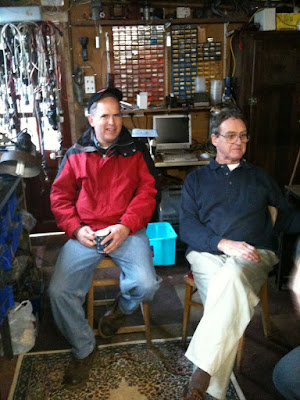
For anyone who wants to find this on Google Earth, it is at the corner of Jersey Pike and Shallowford Road in Chattanooga Tennessee, near the intersection with the TN 153 freeway.
Category: UK
Some Tech Humor
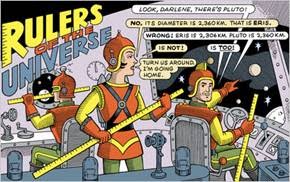
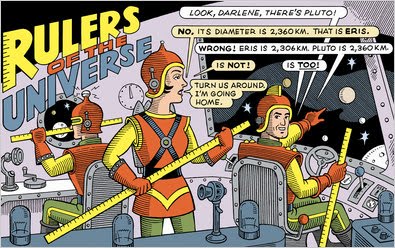
Apparently Pluto’s demotion from planet status might have been a bit unfair. Researchers say that the rival to Pluto that was discovered six years ago is actually smaller than Pluto.
And I thought this BBC skit on computer problems would yield a few chuckles from the SolderSmoke community. (For U.S. readers: Orange is a big ISP/mobile phone provider in the UK and elsewhere.):
http://www.youtube.com/watch?v=kAG39jKi0lI
G3ROO’s AMAZING Antenna Book
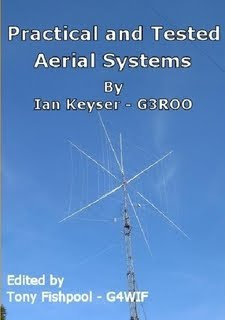
A few years back Ian Keyser, G3ROO, put together a really wonderful antenna book. It is very “down to earth,” very practical, very useful for hams seeking to succeed with homebrew antennas. The book was edited by another great person from G-QRP Club — Tony Fishpool, G4WIF. It has been out of print, but Ian has just made it available through Lulu.com.
Lulu is the printer who also handles my book: “SolderSmoke — Global Adventures in Wireless Electronics.” This means that you can order both books at the same time, perhaps saving on shipping costs. (But remember, for U.S., buyers shipping is free all summer long. ) And there is a 10 percent off sale for all buyers during the month of May (Coupon Code: FLOWERS).
Check out Ian’s book here:
http://www.lulu.com/product/paperback/practical-and-tested-aerial-systems/10904725
For more info on the SolderSmoke book, go here:
http://soldersmoke.com/book.htm
YET ANOTHER HB DSB QRP WSPR Station! And more “inverted FSK”!
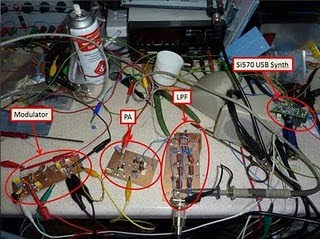
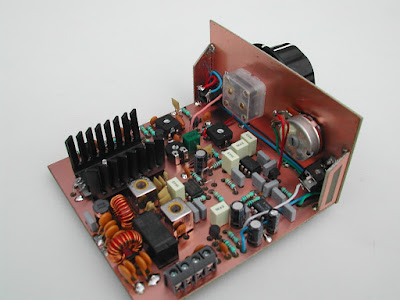
Paul, M0XPD, reports that he has joined the DSB revolution and has put a homebrew DOUBLE Sideband WSPR signal on the air. The rig is pictured above. So I can no longer claim to be the ONLY DSB WSPR station in the world. FB Paul. For more details go to Paul’s site:
http://m0xpd.blogspot.com/2010/05/homebrewed-whispers.html
This was the second time in a week that I’ve found someone else doing the same nutty thing that I’ve been doing. The first incident involved G0XAR. I found him transmitting upside down FSK on 30 meters. Again, I am no longer alone…
Note that both of my colleagues in radio eccentricity are from Britain, a land that takes justifiable pride in its eccentric boffins!
Altoids to the Max!
Rogier, KJ6ETL, sent an interesting link to some inspirational projects involving Altoids tins:
http://blog.makezine.com/archive/altoids_and_tin_cases/ The first one that appears seems to belong somewhere else — just scroll down to find the tins.
Wiki provides background info:
Altoids are a brand of breath mints that have existed since the turn of the 19th century. Altoids are less widely available in Britain—their country of origin—than in the regions to which they are exported, the standard peppermint mints being the only flavour available and only stocked in relatively few stores. Callard & Bowser-Suchard manufacture and produce Altoids at a plant in Bridgend, Wales, although Wrigley, the brand’s owner, announced in mid 2005 they planned to move Altoids’ production to an existing plant in Chattanooga, Tennessee, in order to manufacture its products closer to where they are sold.
The history of Altoids dates back to the reign of King George III. The brand was created by a London-based Smith & Company in the 1780s but eventually became part of the Callard & Bowser company in the 1800s. Their advertising slogan has been “The Original Celebrated Curiously Strong (insert flavour here) Mints” for a number of years, referring to the high concentration of peppermint oil used in the original flavour lozenge. The “Story of Altoids” text is printed on the paper liner inside certain tins.
—————————————————
One cautionary note: Apparently Altoids mints played a minor role in the Bill Clinton-Monica Lewinsky mess. We won’t go into the technical details here, but suffice it to say that a collection of Altoids tins on your desk at work may raise some eyebrows among some of your colleagues.
The FUNKY Keyer
Paul up in Manchester has some really intriguing ideas on CW and keyers. He likes highly personalized CW from straight keys, and thinks he can even hear the influence of Latin-based languages when receiving signals from stations in France and other Romance language countries. (Like me, he also thinks a bit of homebrew chirp adds some character to signals. ) Automatic keyers seem to squeeze all of the individuality out of CW. So Paul has written some computer code to put that individuality back in! Can we get a “Lake Erie Swing” option Paul? Check out Paul’s blog. Interesting stuff!
Hi Bill
Further to the kind words of introduction you gave me as a “new homebrewer” in Soldersmoke 104, I’m writing to let you know about a little project of mine which I think you might appreciate…
I made a h/b keyer a while back and recently added the ability to send automated 3*3 cq calls (and cq FISTS calls).
On doing this, I realized how much I HATE the sound of machine generated CW – so mechanical and lifeless. I want to hear a real fist – preferably with some chirp and drift thrown in for good measure!
So – I’ve come up with an alternative – The FUNKY keyer!
It adds some random timing “jitter” to each automated cq call, to simulate the sound of a real fist on a straight key.
You can read all about the Funky Keyer on my blog, http://m0xpd.blogspot.com
The blog also documents some of the other outcomes of my personal puffs of solder smoke, including the “Funster PLUS” 40m CW Transceiver and the “Not-so-superhet” experimental valve receiver. There’s some operating stuff, including WSPR on 40 and 80m with my Softrock SDR and I was inspired by Soldersmoke to include some travelog – ZL, VR2, BY, HB, etc.
Hope you enjoy it.
Let me take this opportunity to thank you for all the enthusiasm and inspiration you continue to give us in Soldersmoke,
73 de Paul, m0xpd
Paul Darlington
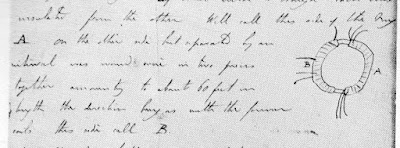
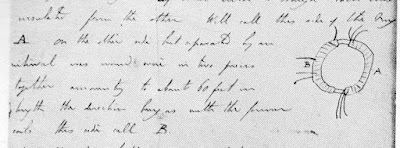
Faraday’s Transformer Diagram
Faraday’s Shack and the First Transformer
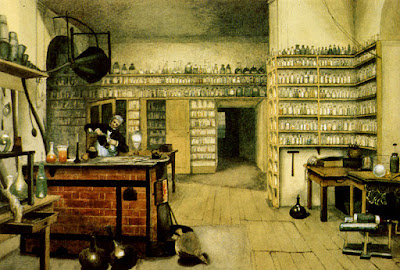
In London, Billy and I visited Faraday’s workshop in the Royal Institution. Poor Michael set up shop in the servants’ quarters in the basement. The shop is still down there (behind glass and well-preserved now). The painting above depicts Faraday at work in his shack.
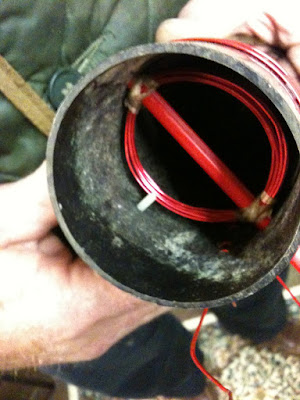
On display was the very first electrical transformer. And guess what guys: It was a toroid! Here is a picture of it:
I found one of Faraday’s drawings of the toroidal transformer and its windings. It looks a lot like the drawings of Doug DeMaw! I’ll scan it and post it tomorrow. Off to work now.
At the Royal Institution
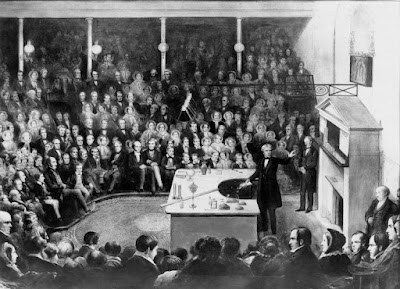
The Royal Institution in London is one of the world’s most important scientific organizations. In the picture above, Michael Faraday delivers one of the famous “Christmas Lectures.”
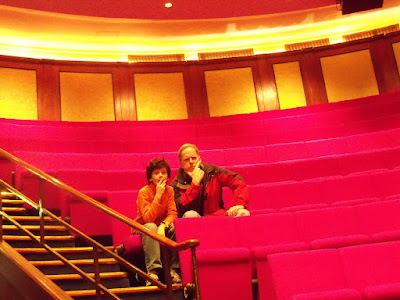
Billy and I visited the RI a couple of weeks ago and got to sit in the famous theater.
I even got to stand at the famous desk on which so much new science was presented to the world. More on the RI (and Michael Faraday) tomorrow.
Marconi’s House in London
In London, the places where famous people lived are marked with Blue Plaques. I knew that Marconi’s name was on the list, but I had never actually seen his plaque. When we were up in London last month we were staying in Marconi’s old neighbourhood (Bayswater) so and Billy and I decided to take a look. Video by Billy.
This house is mentioned in the book Thunderstruck by Eric Larson and in Peter Jensen’s wonderful Early Radio. Marconi lived here as a young man. His mother took him to London in order to get patent protection for his wireless invention. The way in which Marconi’s mom watched out for her son’s intellectual property rights reminds me of the way Bill Gates’ dad watched out for his.
Marconi’s arrival in the UK was a bit difficult. British customs officers were apparently very suspicious of the strange device being brought in by the young Italian. One book hinted that they might have thought that Marconi was involved in some plot to kill Queen Victoria. During the inspection serious damage was done to Marconi’s rig.
Dover update: Falling from tree, B2 inheritance?, HB variometer
That’s me (the new boy in the workshop) at the key of Ian G3ROO’s B2 spy set. Beautiful rig. You will all, I’m sure, understand Nigel M0NDE’s question to Ian (see below). The Dover variometer project is very interesting (picture at the bottom). Thanks Nigel! (Try to keep Ian at ground level, OK?)
Black Holes in Workshops?
When I was out in Dover (UK) last week the fellows in the Dover Construction Club alerted me to a problem that has been affecting their workshop, and that may be causing trouble in yours: black holes. Apparently through some strange quirk of quantum physics, small black holes are sometimes generated in electronics workshops. They cause parts and tools to disappear. The quantum element of all this is readily apparent: only those parts and tools that you REALLY need disappear. If you don’t need a particular part or tool, it will not be affected. The guys out in Dover recently lost a variometer this way, and while I was there a telegraph key briefly disappeared into the quantum mist. In a variation of this phenomenon, very small black holes sometimes pop out of the quantum vacuum when small parts are dropped to the floor — that’s why you often can’t find them! SMT parts are especially susceptible to this (obviously because some of the damn things are getting down to quantum scale) . I don’t really know what can be done to counteract this problem — if you have any suggestions, please post a comment.
On a related subject, Jim Miller sent us this:
|
SolderSmoke Podcast #122
SolderSmoke!
A SHOW FOR ELECTRONICS HOMEBREWERS!
Listen at: http://www.soldersmoke.com
SolderSmoke #122
Feb 28, 2010
Snow in Rome!
In London: A visit to Marconi’s house, Maplins, and Faraday’s lab
A visit to the Dover Construction Club
Computer problems resolved
A short period of QRSS, then back to WSPR
Putting the Drake 2-B into WSPR mode
The Rome-Norway WSPR pipeline
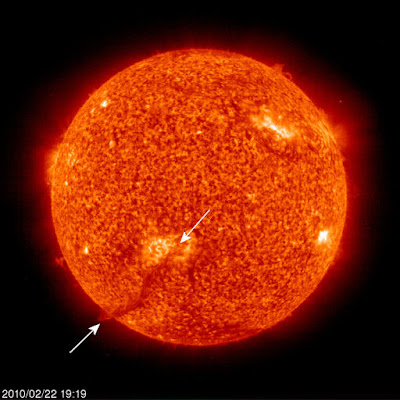
Increased solar activity
50 years of SETI with Frank Drake
QQ Review
Work Bench Eye Candy
Movie Review: UP! (Five Soldering Irons)
MAILBAG
Homebrew QRP Contest… With DSB!
Homebrew QRP (DSB!) Contest

Hi Bill
BATH BUILDATHON CONTEST RULES 2010
Background: This contest is primarily intended to activate the radios built at the Bath Buildathon events but is open to all
- 14:00 to 16:00UTC, Sunday 30th May
- 18:00 to 20:00UTC, Monday 31st May to Friday 4th June inclusive
- 10:00 to 12:00UTC, Saturday 5th June
Scoring per QSO:
- With a QRO station (over 10W) = 1 point.
- With a factory built QRP station (max 10W) = 10 points.
- With a homebrew QRP station (max 10W) = 20 points.
- With a the ‘BBC’ (Bath Buildathon Crew; G0FUW, G3VTO, G4YTN) = 50 points.
- Entrants using homebrew transceivers = add 100 points to total.
Multiplier: Your total points per session will be multiplied by the number of stations you worked who were using Brendon transceivers constructed at one of the Bath Buildathon events. Note: the adjudicators will apply the multiplier after the contest.
Spy Radio: “The Looking Glass War”
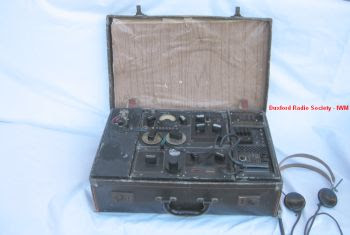
Dave in Ireland alerted me to some interesting radio content in the John LeCarre spy novel “The Looking Glass War.” (I think presenting this excerpt is allowable under “fair use.”) Dave reports that the radio they are working on is the one pictured above. It is a British B2, SOE Type 3. The instructor obviously has the Knack, but the student seems a bit shaky.
‘Now it’s Fred’s turn...’
The D-104 — A Completely Respectable Piece of Ham Radio Gear
Recently we have received some comments along the lines of, “Hey Bill, what’s that chrome CB-lookin’ mic doin’ in your shack?” Having come into ham radio during the great Amateur vs. Citizen Band wars of the 1970s, naturally I was quite stung. Fortunately, an old magazine soon arrived with a photo (above) that should end forever any speculation about the D-104 being somehow “CB.” The picture above is from the January 1952 issue of “The Shortwave Magazine” from the UK. G3ZI, L.S. Woollatt, is shown with his very fine station. With the exception of his two main receivers, all of this OM’s gear was homebrew. Racks and racks of FB HB gear. If a chrome lollipop was OK with G3ZI, well, then I think that settles it.
Micro Men on the BBC: Sinclairs, Acorns, and the Knack
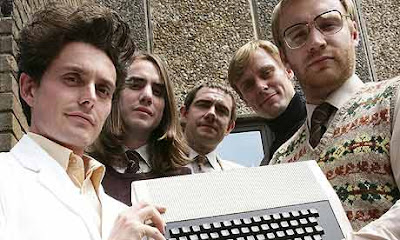
Now these guys look like some proper British boffins!
Tony Fishpool, G4WIF, sent me this link to a wonderful new BBC program about the early days of home computing: http://www.guardian.co.uk/technology/gamesblog/2009/oct/08/armstrong-freeman-micro-men-bbc
Tony also sent me his own story of computer derring-do in the early days. Here Tony once again marks himself as a true Knack victim, and a true wizard. Commenting on the BBC show, Tony wrote:
…I enjoyed a huge dose of nostalgia. I owned both Sinclair and Acorn computers back then and I suppose they launched me on a geek career that’s put food on the table ever since.
One of the first Christmas’s of my early married life tested my new bride’s
patience with a knack victim for a husband.
A long awaited Acorn Atom kit computer finally arrived on Christmas Eve. All during Christmas day I was hunched over a steaming soldering iron installing every capacitor, resistor and semiconductor in the computer’s printed circuit board.
That evening after the last component was installed I applied power and
there was a beep and the TV (which should have been showing Christmas
movies) displayed :-
Acorn Computers
Ready>
Wow!
How I managed to get that computer working first time still amazes me to
this day. How I am still married amazes me even more – but I was “in the
zone” and that computer just had to be built.
The TV show is called “Micro Men” so look out for it.
Kind regards
Tony G4WIF
RSGB Convention… via Skype
The fellows running the RSGB convention asked me to come up to the UK and speak at this year’s event. I couldn’t make the trip, but we decided to try to set up a virtual appearance via Skype video. Brian, G8OSN, put it all together, and the link worked like a charm. It was really a lot of fun, and I didn’t have to be away from the family.
As noted below, you can see a video of one version of my talk by clicking on the video links off to the sides of this blog page. Thanks again to RSGB, and especially to Brian, for giving me the chance to do this.