Kick Panel Progress; Podcast Delay

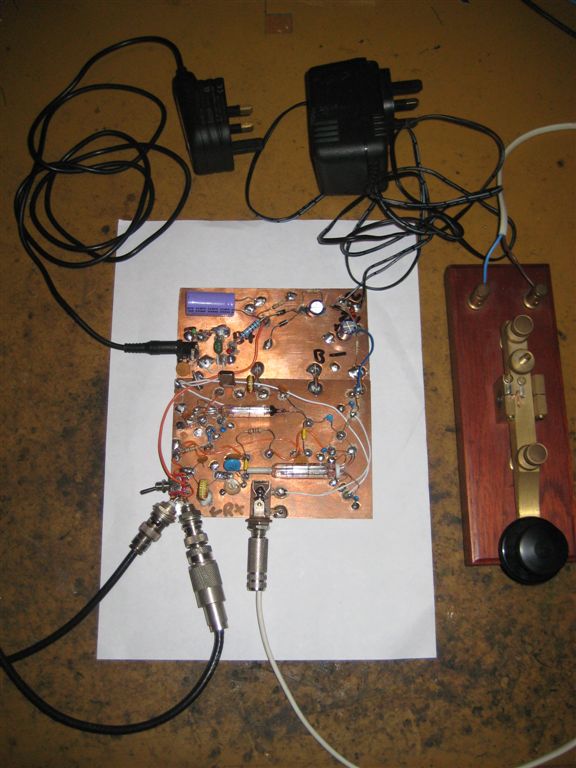
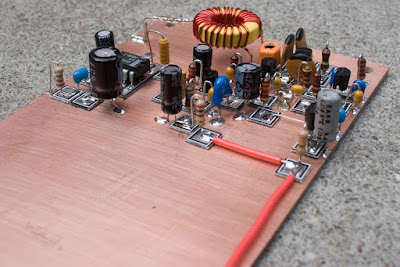
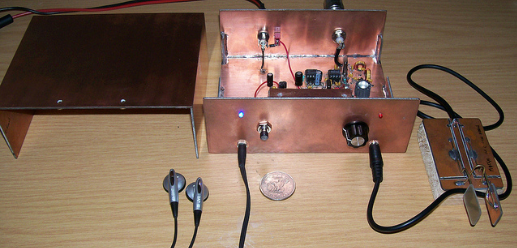
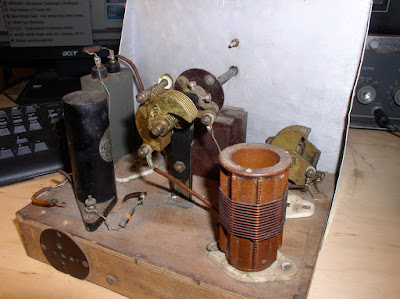
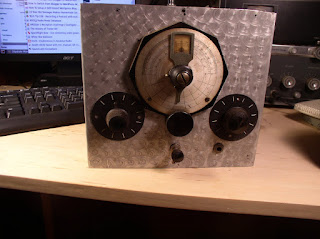
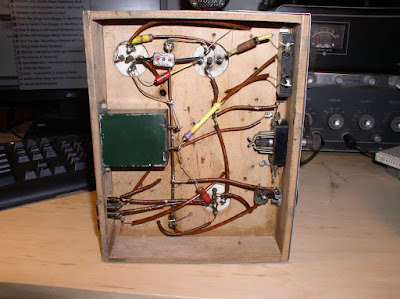
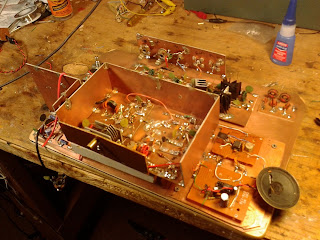
I’m kind of behind on podcast production, but once again I have a good excuse: I’ve been melting solder. I decided to finally finish the Kick Panel DSB rig that I started building back in London. It is built on a kitchen cutting board purchased in a Dyas store in Windsor. The cabinet is fashioned from an aluminum kick panel for a door (a pub door!).

I originally intended this to be just a transmitter (for use with my trusty Drake 2-B) but it is so easy to add a direct conversion receiver to a DSB rig that I just threw together a version of the NE-602 LM386 Neophyte receiver and hooked it up to the 75 meter VFO. It sounds great. I love DC receivers. They seem to connect you directly to the ether. And now I’ll have a complete 75 meter DSB station in one box.

This morning I tested the balanced modulator (singly balanced with two diodes). DSB is being generated. All I have to do now is put a little 6 db pad between the modulator and the amplifier chain, then work on the antenna a bit and I should be on 75. The amplifier chain dates back to the period when Mike, KL7R, and I were using LTSpice to design amps….

I was very pleased to include in this rig a part that Michael, AA1TJ, sent me: I have a little 10.7 MHz IF can in the front end of the RX. A cap allows it to tune in 75 meters. Thanks Mike!

I hope to get a podcast out this weekend (if the computers cooperate — the Sony Vaios “light bulb-repaired” laptop finally gave up the ghost last weekend.)

Our book: “SolderSmoke — Global Adventures in Wireless Electronics” http://soldersmoke.com/book.htm Our coffee mugs, T-Shirts, bumper stickers: http://www.cafepress.com/SolderSmoke Our Book Store: http://astore.amazon.com/contracross-20
Back to the “Kick Panel” DSB Rig

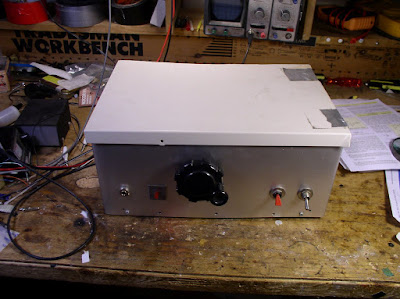
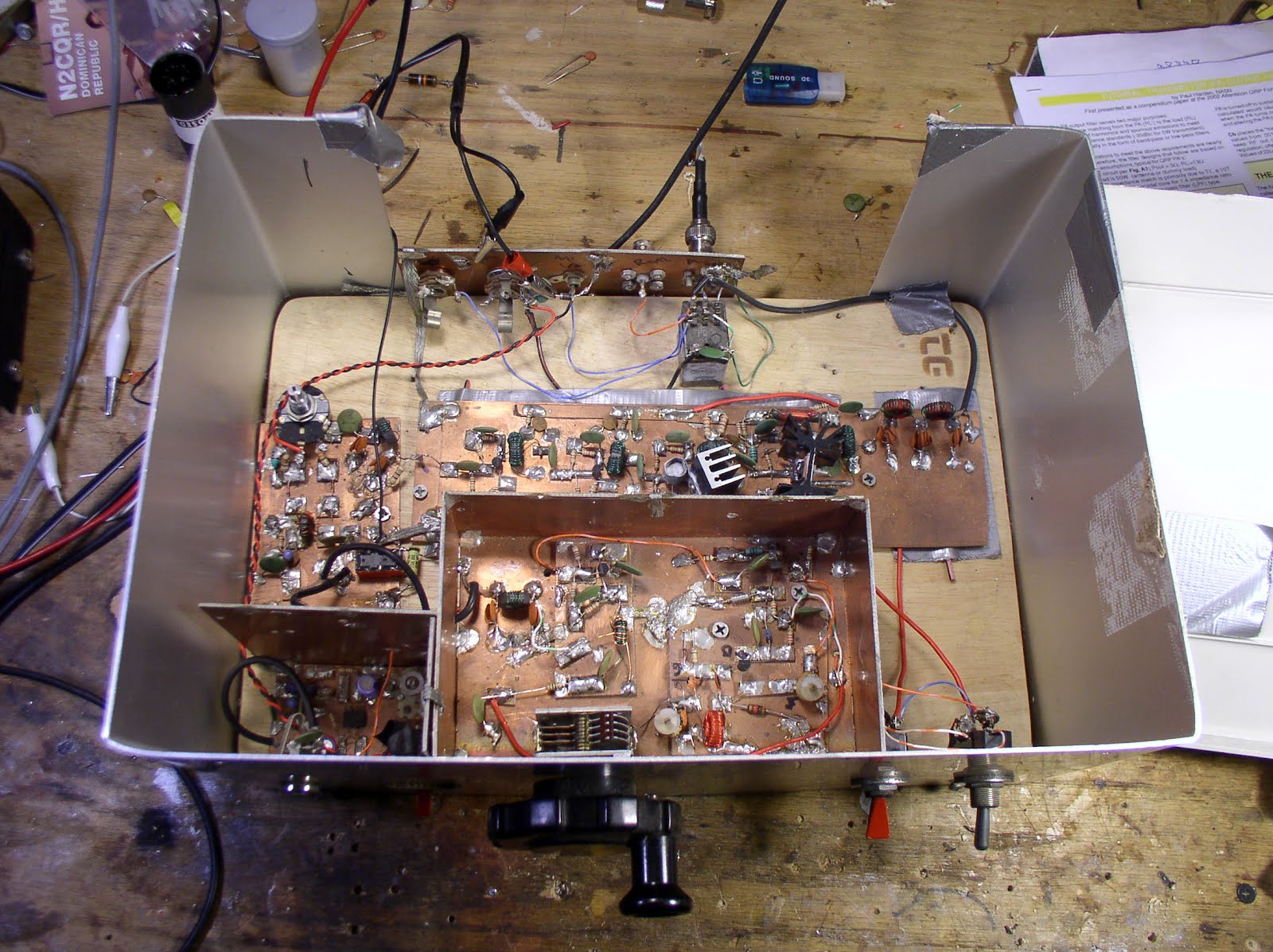
OK, so now that the 17 meter rigs are fully operational, I am turning my attention to another homebrew rig from days gone by: This is what I call my “kick panel” DSB transmitter. You see, the metal cabinet is made from a piece of metal intended for placement on the bottom part of a door — so that people (in a pub, I suppose) won’t wear out the door with their feet. I built this rig in my attic shack in London. The breadboard on which it is built is from a Dyas store in Windsor, England. The top of the box comes from a computer I found discarded on the mean streets of South Kensington. I think I originally built this thing for 40 meters, but later switched the VFO and the low pass filter to 80 meters. This rig is discussed in the opening pages of the London chapter of “SolderSmoke — Global Adventures in Wireless Electronics.”

The oscillator is running as it should and the RF amplifier chain (my design) is amplifying (and not oscillating!). The balanced modulator is doing its balancing act quite nicely. The only problem seems to be with the the little op-amp that have in there for the AF — it seems to be distorting the audio quite a bit. That shouldn’t be hard to fix.

There is room in the box for a simple Direct Conversion receiver, so this box will become a DSB/DC transceiver.

But here is my problem: I find myself unenthusiastic about working on a rig for 75 or 80 meters. On the one hand those frequencies are good for me — I’m an early riser and I need a rig that I can use in the hours before sunrise. But 75/80 always seems to be an unfriendly place — lots of frequencies that seem to be “claimed” by groups who don’ t seem interested in meeting newcomers, not a lot of people calling CQ…

I can put this rig on another HF band. 40 seems nice, but I have plenty of old boatanchor stuff that covers 40. I don’t need another 17 meter rig. I already have a homebrew 20 meter DSB rig. How about 12 meters? Or 10? I know they are both dead in the early morning, but better times are coming, right? What do you guys think? To what band should I kick the kick panel rig?


Our book: “SolderSmoke — Global Adventures in Wireless Electronics”http://soldersmoke.com/book.htmOur coffee mugs, T-Shirts, bumper stickers: http://www.cafepress.com/SolderSmokeOur Book Store: http://astore.amazon.com/contracross-20

QROoooooooo!

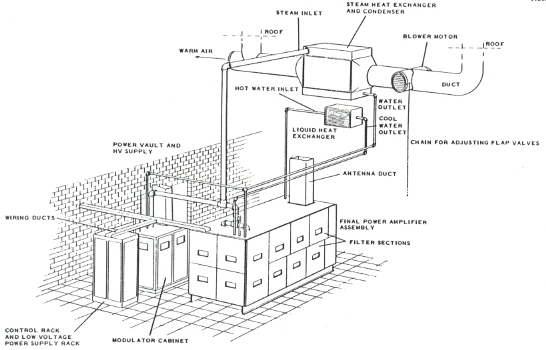
Here’s a rig that will never be featured in SPRAT or QQ! Welcome to the Gates HC-114: http://www.transmitter.be/gat-hc114.html
(Stephen, G7VFY, sent me this, so blame him if this exposure to QRO causes any psychological trauma.) I note that the rig does have a five element low-pass filter.

Our book: “SolderSmoke — Global Adventures in Wireless Electronics”http://soldersmoke.com/book.htmOur coffee mugs, T-Shirts, bumper stickers: http://www.cafepress.com/SolderSmokeOur Book Store: http://astore.amazon.com/contracross-20

QROoooooooo!

Here’s a rig that will never be featured in SPRAT or QQ! Welcome to the Gates HC-114: http://www.transmitter.be/gat-hc114.html
(Stephen, G7VFY, sent me this, so blame him if this exposure to QRO causes any psychological trauma.) I note that the rig does have a five element low-pass filter.

Our book: “SolderSmoke — Global Adventures in Wireless Electronics”http://soldersmoke.com/book.htmOur coffee mugs, T-Shirts, bumper stickers: http://www.cafepress.com/SolderSmokeOur Book Store: http://astore.amazon.com/contracross-20

The Knack, defined

Of course, our British cousins will have some problems with this. (We already have some lexicon problems there — I can sense many of them wincing every time I say “SodderSmoke”!) But I’m sure they will be understanding here. And indeed, the Knack can sometimes leave you Knackered! (BTW: I currently have an annoying little soldering iron burn on the tip of my right finger.)

Hi Bill,

Maybe I’m not the first to think of these two words, but here goes:

Knacking v/n. as a noun, the act of artfully and cleverly designing, building from scratch, or repairing devices using, usually electronic in nature, specifically amateur radio related…not related to hacking As in: “My knacking was a success and I finally got my Drake 2B working on 30 meters” Somewhat redundant, since knacking IMPLIES extreme cleverness, knacking ALWAYS has a successful result, by definition!

as a verb (as in “Googling”) to artfully and cleverly design, build, or repair a device, normally electronic in nature as in “I was knacking my JBOT amp yesterday and successfully added a new low pass filter” Implies high level of cleverness and determination and a modicum of luck

knacker n. one who artfully and cleverly designs, builds or repairs electronics, especially amateur radio related, implies high level of accomplishment and can be used by knackers to describe themselves without embarrassment or outright bragging. Knackers do not need formal training in electronics to fully qualify. Knackers always know who they are and can be identified by burn scars on their fingers from soldering accidents.

Keep your great blog and podcasts going.

73

Steve Silverman
KB3SII

Our book: “SolderSmoke — Global Adventures in Wireless Electronics”http://soldersmoke.com/book.htmOur coffee mugs, T-Shirts, bumper stickers: http://www.cafepress.com/SolderSmokeOur Book Store: http://astore.amazon.com/contracross-20

DIY at the V&A (Victoria and Albert Museum)

http://blog.makezine.com/2012/01/17/the-power-of-making-at-the-va/

Power of Making from Juriaan Booij on Vimeo.

One of the many perks that I enjoyed during my four years in London was living near that city’s amazing museums. I was more of a Science Museum or Natural History Museum guy, but the we also loved the V&A. Each day on my way to work, the 414 bus took me past the V&A’s magnificent facade. I always tried to get a seat that would allow me to get a good look.
The Maker Blog reports that the Victoria and Albert recently had an exposition on people who make things in their own private workshops. We are not alone! The video imbeded above is some sights and sounds from the world of DIY. The link below takes you to another video that includes some nice interviews with folks who are making things.

http://blog.makezine.com/2012/01/17/the-power-of-making-at-the-va/

Our book: “SolderSmoke — Global Adventures in Wireless Electronics”http://soldersmoke.com/book.htmOur coffee mugs, T-Shirts, bumper stickers: http://www.cafepress.com/SolderSmokeOur Book Store: http://astore.amazon.com/contracross-20

Secret Listeners — The Voluntary Interceptors

Jim, AL7RV, and several others sent me the link to this really interesting video about the British radio amateurs in WWII. Real “stiff upper lip” spirit in this video. Musn’t grumble! Great stuff from Great Britain: http://www.eafa.org.uk/catalogue/5108

That regen receiver they showed looks a lot like the beast that I brought back from the UK with me. Once again, I am hearing the siren song of the diabolical regens….

Progress continues on my Indian-ized Azorean DSB transceiver (with JBOT amp). I now have the amp nicely stabilized (thank God!). Now I just need to get the output from the balanced mod close to the 1 mW PEP level needed by the amp. Should be done soon. And my cold seems to be going away, so maybe I’ll be able to share my tales of JBOT derring-do in a podcast this weekend.

Our book: “SolderSmoke — Global Adventures in Wireless Electronics”http://soldersmoke.com/book.htmOur coffee mugs, T-Shirts, bumper stickers: http://www.cafepress.com/SolderSmokeOur Book Store: http://astore.amazon.com/contracross-20

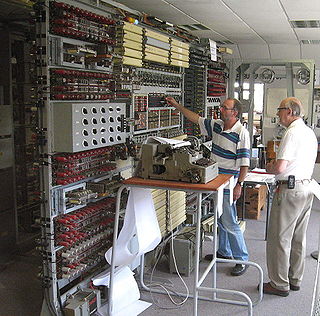
Tony Sale and the Re-Building of Colossus

Steve “Snort Rosin” Smith sent us this, noting that “Tony Sale definitely had The Knack.” As the Brits would say, “indeed.”

http://mathdl.maa.org/mathDL/?pa=mathNews&sa=view&newsId=1195

Amazing info on Tony Sale’s work here:
http://www.codesandciphers.org.uk/lorenz/index.htm

I got a kick out of this bit:

One reason for wanting to get Colossus working in 1996 was that for far too long the Americans have got away with the myth that the ENIAC was the first large-scale electronic digital calculator in the world. It was not, but they got away with it because Colossus was kept secret until the 1970s. As 1996 was the 50th anniversary o the switch-on of ENIAC I made sure that Colossus was rebuilt and working in Bletchley Park, just as it was in 1944.

There has been a stunned silence from across the water!

Our book: “SolderSmoke — Global Adventures in Wireless Electronics”http://soldersmoke.com/book.htmOur coffee mugs, T-Shirts, bumper stickers: http://www.cafepress.com/SolderSmokeOur Book Store: http://astore.amazon.com/contracross-20

Another Treasure Trove: The Royal Society’s Archive

I’m a big fan (wanna-be really) of The Royal Society. In SolderSmoke 138 I noted that Isaac Newton (former Society president) seems to have had The Knack. And when I was in London one of the major perks of my job was that I occasionally got to visit the Society’s headquarters. Bill Bryson recently edited a book about the Royal Society — in his intro he noted that they have always been a very international group (just like us!)
Several readers wrote in with the happy news that the Society’s 350 year archive has been placed on-line. Here it is:
http://royalsocietypublishing.org/site/authors/free-archive.xhtml

Our book: “SolderSmoke — Global Adventures in Wireless Electronics”http://soldersmoke.com/book.htmOur coffee mugs, T-Shirts, bumper stickers: http://www.cafepress.com/SolderSmokeOur Book Store: http://astore.amazon.com/contracross-20

SolderSmoke: Engineering Site of the Day on EE Web!

Dilbert would be so proud! In spite of my Bachelor of Arts Degree, yesterday the SolderSmoke blog was named Engineering Site of the Day by EE Web. I’m especially pleased that the Sputnik rig of the G3XBM team was the featured photo. Check it out:

http://www.eeweb.com/websites/solder-smoke-daily-news

http://www.eeweb.com/

Our book: “SolderSmoke — Global Adventures in Wireless Electronics”http://soldersmoke.com/book.htmOur coffee mugs, T-Shirts, bumper stickers: http://www.cafepress.com/SolderSmokeOur Book Store: http://astore.amazon.com/contracross-20

Sputnik Rigs Cross the Pond, Cambridge to Cambridge

The Chief Designer, Michael, AA1TJ, alerted us to this wonderful post on Roger, G3XBM’s blog:
http://g3xbm-qrp.blogspot.com/2011/09/sputnik-across-atlantic-today.html
We clearly see the spirit of the International Brotherhood of Electronic Wizards in Roger’s comment: “Nice to think that valves used in missiles aimed at each other in the Cold War end in bringing friendship and joy. CW is a wonderful mode if you want simple equipment capable of DX.” Indeed. Well done!

Our book: “SolderSmoke — Global Adventures in Wireless Electronics”http://soldersmoke.com/book.htmOur coffee mugs, T-Shirts, bumper stickers: http://www.cafepress.com/SolderSmokeOur Book Store: http://astore.amazon.com/contracross-20

Walford Electronics’ “QRP In the Country”

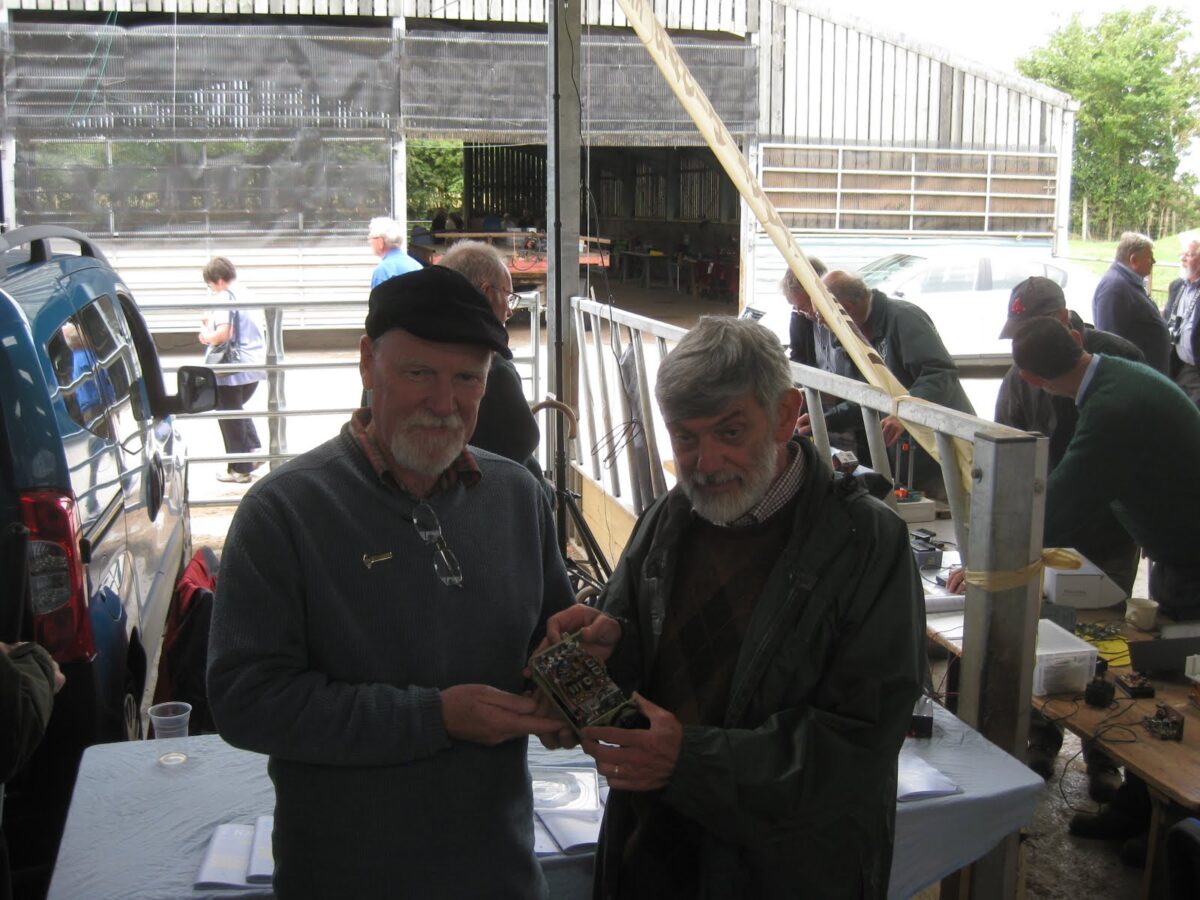
A stiff wind and occasional drizzle did not put off the large attendance of QRP and home building enthusiasts who attended QRP in the Country on July 17th. Hundreds of people from all over England and Holland found their way to Upton Bridge Farm, Somerset where the farm barns provided cover. About 25 stalls and displays showed off or sold everything from components to large construction projects. Apart from a few traders selling components, most displays were from Clubs publicising their activities or of ancient domestic and wartime radios, with a few individuals selling items to make space for new projects! There were also practical construction projects to be seen as ‘students’ built their Cary RXs with occasional help from the Bath Buildathon team led by Steve G0FUW. The catering team led by Tony G0GFL cooked a prodigious amount of special local burgers and sausages from the host Tim G3PCJ’s farm served in rolls baked locally that very morning, and washed down by village beer and cider, under the careful eye of Robert PA9RZ!

A raffle raised £200 for those suffering in East Africa; the main prize being a year’s subscription to PW kindly donated by Rob G3XFD which was won by Graham G4DPH. George G3RJV was asked to select a couple of displays that ‘appealed’ to him for two other prizes. The GQRP Club had kindly donated a special edition of Drew VK3XU’s latest project book which was also won by G4DPH for his PW Sprat project; a Walford Electronics Radlet CW TCVR kit went to Colin G3YHU for his valved superhet. A years subscription to BYLARA was won by SWL Mike Jones who is about to take his Foundation licence course.

After the event Tim G3PCJ said he was said delighted with the increased attendance and wished to thank everybody whose hard work had made the event so successful. He urged all Clubs within reasonable distance to plan their displays for next year! Watch the press for announcements of the date!


Any questions to:-
Tim Walford G3PCJ
walfor@globalnet.co.uk
WALFORD ELECTRONICS
www.users.globalnet.co.uk/~walfor


Designers & suppliers of kits for radio enthusiasts

Proprietor Tim Walford BSc MIEE CEng G3PCJ

—————–

Our book: “SolderSmoke — Global Adventures in Wireless Electronics”http://soldersmoke.com/book.htmOur coffee mugs, T-Shirts, bumper stickers: http://www.cafepress.com/SolderSmokeOur Book Store: http://astore.amazon.com/contracross-20

Regens: A Complex Relationship; AA7EE’s WBR

Bill –
I’ve been following your blog for a while now and am moved to let you know of my recent experience with regens, a subject that I know is dear to your heart or perhaps, more accurately, the basis of a complex relationship!
Anyway, the last time I built and owned a regen was as a teenager in the UK in the late 1970’s when I had a one-tube HAC Model DX one tube regen. Recently I’ve been looking for a fairly simple receiver to build that would
receive CW and SSB on 40M, as well as AM. I’m developing an interest in AM on 40, a rather impractical mode in some ways, but one that I have an attachment to. A regen seemed an obvious choice, so after seeing the
reprint in “More QRP Power” of the QST article describing N1BYT’s WBR regen, I decided to have a go at it.
In short, I’m so glad this was the first regen of my adult life. It is sensitive, suffers no hand-capacitance effects, has very little radiation from the antenna port due to the oscillator tank circuit being in a Wheatstone Bridge arrangement,
no microphony and to make things even better, is very stable in frequency. I can set it to a net or long-winded CW QSO and it stays there with no easily discernible drift (after a short warm-up period of course).
I know you’re probably aware of this receiver, but have you tried building one? I think you’d be pleasantly surprised.
The blog post about my version of this great little receiver is here:
Yours,
Dave Richards
AA7EE

Our book: “SolderSmoke — Global Adventures in Wireless Electronics”
http://soldersmoke.com/book.htm
Our coffee mugs, T-Shirts, bumper stickers: http://www.cafepress.com/SolderSmoke
Our Book Store: http://astore.amazon.com/contracross-20
Royal Order of the Sputnik Clone Chasers

Kettering Group, UK


From the Chief Designer (AA1TJ):

Fellas,

I came across an online blurb for the recent book, Sputnik: The Shock of the Century, by Paul Dickson; a worthwhile read, judging from the introduction and first chapter.

http://www.sputnikbook.net/intro.php

“Someone brought out a shortwave radio, and soon a beeping noise filled the room. A Russian scientist, Anatoli Blagonravov, confirmed it was Sputnik. “That is the voice,” he said dramatically. “I recognize it.” John Townsend Jr., one of the scientists at the party, recalled watching Blagonravov: “I knew him quite well, and I could tell that he was a little surprised and quite proud. My reaction was ‘Damn!'”

And so an abstraction now had a voice. It also had a name – Sputnik.

Many of those at the party adjourned to the Soviet Embassy’s rooftop, attempting to view Sputnik with the naked eye. Several of the American scientists drifted over to the American IGY headquarters in Washington, where they began speculating on what impact the satellite would have. They feared that the American people would be disappointed.

It also dawned on them that they had better start tracking the satellite’s orbit. They got in touch with the American Radio Relay League in West Hartford, Connecticut, asking its 70,000 members-all “ham” radio operators-to lend a hand and help track the Sputnik. In less than twenty-four hours, reports on the satellite were coming back to the National Science Foundation, where a temporary control room had been established. Eventually, these hams and other amateur and professional trackers would consider themselves part of a great international fellowship known as ROOSCH, or the Royal Order of Sputnik Chasers.”

That’s right guys…ROOSCH…the Royal Order of Sputnik Chasers. And to think that fifty four years later a second great international fellowship would rise from the ashes…ROOSCCH, or the Royal Order of Sputnik Clone Chasers! ;o)

(BTW, October 4, 1957 is an important date in American history for a second reason. On that evening the first episode of Leave it to Beaver made its debut.)

………………………………………..

I thought we should also at this point remember the intrepid lads of the Kettering Group, pictured above. (Some of those dudes look like they would have been right at home in “Leave it to Beaver.”) For more info on their amazing Sputnik adventures go here:
http://www.svengrahn.pp.se/trackind/getstart/oldcyts.htm
and here
http://www.svengrahn.pp.se/trackind/trackin1.htm#KEttrack


Check out “SolderSmoke — Global Adventures in Wireless Electronics”
http://soldersmoke.com/book.htm

Colin’s FB Rig

Hi Bill,

I’m still enjoying your podcast very much – I have the T-shirt to prove it!

My parents bought me SolderSmoke the book for Christmas and I must echo other people’s comments that it is very good and the explanations you give make a lot more sense than those in other technical publications.

Listening to your podcast got me thinking about radios again and I have nearly completed my first homebrewed transceiver project. It’s all YOUR fault! I had a spare RockMite keyer chip in my junk box, so I thought I’d use it……….. Take one small keyer chip and……… build a whole new radio!

Okay, I used Dave’s (K1SWL) schematic, but I did not use any printed circuit boards and I have made some modifications to the circuit. I think I can class this as homebrew. I even made the twin paddle key! The only thing I didn’t make from parts are the earphones, see http://www.flickr.com/photos/24901892@N03/5833428467/ There are more photos on the Flickr site too.

Looking forward to the next edition of the SolderSmoke podcast.

72/3

Colin
M0CGH

How to Join G-QRP (and get SPRAT) in the USA


From the G-QRP web site:

Formed in 1974, the GQRP Club is a non profit organisation run entirely by volunteers to promote Low Power Radio. Whether you have a ham licence or not – everyone is welcome. Our quarterly magazine SPRAT provides a fascinating read containing articles of varying complexity, from simple test equipment, to fully functioning radio transmitters and receivers. Membership fees are about as low as you will find anywhere and our club sales service to members is second to none.

Indeed. Joining G-QRP and getting SPRAT is something all QRPers and homebrewers should do!

Some SolderSmoke listeners have asked me how they can join G-QRP from the U.S. Bill Kelsey is the club’s man in America:

Bill Kelsey – N8ET 3521 Spring Lake Dr., Findlay, OH 45840 U.S.A.

$18 paid in USA.

Bill’s e-mail and more info here:
http://www.gqrp.com/memb_usa.htm

OR… You can pay directly via PAYPAL:

http://www.gqrp.com/paypaldx.htm

A Language Guide for the International Brotherhood of Electronic Wizards

Hello Bill,

I heard mention of your book, Soldersmoke – Global Adventure in Radio Electronics, on the G-QRP reflector and bought it on a whim. Since it arrived I have not been able to put it down. What a great read! Very enjoyable and an inspiration. I say that because my homebrewing had taken a bit of a back seat while other hobbies – flying RC gliders, ballroom dancing etc – came to the fore. But after reading just a few chapters of your book, the old soldersmith in me was stirred and I had to go and make something.

Like most Hams I am the ‘caretaker’ of a huge stock of components – well let’s face it we are really just looking after part of the world’s supply of components for the other guy who might need them! – I decided on a simple phase shift oscillator for 600 Hz and soon found a circuit from my old collection of circuit drawings. I had all the parts and quickly soldered it together. Sadly my elderly ‘scope confirmed that it was not working and after a bit of head scratching I decided to make it up on a construction board. In the process I realised that my design had included components of the wrong values and if it had oscillated at all, it would have been in the MHz region! The final product worked a treat and I cobbled together some photos (in the attached PDF) to send to my radio pal – Roger DL3RMU – in Berg Bacchaussen in Bavaria. From your podcasts, I suspect you are a bit of a language wizard as well, but just in case – “Jede Schaltung braucht eine Lichtdiode !!” means, ‘Every circuit needs an LED!’ and “Erfog!” means ‘success!’ The result was a lovely 600Hz sine wave at nearly 5V p-p. Not exactly wizardry but very satisfying. Now wouldn’t it be great if I could get it to oscillate at RF frequencies!?

Roger DL3RMU and I have shared an hour long, weekly, CW QSO since early 2005. Just to make it that bit more interesting we do it in German! Helpfully CW overcomes my pronunciation problems. This all started with my realisation that my urban location and limited antenna space restricted my effective operating range for a number of reasons. I am not a great linguist but I have always been interested in languages and I figured that while I might not have much reach, I could have a lot of fun trying out CW QSOs both QRO and later QRP in the language of the other guy rather than ‘rubber stamp English’. To my surprise my rusty schoolboy French and slightly better German were well received. I met Roger a few times on the air and we decided to keep a weekly sched. I decided to give European languages a real go, so I cobbled together a handful of common phrases from dictionaries and online language resources to get by, before embarking on a more ambitious project: a set of translations for every European language.

Originally I wrote to the radio societies of every European country to seek help but this was not an effective approach. So I then contacted every non-English member of WACRAL (to which I belong) and asked them if they would kindly translate roughly 50 common QSO related phrases into their mother tongue. To my delight and surprise the response was great and a number of guys helped put together the translation files. There are now 15 European languages on my fledgling website. I call the website, ‘Parlez Vous QSO’ and it can be found at: http://web.onetel.com/~stephenseabrook/. I really ought to find out how to get a proper domain name sorted out (any advice welcome!) but it is easiest to find by typing ‘Parlez Vous QSO’ into your search engine. The site itself somehow caught the attention of a number of enquirers, some of whom simply emailed me the translations in their own language! This is the sort of ‘fraternity of amateur radio enthusiasts’ that makes our hobby great! There are quite a few ‘missing’ languages but the pleasure of being able to communicate – even falteringly – in the other guy’s language is great and I am delighted with the response I have had from the guys on the other end of the QSO.

My construction was mainly limited to station accessories: PSK interface, RTTY interface, CAT interface and various test equipment before I got into QRP. I built a FoxIII, MFJ Cub for 20m and a couple of Christmas‘ ago a K1. What a great radio! I never cease to be amazed that if the station Icom 706 or the Kenwood 570D fails to yield a QSO with lots of Watts, a changeover to the K1 often finds a QSO within minutes! How can that be!?

Keep up the good work on Soldersmoke. I thoroughly enjoy the podcasts and look forward to the sequel to the book!

kind regards

Steve Seabrook M0ECS

Sittingbourne

England

Regen Madness


How many times have I said “never again, no more regens”? I guess I need a twelve step program or something like that. This latest bout of regen fever started with the King’s Speech movie. So I blame the Brits. All of them. Then this Belgian guy with the video comes along (see above). Now I find myself drawing out a schematic for the old regen that I picked up years ago at the Kemption Park rally in London. Someone please, STOP ME!

The King’s Speech Regen

In SolderSmoke 131 I talked about this old homebrew receiver. I picked it up at a radio rally in London and almost sold it at a hamfest in Virginia. A fit of UK nostalgia provoked by a screening of “The King’s Speech” caused me to hold onto it. Now it is luring me into two areas that I don’t really want to get into: high voltage and regeneration. But here we go… I turn now to our British cousins: What can you tell us about this receiver? 1920s? 30’s? What tubes should I be looking for? How would they have powered this receiver? Does anyone have a schematic that might describe this device? (Or something close?)