
Todd K7TFC on Pessimism, Optimism, and Homebrew Radio

In response to my blog post about Rob Sherwood, Todd K7TFC sent this very thoughtful comment. It is so good that I wanted to put it up as a more visible blog post. Thanks Todd.

Todd wrote:

Several of 4Z1UG’s recent interviews have either hinted at or clearly expressed pessimism over the future of technically-oriented, homebrew ham radio. Of an age myself (another IGY baby) in which disgruntled cynicism is endemic, I nevertheless found their pessimism exaggerated and perhaps a little-too conventional.

Not that there’s little evidence to back them up: recent retirements at QST and the magazine’s thin technical coverage have not improved matters, and even QRP Quarterly recently found it necessary to spend more pages on UFOs in New Mexico than on VFOs in their readers’s hamshacks. Even podcasts whose names might suggest otherwise–I’m thinking of Ham Radio Workbench–actually spend more time talking about store-bought black boxes, antennas, and cool things they’ve purchased (or want to purchase) than melting solder or winding coils. To be sure, HRWB, QRPQ, and even QST, make important contributions , but they do reflect the *proportional* decline of hands-on electronics.

For me, though, that the *proportion* of homebrewing, technically-oriented hams has declined is not as important as the actual numbers of hams so oriented. If their proportion is down to, say, five-percent of the total number of hams in the world, that’s still *a lot* of homebrewers worldwide, and now that we interact in a truly-global theater of enthusiasts, we’ve never had it so good when it comes to the numbers of people who share our enthusiasms.

This question of actual numbers versus proportions can be seen in the most common modes of operation as well as on the hardware side. SSB long ago passed CW as the mode-of-choice, and now SSB is in decline *proportionally* as the weak-signal digital modes seem to be taking over. But when the bands are open, you can still tune through the lower portions of most bands and find *plenty* of CW ops at all levels of speed and clarity. CW is not dead, and in fact it’s easier to learn than ever before. I expect a proportion will always see CW as essential to ham radio–enough in fact to keep them supplied with contacts to satisfy their retro-cravings and keep the tradition alive.

I may be in the last quarter (third?) of my life, but the older I get the more I come to believe in living *three-dimensionally*. The “X” is my own time and place (a west-coast Boomer), the “Y” is my own time but other places and cultures, and the “Z” is other eras, times, and places. The “other eras and times” in the ham-radio context means I don’t have to abandon tank circuits and crystal filters and vacuum tubes *merely* because other and perhaps objectively-superior technology is now at my disposal. I can use the new stuff and the old stuff, too. I’d even argue that to abandon all use of older technologies means there’s been no *growth*, only “progress.”

We see this clearly enough in other aspects of the human endeavor. The computer may have totally replaced the typewriter, but it hasn’t replaced pen, ink, and paper. The internet may be a superior repository of knowledge than printed books, but books and magazines are still widely used and are in some ways superior to online media. Microwave ovens cooking prepackaged, processed, and *manufactured* food are more efficient, but no one denies a meal made with raw whole foods and hand-prepared is better.

I expect there will always be plenty of people living three-dimensionally as hams with whom I resonate. There’s already a high SWR between me and *most* people anyway. I’ve grown comfortable with a more-narrow bandwidth–73, Todd K7TFC

————————
Todd’s Web Site: https://mostlydiyrf.com/

Grayson Evans KJ7UM on the Ham Radio Workbench Podcast

OM Grayson was on the HRWB podcast with George Zaf and company. This was a really informative and entertaining session. For example, when asked if special precautions are needed when working with thermatrons, Grayson replies, “Well, try not to swallow anything… and don’t sit on the thermatrons.” Words to live by my friends. Grayson’s story about cooking Tektronix scopes in a refrigerator re-purposed as an oven (after cleaning the ‘scope with a Home Depot power washer) is the kind of practical advice that readers of this blog REALLY NEED!


But seriously, I learned a lot just listening to Grayson talk about thermatrons with George and the HRWB crew.


The interview includes nice shout-outs to SolderSmoke, SPRAT/G-QRP, and Electric Radio magazine.

Stay to the end for some thermatron-related password management advice from George.

Thanks to Grayson and to all the folks at HRWB.

Pete’s Drakes

Pete Juliano N6QW has on his blog two very nice videos about the Drake A-line.

As long-standing fanatical fan of the Drake 2-B, I was struck by the similarities between the 2-B and the R4 seen in Pete’s video:

— The S-meter is the same.
— The passband tuning control and indeed the visible internal circuitry for the passband tuning seem to be the same.
— Drake even used the same “hook” for selectivity selection.

The transceive feature with the T4 seems very nice.

Pete’s first video is above. Pete’s second video, showing his first contacts with the newly acquired A-line, can be seen here:


Thanks Pete!

Parasets, Parachutes, and Tubes in “A French Village” Season 3

https://en.wikipedia.org/wiki/Un_village_fran%C3%A7ais

In season 3, Episodes 7 and 8, resistance members parachute in from London. They are equipped with what looks a lot like a paraset. One of their tubes develops an open filament. The Germans engage in radio direction finding. The Morse code is fairly good (but not great). All in all, there is quite a bit of radio-related material.

“A French Village” is a very well-done series. But it is (of course) quite dark.

For Your Vacuum Tubes: Isotopic Ionization Sources from U.S. Radium

One or two podcasts ago I mentioned radium in regulator tubes. As I predicted, this provoked a number of comments about how silly it is to even mention such things. Nonetheless, I find it interesting. It seems that real radios really do glow in the dark!

More info on the company:

Aladdin’s Lamp == The Vacuum Tube (aka The Thermatron) (Video)

After our posting of the video about 1957 transistor production, our friend Peter O’Connell VK2EMU asked for some equal time for vacuum tubes. He sent me this 1940 Western Electric video. It is quite interesting.

— I like the Aladdin’s lamp metaphor. When I was out in the Azores I thought of my homebrew 17 meter DSB rig as my “magic carpet.”

— Lowell Thomas was brought in to narrate. His voice sounds a lot more natural than that used to narrate the transistor film.

— To explain the effectiveness of transcontinental telephony with vacuum tube repeaters, they compared the system that of a relay of “hog callers” claiming that it would take 100,000 hog callers to carry a signal from New York to San Francisco. So perhaps this could be a rival to db? 100,000 hc?

— Arlington to Paris 1915 caught my eye — Arlington Va. is right down the road.

— The film of Edison in his lab was good to see. And note the importance of his lab notebooks.

— The explanation of thermionic emission was quite good. But of course too much credit was given to Lee DeForest.

— The breathless description of the amazing uses of tube technology was for me a reminder of how recent this technology is. My father started as New York City cop in the 1950s. He always referred to his police car as a “radio car.”

Hey, are any radio amateurs out there using one of those big water-cooled tubes? If not, why not?

Straight Key Night 2021 at SA2CLC in Sweden

Wow, check out the FB gear of Tommy SA2CLC in Sweden, in use on Straight Key Night 2021. There is some German WWII gear, a BC-348, a homebrew transmitter, and some FB QRP kits.

More on Tommy SA2CLC here: https://www.qrz.com/db/SA2CLC
The culvert under the road for coax to the antennas is very cool.
FB Tommy! A belated HNY to you OM.

LA6NCA’s German Military WWII Receivers, and a Luftwaffe Receiver with FAST QSY

Discussions of old military radio gear are dominated by talk of U.S. radios. Yesterday in the comments section of the SWLing Post I found two interesting videos about German WWII equipment. Above you can see LA6NCA’s receivers. Below there’s a video of a Luftwaffe receiver with an amazing capacity for really rapid frequency change.

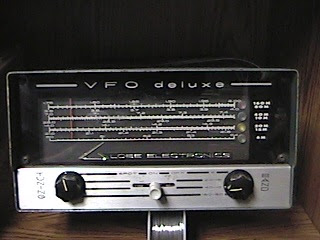
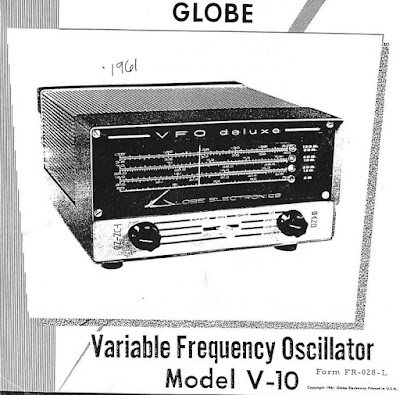
The VFO that I am looking for: The Globe VFO deluxe

I mentioned this in the last podcast. I’m looking for one of these. I had one as a kid, and used it with a DX-40 and a Lafayette HA-600A. It is now the only piece of gear that I need to recreate my novice station.

Does anyone have one of these, perhaps gathering dust in some corner of the hamshack? Please let me know. Thanks.
Here’s the manual:

Guilt Trip: Video on the Heath QF-1 Q Multiplier

Hack-A-Day had a nice post about this piece of gear:

My radio emotions were swinging wildly as I watched this video.

Readers may recall that over the years I have brutally cannibalized several QF-1s. I was enticed into doing this precisely by the tuning cap that the videographer so alluringly describes. It has a built in 7:1 reduction drive! How could I resist? These wonderful caps live on in several of my homebrew rigs.

I also put the conveniently sized metal cabinets to good use — one holds frequency counters for my AM station, the other houses an Si5351 VFO/BFO that can be used with many rigs.

After extracting the cap and putting the boxes to good use, I was left with the remainder of the circuitry. I recently put even this stuff to use by using the coils to make a triple LC circuit filter for 455 kHz. This may someday be used in a receiver. So you see, I’ve not been wasteful.

And the thing only cost 9 bucks back in the day… So I didn’t really do anything bad. And besides, adding a regen circuit to a superhet is kind of backwards, right?

But then the video producer started talking about how nice his QF-1 looks, even after more than 60 years. And about how much it improved the performance of his AR-1. And then, the kicker: He said the QF-1s are now “relatively rare.”

I hang my head in shame. I am a serial QF-1 killer. And I don’t know if I can stop.


Grayson Evans KJ7UM’s New Blog — Lots of Great Technical Info

Our friend Grayson Evans KJ7UM, author of “Hollow State Design” has launched a new blog. It is filled with great technical info. The blog has links to the articles Grayson wrote for Electric Radio magazine.

“Radio, Radio” By Elvis Costello and The Attractions

Wow. At one point in the video Elvis C. climbs onto a radio chassis and sings while standing between two Thermatrons. FB OM.

And here is an interesting article about Elvis Costello’s music, and opposition to Fascism.

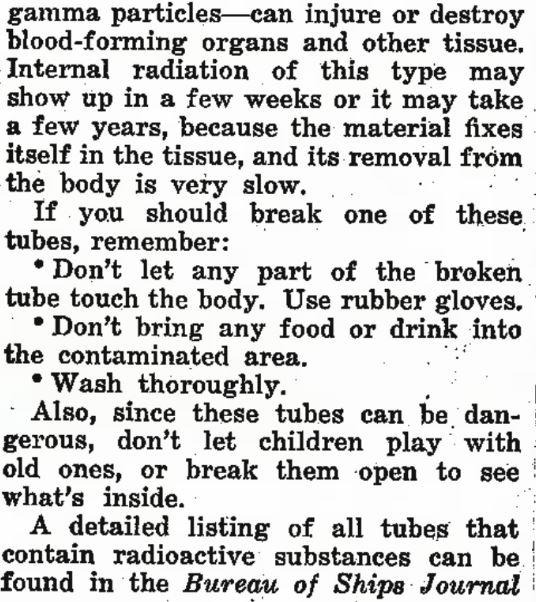
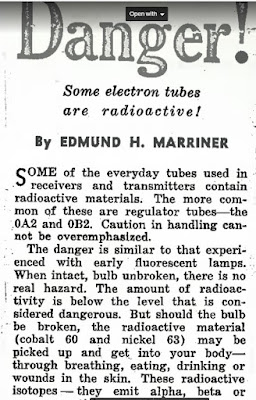
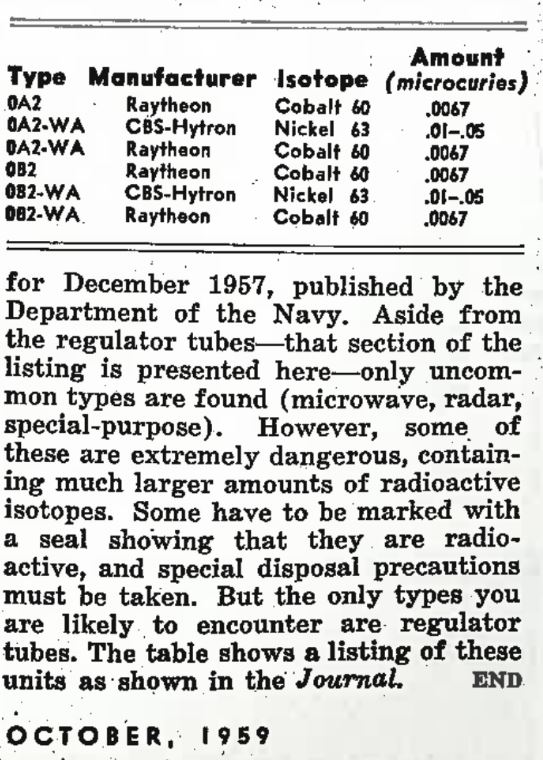
Radioactive Regulator Tubes — OA2s! Who knew?

Pete found this amazing collection of articles by master homebrewer Ed Marriner W6BLZ. They were published in a West Coast radio newsletter during the 1950s and 60s. The above is from this collection.

I know that this kind of article upsets some people. They will write in saying that they have using OA2s for 50 years with no ill effects. Others will sarcastically say that we should just try to avoid eating the OA2s. I know. Don’t blame me. Don’t blame Pete. You can blame the Navy. And Raytheon. And Cobalt 60 and Nickle 63.

A Regen Receiver Made with Homebrew Tubes

Wow, a regen receiver using homebrew triodes. Makes me feel like such a pathetic appliance operator, what with all my STORE-BOUGHT TUBES… I hang my head in shame. Real hams make their own tubes. And vacuums, apparently.

Here is how the tubes were made:


Lots of amazing videos in this YouTube channel:

Kudos to jdflyback! (Who is this amazing homebrewer?)