A Look at Old Radios in Australia (video)

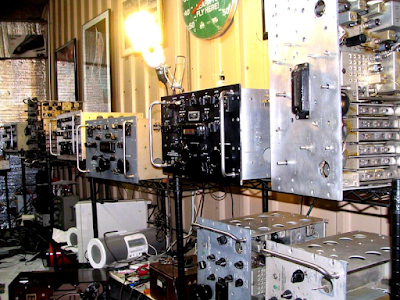
I thought you guys would like Peter Parker’s latest video. And in it, Dean KK4DAS might see a clue or two for his Halli restoration/repair project.

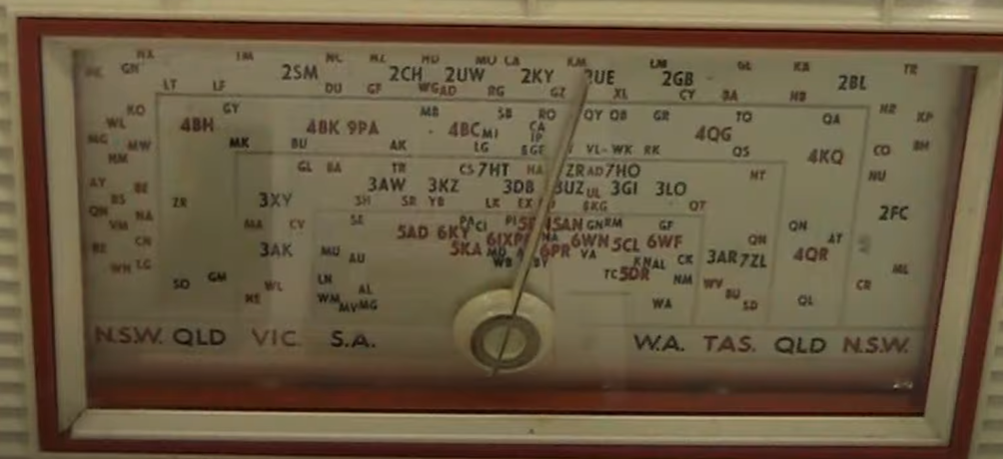
What really struck me was the dial markings on the Australian radios. They seem to be mostly oriented toward the reception of Australian AM or LW broadcasters — not many exotic DX locations are marked. Australia is big!

Looks like a lot of crystal detectors in glass tubes. At first I thought they might have been coherers, but I think they are crystal detectors.

Many variometers visible.

I saw one Geloso-Milano Communications 8 receiver. Va bene!

I also saw one “Tasma 780” Superhet. Cool name!

What is up with the “Green Theme”?

I have some of the headphones they showed.

Please note in the Comments section anything special that you noted in watching Peter’s FB video.

More on the coil winding machine here:

HB2HB — A Contact with Denny VU2DGR (video)

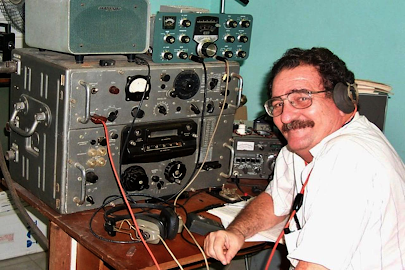
At first I didn’t realize it was Denny. On September 11, 2023 at about 2330Z I had walked back into the shack after dinner. I think DX spots showed an Indian station on 20 meter SSB. Without realizing who it was, I tuned him in on my Mythbuster rig, heard the other station sign off, and quickly threw in my call. Denny came back to me right away, and I think both of us then realized that we recognized the call of the other station. Wow, it was Denny, VU2DGR, the Wizard of Kerala! At the time of the QSO, I didn’t have my phone with me; after we spoke, I went to get it, so the video above captures part of Denny’s subsequent contact. (You can also at one point hear Guapo barking.)

Denny has been running a wonderful station that combines SDR gear with and HDR tube type amplifier and a homebrew Moxon.

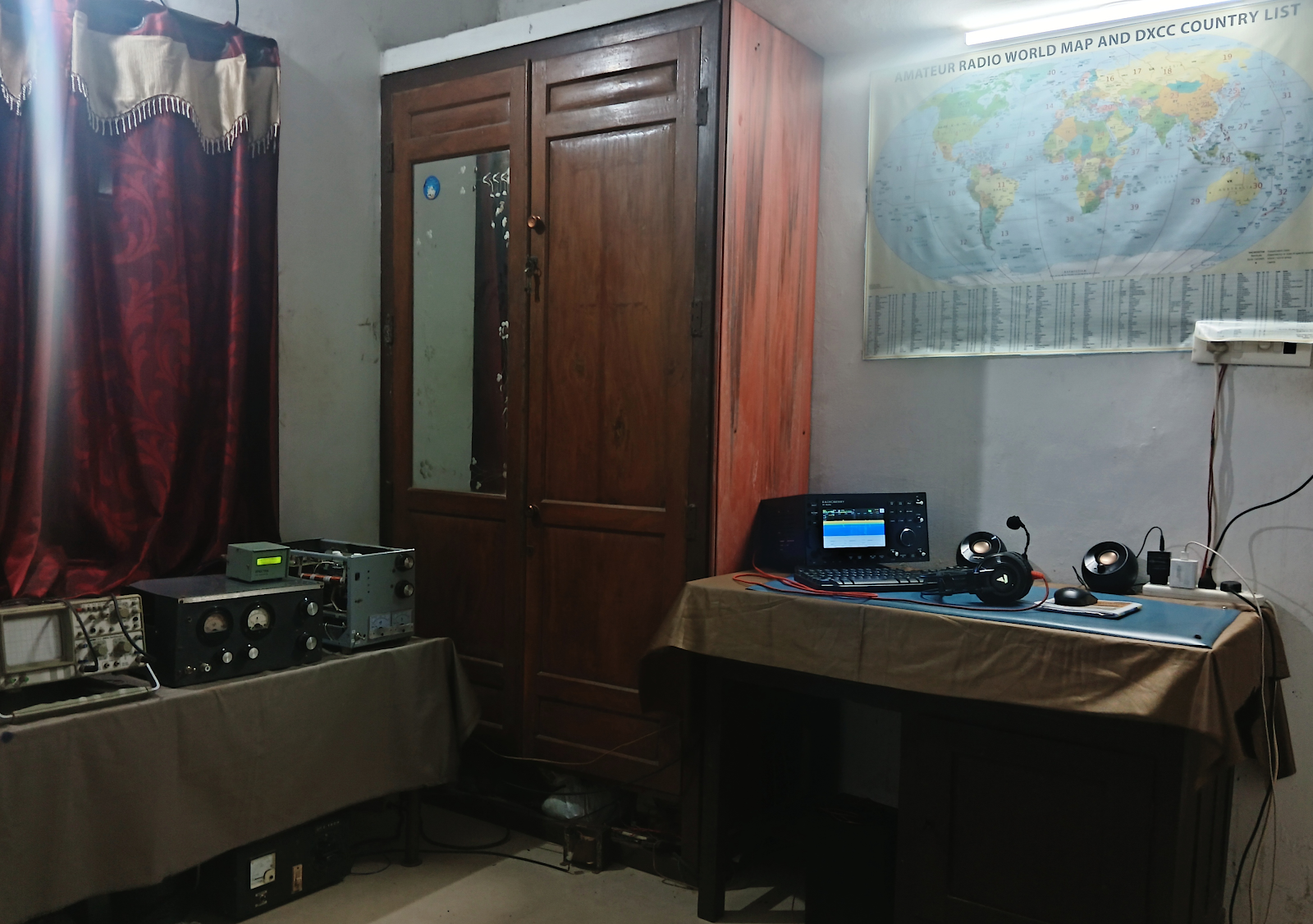
Here is Denny’s station. The transceiver is a RadioBerry. the amplifier and power supply are on the other table.

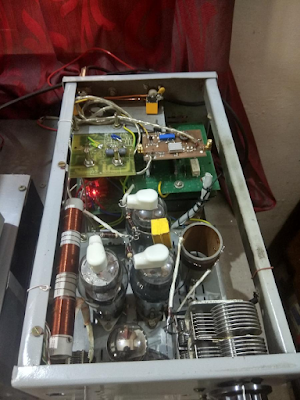
Here is the homebrew tube-type amplifier. This is the part of the station that really puts the HB in HB2HB! That’s the power supply on the left and the amplifier itself on the right:
That amplifier has three 807s in it, with a 6L6GC:
Here’s a video on the RadioBerry transceiver.

Finally, here is Denny’s magnificent homebrew 20 meter Moxon:
Thanks Denny!

Building Nixie Tubes for a Hiroshima Project

Thanks to Bob Scott KD4EBM for alerting me to this wonderful video. It seems especially timely, given the recent release of the Oppenheimer movie.

I posted back in 2000 about Dalibor Farny and the Nixie tubes he makes in a castle in the Czech Republic:

In this more recent video (above) Dalibor describes a very cool and very challenging Nixie tube project: A museum in Hiroshima Japan was presenting an art project designed by a Chilean artist. The display needed a lot of large, custom-made Nixie tubes, some of which would display Japanese language characters. So: Museum in Japan, Chilean artist, Nixe maker in the Czech Republic. There are big geographic challenges before you even get to the technical challenges.

Dalibor does a great job in describing all of the challenges that they faced. The technical stuff will be especially interesting to SolderSmoke listeners. His description of the evolution of his Czech workshop fits very well with our “other kinds of workshops” theme.

The video is really worth watching. Check it out (above). The ending is quite moving.

Thanks again to Bob Scott. Congratulations to Dalibor, his crew, and to all those involved in this Hiroshima museum project.

Valveman — The Story of Gerald Wells

Don’t be deterred by the annoying test patterns at the start of this video. Just skip past them. The rest of the video is quite good. Or you could just click on this link and avoid the first 83 seconds of test pattern: https://youtu.be/Y8w6iwaAGJ4?t=83

Gerald Wells has been mentioned on this blog before, but I don’t think we’ve ever presented the full documentary on this fellow. Here it is. Gerry is clearly one of us: a radio fiend, obsessed (as he admitted!) with wireless, a victim of THE KNACK.

George WB5OYP of the Vienna Wireless Society got to meet Gerald Wells and visit his museum. George alerted me to this video. Tony G4WIF also was able to visit Gerry and his museum.

The documentary is full of interesting stuff, and is, in itself, a Knack Story. Wells mentions the Crippens murder so well described by Eric Larson in “Thunderstruck.” It was this crime that brought radio to the center of public attention.

The Wizard of Kerala (India) — Denny VU2DGR — SDR and HDR

His signal was just booming in on 20 meter SSB yesterday evening. It was one of the strongest signals I’ve heard from India. I wasn’t able to get through the pileup, but I heard mention of a homebrew station at his end… Sure enough a look at his QRZ.com site shows that a LOT of solder has been melted in his shack. Both SDR and HDR stuff. Tube projects including an 807 amplifier made from “components collected from the scrapyard.” And a homebrew 20 meter Moxon. Check it out:
FB Denny!
Kerala is on the southwest tip of India. It is something of a hotbed of technological innovation. My only Indian contact using my current series of homebrew dual-banders was with VU3TPW — Renju is also in Kerala.

The Wizard of Kerala (India) — Denny VU2DGR — SDR and HDR

His signal was just booming in on 20 meter SSB yesterday evening. It was one of the strongest signals I’ve heard from India. I wasn’t able to get through the pileup, but I heard mention of a homebrew station at his end… Sure enough a look at his QRZ.com site shows that a LOT of solder has been melted in his shack. Both SDR and HDR stuff. Tube projects including an 807 amplifier made from “components collected from the scrapyard.” And a homebrew 20 meter Moxon. Check it out:
FB Denny!
Kerala is on the southwest tip of India. It is something of a hotbed of technological innovation. My only Indian contact using my current series of homebrew dual-banders was with VU3TPW — Renju is also in Kerala.

Part 2: CuriousMarc Fixes an All-Discrete Counter — “Like an IC, but in discrete form.”

Marc nicely sums up this project with this line: “It’s an IC but in discrete form!” On the same theme, he later says, “Who needs a logic analyzer when you can do a visual debug with neon bulbs?”

Very cool. Lots of troubleshooting and repair lessons in this video:

— Again we see the benefits of paper manuals. (Todd K7TFC commented astutely on this under yesterday’s post.)

— 2N2222s to the rescue.

— A surprisingly large number of bad transistors (6?) found. Why did they go bad?

— Marc repeatedly says, “Let me poke around.” Poking around is often important. Mark fixes the reset line after poking around. He is not sure HOW he has fixed it, but he has… by poking around. Sometimes this happens. Thank God for small favors.

— Marc has some fancy HP board extenders. I am jealous.

— He also has a cool de-soldering tool. More jealousy. Want one.

— Marc’s understanding of how the HP engineers had to put one of the flip-flops “on the edge of stability,” and how his ‘scope probe was capable of disturbing this stability.

— Remember that those Nixies are TUBES with enough voltage on them to really zap you. So be careful in there. This is an especially dangerous mix of transistor tech and tube tech. With transistors you can work on them with the rig fired up. With tubes, well, you have to be careful.

Part III tomorrow.


Part 2: CuriousMarc Fixes an All-Discrete Counter — “Like an IC, but in discrete form.”

Marc nicely sums up this project with this line: “It’s an IC but in discrete form!” On the same theme, he later says, “Who needs a logic analyzer when you can do a visual debug with neon bulbs?”

Very cool. Lots of troubleshooting and repair lessons in this video:

— Again we see the benefits of paper manuals. (Todd K7TFC commented astutely on this under yesterday’s post.)

— 2N2222s to the rescue.

— A surprisingly large number of bad transistors (6?) found. Why did they go bad?

— Marc repeatedly says, “Let me poke around.” Poking around is often important. Mark fixes the reset line after poking around. He is not sure HOW he has fixed it, but he has… by poking around. Sometimes this happens. Thank God for small favors.

— Marc has some fancy HP board extenders. I am jealous.

— He also has a cool de-soldering tool. More jealousy. Want one.

— Marc’s understanding of how the HP engineers had to put one of the flip-flops “on the edge of stability,” and how his ‘scope probe was capable of disturbing this stability.

— Remember that those Nixies are TUBES with enough voltage on them to really zap you. So be careful in there. This is an especially dangerous mix of transistor tech and tube tech. With transistors you can work on them with the rig fired up. With tubes, well, you have to be careful.

Part III tomorrow.


Helge LA6NCA’s Altoids Tin Receiver

Here’s another great video from Helge LA6NCA. This is a follow-up to his Altoids Spy Transmitter project. Really well done. Hack-A-Day called this receiver “regenerative” so naturally I was disappointed, but when I watched I realized that it is NOT a regen but is instead a direct conversion receiver. TRGHS. All is right with the world. Thanks Helge! 73

Arnie Coro CO2KK (SK) Provides More Info on the Islander DSB rig

Peter Parker VK3YE found this message from Arnie CO2KK in the Wayback Machine. We continue to look for more information on the Jaguey solid state DSB rig.

Arnie wrote:

Several years ago an amateur in central Cuba was approached by some of his young friends to help them build their first rig. CO7PR, Pedro, a telecommunications technician for the phone company, had a vast experience both with vacuum tubes and solid state circuits, plus that special gift of designing and building with whatever is available. After a few days, Pedro came out with the “Islander” prototype, a low parts count, easy to build single band transceiver!

Here is the circuit description of that little radio that has provided many cuban young and old, newcomers to our hobby, with their first rig… and the challenge to improve it.


RECEIVER:

It is a direct conversion, YES, a DC receiver made with vacuum tubes. The very thought of having those tube filaments fed from the AC power supply and at the same time having 80 or 90 dB of amplification made me shudder when I first talked to Pedro on the very popular here 40 meter band! You are LOCO Pedro, I told my good friend… CRAZY, those poor kids are going to hear 50 percent 120 hZ hum when they tune across the 7 megahertz band.

Yes Arnie, you are right, it has a little background hum, but by using a small loudspeaker and small coupling capacitors… it’s tolerable! The receiver shares, in its original version, the same antenna input as the transmitter output stage, a PI network, but we soon learned to add a separate LC tuned circuit first and latter a bandpass double tuned input filter…PLUS a signal attenuator… a very primitive but effective attenuator… just a 10 k potentiometer!

For an RF amplifier stage the Islander uses a russian pentode, which is the equivalent of the popular TV IF amplifiers of the 50’s… looks like a 6CB6, for those of you that fixed TV sets 40 years ago or so.

The 6 “little spider” five, as everyone knows that tube here,has a lot of gain, and it can be kept rather stable by a judicious choice of screen and cathode resistor values.. Noisy pentagrid converter follows!

The 6A2P… a russian 6BE6, was the first tube type used in the Islanders, later some people tried the ECH81 triode-hexode and found it works better.

The circuit of the 6A2P-6BE6 is quite straighforward… a… you guessed right… PRODUCT DETECTOR… fed from the vacuum tube VFO… and providing its audio output to the two stage audio amplifier.

Audio amplifier is made with a triode-pentode tube of which plenty are locally available from defunct TV’s… the ECL82 and the 6F4P and 6F5P of east european and russian manufacture respectively provide a lot of gain.

So… that’s your receiver.. quite straightforward, works on 160, 80 and 40 meters by just changing the input filter and the VFO injection, it does NOT provide very good selectivity at all, but during the daytime, when the 40 meter band is used for local and regional contacts, it puts those new hams ON THE AIR!


VFO… the big problem amigos!

CO7PR worked very hard to try to make a stable vacuum tube VFO… and he almost made it..

YES, ISLANDERS drift, some not too much, others are not so good, depending on who built the rig, and how close they followed Pedro’s advice at first, and Arnie’s CO2KK later (as yours truly became quite involved in the project, as soon as I found that it was THE way of getting all those guys ON THE AIR!)

VFO is made with ONE of the 6 “little spider” 5 pentodes… By the way, I am sure you will like to know why the tube is locally known like that… the ZHE letter of the Cyrillic alphabet is something difficult to pronounce to a cuban – or any other non slavic for the matter – and it resembles like a little spider on the tube’s carton and… that’s why it is not a 6 “ZHE” 5 but a 6 “little spider” five!!!

The VFO cleverly works at one half the operating frequency… and then it DOUBLES frequency at the plate circuit… output is via a link to the pentagrid or hexode mixer depending on which type you use.

BUT… the VFO also has a second output to the transmitting chain.. Well that’s the receiver… OH YES… the VFO is fed from a VR tube, a gaseous discharge voltage regulator similar to a VR-150 or VR-105… CO7PR advises to use the VR105, but when building the Islander, special in the countryside, that’s a very hard part to find, as old TV sets don’t use VR tubes! So people use whichever VR they can find. ZENERS? They are only available locally for 6 to 24 volts, so they can’t be used with this rig.


ISLANDER DSB AND CW transmitter circuit:

From the VFO plate circuit, you pick up 7 mHz energy (usually you must wait at least half an hour for that said 7 mHz energy to be stable enough in frequency) and feed two diodes (ex-video detectors from russian TV type D20) acting as what I like to call BALANCED AND UNBALANCED modulator!

When used for DSB, it is certainly a DSB generator… but when you want to work CW, it must be UNBALANCED.something easy to achieve with just a resistor from the +12 volts line and a switch!

The balanced modulator receives its audio from a carbon microphone capsule salvaged from an old telephone, and conveniently connected to same +12 volts with some additional filtering via biggest possible electrolytic + small ceramic dogbone from TV set IF amplifier as RF bypass… no dogbone capacitor there… strange howls on Islander audio as RF leaks into balanced modulator you know.

So dogbone ceramic capacitor is a must! No, disk ceramics are not locally available, so people must use the next best choice… dogbone ceramics in the 100 pf to 5000 pf range, usually rated at 300 volts or so… (that 300 volt rating we learned the hard way, but more about that later.)

The original version of CO7PR’s Islander ran with the carbon microphone, no MIC LEVEL control option, as he really wanted to keep things simple… later versions have audio preamps of various designs, and some even have a sort of primitive compressor.. From the balanced modulator the DSB (plus a little carrier leak that is always there) drives the rig’s one or two transistor low level RF amplifier, which is made using whatever NPN silicon transistor is available, usually KT315’s salvaged from TV’s too. the KT315 is sort of a russian version of the 2N2222, so you understand why we use it here!

RF voltage reaches then the grid of an ex-video output amplifier vacuum tube, and there you are… about 2 to 5 watts of either DSB or CW on 40 meters and a new cuban amateur ON THE AIR!

Before I forget… keying… a little chirpy always because of so many interactions between simple circuits, sometimes not too well shielded, first time builder etc.

BUT… ISLANDER is ON THE AIR providing that young kid from the local junior high school or that doctor that always wanted to be a ham, or maybe the fresh out of school electronic technician, with the fascination of their first ever rig. YES, they drift, and some drift badly, when the frequency determining capacitors in the VFO are not too good… (most of the time), as I said they are a little chirpy. and the receiver’s selectivity makes working 40 meters at night almost impossible (although some wizards do make nightime contacts at the low end of 7 mHz) BUT. YES, they are ON THE AIR.

Today there are a few Islanders still on the air, and some are even still built brand new (with many of CO7PR’s and CO2KK’s mods), but the trend is for all solid state rigs centered around CO5GV’s and CO2JA’s prototype the “JAGUEY,” a design that draws a lot from Wes Hayward’s Solid State Design for the Radio Amateur, and as of late, with lots of ideas coming from SPRAT, the G-QRP club magazine and QRPp from NORCAL, the Norther California QRP club!!!

In a future posting I will describe the “Jaguey,” too.

————-

More info on the Cuban DSB and AM rigs can be found here:

https://soldersmoke.blogspot.com/2023/04/more-info-on-cuban-jaguey-solid-state.html

https://soldersmoke.blogspot.com/2023/03/homebrew-am-from-cuba.html

https://soldersmoke.blogspot.com/2023/03/more-cuban-homebrew-from-80s-and-90s.html

https://soldersmoke.blogspot.com/2023/03/schematics-for-cuban-islander-double.html

https://soldersmoke.blogspot.com/2023/03/the-islander-homebrew-dsb-rig-from-cuba.html

https://soldersmoke.blogspot.com/2023/03/needed-more-info-on-cuban-islander-or.html
Helge LA6NCA Builds a Double Sideband Thermatron Transmitter

Helge is an amazing homebrewer. Check out the shack. Note the R-390 and the Tek ‘scope. Watch how Helge designs his rig. Watch him check the 3-D printed coil and the variable caps for resonance. Most of all, watch his happiness when the new transmitter works. I just wish he would have showed us some OM complaining that he was on the “wrong” sideband. FB Helge! Thanks.

Schematics for the Cuban Islander Double Sideband Transceiver (Please Send More Info)

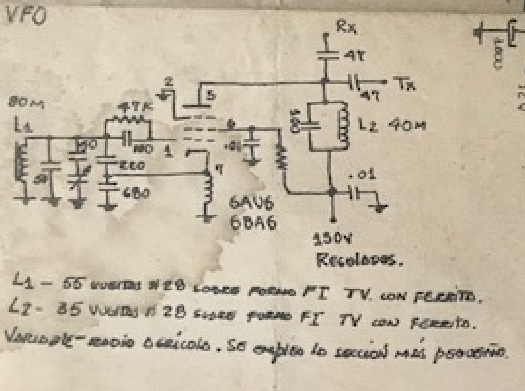
Jose CO6EC has been digging up 30 year-old Islander schematics for us. Thanks Jose. This one shows a VFO for the Islander. Note that it runs on 80 meters, but they select the second harmonic at 40 meters. This was a smart move that surely helped with VFO frequency stability.

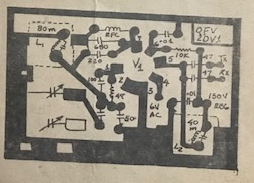
Jose sent this printed circuit board pattern for the VFO. Obviously they were making many of these rigs.
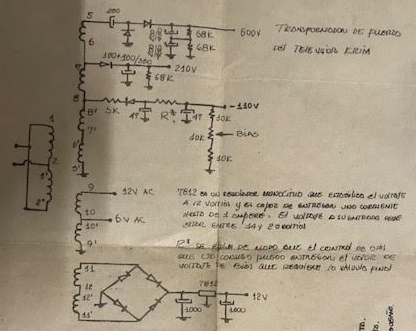
Here is the power supply. Jose reports that the transformer came out of a Soviet Krim 218 TV set. As a kid, I also pulled a transformer out of an old TV — I did it to build a power supply for a Heath HW-32A.
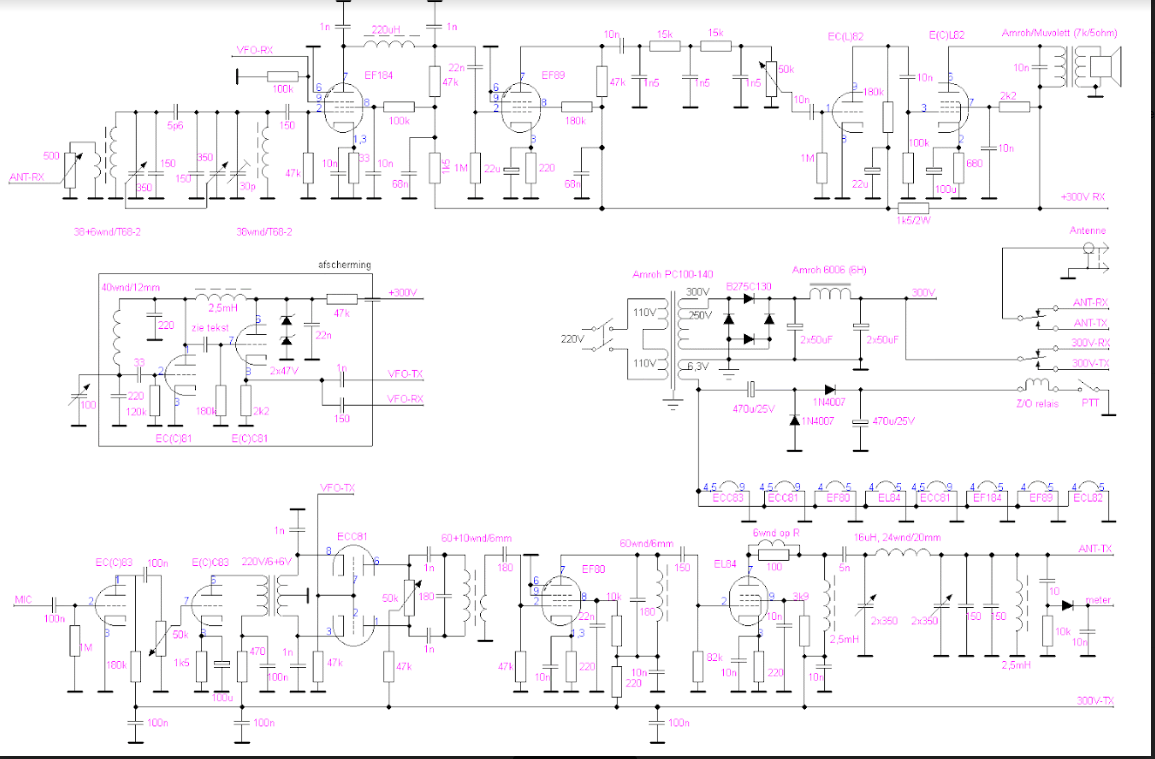
Here is another version of the Islander. Click on the image for a better view. Jose reports that this version was circulating during the time Islanders were being built. He says this diagram many have been done by Arnie Coro CO2KK (SK), and may have been circulated on the internet.
Here’s the first schematic that Jose sent. Again, click on the image for a better view.


I will continue to gather information on the Islander and the Jaguey. If you have any info please send it to me.

Here are some earlier posts on these rigs:


Thanks to Jose CO6EC!

Troubleshooting an Intermittent with Mr. Carlson. And Troublesome Tube Re-Branding.

This is a really great video on how Mr. Carlson (VE7ZWZ) did troubleshooting on a tube-type receiver. The problem was an intermittent. They can drive you nuts, but Mr. Carlson show us how to stay sane.

— His use of ordinary observation at the start of the process is very important. He notices a flickering glow in the voltage regulator tube. The flickering coincides with the intermittent noise that he is trying to fix. That is an important clue.

— He also can see that the grid of one of the AF amplifier tubes is getting way too hot: grid emission. That is another important clue.

— He checks the grid voltage on the AF amplifier and finds that it is way too low. It is fine on the other side of the resistor that carries the voltage to the tube. But it is close to zero at the grid. This means that the mica capacitors on the grid are suspect.

— He uses some fairly esoteric test gear — a homemade device and an an old Heathkit signal tester — to check his diagnosis. They confirm that the mica caps are the problem. He replaces the caps and the problem is gone. A very satisfying troubleshoot.

Mr. Carlson presents us with a lot of good info:

— 6K6 tubes were often in fact 6V6 tubes. And 12AX7s were often 6VJ8s! Manufacturers were deliberately re-branding tubes. So we shouldn’t be surprised if some of our solid state devices turn out to be a bit different from what was promised. This practice goes way back.

— I liked Mr. Carlson’s final sensitivity test on the receiver — he just waved his hand near the antenna connection and we could hear the receiver respond. Excellent.

— Mr. Carlson is very negative about the use of polystyrene caps in oscillator circuits. But we these simple and cheap caps being used to good effect in oscillators in India.

— The leaky and bad micas were a bit surprising. Carlson speculates that their proximity to heat-producing resistors might have caused the trouble.

Finally, it is interesting to hear the Canadian pronunciation of radio words: Solder with the L pronounced (as in the UK). Farad with the second A long and the final D emphasized (I say it just as the first two syllables of Michael Faraday’s last name).

Thanks Mr. Carlson.

Mr. Carlson Replaces Old Capacitors — Bathtub Capacitors

I recently posted a video from CuriousMarc about whether or not to replace electrolytic capacitors in old pieces of gear. This is a hot topic in restoration circles.

This week Mr. Carlson put out a video (above) in which he got rid of a bunch of “bathtub” capacitors in an old receiver.

One of the many interesting things in Mr. Carlson’s video was how his test gear initially showed the old capacitors to be good, but on further examination with better test gear he found them to be BAD!

Out with old, in with the new!

To Re-Cap or Not to Re-Cap — Curious Marc on the Electrolytic Controversy in Ham Radio


A while back I got some fairly acerbic feedback when I DARED to suggest that perhaps it would be a good idea to replace the old electrolytic capacitors in ham radio equipment. It was as if I had attacked motherhood and apple pie!

Yesterday I was looking at CuriousMarc’s YouTube channel and I came across the above video. While I had been in the preemptive replacement camp, Marc makes a good case for leaving some of the old caps in place. The fact that the electrolytics usually are open when they fail, and that there are fuses in the power supply to protect the transformers, are important points. His admonition not to replace electrolytics with tantalum caps (which fail closed) was also very useful.

OK, my flame-proof suit is on!

CuriousMarc (AJ6JV) Goes to a Hamfest

Jean Shepherd once said that all of us at one point come to a cross-roads in our lives — one road leads to success, the other to ham radio flea markets.

As I watched this, I realized that CuriousMarc sounds like a ham. Sure enough, some Googling revealed that his real name is Jean-Marc Verdiell and his ham radio callsign is AJ6JV.

I knew Marc was one of us when, in the video, he opens up the teletype. He says that the seller claimed that it still worked. But Marc comments that he hopes that this is not true, so that they will be able to troubleshoot and fix the device. FB. That’s the spirit.

We are really lucky to have someone as successful and creative as Marc in the ranks of ham radio operators.

Be careful with the high voltage Marc!

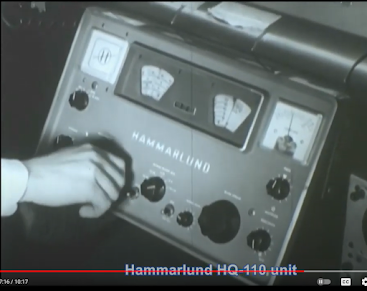
Hammarlund HQ-100 Misidentified in 1963 FCC Film

Oh the indignity! It appears at 7 minutes 16 seconds in this FCC film. It is clearly an HQ-100, but the FCC subtitles identify it at an HQ-110. It is clearly an HQ-100 ( the model without the clock).

https://www.youtube.com/watch?v=LzPIOfpKkRM

As the owner and operator of what must be one of the few remaining HQ-100s, I feel obligated to defend the reputation of this fine piece of shortwave gear.

How many of you have HQ-100s?

R-390s, KWM-2s, Airplanes, and Magnetic Loops — A Really Interesting Interview with Ted Robinson K1QAR

Eric Guth 4Z1UG has a really interesting interview with Ted Robinson K1QAR.

I really enjoyed hearing Ted’s inspiring story:

https://www.youtube.com/watch?v=SUUzlKMMANg

https://www.qsotoday.com/podcasts/K1QAR

Listeners will like the discussion of the R-390 and the KWM-2. And his talk about airplanes. And the joy of repair.

Here is Ted’s QRZ.com page: https://www.qrz.com/db/K1QAR

Thanks Eric! Thanks Ted!