The Transistor that Changed the World — the MOSFET

Another great video from Asianometry.

My only quibble is that it kind of left unclear the differences between JFETs and MOSFETs. After all, we still use both. Note our beloved J310 JFET. And the IRF510 is a MOSFET.

Google’s AI explains:

A JFET (Junction Field-Effect Transistor) and a MOSFET (Metal Oxide Semiconductor Field-Effect Transistor) are both types of field-effect transistors, but the key difference is that in a JFET, the channel conductivity is controlled by a reverse-biased PN junction, while in a MOSFET, it’s controlled by an electric field across an insulating layer between the gate and the channel, allowing for a much higher input impedance and greater design flexibility in MOSFETs; essentially, MOSFETs are considered a more advanced version of JFETs with superior performance in many applications like high-speed switching and integration into complex circuits.

Fernando’s Rigs — Vintage Ham Radio Receivers

Thanks to Rogier PA1ZZ for sending me this YouTube link. It is a truly wonderful channel from Spain. Not only the Collins Gold Dust Twins, but also lots of great (and not-so-great!) older receivers. SP-600s, S-38s, Rhode and Schwartz rigs, lots of great stuff. Go to the “Videos” link and enjoy the Thermatron goodness. Thanks Rogier! And thanks Fernando!

https://www.youtube.com/@jonglei

Ham Radio in the 1970s (and earlier, with some cool Jazz). What favorite rigs do you see?

Rogier PA1ZZ sent me this today. I think I may have seen pieces of it before, but this restoration
is really nice. But ham radio seems to have been a lot cooler in California. I don’t remember it being so socially advantageous on the East Coast. See Dilbert cartoon below.

So many memories:

— The video opens with someone working on a QF-1 Q multipliers. We have destroyed so many of these relics, in pursuit of the variable capacitors (which turn out to be not so good).

— A Drake 2-B on Field Day.

— An HT-37 in a shack.

–What looks like an HW-32a in a mobile rig.

— Maybe an HW-101.

— A BC-348.

— The ATV station with lots of homebrew gear was very cool.

— I also liked the single THERMATRON homebrew CW rig made from an old TV. FB.

— The CW used in the video was all pretty good. There was a lot of chirp. This, of course, adds character to a signal. FB.

After the video, they take a walk down memory lane, looking at ham radio magazines with some cool jazz playing in the background. I saw a Swan 240 and a D-104. The debauchery of the 1970s was evident on the magazine covers. Even QST seemed to be caught up in this. Check out the August 1975 cover of QST.

Anyway, this video was a lot of fun. Thanks Rogier!

What favorite rigs do you see? Make note of them in the comments.

This video and the Dilbert cartoon reminded me of a discussion we had many years ago about THE KNACK:

Excellent New Video from Grayson KJ7UM on his Thermatron version of the Michigan Mighty Mite

Here is a really wonderful video from Grayson Evans, KJ7UM, author of Hollow-State Design for the Radio Amateur.

I really loved this video. Throughout we see Grayson’s sense of humor. Early on he explains the differences between a tube (what remains from a roll of paper towell), a valve (like the plumbers use) and a THERMATRON (like a 6146). Grayson is the inventor of the word Thermatron. We should all pledge to use it whenever possible.

Grayson’s humor also shows up when describing the parts acquistion process for the Thermatron Michigan Mighty Mite. He puls out a coil (a huge coil) and laments that it is not — despite its large size — sufficiently inductive.

There are wonderful shout outs to SolderSmoke, to Electric Radio, to the Color Burst Liberation Army, to Pete Juliano, and to Rex Harper.

Grayson describes the utility of Rex Harper’s Thermatron ME pads.

During the video, Grayson actually builds the Thermatron MMM. In under 2 minutes! He then experiences the Joy Of Oscillation, or JOO as it has come to be known. OM needs a contact — listen for him on 3579. He is calling CQ.

Grayson talks about his book, Hollow-State Design. I have a copy with me here at SolderSmoke Shack South in the Dominican Republic. Great stuff. The above link takes you to Lulu, where you can order the book. You can also get it from Electric Radio Magazine here: https://www.ermag.com/product-category/books/

Thank you Grayson for bringing us this video, and so much more over the years. And for giving us the very useful and fun word: THERMATRON!

“Matter Waves” — A 1961 Bell Labs Film

I continue to mine the AT&T video archive. Here’s a really wonderful 1961 film showing how particles really are waves also. The simplicity of the gear that the Bell Labs folks used to demonstrate this is really admirable. I would love to see the preceding film (the one that shows how light waves are really also particles).

“The Far Sound” — Bell System Video from 1961 — Good Radio History (video)

This is a really OLD video, but there is a lot of great material here:

— Tubes. (Valves or Thermatrons)
— Coax.
— Frequency Division Multiplexing.
— Negative Feedback and the fight against distortion.
— Transistors and early experiments with semiconductors.
— Fiber optics and Masers.
— Satellite communications.
— Early hopes for video communications.

The video is, by today’s standards, extremely misogynist. And the sound experiment with the poor woman wearing a male head was just weird. But still, an interesting film.

Thanks to Mark KM4GML for reminding us of this wonderful Bell Labs (AT&T) video archive.

Ragnar LA1UH’s Wonderful Museums in Norway

Here are two more great museum visits by Helge LA6NCA. In these two he visits Ragnar LA1UH.

Ragnar has a lot of maritime experience, so we see a lot of older ships’ radios. But his interest in the radio art is much broader and we also see a lot of other kinds of gear:

— Wow, a “travel radio” in a suitcase from 1927. Was this the idea that later lead to the Parasets of WWII?

— Lots of “Stay Behind” gear from the Cold War. That “Africa” receiver (that never made it to Africa!) is very interesting.

— We see an ART-13 with autotune, ANGRC-9s, several ARC-5 command sets. I was hoping Raganar would fire up a Dynamotor, but no.

— I spotted a Galaxy V transceiver. I have the VFO reduction drive from one of these in my homebrew 15/10 rig.

— We see several variometers in the emergency (500kc?) maritime transmitter. I used a variometer in my super-simple ET-2 transceiver (with an N0WVA receiver).

— Lots and lots of tubes.

Ragnar says he himself is of 1944 vintage. I hope some “stay behind” provisions have been made for these amazing museums.

Thanks to Helge LA6NCA and to Ragnar LA1UH.

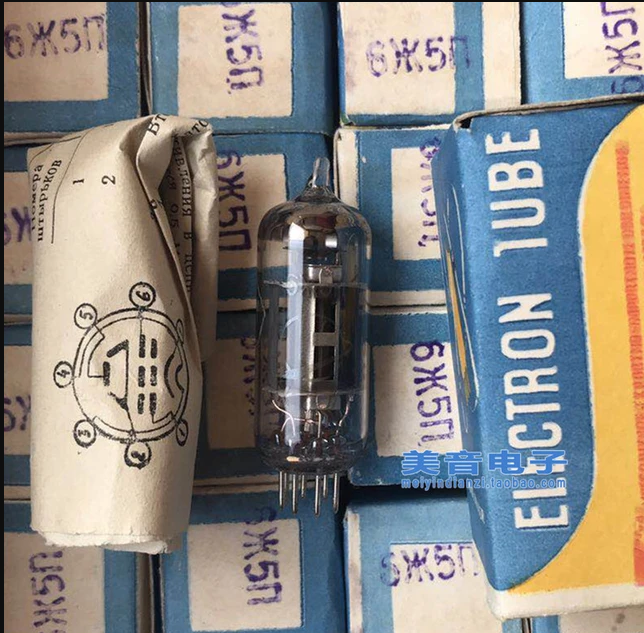
A Soviet Tube in Cuba: The “Little Spider”

I hope readers have picked up on the discussion of the Islander DSB rig out of Cuba. We had a bit of a breakthrough on this recently. I’ve been writing about it on the blog:

https://soldersmoke.blogspot.com/2024/04/re-building-islander-dsbcw-rig-in-cuba.html

One thing I think is especially interesting: The Cubans were using parts taken out of old Soviet TV sets. One of the tubes used in the VFO section of the Islander was known among the Cuban hams as “the little spider.”

Arnie Coro CO2KK explains why:

“VFO is made with ONE of the 6 “little spider” 5 pentodes… By the way, I am sure you will like to know why the tube is locally known like that… the ZHE letter of the Cyrillic alphabet is something difficult to pronounce to a Cuban – or any other non slavic for the matter – and it resembles like a little spider on the tube’s carton and… that’s why it is not a 6 “ZHE” 5 but a 6 “little spider” five!!!”

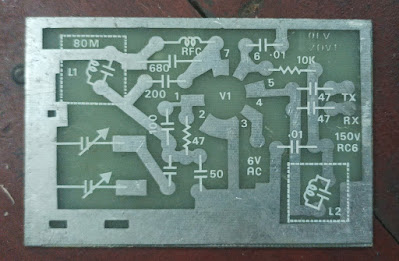
Re-building the Islander DSB/CW Tube Rig in Cuba

The VFO Board
The “motherboard” for an Islander
Islander boards recently obtained in Cuba by CO7WT

Pavel CO7WT is making great progress in re-building an Islander DSB rig, the same kind of rig that got him started in ham radio, and that was so popular in Cuba years ago. Here are some background blog posts on this rig: https://soldersmoke.blogspot.com/search?q=Islander In essence, the Islander was the earlier tube DSB/CW rig; the Jaguey was a later, solid-state DSB/CW rig.

When they get this Islander going, hams outside Cuba should definitely try to work this re-creation of an important rig.

Thanks Pavel for all the information. I will share with the group info that Pavel sent about temperature stabilization techniques used on this rig.

Pavel CO7WT writes:

Great news, today I received the package from my colleague in zone 6.

Two original islander motherboards and one from the vfo!

I’m doing a search among old technical friends in the city and in the country to see if I can put together at least a transceiver motherboard.

Audio triode-pentode is easy, as is tx pentode and audio double triode.

The difficult ones would be the 6cb6 and 6bz6 of the receiver… At least according to what I have polled among my local friends…

Tomorrow some friends are going to start looking for bases and valves that can be used to build a trx islander.

All out of pure nostalgia. I intend to make it qrp, that is, up to the output pentode, which there is between 3-5W of power, that is enough for me.

I am looking for alternatives for small sources, perhaps I will use switching for the filaments and we will see what I can get for the 180-250v of the plates.


Earlier:

CO7WT here, built a pair of the Islander back in the time, the most scary part was the power supply.

The 600V is 300ish V from the transformed DOUBLED stright from the transformer and if you look closely on the diagram the doubling capacitor need to be of good quality otherwise it will explode in the spot.

As you can imagine, using scrapped parts means that very often this capacitor explodes, even after a few months of duty, that was a common problem.

We used to use 47uF/800v from Germany that was almost easy to obtain, but exploded like fireworks a given day.

Later I learned that if you put a resistor of about 1k 5W in series and work it for a while like this [no real voltage at the end] it will behave in the future and this trick saved many, a trick that was shared with Coro CO2KK and he found the explanation on the taming/training of the dielectric after storage/inactivity will prevent it from exploding.

I think he made mention this on a DXers Unlimited program…
Ian Keyser G3ROO and Spy Radios

Above is a recent ICQ podcast interview with Ian.


This sojoun into spy land started with this WTF video: https://www.youtube.com/watch?v=4f3ZJYdmpZw

Crypto Museum explains what the Mk 301 was all about: https://www.cryptomuseum.com/spy/mk301/index.htm

I have had Ian on the SolderSmoke blog several times: https://soldersmoke.blogspot.com/search?q=%22Ian+Keyser%22

N2CQR at the key with a G3ROO paraset

Grayson Evans KJ7UM Video on Homebrewing with Thermatrons

Grayson Evans KJ7UM is the author of Hollow-State Design for the Radio Amateur, a wonderful book about using Thermatrons (aka tubes, or valves) in radio projects. Buy it here:

https://www.lulu.com/shop/grayson-evans/hollow-state-design-3nd-edition/paperback/product-5mpzqr.html?page=1&pageSize=4

More info on the book is here: https://kj7um.wordpress.com/2020/12/02/hollow-state-design/ In this video, Grayson talks about construction techniques (including the use of Thermatron Me-Pads), and Manhattan construction for Thermatron projects. FB! Visit Grayson’s blog: https://kj7um.wordpress.com/

Jean Shepherd has Trouble with his Heising Modulator (and his date)

This is probably Jean Shepherd’s best program about homebrew ham radio. It is about how we can become obsessed with the problems that arise with equipment that we have built ourselves, and how normal people cannot understand our obsessions.

I posted about this back in 2008, but I was listening to it again today, and quickly realized that it is worth re-posting. Realize that Shepherd’s Heising modulation problems happened almost 90 years ago. But the same kind of obsession affect the homebrewers of today.

Note too how Shepherd talks about “Heising” in Heising modulation. Heising has an entire circuit named for him, just like Hartley, Colpitts, and Pierce of oscillator fame. Sometimes, when I tell another ham that my rig is homebrew, I get a kind of snide, snarky, loaded question: “Well, did you DESIGN it yourself?” This seems to be a way for appliance operators to deal with the fact that while they never build anything, someone else out there does melt solder. They seem to think that the fact that you did not design the rig yourself makes your accomplishment less impressive, less threatening. This week I responded to this question with Shepherd’s observation — I told the enquiring ham that my rig is in fact homebrewed, but that I had not invented the Colpitts oscillator, nor the common emitter amplifier, not the diode ring mixer, nor the low-pass filter. But yes, the rig is homebrew, as was Shepherd’s Heising modulator.

Guys, stop what you are doing. Put down that soldering iron, or that cold Miller High Life (“the champagne of bottled beer”) and click on the link below. You will be transported back to 1965 (and 1934!), and will hear master story-teller Jean Shepherd (K2ORS) describing his teenage case of The Knack. He discusses his efforts to build a Heising modulated transmitter for 160 meters. He had trouble getting it working, and became obsessed with the problem, obsessed to the point that a girl he was dating concluded that there was “something wrong with him” and that his mother “should take him to a doctor.”

This one is REALLY good. It takes him a few minutes to get to the radio stuff, but it is worth the wait. More to follow. EXCELSIOR! FLICK LIVES!


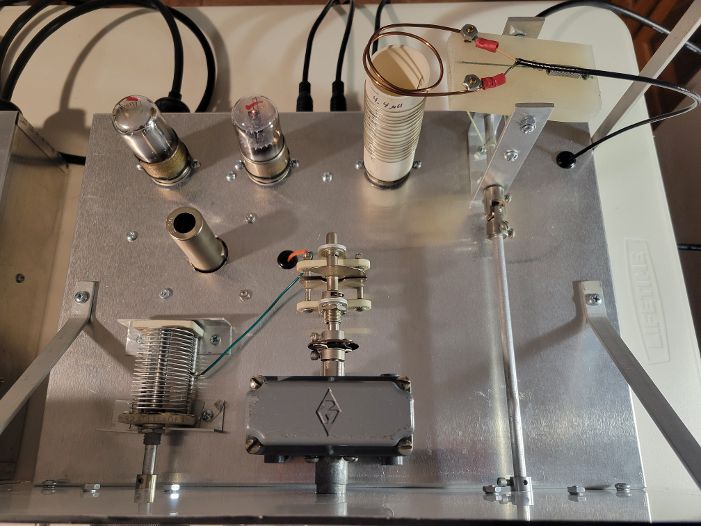
Nate KA1MUQ’s Amazing Thermatron Receiver


Wow, some really wonderful work is taking place in Nate KA1MUQ’s basement in California.

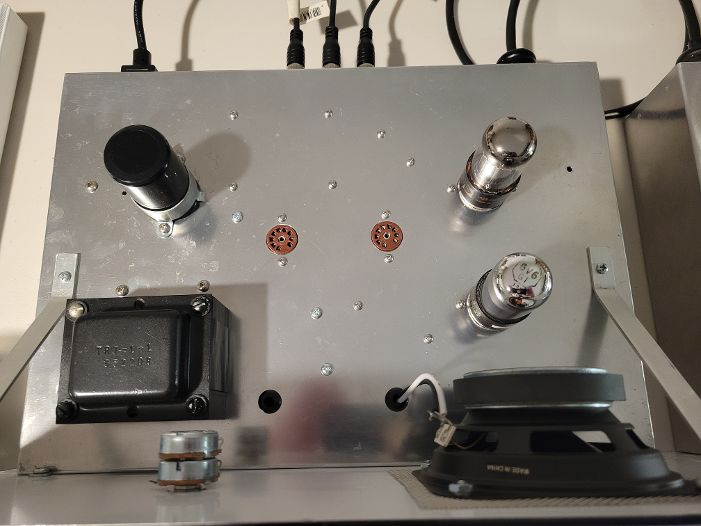
— I really like the pill bottle coil forms. I wonder if Nate faced suspicion (and possible arrest) in the pharmacy when he asked for the pill bottles. (I got some suspicious looks when I went I asked for empty pill bottles while building my thermatron Mate for the Mighty Midget receiver back in 1998.)

— The variable capacitors are also quite cool, as is the big rotary switch. Is that for band switching?

— Oh man, all on a plywood board. Frank Jones would approve!

— Indeed Nate, that beautiful receiver NEEDS an analog VFO. And we need to hear it inhaling phone sigs, not that FT8 stuff.

— Please keep us posted on your progress. And of course, one hand behind your back OM. Lots of high voltage on those thermatrons.

Thanks Nate!

Armand’s Receiver — A Beautiful Regen from WA1UQO

Armand writes:
The video above shows a quick pass up 40M. The radio sounds better than the video would have you believe (better than I expected). So now the Select-o-Ject circuit is next (Stay tuned Grayson).
A long list of folks helped with bringing this project as far as it has come. The original description was by Bruce Vaughan, NR5Q SK. Jim Stoneback, K4AXF tweaked it and added the Select-o-Ject circuit.
The power supply picture (below) shows a ganged potentiometer and two empty sockets. These will be for the Select-oJect.
Anyway, it was a fun build and I learned a lot. Now I’m at the point that Farhan advises to make a cup of coffee and just enjoy listening.
73, Armand

Receiver
Power Supply

The System Source Museum (Computers, Maryland)

Thanks to my friend Bob KD4EBM for alerting me to this. Bob provides some very useful background:

(Just north of Timonium, colocated with the future home of the National Electronics Museum)

System Source has a computer museum displaying technology from the inception of computing. Founders Bob Roswell and Maury Weinstein opened ComputerLand, a predecessor to System Source, in 1981. Rapid advances in technology in the early 1980’s made some ComputerLand inventory obsolete before it could be sold. Bob and Maury’s old ComputerLand store on Redwood Street had a bank vault in the basement, so they filled it with vintage tech.

Wow, that bank vault in the basement is really intriguing. We need to find more of those.

The Usagi guy’s 6AU6A T-shirt is pretty cool. I also liked his reference to Tracy Kidder’s book “The Soul of A New Machine.” I happen to be re-reading that book now. I’m struck by the complexity of even the computers of the late 1970s. At one point Kidder notes that there is only one guy on the hardware team who has a complete grasp of how the hardware in the new machine actually works. The software was probably even more inscrutable. And of course, things have gotten a LOT more complex. This is the big reason that I have decided to stick with simple, analog, discrete component, HDR rigs that I can understand. To each his own. One look at the wiring on some of those old computers tells me that this is not for me.

AA9IL’s Sputnik Tube, Altoids Tin Transmitter

November 24, 2023
Hello Bill
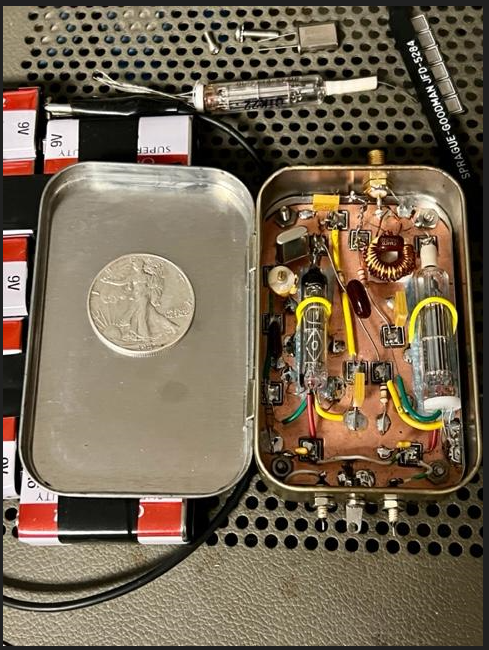
I have just built an tested a 20 meter “Sputnik” transmitter. It uses two Soviet era “rod” tubes and is fixed tuned to 14.060 MHz. I was able to compress the design to fit in an Altoids tin. The plate tuning capacitor was replaced with a fixed capacitor value closest to the variable for peak power out. Plate voltage is 90 volts and I key both the oscillator and PA via the B+ line. Power output is around 200mW and my first test transmission from the Chicago area was picked up 864 miles away on the east coast via the Reverse Beacon Network. It was definitely Joy of Oscillation and Joy of Transmission!

73, Mike
AA9IL
EN52
—————-

Mike’s rig has been heard by many Reverse Beacon Network stations:

——————
November 29, 2023
Bill:
I started a QSO with AC2C in Ellicott, MD who responded to my CQ but the band dropped (20m)

But that’s a good start and I’ll keep at it! So, yay!
73 Mike
——————-
Here are some earlier blog post on rigs using Soviet rod tubes:

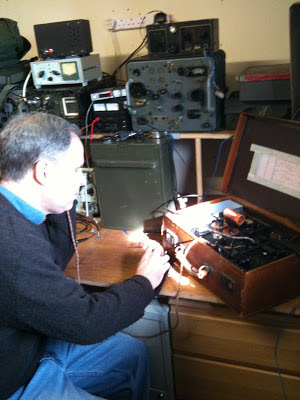
Mr. Carlson’s ART-13 Transmitter (with Dynamotor)

Here we have a really cool video from Mr. Carlson. In it he reveals (admits!) to what we already know: HE IS A HAM RADIO OPERATOR. FB Mr. C!

You can see that he is a true ham, with a true case of THE KNACK, when you see his reaction to the inside view of the ART-13. He seems to gasp as he notes that there is a lot of “RF goodness” in that box. There is a vacuum relay, a bread-slicer capacitor, there is even a variometer. And lots of good, big THERMATRONS. Only a true ham, a true Knack victim can recognize this RF goodness.

The Dynamotor that goes with this transmitter is really interesting to me. I have been hearing these things whining in the background (audible noise, not a signal defect) on many early morning (Saturday 3885 kHz) of the Old Military Radio Net. I can often hear the dynamotor of Buzz W3EMD as he transmits from Rhinebeck, New York. It was great to see the inside of this device.

Back in 2017, Hack-A-Day took a look at Dynamotors:

There are several good ART-13/BC-348 pictures on W3EMD’s QRZ page:

I was especially taken by the handwritten frequency chart on the front panel of the ART-13. This reminded me a lot of the handwritten readout that I have been using on various rigs, including (most recently) the 15-10 SSB transceiver. I hope Paul focuses on this paper-and-pencil frequency chart; it is nice to step away a bit from the glowing numerals of San Jian.

Mr. C points out that the ART-13 was the transmitter that was paired up with the BC-348 receiver. He will be working on both in the weeks ahead.

Thanks Mr. Carlson. 73 OM.

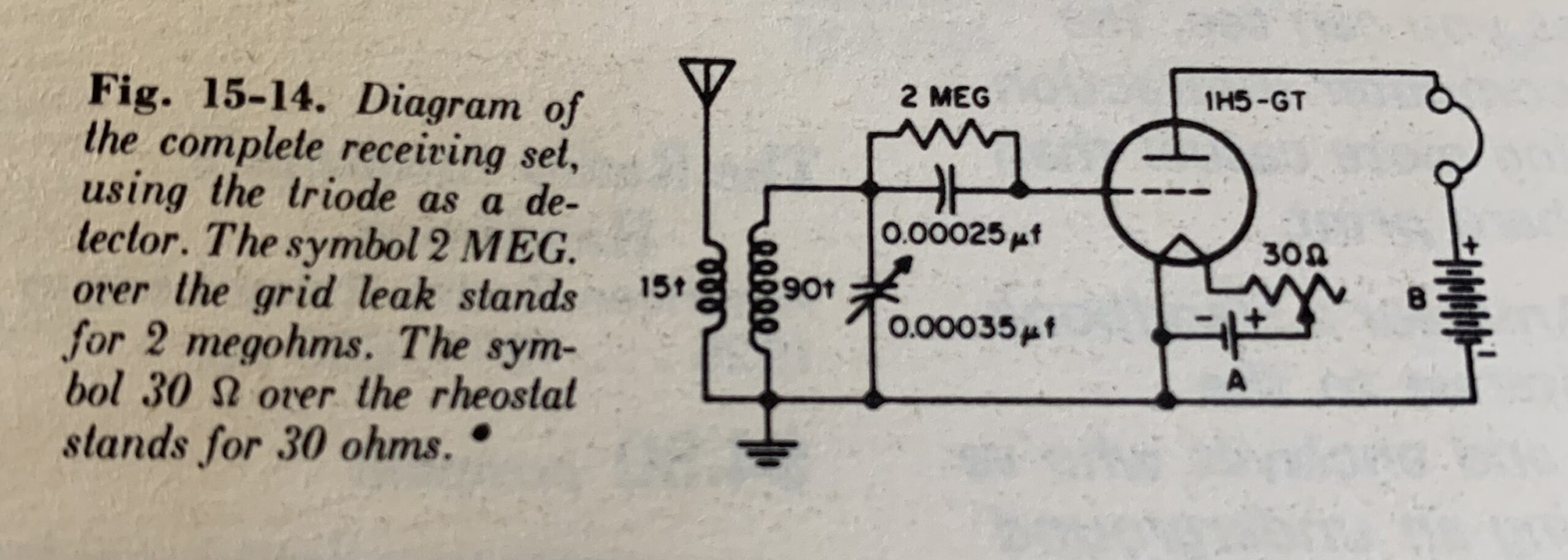
The Grid Leak Detector — Follow-up from Yesterday’s Post on the Whole Earth Catalog’s “Hippy” One Tube Receiver

Click on image for a better view
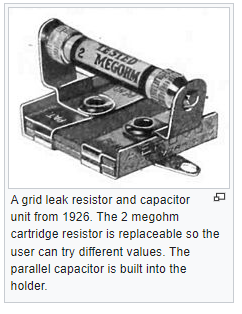
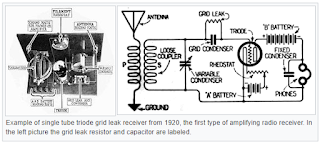
When I first looked at it in the Whole Earth catalog circuit, I thought it was a regen. But a commenter correctly questioned this conclusion. I remembered the grid leak circuit (WN2A provided more info in the comments). This morning I found a Wikipedia page that explains it all very well. I especially like the description of how this detector works both with small signals in the “square law” range of the tube, and with larger signals in the linear range of the tube. The history of the discovery of the need for the large resistor is also very interesting. I remember building FET amplifiers and finding that they would — after time — shut down. This would happen as charge built up on the gate. I had neglected to include the normal 100k ohm resistor (that would “leak” this charge to ground). Once I put this resistor in, the amp worked fine.

Here is the Wikipedia article:

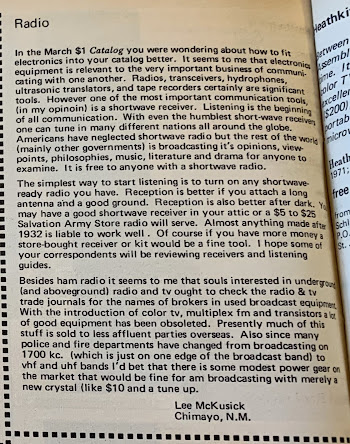
Whole Earth Catalog Part II: More on SWL (and a Hippy One-Tube Receiver)

Click on image for a better view
Lee McKusick was correct about many things, but of course we were a bit disappointed by his focus on store bought gear. But the 1971 Whole Earth catalog made up for this by publishing the schematic for a very simple single-triode receiver:

Click on image for a better view

There is a follow-up article on grid leak detectors here:

Sunburst and Luminary: Apollo “Rope” Memory, and other items of interest

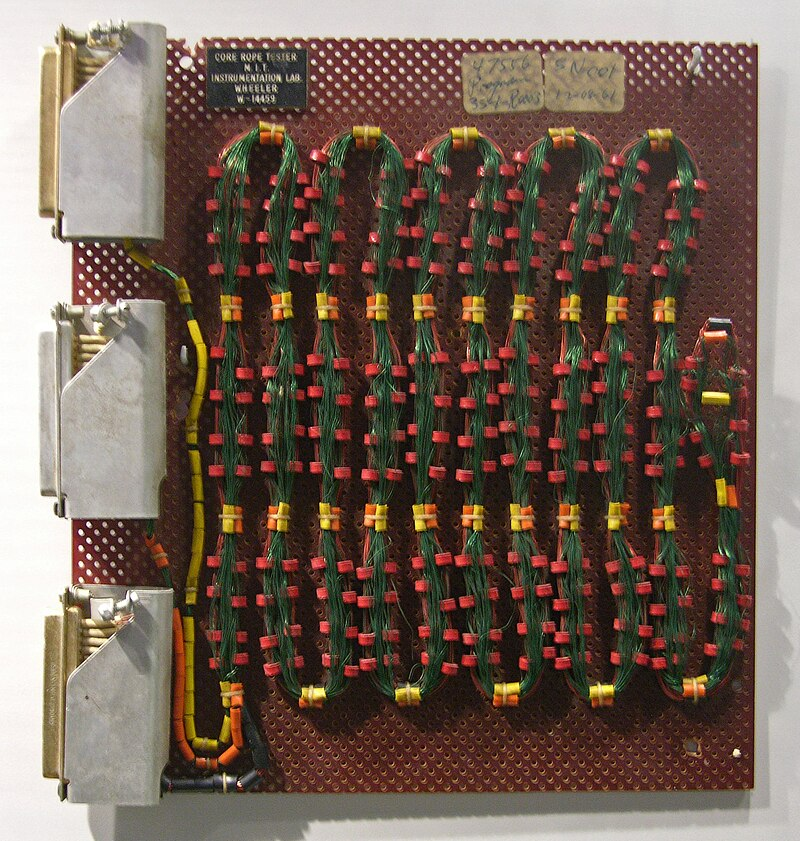
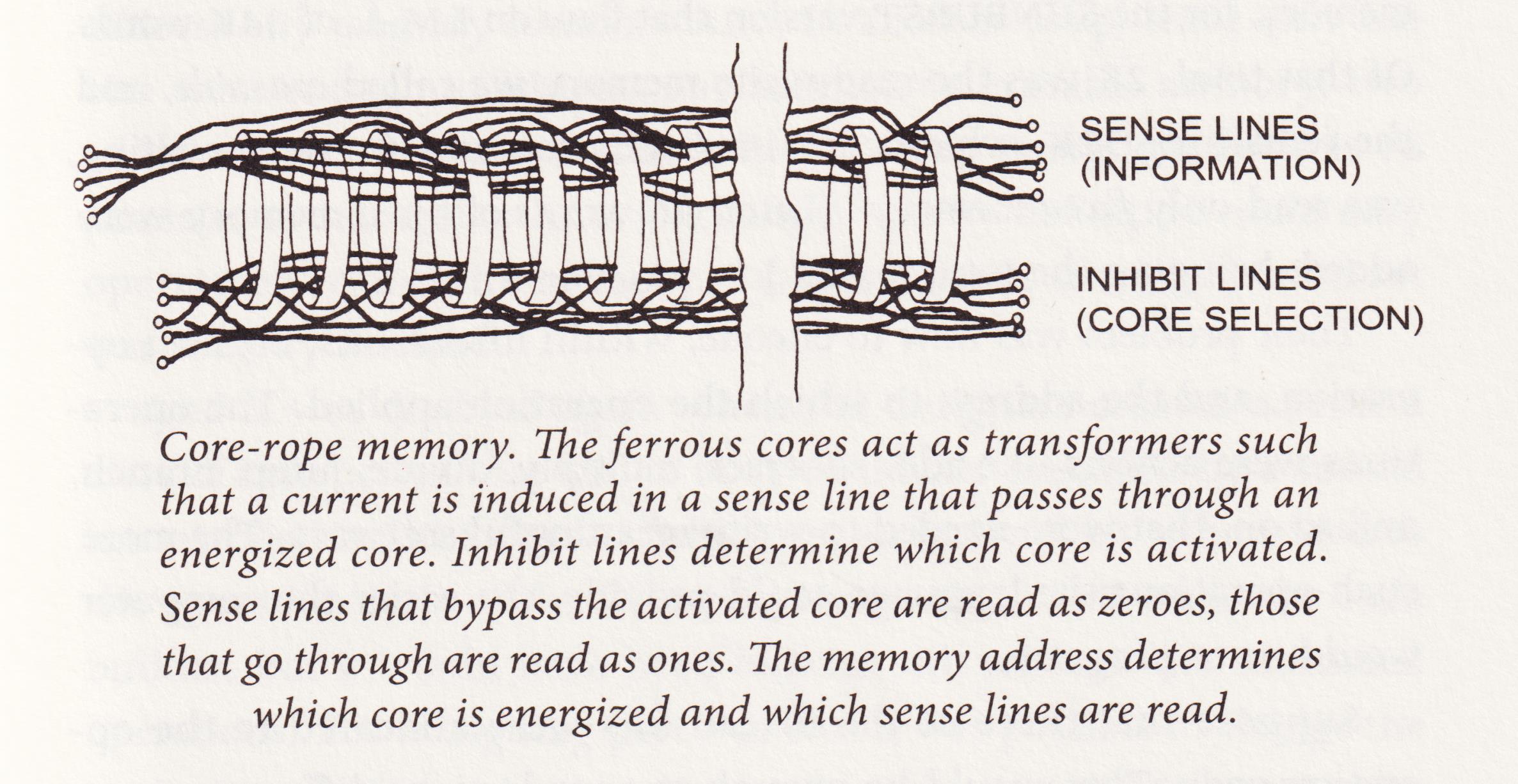
Wow. That is the method that they stored computer memory for the moon missions. When they were satisfied with a program they would say it was time to “put it on the rope.”

Here’s an article on the women who built the rope memory (and the integrated circuits used in Apollo). This reminded me of the women’s collective in Hyderabad that “wove” the ferrite core transformers for Farhan’s BITX rigs:

https://www.sciencenews.org/article/core-memory-weavers-navajo-apollo-raytheon-computer-nasa#:~:text=Core%20memory%20used%20metal%20wires,to%20create%20a%20particular%20pattern.

Here is a Wikipedia article on core rope ROM memory with some great illustrations:

https://en.wikipedia.org/wiki/Core_rope_memory

The Rope
Other stuff of interest that I have spotted so far in the book Sunburst and Luminary — An Apollo Memoir by Don Eyles:

— Not long before the fatal Apollo 1 fire, an MIT colleague of Don Eyles had a drink with Astronaut Gus Grissom. Grissom unloaded about the poor state of the spacecraft, saying that, “What we have here is a Heathkit.” Grissom died in the fire.

— Eyles mentions the use of 6L6 tubes in analog audio amplifiers.

— MIT’s Doc Draper used a Minox camera.

— When the Apollo 11 astronauts came back and were living for two weeks in an isolation chamber, NASA had bulldozers on standby to bury the whole thing (“astronauts, staff and all”) in case some dangerous moon bug was detected. (Is that true?)

— At one point soon before an important missile test, engineers realized that they needed an isolation transformer. They did not have enough time to order one. So they took an isolation transformer out of one of their soldering stations and used it in the missile. It worked. Sometimes you just use what you have on hand.