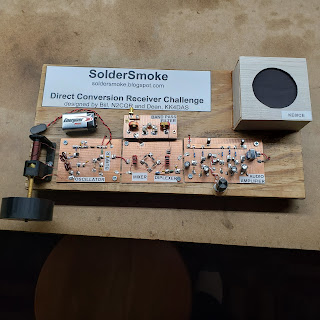
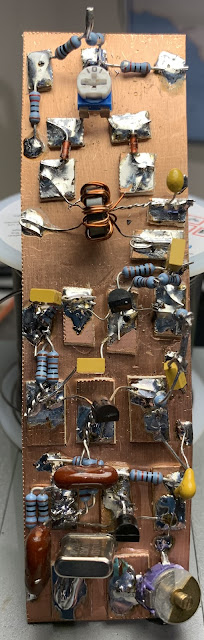
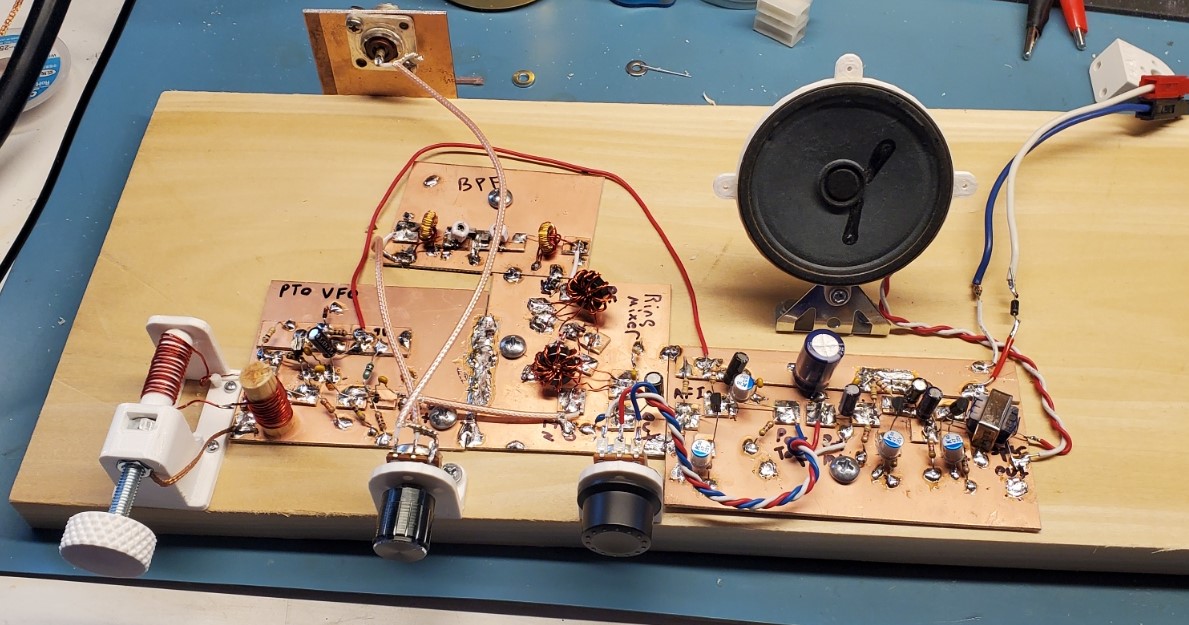
Steve N9SZ’s FB SolderSmoke Direct Conversion Receiver

FB Steve! Your receiver looks and sounds great! Congratulations!


Steve writes:

Thanks to Bill and Dean for all their work and promotion of this project. I learned alot and had fun. The receiver works well now after much tweaking. I need to finalize how the boards will be mounted. I am thinking of mounting the BPF and audio amp boards vertically on the edge of my small piece of wood and create a front panel using a PCB to mount a on-off switch, volume control. on/off LED, and the speaker/headphone jack. I also want to add a rear PCB to hold an antenna jack and power jack.

————————-
For more information on how you too can build the receiver:

Join the discussion – SolderSmoke Discord Server:

https://discord.gg/Fu6B7yGxx2

Documentation on Hackaday:

https://hackaday.io/project/190327-high-schoolers-build-a-radio-receiver

SolderSmoke YouTube channel:

Martin GM5JDG’s SolderSmoke Direct Conversion Receiver Inhales on SSB Contest Weekend

When I first saw Martin’s boards, I thought I was looking at something that was not really Manhattan style. But I was wrong — Martin had simply drawn grid squares on his boards. He used MeSquares for his non-ground connections. The SSB his receiver was picking up sounded great.

Martin is a relatively new ham — he started in 2020. It is really nice to have Scotland represented in the group.

Martin writes: One of the main things I learned was how to really start to use my oscilloscope. The band pass filter proved to be challenging as I initially placed my trimmers incorrectly and it took quite a while to find the problem. I’m looking at this as a potential high school project, so all my soldering was with lead free solder, as I run a community interest company providing tech workshops for disadvantaged kids. I would like next to look at building a complimentary transmitter. Will also have a look at the mods and upgrades.
Martin has noted the touchiness of the main tuning knob. One of the mods he should look at is the one that allows for easier tuning across the 40 meter band. It is described in detail in a post on mods-and-modifications.

Thanks Martin, and congratulations.

———————————
For more information on how you too can build the receiver:

Join the discussion – SolderSmoke Discord Server:

https://discord.gg/Fu6B7yGxx2

Documentation on Hackaday:

https://hackaday.io/project/190327-high-schoolers-build-a-radio-receiver

SolderSmoke YouTube channel:

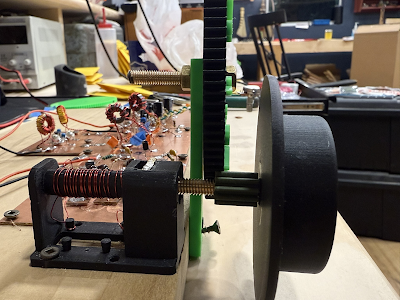
Mark KI5SRY’s SolderSmoke DC Receiver with a Cool Gear-Driven Tuning Dial

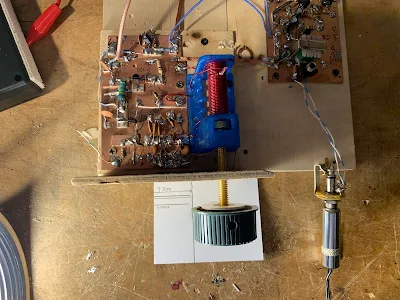
Mark KI5SRY came up with a very innovative solution for the tuning dial problem. See above. My solution was much less sophisticated: At the suggestion of VK3YE, I just put a calibrated card underneath the screw. By looking at the screw edge from above, I could get a rough estimate of where I was in the band:

Looking back on his successful build of the receiver, Mark wrote:

You made this pretty straightforward. My biggest challenge was trying to understand what was really happening in the circuit.
I learned how to use my oscilloscope, seeing the oscillator come to life was great.
I would like to build a transmitter or a complete transceiver.

Bill, thanks to all of the effort you and Dean are putting into this project. There was definitely a magical feeling dialing in and getting legible sound out something built on my bench.

Very cool Mark. Congratulations!

———————————
For more information on how you too can build the receiver:

Join the discussion – SolderSmoke Discord Server:

https://discord.gg/Fu6B7yGxx2

Documentation on Hackaday:

https://hackaday.io/project/190327-high-schoolers-build-a-radio-receiver

SolderSmoke YouTube channel:

Jeff N0NQD’s Direct Conversion Receiver has led to a problem like Jean Shepherd’s Heising Modulator Obsession

Wow, Jeff N0NQD built a beautiful receiver, and has been bitten bad by the homebrew bug. Jeff admitted that he recently went to a gala with his wife. He was preoccupied with the problems he was having with his DC receiver. Suddenly DURING THE GALA he remembered having mis-identified two capacitors in the mixer. So he and his wife HAD TO GO HOME FROM THE GALA so that he could fix the problem. And apparently he is still alive, and married! Amazing!

Jeff wrote:

I have been a ham for just about 40 year and typically build kits lots of them most recent the QMX. I found a new passion and seemingly addiction now because of this build. My next Home-brew project is probably going to be a transceiver or a complex receiver not sure what type just yet. It has been so much fun and highly distractive to be apart of this Soldersmoke DCR family. And hope this continues!! Thank you and 73 Jeff N0NQD

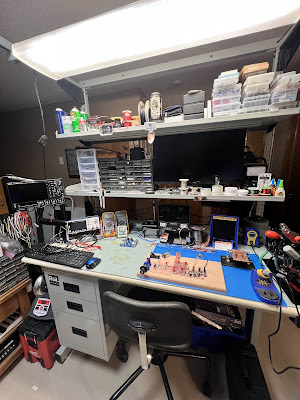
Jeff N0NQD’s Bench

Thanks Jeff. Congratulations!

———————————
For more information on how you too can build the receiver:

Join the discussion – SolderSmoke Discord Server:

https://discord.gg/Fu6B7yGxx2

Documentation on Hackaday:

https://hackaday.io/project/190327-high-schoolers-build-a-radio-receiver

SolderSmoke YouTube channel:


Ryan AC3NG’s FB SolderSmoke Direct Conversion Receiver

All the way through, Ryan displayed a desire to really understand each of the four circuits included in this receiver. He wanted, as Maxwell said, to know not only the “go of it” but “the particular go if it.” FB!

Ryan wrote:

Here’s a short video of my receiver in action. I’m very pleased to be receiving real radio! I’m too inexperienced, so don’t really know if this is good or bad performance for this receiver. This is about as good as I’ve gotten so far. A few people I can understand well, but many are not really intelligible. Thanks to everyone, this is a fun project!

I think it sounds great. Tuning in an SSB station with a DC receiver is an aquired skill — we all get better at it over time.

Congratulations on building a really nice receiver Ryan.

—————————–
For more information on how you too can build the receiver:

Join the discussion – SolderSmoke Discord Server:

https://discord.gg/Fu6B7yGxx2

Documentation on Hackaday:

https://hackaday.io/project/190327-high-schoolers-build-a-radio-receiver

SolderSmoke YouTube channel:

Jason WV3V’s Beautiful SolderSmoke Direct Conversion Receiver

Jason did a great job on this receiver, hanging in there as he worked to overcome techincal difficulties, some of which were related to test gear. That is a big part of the homebrew process. The receiver looks and sounds great Jason. Congratulations.

Jason wrote:

I really like the camaraderie and elmering during the process. Not to mention seeing the different builds and how people approached the design. That helped me, as I’m a visual learner. I’ve been a ham for almost 40 years and I love building rigs. This was a blast.Thanks again, Jason WV3V

——————————————

For more information on how you too can build the receiver:

Join the discussion – SolderSmoke Discord Server:

https://discord.gg/Fu6B7yGxx2

Documentation on Hackaday:

https://hackaday.io/project/190327-high-schoolers-build-a-radio-receiver

SolderSmoke YouTube channel:

John KE2AMP’s SolderSmoke Direct Conversion Receiver — With a Spring-Loaded PTO

Dean and I often say that we too have learned a lot from this project, and that the receiver has gotten better as a result of all these builds. But in KE2AMP’s case we really see an innovation that nobody has used before. But it is a great idea and it solves the “loose screw” problem of the PTO. Check out the spring on John’s PTO. That is really smart. Thanks John.

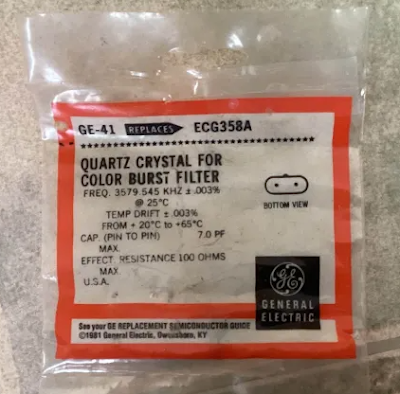
John also sent me a crystal wrapper that will long be cherished by the CBLA (Color Burst Liberation Army):
John wrote:

Well I completed my DCR, and am receiving signals on 40 meter at 1900UTC. My audio amp will oscillate if I turn up over half way and my pto is little loose and makes it bit hard to tune. I put a light spring behind the pto bolt to give it some friction and tighten up. I’m thrilled that I’m receiving signals. I still want to add a front panel to mount the volume pot, the on/off switch and speaker if I have the room.
I am so Thankful to Bill, Dean and everyone on the discord for this project I learned so much more being able to ask questions and follow along with other builders as we worked through each stage of the build. I definitely learned some things about oscilliscopes. And testing each of the stages as we went along.
I would like to try my hand at a SSB transmitter to go along with this receiver. I have built a working MMM but was just to see if I could. I don’t know CW
Oh and I included pic’s of something Bill will like.
Pick it up at a ham fest last summer.
Will that get me into the color burst liberation army?
Thanks Again, 73
de John KE2AMP

Consider yourself inducted John. The CBLA needs innovative people like you!

————————-

For more information on how you too can build the receiver:

Join the discussion – SolderSmoke Discord Server:

https://discord.gg/Fu6B7yGxx2

Documentation on Hackaday:

https://hackaday.io/project/190327-high-schoolers-build-a-radio-receiver

SolderSmoke YouTube channel:

Calvin KE8ICE’s SolderSmoke Direct Conversion Receiver

Calvin KE8ICE said that building this receiver marks his transition from a kit assembler to a homebrewer. FB!

Check out this short video of Calvin’s receiver in action:

https://www.youtube.com/shorts/BbcBVmmKygw

Thanks Calvin!

For more details on this project, and info on how you could build this receiver see:

Join the discussion – SolderSmoke Discord Server:

https://discord.gg/Fu6B7yGxx2

Documentation on Hackaday:

https://hackaday.io/project/190327-high-schoolers-build-a-radio-receiver

SolderSmoke YouTube channel:

Wayan YD9BAX’s SolderSmoke Direct Conversion Receiver — From Bali, Indonesia

Our Direct Conversion Receiver is being built around the world, but one of the most exotic locations for a build is the island of Bali in Indonesia. There Wayan YD9BAX set out to build the receiver.

Early on, Wayan noted that he would have difficulty getting the 1000:8 ohm AF output transformer we were using. This transformer was easy to get if you have easy access to Mouser, but a few prospective builders in Europe and the U.S. expressed deep objections to our use of this device. Some complained that we should have used a push-pull amplifier. Others complained that they didn’t have one of these in their junk box. Some even hinted that we should have gone with an LM386 chip. But we stuck to our plan, noting that the very simple AF amp circuit we had developed would be understandable in ways that the alternatives were not. Still, I worried about Wayan. He might have really been out of Mouser range.

Yesterday the above video appeared. Wayan finished the receiver. It is inhaling nicely on both SSB and CW. The CW signal you hear in the recording is that of YB1IHL. That is CW from Indonesia as picked up by a homebrew recevier. FB!

How Wayan cracked the code on the transformer is inspiring. He essentially homebrewed the part. Wayan wrote on the Discord server:

At last I can hear the CW and SSB coming in. The one and only 9v battery that I have during homebrewing forcing to switch to bench PSU with 9,3v setup Pardon me for the messy board and layouts, excitement that it works with parts I have in hands is everything. I learn a lot during this project, including inability for sourcing 1k:8 audio transformer causing me to build my own xformer from 600 ohm transformer former and magnet wire from a broken relay, tedious works but I learn new things. Need to tidy up and may need to build another mixer and BPF again.

He also homebrewed the PTO coil former.

Wow, that is all really inspiring, and is a great example of the homebrew spirit at work.

And Wayan is a new ham, licensed only since 2019: https://www.qrz.com/db/YD9BAX

Congratulations Wayan!

For more info on this project and info on how you should build this receiver see:

Join the discussion – SolderSmoke Discord Server:

https://discord.gg/Fu6B7yGxx2

Documentation on Hackaday:

https://hackaday.io/project/190327-high-schoolers-build-a-radio-receiver

SolderSmoke YouTube channel:

https://www.youtube.com/@soldersmoke


Chris G7LQX’s SolderSmoke Challenge DC Receiver

It looks and sounds really good. It is inhaling SSB, CW, and digital signals on 40 meters. Great job Chris.

More details here. It is NOT to late to build one of these.

Join the discussion – SolderSmoke Discord Server:

https://discord.gg/Fu6B7yGxx2

Documentation on Hackaday:

https://hackaday.io/project/190327-high-schoolers-build-a-radio-receiver

SolderSmoke YouTube channel:

https://www.youtube.com/@soldersmoke

SolderSmoke Direct Conversion Challenge The Mixer and Diplexer

SolderSmoke Challenge – Direct Conversion Receiver – the Mixer

The mixer is the heart of the direct conversion receiver. It’s the circuit that makes a receiver a receiver. It takes the RF from the antenna and mixes it with the local oscillator to extract the audio. In this video, Dean, KK4DAS walks us through the design, build and testing of the double balanced diode ring mixer we chose for the SolderSmoke Challenge DCR. He also explores some of the myths, legends, and lore around mixer design. If you are not yet convinced, we can make an effective receiver with just four simple boards you definitely want to watch this vido to the end. Mixers have been a passion (some say obsession) of mine for a long time. If you search for “mixer” on the SolderSmoke blog you will find many postings over the years. Whenever I want to learn more about some RF circuit or other I always turn to Alan Wolke, W2AEW’s excellent YouTube video series. In the video linked below Alan does an excellent job of explaining mixer theory and demonstrating how the switching action of the diodes produces the sum and difference frequencies.

Related links:

Alan Wolke, W2AEW – YouTube Video #167:

How a Diode Ring Mixer works | Mixer operation theory and measurement

https://youtu.be/junuEwmQVQ8?si=zinwuz9FcBDbUXM6

SolderSmoke Blog on Mixers:

https://soldersmoke.blogspot.com/2022/10/how-diode-ring-multiplies-by-1-and-1.html

Join the discussion – SolderSmoke Discord Server:

https://discord.gg/Fu6B7yGxx2

Documentation on Hackaday:

https://hackaday.io/project/190327-high-schoolers-build-a-radio-receiver

SolderSmoke YouTube channel:

https://www.youtube.com/@soldersmoke

SolderSmoke blog DCR posts:

https://soldersmoke.blogspot.com/search/label/TJ%20DC%20RX

SolderSmoke Direct Conversion Receiver Challenge — Soldering!

The DCR challenge is going well, and we have several builders making good progress. We noticed that some first-time builders are having a little trouble with soldering. Cold or weak solder joints are the bane of the of the homebrew builder’s existence. It happens to all of us. A board that was working fine suddenly is not working – you poke around and touch some part and the board springs to life – you just found a cold solder joint. Dean, KK4DAS put together a short bonus video just on soldering. He covers the tools you need for a basic soldering station, and step-by-step instructions for reliable soldering Manhattan Style.

SolderSmoke Direct Conversion Receiver Project — Video #2 — Building the PTO/VFO

The response to the SolderSmoke DCR challenge has been terrific -with nearly 7,000 views of the first episode! Thanks so much for checking it out. The goal is to convince you that you can build your own receiver and then go get you started on Homebrew ham radio. We already have confirmation that it can be done! Congratulations to Peter, VK3PTM and Matthew, KY4EOD who have both completed the receiver. The boards look good and, even better, they sound great. Videos and descriptions are here on the blog and on the SolderSmoke Discord sever. Speaking of the Discord server, we already have a very robust conversation going, It’s a great place to give feedback and to get your questions answered. Builders are helping builders and we at SolderSmoke are trying to answer as many of your questions as we can. This is a beginner’s project, so all are welcome.

In episode 2 of the SolderSmoke Direct Conversion Receiver challenge we tackle the PTO. We discuss a bit of the theory, walk through the schematic, and take you step-by-step through building and testing the oscillator and buffert. By the time we are done we will have achieved JOO! (the Joy of Oscillation). And when you build it you will be 1/4th of the way to having build your own 40 meter receiver.

Links:

Join the discussion – SolderSmoke Discord Server

https://discord.gg/Fu6B7yGxx2

Documentation on Hackaday

https://hackaday.io/project/190327-high-schoolers-build-a-radio-receiver

SolderSmoke YouTube channel

https://www.youtube.com/@soldersmoke

SolderSmoke blog

https://soldersmoke.blogspot.com/search/label/TJ%20DC%20RX

SolderSmoke Direct Conversion Receiver Project: The Input to the Mixer from the VFO — How Much Is Enough?

I was asked to post some pictures of how the input from the VFO (from the J-310) to the diode ring mixer looks. The picture above is the VFO output across a 47 ohm resistor to ground through the .1 uf cap to the drain of the J-310. The mixer is NOT connected. The question is: Is this enough VFO signal?

Realize that the VFO is just turning the diodes on and off at the VFO rate. See this page for more details:
Look carefully at the scope pattern and at the diagram. Also look at Alan Wolke W2AEW’s excellent video (URL in the above post). You will see the importance of the VFO turning on and off the diodes. This is how the diode ring multiplies by 1 and -1. This is how mixing happens. This is how audio is produced.

Now, back to the question: Is the output we see above “enough.” We can check to see if the VFO is turning on and off the diodes by reconnecting the mixer to the VFO and looking again at the mixer’s VFO input port (with no resistor connected). This is what I see when I do this:
Here you can see the diodes being switched on and off on the peaks of the VFO voltage. That is the flat topping you see. It looks to me as if this is enough. And indeed I have no problem hearing down to the band noise (I can hear an increase in the hiss when I connect the antenna) and I can hear plenty of CW, FT-8 and LSB signals. I am using ordinary 1N4148 silicon diodes.

Often we hear manufacturers say that their mixer (like the SBL-1) needs 7 dbm (about 1.4519 V peak to peak across 50 ohms) input from the VFO. But I think that is just for the SBL-1. Ours is a homebrew diode ring. It is, I think, different. So it might not NEED 7 dbm. In fact, look at the voltage level differences: Across the 50 ohm resistor we see 504 mV p-p. But with the diode ring connected we see 1.5 V p-p. This implies that the LO port input impedance is not 50 ohm, but is probably around 150 ohms. Indeed when I put a 150 ohm resistor across the output of the VFO (no mixer connected) I measured aroung 1.4 V p-p

Bottom line: Just make sure your VFO is turning the diodes on and off.

SolderSmoke Direct Conversion Challenge — Video #1

This is the first in a series of videos and postings on the SolderSmoke Direct Conversion Receiver challenge. Dean, KK4DAS takes us through an overview of the project. He covers the architecture of the receiver, construction techniques, component sourcing and selection and generally sets the stage for the build. Future videos will cover each board in detail.

We are very excited invite you to join the SolderSmoke Discord server. This is an experiment to see if Discord is a good forum for SolderSmoke listeners to interact with us and each other on topics of interest. For now, we will be used Discord exclusively for discussion of the DCR challenge. To join the SolderSmoke Discord server click on the link below.

Links and references:

Join the discussion – SolderSmoke Discord Server

https://discord.gg/Fu6B7yGxx2

Documentation on Hackaday

High Schoolers Build a Radio Receiver | Hackaday.io

SolderSmoke YouTube channel

SolderSmoke — Homebrew Ham Radio – YouTube

SolderSmoke blog

https://soldersmoke.blogspot.com/search/label/TJ%20DC%20RX

A Tale of Woe — Troubleshooting my 15-10 Rig in the Dominican Republic

— Problem first showed up as a low level oscillation in the background. Annoying.
— I suspected the simple AF amp from the TJ DC RX project was oscillating. Wasted a lot of time.
— Isolated the problems by cutting off all of the RF input to the SBL-1 mixer.
— While watching the carrier osc signal, noticed that the hum appeared as the waveform got fuzzy.
— I had used the osc/product detector circuit from the BITX 20.
— I had added an amplifier stage to get the signal to higher level. But it was poorly designed.
— After some struggle, I decided to rebuild the osc/mixer board.
— Redesigned amplifier stage using LTSpice.
— Changed from an SBL-1 mixer to a singly balanced mixer like in the BITX 20.
— This worked well. Hum disappeared.
— But I had neglected to put the .001 uF cap to ground from the AF port! Thus the cartoon!
— This is a very important cap. Circuit was a lot more balanced with this cap in place.
— Noiticed that output on 10 was only about 25 watts PEP, while on 15 it was around 100.
— Checked input to final amps. Input on 10 was a lot lower.
— Tweaked the 10 meter bandpass filter and got the output on 10 up to about 80 watts.
Re-Built board for carrier osc/BFO and mixer for TX and RX


Scott KQ4AOP’s PTO Coil Forms for the High-School Direct-Conversion Receiver (Video)

Scott KQ4AOP listened to amateur radio signals for the first time using a homebrew receiver. That is really something. See: https://soldersmoke.blogspot.com/search?q=KQ4AOP

Scott then very kindly offered to 3D print the coil form for the PTO that is one of the four stages of our High School receiver project. The above video shows the coil forms being 3D printed on Scott’s machine, and explains where some of them are going.

Dean KK4DAS will soon launch a video and e-mail-based build of the receiver. Stay tuned. Dean’s series should clear up any remaining questions about how to build this receiver. As Scott so rightly said:

“This was my first receiver build and, it was great fun. When you finish the build and prove you are able to tune through the band, you are welcomed into the secret society! The build is the initiation. I am happy to print and ship the PTO if needed.”

Derek N9TD’s Magnificent Build of the TJ Direct Conversion Receiver

I think it is magnificent. Derek N9TD fought his EE tendencies and recognized that the perfect can be the enemy of the good. So he went ahead and built this receiver pretty much as we intended it to be built: Four stages: BP filter, PTO, Diode Ring Mixer, Super-simple AF amp.

He went several steps further and added a fixed coil to slow down the tuning and keep it in the 40 meter band. He added an RF gain control. And he went with a steel (vs. brass) screw. But these are all things that I myself have done. (We still advise people to build it the simple way first.) FB Derek.

The challenge is still out there. The gauntlet has been thrown down. Derek’s completed project shows us that this project is entirely do-able. Do it!

Derek wrote:

Bill,

Let me introduce myself, I am a recent electrical engineering graduate from Purdue and a long-time listener of the podcast. I want to thank you and Pete for being one of the reasons I chose to pursue my degree in the first place. I’ll admit that in the more difficult stretches of getting my degree, I often pulled out the podcast to be reminded of the fun that can be had with radio and electronics.

Until recently I had to hang my head low along with the majority of the other ‘appliance operators’ out there having never built anything with my two hands that can be used to pull signals out of the ether.

I am no stranger to building projects, PCBs, and melting solder but I usually chose to either stick to the dreaded digital domain or focus on antennas, filters, and other ancillary equipment. The logic being that I like to have a “known good” radio for the shack and that I would focus on other equipment to supplement the radio. I still follow this logic when I want to contest and we all know that antennas are well worth the effort, I’ve just finally had enough of being an appliance operator and have your podcast to thank for the extra push.

I had been following the original effort of the TJ DCRX with interest from the start and earmarked this project as one I would like to build based on its inherent simplicity and good performance. However, the demands of school and a recent (at the time) abortive attempt to build an AM superhet with an SA602 the year prior made me (I got as far as feeling the joy of oscillation but regretfully petered out after that) put this one the backburner for about two years until December 2024.

By coincidence, I independently decided to start this project just before your show with the HRWB folks and the gauntlet being thrown down, which has spurred many to build this receiver. It has been great to see the extra coverage on the receiver, and the commentary has been very insightful for someone trying to build this for the first time and with as many of the “improvements” as possible.

For better or for worse, I’m the type of guy who wants to understand the “why” behind all the design choices and, from there, try to incorporate as many lessons and improvements as possible to make the “best” version possible. I’m not saying I make the best version of anything, but it’s just a quirk of the way I think and justify doing a project. It always has to be “this and some additional improvement;” otherwise, I would decide against doing it.

Rambling aside, I ended up building the DCRX, adding the RF attenuator from N3FJZ’s website, and incorporating the lessons you learned after experimenting with improving the tuning on the PTO. I added an external series inductor wound on a dowel rod and used a zinc-coated steel screw as opposed to brass. I found that this gave solid tuning performance across 40m and was easy enough to tune in CW or SSB signals (after 3D printing a large knob for the PTO bolt). Alan W2AEW’s video on mixers was a great tutorial to use to verify that my mixer was mixing. With the radio assembled I was treated to the joy of hearing my receiver breathe in the sounds of 40m for the first time last weekend and even managed to copy some Croatian DX during last week’s contest. As Farhan said to do, I have spent the last few days enjoying the receiver and figuring out its quirks before moving on to the next step.

The only “issue” I have noticed is that I still get some AM breakthrough despite tuning in the bandpass filter. The problem is very noticeable if I accidentally put my finger on the wires going to the AF gain pot. If I do that the AM station is the only thing I can hear. This makes me think the problem is after the bandpass filter and more investigation is needed. Maybe using coax on the control lines to shield it will help? Regardless I am impressed with how well the receiver sounds, the stability of the oscillator, and the effectiveness of the simple audio amp….

Again thank you and Pete for your work on the podcast and for helping inspire countless homebrew radio operators!

As a thanks for reading through this long email, I’ll leave you with some photos of my build as a reward.

73s,
Derek N9TD
Listening to 40 meters on the DC Receiver — And I Heard a Distinguished Homebrewer!

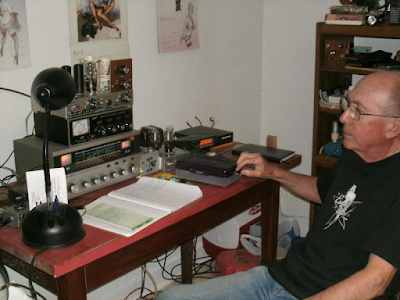
I made the video above to show postential builders how useful our Direct Conversion receiver really is. Late in the video (starting at 11:17), I heard a station calling CQ. It was N4QR. A check of QRZ.com shows it was Bob Null. Here is picture from Bob’s QRZ page:
Check out the old general coverage receiver and — wait for it — the homebrew thermatron transmitter. TRGHS.

Google led me to this amazing video by Stever N4LQ that describes a book that N4QR put together on how to build thermatron transmitters from Junkbox/Hamfest parts:

Steve N4LQ is in contact with Bob N4QR and asked him which transmitter he was using when I heard him. Bob said he thinks it was his 30 watt 807 final transmitter.

Thanks Bob. and thanks Steve!