Santa Arrives at SolderSmoke HQ! Rigol and Black&Decker

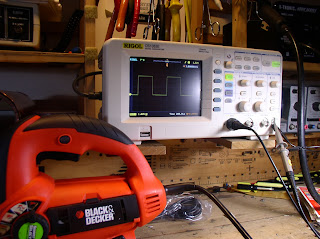
Santa Claus obviously heard my distress call when the TEK 465 gave up the ghost. This morning it was replaced by a RIGOL digital scope. I’m going through the tutorials. Wow, lots of features. A Black&Decker jig saw also arrived — this will help in my cabinetry efforts.

Last night just before dinner I talked to Kiyo, JH1MDJ, in Tokyo on 17 meter SSB with the 5 watt BITX. I kind of broke through a small pile-up and we then had one of those “please repeat your power level… I can’t believe that is 5 watts to a dipole” conversations.

Happy Holidays to all!

Our book: “SolderSmoke — Global Adventures in Wireless Electronics” http://soldersmoke.com/book.htm Our coffee mugs, T-Shirts, bumper stickers: http://www.cafepress.com/SolderSmoke Our Book Store: http://astore.amazon.com/contracross-20
New Book About Heathkit Gear

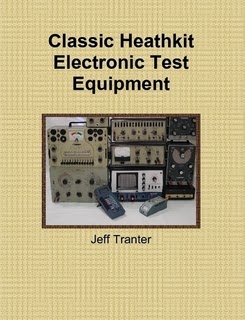
Jeff Tranter, VE3ICH, has a new book out — it is about Heathkit Test Gear. (Hey, I had that VTVM on the cover!) This book looks like it deserves a place under the Christmas trees of SolderSmoke fans. The book is available from Lulu.com, and Santa (or Mrs. Claus) can use the discount coupon below (Coupon code: CORNUCOPIA.)

http://www.lulu.com/shop/jeff-tranter/classic-heathkit-electronic-test-equipment/paperback/product-21272772.html

Our book: “SolderSmoke — Global Adventures in Wireless Electronics” http://soldersmoke.com/book.htm Our coffee mugs, T-Shirts, bumper stickers: http://www.cafepress.com/SolderSmoke Our Book Store: http://astore.amazon.com/contracross-20

An Interesting Idea for Checking Crystal Filter Passbands

Today at 9:37 AM

Hi Bill,
Just listened to your last soldersmoke blog with reference to xtal filter checking using a DDS and scope. What do think of this idea to check filter performance?
Logical, relatively easy to build and NO digital electronics to deal with. *;) winking
Best 73
Rick G6AKG
PS keep up the great work, love the Blogs.*:) happy

Our book: “SolderSmoke — Global Adventures in Wireless Electronics” http://soldersmoke.com/book.htm Our coffee mugs, T-Shirts, bumper stickers: http://www.cafepress.com/SolderSmoke Our Book Store: http://astore.amazon.com/contracross-20
SolderSmoke Podcast #155 BITX17, TEK465

Podcast # 155 is available for download (or you can listen by clicking on the button above):
http://soldersmoke.com/soldersmoke155.mp3

October 14, 2013 (Delayed Back-to-School edition)

Topics covered:

— BITX Beauty — Building a BITX17

— VFO woes, and the wisdom of Doug DeMaw’s love for crystals

— Why does a 55 year old man NEED clear nail polish varnish?

— How the VFO KILLED the Tek 465

— Trying to fix the Tek 465 (not for the faint of heart)

— New products: Justin Beiber Duct Tape, bifocal safety glasses,
magnetic reading glasses, Ward Silver’s new book

— Backwards British Bike Brakes

— MAILBAG

Our book: “SolderSmoke — Global Adventures in Wireless Electronics” http://soldersmoke.com/book.htm Our coffee mugs, T-Shirts, bumper stickers: http://www.cafepress.com/SolderSmoke Our Book Store: http://astore.amazon.com/contracross-20
Tek Troubleshooting Triumph

Thanks to the manual provided by Jim and the HV test gear provided by Alan Wolke, I was able to finish the troubleshoot on the broken Tek 465. It is the HV multiplier, U1432. The cathode voltage is supposed to be -2450. It initially tested at -1000. The manual calls for a jumper to be removed to take the HV Multiplier out of the circuit. As soon as I did that, the cathode voltage went to -2500. Bingo.
Now I have to get a replacement for U1432. Any carcasses laying around?
Thanks guys.

Our book: “SolderSmoke — Global Adventures in Wireless Electronics” http://soldersmoke.com/book.htm Our coffee mugs, T-Shirts, bumper stickers: http://www.cafepress.com/SolderSmoke Our Book Store: http://astore.amazon.com/contracross-20
Tek Troubleshooting Triumph

Thanks to the manual provided by Jim and the HV test gear provided by Alan Wolke, I was able to finish the troubleshoot on the broken Tek 465. It is the HV multiplier, U1432. The cathode voltage is supposed to be -2450. It initially tested at -1000. The manual calls for a jumper to be removed to take the HV Multiplier out of the circuit. As soon as I did that, the cathode voltage went to -2500. Bingo.
Now I have to get a replacement for U1432. Any carcasses laying around?
Thanks guys.

Our book: “SolderSmoke — Global Adventures in Wireless Electronics” http://soldersmoke.com/book.htm Our coffee mugs, T-Shirts, bumper stickers: http://www.cafepress.com/SolderSmoke Our Book Store: http://astore.amazon.com/contracross-20
Inside a Tek 465

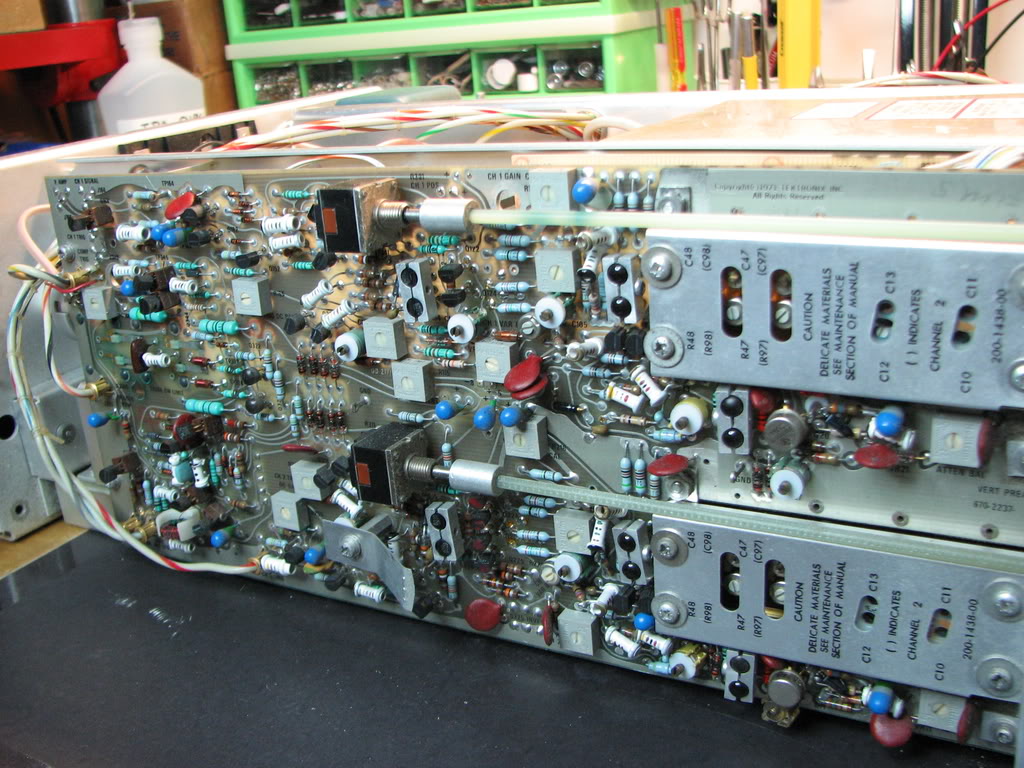
The TEK 465 ‘scope is as they’d say back in the Bronx “a piece of work.” It has real character. Perhaps a bit too much. If you look closely, you’ll see transistors in sockets. I had kind of gotten my head around that, when I noticed that many of the transistors were not in sockets. They looked like they had been soldered to into the holes in the PC boards. But NOOOOO! They are snugly in the holes, but they are NOT soldered in! You can pull them out, then (if you are lucky!) slide them back in. There is even quite a bit of “ugly construction.” with connections floating in the air. You can really see the influence of tube era thinking in this instrument.

I think I have narrowed the problem down to the HV supply. Alan Wolke is lending me a high voltage probe. I hope to be able to get it fixed this weekend. I need to get it working because my BITX 17 is nearing completion and I’ll need the ‘scope for the lineup and de-bugging.

The picture above is from: http://www.eevblog.com/forum/projects/tektronix-465-repair-and-restoration/ More pictures of the scope are available there. Also see http://www.spurtikus.de/basteln/repair/tek465/index.html for more scenic views of this instrument.

Our book: “SolderSmoke — Global Adventures in Wireless Electronics” http://soldersmoke.com/book.htm Our coffee mugs, T-Shirts, bumper stickers: http://www.cafepress.com/SolderSmoke Our Book Store: http://astore.amazon.com/contracross-20
BITX Build Update #6: Rock Steady

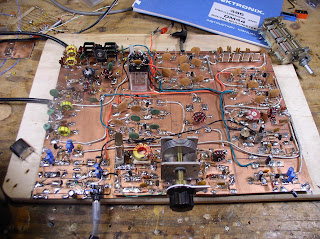
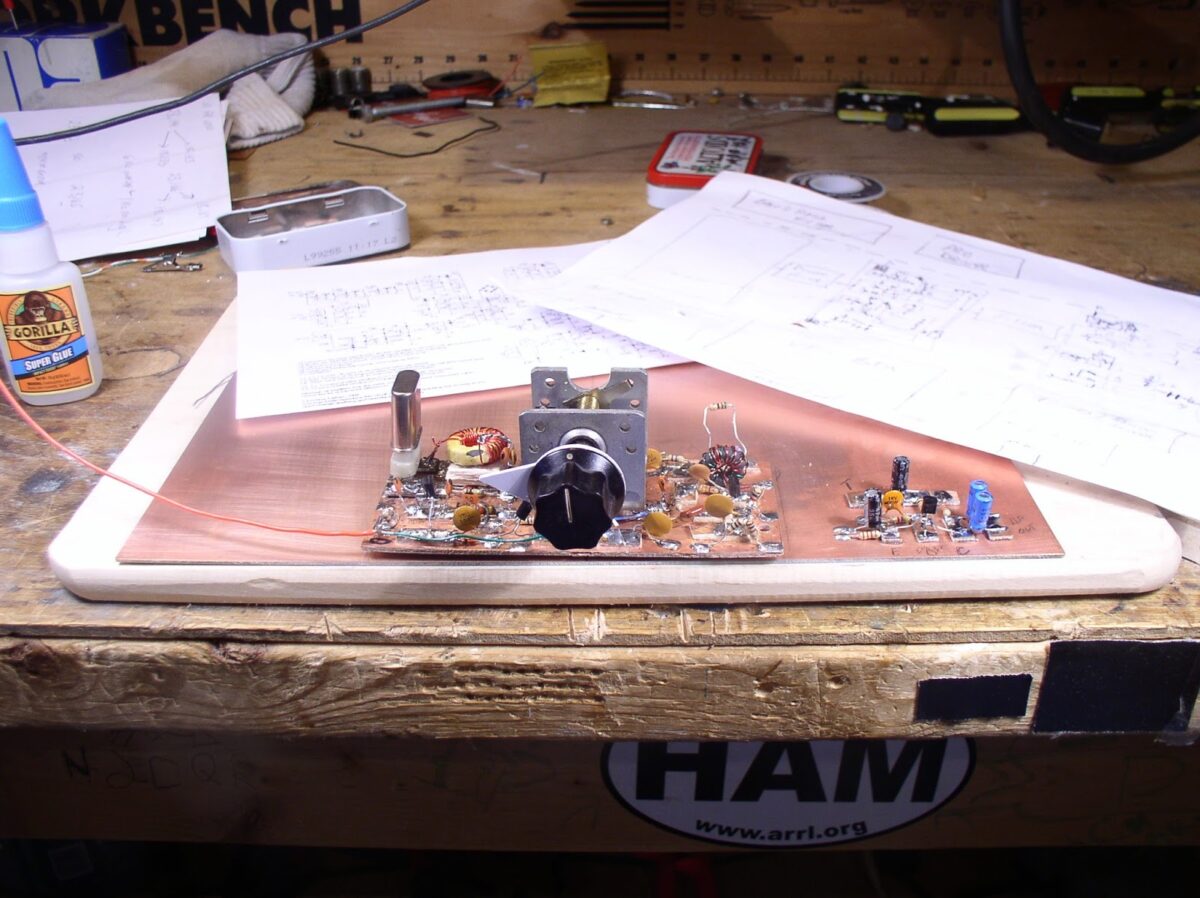
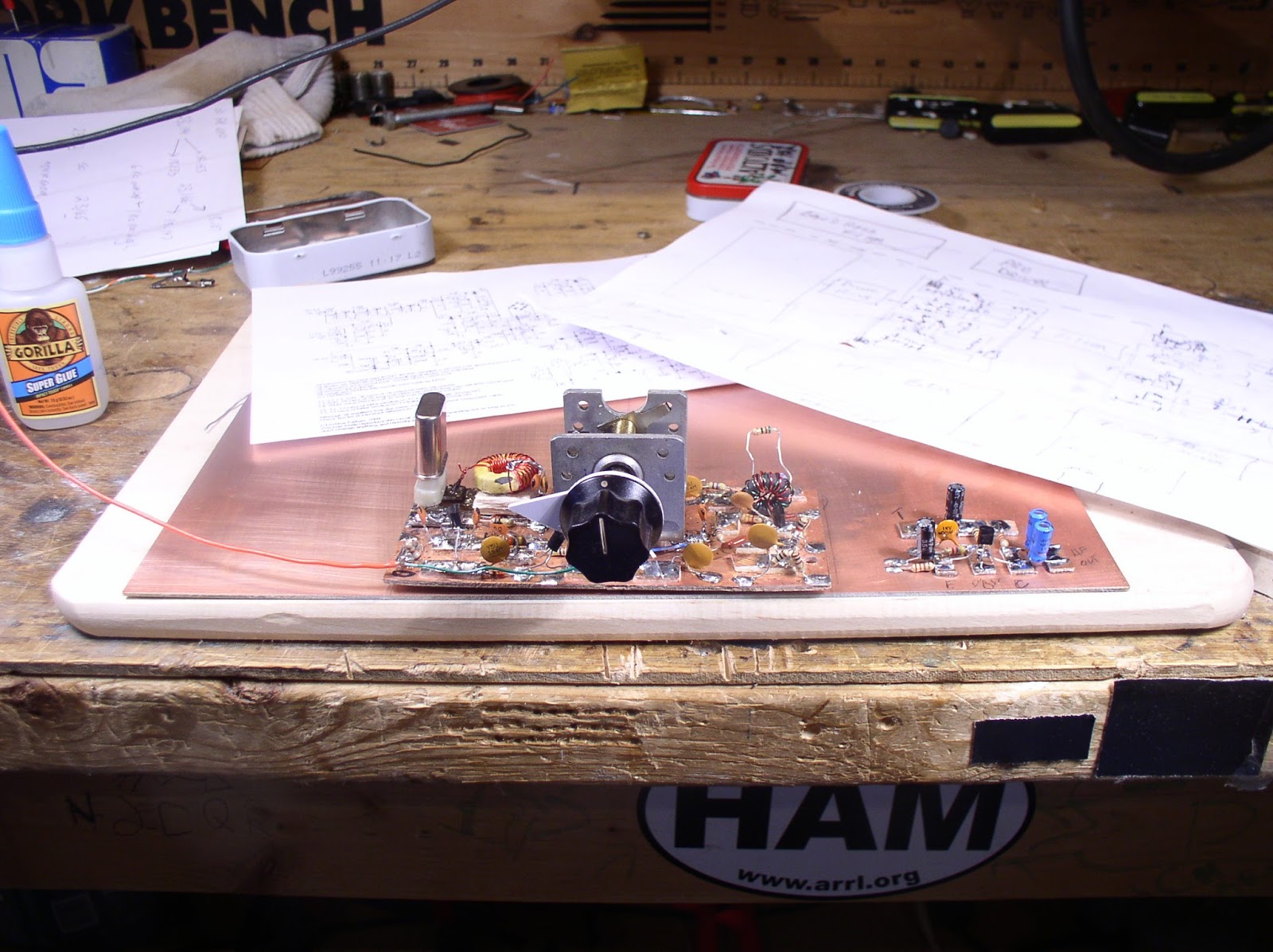
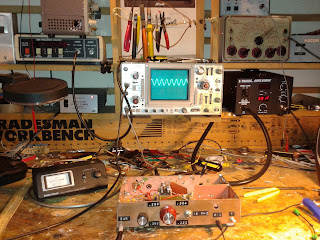
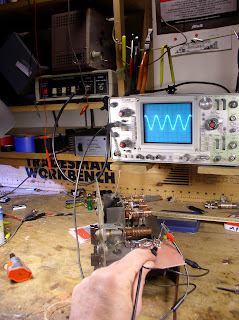
So, having given up on the VFO, this week I built a VXO. The IF in my W4OP-built Barbones Superhet is at 5 MHz. That receiver has a VXO running at 23.133-23.168 MHz with two crystals switchable from the front panel. My plan is to build a 5 MHz filter for the BITX 17. So I just plucked one of the crystals in the Barebones RX and used it to test and tweak the VXO. Trying different values for the series inductor, I got wide variations in freq swing. With .7uH I could only pull the rock 9 kHz (too little). With 5.6 uH, it was pulling 434 KHz (way too much — it was acting like a VFO). 3.213 uH was just right: With my 19-148 pF variable cap (with 53pF in series) I got a swing of 22 kHz, with crystal-oscillator stability.

I know, I know: I could have done this with a DDS chip, or with an SI570. But simplicity is a virtue, and the BITX is all about simplicity, right? Having recently built a DDS RF generator, and now this simple three transistor device, I must say that I like the simple analog circuit better. But hey, that’s just me. I’ll talk about this in the next podcast.

Today I built the mic amp circuit. You can see it off to the right of the VXO.

One of these days I’m going to have to actually troubleshoot and fix my Tek 465. But I’m
afraid of that thing! The voltages in there are HIGH, and so is the circuit complexity.

Our book: “SolderSmoke — Global Adventures in Wireless Electronics” http://soldersmoke.com/book.htm Our coffee mugs, T-Shirts, bumper stickers: http://www.cafepress.com/SolderSmoke Our Book Store: http://astore.amazon.com/contracross-20
BITX Build UPDATE # 5: ADRIFT!

Sometimes it is better to have LESS test gear. Watching my 5 MHz VFO on the frequency counter was driving me nuts. If I hadn’t had the counter, I might have been satisfied with the VFO. Ignorance is bliss! It did settle down a bit. But then it would wander off. I hated watching it drift around. I have been spoiled by Doug DeMaw’s VXOs. So, I went for the VXO. It will run around 23 MHz. I’ll build the filter at 5 MHz. That’s definitely the plan. For now.

I intend to go back and build a real VFO someday. There seems to be a lot of magic and lore involved. Bees Wax! Hot Glue! Nail Polish! Q-Dope! Air-wound coils!

TEK 465 is still broke. I think it is the high voltage supply or (less likely) the CRT.

Our book: “SolderSmoke — Global Adventures in Wireless Electronics” http://soldersmoke.com/book.htm Our coffee mugs, T-Shirts, bumper stickers: http://www.cafepress.com/SolderSmoke Our Book Store: http://astore.amazon.com/contracross-20
Fixing TEK 465 Oscilloscopes

I’m having TeKnical difficulties. My beloved Tek 465 ‘scope quit on me. I’d been running it continuously for a day or so, watching the output on my BITX VFO. Then, suddenly, it blew the 1.5 amp fuse. I replaced the fuse, but afterwards the trace was gone and the “Low Line” light was acting weird — on when it should have been off, then flickering. I consulted with Alan Wolke. He happened to be out at TEX HQ in Beaverton, Ore. He provided some good suggestions, but before I had a chance to try them, the trace came back. I attributed this good luck to the Radio Gods being pleased with Alan’s presence in Beaverton… but my reprieve was short-lived. Trace went out again today.

I found this video of the legendary Jim Williams (RIP) fixing a Tek 465. (Check out Jim’s junk box!)
I’ll start by checking the Tantalums. I may get lucky.

If anyone has any other suggestions, send them this way. The Tek scope may be old, but it is a COMPLICATED piece of gear…

Our book: “SolderSmoke — Global Adventures in Wireless Electronics” http://soldersmoke.com/book.htm Our coffee mugs, T-Shirts, bumper stickers: http://www.cafepress.com/SolderSmoke Our Book Store: http://astore.amazon.com/contracross-20
Oscillo-porn! A $500,000 Oscilloscope! (video)

I don’t know, I think I like my Tek 465 better! But if any of you guys are thinking of buying one of these, PLEASE do so via the Amazon link on my web page!

Our book: “SolderSmoke — Global Adventures in Wireless Electronics” http://soldersmoke.com/book.htm Our coffee mugs, T-Shirts, bumper stickers: http://www.cafepress.com/SolderSmoke Our Book Store: http://astore.amazon.com/contracross-20
1-29 MHz In One Small Box

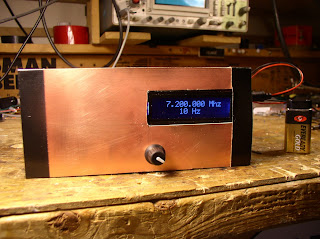
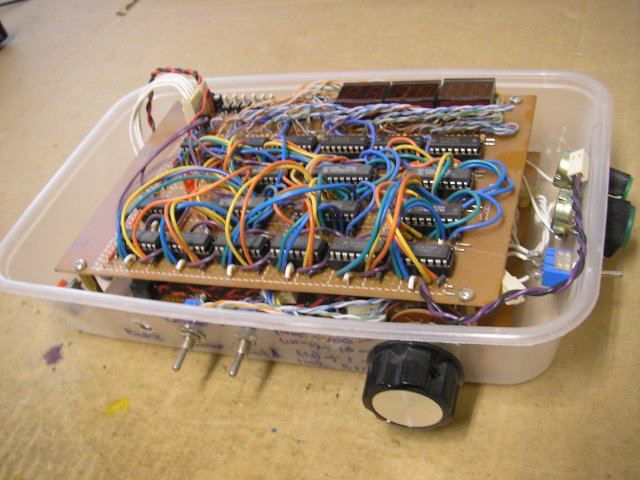
This weekend I put the Arduino/AD9850 Direct Digital Synthesis device into a box this weekend. It is sort of evolving into a general purpose HF signal generator and/or VFO. It is really kind of neat that this little collection of boards can generate RF across that range, with accurate digital readout. Thanks again to Richard Visokey, AD7C, for the circuit and the code. As you can see, my cabinet making skills will never land me a job on the Discovery Channel, but I’m kind of pleased with the box. I picked up the wood panels from a hobby/craft shop.

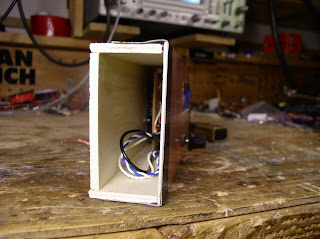
I left a lot of space in the box. I envision an amplifier taking the output from its current .4 milliwatts up to around 10 milliwatts, followed by step attenuators (pads).

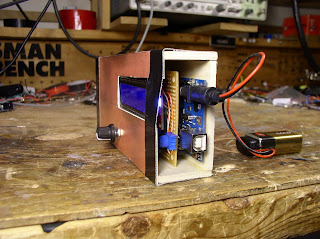
Here is the other end. Of course, I could have just taken the ATMega chip out and avoided putting the whole Arduino board inside the box, but I’ll leave that exciting digital adventure for a future project.

Our book: “SolderSmoke — Global Adventures in Wireless Electronics” http://soldersmoke.com/book.htm Our coffee mugs, T-Shirts, bumper stickers: http://www.cafepress.com/SolderSmoke Our Book Store: http://astore.amazon.com/contracross-20
Direct Digital Synthesis

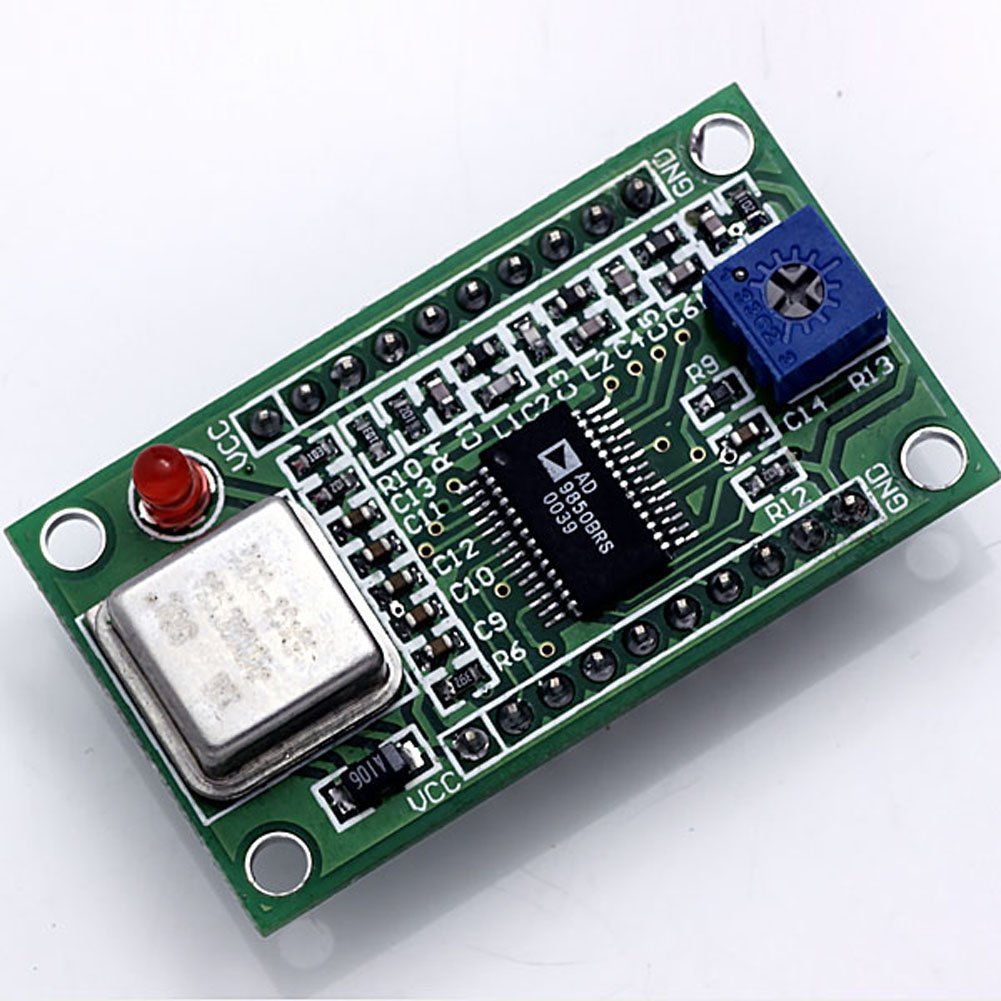
I just bought one of these. I hope to hook it up to an Arduino and turn it into a VFO. Or a signal generator. Six bucks!

http://www.amazon.com/dp/B009I7DR7E/ref=pe_175190_21431760_3p_M3T1_ST1_dp_1

Our book: “SolderSmoke — Global Adventures in Wireless Electronics” http://soldersmoke.com/book.htm Our coffee mugs, T-Shirts, bumper stickers: http://www.cafepress.com/SolderSmoke Our Book Store: http://astore.amazon.com/contracross-20
An update from Yi Yao, VA3YAO

We did a short article on Yi Yao a while back, noting that he definitely has The Knack. His homebrew frequency counter (above) confirms that he does. In a recent e-mail from him I also detect an inclination toward poetry. April is Poetry Month, so I thought I should share the latest from Yi:

Hi Bill,

I haven’t gotten around to making my first rig yet. But, after
listening to SolderSmoke since the beginning, it seems like the universal rule
of homebrewing has been to avoid regens!

I’ve been focusing on mechanical design for the last while. Having
spent 2 years in a heavily electrical engineering oriented
environment, I decided to try something new.
Most of the smoke that

I inhale these days is from cutting oil vaporizing as I turn something
on the lathe. Chips mean bits of metal that are created from cutting
metal. Soldering is done with a torch. The common thread with
electronics is the knackish pursuit of elegant design and beautiful
construction.

I’ve been thinking about getting myself a copy of SSDRA, but even
looking at online used book stores, this is costing in the
neighbourhood of some of my university textbooks. There’s no shortage
of good information and ideas for homebrewing online though. I think
that’s what I will use.

Cheers,
Yi

Our book: “SolderSmoke — Global Adventures in Wireless Electronics” http://soldersmoke.com/book.htm Our coffee mugs, T-Shirts, bumper stickers: http://www.cafepress.com/SolderSmoke Our Book Store: http://astore.amazon.com/contracross-20
A Beautiful Workshop in Scotland

A nasty Coronal Mass Ejection hit our magnetic field at around 0600 UTC today. The HF bands are now in poor shape. What better time to visit a really impressive workshop in Scotland?

Ian has an interesting site: http://www.ianjohnston.com/

Our book: “SolderSmoke — Global Adventures in Wireless Electronics” http://soldersmoke.com/book.htm Our coffee mugs, T-Shirts, bumper stickers: http://www.cafepress.com/SolderSmoke Our Book Store: http://astore.amazon.com/contracross-20
Signal Generator Ideas


Hi, Bill

Howzabout a generator that goes from 1 Hz to 40 MHz with 1 Hz resolution, adjustable cursor so you can step any of the 8 digits, presettable offsets for if frequency, repeater offset, or r.i.t., directly synthesized output so almost no phase noise and 12 bit waveform accuracy? How about a price tag of less than $20 for all the major parts? Start by Googling dd_synth.asm for control software, and rather than buying the PCB recommended in the notes at the head of the program, search for AD9850 on Ebay for the synthesizer board and LCD 16×2 for the display. A 16f628a PIC is a couple bucks. Both the display pinout and the synthesizer pinout match standard perfboard. For a little more than $10 more get the AD9851 board and the upper frequency limit is 60 MHz.

A better way to transistorize the old tube-type generator is to use a dual-gate RF mosfet for the oscillator. You can trim the gain for waveform purity by adjusting the bias on gate 2. Once you find the optimum bias on each band, diode-switch the bias level with the bandswitch. Since gate 2 has an extremely high impedance you can use resistors in excess of a megohm, so it won’t affect the Q of the tank coil.

Jim Daldry
Raleigh NC

Our book: “SolderSmoke — Global Adventures in Wireless Electronics” http://soldersmoke.com/book.htm Our coffee mugs, T-Shirts, bumper stickers: http://www.cafepress.com/SolderSmoke Our Book Store: http://astore.amazon.com/contracross-20
SolderSmoke Podcast #148

SolderSmoke Podcast #148 is available:
http://soldersmoke.com/soldersmoke148.mp3
December 30, 2012

SPONSORED BY usedradiomall.com

— Hurricane Follow-up
— Subliminal Mind Control to Encourage Homebrewing (beep-beep)
— The Shortcomings of the All American Five Receiver
— Solid-Stating a Heath SG-6 (with Farhan’s circuit)
— VK3YE’s Beach DSB Rig
— Tek ‘scope connection to frequency counter
— Mod to W7ZOI/W7PUA power meter
— JBOTing my 20 meter DSB Rig — A Tale of Woe
— LU1AR “The Most Interesting Ham in the World”
— Billy’s Raspberry Pi
— Latest QST, SPRAT, Hot Iron
— Videos: Landfillharmonica, Knack in Sierra Leone
— Santa delivered a Soldering Station
— MAILBAG

Our book: “SolderSmoke — Global Adventures in Wireless Electronics” http://soldersmoke.com/book.htm Our coffee mugs, T-Shirts, bumper stickers: http://www.cafepress.com/SolderSmoke Our Book Store: http://astore.amazon.com/contracross-20

A Promising Start for the SG-6 Solid State Conversion

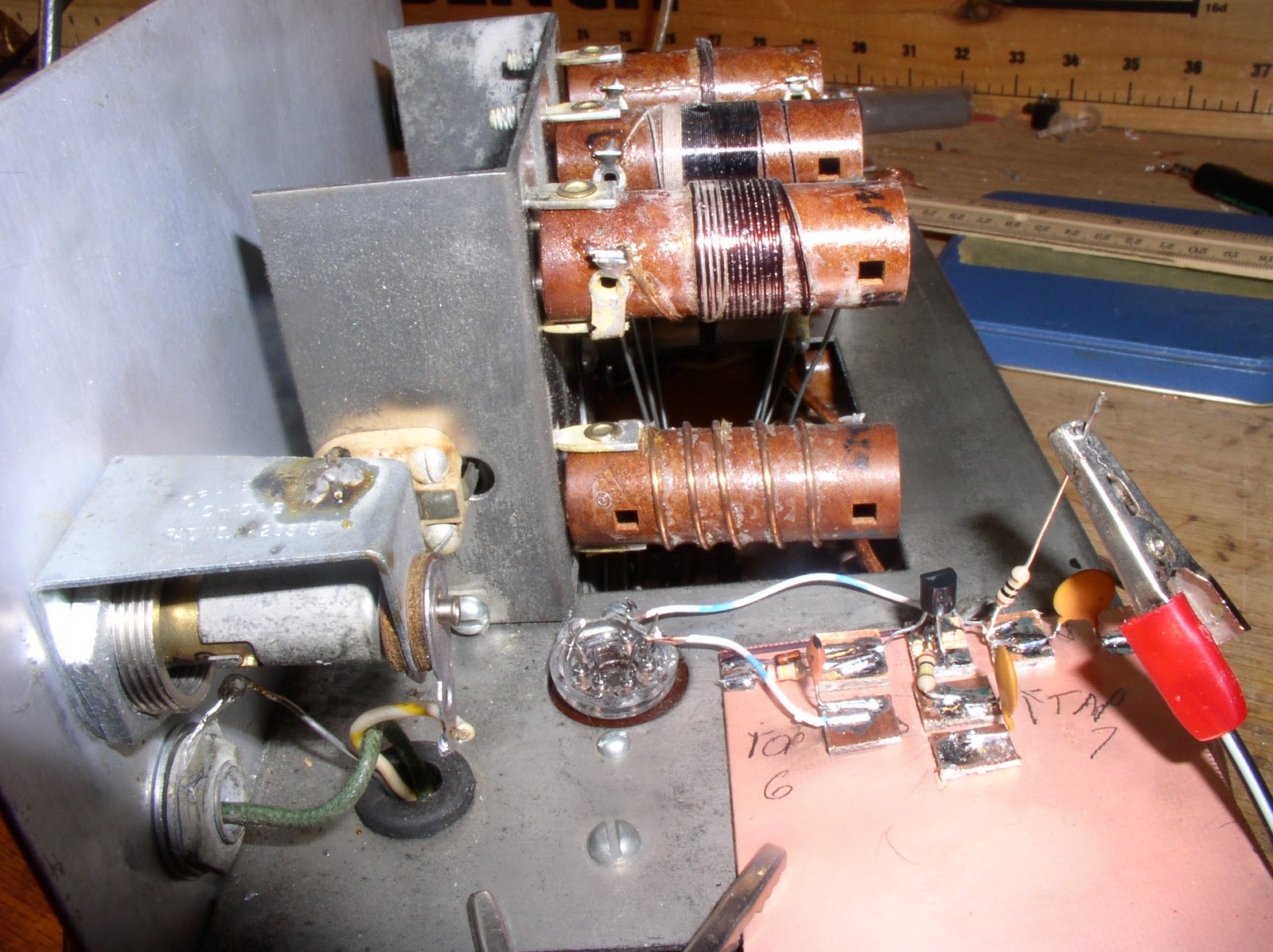
We have kind of half a holiday today — I have the day off, but the kids went to school. I made use of the additional shack time to test the feasibility Farhan-izing my old, not-so-beloved Heathkit SG-6 signal generator. I did a quick Manhattan build of the oscillator section from Farhan’s sig generator (link in yesterday’s post). Using an idea from an old 73 Magazine article on a similar project (thanks Clint!), I smashed the tube (appropriate, don’t you think?) and connected (using the glass stump!) Farhan’s oscillator directly to the pins that lead to the switchable coils and the variable cap of the SG-6. I just wanted to see if it would oscillate, and see if there was a big change in SG-6 dial calibration.

Wow, it worked great! It oscillates very nicely on all but the upper frequency band setting (20-50 MHz). I feel confident that I’ll get it to oscillate at least up to 30 MHz. Next I’ll build Farhan’s buffer and amplifier stages. The SG-6 had a switchable attenuator — I want to include that feature in the solid state version. I’ll have to give some thought to the audio modulation feature (nice for aligning AM receivers).

Our book: “SolderSmoke — Global Adventures in Wireless Electronics” http://soldersmoke.com/book.htm Our coffee mugs, T-Shirts, bumper stickers: http://www.cafepress.com/SolderSmoke Our Book Store: http://astore.amazon.com/contracross-20

Solid State Conversion for a Heath SG-6 Signal Generator?

I’ve recently become acutely aware of the shortcomings of my signal generator.
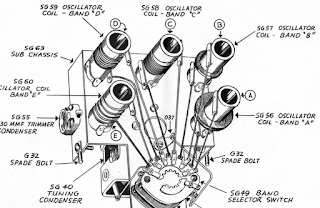
It is a Heathkit SG-6. It is really old. It has a selenium rectifier in it. It has one of those old mic connectors on it for the output. The output is very low. But I like the cabinet and there is a nice switchable coil/variable capacitor LC circuit in there (see above).

In 2008 in Hyderabad, India Farhan went to McDonalds with his kids and went home with some straws. Soon the straws are chopped up and turned into coil forms for a signal source: http://www.phonestack.com/farhan/siggen.html

So here is my idea: de-tube the SG-6. Turn the selenium over to the HAZMAT authorities. Save the coils and the cap and most of what George Dobbs would call “the socketry.” Use an MPF-102 for the oscillator, then make use of the buffer and feedback amp from Farhan’s soda straw circuit.

What do you guys think?

Our book: “SolderSmoke — Global Adventures in Wireless Electronics” http://soldersmoke.com/book.htm Our coffee mugs, T-Shirts, bumper stickers: http://www.cafepress.com/SolderSmoke Our Book Store: http://astore.amazon.com/contracross-20

The Joy of Tinkering at RIT

Our Dayton corrrespondent Bob Crane, W8SX, sent us this. Thanks Bob!

http://www.edn.com/design/test-and-measurement/4396825/The-Joys-of-Tinkering?cid=EDNToday

Our book: “SolderSmoke — Global Adventures in Wireless Electronics” http://soldersmoke.com/book.htm Our coffee mugs, T-Shirts, bumper stickers: http://www.cafepress.com/SolderSmoke Our Book Store: http://astore.amazon.com/contracross-20