SolderSmoke Podcast #236 — Bill’s 17-12 Rig, Pea Shooter, VFO Wisdom, Temp Compensation, Need Code for Max2870, Making Enclosures, MAILBAG

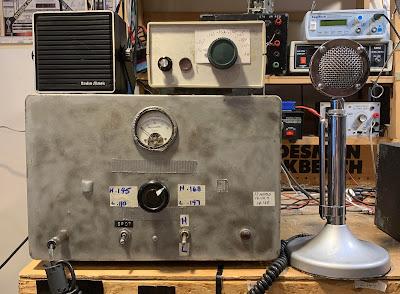
ARC-5 R-23 Nav Receiver Parts

SolderSmoke Podcast #236 is available!

http://soldersmoke.com/soldersmoke236.mp3

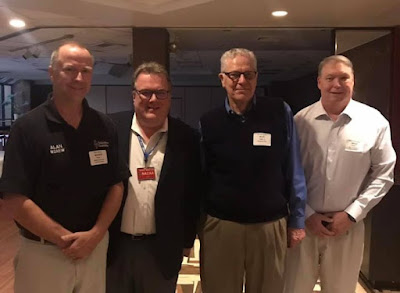
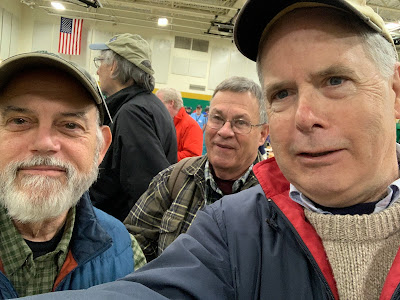
Winterfest! Many Boatanchors. Lots of old good analog test gear. Talk with Dean KK4DAS. Met up with Armand WA1UQO and Charles AI4OT.

Pete’s Bench:

— Looking for help in software development for MAX2870 board.
— Tapped Capacitance Impedance Matching
— The Pea Shooter (See N2USD’s version in videos
below).
— Tribal Knowledge on Making Enclosures

Bill’s Bench:

— 17-12 Band Imaging SSB Transceiver. It works on both bands.
— Plan for Glowing Numerals (N6QW has been there and done that!)
— WU2D’s videos on VFOs.
— Temperature Compensation: HT-37 capacitor. FT-101 VFO, even in the ARC-5 receiver!
— Trying to get more rigorous about receiver design. Gain distribution, IMD, Dynamic Range, etc.
— Do I need a true RMS audio voltmeter? Or can I get the same info from freeware audio spectrum analyzer and soundcard?
— 6EA8s replace 6U8s in MMRX

SHAMELESS COMMERCE DIVISION: We have a sponsor!

PARTS CANDY out of Chicago produces quality test leads for your bench. The guy who runs the company is Carlos, and he is one of us. He is an electronic tinkerer. See the ad on the left hand column of the SolderSmoke blog. Just click on the picture of the test leads and you will be taken to Carlos’s ebay store. Go for it.

Mailbag

Walter KA4KXX in Orlando — Diodes in BITX Bilats — Why? Farhan says To prevent reverse junction of off transistor from conducting and clipping waveform.
Tony G4WIF — Audio test gear and G3ROO paraset
Todd K7TFC Pine boards, TIAs and 12 meters
Dean KK4DAS Ceramic Variable Oscillators on 40. Juliano Criteria?
Mike WU2D VFOs and Temp compensation. ARC-5s
Chris KD4PBJ A really nice parts care package — Thanks Chris!
Steve M0ECS. Inspired by SS, moved something off the Shelf or Box of Shame.
Jason KD2RKN Building a DC receiver. It is all our fault.
Chris Mannon in Indiana joining the CBLA
KC4GMH is listening!
Ed N2XDD has been armed with a 3.579 MHz crystal.
Harvey Wa3EIB working on his museum
Tim AG4RZ is BACK IN THE SOLDERSMOKE!
Fred KC5RT — an old friend — recommends Bangood RF sig gen for 88 bucks.
Shlomo 4X4LF listening and homebrewing from a Kibbutz in Israel.
Chuck KF8TI was a Peace Corps Volunteer in the Philippines.
Vienna Wireless Winterfest Hamfest 2022

After a two-year pandemic hiatus, yesterday the Vienna (Virginia) Wireless Society’s annual “Winterfest” hamfest was back. And the weather was in fact COLD — it definitely felt like Winterfests of years-gone-by.

Club President Dean KK4DAS kindly invited me to participate in a forum on homebrewing. You can watch the presentation STARTING AT 2:04:06 (hours:minute:seconds) here:


It was especially cool to be able to tell the audience about Pete N6QW and Farhan VU2ESE. We talked about Pete’s Simple SSB transceiver, the Michigan Mighty Mite and the BITX rigs.

Some observations on the hamfest scene:

— There are lots of boatanchor radios out there, and it seems like a buyer’s market. These old rigs do not seem to be selling nearly as fast as they did a few years ago.

— There is a lot of older analog test gear on sale too, and it too seems to no longer be as in demand as it was a few years ago. Perhaps the availability of cheap, small, and very effective digital oscilloscopes is affecting the sale of these once sought-after items.

My purchases:

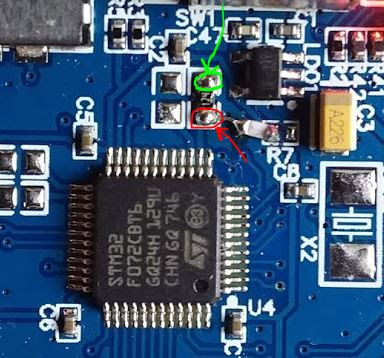
— A really old beat-up (crashed?) ARC-5 R-23 receiver. I have already extracted the variable capacitor.
— A nice box of smaller variable caps.
— 100 feet of 550 parachute cord.
— Two nice metal chassis/boxes
— A bag of shaft adapters/connectors

With Armand WA1UQO (left) and Steve Boles W4SB (center)

With Charles AI4OT


Thanks to Dean KK4DAS and the entire VWS team for a great event.

Getting More Rigorous About Receiver Design (Video)

As I finished up the receiver on my 17-12 SSB transceiver, I started to wonder — how good is it?
Sure, I could hear stations on both bands, and when I got started as a homebrewer that was enough for me. But now, I find myself wondering about receiver performance. Did I get the gain distribution right? Do I have too much gain ahead of the mixer? Ahead of the crystal filter? Is the receiver generating too much noise? Can I hear the band noise? If not, why not? Do my circuits lose linearity in the presence of strong signals? What is my dynamic range?

This is a big complicated subject that takes time to master.

I am just beginning. I found the video above to be very helpful.

I was jealous of this fellow’s audio spectrum analyzer, but then Tony G4WIF told me that the the analyzer that this fellow was using was really just a sound card and some software. I quickly found a similar piece of free software that lets me do the same thing he did: Look at the audio output of my receiver and watch what happens as I put an RF signal of varying levels into the antenna port.

I am using Visual Analyzer, a free program out of Italy:

https://www.sillanumsoft.org/

The author of the software seems very cool”

My name is Alfredo Accattatis; I love electronics and software, and I have been working for years in commercial companies as software/firmware engineer and software designer. I’ve been writing programs for embedded systems (with DSP and MICROCONTROLLERS), for PC, for Avionic Computers and even for Mainframes, using C, C++, Pascal, Ada, REXX and assembly. I starting write VA during my free time just for fun and using (also) my DSP experience. The program was and is completely FREE.

More info about Alfredo here:

https://www.sillanumsoft.org/about_the_author.htm

Do you folks think I need to buy the kind of True RMS Audio Voltmeter that is being used at the end of the above video?

LA6NCA Designs and Builds a Very Hybrid 80 Meter Transmitter (Si5351 and a 12A6 Tube) (Video)

Helge LA6NCA put out a really nice video explaining how he designed and built an 80 meter transmitter.


I like how he put the Si5351 and the Arduino chip in what looks like a slightly expanded FT-241 crystal box. Nice.

I like the box and the chassis.

I like his testing/tuning technique.

The homebrew capacitor was a very nice touch.

Where can I get some of those coil forms?

And of course, the R-390 receiver adds a lot of mojo to the shack.

Helge’s web sites document an enormous number of great projects:

Helge’s page on the 12A6/Si5351 transmitter: https://www.la6nca.net/homebrew/tx_12a6/index.htm


Thank you Helge! And thanks to Hack-A-Day for alerting us to this.

SolderSmoke Podcast #235 NE-602, Azores Rig, Spur Problems, SSB Rigs, Peashooter, HB Filters, MAILBAG

SolderSmoke Podcast #235 is available for download:


http://soldersmoke.com/soldersmoke235.mp3


Travelogue:

6 weeks in the DR for Bill
One contact on uBITX. More SW listening.
Repaired my Chrome Book in Santo Domingo!
Christmas Present for All: James Web Space Telescope launch


Bill’s Bench
— Understanding the NE-602 (see blog post)
— Thinking about a 17/12 dual bander. Looked at old G3YCC Tx for circuits…
— Using Spurtune08. WB9KZY found it. In the LADPAC zip file here:
— Then Put G3YCC Acores SSB TX back in operation
— Now working many stations with this old “split” TX/RX

Pete’s Bench
— Dean’s VWS build of your DC RX
— Homebrew Crystal Filters
— The shrinking of the PSSST

Bad Dead Soldering Stations
— My X-Tonics 4000 dies. But it left behind a great box with ample socketry.

Mailbag:
AA1TJ Mike Rainey — Again in the Hobbit Hole! 486 kc RX
Thomas K4SWL — Radio Astronomy and the Raspberry PI
WC8C Dennis Invite to the L’Anse Creuse ARC FB Fun
Todd K7TFC got boosted at Tektronix Beaverton Ore.
What happened to Chuck Adams K7QO? His work taken off the net.
W1MJA ex WN2RTH
N7DA worked W7ZOI in Sweepstakes. FB
Kirk NT0Z formerly of ARRL HQ
Farhan VU2ESE was up in the Pench Forest, trying to spot a Tiger!
We spoke to Farhan’s Lamakaan ARC in Hyderabad. QO-100 beam down!
Dean KK4DAS’s 16 watter. On SS blog
Scott WA9WFA Bad 6U8s? Ordering 6EA8s
Bruce KC1FSZ Peppermint Bark gift box
Bob Scott KD4EBM So many good ideas and links
Rogier PA1ZZ sending parts packages — Thanks Rogier

Exorcism Completed! Getting Rid of the Spur in my 17 meter SSB Transmitter using a TinySA (video)

To re-cap: The problem became evident when trying to “net” or “spot” my transmitter onto my receive frequency. Around 18.116 MHz, I could hear at least two tones in the receiver as I moved the transmitter frequency. I needed to get rid of the extra tone.

First, thanks to all who sent in suggestions. They came in literally from around the world, and this is a demonstration of the IBEW in action. I used or at least tried all of them. They were all good ideas.

Following Vasily Ivananeko’s pseudonymous suggestion I rebuilt the carrier oscillator (apologies to G3YCC). I used the carrier oscillator/buffer circuit from Farhan’s BITX20.

Henk PA0EME said I should look at the signal level at the input ports of the NE602 mixer. Henk was right — the VXO input was far too high. I lowered it, but the problem persisted.

At first, I thought that the spur in question was so small that it would not show up on the air. I could not see it in the TX output using my TinySA spectrum analyzer. That was good news and bad news: Good that it was not showing up on the air, bad that I could not see it in the TinySA and use that image in the exorcism.

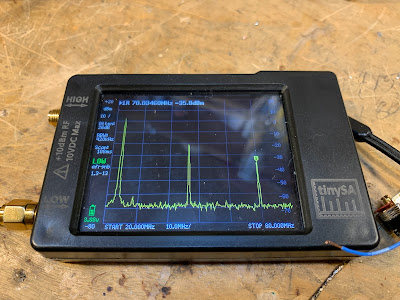
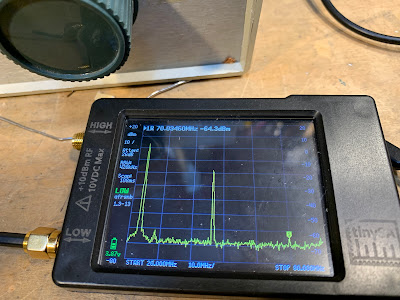
At first I thought that the spur was being caused by the 10th harmonic of the carrier oscillator and the third harmonic of the VXO. This seemed to fit. So, following VK3YE’s sage advice, I built a little 69 MHz series LC trap (using a coil sent by AA1TJ, on a board CNC’d by Pete N6QW). That trap succeeded spectacularly in crushing the 10 harmonic. Look at these before and after shots on the TinySA:

Before Trap
After Trap

Spectacular right? But guess what? The problem was still there.

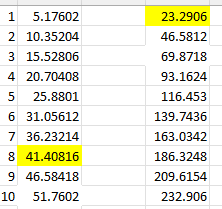
I scrutinized the situation once more. I realized that the spur would be more visible if I put the TinySA on the input of the transmitter’s PA (a JBOT amp designed by Farhan) as opposed to putting it on the output. Watching the spur and the needed signal move in the TinySA as I tuned the VXO, I realized that they were moving in opposite directions. This indicated that the spur was the result of a carrier oscillator harmonic MINUS a VXO-generated frequency (as the VXO frequency increased, the spur frequency decreased). Looking at my EXCEL spread sheet, I could see it: 8th harmonic of the carrier oscillator MINUS the main output of the VXO.

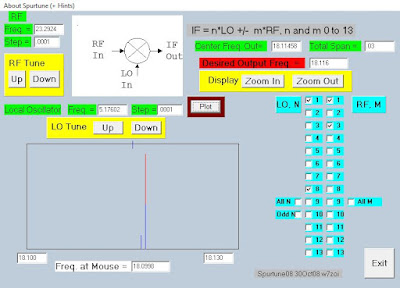
To confirm this, I plugged the values into W7ZOI’s Spurtune program. Yes, the spur popped up and moved as predicted.

For further confirmation I shut down the carrier oscillator by pulling the crystal from the socket, and then just clipped in a 5.176 MHz signal from my HP-8640B signal generator (thanks KB3SII and W2DAB). Boom! On the TinySA, the spur disappeared. Now I at least knew what the problem was: a harmonic from the carrier oscillator.

Following good troubleshooting practice, I turned off the gear and went to bed. When I woke up, an idea came to me: Before launching into a lot of filtering and shielding, just try running the carrier oscillator at a lower voltage, seeing if doing so might reduce the harmonic output. I disconnected the carrier oscillator board from the main supply and clipped in a variable voltage bench supply. Watching the signal on my TinySA, I watched as the spur completely disappeared as I reduced the voltage from around 13V to 10V (see video above). The main signal frequency level did not change much. I tested this by listening for the hated extra tones. They were gone. Exorcised.

Key lessons:

— Spur problems are difficult to troubleshoot. Armstrong’s superhet architecture is, of course, great, but this is definitely one of the pitfalls. Single conversion makes life easier. IF selection is very important. Choose wisely!

— When looking at the TinySA as you tune the rig, pay attention to which way the spur is moving. This provides an important clue regarding the combination of harmonic you are dealing with.

— The TinySA is a very useful tool. It seems like it is easier to use than the NanoVNA (which is also a fantastic tool).

— It can be fun and rewarding to re-visit old projects. In the years between original construction and the re-look, new test gear has become available, and the skill and experience of the builder has improved. So problems that once seemed insurmountable become fix-able.

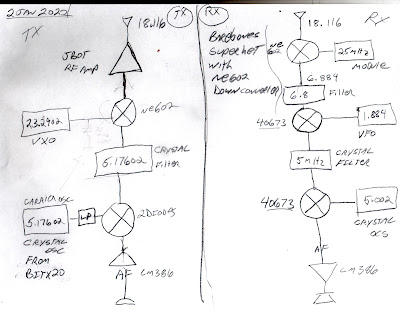
— Thinking through a problem and thinking about possible solutions is very important. It pays to step away from the bench to think and rest. Rome wasn’t built in a day. Here’s a rough block diagram that I drew up (noodled!) while trying to figure out this problem:

Alan Wolke W2AEW: YouTube Silver Play Button Award, and ARRL Hudson Division 2020 Technical Achievement Award

Three cheers for Alan Wolke W2AEW, truly one of the great guys of homebrew ham radio. Alan’s wonderful YouTube videos have enlightened hams all around the world. He is always there to answer questions and help hams (like me) who are at times struggling to understand technical concepts.
Photo from the November 13, 2021 ARRL Hudson Division Awards Luncheon. That’s Alan with the ARRL CEO David Minster NA2AA, the Nobel Prize winning Dr. Joe Taylor K1JT, and 2021 Technical Achievement winner David DeCoons WO2X. Alan was presented with the division’s 2020 Technical Achievement award.

M0NTV’s “Crystal Filters for the Fearful” (video)

I really liked Nick M0NTV’s approach to making a crystal filter (see video above). He really simplifies a process that desperately needs simplification. I remember when I was building my first superhet receiver, I came across Doug DeMaw’s schematic for a crystal tester that would allow me to properly build the filter. But the piece of test gear was far more complicated than the receiver I was building. I never built Doug’s device.

Nick’s technique is simpler even than the G3UUR method that many of us have been using for years. Nick dispenses — wisely I think — with the need to calculate motional parameters, Q, and equivalent series resistance. This also eliminates the need to fidget around with the design software such as Dishal or AADE.

Nick uses the Cohn topology (good choice) and uses kind of an “informed cut-and-try” technique to come up with the capacitor values.

Filter impedance is determined with series trimmer resistors and the NanoVNA to watch the resulting passband. Nick says this is a Charlie Morris ZL2CTM suggestion. It obviously works very well — the ripple that would result from impedance mismatch is eliminated.

Nick’s determination of the best turns ratio for the impedance matching transformers is brilliant.

Nick apologizes for what he says is a long video. But it is only 30 minutes or so long, and if you are going to build your own superhet or SSB filter rig, it is well worth watching.

Three cheers for Nick and for Charlie! Thanks guys!

The Importance of Keeping the Noise FLAT

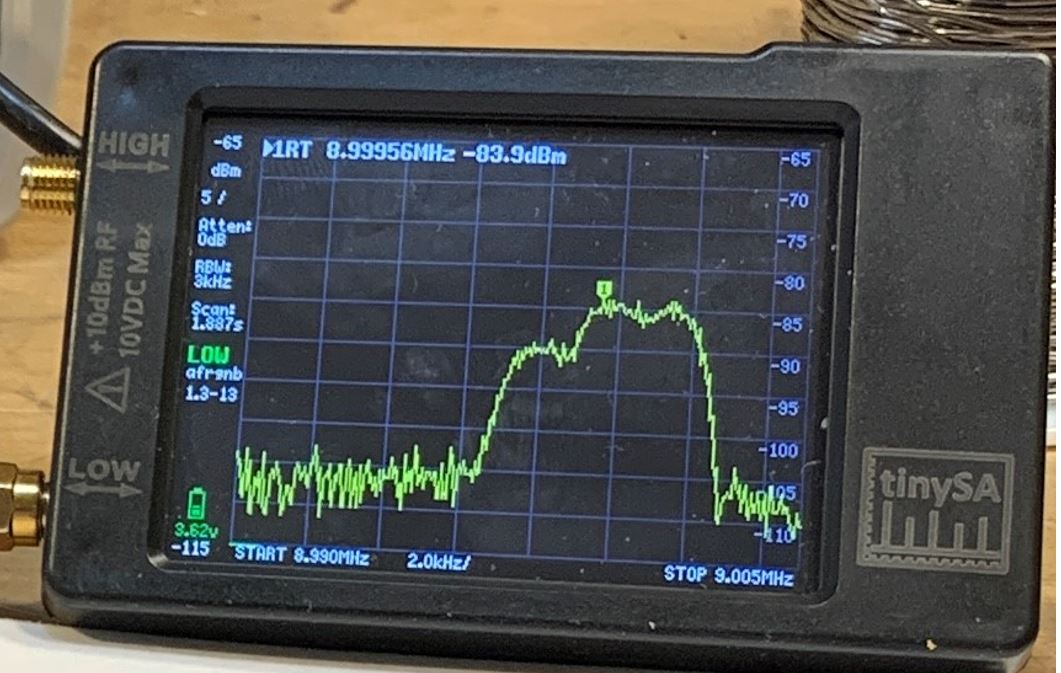
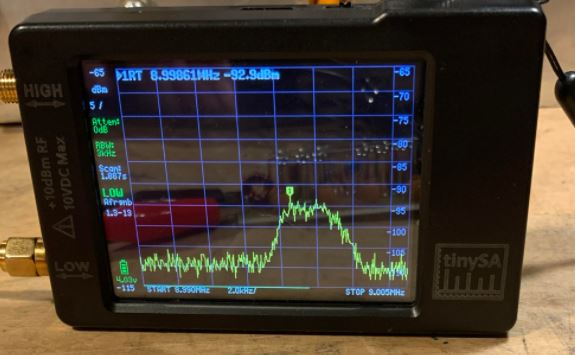
A few days ago I put up a blog post about using a noise generator (in my case my cheap FeelTech sig generator) and my TinySA spectrum analyzer to look at the passband of a crystal filter. I was using the 9 MHz filter used by Dean KK4DAS and the Vienna Wireless Makers Group. The idea is simple: insert broadband noise into the input. The filter should pass more of the noise that falls within its passband. The TinySA should let you see this. At first, I was pleased that I could clearly see the passband. I thought I had succeeded. See above.

But I was bothered by something. Look at that bump in the passband. It should be close to flat across the top.

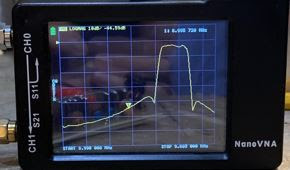
I decided to take a look at the same filter with my NanoVNA. Here I was not using a noise generator. The NanoVNA sweeps the filter using and looks at output in the Log-Mag mode. Here is what it looked like (below):
That was much better. But why the difference? Tony Fishpool G4WIF suggested that my noise source might not be putting out noise at the same level on all frequencies. I took at look at the noise output of the FeelTech sig gen in the range of the filter passband (with some above and below frequencies for reference) and I found that the flatness of this noise depended a lot on what frequency I had the sig gen set to. I tuned it around a bit until I found a setting that produced a flat noise output in the desired frequency range. Then I went back and swept the filter with the noise and the TinySA again. Here is what it looked like with the “flat” noise:


Better, I think. Closer to the passband displayed by the NanoVNA.
Tony points out that these Chinese sig gens don’t really put out random noise — they give us predictable noise. Dean said “Predictable Noise” would be a good name for a rock group. I said they could open for my favorite: “The Ceramic Spurs.”

Using Noise to Sweep a Filter with the TinySA

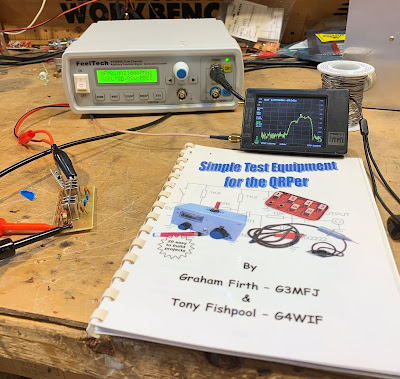
I’ve been meaning to try this for a long time. Years ago Tony Fishpool and Graham Firth wrote about using a noise generator and a spectrum analyzer to sweep the bandpass of a filter. The idea here is to send very broadband noise into a filter, and then use a spectrum analyzer to see which frequencies make it through.
I thought about building a noise generator like the one in Tony and Graham’s book, but then it occurred to me that probably had one sitting on my bench. Sure enough, a look at the manual for my cheap FeelTech function generator revealed that PRESETS 3 and 8 are noise generators. I quickly pulled out a 9 MHz filter that Dean KK4DAS had given me, put the noise into one end and the TinySA on the other end. Bob was quickly my uncle. See above.

More recently Tony G4WIF built a comb generator as a noise source:

Thanks to Tony, Graham, and Dean. And to the folks who developed the TinySA.

How to Listen with your TinySA

We don’t get many chances to do hardware work on a piece of gear like the TinySA, but here we have one. I mentioned this a while back: Not only will the TinySA display the signals it detects, but it will also allow us to listen to these signals. Very cool. I am going to do this.

Here is the link showing how to do the mod:


All the cool people listen to classic rock with a TinySA:

SolderSmoke Podcast #232 — Mythbuster, Pete’s Tube CW Rig, Pete’s DC RX and Simple SSB Rig, NanoVNA and TinySA, Very FB Mailbag

SolderSmoke Podcast #232 is available — Crank it in Robert!

Featuring a guitar intro by Pete “Bluesman” Juliano, playing his own composition: “Juliano Blues.”

Upcoming GQRP convention and the N6QW rig
Frank Jones and the FMLA — Possible Victory?
IBEW Stickers: NASA, Johns Hopkins APL….
Cycle 25 Lookin Better Today: SFI 93 SN 47

Pete’s Bench:
Toobular! A Tube Transmitter
SR-160
Simple SSB rigs around the world!
KI7NSS’s Pacific 40

Bill’s Bench
The Mythbuster and the Struggle Against the Urban Legend
W2EWL’s Cheap and Easy SSB
W4IMP’s IMP. Articles in ER by Jim Musgrove K5BZH and Jim Hanlon W8KGI
The Spirit of Homebrew SSB. From Electric Radio K5BZH December 1991
Reduced Front End Gain on the DIGITIA
Back on 17! HP3SS sells HBR receiver to Joe Walsh
Maybe another Moxon?

SHAMELESS COMMERCE DIVISION

Test Gear
NanoVNA — Alan W2AEW helped solve mystery of why NanoVNA not providing accurate readout of circuit impedance. Over driving. Need attenuator.
TinySA — Limited Resolution Bandwidth. But you can listen with it! See video on blog.

MAILBAG
— Google Feedburner to end e-mails from the blog 🙁
— Paul VK3HN — TIA AGC? Farhan and Paul looking into options
— Ciprian’s Romanian Mighty Mite
— Dino KL0S SolderSmoke GIF and graphical presentation on sideband inversion
— Allison KB1GMX helped me on 24 volts to IRF 510 issue.
— Dave K8WPE Wabi Sabi and Martha Stewart. And thanks for parts! 40673s!
— Steve N8NM building a 17 meter rig with 22.1184 crystals in a SuperVXO and a 4 MHz filter.
— Dean KK4DAS restoring an old Zenith. One hand behind your back OM.
— Pete Eaton debating SSB or DSB for 17. Go DSB Pete!
— Richard KN7FSZ a FB HBer. Asked about my solid-stating of Galaxy V VFO.
— Walter KA4KXX on benefits of no-tune BP filters like Farhan’s FB.
— Jack 5B4APL on Time Crystals and Homebrewing in the 4th dimension. FB OM!
— Moses K8TIY listens to the podcast with his young son Robert. Crank it in Robert!
— Farhan and the SBitx on Hack-A-Day
— Also Tom’s receiver from junked satellite rig on Hack-A-Day
— Todd K7TFC sent in beautiful message about the spirit of homebrewing. On the blog.
— Grayson KJ7UM was on Ham Radio Workbench with George Zaf
— AAron K5ATG running a uBitx with a homebrew tuner and antenna. Hope I can work him
— Heard Mike WA3O last night on 40 DIGITIA. Water cooled amplifier

Grayson Evans KJ7UM on the Ham Radio Workbench Podcast

OM Grayson was on the HRWB podcast with George Zaf and company. This was a really informative and entertaining session. For example, when asked if special precautions are needed when working with thermatrons, Grayson replies, “Well, try not to swallow anything… and don’t sit on the thermatrons.” Words to live by my friends. Grayson’s story about cooking Tektronix scopes in a refrigerator re-purposed as an oven (after cleaning the ‘scope with a Home Depot power washer) is the kind of practical advice that readers of this blog REALLY NEED!


But seriously, I learned a lot just listening to Grayson talk about thermatrons with George and the HRWB crew.


The interview includes nice shout-outs to SolderSmoke, SPRAT/G-QRP, and Electric Radio magazine.

Stay to the end for some thermatron-related password management advice from George.

Thanks to Grayson and to all the folks at HRWB.

Video: Rob Sherwood NC0B on Transceiver (and Especially Transmitter) Performance

Rob Sherwood NC0B is one of the real authorities on receiver performance. Many of us have relied on his ratings of commercial receivers for many years. His recent presentation to the Madison DX Club has a lot of really interesting information. There is also, I think, some stuff that homebrewers will find distressing.

Just some things that I noticed:

— Rob mentioned a move back to 9 MHz IF filters and a move away from dual-conversion rigs with a high IF. He also mentioned the combination of a 9 MHz IF and a 5 MHz VFO as a way of easily getting on both 75 and 20 meters.

— Rob discussed phase noise from synthesizers, a topic we discussed at length (some would say ad nauseum!) a year or so ago.

— Rob really praised the “Pure Signal” system of one of the SDR manufacturers. He showed the completely rectangular waterfall display of a Pure Signal transmitter. I’m afraid that simple crystal rigs might never live up to this standard. An embrace of this high standard could discourage the construction of simpler, HDR rigs. We should not let the perfect be the enemy of the good!

— We often hear SSB ops complaining that some other SSB op is “splattering all over the band.” It often turns out that what is really happening is that a clean SSB signal is just overloading the receiver of an operator who does not know how to turn off his pre-amp or turn on an attenuator. Rob shows us how to really know if the problem is in fact at the other end: He looks at key clicks from two different CW signals on 160 meters. Both are at roughly the same level in his receiver But one is clicking all over the place while the other is not. With this kind of comparative info, we can be sure that the problem is the transmitting station’s fault.

— In discussing when to turn on the pre-amp (or the attenuator) Rob revives the old practice of just listening to the band noise. If you can hear the band noise when you switch from dummy load to receive antenna, you have enough RF gain. Adding more will only make things worse.

— There was an interesting question about how to evaluate the performance of receivers when there are many signals inside the receiver’s passband. This is the case with FT-8. Rob said this situation needs more research.

I don’t mean to be critical here — Rob is the guy who evaluated commercial rigs. And he is a contester. So his presentation is, of necessity, going to have a very “appliance operator” orientation. There seems to be an assumption that the only “rigs” that modern hams can use are commercial products. At one point Rob admits that most hams just can’t repair these rigs. There is much for homebrewers to learn from experts like Rob, but presentations like this also remind us of what a tiny minority we really are, and how most hams have moved completely away from the old ham tradition of building our own rigs.

Thanks to Rob Sherwood and the Madison DX Club. And thanks to EI7GL for alerting us to this important presentation.

Video: Introduction to the TinySA Spectrum Analyzer

The TinySA has some very cool capabilities, and this short intro video provides a good sense of what it can do.

I am learning how to use the TinySA so that I can check the output of my Mythbuster transceiver (I now have the first portion of the transmitter working.) I tried to use the TinySA to check the carrier and opposite sideband suppression on my new Mythbuster transceiver, but I think the max Resolution Bandwidth (3 kHz) is too high for me to do this. Please let me know if I am missing something. That would have been a very useful capability.

The rest of the videos are here:

It also functions as a signal generator that also provides AM and FM modulated signals. You can also have a waterfall on the spectrum display. Very nice.
I have not yet figured out how to listen to the signals. This is one of Erik’s videos — it looks like you have to solder in a connection for audio out.
Thank you Erik Kaashoek.

Alan Wolke W2AEW’s Great Video on Using NanoVNA to Measure Amplifier Input Impedance and Gain

Alan Wolke W2AEW is a true wizard. We are all lucky to be interested in homebrew radio at the same time that he is sharing his knowledge and wisdom via YouTube.

The ability of the NanoVNA to measure circuit impedances is, in my mind, one of its most valuable features. With this, we can MEASURE input and output impedances. We can put bits and pieces of circuitry together without wondering whether or not we were introducing impedance mismatches.

But I had trouble getting good NanoVNA impedance readings on my TIA amps. I wrote to Alan about this and he pledged to make a video about how to do it right. That video was posted to YouTube today (see above).

Not only did I learn how to get a good impedance reading, I really learned a lot by just watching Alan move around through the various NanoVNA screens. I want to be able to do that too! I want to monitor the Smith Chart, and gain, and SWR, all at the same time. Yes I do! I also now realize that I have to order a bunch of those cool PC board SMA female connectors from Bezos.

Thanks a lot Alan.

10 Pole Crystal Filter Passband as Seen in Antuino and NanoVNA

I continue to work on the “Mythbuster” rig, but I am taking it slow, trying to learn something from each stage. I’m especially trying to master the used of the great test gear that has arrived in my shack in recent years: The Antuino, the NanoVNA, and the TinySA.

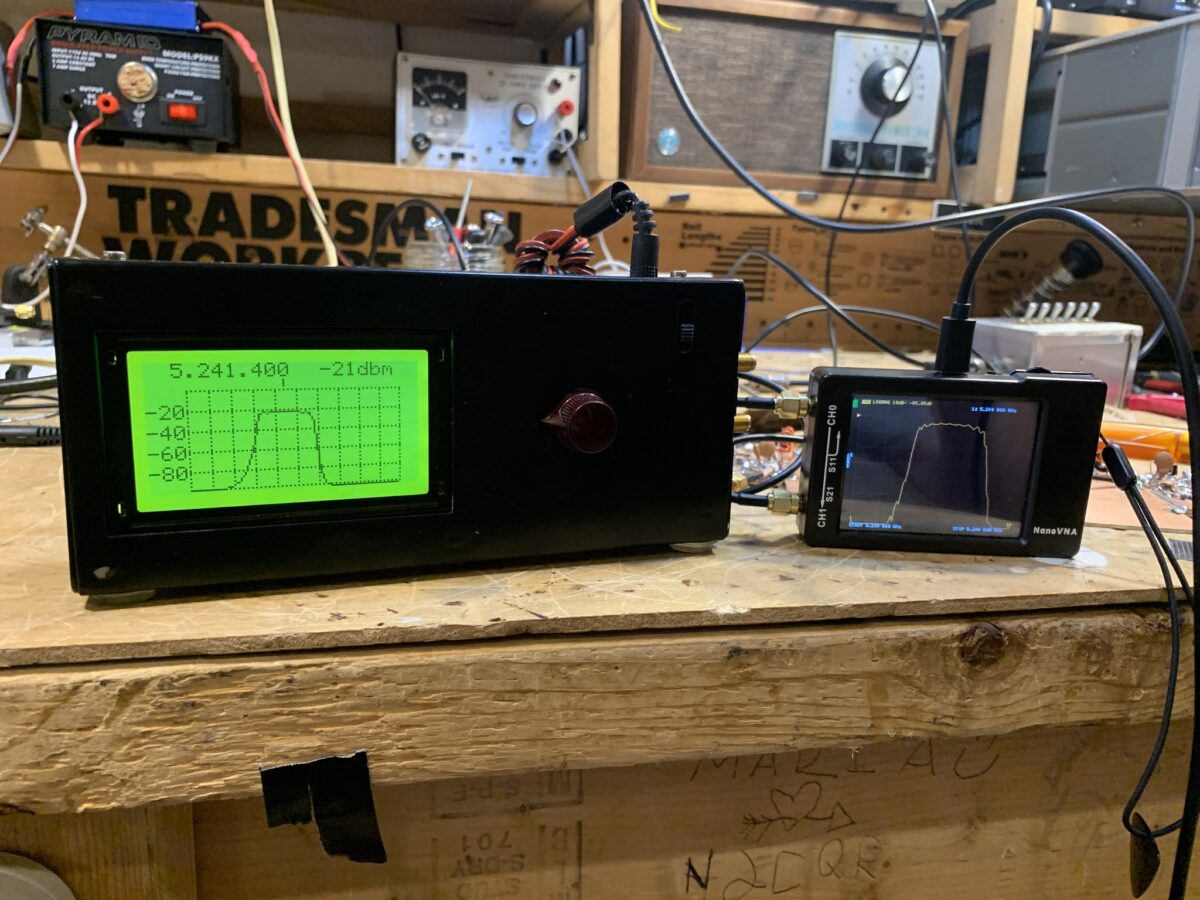
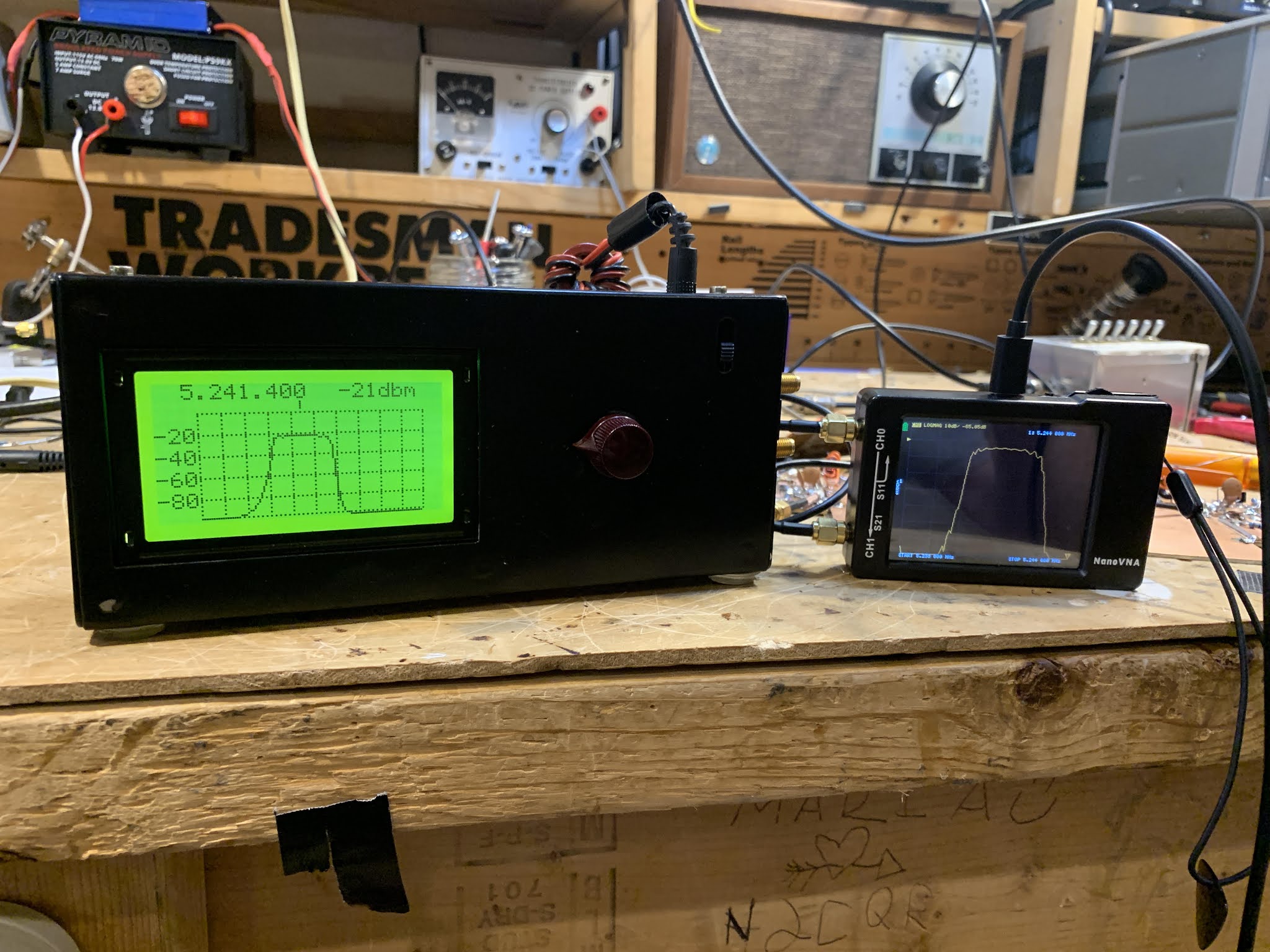
Above you can see the passband of the 10 pole crystal filter as measured across the 50 ohm terminations on the filter. I use simple FT37-43 transformers to match the filter impedance down to 50 ohms. I used the Antuino first — it scanned the passband and held the image on its screen. I then disconnected the Antuino and connected the NanoVNA. So in this shot you can see the passband on both devices.

You will notice that the Antuino says there is a 20db insertion loss. That’s only because in the Antuino 20db is really 0 db loss. I think the NanoVNA gives a more accurate insertion loss reading — about 3-5 db. The cool thing is how similar the shapes of the passband are.