Category: surface mount
Surface-Mount Solder Smoke — Is THIS Really Homebrew?
Repairing the Sony ICF SW1 Receiver — Used for Numbers Station Reception? Why no replacement for C-625?
Great Video on PC Board Techniques, with a Focus on Surface Mount
Wow, lots of wisdom in this video from Leo Fernekes. Great hints and kinks on prototyping with copper clad boards. I need a Dremel just so that I can make Leo’s board cutter. And I can see that I need some of that liquid flux and isopropyl alcohol. Surf boards and headers! Who knew? Teflon coating for the wires — gotta get it. Glad to see that Leo is also a fan of copper tape.
His emphasis on the importance of stage-by-stage construction and testing is right on the mark.
My only disagreement with Leo is about his use of steel wool. I’ve found that steel wool will inevitably cause little tiny “Murphy Whiskers” to float around your workbench. They will eventually settle onto the most inconvenient and damaging place on your board. So I have banished steel wool from my workshop. Those green, non-metallic Scotch Brite pads work just as well and don’t cause shorts.
Three cheers for Leo. He is based in Thailand. He has an interesting background and some really amazing projects and insights:
http://www.luminati.aero/leofernekes
http://www.fernekes.com/blog/
https://www.youtube.com/channel/UCe1bjEcBichpiAMhExh0NiQ/videos
Thanks to Tore LB4RG for alerting us to Leo’s video.
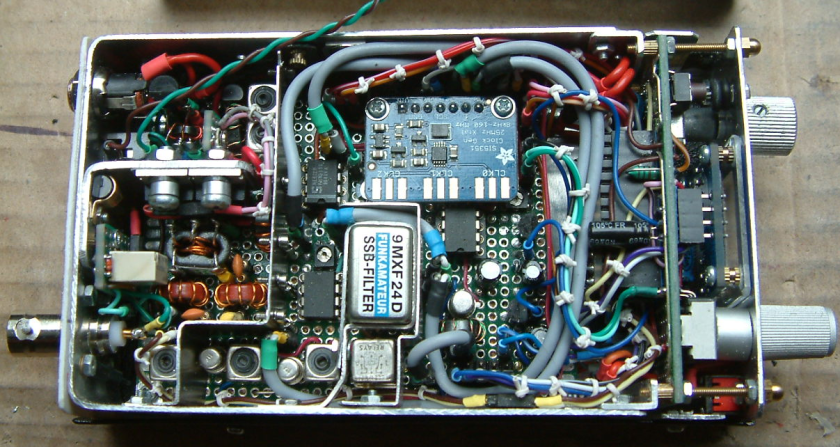
DK7IH Improves his Shirt-Pocket Transceiver
Thanks Peter!
Above Board: Manhattan-izing an SMT kit
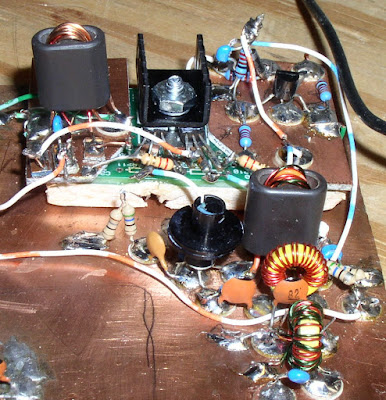
A while back, Tony Parks very kindly sent me one of his wonderful Softrock RXTX V6.3 Software Defined Radio kits. I took a shot at it, but it turns out that I’m not very good with surface mount construction using small parts. I’ve gotten very used to the Manhattan style. Still, I did manage to build one of the Power Amplifier modules, and I put it to good use in a DSB WSPR transceiver I’ve been building (see above) . It worked great. For a while… Then it released some smoke.
I started trouble shooting and it was at this point that I REALLY began to miss good ole’ Manhattan (you see, I was born there, and I went to Manhattan College, so I guess this helps explain the affinity). It was difficult to get to components mounted under the board. The whole thing was the size of my thumb… I know, whine, whine, whine… Luddite Geezer-ism strikes again. SPARK FOREVER!
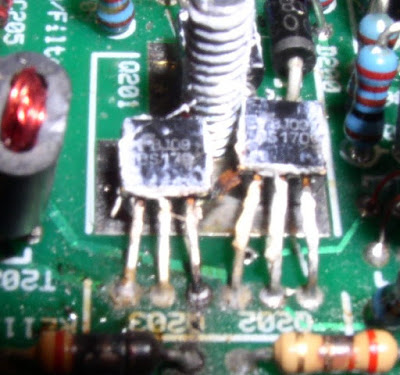
It turns out that the problem was caused by the fact that my shack is just not well suited for this kind of construction. There is a lot of stuff floating around. Conductive stuff. Look closely at the picture below and you will see what I mean. You will see what caused the release of the smoke. Look at the leads on the PA transistor on the left. That’s a little bit of stray wire that found its way to the WRONG place. Note the toasted source resistor just below!
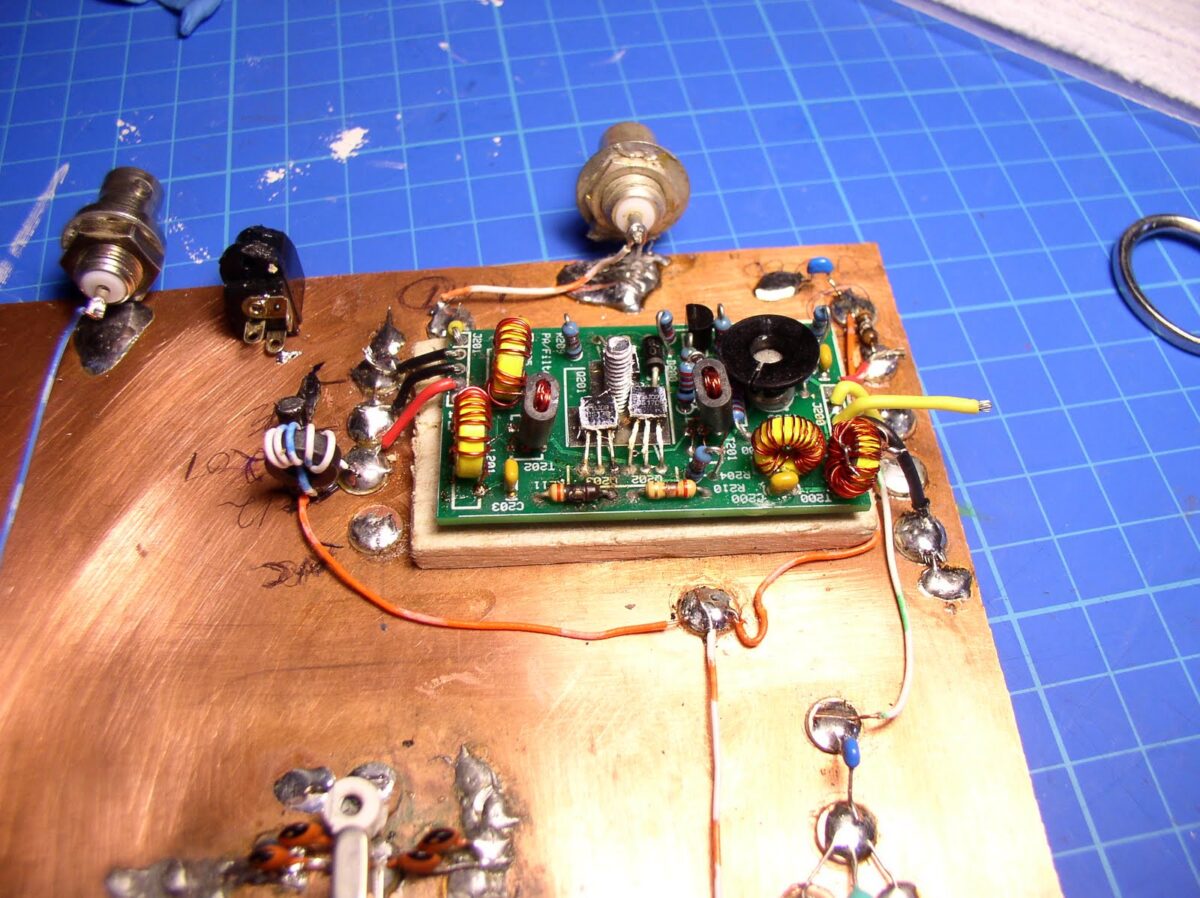
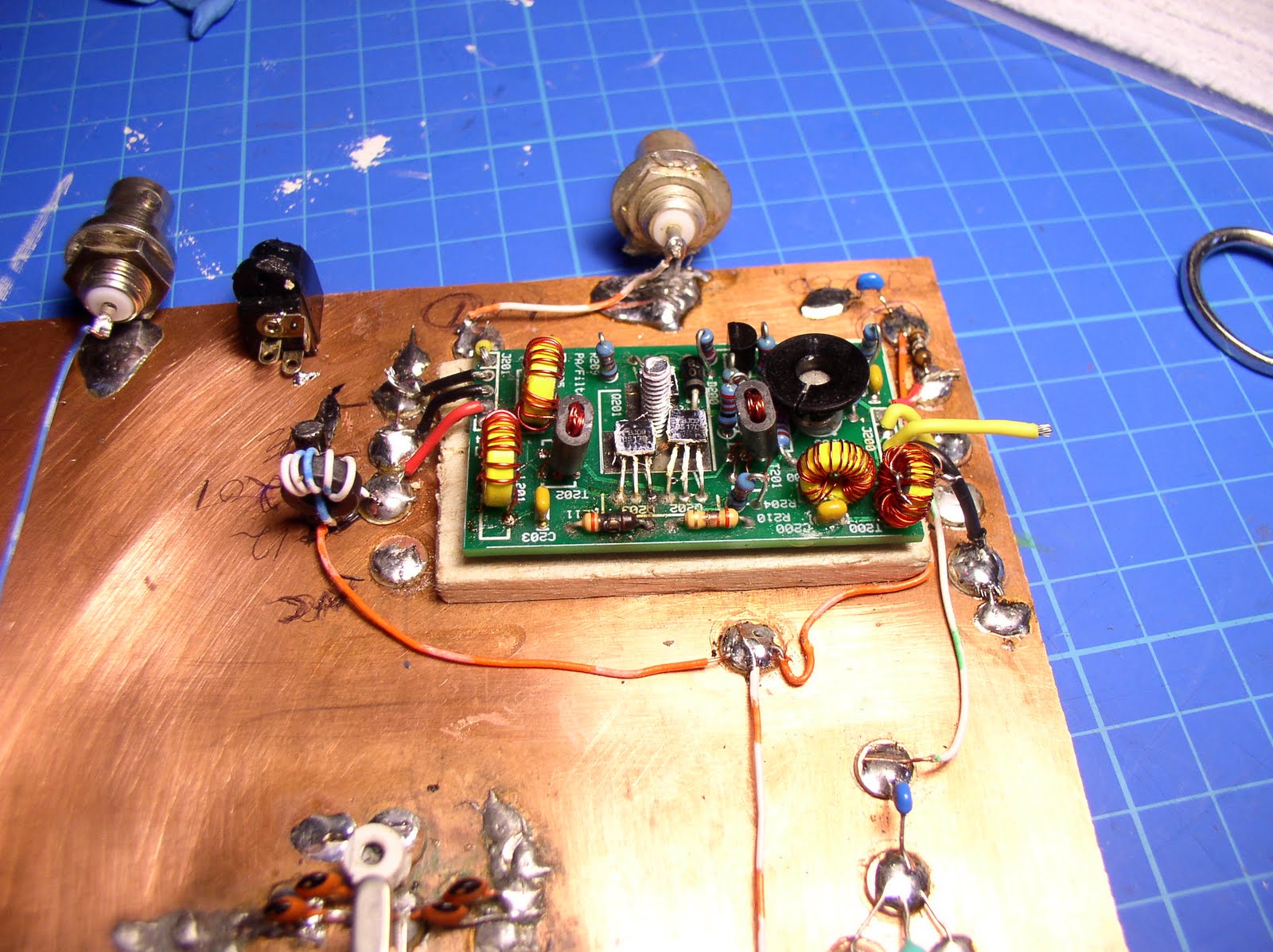
Anyway, after a trying to fix this thing, I finally gave up and decided to use the circuit, but in Manhattan form. Everything up top. No SMT. Bigger coil cores. The temperature sensing circuitry went off to the right. The output transformer went off to the left, and the driver stage went down below the kit’s board. Here is what it looks like now. Again, it works great.
I want to thank Tony and the Softrock guys for giving me this experience. Their kits are wonderful and are really making a tremendous contribution to the hobby. I strongly recommend them. The instructions are great, much like those of the old Heathkits. But for me, I’ll take Manhattan.
VK6ADF: Echolink, WSPR, 6 Meter Yagi
From London I used to talk to Phil, VK6ADF, on Echolink. We have a lot of interests in common. This may be due to the fact that we were both born in the International Geophysical Year. Phil is now reading “SolderSmoke — The Book,” so we will probably discover other areas in which we have crossed paths. This week, I decided to get back onto Echolink, and in my first session I was looking for OM Phil. He wasn’t on, but, IN A VERY MYSTERIOUS TWIST, that morning he sent me an e-mail. Spooky, eh? Anyway, yesterday we got on Echolink and covered our usual wide-range of tech topics. Phil alerted me to a web site called Real Flight that provides an on-line simulator for Radio Controlled airplane pilots. Obviously Billy and I could use some time in the simulator!
Phil is also into WSPR and as we spoke I fired up my 20 mW DSB WSPR rig. I was immediately heard by an Irish station, and Phil almost instantly saw the report on the WSPR database. I noticed that the EI station was reporting that I was on 40 meters, when in fact I was rock-bound on 30. Again, as Phil and I talked, I went to the WSPR chat section and asked about the freq discrepancy. Another VK6 (a friend of Phil’s!) answered my question (a simple set-up problem). Small world.
Phil and I have similar curmudgeon-like thoughts on Surface Mount Soldering, and he seemed sympathetic when I said that I think I am more of a “Hardware Defined Radio” guy. Again, this may be an IGY thing. Oh yea, almost forgot: We’re not crazy about LINUX either. We are only a few short steps away from the “SPARK FOREVER” mentality and full-fledged Luddite status.
One interest that Phil and I DO NOT share is Six Meters. Phil is now addicted to the Magic Band (which I still consider to be a white noise generator). Check out his video on his six meter yagi.
Stagnosald! (Italian flux)
For some reason I like the packaging for this Italian soldering flux. Sort of takes you back to the days when soldering was soldering, if you know what I mean. Now (somewhat ironically) we are using this flux for SMT soldering. On the left you can see the PA stage of my slowly-coming-together SMT SDR LINUX Compu-radio. As you can probably tell, I am struggling to keep a positive attitude towards SMT and SDR. Lately, even Linux has been giving me trouble. The problem here is clearly with the operator, not the equipment. The Softrock SDR kit is really excellent. I’m sure I will eventually get it working, but I think there will be a lot of geezer-like complaining about all this new-fangled surface mount, software stuff. Please, bear with me.
A Report from South Africa
Africa “field QRP station”
Thanks for another great episode of your experiences – I’m tuning in from Africa while on my vacation Each December I make the trek from San Diego to Cape Town.
Then, my Dad (zs1xd) and I take the family out to a remote
location – and setup a field station. Around the camp-fire, under the Milky Way and no rf-pollution is a great way to hunt some dx and spend vacation time. This year
we selected a cabin located in a beautiful mountainous region about 100 miles north of Cape Town. 2 wheel vehicle will get you there and “just in case” , we
also took a capable 4×4 with.
I posted some pics and QRP HF operating notes here: http://k6wh.blogspot.com/
“SMT”
I’m following your Softrock SMT construction comments with keen interest and am glad you’re finding the challenge – well – “not so much of a challenge”
I think it’s so great that you’re encouraging hams to jump into SMT.
I chuckled at your comment about “desoldering smt’s” – Try de-soldering the Si570 SMT chip. I had the good fortune of measuring messing up the
“measure 10 x then cut once” when soldering this IC on the rxtx kit. Well – we know a mistake will happen, and when it happens, murphy’s law will ensure
that it involves the most sensitive and tricky smt component on the board – hi.
It’s a real trick, due to the contacts being under the chip (no pins like the other smts)
Well – try de-soldering that piece. And of course one realizes the mistake, only once the last solder joint has dried. Determined to correct the mistake there and then,
at 9pm while busy with the kit, I rushed off to the nearest radio shack to get some de-solder wick. Took me about 1 hr of patience, and careful “wicking” to suck
up all the solder underneath the chip – one contact at a time, (each desolder attempt, hoping the chip pops loose) – no easy task. I don’t know of another easy way
than lots of patience, and a good magnifying glass.
I agree there is no greater reward than “homebrew” and with the advances in SDR tech, we’re surely living in a wonderful age.
Once you get the SDR on-air, I’m sure you’ll be blown away by the reception quality – sensitivity and especially the almost non-existent noise-floor.
(I’m not sure which model you’re building, but I think all of Tony’s designs are utilize the same Tayloe detector design which is very quiet)
I still can’t believe the performance I get with the Softrock’s kit – It’s now become an antenna measuring instrument – While having fun with PSK QSO’s and WSPR.
Of course, with the SDR one can adjust the output (via soundcard drive) to basically uW levels.
As we know, at these levels, each little bit of antenna optimization helps, and SDR+WSPR/PSK has become my “far field antenna measurement tool” of choice.
WSPR from Africa
Not too many stations active on WSPR on the African continent – Now that I’ve setup my Dad on DSL, I assisted him in activating his WSPR station in
Cape Town (ZS1XD). His antenna is a 20m homebrew 2 el yagi. I’m pointing it north during the evenings to see if n2cqr pops up in the log. Nothing yet, but I’m sure
one of these days, you may just be surprised. Keep watching for the Africa report 🙂
thank you again for such a great entertaining and educational program …
73 – best wishes to you and the family from the tip of Africa.
de deon (k6wh)/zs
Scrimshaw, Syringes, and Easy-Bake Ovens: The World of Surface Mount
I’m struggling with the whole surface mount thing. I am trying to maintain a good attitude and not turn into a grumbling techno-Neanderthal here… But it is really different.
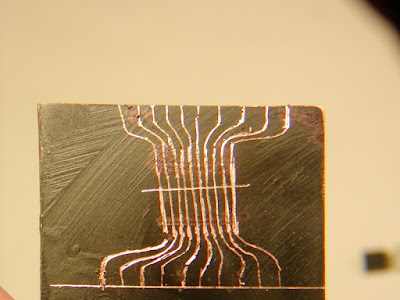
Very apropos of my current struggles, some work done by our friend Mike, KL7R, came across my screen this week. It was about his effort to deal with the REALLY TINY SMT ICs. Surely his Alaskan roots had some influence in his decision to go with the scrimshaw technique.
For more details see : http://kl7r.ham-radio.ch/scrimshaw/
BTW: Todd, VE7BPO, has put together a memorial page for Mike:
http://www.qrp.pops.net/K7LR-Memorial.asp
Another SMT technique is outlined by Mike, N5 JKY. I couldn’t help think about the old Easy-Bake oven that my sisters played with:
Hi Bill,
I’ve been doing some surface mount projects over the last couple of years and found one method of soldering that I really like: my toaster oven. I use Kester Easy Profile solder paste which I get in a syringe from KD5SSJ for $5:
http://www.kd5ssj.com/index.php?option=com_content&view=article&id=120&Itemid=54
The syringe allows you to put a little dab of solder on the board where each SMT component goes. I use my forceps to place the components, and the paste holds them in place. You can even invert the board and they won’t fall off. After the board is populated, you just carefully bake it in a toaster oven. The guys over at Seattle Robotics have a nice description of the baking process:
http://www.seattlerobotics.org/encoder/200006/oven_art.htm
The first SMT project I did was an ATS3a transceiver, soldering each part in one at a time. It was a real pain. I used the solder paste and baking to put together a Juma1 receiver kit from the Finnish QRP club, and it went like a breeze. I am getting one of these cute digital storage oscilloscope kits ($35, can you believe it?) and will use that method for soldering it. In case you haven’t seen these kits yet, here is the link:
http://www.seeedstudio.com/depot/digital-storage-oscilloscope-diy-kit-with-panels-p-515.html?cPath=71
I hope you and your family have a great holiday season and happy new year from another Drake 2B owner.
Very best 73, Mike McShan N5JKY
KD1JV’s Surface Mount Video
OK SolderSmoke fans, here’s a video for YOU! Steve “Melt Solder” Weber has put out his first video. It is about surface mount soldering. It is all very interesting, and some actual solder smoke is released, but I was a bit disturbed when Steve put the PC board on an electric stove and then started using this purple thing that looked and sounded like a hair dryer. Made me yearn for my Weller soldering gun. Great video Steve, thanks!