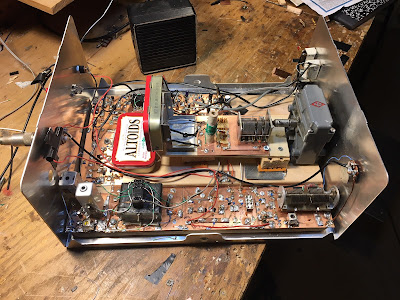
Thanks to all who offered advice and assistance. With help from you guys — and especially from Pete Juliano N6QW — I think I have this fixed.
Pete was right — the problem was really with the variable capacitor. The one I was using was kind of stiff and irregular in its motion. I found another one in the junk box that was easier to turn (it has one set of ball bearings). This fixed most of the problem.
I also spent more time making sure the shaft of the cap lined up perfectly with the shaft of the gear box. This also helped a lot.
I realize now that some of the “stickiness” that I occasionally feel while tuning may be coming from the dial — not from the gear box. It looks like my dial took a hit that slightly bent one portion of it. It seems that the numbers have a bit of trouble clicking over on that portion of the dial. Some lubricant may help there. But I can live with it.
The receiver now tunes very smoothly and I can go right back to a frequency and find the signal exactly where I left it. There does seem to be a very slight difference depending on whether I “approach from above” or “approach from below” — but this is not a big deal.
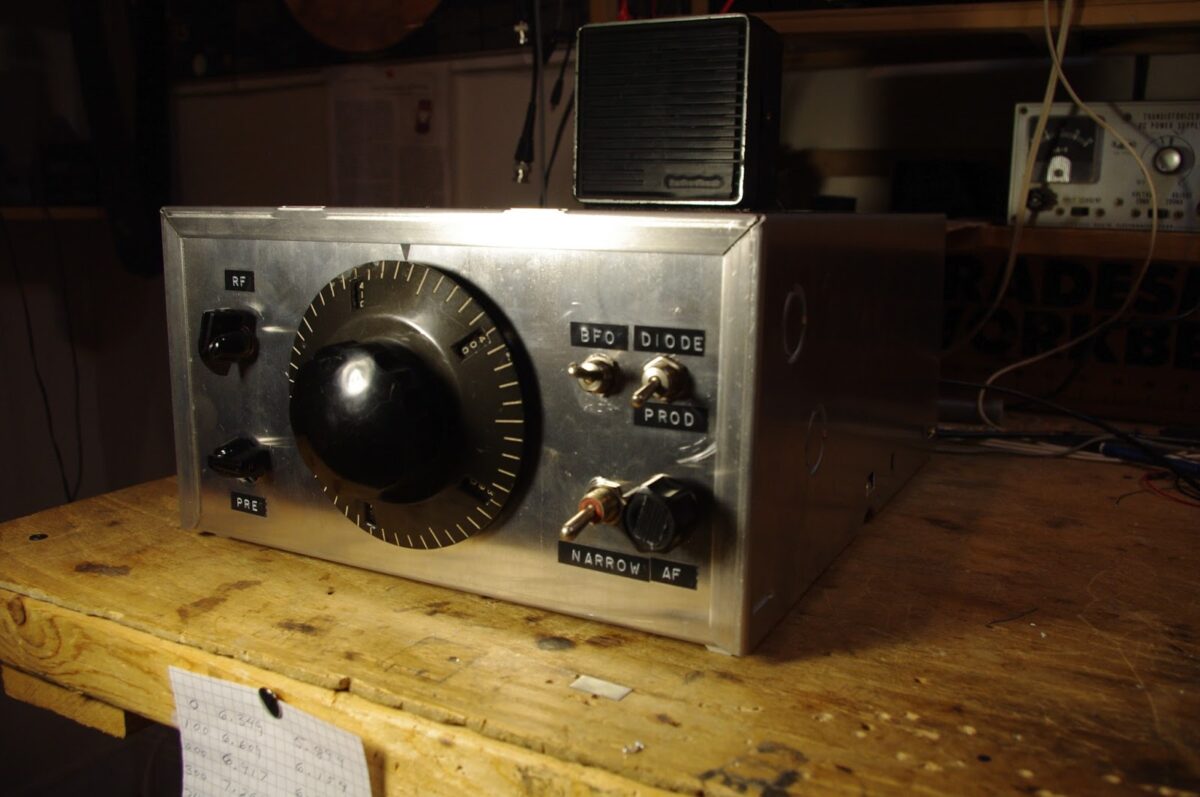
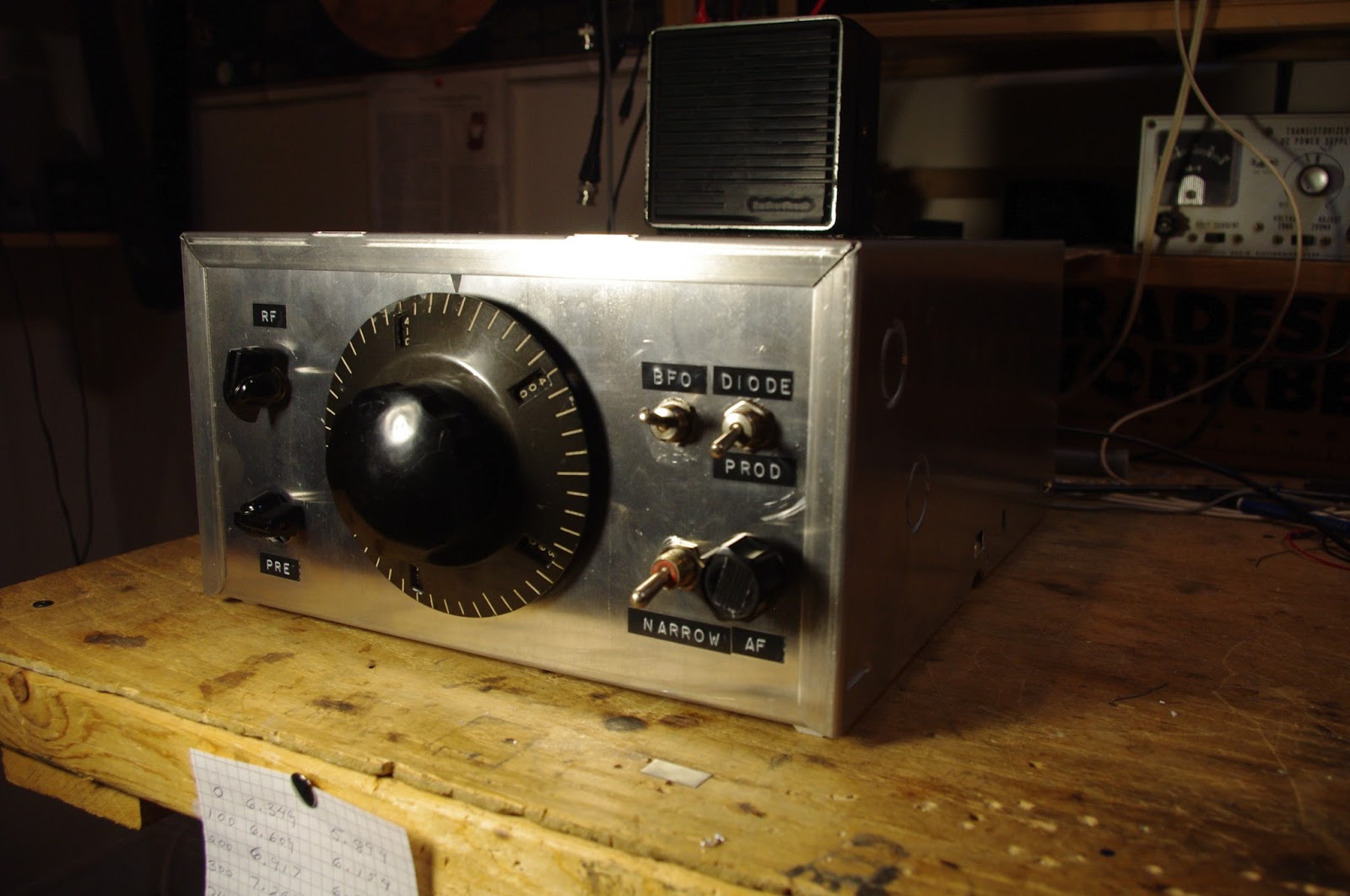
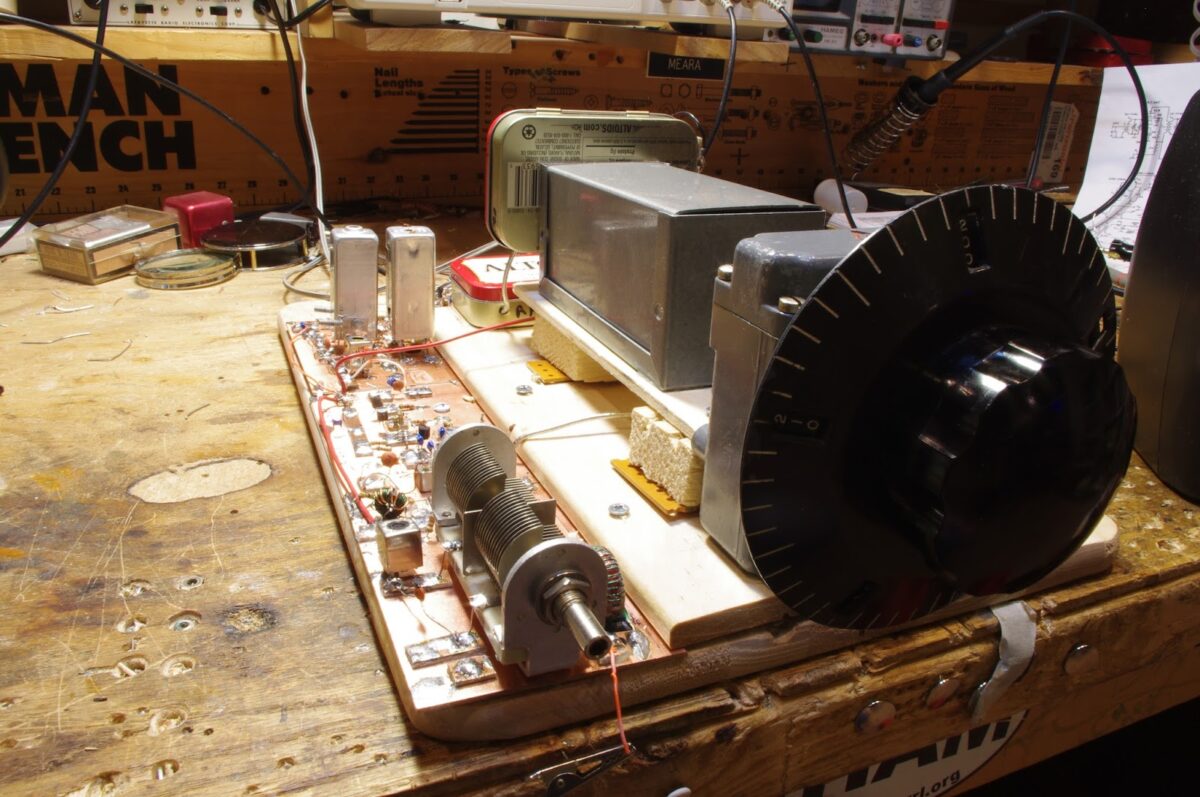
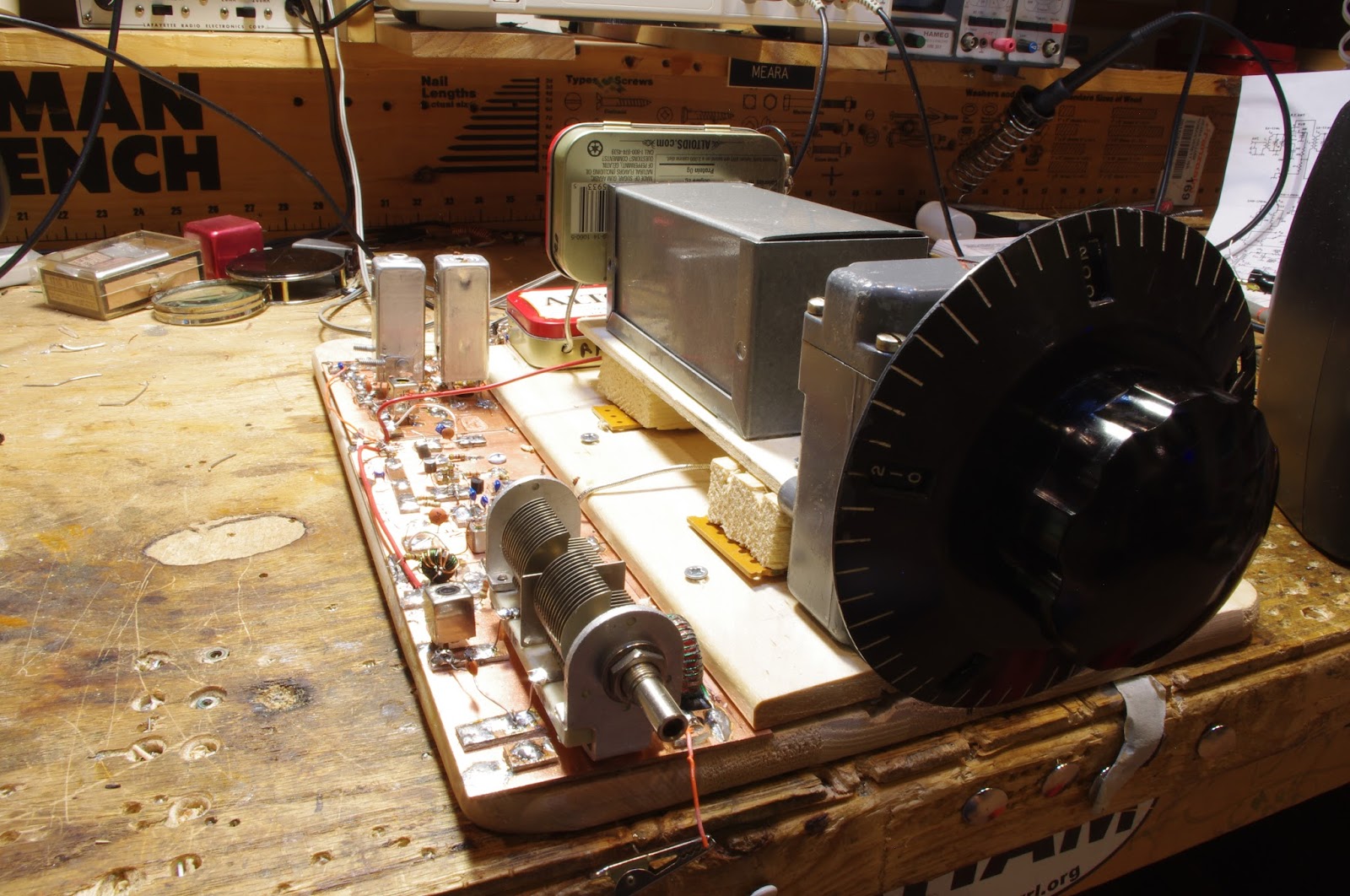
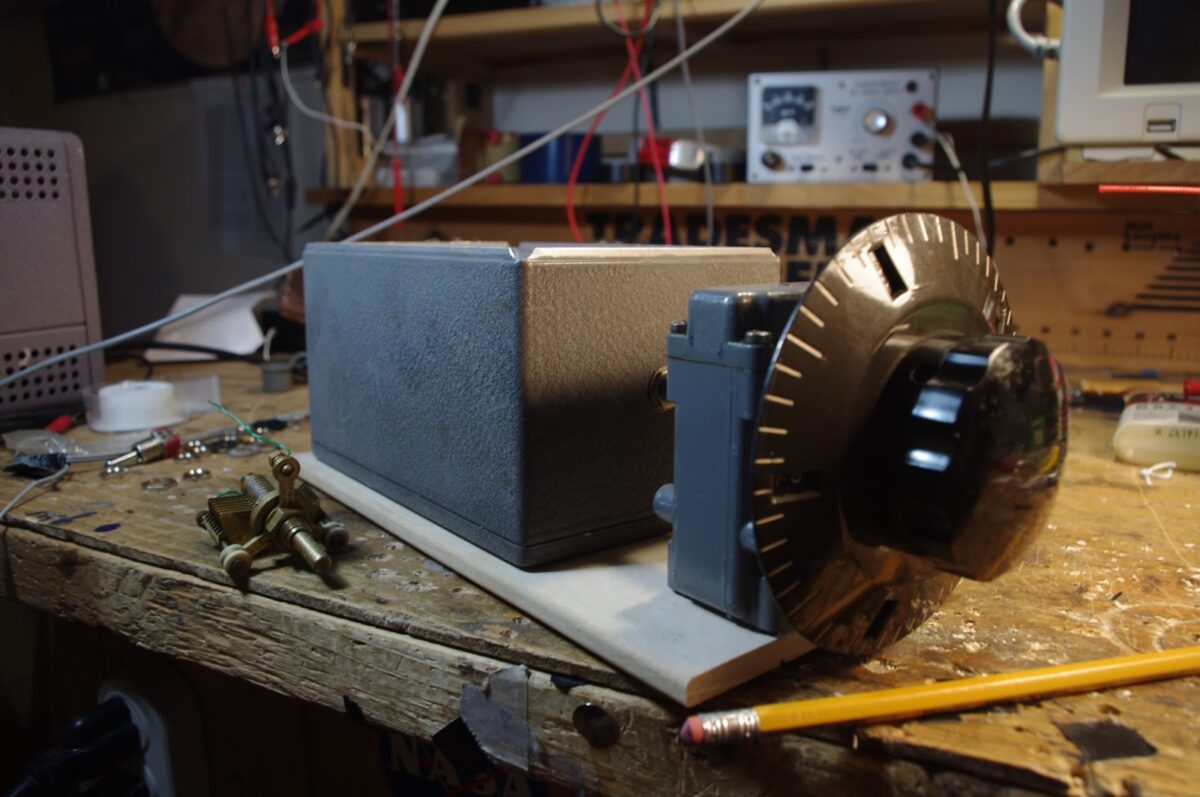
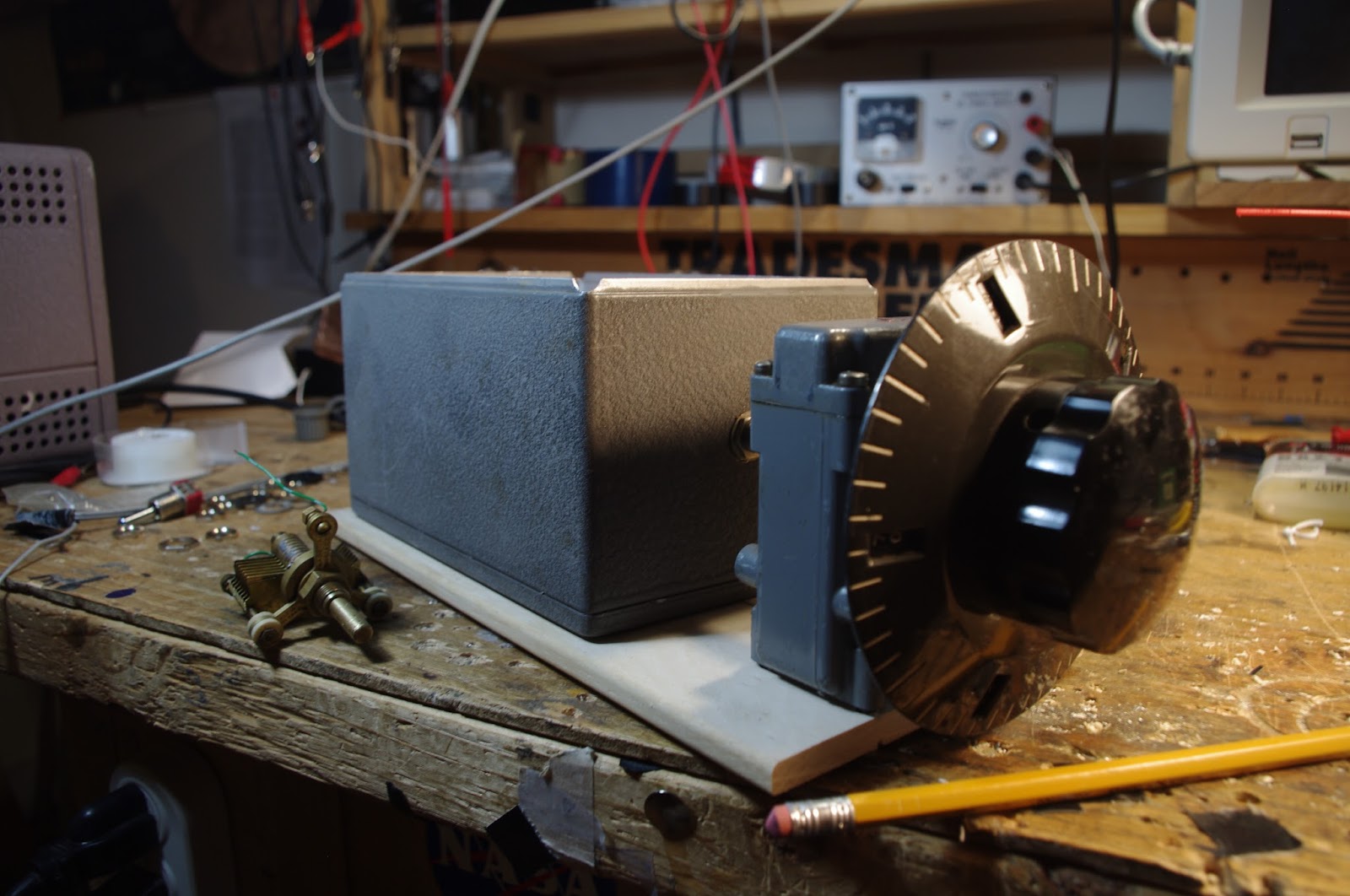
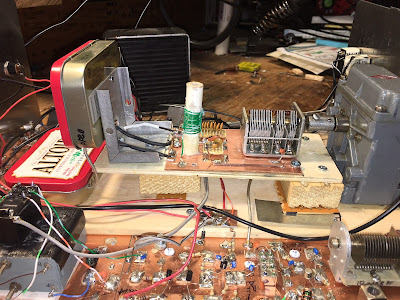
Check out the pictures of the receiver and the VFO. Note the “cardboard from a coat hanger” coil form. The winding is held in place with nail polish varnish. I had planned on having the variable cap, the coil , and the associated fixed caps all in a box for better thermal stability, but the VFO is very stable even without the box. I have the VFO running 455 kc ABOVE the signal frequency. It runs from about 7455 kc to about 7800 kc. I could have set it up to run 455 kc BELOW the signal freq. That would have made it a bit more stable (it is easier to attain VFO stability at lower frequencies) but VFO is so stable that I probably won’t mess with it. I followed DeMaw’s rules: Physical stability, NP0 caps. For the NP0 caps, put several of them in parallel to get the desired capacitance value. Keep heat-producing active components away from the coils and caps.
Thanks again to Armand WA1UQO for giving me this amazing piece of radio history. And thanks to Tim Sutton for the big box that holds this receiver.
James Millen knew what he was doing. See: http://www.isquare.com/millen/millen-page.htm
Category: Superhet receivers
F5LVG’s Nail Board Receiver — Names for the Technique
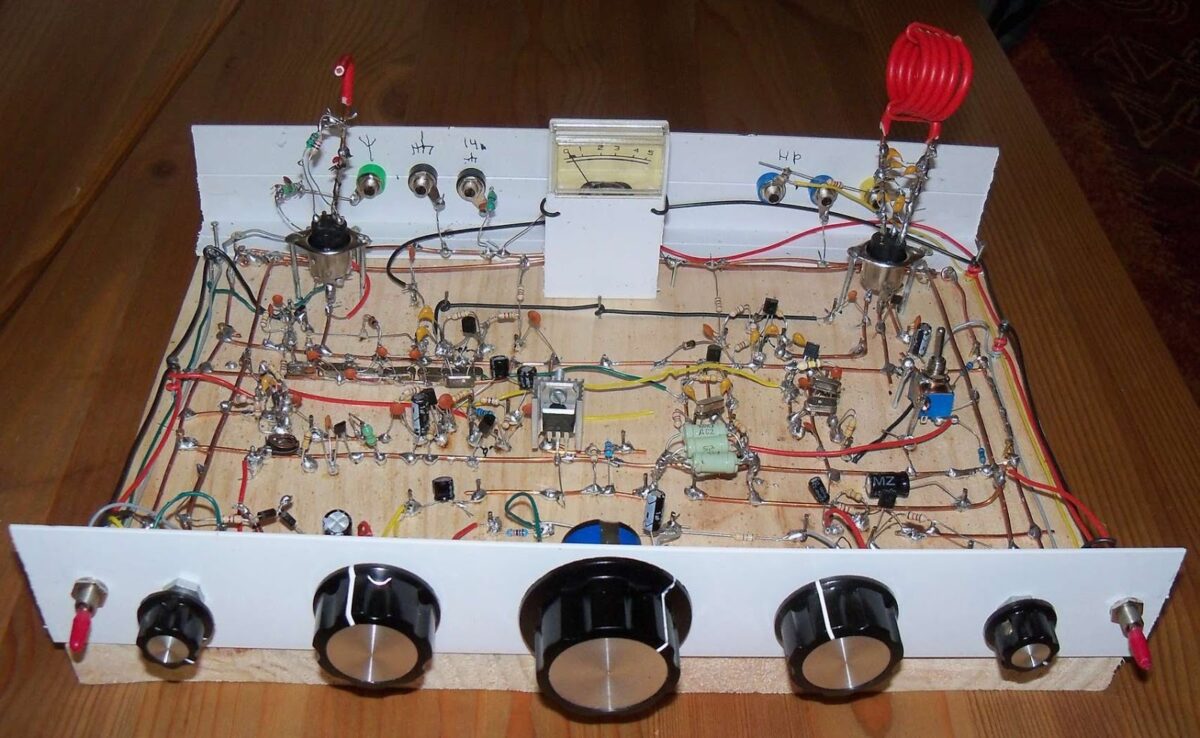
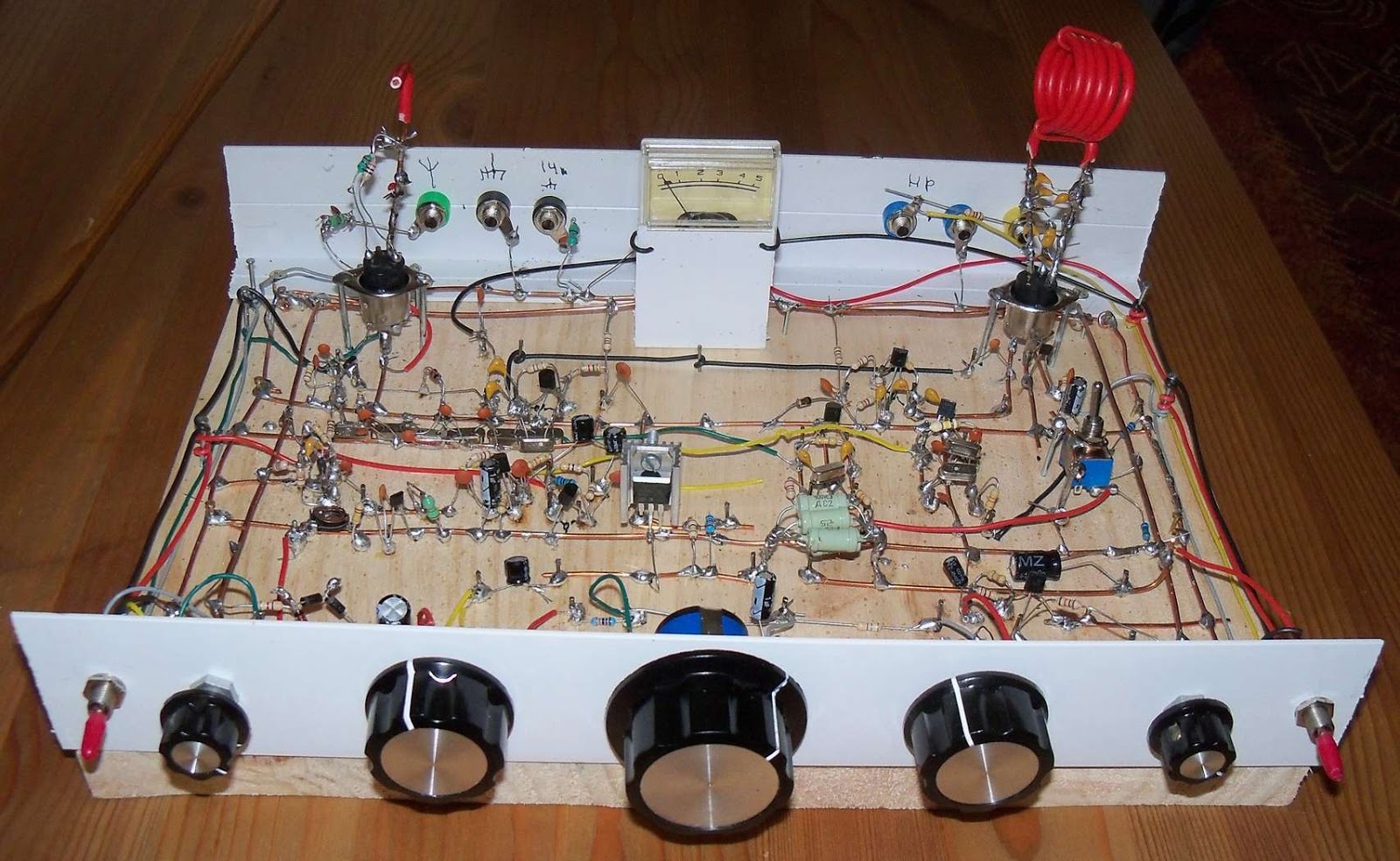
Pete WB9FLW reminds us that Olivier F5LVG has LONG been using copper nails and wood boards to build amazing rigs. See above for one magnificent example. That, my friends, is a superhet receiver. Inspirational!
An Old but Cool DiFX: The Epiphyte
I’ve been hearing about this rig for many years. It first appeared in the September 1994 issue of QRPp, the journal of the NORCAL QRP club. A condensed version of that article appeared in SPRAT 81 (Winter 94-95). The designer is Derry Spittle VE7QK from Vancouver, British Columbia.
The name always puzzled me. Here is the explanation: It started with the Neophyte: A very simple direct conversion receiver that many of us built. The Neophyte was mostly an NE602 and an LM386. In the Epiphyte, a crystal filter and a second NE602 were added, turning the Neophytes into a superhet receiver and — with some additional circuitry — an SSB transceiver. The Oxford English Dictionary reportedly defines an Epiphyte as “a plant that grows on another plant”(see picture below). The Epiphyte grew out of the Neophyte.
And this plant grew in British Columbia, which seems — like Australia and New Zealand — to be fertile ground for simple phone rigs. I’m pretty sure the “Wee Willy” DSB rig also came out of BC, and it may have had a similar purpose: allowing for portable contact with the BC Public Service Net on 75 Meters.
There are many features of the Epiphyte that I like: There is a simple 455 kHz filter and a ceramic resonator BFO/Carrier oscillator. The original design featured a VXO-like circuit using a ceramic resonator at 4.19 MHz. And it ran off AA batteries (as did the NE602 DSB rig I took to the Dominican Republic).
Unlike my NE602 rig, the Epiphyte made an artful use of the fact that NE602’s can be set up to have TWO inputs and TWO outputs. Where I used DPDT relays to switch inputs and outputs from both NE602s, OM Spittle left all the inputs and outputs connected, and simply switched the VFO and BFO signals. Ingenious.
There were updates and improvements. The Epiphyte 2 and 3 featured increased power out (5 watts vs. 1 Watt). Version 3 has an IRF-510 in the final, driven by a CA3020A chip. That chip is capable of 70 db gain. Wow.
In 1996 NORCAL and G-QRP donated 50 EP-2 kits to radio amateurs in third world countries. Very nice.
In 2000 NORCAL did a kit of the EP-3 — it sold out in 24 hours. Here is a nice article on the EP-3:
http://www.norcalqrp.org/files/Epiphyte3Mnl.pdf
And above we have a video from Japan of an EP-3 in action.
Another Thermatron Receiver (video)
Thanks to Steve N8NM for sending this along. He said it seems to be crying out for a synthesized VFO — I disagree,of course.
I like the filter arrangement — one crystal at 455 kHz, two tune-able IF cans and a phasing control. This seems like a good way to get both AM selectivity (broad) while still having the ability to narrow the bandpass for SSB.
The builder did a great job. Does anyone know who he is?
The Soul of the Old Machine
I continue to peruse the stack of Electric Radio magazines that Armand WA1UQO gave me last month. Great stuff. I’m really struck by how much of our ham radio history is captured in the pages of ER… and nowhere else. This is a resource that should be protected.
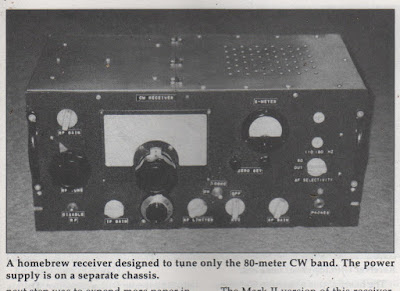
In the last podcast I shared a few lines from the “Amateur Radio SSB — The First Fifty Years” series or articles. Today at lunch time I was reading the March 1994 issue, there was an article by Don Meadows N6DM entitled “A Homebrew CW Receiver.” From the last paragraph:
“This homebrew receiver as the main station receiver until 1975… In 1989 the homebrew receiver was finally mothballed… In its place I acquired an imported box that does everything. This box is friendly and cooperative, but I have no rapport with its soul. When it ultimately falters, it will need to be cured in the manufacturers sanitarium for sick gear instead of on my own workbench.
I’ve always been proud of this homebrew receiver. It did its job exceedingly well. Retrieving recently this old friend from storage for photographs, cleaning out the dust and dead insects, inspecting its wiring up close — all this evoked fond memories.”
N6ORS’s Franken-SDR Superhet
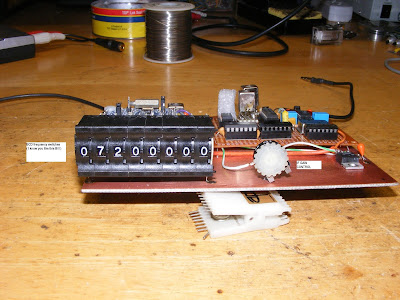
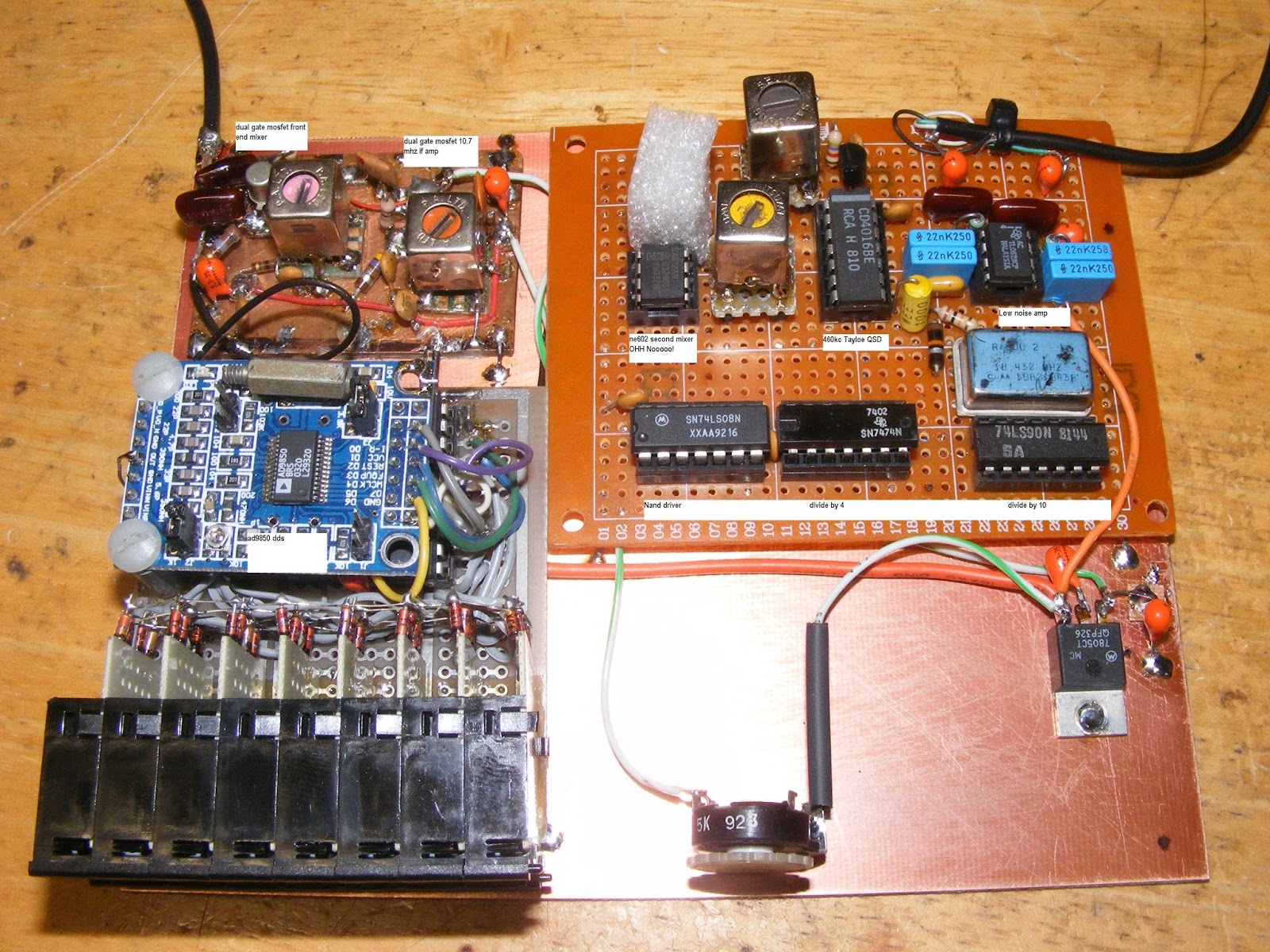
Of course, I love it. MOSFETS! NE602’s! 10.7 Mc IF cans! Cycles, not hertz! And a Tayloe Quadrature Sampling Detector made from junkbox parts from the Reagan administration. FB Keith. And the frequency display is icing on the cake.
Bill:
I thought the group might find my new Franken-SDR interesting.
It is an SDR with a superhet front end.
I wanted to play with an SDR but I didn’t want to get a kit or buy
parts, so I scrounged through he drawers and found a mux chip
cd-4016 circa-1980 some old 7400 logic that is probably per-1980.
This could make a QSD but only very low frequencies. Well I thought
how about at IF frequencies?
The frontend is a MOSFET mixer (1975) , the 10.7 IF is a dual gate MOSFET
(1975), the second mixer is a NE602, the IF cans are all stagger tuned to
give a bandwidth of 50kcs.
The only thing modern is the DDS but I old-time-ifyed it with BCD switches.
Keith N6ORS
NE602 Si5351 OLED “Whole Foods” Receiver
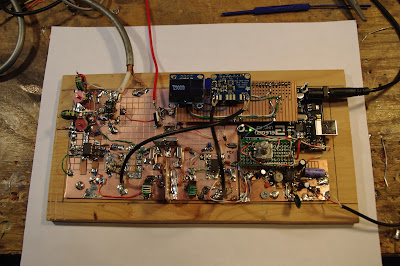
This is one of those projects that sort of just happened. First I built an Si5351/Arduino synthesizer with a small OLED I2C display (program by Thomas LA3PNA — thanks Thomas). Tom Hall AK2B up in New York helped me get the Si5351 VFO and BFO going — thanks Tom. Then, over the holidays I decided to build a rig of some sort around the Si5351. I started with a superhet receiver using an NE602 as the mixer and another as the product detector. I power the NE602 with an 8 volt regulator from W8NSA — thanks Jim. I made a 4 crystal 11 MHz Cohn filter using crystals left over from a BITX project. The software from AADE helped me design the matching networks to match the filter to the 1500 ohm impedances of the NE602s. I built the circuits on a milled board sent to me by Pete Juliano N6QW — thanks Pete! I put a dual tuned circuit at the front end, going into a MOSFET RF amplifier. For audio amp I have an LM386. The whole thing is screwed down to a barbeque grilling plank from Whole Foods — thanks Whole Foods! (This seems appropriate — the “O” in OLED is for “Organic”!)
It sounds nice. I may eventually try to put some relays in to switch the NE602s and the filter around to make this a transceiver.
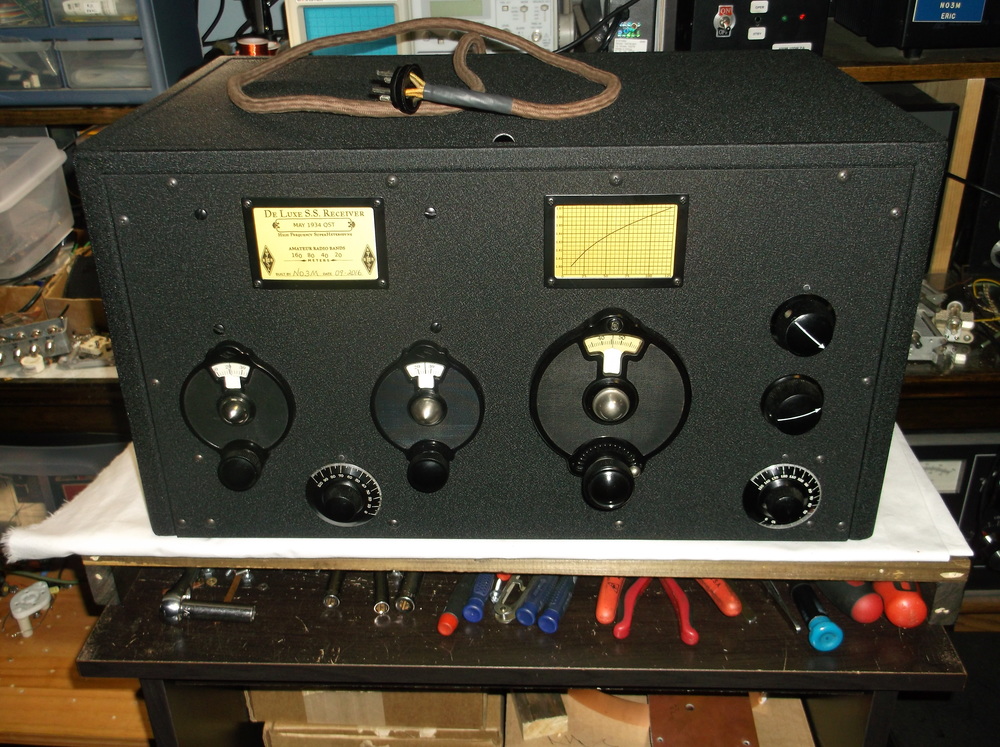
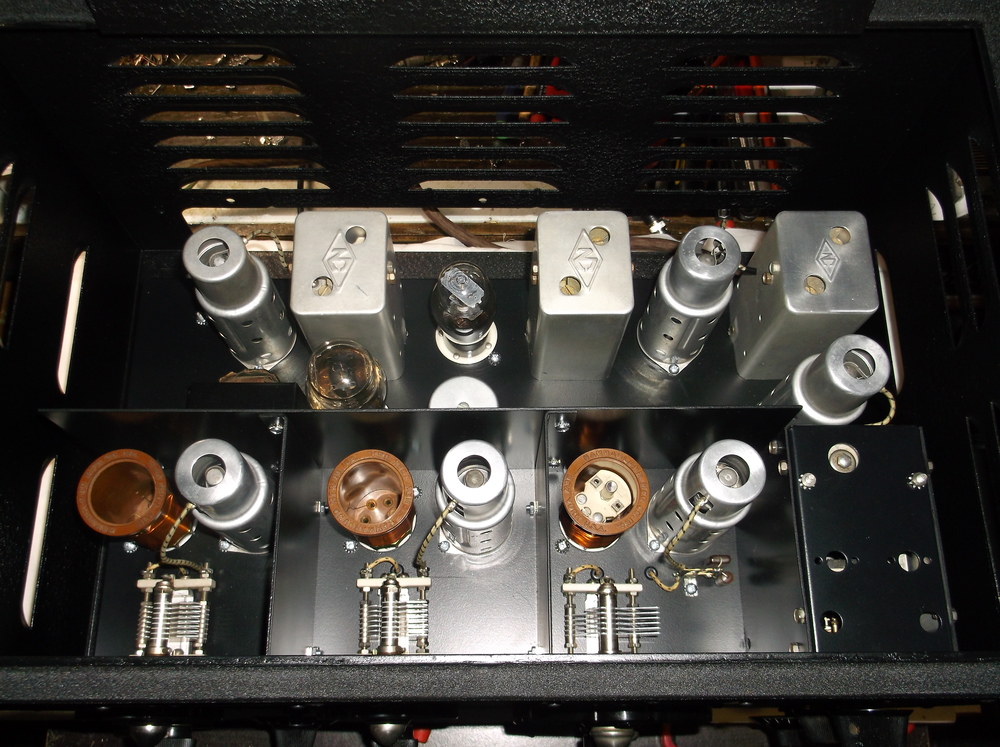
NO3M’s Amazing Homebrew 1934 Single Signal Superhet
Boxed-up and Looking Good: An End to “HRO Al Fresco”
The “al fresco” phase has ended for my HRO receiver project. As has happened with homebrew projects around the world, this rig was literally pushed aside on the workbench to make room for BITX-40 Module Mania. I began to worry that the circuitry of the HRO receiver might suffer damage from the various kinds of electronic construction mayhem that take place on our workbenches. Also, I wanted to see what it would look like in the nice big metal box that Tim Sutton had sent me (thanks again Tim.) And I was hoping that the box would help with the AM broadcast breakthrough that I sometimes hear with this receiver. So, as you can see, I have good excuses for declaring Basta! on the HRO Al Fresco.
I think it looks great. Black on silver is very cool. It sounds great. I’m listening to 40 right now. Thanks to Armand WA1UQO for the very cool HRO dial that got this all started.
Cool Jazz from New Zealand as Heard on a Homebrew Superhet Receiver (VIDEO)
I’m making slow but steady progress on this one. The origin of the project was the beautiful National HRO dial and gearbox that Armand WA1UQO gave me.
I decided to use a 455 kHz IF because;
1) That was the IF of the old HRO receivers (the ones that won WWII)
2) I had a nice TOYO CM455 crystal mechanical filter that would be good for SSB.
3) I figured it would be easy to add in a wider filter that would be good for AM shortwave listening.
4) I like to keep the IF below the frequency of the VFO.
The wide filter turned out to be harder than I thought, but I think I have finally achieved the selectivity I was looking for. I’ll have a switch on the front panel that will allow me to go from “AM-Wide” to “SSB Narrow.” The switch will change the filters and the detectors, and will turn the BFO on and off.
Still to do: I need a high-pass filter to knock down RFI from nearby AM broadcast transmitter. And an RF gain control would be nice.
I’m really glad Radio New Zealand is there. It provides welcome relief from the shortwave fire and brimstone. Radio Romania is also doing a fine job on shortwave.
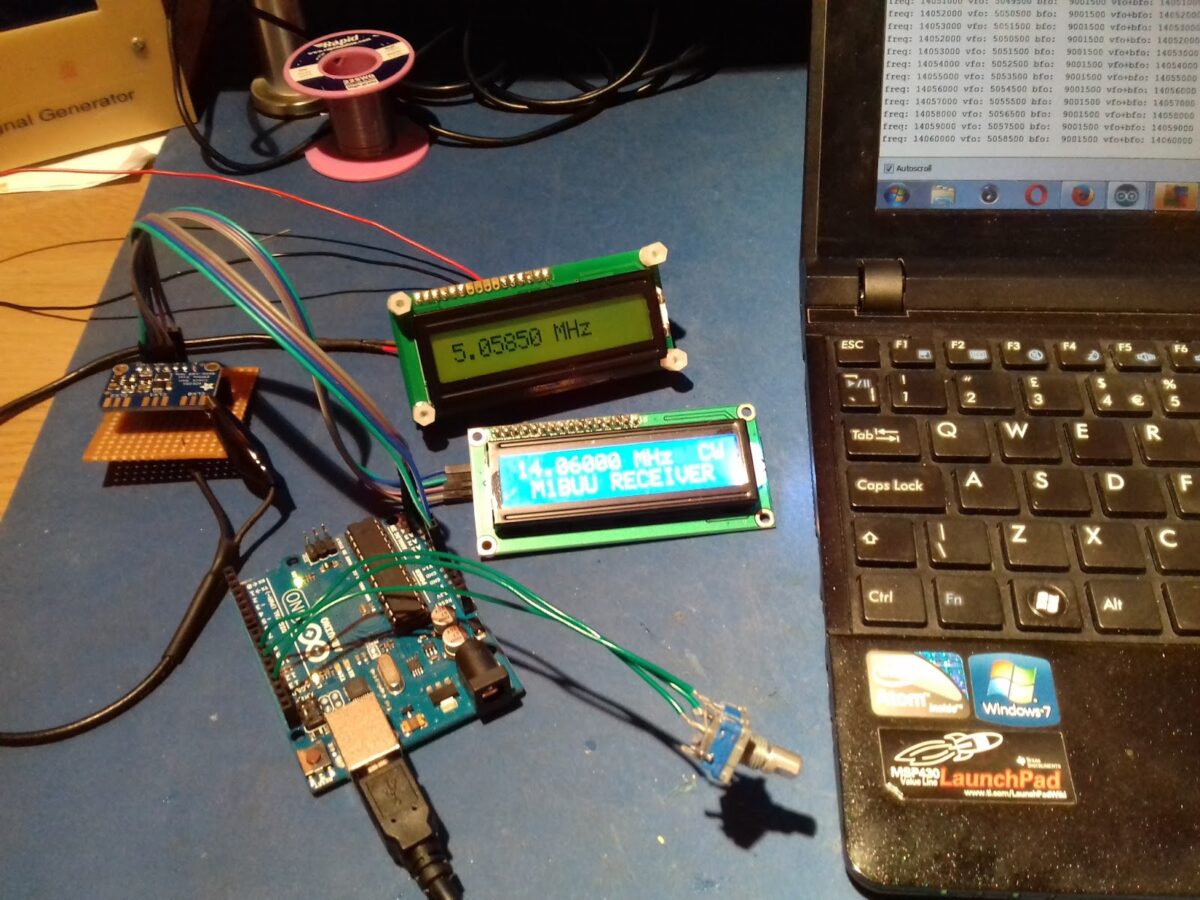
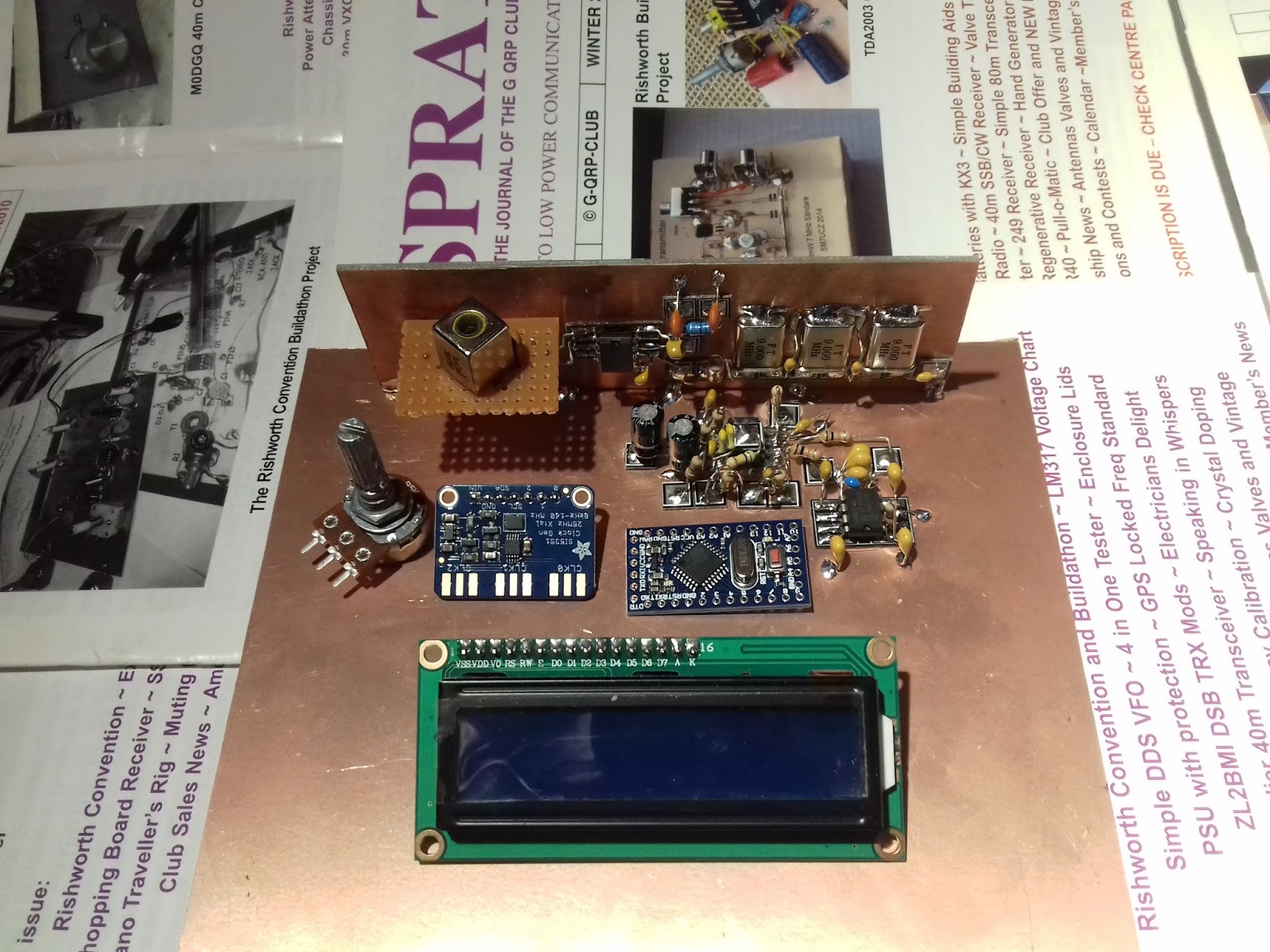
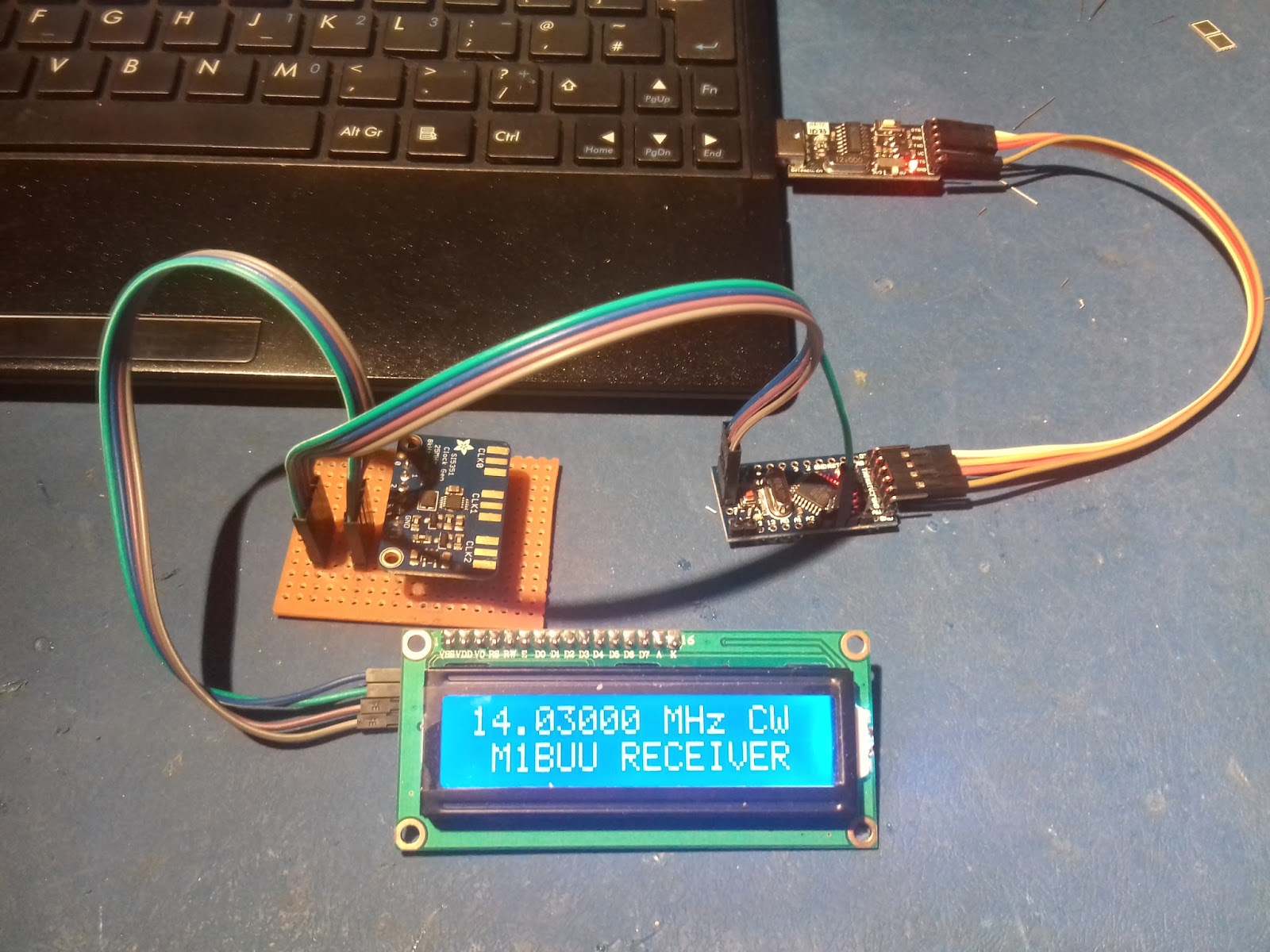
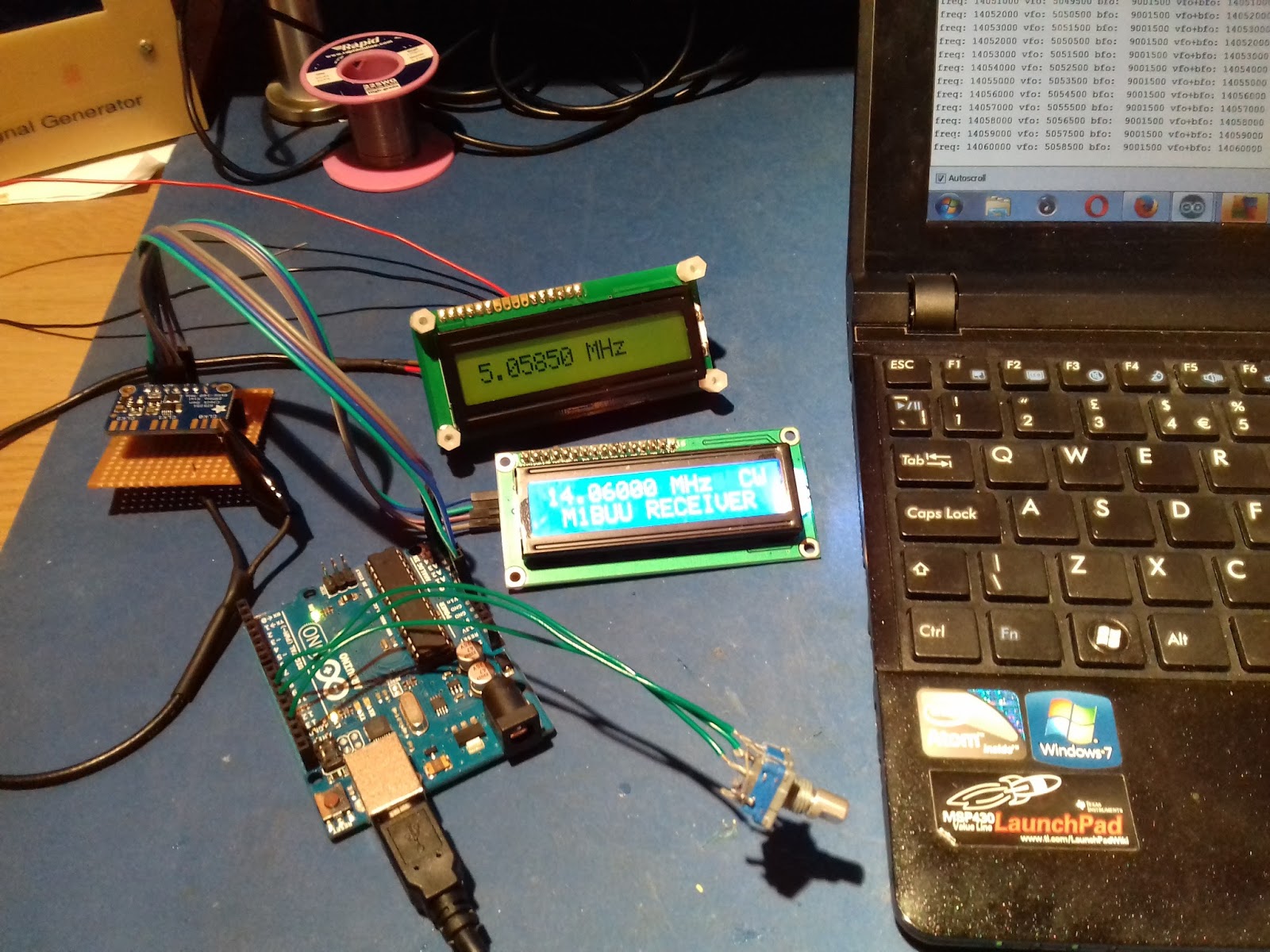
Colin M1BUU’s New Receiver Project
Beautifully Ugly! A Homebrew Receiver from the Netherlands (video)
This one is similar to the receiver I’ve been working on: middle of the HF band, discrete components, all analog, 455 kc IF, wooden chassis, eclectic circuit boards. Very cool.
The builder is Ko Tilman. His YouTube channel is here:
https://www.youtube.com/channel/UCqe1Y4StR9cZ8BQDWuoMq9w
I came across Ko’s channel when I was looking for a circuit for an AM detector. I have been experimenting with the standard one diode and two diode (Germanium) circuits, but the receiver doesn’t sound very good when using these circuits. Any recommendations for something a bit better (without getting carried away with complexity)?
About Ko Tilman:
JH8SST/7’s Build of Pete’s Simpleceiver
Beautiful.
Makes me want to put S-meters in my rigs.
More on Pete’s design here:
http://n6qw.blogspot.com/2015/09/simpleceiver-40m-ssbcw-receiver-and.html
GW4ZUA’s “Let’s Build Something” Receiver
The LBS project of Pete and Ben continues to inspire homebrewers all around the world. Check out the video of GW4ZUA’s version. Peter GW4ZUA writes:
Hi Pete,
Thank you for your kind words,
I suppose it started with a knob and a pointer to know (guess) where you were on the band, probably most radio builders did the same, and some still do, but as long as it worked you were very satisfied, what a marvelous feeling when you switch on and those electronic components do their job and deliver the goods……amazing.
So time moves on you get better at building and technology gives you a hand, LCD displays, homebrew frequency counters,cheap components, wow now you Know where you are on the band.
Then I saw your rig with a colour display and DDS “I gotta get me one of these.”
I watched most of your videos, Your “easy going, down to earth manner” made it look easy to do.
I love the internet, without it I’d probably still be using knobs and pointers, there are is a wealth of knowledge available to those lucky enough to have access. I also love email, as you can now contact people who are willing to share their projects and give advice.
So the LBS well it certainly works, so few parts but they are all eager to please, with the display (did I mention the display) it is a project you can be proud of.
A big thank you to you and Ben for the project,
I don’t know if it will ever go in a box as I just love to look at it and I’m amazed at what comes out of the speaker.
Regards to you all……….
73’s for now. ………..Peter (GW4ZUA)
————————
As is well known, I’m more of a knob and pointer guy myself, but I understand the attractions and advantages of the glowing numerals. And I definitely sympathize with Peter’s comment about the beauty of an in-boxed rig.
Video of Armand HROish Receiver
SolderSmoke Podcast #190: Pilgrims, Junkbox rigs, BANDSWEEP, Matching xformers, On the Air with HB, MAILBAG
SolderSmoke Podcast #190 is available:
http://soldersmoke.com/soldersmoke190.mp3
Pilgrims’ Progress: Inspiring words from G3RJV
BENCH REPORTS on JUNKBOX RIGS:
Pete describes his beautiful 40 meter blue transceiver (video above)
Bill describes his “Armand HROish” receiver
BANDSWEEP!
Bill needs small (yellow slug) 455 kc transformers.
We need a good user-friendly 40673 SPICE model.
SEND US YOUR BENCH REPORTS!
The BD139 transistor
Ferrite Core Matching Transformers
QSO Reports: Getting on the air with HB rigs
Bill’s new FeelTech Signal Generator
MAILBAG
First Signals from the “Armand HROish” Receiver
Building a VFO. A BIG VFO. IF options?
KC9KEP’s Superhet Receiver with HOMEBREW 455 kc IF Transformers