W7RLF Homebrews a Receiver — FB!


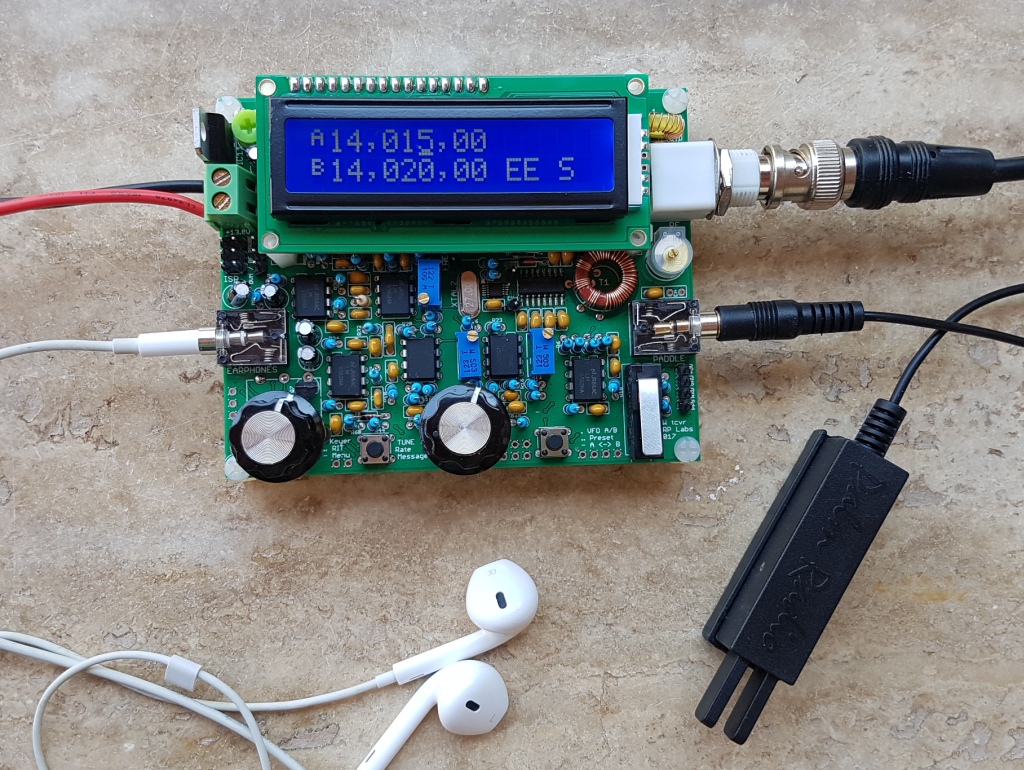
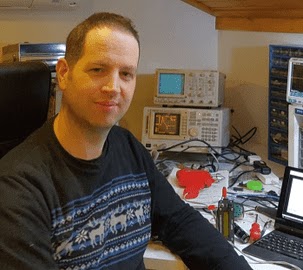
Ryan W7RLF has joined the small and elite group of radio amateurs who have homebrewed a receiver. And it is a receiver filled with soul, juju and mojo; the project was inspired by Wes Hayward and Farhan, and used components from Hans Summers. Congratulations Ryan and thanks for all the work you did in documenting your experience.

Who will be the next intrepid ham to join the homebrew receiver club?

Hello Sirs!


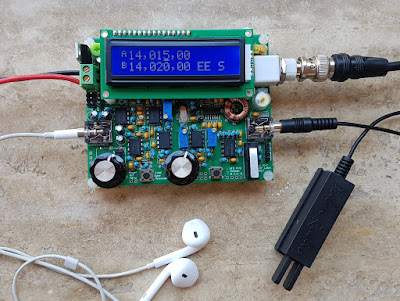
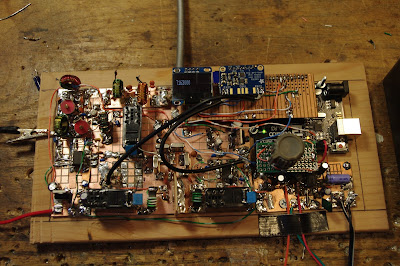
This month I read Wes Hayward’s post on the history and heritage of DC receivers in ham radio and it brought a lingering interest to a head. I had to build one. I run the BITX40 and uBITX group on Facebook, and I posted to the other hams there: Which DC receiver should I build? Farhan recommended his DC40. Mind you, I’ve never homebrewed a radio before, so this is all new territory for me.

I did build it, and it does work. It also uses QRP Labs stuff from our friend Hans Summers. This thing has a lot of QRP heritage 🙂 I documented it every step of the way including all of my dumb moves and things I got wrong, and my desire is to inspire others to try homebrewing the way Wes, Farhan, Hans, and you YOU GUYS have inspired me to try it. I am hooked, of course! Here’s a link to my blog to Part 1:


It’s a four part series (unofficially 5 really) with 8000 words to it, and I hope you guys enjoy it and I’d be ticked pink if was worthy of mention on your show. Here’s a video of it too:


73 to you both and I wish you the best!

Ryan Flowers W7RLF

QSX! Hans Summer’s New SSB Rig Revealed in South Africa

I liked this video. I liked Hans’ description of his mechanical skills, and the way he has at times become a “human CNC machine.”

This seems like a much more sophisticated rig than the QCX. I may be wrong, but QCX seemed to be essentially an analog phasing rig with a narrow CW audio filter. I kind of expected the SSB version to be a QCX with broader filter, but QSX is a different, more sophisticated, SDR rig.

Once again, three cheers for Hans Summers. We should all pay him to go to those summer conventions — every time he does, something new and important for ham radio comes out of the trip.


Hans Summers and his QCX — G0UPL Cracks the Code on Si5351A Quadrature


Pete, Brad WA8WDQ and I were recently e-mailing about our admiration for what Hans G0UPL has achieved with his QCX rig. I cc’d Hans — we got this nice and very informative e-mail. Be sure to click on the link provided by Hans, and from there go to the link to his FDIM proceedings article. I think that article is a real masterpiece — there is a lot of very valuable information in there. For a long time, getting quadrature output from the Si5351 seemed like an impossible dream. But Hans has obviously figured out how to do this, opening the door to much better and simpler single-signal phasing receivers. Thanks Hans!


Hi all


Thanks for the nice feedback on the QCX and the FDIM conference proceedings a article, which I have published on QRP Labs web page along with other Dayton trip miscellany. See


My seminar presentation audio was recorded by Ham Radio Workbench podcast and they will be publishing it on 5th June.

The QCX kit has indeed been unbelievably popular, almost 5,000 kits have been sold since the launch on 21st August. It seems to have itched an itch that needed itching, in the QRP world. Sales continue to be strong and I’m currently preparing another batch of 1000 more.

I’m very proud of my 90-degree quadrature Si5351A and it helped me towards my low cost, high performance target for QCX. Abandoning the 74AC74 saves a part, reduces cost, reduces complexity, reduces board area (and hence more cost) and even seems to provide better performance (higher unwanted sideband rejection when using the Si5351A in quadrature mode). Getting the Si5351A to do this is one of those things which look easy afterwards. But at the time, and faced with SiLabs un-useful documentation, it took an awful lot of headscratching, trial and error!

I’m not sure of the answer to the question about noise figure. Certainly radios such as QCX and the NC2030 which use the QSD architecture seem to have very high sensitivity without an RF amplifier ahead of them. This must indicate a low noise figure.


73 Hans G0UPL

INTERVIEW: Four Days in May 2018 — G0UPL Hans Summers talks to Bob Crane


Once again, our correspondent Bob Crane W8SX has gone to the Four Days in May event and has sent back some really great inteviews with those who made presentations there.

First on the list was Hans Summers G0UPL. Hans is a justifiably famous Homebrew Hero, and a member of the QRP Hall of Fame. The latest of his many contributions to the hobby is his amazing QCX transceiver. Like the BITX rigs, the QCX refutes the idea that hams need to spend kilobucks to get on the air with a decent rig. Priced at around $50, the QCX offers excellent performance. And it comes with built in test gear: the signal generator you need to align the rig COMES IN THE RIG! FB Hans.

I think it was Pete who noted that the price range for rigs like the QCX, the BITX, and the uBITX is in the $50 to $110 dollar range, meaning that “One hundred bucks is the new three thousand bucks.” We owe a lot gratitude to Hans and Farhan for this very positive paradigm shift.

Listen here for Bob Crane’s 2018 FDIM interview with Hans:

http://soldersmoke.com/G0UPL-18.mp3

We all also owe a debt of gratitude to the QRP ARCI folks who did all the hard work that goes into organizing Four Days in May. Special thanks to QRP ARCI Preston Douglas WJ2V, and to FDIM Chair Norm Schklar WA4ZXV. FDIM is one of the most important events on the Homebrew/QRP calendar.

More info on the QCX (and order yours) here: https://qrp-labs.com/qcx.html

SolderSmoke Podcast #200! 17, Knack Nobel, QCX, 630, UHF, Fessenden, TROUBLESHOOTING

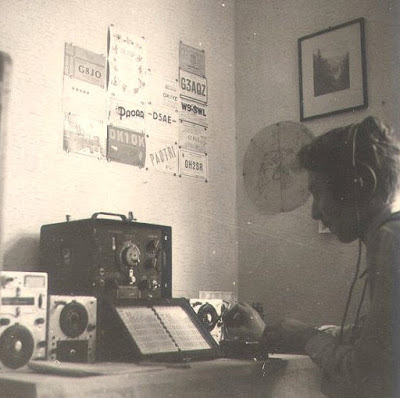
DL3AO 1950

SolderSmoke Podcast #200 — TWO HUNDRED!!!!– Is available

http://soldersmoke.com/soldersmoke200.mp3

— Old friends on 17 meters.

— Another Knack Nobel in Physics.

— Hans Summers’ QCX transceiver: $50 IS THE NEW 10 GRAND!

— New Bands! 630 and 2200 Meters. BIG ANTENNAS!

— Nuke Powered QRP. No joke!

— The Challenge of UHF. Not for the faint of heart.

— Reginald Fessenden, Father of Phone.

PETE’S BENCH REPORT: The New Simple-ceiver. Soon to be a Transceiver.

BILL’s BENCH REPORT: Discrete, Direct Conversion, Ceramic Receiver in iPhone Box.

THE EDUCATIONAL PORTION OF TODAY’s PROGRAM:
HOW TO TROUBLESHOOT A HOMEBREW RECEIVER.

MAILBAG.

DL3AO 1950


SolderSmoke Podcast #200! 17, Knack Nobel, QCX, 630, UHF, Fessenden, TROUBLESHOOTING

DL3AO 1950

SolderSmoke Podcast #200 — TWO HUNDRED!!!!– Is available

http://soldersmoke.com/soldersmoke200.mp3

— Old friends on 17 meters.

— Another Knack Nobel in Physics.

— Hans Summers’ QCX transceiver: $50 IS THE NEW 10 GRAND!

— New Bands! 630 and 2200 Meters. BIG ANTENNAS!

— Nuke Powered QRP. No joke!

— The Challenge of UHF. Not for the faint of heart.

— Reginald Fessenden, Father of Phone.

PETE’S BENCH REPORT: The New Simple-ceiver. Soon to be a Transceiver.

BILL’s BENCH REPORT: Discrete, Direct Conversion, Ceramic Receiver in iPhone Box.

THE EDUCATIONAL PORTION OF TODAY’s PROGRAM:
HOW TO TROUBLESHOOT A HOMEBREW RECEIVER.

MAILBAG.

DL3AO 1950


Amazing $49 Rig from QRP Labs

Hans Summers’ QRP Labs has an amazing new rig — The QCX — that is chock-full of features and FB technology. Hans has long been one of the most innovative guys in ham radio, and this latest rig is one of his most amazing creations. Like Farhan’s BITX40 Module, this new rig is priced in the 50 dollar range. Hams who are paying many thousands of dollars for their “radios” should be asking themselves a question: Could I be having much more fun for far less money? This rig is in big demand and there is already a waiting list, so place your order now if you want to work on this during the winter. Here is the link:
http://qrp-labs.com/qcx.html

QCX Features:

  • Easy to build, single-board design, 10 x 8cm, all controls are board-mounted
  • Professional quality double-sided, through-hole plated, silk-screen printed PCB
  • Choice of single band, 80, 60, 40, 30, 20 or 17m
  • Approximately 3-5W CW output (depending on supply voltage)
  • 7-16V recommended supply voltage
  • Class E power amplifier, transistors run cool… even with no heatsinks
  • 7-element Low Pass Filter ensures regulatory compliance
  • CW envelope shaping to remove key clicks
  • High performance receiver with at least 50dB of unwanted sideband cancellation
  • 200Hz CW filter with no ringing
  • Si5351A Synthesized VFO with rotary encoder tuning
  • 16 x 2 blue backlight LCD screen
  • Iambic keyer or straight key option included in the firmware
  • Simple Digital Signal Processing assisted CW decoder, displayed real-time on-screen
  • On-screen S-meter
  • Full or semi QSK operation using fast solid-state transmit/receive switching
  • Frequency presets, VFO A/B Split operation, RIT, configurable CW Offset
  • Configurable sidetone frequency and volume
  • Connectors: Power, 3.5mm keyer jack, 3.5mm stereo earphone jack, BNC RF output
  • Onboard microswitch can be used as a simple straight Morse key
  • Built-in test signal generator and alignment tools to complete simple set-up adjustments
  • Built-in test equipment: voltmeter, RF power meter, frequency counter, signal generator
  • Beacon mode, supporting automatic CW or WSPR operation
  • GPS interface for reference frequency calibration and time-keeping (for WSPR beacon)

FDIM: Listen to Bob Crane Interview Hans Summers, G0UPL

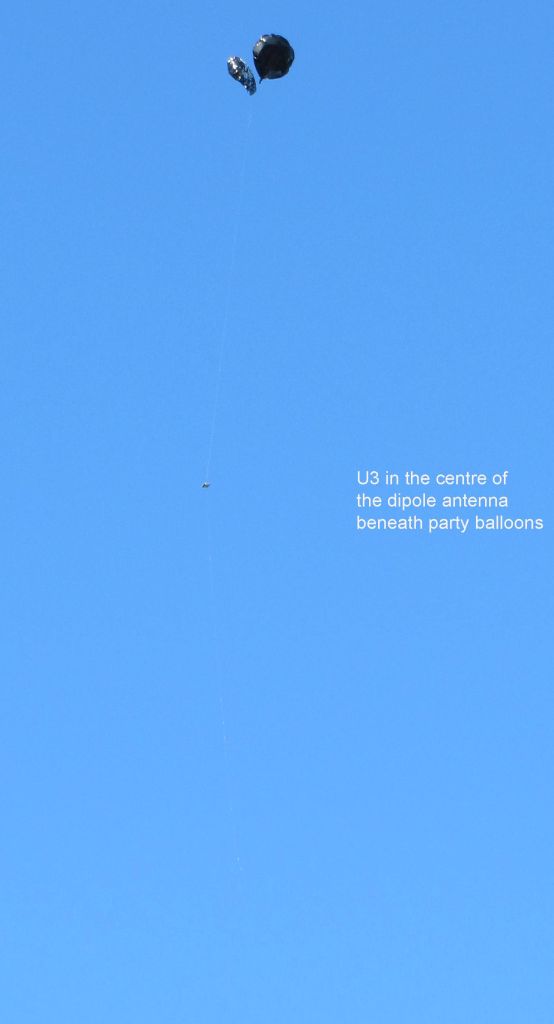
Bob Crane, our intrepid correspondent at the 2017 Four Day in May event, caught up with Homebrew Hero Hans Summers G0UPL. Hans’s amazing web sites have been the inspiration for many projects in my shacks. My favorite so far was his QRSS transmitter using an LED based multivibrator circuit to generate a shark fin pattern on grabber screens. That was fun. I am now really tempted to send one of Hans’s WSPR transmitters into the stratosphere using party balloons.

Listen to the interview here:

http://soldersmoke.com/FDIM17G0UPL.mp3

Visit Hans’s QRP-Labs here:

https://www.qrp-labs.com/

Thanks Bob! Thanks Hans!

Video: Farhan in the SolderSmoke Shack! BITX, JBOTS, McDonald Straw Sig Gen, uBITX, Sweperino and more!

Thanks again to Farhan for visiting us. It was great to see his reaction to my humble implementations of his great designs. I got him to sign my BITX17. This was really a fantastic day for me and for my family.

SolderSmoke Podcast #193: BITX 40, OLEDs, KWM-4, Noise Abatement

SolderSmoke 193 28 Jan 2017


Report from Pete on BITX 40 Session with California radio club.

Update on the BITX40 Module Revolution
— Check out the BITXHACKS page. Send in contributions.
— BITX20 mailing list very active.
— Raduino!
— Interview with Farhan with W5KUB — Eliminating the commercial gear.
— BITX 40s on the beach in Australia. FB

Bench Reports:

Pete:
— Color Displays!
— KWM-4
— OLED MADNESS!

Bill:
— Fixing up the old HT-37 HT37 to HT37 QSO with W1ZB
— Dabbling in VHF with Ramsey Aircraft band receiver. NOT FUN.
— Going all IC with Si5351 OLED NE602 rig.
— BANDSWEEP
— OLED Noise and the Active Decoupling solution.

Using LTSPICE as a diagnostic or understanding tool.

Of Waterfalls, Homebrew Rigs and Casual Critics on 40 meters. Words of Wisdom from W8JI.

LEXICON: HAYWIRE TOMBSTONE BIKESHEDDING from Todd K7TFC

Some great recent interviews by Eric 4Z1UG:
Ian G3ROO Origins of ROO Regen at age 8
Hans Summers G0UPL Balloons! NO COMMECIAL GEAR
David White WN5Y ELECTROLUMINESCENT RECEIVER EXPLAINED
Rob Sherwood NC0B

MAILBAG:

Chris KD4PBJ’s BITX 40 with improved stability
Jerry W0PWE built a DIGITIA! Very nice. Worked Keith N6ORS and heard me! TRGHS
Mike AB1YK’s Al Fresco Scratch built BITX. But give that LC VFO another chance Mike!
Steve N8NM 30 meter rig with salvaged CB LC VFO. FB
Keith N6ORS Franken SDR rig with parts from the 1980s. FB
SKN Bandscan from Mike WA6ARA I worked W1PID Jim!
What is Mikele up to?
Rocking Johannesburg and Kirghizstan via local repeaters:


Christmas Present! 4Z1UG’s Interview with Han Summers G0UPL

I found myself almost cheering out loud as I listened to this wonderful interview, especially at the point where Hans lets it be known that he has NO COMMERCIAL HAM GEAR in his shack! Yes! That’s the ticket! You can also hear the story of Hans and Farhan meeting up in Mumbai for dinner. The interview includes discussion of WSPR and QRSS and BITX and crystal ovens and, at the end, a special QSO TODAY overtime session in which Hans describes the little WSPR rigs that fly around the world, carried aloft by half-filled birthday party balloons.

Thanks to Eric 4Z1UG and Hans G0UPL for this very nice Christmas present.

Listen here:

http://www.qsotoday.com/podcasts/g0upl

WSPR Party Balloons Make it Across the Pond

Hans Summers
April 15 at 11:25am
VE3KCL/QRP Labs S-9 balloon finally reached Europe! What a crazy way to cross the Atlantic. Crossed Portugal, now into Spain. France is next! 16mW 30m WSPR signal was reported in ZL and VK (19,000km DX). Who says you need 5W on HF WSPR? 73 Hans G0UPL http://qrp-labs.com

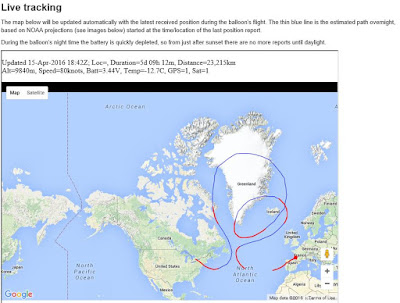
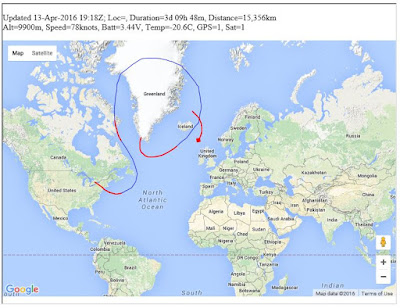
VE3KCL Balloon makes “several loops around Greenland”

Oh, I really want to do this. We had a bunch of balloons for my daughter’s birthday and I found myself trying to guestimate how much they could lift. There is a balloon store that sells the metalized party balloons used here. They have a helium tank. I hate to be a party pooper (!) but wouldn’t the antenna represent a bit of a hazard? If it came down in power lines, that wouldn’t be good right?
In any case, three cheers for Dave VE3KCL and for Hans, G0UPL, the wizard who makes the QRSS/WSPR transmitter that is currently flying over Iceland.

Hi all


Some of you must have seen this already – but the rest of you may find it interesting. Dave VE3KCL launched his S-9 balloon 4 days ago (2 standard party-balloons, hydrogen-filled) with modified QRP Labs Ultimate3S QRSS/WSPR transmitter onboard.

We are using WSPR messages for tracking – one normal WSPR message and one with a special data protocol to provide altitude, speed, Maidenhead 5/6th characters, battery voltage, temperature and GPS/satellite status. The transmitter has about 16mW power output, on 30m band. It is sending CW and JT9 as well. Altitude is a little over 10,000m. So far it has traveled in several loops around Greenland and the North Atlantic. Currently it is near the Faroe islands. See live tracking at QRP Labs website http://qrp-labs.com/ultimate3/ve3kcl-balloons/ve3kcl-s9.html

G-landers, don’t get too excited that it appears to be heading your way – the wind prediction shows it likely to head back West almost as far as Newfoundland, before turning back East towards Spain!

73 Hans G0UPL

DD4WH’s Fantastic Teensy SDR Receiver (Videos)

This is almost enough to make me abandon my analog, discrete component, HDR fundamentalism. Check out that display. And that StereoAM mode in which the upper and lower sidebands go to the left and right headphones “useful for CW”… Wow, that’s seems like a step beyond binaural.

Don’t miss Parts 2-4 –They are all on YouTube and will appear in the right hand column when you are watching Frank’s videos. But I couldn’t resist embedding the video that shows the hardware. Note: the oscillator is an Si5351! Yea! And the LP filter board comes from Hans Summers.

Beautiful work Franz! Thanks for making the videos. 73 Bill

Colchester Mighty Mite

GM Bill,

So, I got round to making my Michigan Mighty Mite!

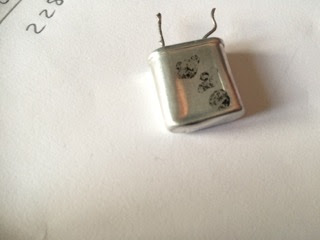
The crystal arrived almost safe and sound, thanks to the USPS’ mail crusher. Perhaps they think that because email and packets can be compressed they can do the same with parcels? (the photo really doesn’t do it justice – the orange area is a large dent…):


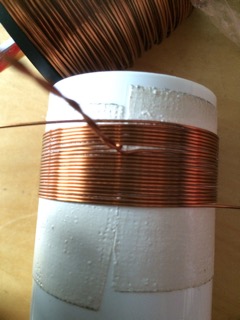
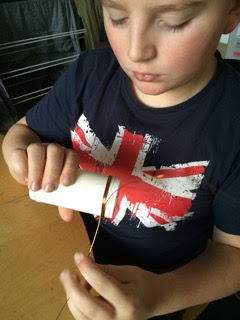
No 2 son, Cameron (12), got involved – The extremely neat tank coil is his handywork :


And so to the video: Not only does it oscillate on the correct frequency as shown here, it also has the added bonuses of oscillating around 21.5Mhz (which is the number my frequency counter gives – which caused a great deal of head-scratching on first smoke), and muting the FM broadcast receiver on 96.1MHz on the shelf 3 feet away!. The dummy load is the 3w metal film resistor suspended in mid air.


You might notice more resistors in the circuit itself than the diagram calls for. I chose to have 2 x 20K resistors in parallel to produce a single 10K resistance that could handle .6W. And the poor old 27R .3W resistor got really hot and discoloured before rapidly increasing its resistance ( !! ), so I used 4 (2 serial pairs in parallel) to handle the current. They still get hot, but survive. And the 2N2222a has a bulldog clip heatsink.

Please excuse the uncorrected error at the end of the CQ call!!

This is the second transmitter I have ever built – the other one is a 30m Hans Summers QRSS kit which you also get the ‘blame’ for 🙂

Thank-you, Bill. Keep up the good work.

73’s de G7TAT, Colchester, England.


Two Party Balloons, an Arduino and an Si5351 FLY! ALOFT! UP IN THE AIR!

http://www.qrp-labs.com/ultimate3/balloon.html

Farhan alerted me to this. This is clearly the coolest use so far of the Dynamic Duo (Arduino+Si5351).

It took me a moment to get my head around this. It is so fantastic. Let me break it down for you:

You take two party balloons. You build a little payload consisting of an Arduino Nano, an Si5351 board, a GPS module and a battery. You load the Nano with firmware that will take the GPS info and transmit it via WSPR and JT9. Then you release the whole thing and sit back to receive the telemetry packets that tell you where the thing is. Very cool. Very cool indeed.

THE Si5351 SERVES AS THE WHOLE TRANSMITTER. It connects to the antenna. (Steve Smith will, I’m sure, insists on a low pass filter, even here!)

Here is a similar project:

http://picospace.net/

And be sure to stop by the QRP Labs online store. Lots of good stuff there:

https://shop.qrp-labs.com/

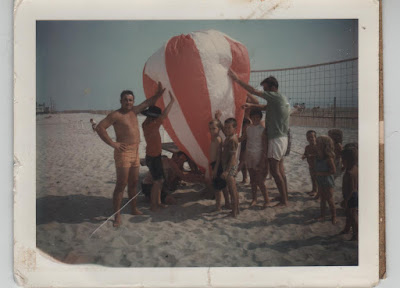
I’ve been interested in balloons for a long time. A few years ago Billy, Maria and I released a party balloon over Northern Virginia with a note requesting that the finder send us an e-mail (It landed about 10 miles away, across the Potomac river, in Washington D.C.). Here is a picture of a paper-mache hot-air balloon that we built and flew near Lavallette, New Jersey (Ocean Beach Unit III) sometime around 1969. Many of the kids in the picture are my cousins:

Our book: “SolderSmoke — Global Adventures in Wireless Electronics” http://soldersmoke.com/book.htm Our coffee mugs, T-Shirts, bumper stickers: http://www.cafepress.com/SolderSmoke Our Book Store: http://astore.amazon.com/contracross-20

Hans Summer’s Homebrew ‘Scope

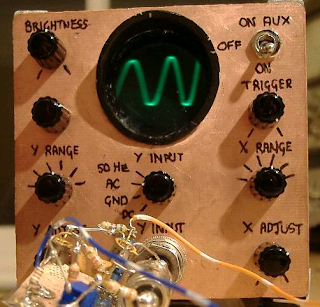
The picture right away gives you a sense of the depth of this project, and of the guy who completed it. One of my biggest mistakes in the UK was missing the opportunity to meet Han Summers, G0UPL. Check out Han’s Homebrew ‘scope project, and be sure to look around his site for other, similar adventures:


http://www.hanssummers.com/tinyscope.html

Our book: “SolderSmoke — Global Adventures in Wireless Electronics” http://soldersmoke.com/book.htm Our coffee mugs, T-Shirts, bumper stickers: http://www.cafepress.com/SolderSmoke Our Book Store: http://astore.amazon.com/contracross-20

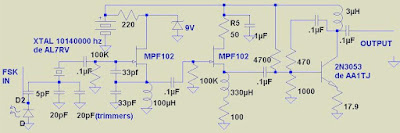
Schematic for QRSS Transmitter

Here is the schematic for the little QRSS (visual) transmitter that is currently rockin’ Europe’s 30 meter band with an AWESOME 20 milliwatts of SLOOOW FSK. (As I type, it is 0415 UTC, 0615 local, and the first signs of my signal have just appeared on the ON5EX grabber up in Belgium.) The FSK modulation comes from Hans Summers’ multivibrator circuit (see earlier posts).

It was a lot of fun to take this thing very quickly from LTSpice, to the workbench, then to the antenna, with Johan’s grabber providing instant feedback. This started out as a one-stage Colpitts oscillator transmitter. But I needed more stability. Indeed, the separate oscillator with the source-follower buffer makes it much more stable. Before, any adjustment to the antenna tuner shifted the frequency. At one point I even suspected that wind blowing the antenna was shifting the frequency — we are talking about a band that is 100 HERTZ wide, so even a few hz of instability is noticeable. But I find that crystal ovens and other extraordinary measures are not really necessary.

I had one unusual problem with this little rig: As I was doing my initial tests, I noticed that the output signal was sort of jumping up and down. The problem was in the PA. I isolated the problem to the base circuit. At first I thought that some small blob of solder was intermittently messing up the bias voltage (that’s quite possible here in the N2CQR lab!). But no! It was that 4700 ohm resistor. It was bad, and kind of intermittently bad! I never had a resistor go south on me like this. It is an ordinary 1/4 resistor. It is not dissipating a lot of power.

I’ll keep it around 10140010 today. Check it out on Johan’s grabber:
http://www.on5ex.be/grabber/grabber.html
Look for a horizontal lines with little bumps (about 4-5 per minute). That’s me.