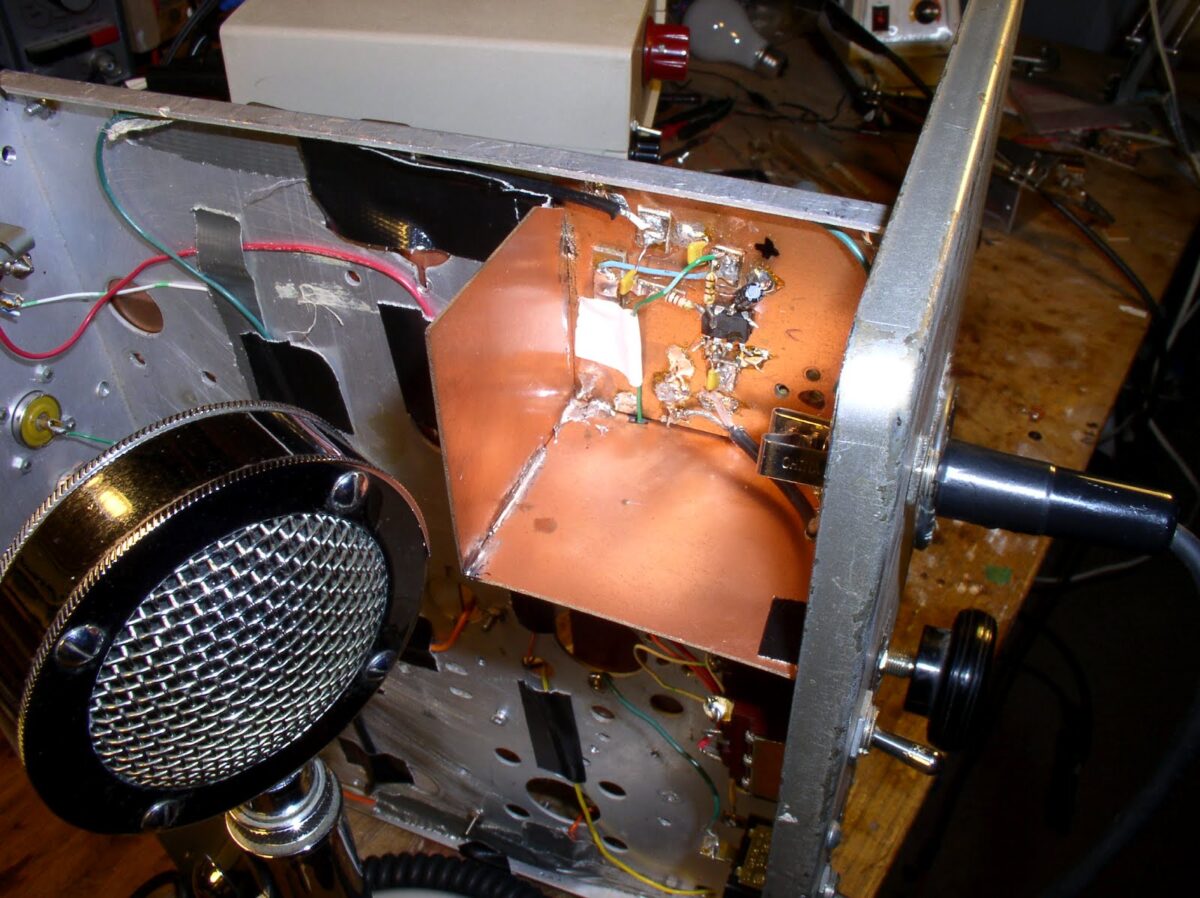
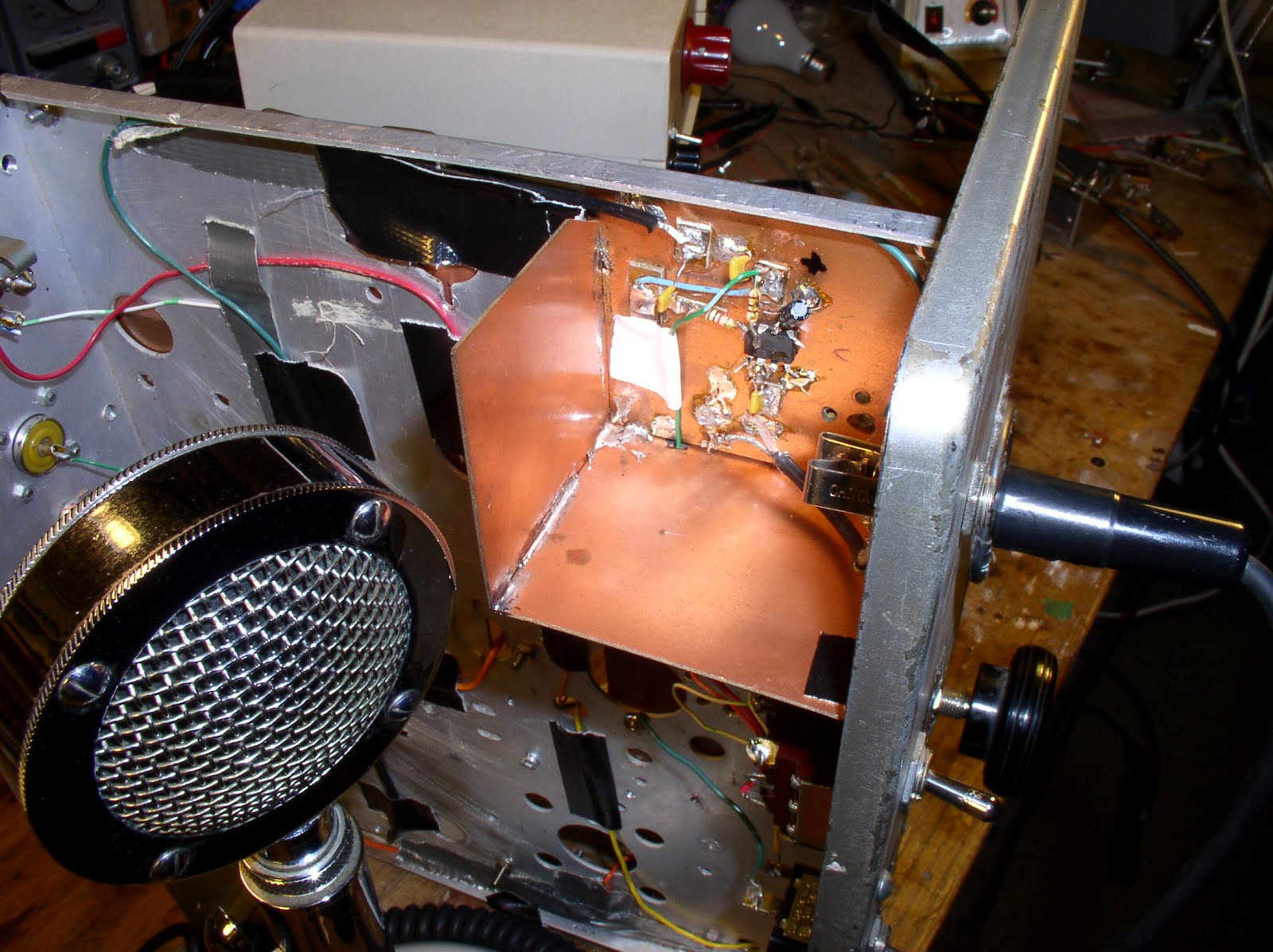
 As I was aligning my “23/24 Re-cycle” 17 meter SSB rig, I noticed the tell-tale sounds of RF getting into my audio. (I guess I should be pleased — my amplifiers are now producing enough RF to cause some trouble!) So this morning I went in and battened down the hatches in the AF part of the rig. Lead lengths were reduced. Unshielded cables were replaced with RG-174 (with due attention to “Murphy’s Whiskers”). A ferrite bead was placed on the wire that carries voltage to the op-amp chip. I wrapped some foil (actually some of that conductive tape used to protect windows in alarm systems) around the plug on the D-104). And finally I cut out two pieces of PC board and made a shield for the whole AF section (see above). I think all this has had the desired effect. The audio sounds clean. I have the day off today, so if there are no Coronal Mass Ejections I hope to make some contacts on 17. Stay tuned!
Our book: “SolderSmoke — Global Adventures in Wireless Electronics”http://soldersmoke.com/book.htmOur coffee mugs, T-Shirts, bumper stickers: http://www.cafepress.com/SolderSmokeOur Book Store: http://astore.amazon.com/contracross-20
Category: SSB
Putting 17 Meter SSB Station On the Air
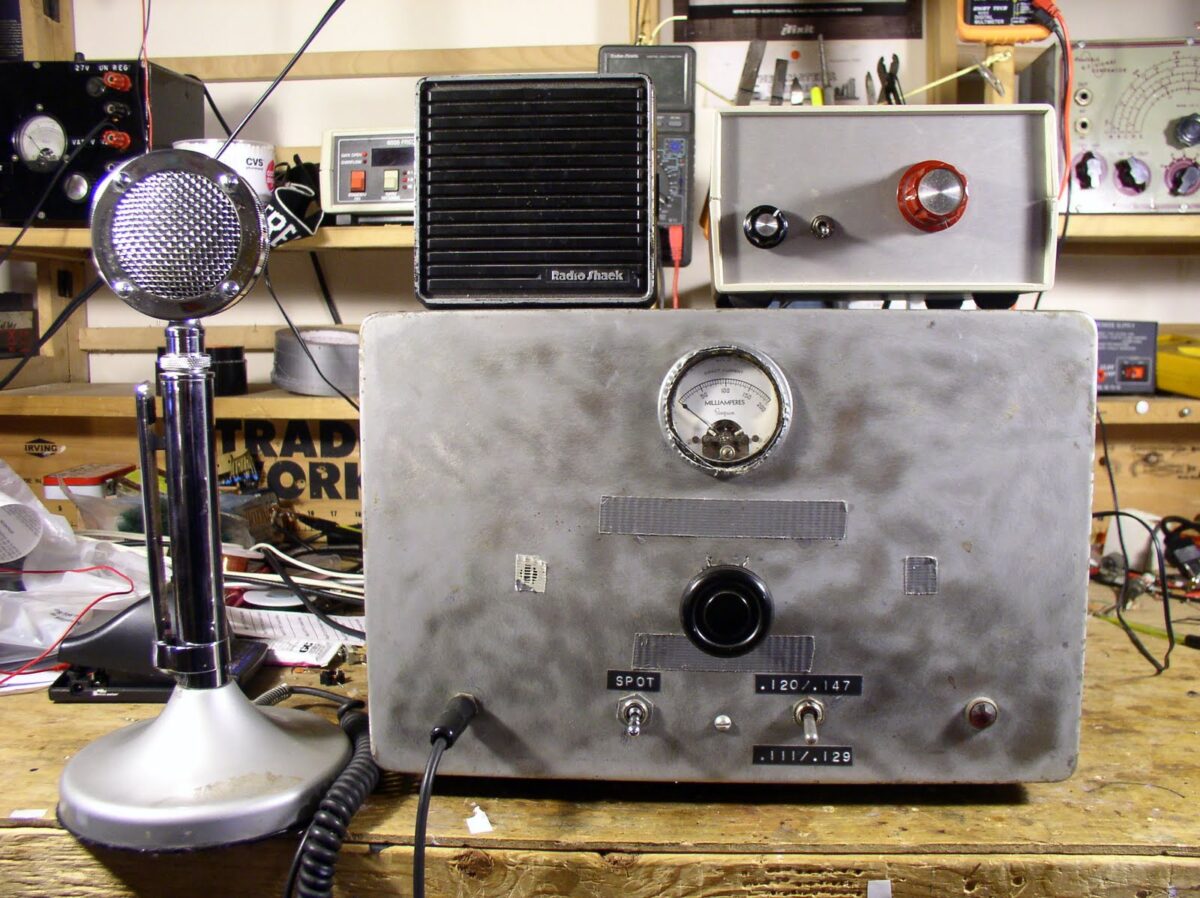
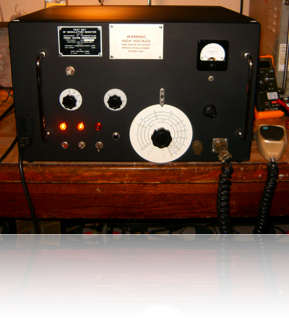
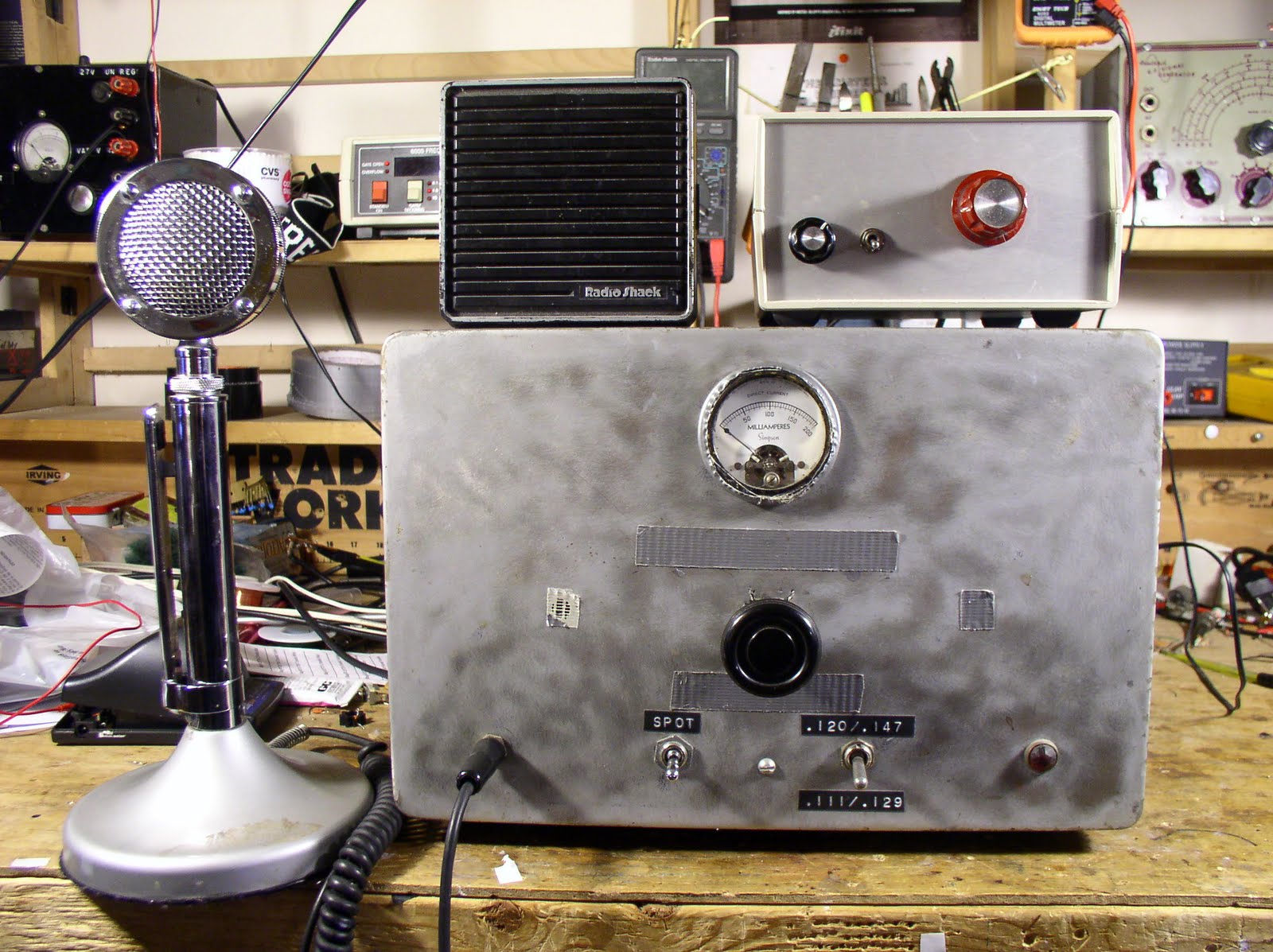 Magnificent, don’t you think? The sun is rising over Northern Virginia, and 17 meters is starting to come alive. Yesterday I finished the tweaking and peaking of the JBOT amplifier for the transmitter. It is nice and stable now. (And yes, Steve, it has a low-pass filter!) On top of the transmitter cabinet is the receiver. It is a Barebones Superhet designed by Doug DeMaw and built on a FAR circuit board by Dale Parfitt, W4OP. I changed it to 17 meters and broadened the filter response for use on SSB. Both the transmitter and the receiver use variable crystal oscillators, with two crystals in each (switch-able from the front panels). The frequency coverage of of the transmitter and the receiver match up fairly well (good thing!). Wish me luck! Today I will venture forth amidst the coronal mass ejections and try to make a few SSB contacts on good-ol’ 17.
Our book: “SolderSmoke — Global Adventures in Wireless Electronics”http://soldersmoke.com/book.htmOur coffee mugs, T-Shirts, bumper stickers: http://www.cafepress.com/SolderSmokeOur Book Store: http://astore.amazon.com/contracross-20
JBOT Installed in Azores 17 Meter SSB Rig
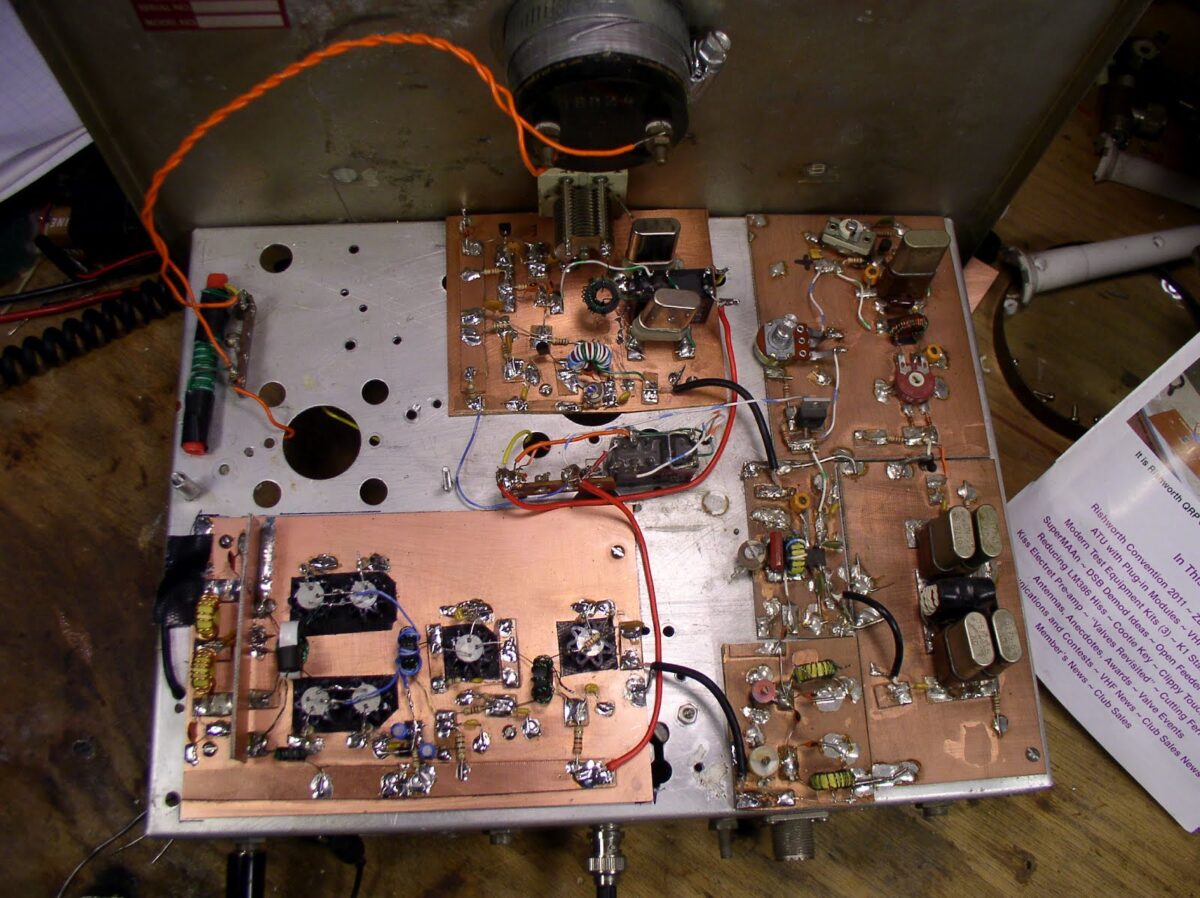
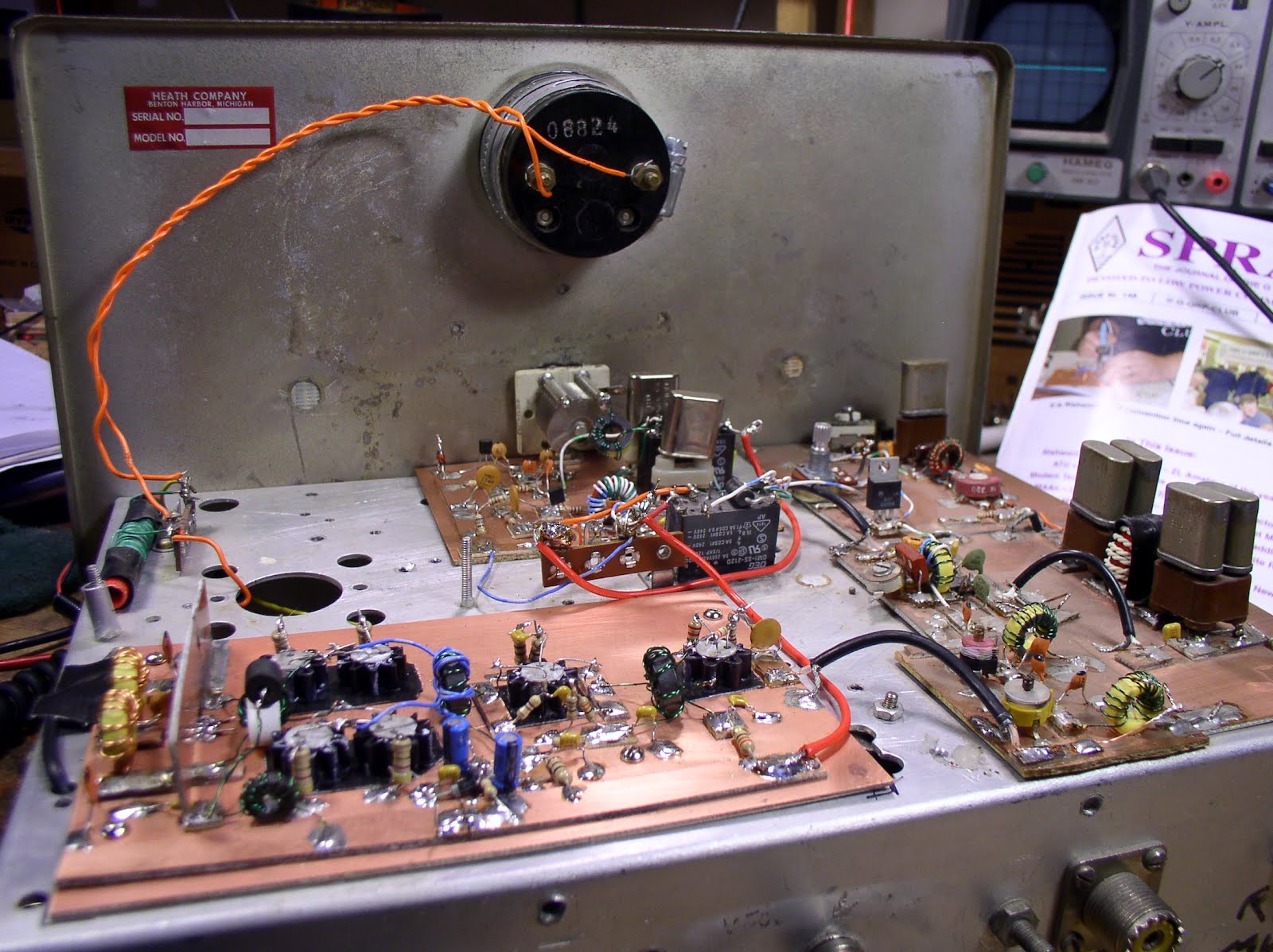 Even though one of their Coronal Mass Ejections is due to hit us soon, the radio gods have been quite kind to me this morning. I installed the JBOT amplifier board in the 17 meter SSB transmitter that I had built out in the Azores during the last solar cycle. The board went in without any trouble. And I was a very surprised when it DIDN’T break into oscillation and instability! Holy Cow! This one was stable from the start! Even when connected to my antenna! Eureka!
The rig still needs some peaking and tweaking. I’m only getting about 2-3 watts out and I should be getting 4-5. I did a quick and dirty “by ear” alignment — I just listened to my own signal with my trusty Drake 2-B and moved the carrier oscillator freq around a bit until the SSB audio sounded good (you never have to do that with DSB!).
For those of you not familiar with this rig, here is some background:
— Built on the chassis of an old Heath DX-40
— Crystal filter at 5.174 MHz. Filter rocks and carrier oscillator rocks from an old Swan 240 I picked up in the Dominican Republic from Pericles Perdomo HI8P (SK).
— Based on a design published in SPRAT by Frank Lee, G3YCC (SK).
–Heterodyne oscillator is a G3RJV Universal VXO circuit running at around 23.3 MHz.
— That orange cord to the big meter that you are no doubt wondering about is just a little circuit that monitors total current drawn by the rig. It bounces up and down as I talk. I put it in there mostly because I wanted to make use of a beautiful old Simpson meter that I picked up in 1973 at the Crystal Radio Club (W2DMC) in Valley Cottage, New York.
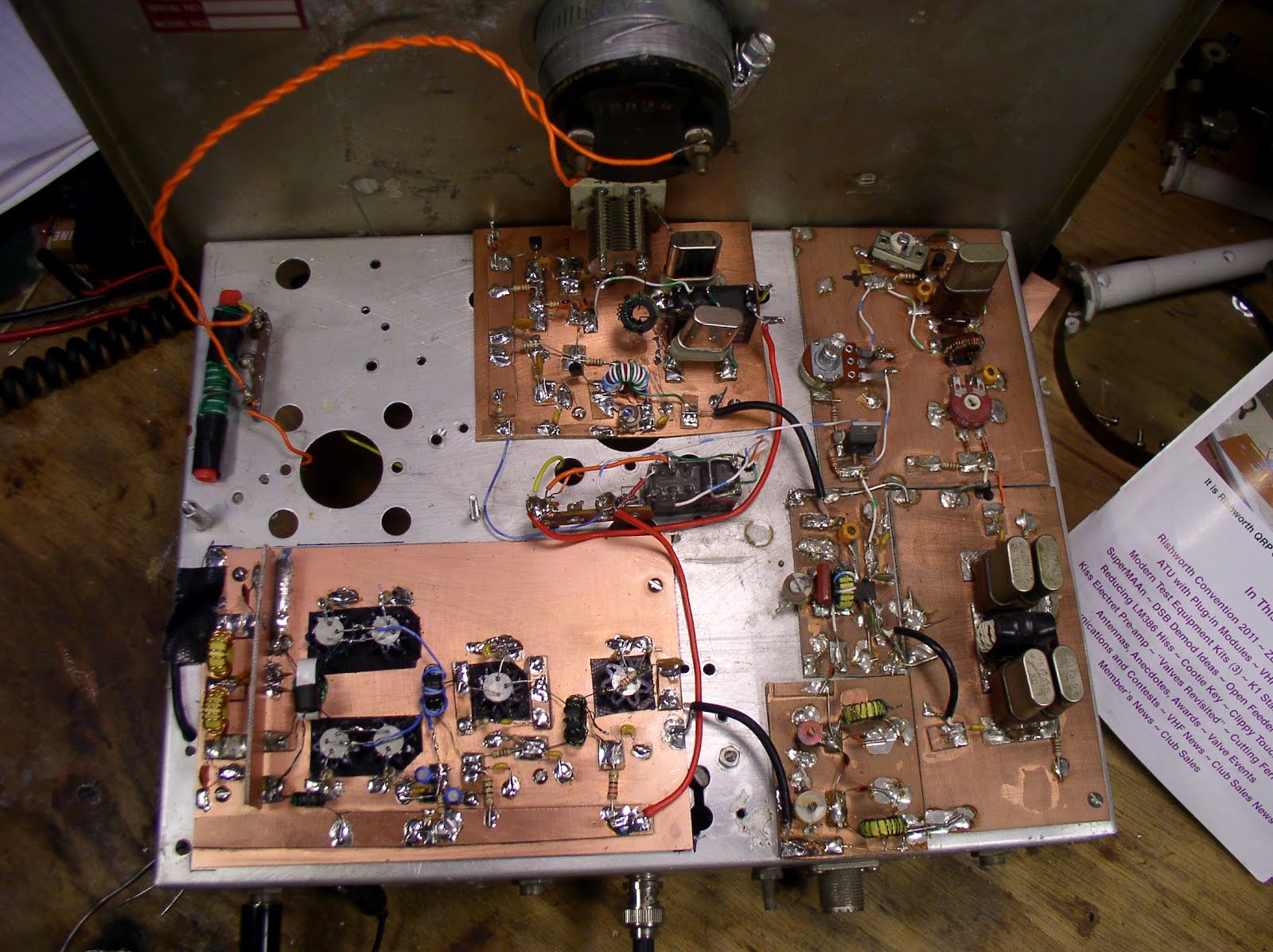 Going around, clockwise from below the meter: G3RJV VXO, carrier oscillator and two diode balanced modulator board, crystal filter (with NE602 mixer and post-filter bandpass filter to the left), JBOT PA. Audio amp (using op amp) below the chassis. T/R relay in the center (antenna changeover relay below the chassis).
Our book: “SolderSmoke — Global Adventures in Wireless Electronics”http://soldersmoke.com/book.htmOur coffee mugs, T-Shirts, bumper stickers: http://www.cafepress.com/SolderSmokeOur Book Store: http://astore.amazon.com/contracross-20
Homebrew SSB Portable from Australia
Peter Parker, VK3YE, is one of the true gurus of QRP phone. When I first started building DSB and later SSB rigs, I frequently found inspiration and ideas in Peter’s articles and web sites. This morning I came across this amazing video, produced just days ago, showing Peter and his new SSB transceiver in operation from a beautiful Australian beach. The rig is a 40 meter version of Farhan’s BITX-20. (I really like the frequency dial.)
Peter describes his rig this way:
It’s made from scratch, ugly style, with 99% being from the original design.
It covers 7 to 7.2 MHz, using a 9.05 MHz IF and a 2 MHz VFO.
I used a different microphone amplifier (I got more and clearer output than
the original with my electret mic) and a BD139 driver transistor.
The PA circuitry is also slightly different.
It’s been about my easiest and most trouble-free transceiver project to
date. Performance is excellent and a tribute to Ashhar. The furthest distance so
far was a 5/6 report from ZL (about 2000 – 3000km away).
The grand finale of the video is a four-way contact with homebrew rigs in use at all four stations. Excellent. Thanks a lot Peter.
Here is Peter’s web site: http://home.alphalink.com.au/~parkerp/
Our book: “SolderSmoke — Global Adventures in Wireless Electronics”http://soldersmoke.com/book.htmOur coffee mugs, T-Shirts, bumper stickers: http://www.cafepress.com/SolderSmokeOur Book Store: http://astore.amazon.com/contracross-20
Don Norgaard, W2KUJ — SSB Pioneer
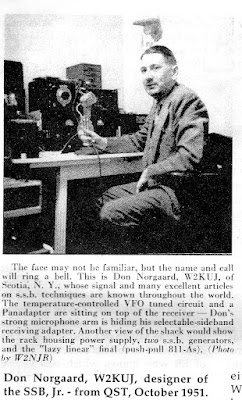 In SolderSmoke — Global Adventures in Wireless Electronics I tell of how I struggled to understand the inner workings of my Hallicraters HT-37 single sideband transmitter. This rig used the phasing method of sideband generation, and as a kid I just couldn’t understand how it really worked. And this really bothered me. As I recount in the book, through a QST article that was reprinted in the ARRL book SSB for the Radio Amateur, Don Norgaard came to my rescue and allowed me to understand the phasing method.
It was only recently that — through reading the August 1998 issue of an Electric Radio Magazine article by Jim Hanlon, W8KGI — that I came to realize that Don was one of the true pioneers of SSB. I think this blog post may be one of the first presentations online of a picture of OM Norgaard. The 1951 QST article notes that “the face may be unfamiliar.”
In addition to writing very clear QST articles, Don was the creator of a rig that “revolutionized amateur use of SSB.” It was a three tube 75 meter SSB transmitter called the “SSB, Jr.” From Jim Hanlon’s article: “It used nothing more complicated than simple coils, condensers, resistors, one carrier frequency oscillator crystal, four germanium diodes and three tubes in the classic phasing circuit to put out 5 watts PEP.”
Three cheers for Don Norgaard! Three cheers for the phasing method!
N8ZRY’s Homebrew SSB Rig
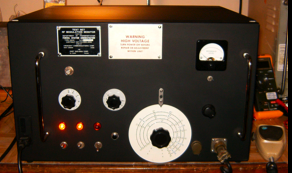 A while back we had post about amateur RADAR. The wizard behind that project was Greg, N8ZRY. (I liked his quote: “Old radars do not die… they simply phase array.”) Greg’s latest project is the 20 meter SSB rig pictured above. It was recently featured on the Make blog.
Check it out here. Be sure to look at the YouTube video. Nice job Greg!