Our book: “SolderSmoke — Global Adventures in Wireless Electronics” http://soldersmoke.com/book.htm Our coffee mugs, T-Shirts, bumper stickers: http://www.cafepress.com/SolderSmoke Our Book Store: http://astore.amazon.com/contracross-20
SolderSmoke Daily News — Ham Radio Blog
Serving the worldwide community of radio-electronic homebrewers. Providing blog support to the SolderSmoke podcast: http://soldersmoke.com
Our book: “SolderSmoke — Global Adventures in Wireless Electronics” http://soldersmoke.com/book.htm Our coffee mugs, T-Shirts, bumper stickers: http://www.cafepress.com/SolderSmoke Our Book Store: http://astore.amazon.com/contracross-20
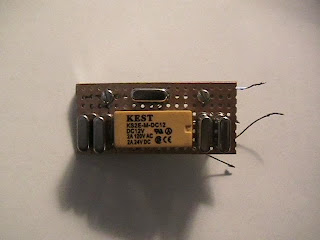
Pete Juliano, N6QW, is an electronic genius. The ideas in his SPRAT article will be of great use to all those who share in Doug DeMaw’s devotion to VXOs and reluctance to spend money. I’m really tempted to go back and re-do my BITX using Pete’s 11.52 MHz computer crystal super-VXO and 4.9152 IF (I could then take my expensive 23.1 MHz crystals and put them back in my Doug DeMaw Barebones Superhet). I also like Pete’s DPDT reed relay crystal switcher too. Three cheers for Pete Juliano, Doug DeMaw, and SPRAT! And thanks to WB9FLW for reminding us of Pete’s articles.
Hi Bill,
http://www.jessystems.com/SPRAT%20Article.pdf
https://www.homebrewradio.us/blog/wp-content/uploads/2013/11/2320MHz20VXO.jpg
Pete WB9FLW
Our book: “SolderSmoke — Global Adventures in Wireless Electronics” http://soldersmoke.com/book.htm Our coffee mugs, T-Shirts, bumper stickers: http://www.cafepress.com/SolderSmoke Our Book Store: http://astore.amazon.com/contracross-20
Podcast #156 is available:
http://soldersmoke.com/soldersmoke156.mp3
Special hour-long interview with Peter Parker, VK3YE
— Early experiences with radio
— CW
— DSB Gear
— Simple gear, and gear that is TOO simple
— VXOs, Super VXOs and Ceramic Resonators
— Building receivers
— Chips vs. Discrete
— Making the leap to SSB
— The Knob-less wonder and the BITX
— No need for a sophisticated workshop
— Advice for new phone QRPers
Our book: “SolderSmoke — Global Adventures in Wireless Electronics” http://soldersmoke.com/book.htm Our coffee mugs, T-Shirts, bumper stickers: http://www.cafepress.com/SolderSmoke Our Book Store: http://astore.amazon.com/contracross-20
I hope to get the next podcast out within a week or so. The BITX has been keeping me busy!
Our book: “SolderSmoke — Global Adventures in Wireless Electronics” http://soldersmoke.com/book.htm Our coffee mugs, T-Shirts, bumper stickers: http://www.cafepress.com/SolderSmoke Our Book Store: http://astore.amazon.com/contracross-20
Having concluded that I was significantly short on overall receiver gain, I went in yesterday and changed my AF amp from a 40db direct-coupled circuit to a 100db Darlington pair. I immediately noticed a big increase in audio output.
I did a quick receiver alignment using my Arduino/AD9860 sig generator. First I determined the actual bandpass of the crystal filter: 4.998170 MHz — 5.000960 MHz. Using a freq counter, I set the BFO at 5.00126. I immediately started hearing 17 meter SSB signals from the West Coast. That’s always a nice moment: first signals through a new receiver. Kind of like “first light” in a new telescope. Even with the filter ripple, it sounds great.
I think I’m still significantly short of gain. Audio is still faint. I notice that in the BITX17A they have added a second transistor (Q17) in the second RX receive amp. Maybe I should try something similar. Or should I add some gain in the audio chain?
I’m really enjoying this BITX project.
Our book: “SolderSmoke — Global Adventures in Wireless Electronics” http://soldersmoke.com/book.htm Our coffee mugs, T-Shirts, bumper stickers: http://www.cafepress.com/SolderSmoke Our Book Store: http://astore.amazon.com/contracross-20
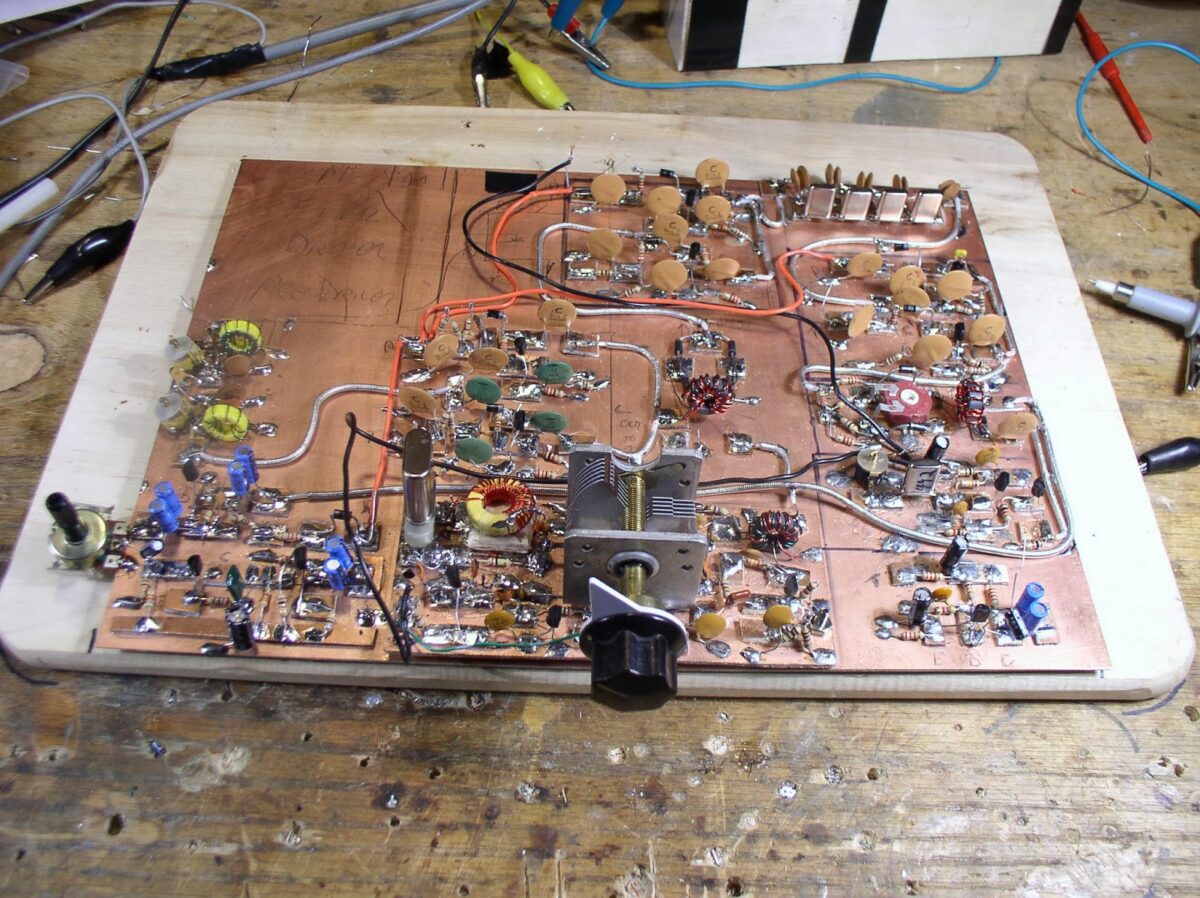
With the exception of the PA, all of the stages of my BITX 17 are built. Over the weekend I put in the DC wiring for the receiver and the inter-stage connections (using the Belden coax with the exposed shield and Teflon di-electric). It looks nice.
In my experience, almost all new superhet receivers require a certain amount of debugging and coaxing before they will work. This one is no exception. The VFO and the BFO work fine, and all three RF and IF amp stages are also good. The bandpass filter that I built passes the desired band and tunes up nicely on the right frequency. The product detector was acting weird and wasn’t balancing out properly, but I got that all sorted.
I can put an 18.110 MHz signal at the antenna connection and see the signal go through the bandpass filter (with loss), on to the RF amp stage, to the first mixer where it meets the 23 MHz energy from the VFO. A very messy mixture goes from the mixer to the first IF amp which sends it to the 5 MHz Cohn filter. The filter works, but it has a lot of ripple, so I need to work on the termination impedances. Second IF works fine, then the signal goes to the product detector. AF comes out.
Here’s where the discretion comes in. Instead of the LM386 chip, I built a 40db two transistor direct coupled AF amplifier.
So it all works, but the receiver is quite deaf. I think I just don’t have enough gain in the whole system. I looked at the schematic for the BITX-17 kit. It very helpfully has total (net) gain figures for the RX. I can see that my current configuration comes up short.
Here is what I’m thinking of doing: I might replace the 40db direct-coupled AF amp with a 100 db Darlington pair. I really like the discrete Darlington AF amp that KD1JV has in his “all discrete” transceiver:
http://kd1jv.qrpradio.com/ADC/ADC-40.htm Nice. 3 2N3904’s driving a speaker. I may use that.
Our book: “SolderSmoke — Global Adventures in Wireless Electronics” http://soldersmoke.com/book.htm Our coffee mugs, T-Shirts, bumper stickers: http://www.cafepress.com/SolderSmoke Our Book Store: http://astore.amazon.com/contracross-20
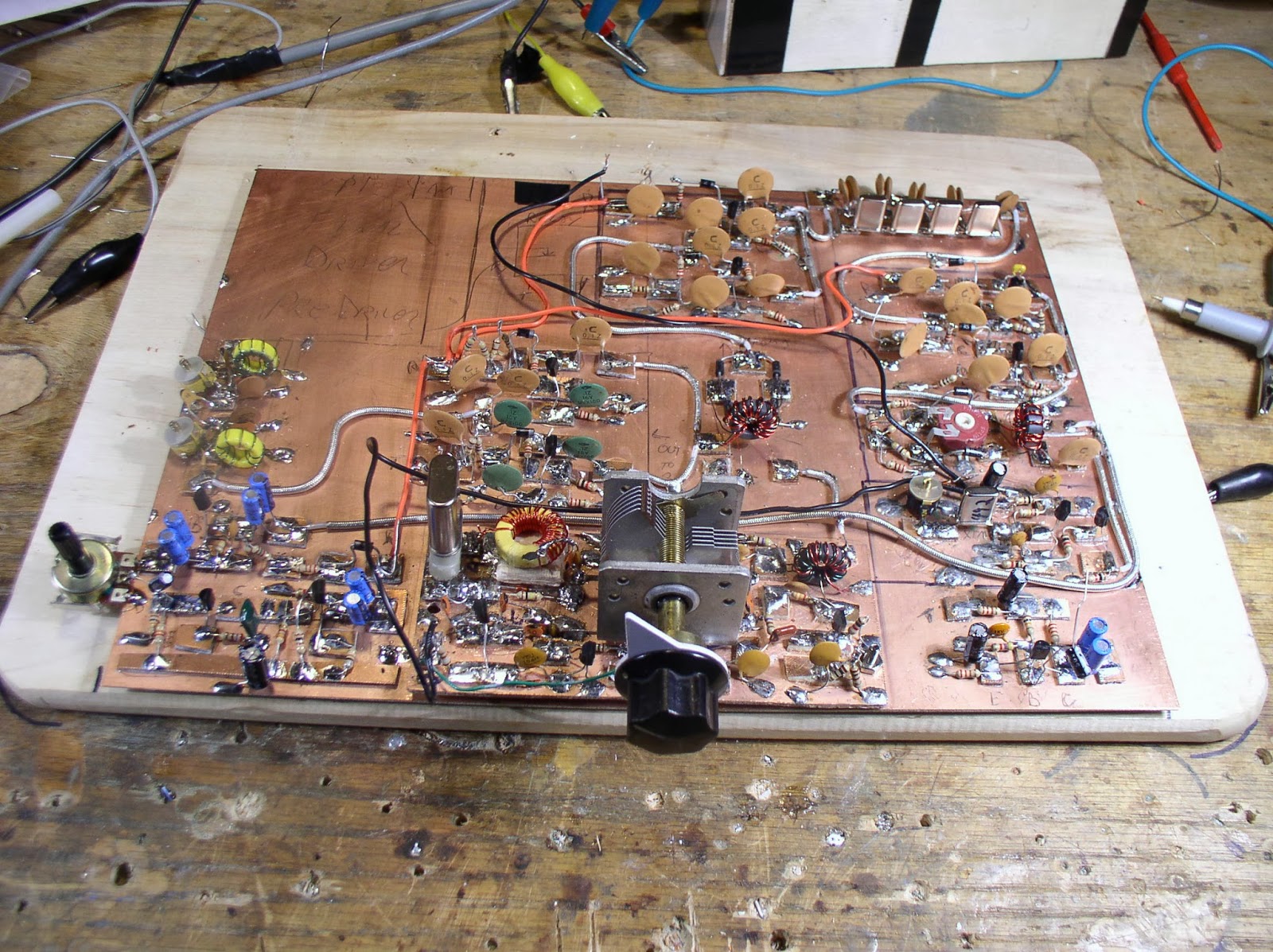
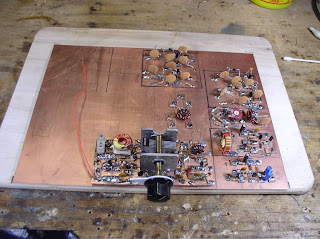
As you can see (above) I’ve made lots of progress on the BITX-17. Going counter-clockwise from the lower right, you can see the mic amp, the BFO/carrier oscillator, the first mixer, the first and second bi-directional amplifiers, the diode ring VXO mixer and the VXO.
I plan on building the whole rig (including the power amplifier stages) on this wonderful piece of PC board (thanks to Jim, W8NSA).
I had what I thought was the brilliant idea of using LEDs for all the T/R switching diodes. I thought I’d use red for receive and blue for transmit. I consulted with the BITX yahoo group and cooler heads prevailed.
The design has an LM-386 as the speaker amp. I’m kind of bothered by this — I’d prefer an all-discrete component rig, so I am thinking of building an AF amp with discrete transistors instead, perhaps the circuit from Roger Hayward’s RX for the Ugly Weekender. What do you all think about this?
I’m having a lot of fun building this rig. If anyone out there is looking for a fall/winter project, build one of these.
I have to order some 5 MHz crystals for the filter and oscillator. Mouser has them at about 70 cents each.
Our book: “SolderSmoke — Global Adventures in Wireless Electronics” http://soldersmoke.com/book.htm Our coffee mugs, T-Shirts, bumper stickers: http://www.cafepress.com/SolderSmoke Our Book Store: http://astore.amazon.com/contracross-20
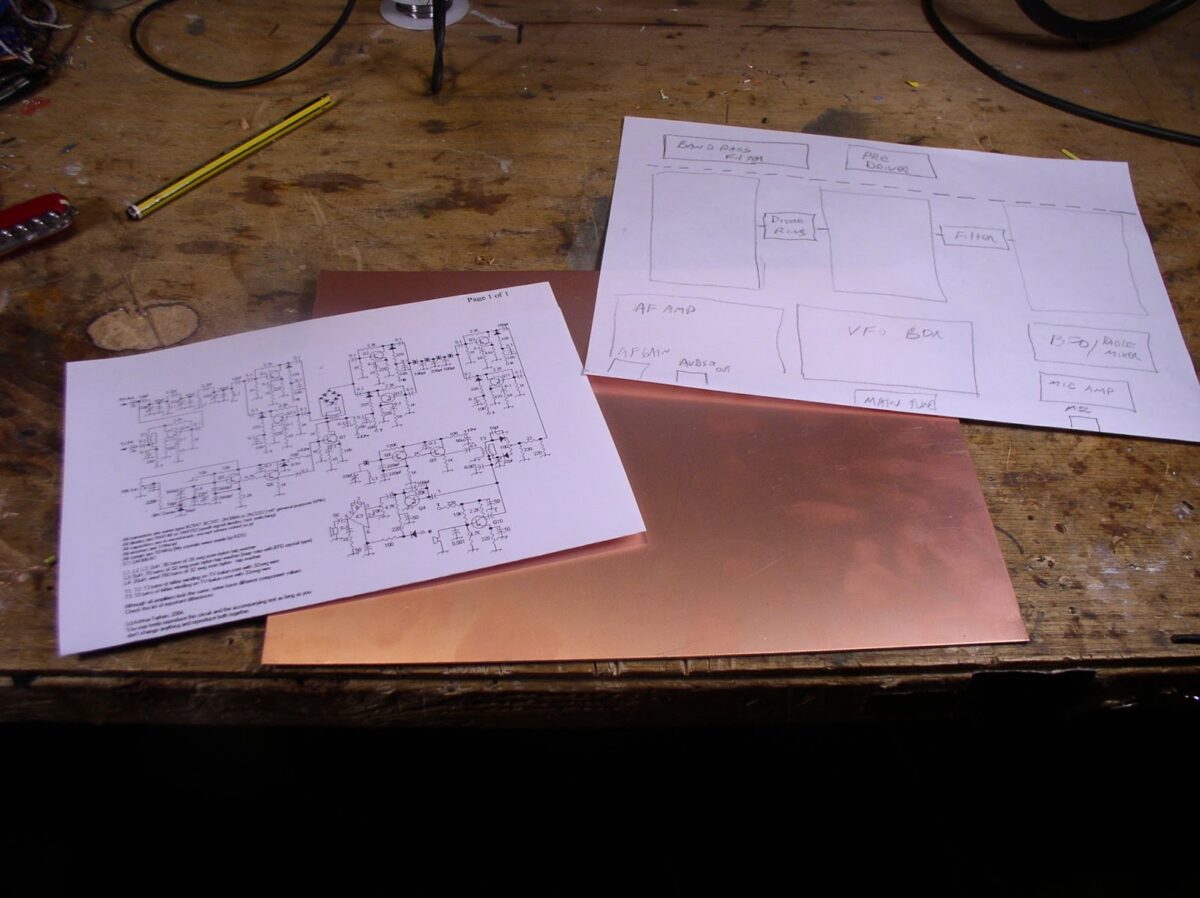
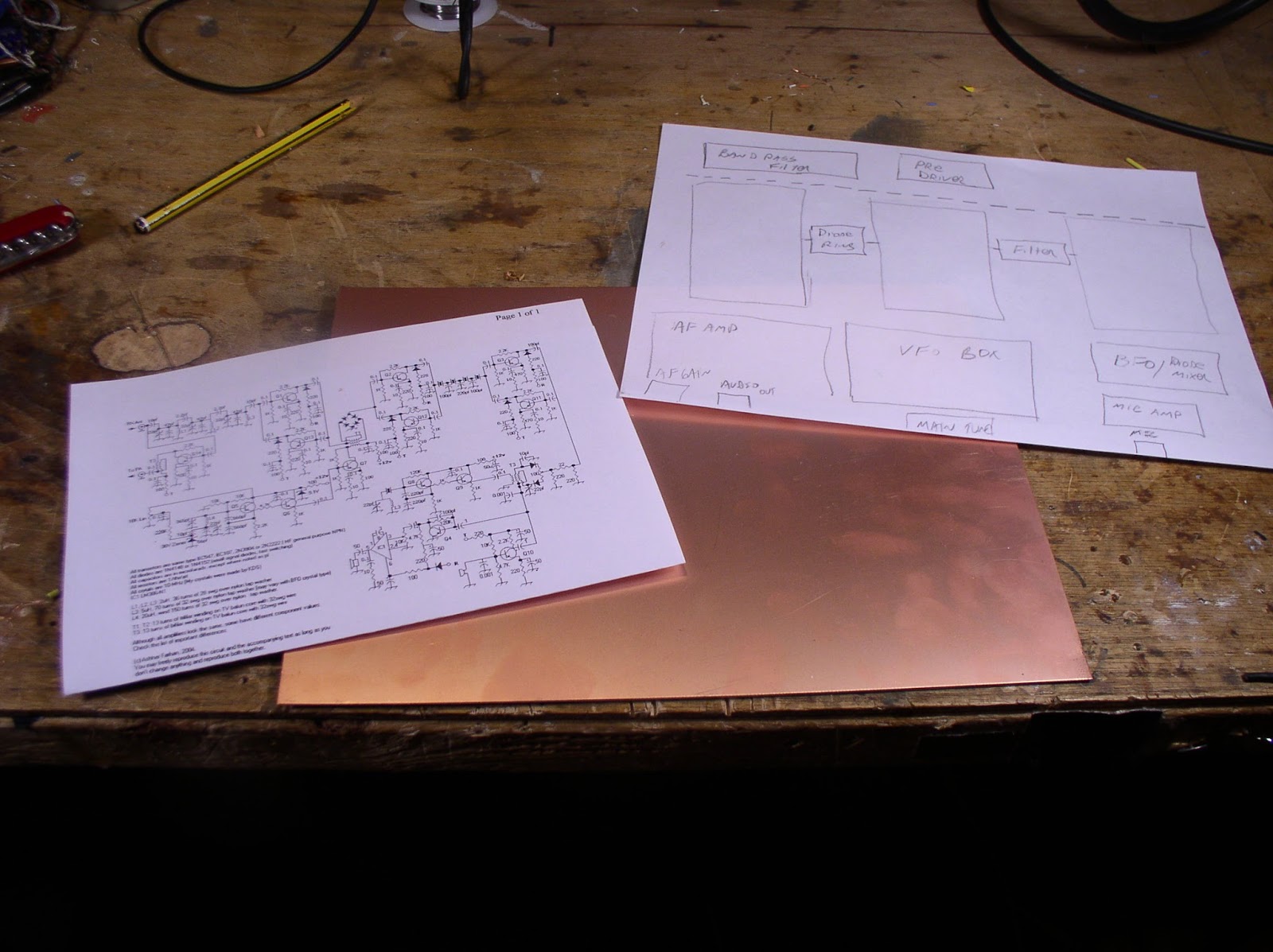
There it is guys: A blank canvas of copper-clad board. A clean slate ready to be filled with the components for a BITX transceiver. As you can see, I am fighting my “build first, design/plan later” tendencies. No real design work for me on this one (thanks Farhan!) but I am trying to plan where everything will go on the board. (Thanks to Jim, W8NSA for the board.) I’m going to build it Manhattan style (perhaps with an ugly dead bug or two). I’m starting with a big board because I always seemed to end up with a shortage of space. It looks like I can easily get all of the circuit (minus the PA) on this board. I’ll build the PA on a separate piece of copper-clad.
I’d like to build it for 17 meters, but if I stick with the 10 MHz filter that means I have to build a VFO at around 8.1 MHz. That’s not impossible, but in my experience it is easier to build simple, stable VFOs at lower frequencies.
Our book: “SolderSmoke — Global Adventures in Wireless Electronics” http://soldersmoke.com/book.htm Our coffee mugs, T-Shirts, bumper stickers: http://www.cafepress.com/SolderSmoke Our Book Store: http://astore.amazon.com/contracross-20
There are so many very cool aspects of this project: I love the phasing receiver arrangement — it uses the same basic concept that allows my old HT-37 to generate SSB (I struggled to understand it as a kid, and finally succeeded!). The use of the mobile phone as an audio spectrum analyzer is wonderful. The N3ZI signal generator looks a lot like the DDS project I was working on (I should have bought N3ZI’s! ). I’ve been seeing these square pattern PC boards in many projects lately — I may try this in my next project. And of course, it is very cool to see a circuit designed in Poland being put to use by a fellow radio amateur in Australia — a good example of the International Brotherhood of Electronic Wizards!
Here is the page for the SP5AHT rig that inspired Peter:
http://www.sp-qrp.pl/modules.php?name=Content&pa=showpage&pid=54
It is in Polish, but Google should translate it, and, in any case, we all speak Schematic!
Our book: “SolderSmoke — Global Adventures in Wireless Electronics” http://soldersmoke.com/book.htm Our coffee mugs, T-Shirts, bumper stickers: http://www.cafepress.com/SolderSmoke Our Book Store: http://astore.amazon.com/contracross-20
N8ZRY has a very nice video on his recent adventures with the legendary R-390A receiver (want one!) and his homebrew 20 meter SSB transmitter. He manages to essentially put the receiver and transmitter into “transceiver” mode. Very nice. I wonder if he had previously used the old standard “spot” or “net” “zero beat by ear” method? This video has me thinking about ways to bring my many separate receivers and transmitters closer together. The problem is that they all use different IF frequencies (the crystal filters are at different frequencies). But using my Arduino-based DDS VFO, I guess it wouldn’t be too difficult to program the thing to generate one VFO freq for transmit, and a different VFO freq on receive, in effect putting the transmitter and receiver on the same frequency.
Both the R-390A and the homebrew transmitter look great. Thanks Greg!
Our book: “SolderSmoke — Global Adventures in Wireless Electronics” http://soldersmoke.com/book.htm Our coffee mugs, T-Shirts, bumper stickers: http://www.cafepress.com/SolderSmoke Our Book Store: http://astore.amazon.com/contracross-20
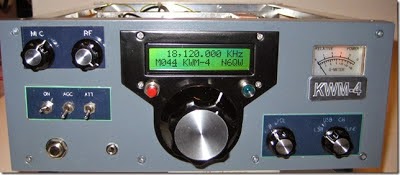
Oh man, Peter Parker has done it again! As he did with the Beach 40, he has come up with a circuit that will attract a lot of attention. It is a single frequency SSB transceiver with no knobs (or windows, or menus!)
Peter Marks recently had breakfast in Melbourne with VK3YE:
http://blog.marxy.org/2013/05/melbourne-meetup-with-homebrew-legend.html
There are some great pictures of the new rig, and the Beach 40.
Here’s the message from VK3YE (to the Minimalist Radio Group) that may
someday be seen as the start of the Knobless Revolution:
Some might reckon that SSB is inevitably too complex to be in the minimalist
class, but I beg to disagree.
I reckon you could build a whole SSB transceiver in 2 days of solid work. I
took a day to build what will be described below up to the stage where it
was receiving & producing a low level SSB on Tx.
Take this recipe:
1. Build the back end of the BitX http://www.phonestack.com/farhan/bitx.html
That is everything to the right of (and including) the Q2 & Q12 stages.
2. Use cheaply available 7.159 MHz crystals in the crystal filter and
carrier oscillator. Keep filter capacitor values the same. Remove L3 in the
carrier oscillator circuit. Use a slightly bigger trimmer in the carrier
oscillator (say up to 50 pF) and wire in series with crystal. Align trimmer
so carrier freq is 7160 kHz.
3. Build a power amplifier stage / relay / LPF as per the Beach 40. Just
the last 2 stages (using BD139s) should be enough. Output maybe 2w.
The result is a 10 transistor / 1 IC SSB transceiver on 7160 kHz. It’s
crystal controlled but at least during the day 2 watts to a good antenna
should be enough for people to hear and reply to your CQ calls up to 800 –
1000 km away. Of course you could go a bit more minimalist and remove the
LM386, substituting 1 transistor instead (as per the original Beach 40)
which is what I did.
The main thing that’s odd is it has no knobs – no tuning, RIT, volume, RF
gain etc. Just sockets – for mic, phones, antenna and power to feed it what
it needs (Rx RF, Tx audio, DC power) and give what you want (Rx audio and Tx
RF).
It is philosophically different to using any other transceiver. You either
accept what the radio dishes up (frequency, AF gain, mic gain etc) or you
don’t. On or off – there is no other state. Take it or leave it. Like a
cat this is a radio that lives on its own terms.
Those used to fiddling with adjustments will find the ‘knobless wonder’
transceiver causes them to be at a loose end. Those so afflicted will smoke
more, bite their nails more or eat junk food more. Sometimes elegant
simplicity in radio can be a health hazard – maybe knobless rigs should
carry health warnings.
On the other hand, and in my view this outweighs the above, there is the
aesthetic satisfaction that comes from using a rig that cannot be made any
simpler. Especially if it’s a mode, like SSB, that’s widely thought
constructionally complex. Plus it takes little in return – the power
consumption will be a fraction of what a commercial rig will demand.
73, Peter VK3YE
Our book: “SolderSmoke — Global Adventures in Wireless Electronics” http://soldersmoke.com/book.htm Our coffee mugs, T-Shirts, bumper stickers: http://www.cafepress.com/SolderSmoke Our Book Store: http://astore.amazon.com/contracross-20
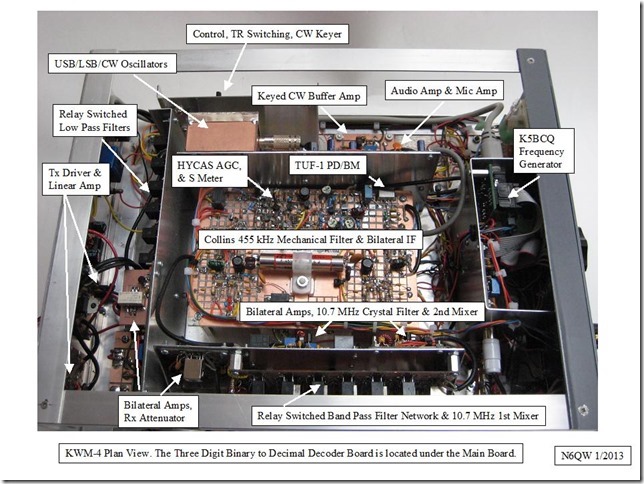
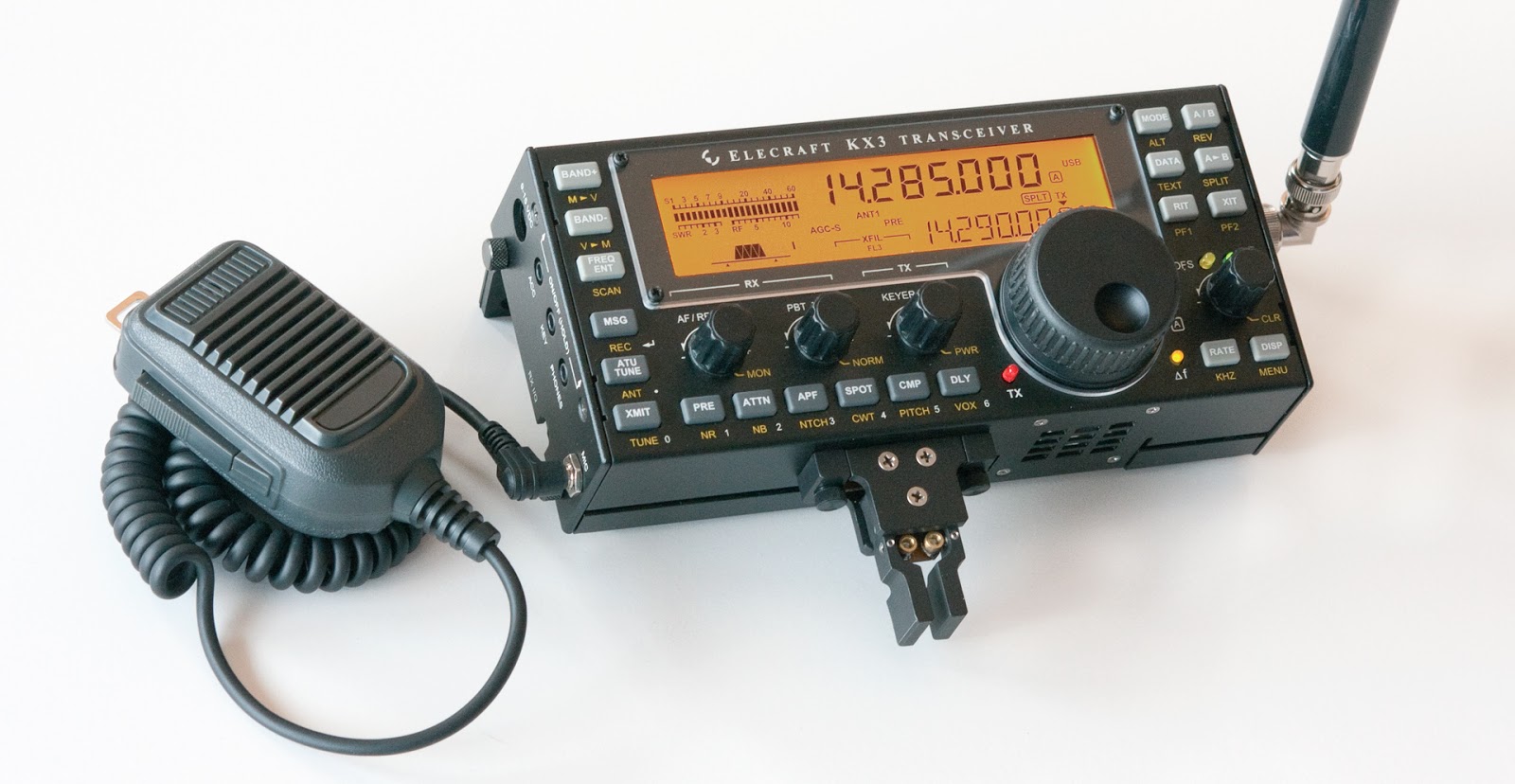
Kelly, WB0WQS, was trying out a new KX3 that his wife had given him as a present. The radio gods must like that low-power rig because, in what seems like a deliberate demonstration of the awesome power of QRP phone, Kelly’s first QSO was with another QRP operator: me! The sun was going down and taking 17 meters with it, but neither of us missed a word. We talked about SolderSmoke and our mutual friend, Jerry, NR5A — Kelly had known Jerry when they were teenage hams. Good luck with the new rig Kelly!
Our book: “SolderSmoke — Global Adventures in Wireless Electronics” http://soldersmoke.com/book.htm Our coffee mugs, T-Shirts, bumper stickers: http://www.cafepress.com/SolderSmoke Our Book Store: http://astore.amazon.com/contracross-20
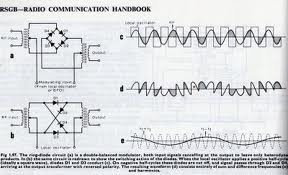
I liked this thread on the EMRFD mailing list. The question of how best to generate SSB is very interesting, and I also liked the global scope of the Q&A: Peter in Hungary asks the question, Farhan in India and Allison in the U.S. respond.
On 9/25/12, ha5rxz
When generating an SSB signal from audio and a 9 MHz carrier which would be
the best mixer to use?
a) A high-level ring bridge mixer such as the SRA-1H
b) An H-Mode mixer using an FST3125 chip
c) An H-Mode mixer using a 74HC4016
d) Something else
Note that this mixer will not be used to demodulate.
Peter HA5RXZ
……………………………..
Ashhar Farhan
In my experience, if you keep the audio level low enough, it is
difficult to beat a simple two diode mixer.with a 10 db attenuator in
the output. Having just two diodes makes balancing of reactive as well
as resistive differences of the two diodes quite trivial. Schottky
diodes are best.
One thing, I did discover though is that the balance should be to
minimize the harmonic distortion, rather than just the carrier
suppression.
What we are shooting for is to keep the In-band IMD down. Carrier
suppression is just hygiene. So, you will want to tune in to the
signal, modulating it with two tones and see it on a audio spectrum
analyzer (freely downloadable from the net) and try getting the third
spike down.
Though the ‘packaged’ mixers don’t give you the needed control for
hi-fidelity, for trivial usage, NE602 is pretty good. Just drop it
into the rig and live with what you get (which is not bad at all).
The best resource is the chapter on phasing receivers and transmitters
in emrfd. Rick is the guru. I hope he joins this thread.
– Farhan
……………………………………..
FROM KB1GMX:
I’ll weigh in..
Yes, they all work. You need a provision for adjusting carrier balance on some but anything over 40db will be good.
I’ve used 602/612s, SBL-1, SBL-1H, diode rings, and even varicap
diodes (there is a design using them in capacitively balanced
a modulator from many years ago. They all work if the levels are correct.
These days I use the sa612 for simple designs, SBL-1 with a 50ohm
pot added for balance for better radios and the 4 diode ring I’ve
used many times as its uncritical, needs only one untapped
transformer and easy to make. Most of those are listed in the
older 1975 through current handbooks and EMDRFD.
If needed I can post to the files section a few designs but
they are all textbook and all are capable of good results.
In just about all the diode modulator cases a fairly strong
carrier (5mW or more) is needed and the audio will be about
10db lower for very good result. The active devices like the
ca3028(and friends), SA612, MC1496 the levels for the carrier
and audio must be matched accordingly for the device. You can
look at the output with a scope and get a first order eyeball
call on quality (no carrier and no clipping or limiting) and a
receiver (any your ears) will tell you if its right.
Allison
Our book: “SolderSmoke — Global Adventures in Wireless Electronics” http://soldersmoke.com/book.htm Our coffee mugs, T-Shirts, bumper stickers: http://www.cafepress.com/SolderSmoke Our Book Store: http://astore.amazon.com/contracross-20
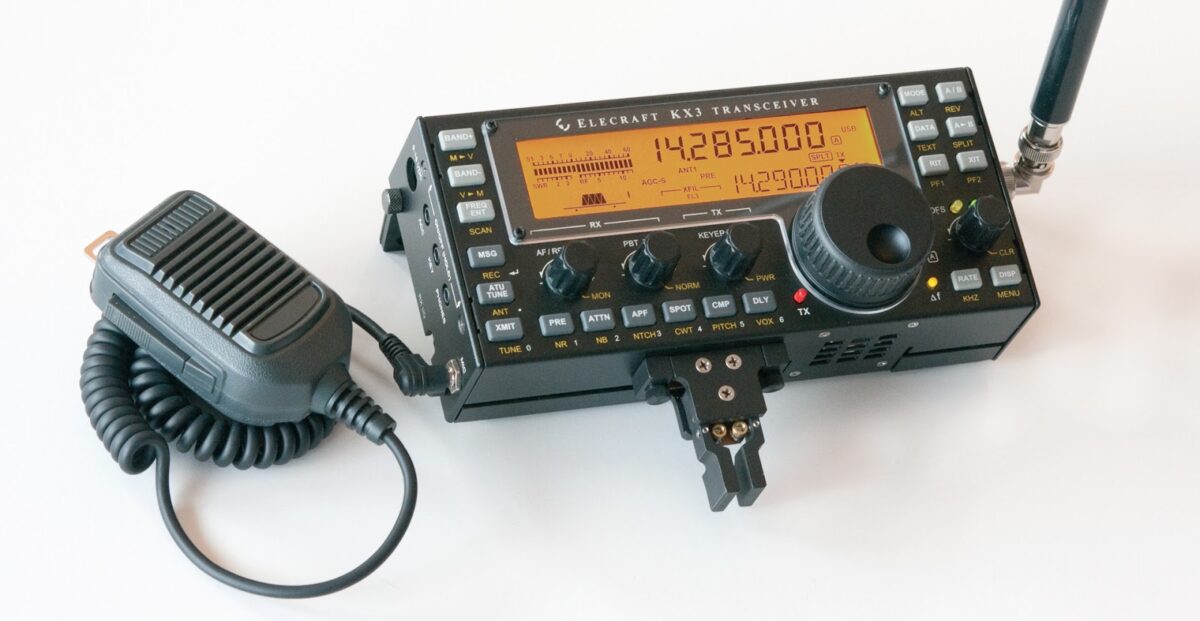
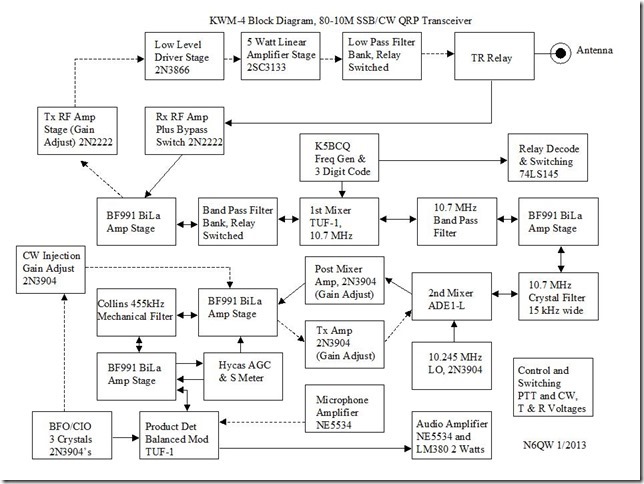
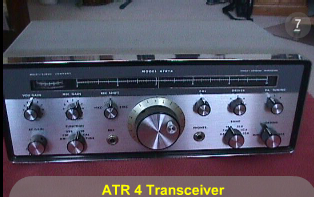
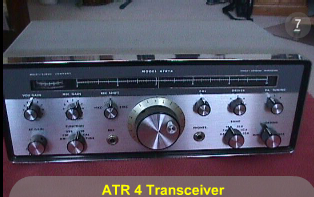
On Monday I was talking to Angelo, W8ERN, on 17 meters. He told me about an SSB transceiver that he had designed for ELMAC, the ATR-4. Take a look at that beauty. The amazing thing is the year in which Angelo created this rig: 1959! Wow, talk about being ahead of its time! Sadly, ELMAC decided not to produce it, and only a few prototypes exist. It is 80-10 meters, SSB and CW featuring a crystal filter. It is a transistor-tube hybrid with a pair of 6146’s in the final. Nice job Angelo.
Our book: “SolderSmoke — Global Adventures in Wireless Electronics” http://soldersmoke.com/book.htm Our coffee mugs, T-Shirts, bumper stickers: http://www.cafepress.com/SolderSmoke Our Book Store: http://astore.amazon.com/contracross-20
On Monday I was talking to Angelo, W8ERN, on 17 meters. He told me about an SSB transceiver that he had designed for ELMAC, the ATR-4. Take a look at that beauty. The amazing thing is the year in which Angelo created this rig: 1959! Wow, talk about being ahead of its time! Sadly, ELMAC decided not to produce it, and only a few prototypes exist. It is 80-10 meters, SSB and CW featuring a crystal filter. It is a transistor-tube hybrid with a pair of 6146’s in the final. Nice job Angelo.
Our book: “SolderSmoke — Global Adventures in Wireless Electronics” http://soldersmoke.com/book.htm Our coffee mugs, T-Shirts, bumper stickers: http://www.cafepress.com/SolderSmoke Our Book Store: http://astore.amazon.com/contracross-20
The 2006 ARRL Handbook had it right. Jeremiah went back and took a look:
Bill:
Our book: “SolderSmoke — Global Adventures in Wireless Electronics” http://soldersmoke.com/book.htm Our coffee mugs, T-Shirts, bumper stickers: http://www.cafepress.com/SolderSmoke Our Book Store: http://astore.amazon.com/contracross-20
Astute aficionados (like Steve –Snort Rosin — Smith) immediately recognized that I was talking rubbish when, in SolderSmoke 143, I said that the current LSB/USB convention on the HF bands has its origins in the FACT (not!) that when using a 9 MHz filter and a 5 MHz VFO, with a single carrier oscillator crystal you can very conveniently get USB on 20 and LSB on 75, supposedly because of “sideband inversion” that takes place when you switch from the sum product of the second mixer (20 meters) to the difference product (75 meters). I got out paper and pen and quickly discovered that Steve was right. No sideband inversion with this scheme.
I was susceptible to this urban legend because when I was building my 17 meter SSB rig out in the Azores, I used a 5.174 MHz filter from an old Swan 240. I started out with a VXO running around 12.9 MHz, obviously using the sum output from that second mixer. Later, I decided to move the VXO up to around 23.3 MHz and take the difference product. Here I DID get a sideband inversion, and I had to go back to the carrier oscillator and change the crystal so as to get LSB coming out of the filter. When this 5.173 MHz LSB went to the second mixer, the sideband inversion took place and –Viola!– 17 meter USB resulted.
The key factor here of course is that the VFO freq was now ABOVE the filter freq.
In the podcast I said that I “learned” about the alleged origins of the LSB/USB convention from the 2006 ARRL handbook. I had read it very quickly while in the local library. I don’t think they would have gotten this wrong. It was probably my quick reading of the article that caused the rubbish talk.
Maybe it was this: Could it have been that in the early days of SSB, guys were using a 5 MHz FILTER with 9MHz VFOs? Maybe from old Command Set surplus gear? With the VFO above the filter freq you would get the sideband inversion that I was babbling about, right? Or might this have been the result of the phasing method of sideband generation popular back in the day?
Our book: “SolderSmoke — Global Adventures in Wireless Electronics” http://soldersmoke.com/book.htm Our coffee mugs, T-Shirts, bumper stickers: http://www.cafepress.com/SolderSmoke Our Book Store: http://astore.amazon.com/contracross-20
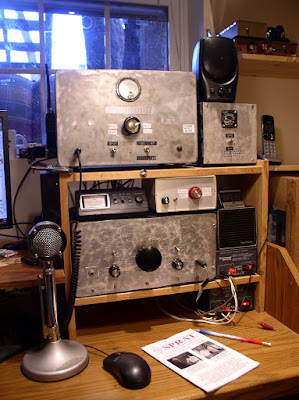
There it is. The SSB station has moved from the workbench to the operating position. I have it situated above the DSB rig, but both of them are hooked up and ready to go. My crystals (and the FCC) allow me to go from 18.110 to 18.128 with the DSB rig. The SSB rig goes from 18.128 t0 18.168 Mhz.
I’ve been having a blast with this setup. I’m running into old friends who I haven’t talked to in one (or in some cases two!) solar cycles. I talked to Lee, G0DBE this morning — our last contact was June 2000 (just before our departure from the U.S.) Yesterday I talked to Jorge, HK4CZE — I hadn’t spoken to him since 1995! Lots of U.S. contacts too. People really like it when I turn off my linear and go to 1 watt; they can almost always hear me with the 1 watt.
Our book: “SolderSmoke — Global Adventures in Wireless Electronics”http://soldersmoke.com/book.htmOur coffee mugs, T-Shirts, bumper stickers: http://www.cafepress.com/SolderSmokeOur Book Store: http://astore.amazon.com/contracross-20
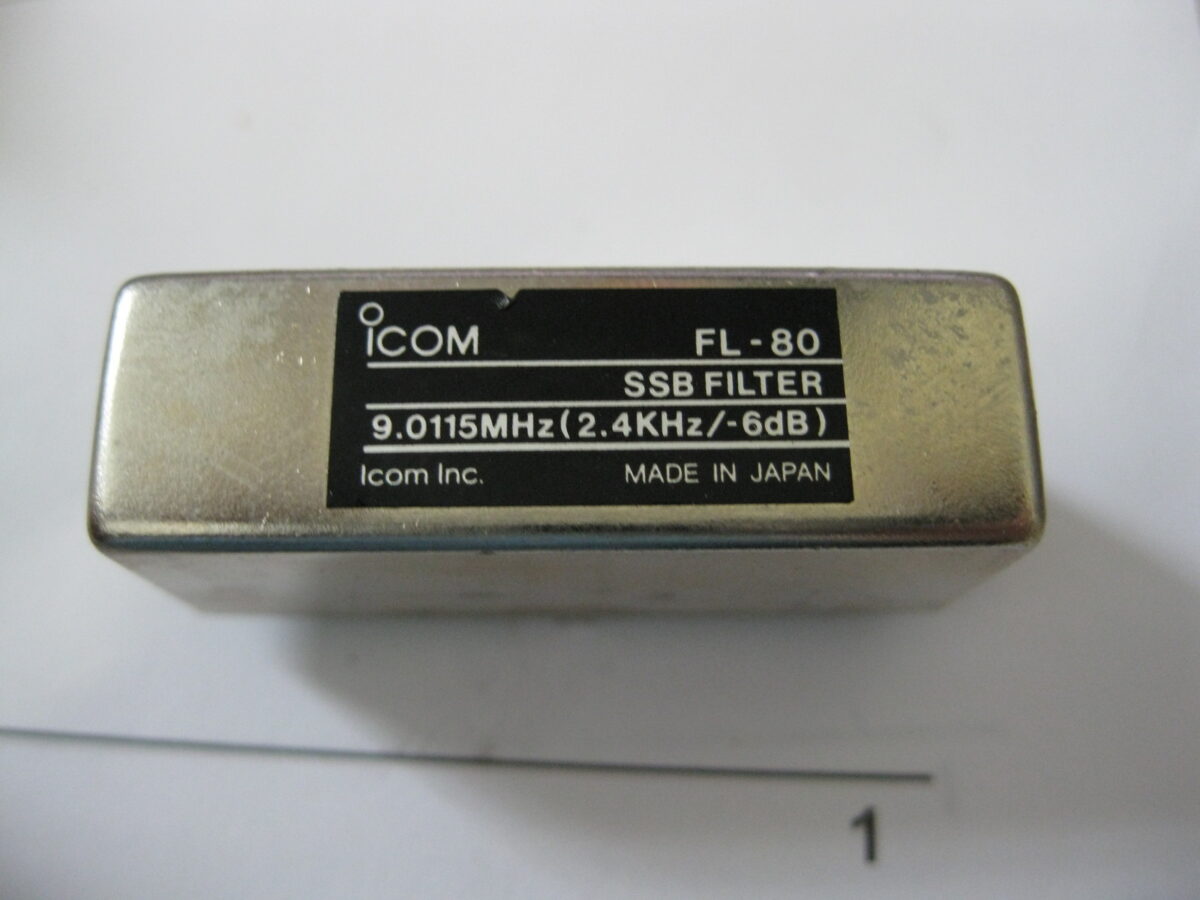
Wow, sometimes scratch-built homebrewing can be a frustrating masochistic activity. Who among us at one point or another hasn’t sat back from the bench and wondered why he didn’t take up stamp collecting? But then sometimes the radio gods are smiling on you, the smoke stays inside the components, the antenna rope doesn’t break, oscillators osc and amplifiers amp and all is right with the universe. I had one of those days yesterday.
The RF feedback measures I described earlier took care of that problem very nicely. Conditions on 17 were not that good yesterday, but as soon as the sun was up I started hearing stations. I called Phil, K5ACR, in Oklahoma and he came right back to me. He said the signal sounded OK, but he thought I might have been driving it a bit too hard. I backed off a bit and he said it sounded very nice.
Our weather was really disturbingly pleasant yesterday (we’re not supposed to be out in T-shirts on January 31). I took advantage of it and went out with my fishing pole and sling shot (the neighbors love it) and got a line over just the right branch. This allowed me to turn my low-to-the ground 17 meter inverted Vee into a proper dipole, up about 15 meters or so.
Back to the shack and K5USI said I was booming into Mississippi’s Gulf Coast. I turned off my 20 watt linear and he could hear me just fine barefoot. Then I worked K2BQ in Florida. All stations report that the signal sounds very nice.
I remembered that I did a QST article about this transmitter a few years back. I can’t find it on the web, but here is an old page that describes it as it was in the last solar cycle:
http://www.gadgeteer.us/17SSB.HTM
Our book: “SolderSmoke — Global Adventures in Wireless Electronics”http://soldersmoke.com/book.htmOur coffee mugs, T-Shirts, bumper stickers: http://www.cafepress.com/SolderSmokeOur Book Store: http://astore.amazon.com/contracross-20