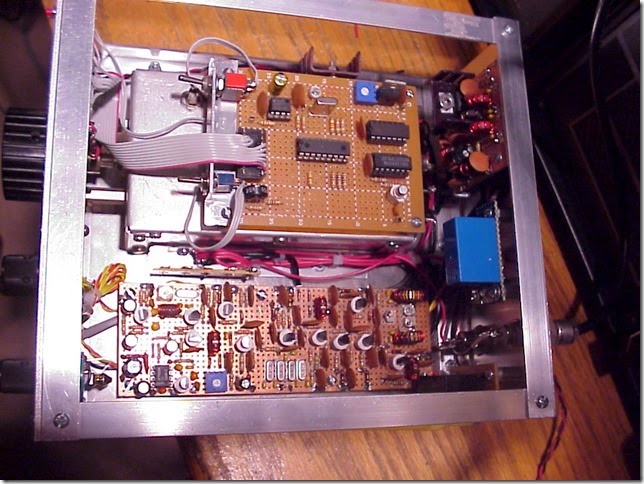
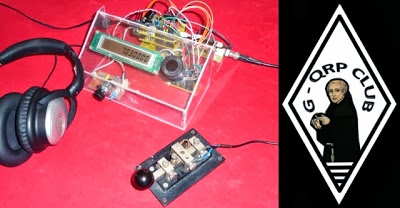
The Homebrew Receivers of F5LVG

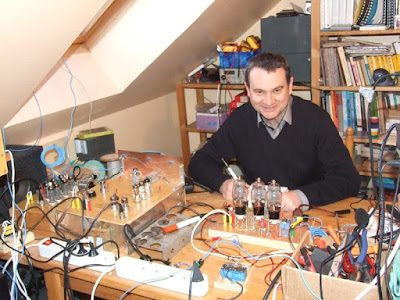
I came across OM F5LVG’s work in SPRAT. He has a wonderful website — it is in French, but Google Chrome translates is quite nicely.

http://oernst.f5lvg.free.fr/index.html

From the site’s introduction:

This site is dedicated to the construction and understanding of radio receivers. If you have dreamed of hearing a radio station with a receiver that you have built yourself, this site is for you. These are essentially direct conversion receivers and modern feedback detectors using only semiconductors, except for retrofitting. The described stations will accommodate amplitude modulation, single sideband (SSB) and telegraphy.

Besides these receivers several articles are devoted to LC oscillators. In particular, an extremely simple original stabilizing device is described.
Similarly, a simple frequency meter is described.
The joy of reception using a homebrew receiver is intense. May this site help you find this joy. Do not hesitate to join the amateur community.


TRGHS: I Can Hear the Roosters of Boa Vista

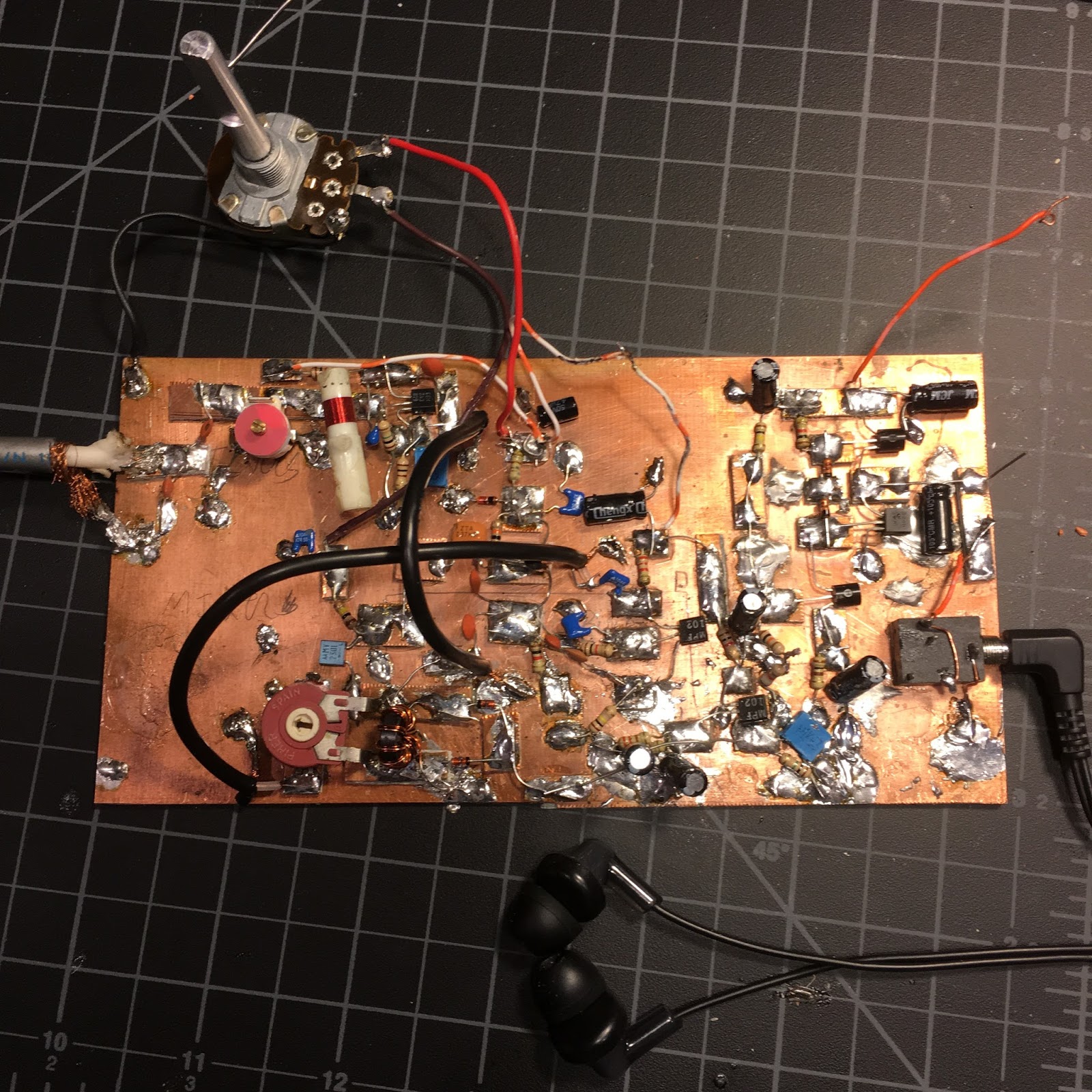
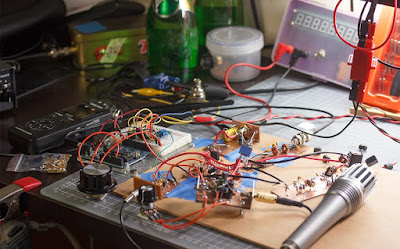
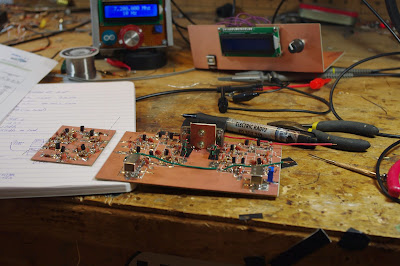
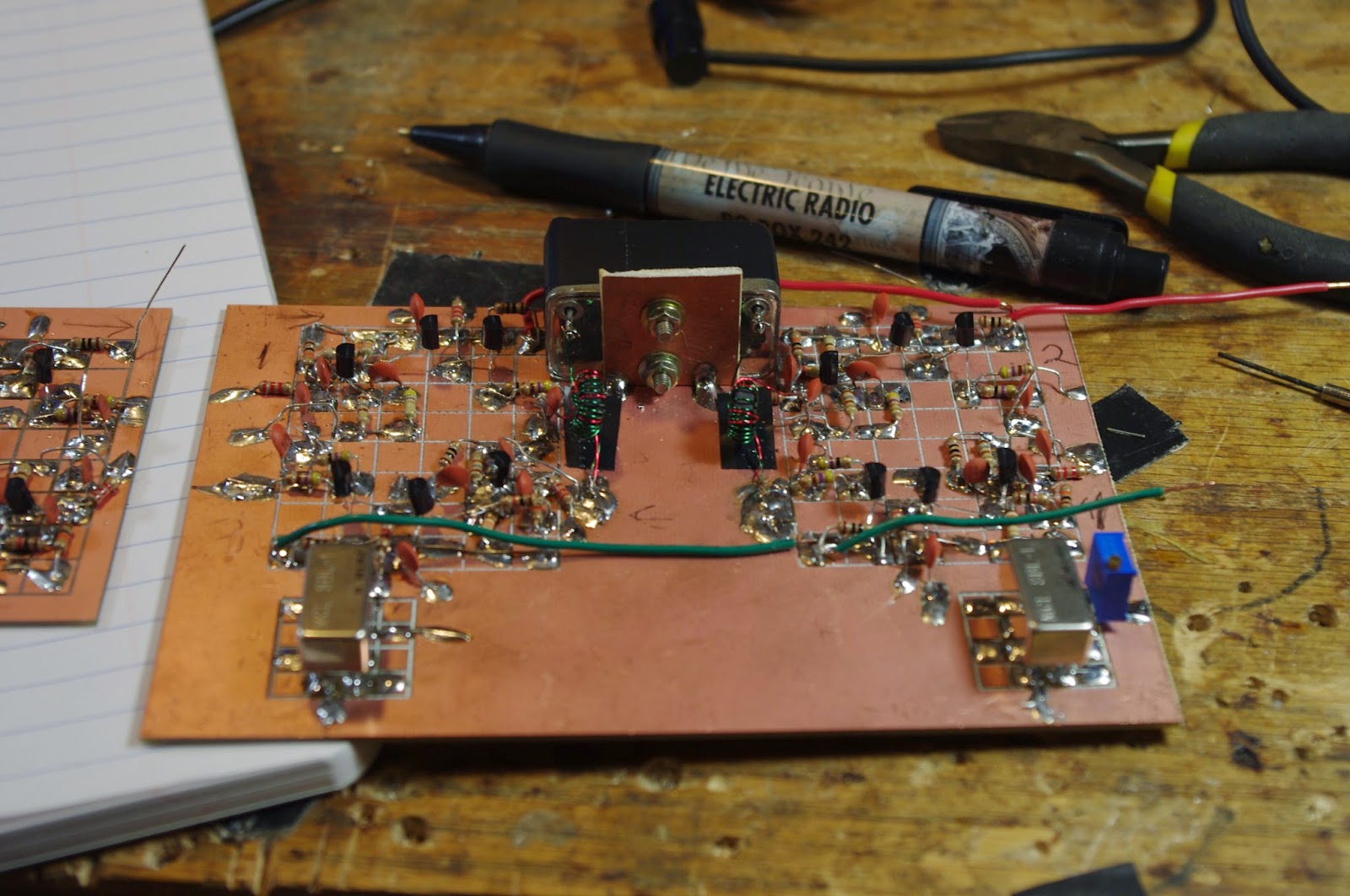
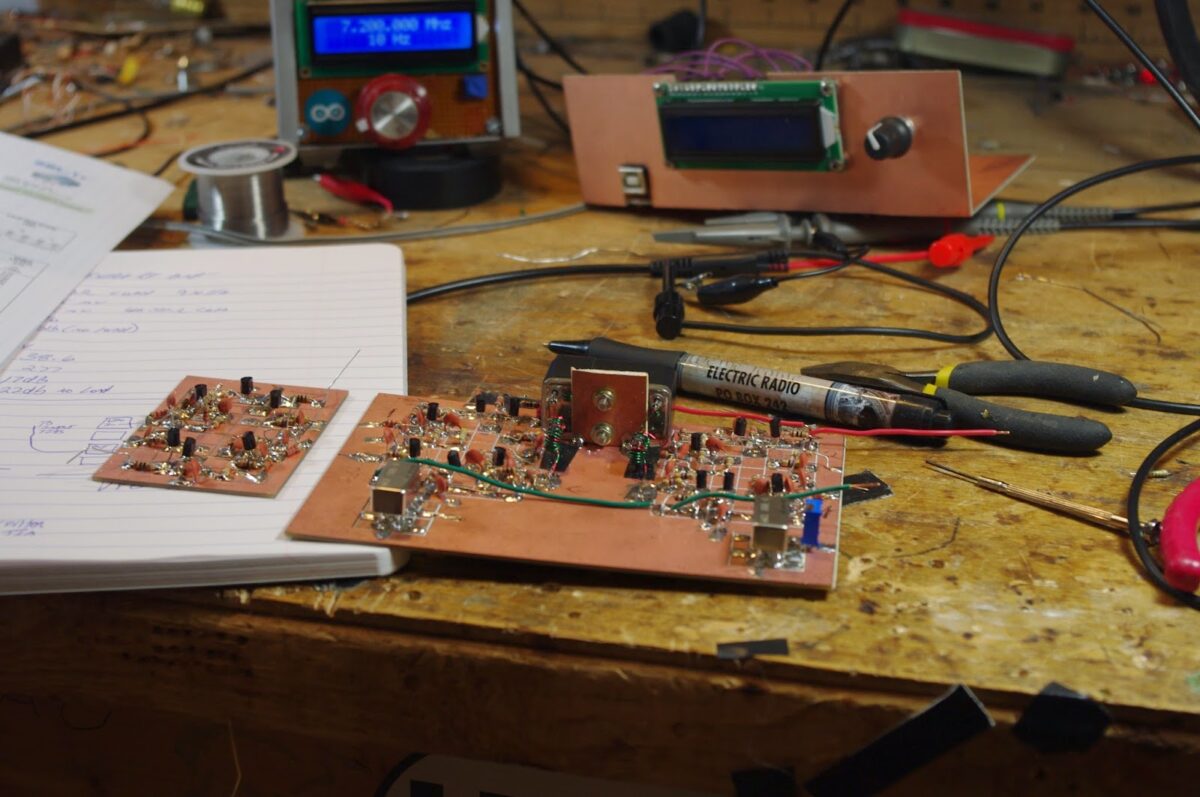
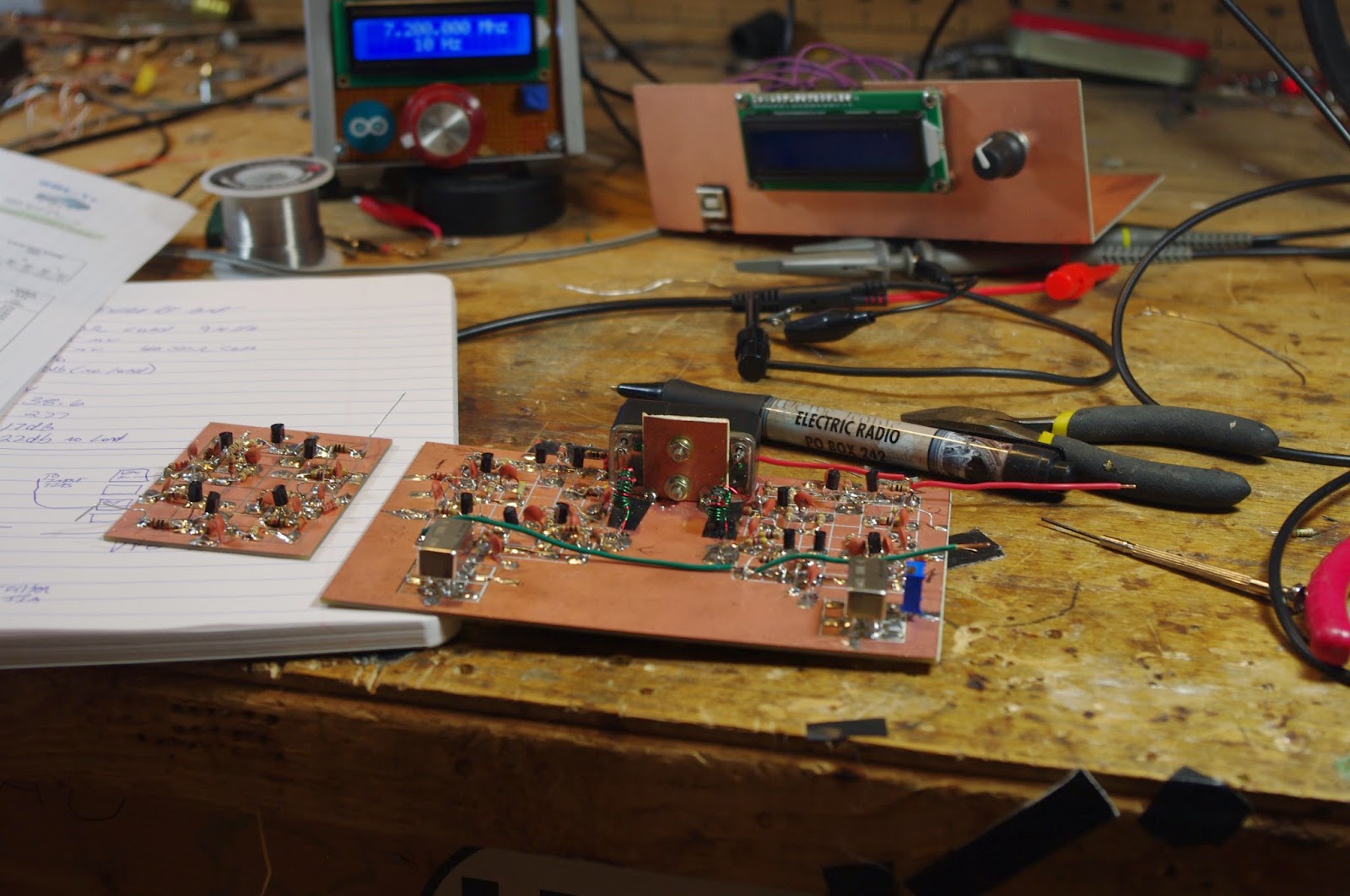
At the instigation of Bob N7SUR I’ve been working on a simple, easy-to-reproduce Direct Conversion receiver for 40 meters. I’m building this for my nephew John Henry, and I’m hoping this will be a circuit that others can use to break into the ELITE corp of successful ham receiver builders. Coincidentally Joh in Freiburg Germany is working on a very similar project — we have been comparing notes.

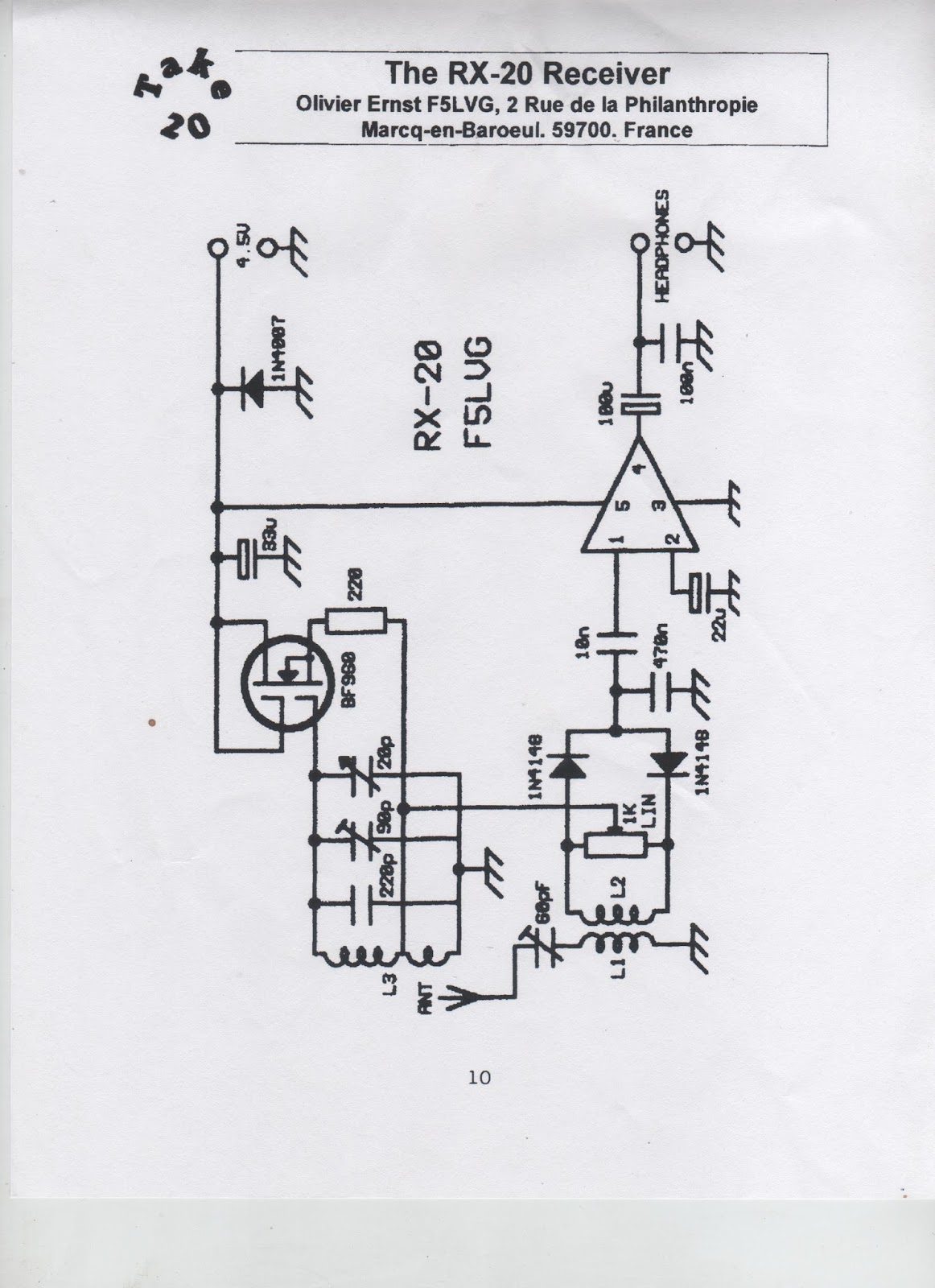
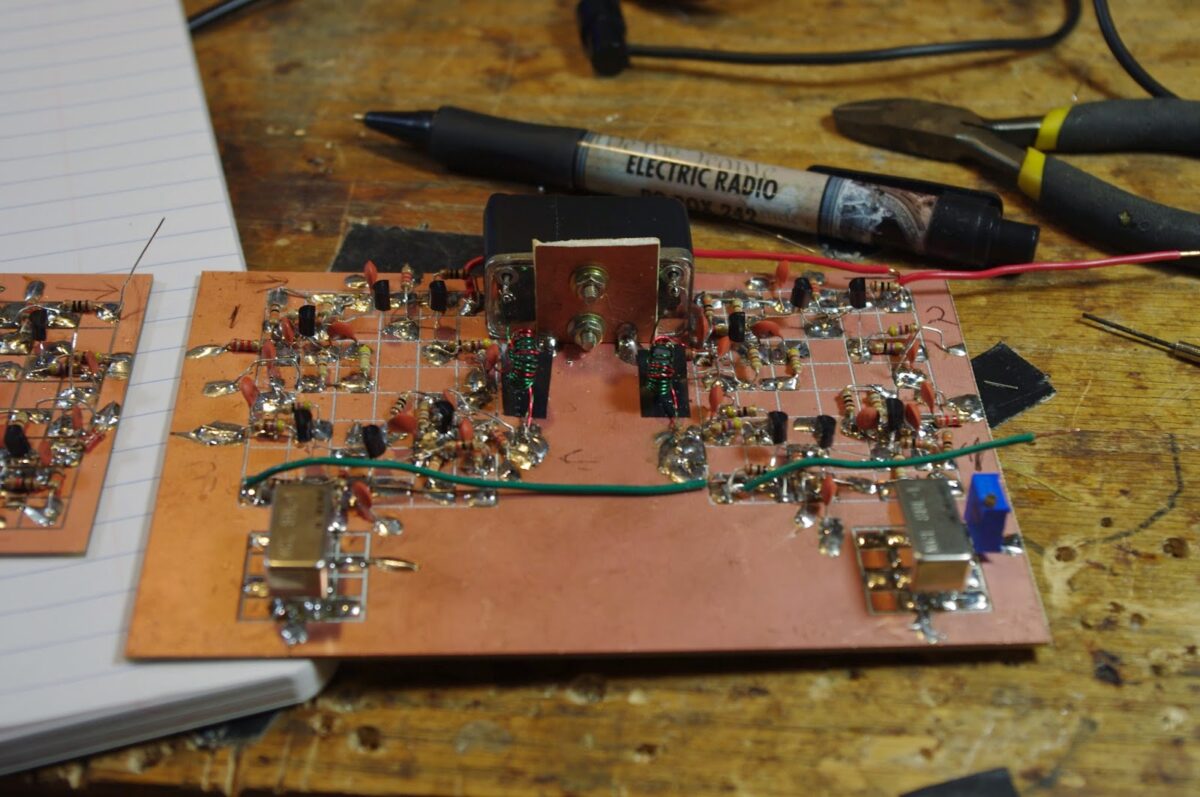
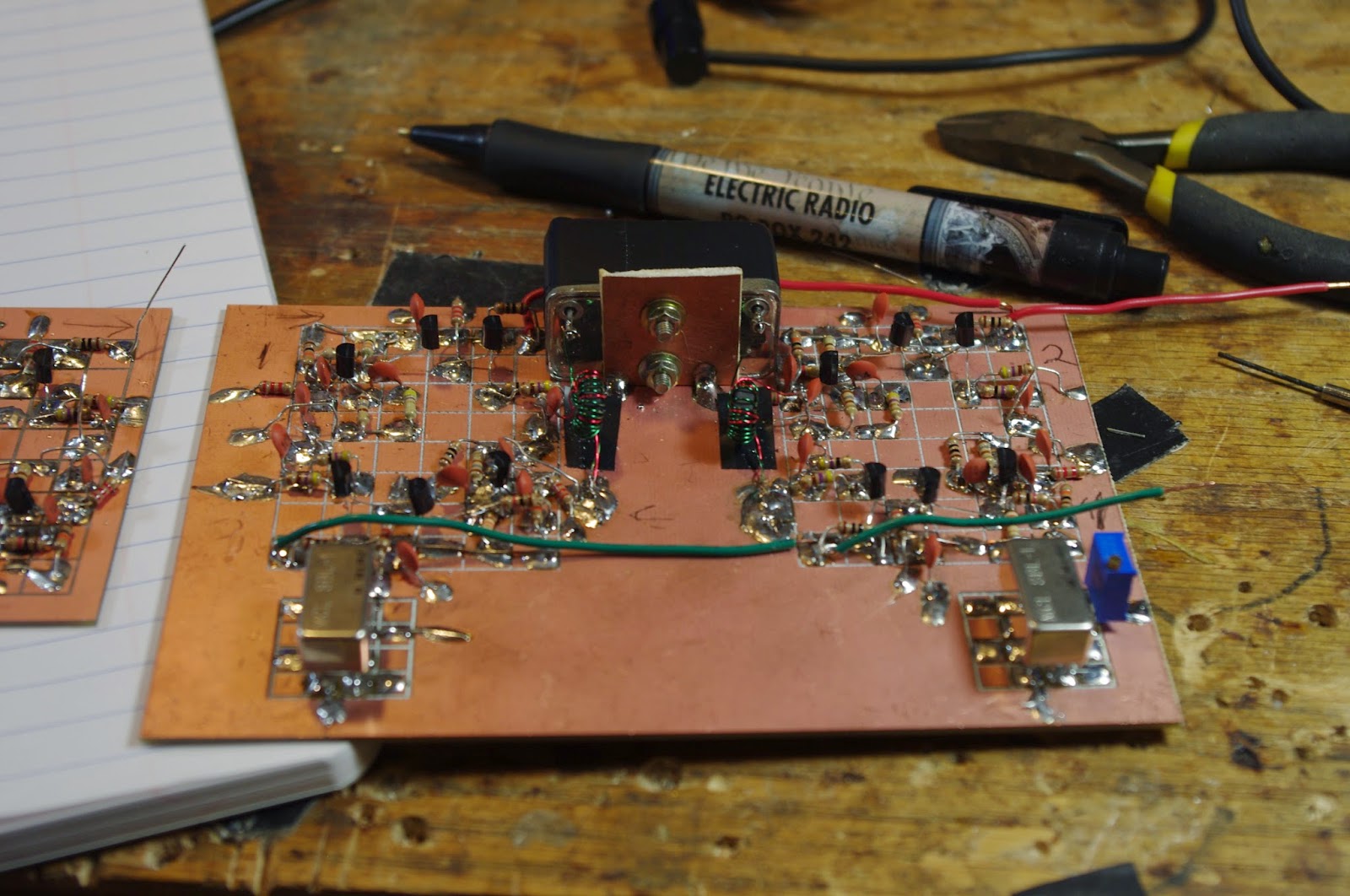
At first I used an FET detector described by Miguel PY2OHH. It worked, but at night the AM detection of powerful shortwave broadcast stations drowned out the amateur signals. So Joh and I started to explore detectors that would eliminate this problem. I went with a version of one described in SPRAT by F5LVG ( “The RX-20 Receiver”- see below). Very simple: A transformer to two back-to-back diodes with a 1K pot to balance the signal from the VFO. OM Olivier used a very, very cool transformer: he took two small, molded chokes and simply glued them together! 22uH choke as the primary, 100uH choke as the secondary. I went with one of the toroidal transformers that Farhan left me when he visited in May.

I’m using a varactor-controlled ceramic resonator VXO (no Si5351 in this one!) and a non-IC AF amp designed for use with ear buds (the world is awash in ear buds). It is a “singly balanced” design with the incoming RF signal being the one “balanced out” in the detector.

Last night the receiver passed the AM breakthrough test. The SW broadcast monsters were balanced out and kept at bay.

This morning the receiver passed The Boa Vista Rooster Detection Test. I fired up the receiver and heard an operator speaking Spanish with a Brazilian accent. When I heard the rooster crowing in the background I knew it was Helio PV8AL from Boa Vista Brazil. TRGHS — this little receiver is a winner.

I’ll try to post a schematic soon.

And hey — look at what wonderful IBEW (International Brotherhood of Electronic Wizards) project this is: Instigation and inspiration from Oregon. Some design ideas from Brazil. A French detector circuit described in a British QRP magazine. A transformer from India. A collaborator in Germany. And finally, the rooster of Boa Vista.

Let’s not forget Wes Hayward W7ZOI for bringing back (in 1968!) the neglected Direct Conversion idea.

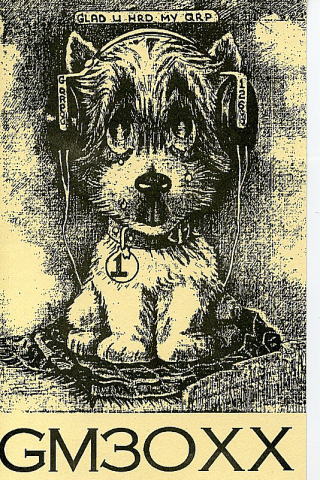
GM3OXX SK

Bill,

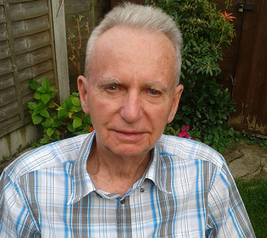
I expect you will have heard via the grapevine, George Burt GM3OXX is silent key. Bad news travels faster than light.

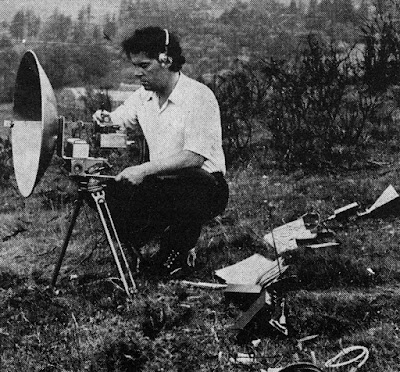
I knew George GM3OXX before I was even licensed in the 70’s, as I heard his broad Scottish accent on 2m AM when he was portable on a local hill and was using 2m to set up 3cm contacts with QRPp WBFM. I climbed the hill and introduced myself and he graciously answered my questions.

George didn’t drive but despite that was able to climb all of the Munros (summits over 3000 feet) in Scotland and operated on 2m from all of them. He used hitch hiking and buses or bicycle to get to foot of the mountains.

Fast forward a few years, I had my first ticket GM8HEY…

I spent a night in my grandfather’s ridge tent on top of Snaefell (the highest mountain in the Isle of Man) (GD) with George. We had planned to take my car to the island by ferry, but had not realized that the TT motorcycle races were on and the Ferry was fully booked. We had to go as foot passengers and reduce the amount of gear. George carried his tripod and dish, 3cm and 2m gear and antennas plus rations etc, I carried this huge ancient canvas tent with wooden poles and pegs. We got to a campsite and we were told it was full, when we asked where the next site was the owner asked us where our motorbikes were, we explained we had come by foot, so he let us pitch our tent after all as we weren’t bikers.

George originally had planned to climb the mountain by foot, but with this huge tent even though I was fifteen years younger than George I would never have made it, so reluctantly we took the mountain railway which goes nearly to the summit of Snaefell.

The previous night it had snowed on the mountain, fortunately it was just freezing cold and windy when we camped right on the top. We had to use rocks to try and hold the old ridge tent down, it had no built in ground sheet. George’s “rations” seemed to be a bar of chocolate and some tea that he boiled on a tiny stove powered by some little pebble sized block of flammable material. I have never been so cold and hungry after a night in a sleeping bag. We idled some of the time calling stations on
2m with George’s homebrew 2m battery powered transistorised transceiver.

Next morning it was too windy to set up the dish and tripod, so we assembled it -inside- the ridge tent and successfully operated from there on 3cm WBFM across to G, GW and GM. on 10mW QRP of course.

George went on to break UK and EU distance records on 3cm before packing microwaves in and going back to QRP on HF.

George was as fit as a mountain goat in his youth, tragically he was struck down with a terrible condition in early middle age that robbed him of his strength and ability to even walk, let alone climb mountains, but you wouldn’t have known it, he never complained, just the same old George “building wee boxes” as he put it to me on one of the last times I spoke to him.

If you visited George’s shack, you wouldn’t find any commercial gear at all, everything he built himself, it was so beautifully made too, I marvelled at how compact and neat it was.

There won’t be another George Mary Three O Ocean X X-Ray X X-Ray on the bands.

Thanks for all the great times George, I am sure you won’t be resting, you are probably designing that next “wee box”.

— David GM4JJJ
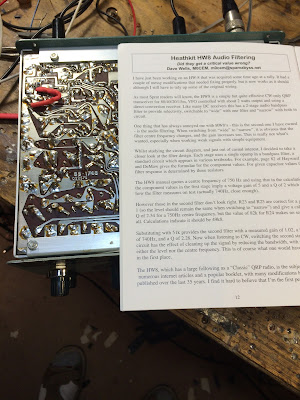
Mod to Correct DESIGN ERROR in Heath HW-8

130k resistor inside heat shrink, across R-24
SPRAT 161 (Winter 2014/15) had a very intriguing article about the Heath HW-8 by Dave M0CEM. Dave wrote about a possible design error in the active filter of the receiver. The center frequency and gain shift significantly when you switch from “Wide” to “Narrow.” I was very interested because for many years I have noticed this problem in my own HW-8. I just left it in “Wide” and never used the more narrow filter.
Dave did some excellent circuit detective work and determined that the problem was R24. He prescribed a change: instead of 82k it should be 49.8k. The placement of a 130k resistor across the 81k R24 would have the same effect.
Yesterday morning I installed Dave’s mod. I did as he suggested and put a 130k resistor across R24. Brilliant! What a difference! In the past, I noticed a significant degradation in signal strength when I put the filter in the “Narrow” position. This doesn’t happen now — the response obviously does narrow, but the center freq stays the same.
It is really amazing to me that the Heath engineers made this error, and that it went uncorrected for so many years. There have been many, many modification articles for the HW-8 over the years, but I haven’t seen any that really address this problem.

If anyone has more info on how this design error happened and why it went uncorrected for so long, please let me know.

Thanks to Dave and SPRAT for getting us back on the straight and narrow.

Listen to Keith Ranger G0KJK on “QSO Today”

http://www.qsotoday.com/podcasts/g0kjk

Wow Eric,

I just listened to all of the Keith Ranger interview and was struck by the eerie parallels between YOUR 24 September podcast and OUR 24 September SolderSmoke podcast:

— Both shows discussed the involvement of Anglican clergy in the hobby.

— Both discussed the joys of simple QRP gear.

— George Dobbs G3RJV came up in both.

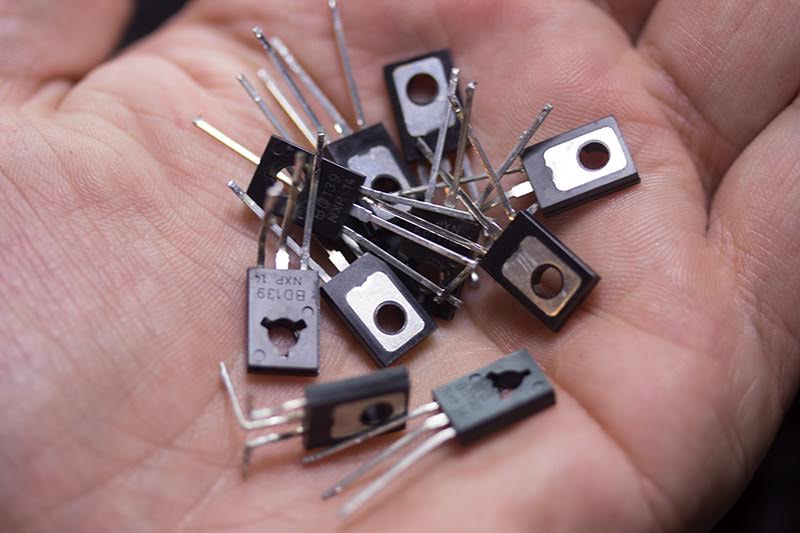
— BOTH featured discussion of the BD139 transistor (!!!)

— Both discussed the use of ceramic resonators in ham circuits.

Great minds think alike!

I really enjoyed your interview with Keith. I have enjoyed reading in SPRAT about his projects — years ago I built his MB4 receiver. I listened while I worked on my homebrew receiver. It was the ideal accompaniment. I also like the stickers on his transmitter.

Please pass this on to Keith if you can.
Thanks and 73 Bill

———————

I also liked Keith’s comments on the joys and perils of amateur electronic engineering.

Dead Chickens and Fake Transistors in Medellin Colombia: HK4DEI’s Micro 40 DSB Rig

Daniel HK4DEI wrote to report that page 149 of the SolderSmoke book was providing some solace and comfort as he struggled to get his version of Peter Parker’s Micro 40 Double Sideband rig going. He was having problems with the amplifier. He was almost at the point of sacrificing chickens to Papa Legba. I wished him luck and told him to hang in there.

Elisa saw my e-mail to Daniel and complained that I hadn’t given him the solution to his amplifier woes. I tried to explain to her that there are sometimes things in this universe that are just UNKNOWABLE. C.F. Rockey W9SCH (who alerted us in SPRAT 22 to the chicken sacrifice option) spoke of transistors that exhibit “quantum mechanical necromancy.” Rockey explained that when this happens, “The transistor simply turns up its toes and dies. Not even an Atomic Physicist can tell you why!”

But Daniel persisted. And he won the battle:

Hey Bill

Did you kill some chickens already? If you did, THANK YOU! If you don’t, then please enjoy a nice sancocho de gallina for me.


But seriously… guess what?

FAKE TRANSISTORS!!!!

I knew I couldn’t be screwing everything up so badly and VK3YE’s circuit couldn’t be so wrong.

I was getting nuts trying to understand why it wasn’t working, changing a single inductor could fry the final instantly or not getting any power out at all (?) also my final BD139 was getting extremely hot, and many of them died with no apparent reason (Page 149!!!!).

I ordered a “good” deal of BD139’s and BD140’s combo for an incredible low price from [A WEB SITE], I’ve ordered many *apparently good components from that site with no problems so far… mainly resistors and capacitors. Having tried everything to get my circuit working and after some quick online search about fake transistors from china my suspicions grew considerably and I remembered some -other- BD139’s I had ordered from Amazon some time ago.

I proceeded to solder the new transistors in place in my PA and Bingo! No more heating of the final and about the expected 0.5W out from my first DSB homebrew rig. I quickly reported to a fellow homebrewer in a local net and the report was amazing! 59 +10, the final transistor was comfortably warm to the touch and my mind could finally rest… lesson learned! What an electromagnetic achievement!

Just wanted to share my success Bill and thank you again for you book and you kind response.

Please say hi to Elisa and the Cristalinhos from a fellow Latin friend.

Clear Skies.

73/72 from Colombia!

Daniel

HK4DEI


SolderSmoke Podcast #184 160 AM and CW, R2 Phasing Receiver, Mailbag

SolderSmoke Podcast #184 is available

http://soldersmoke.com/soldersmoke184.mp3

16 January 2016
— The Radio Amateur is BALANCED
— Pete exhibits CLEAR symptoms of Dilbert’s disease!
— Santa brought me a 160 meter antenna
— Ground Radial systems large and small
— Clip lead L network
— ON THE AIR ON 160!
— AM contacts
— SKN 160 CW with sidetone from the DX-100 transformer
— Stations with character and personality on 160 AM
— Pending projects for the AM station
— R2 phasing receiver Trials and Tribulations
— Bill’s Astatic D-104 goes into rebellion
— Ramsey Kits closing down
— SPRAT 165, Sidetone, M0XPD’s VXO
— “The Martian” movie
— Little Gustavo is doing well. Thanks to all.
— MAILBAG (an especially good one)

SolderSmoke Podcast #181 Of Dongles and DX-100s — SDR vs. HDR, Music & Art, 2B, HB2HB, Noise, The Martian, VK3YE’s New Book

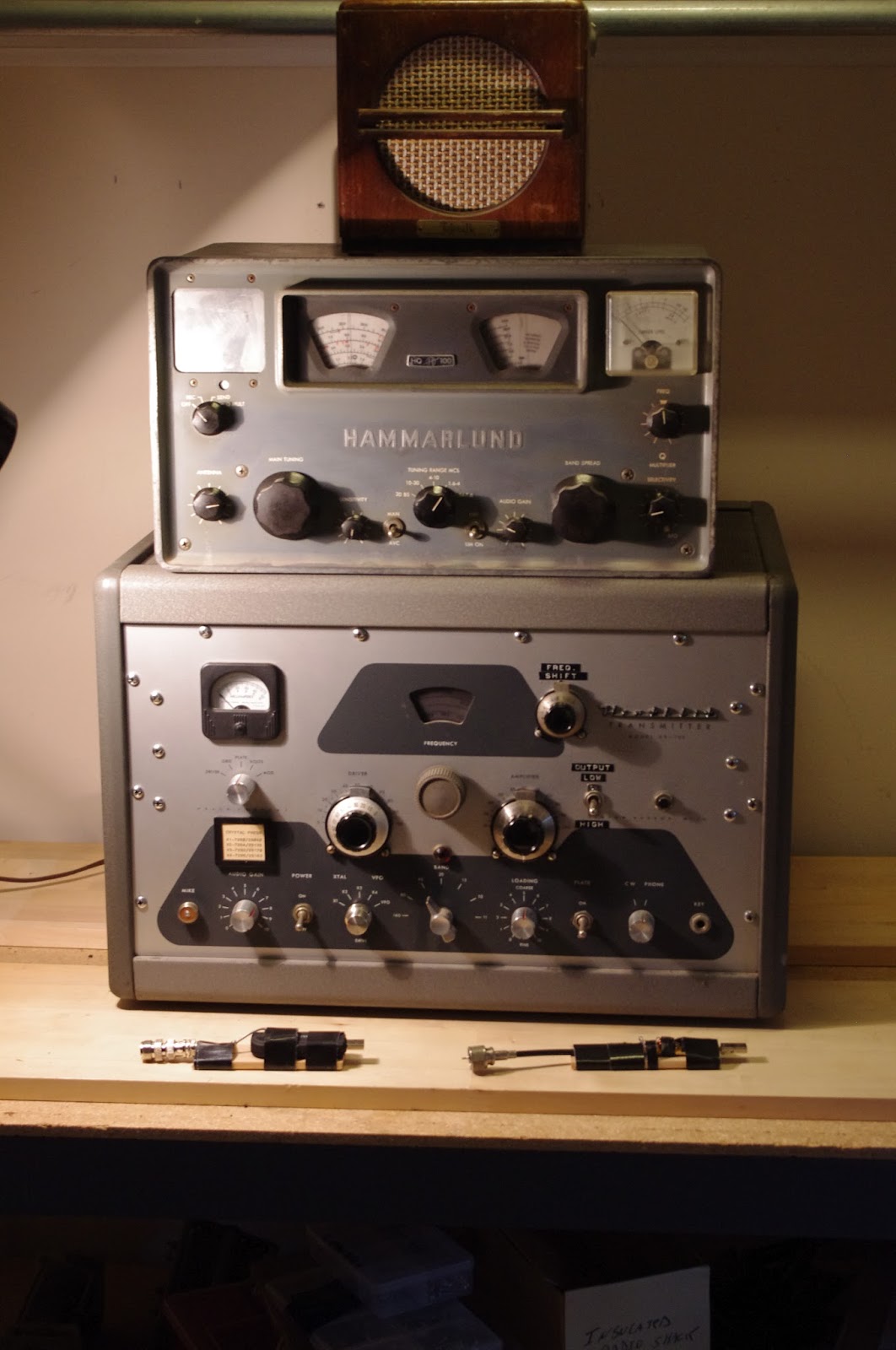
Two RTL SDR Dongles in front of a DX-100 Transmitter

SolderSmoke Podcast #181 is available:

17 October 2015

— Our audience IGNORES Pete’s guitar intro!
— Pete on QSO Today Podcast.
— Part 97, The Radio Art and International Goodwill.
BENCH REPORTS:
— Pete connects his new beam to the KX3.
— Pete puts the Bell-thorn on 20.
— Simple-ceiver update.
— Pete’s new drum machine: http://makezine.com/2015/10/15/learn-electronics-worlds-oldest-drum-machine/
— Bill fights noise in the DIGI-TIA.
— Bill fights power-line noise (and wins!).
— Drake 2B, skirts, reduction drives, and tuning rates.
— Warming up (with!) the DX-100.

— N2CQR — N6QW First Ever HB2HB QSO.

— On 40 AM with an HT-37
— Listening to Chinese CubeSats.
— SDR Dongle as a bandwidth checker.

— SDR and the Future of Homebrew Radio.

— Bryan’s LBS Receiver.
— Dean’s First Ever QSO with his HB rig.

— 32 Mighty Mites Completed

— The Martian — Did Mark Watney REALLY have the Knack?

— MAILBAG:
Peter Parker’s New Book
Sparks from Ron Sparks
Armand’s 1Watter
Rogier’s pyro machine
BIG boxes from Tim KI6BGE
Mikele’s ZIA and N6QW rig collection
SPRAT 141 and SPRAT 164

SolderSmoke Podcast #181 Of Dongles and DX-100s — SDR vs. HDR, Music & Art, 2B, HB2HB, Noise, The Martian, VK3YE’s New Book

Two RTL SDR Dongles in front of a DX-100 Transmitter

SolderSmoke Podcast #181 is available:

17 October 2015

— Our audience IGNORES Pete’s guitar intro!
— Pete on QSO Today Podcast.
— Part 97, The Radio Art and International Goodwill.
BENCH REPORTS:
— Pete connects his new beam to the KX3.
— Pete puts the Bell-thorn on 20.
— Simple-ceiver update.
— Pete’s new drum machine: http://makezine.com/2015/10/15/learn-electronics-worlds-oldest-drum-machine/
— Bill fights noise in the DIGI-TIA.
— Bill fights power-line noise (and wins!).
— Drake 2B, skirts, reduction drives, and tuning rates.
— Warming up (with!) the DX-100.

— N2CQR — N6QW First Ever HB2HB QSO.

— On 40 AM with an HT-37
— Listening to Chinese CubeSats.
— SDR Dongle as a bandwidth checker.

— SDR and the Future of Homebrew Radio.

— Bryan’s LBS Receiver.
— Dean’s First Ever QSO with his HB rig.

— 32 Mighty Mites Completed

— The Martian — Did Mark Watney REALLY have the Knack?

— MAILBAG:
Peter Parker’s New Book
Sparks from Ron Sparks
Armand’s 1Watter
Rogier’s pyro machine
BIG boxes from Tim KI6BGE
Mikele’s ZIA and N6QW rig collection
SPRAT 141 and SPRAT 164

Dongle Update — Dongles, FUNcubes, Meteors, QRP, and SPRAT

Hi Bill, Pete,

Ken Marshall G4IIB here the guy that wrote the SDR Primer in Sprat 162. I have been listening to your excellent podcasts. You guys cover a lot of ground in the May issue and touched on to the SDR dongle, its potential for future developments etc. I noted that you where going to buy another to cover VHF. Well if it ain’t too late consider this New version by Newsky they are already getting difficult to get a hold of and are only available in the USA. It uses an R820T2 tuner (better LNA) an upgraded and stable crystal oscillator, a reinforced antenna coax and socket. The one I managed to get hold of also had a modified PCB with solder pads for the the Q channel (pins 4&5) to connect the toroid. Incredable at 22 of your Bucks. See the pictures and read all about it on amazon.com.

http://www.amazon.com/gp/product/B00QFCNNV0/ref=as_li_tl?ie=UTF8&camp=1789&creative=390957&creativeASIN=B00QFCNNV0&linkCode=as2&tag=rsv0f-20&linkId=VNHED72IVHA5O2KT

All we need is for them to slot a 12 or 16 bit ADC in and we could have a truly great SDR receiver.

I noticed in your podcast you mentioned radio astronomy and satellite reception. Ironicaly back in 2013 this is how I started with SDR dongles. I read an aticle on the web on meteor scatter and started experementing with a dongle. Meteor scatter hunting is a bit like watching paint dry unless there is a known storm. So this led me on to the Funcube satellites. The signals from which although QRP 200mW are very stong and you can receive them on almost any antenna. The funcube dashboard software is available for free from AMSAT and alows you to download telemetry. You can also listen to amateur SSB an CW transmissions. There are lots of satellite tracking software available too. This then led onto weather satelite picture reception I built a 4 ele turnstile antenna for this but I found that I needed an LNA for reception at my location. I then started to listen to the amateur bands. Like you Bill I became interested in radio at the age of 11 and got licensed in the early 70’s but work commitments meant I had a 30 year absence from Ham Radio until I stumbled on these SDR Dongles. They got me back into the hobby and I joined the GQRP Club. I noticed that almost no one in the QRP fraternity was talking about RTL SDR hence I started writing the Primer and submitted it to George in late 2014 for publication in Sprat. As you know it appeared in the Spring Sprat and seems to have generated lots and lots of interest in the QRP community. I am delighted by this response and look forward to lots more interesting articles and podcasts. Have fun with your dongle.

Ken G4IIB

PS I wrote another article on getting these dongles to work under Linux. Linux uses completely different architecture so that the software used is completely different to windows. I notice that the software I use for Linux is also available on Mac OS which uses similar architecture (UNIX) so in theory it should also work on a Mac. Quite a few people have expressed an interest in getting a dongle to work on a Mac. As I do not poses a Mac I have not tried this out.

Funcube Dashboard

Our book: “SolderSmoke — Global Adventures in Wireless Electronics” http://soldersmoke.com/book.htm Our coffee mugs, T-Shirts, bumper stickers: http://www.cafepress.com/SolderSmoke Our Book Store: http://astore.amazon.com/contracross-20

SolderSmoke Podcast 176: Knack-Related Conditions: Termination Insensitivity, Sideband Inversion, Dongle Modification, Area 5351 Conspiracy Disorder

SolderSmoke Podcast #176 is available! (And it is GOOD!)

http://soldersmoke.com/soldersmoke176.mp3

16 May 2015

Bench Update:
Pete releases some magic (amplifier) smoke
Pete’s new termination-insensitive transceiver makes first contact
Bill goes Yaesu (well, just a filter)
Juliano Mill-Pad boards
Termination Insensitivity is not a personality disorder!
Flip those Bilat Boards! Pete’s cool technique for bilat building
Bill’s project notebook and stage testing
Installing the W6JFR EMRFD SBL-1 Bal-Mod Mod

AREA 5351: Myths, Urban Legends, and Conspiracy Theories about the Si5351

A Rule of Thumb for Sideband Inversion

Dongle Madness and the Dangers of Dongle Modification
What is a dongle?
24 Mhz to 1.7 GHz right out of the box
Modification for 0-29 MHz
Tapping the IF of a Drake 2-B
Getting another one for VHF-UHF
Dongling Meteors, Satellites and Airplanes

SPRAT cover AD9850 in 1988! Three cheers for SPRAT (and QQ and QST).

Elecraft’s new Rig

Our book: “SolderSmoke — Global Adventures in Wireless Electronics” http://soldersmoke.com/book.htm Our coffee mugs, T-Shirts, bumper stickers: http://www.cafepress.com/SolderSmoke Our Book Store: http://astore.amazon.com/contracross-20

SolderSmoke Podcast 176: Knack-Related Conditions: Termination Insensitivity, Sideband Inversion, Dongle Modification, Area 5351 Conspiracy Disorder

SolderSmoke Podcast #176 is available! (And it is GOOD!)

http://soldersmoke.com/soldersmoke176.mp3

16 May 2015

Bench Update:
Pete releases some magic (amplifier) smoke
Pete’s new termination-insensitive transceiver makes first contact
Bill goes Yaesu (well, just a filter)
Juliano Mill-Pad boards
Termination Insensitivity is not a personality disorder!
Flip those Bilat Boards! Pete’s cool technique for bilat building
Bill’s project notebook and stage testing
Installing the W6JFR EMRFD SBL-1 Bal-Mod Mod

AREA 5351: Myths, Urban Legends, and Conspiracy Theories about the Si5351

A Rule of Thumb for Sideband Inversion

Dongle Madness and the Dangers of Dongle Modification
What is a dongle?
24 Mhz to 1.7 GHz right out of the box
Modification for 0-29 MHz
Tapping the IF of a Drake 2-B
Getting another one for VHF-UHF
Dongling Meteors, Satellites and Airplanes

SPRAT cover AD9850 in 1988! Three cheers for SPRAT (and QQ and QST).

Elecraft’s new Rig

Our book: “SolderSmoke — Global Adventures in Wireless Electronics” http://soldersmoke.com/book.htm Our coffee mugs, T-Shirts, bumper stickers: http://www.cafepress.com/SolderSmoke Our Book Store: http://astore.amazon.com/contracross-20

SDR Dongle Modified for HF. Watch it work on 40 meters (VIDEO)

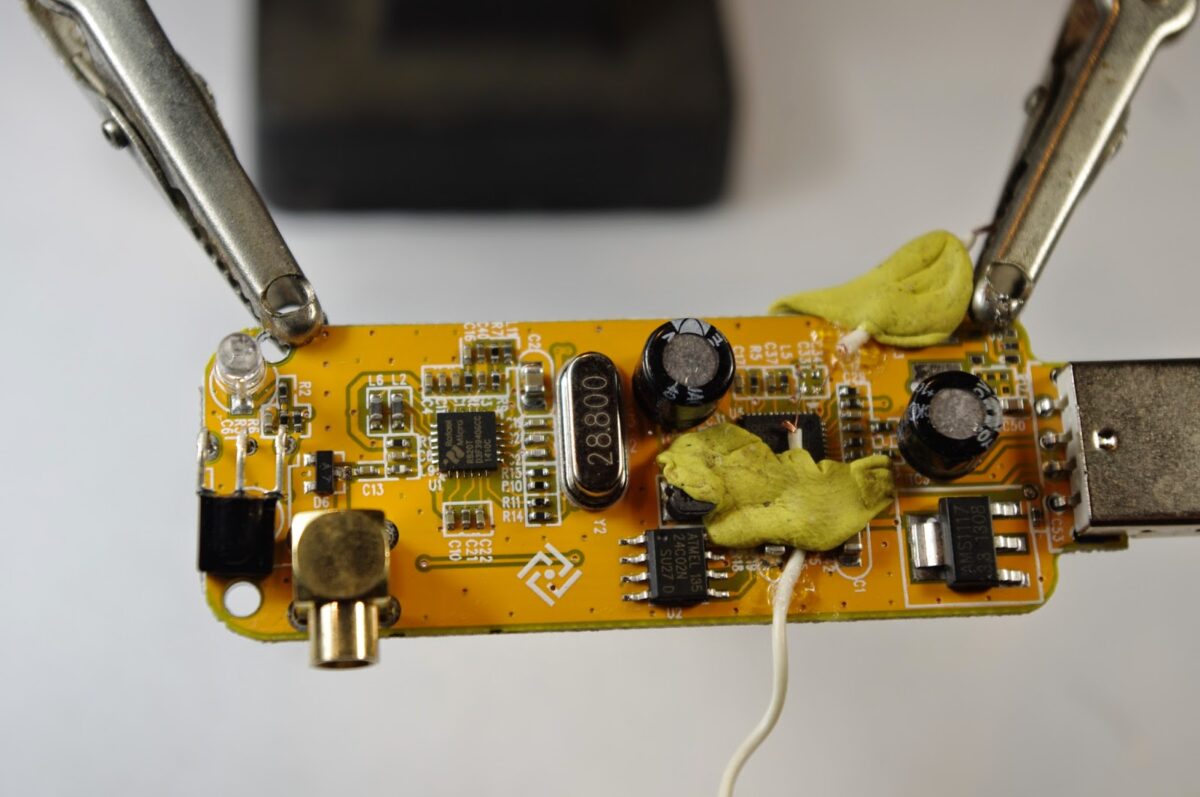
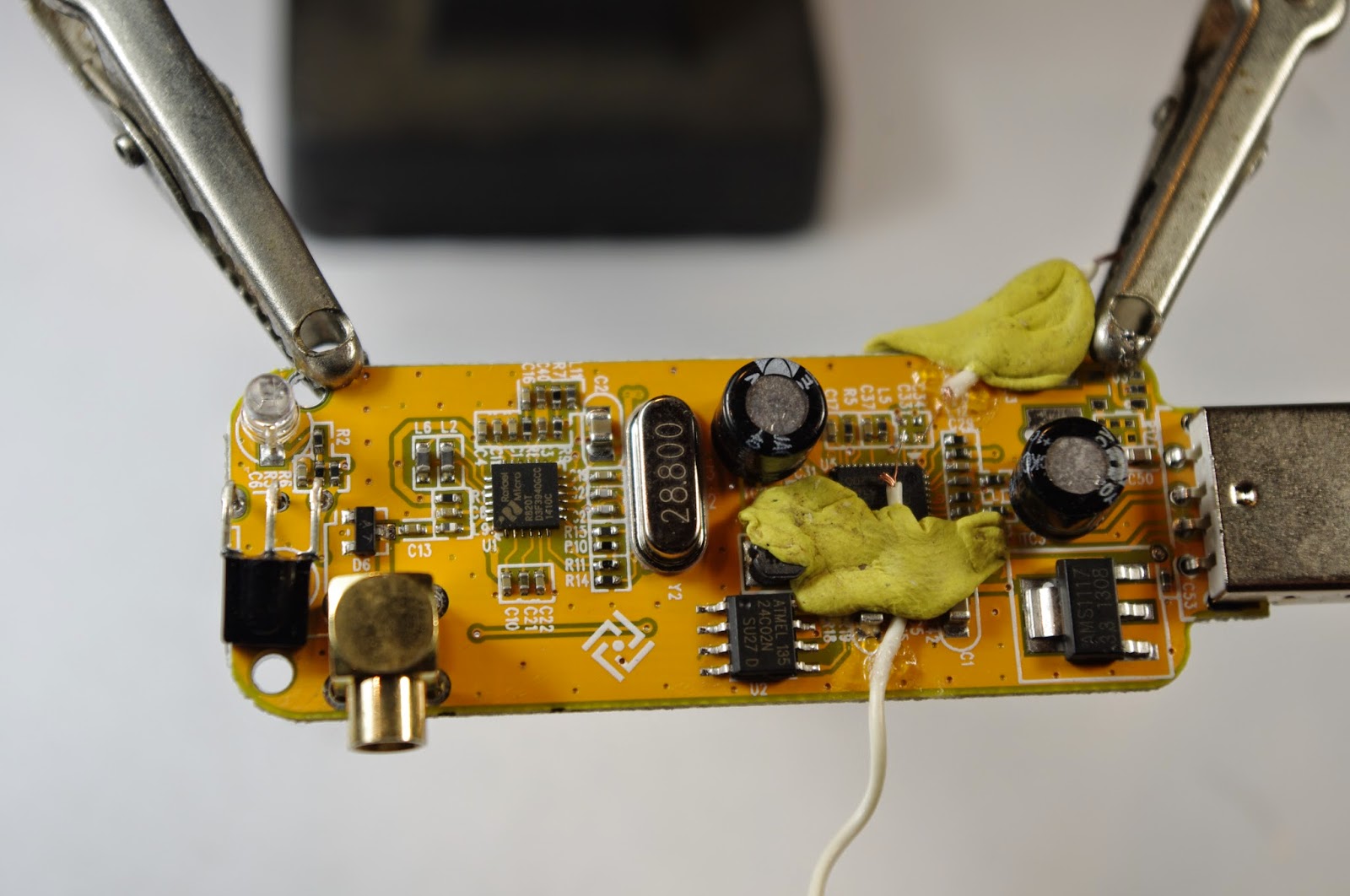
With SPRAT 162 by my side, armed with an FT37-43 trifilar wound transformer, I popped open the RTL-SDR dongle. I had hopes of being able to solder two tiny wires to the unused input pins (3 and 4) but I quickly realized that I was NOT going to be able to do that — they are far too small for me to work on. So I did what Ken Marshall G4IIB did: I took out the SMT caps going to pins 1 and 2 and soldered two small wires there. This will limit this dongle to HF only — if I want VHF/UHF I’ll just spend another $13 dollars! You can see the results in the video above.

I used the yellow stuff to hold the wires in place. It was later removed.

Tony Fishpool did a neater job. See his work here:
https://dl.dropboxusercontent.com/u/1987387/Even_more_on_using_the_RTL2832U_Dongle.pdf

Our book: “SolderSmoke — Global Adventures in Wireless Electronics” http://soldersmoke.com/book.htm Our coffee mugs, T-Shirts, bumper stickers: http://www.cafepress.com/SolderSmoke Our Book Store: http://astore.amazon.com/contracross-20

“Dongle” USB SDR Receiver $13 (VIDEO)


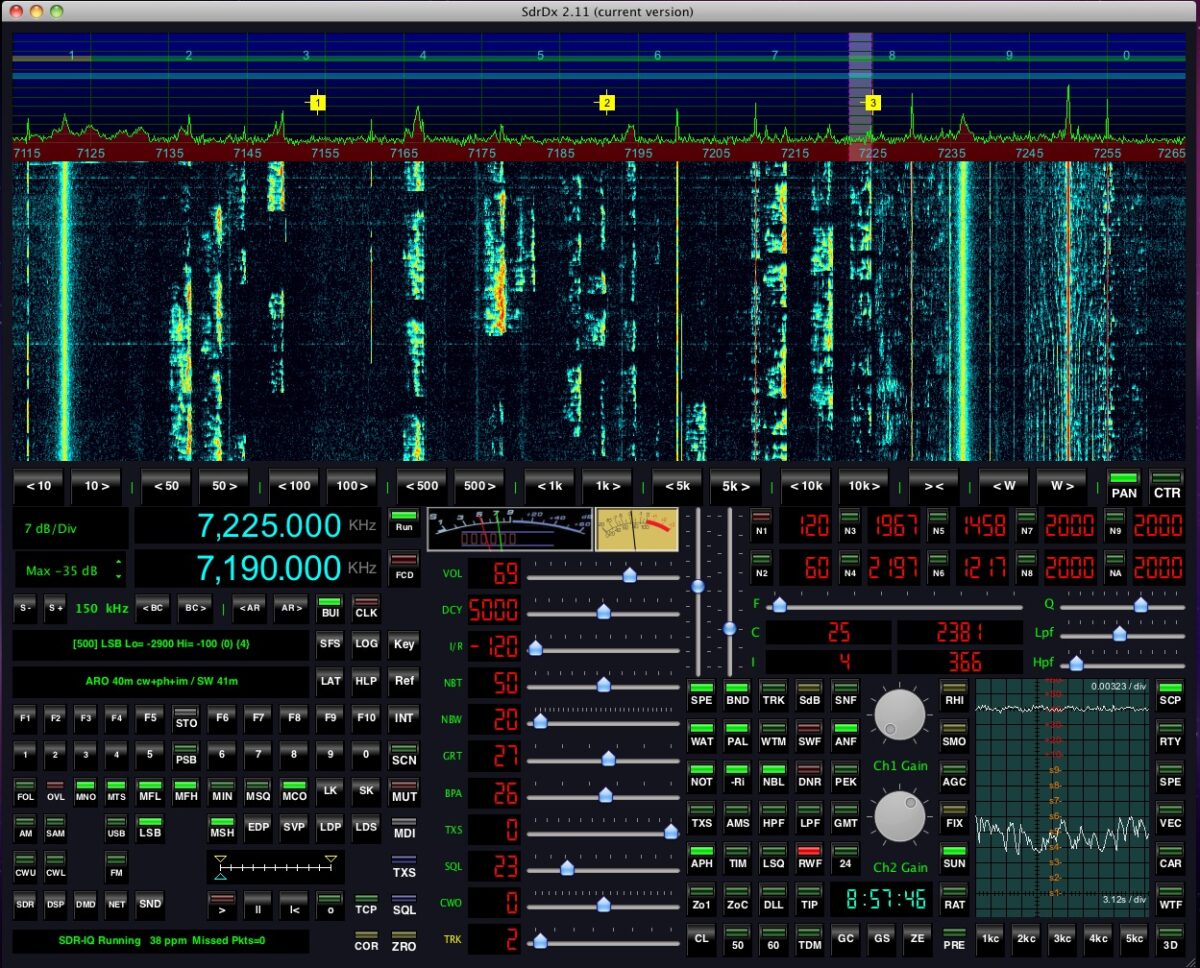
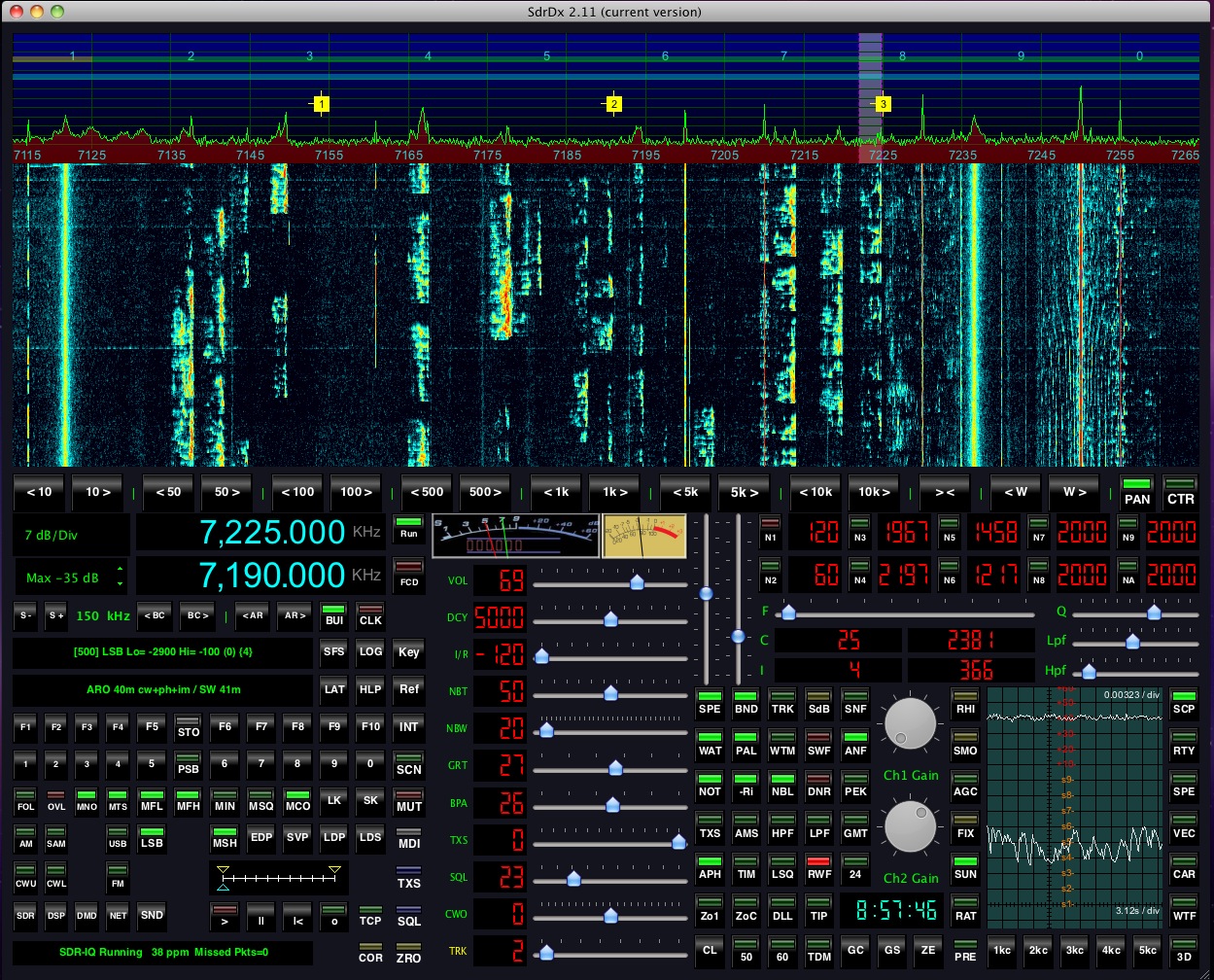
I was recently commenting to Pete that I could use some gear that would give me a better means of checking the bandwidth of my transmissions. Pete. pointed to the latest issue of our much-loved SPAT magazine. Indeed on SPRAT 165 (Spring 2015) there is an article by Ken Marshall G4IIB on how use the RTL2832u R820T DVB-T “dongle” (USB stick) as an SDR receiver. I sent 13 dollars to Amazon. The device arrived yesterday. I followed Ken’s instructions and soon I had the little device inhaling on 12 meters. It is really amazing. Lots of technology in a little box the size of your thumb! I use it with the free HDSDR software and have been listening to 12 and 10 CW and SSB. See the video above. Tomorrow I will attempt Ken’s mod that will open up the other HF bands. Then I will be able to put to use a second SPRAT article about this device : Also in SPRAT 165 Tony Fishpool G4WIF describes how to use this device as a rudimentary indicating instrument for bandwidth measurements.

Great stuff. Get yourself one of these devices. You will in effect be getting an all-band all-mode computer controlled receiver for $13 !!!!!!!!!!!!!!

I got this one:

http://www.amazon.com/gp/product/B00D3GRU24/ref=oh_aui_detailpage_o00_s00?ie=UTF8&psc=1

Thanks Ken, thanks Tony.


Our book: “SolderSmoke — Global Adventures in Wireless Electronics” http://soldersmoke.com/book.htm Our coffee mugs, T-Shirts, bumper stickers: http://www.cafepress.com/SolderSmoke Our Book Store: http://astore.amazon.com/contracross-20

SolderSmoke #171 DC RX in QQ, Power Supplies, Small Screens, 12 Buck Counters, HW8 Error?, KX3 RX

SolderSmoke Podcast #171 is available:

http://soldersmoke.com/soldersmoke171.mp3

Bench Report:
Pete’s Small Screens (in Color!)
Si5351s
Bill’s Graph Paper Frequency Readout
Bill’s Broadened Barebones Barbados RX. DIGITIZED!
Another AD9850 DDS using M0XPD Kanga UK Shield
New 13 dollar Color Display (Prettier than Graph paper!)

Pete and Ben’s Article in QRP Quarterly Available free here:
http://www.qrparci.org/qqsample/qqsample.pdf

The DEEP SPIRITUAL REWARDS of DC Receivers
The Importance of Good Power Supplies
SPRAT Article on HW8 Design Error
Latest Edition of Hot Iron
Elecraft KX3 — Has one of the best receivers in the world

Our book: “SolderSmoke — Global Adventures in Wireless Electronics” http://soldersmoke.com/book.htm Our coffee mugs, T-Shirts, bumper stickers: http://www.cafepress.com/SolderSmoke Our Book Store: http://astore.amazon.com/contracross-20

A Thatched Roof, Some Palm Trees, A Dipole, and a Homebrew Rig


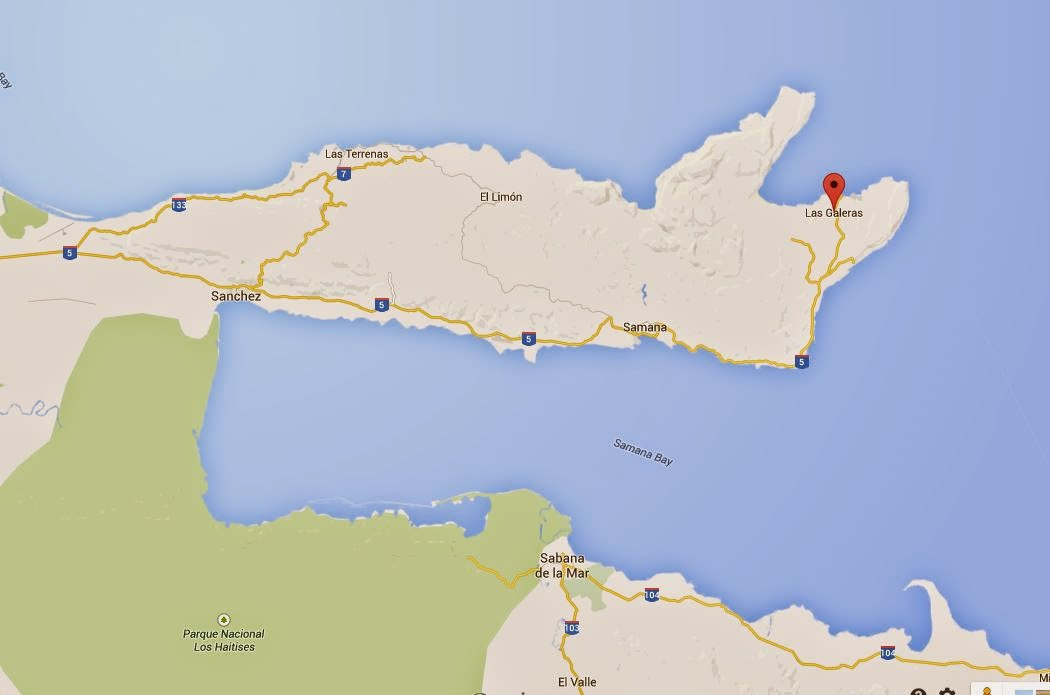
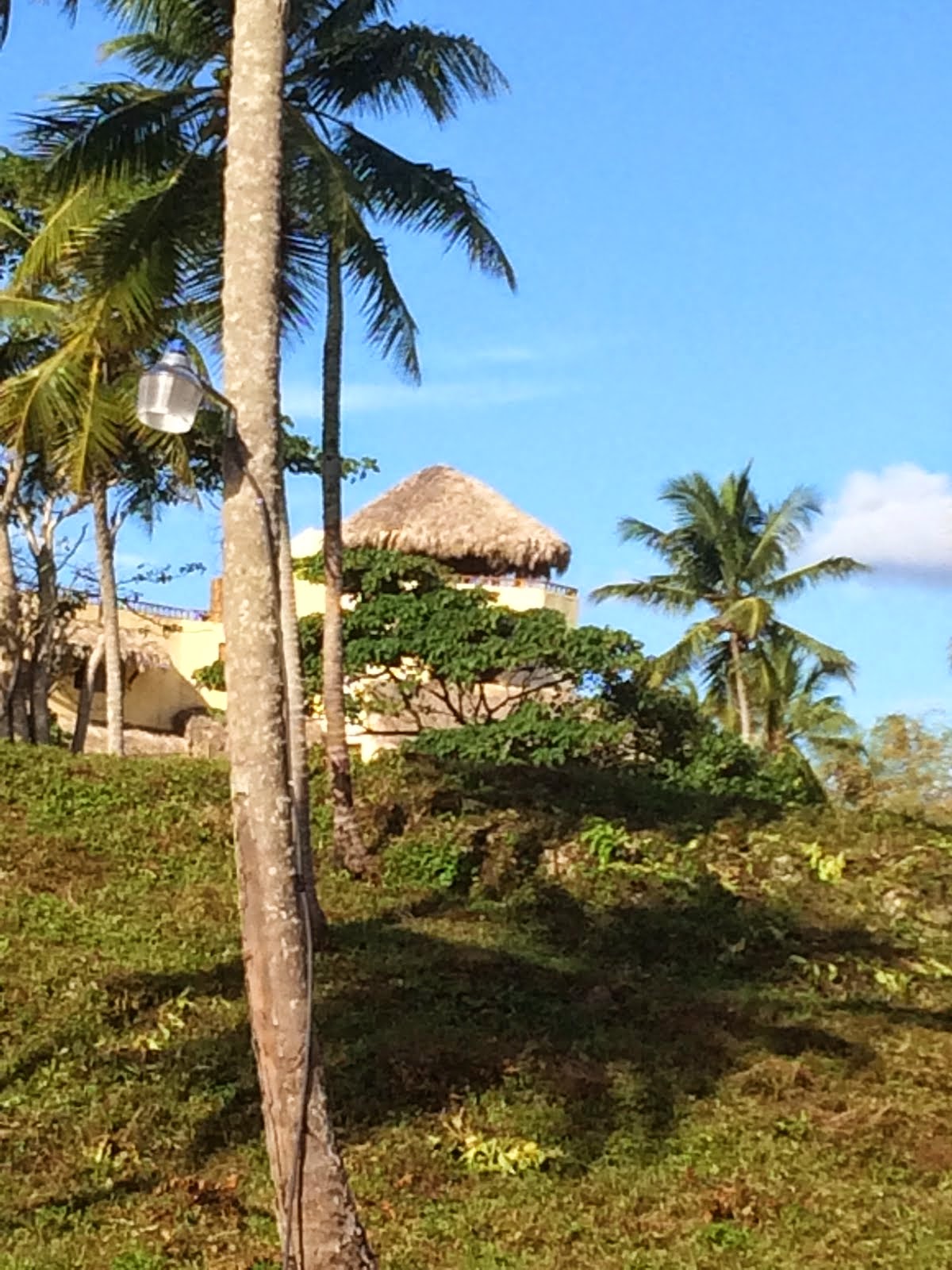
Look at the drawing above. That is the banner logo of Rod Newkirk’s column in QST magazine. For many years Rod regaled us with exciting reports on the activities of intrepid foreign radio amateurs, transmitting from exotic locations using ingeniously devised homebrew radio equipment. Look at the picture on the left side. See the palm trees? See the thatched roof shack with the dipole antenna? Well, that’s pretty close to what it was like for me out on the Samana Peninsula in the Dominican Republic last month.

I set up the station under the thatched roof in this picture:

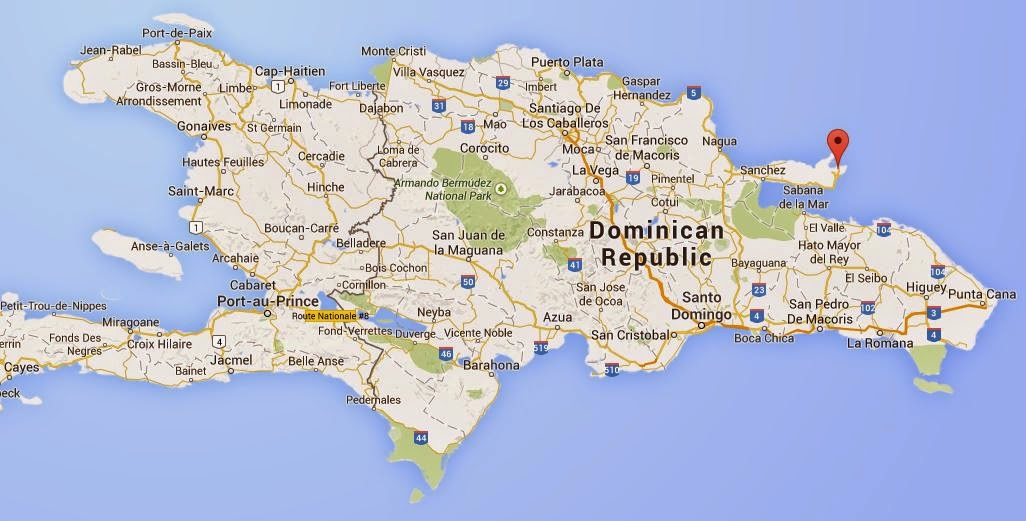
The red pins mark the spot:

Here I am, tuning the rig while looking across Bahia Rincon:

The rig was my Azores-built, oft-modified, NE602-based, ceramic resonator DSB transceiver with a recently added India-designed BITX IRF510 RF amplifier chain. A little article I wrote about the ceramic resonator VXO was featured in SPRAT 127. My antenna was a half wave dipole strung up in the thatched roof. Power came from 10 AA Batteries. So this was the Double A, Double Sideband, Dipole DX-pedition.

I had given some thought to building an SSB rig for this trip, but because of the efforts of Peter Parker, VK3YE, I felt compelled to take a DOUBLE Sideband rig with me to the beach.

Here is an old (2006) video on the rig. The power amplifier has been significantly modified:


Here is some more information on the rig, including a schematic for the receiver and the SPRAT article on the Variable Ceramic Oscillator:

http://www.gadgeteer.us/PORTABLE.html

Here is the log book for my contacts.

17 DECEMBER 2014
W1JPR PAUL MT. DESERT ISLAND MAINE
8P6AE (BARBADOS) COULD BARELY HEAR ME, BUT GOOD QSO

18 DECEMBER 2014
N4USA DAVE IN FLOYD, VA. FAIRS NET. (KK4WW.COM)
KE4UGF DON ALSO FAIRS, NICE GUYS. FUN CONTACTS!
KA4ROG ROGER NORTH OF ORLANDO

19 DECEMBER 2014
WB2HPV GUIDO TALKING TO ITALIANS EVERY MORNING FROM WAYNE NJ. HE HAD TROUBLE HEARING ME.
CONDITIONS SEEMED POOR, BUT I WAS HEARING AUSTRALIAN STATIONS
W8GEO GEORGE IN THE INTERCON NET. HEARD ME. ALSO ON INTERCON: KA4AOQ AND 6Y5MP (JAMAICA) ALSO HEARD ME.
N4PD PAUL
W3JXY/4 NAT IN KEY WEST
N1FM TOM, NORTH OF MIAMI SOLID QSO.
KM4MA PAUL IN ORLANDO WITH MARITIME MOBILE NET.

20 DECEMBER 2014
NA2LF LLOYD IN NY
WB8YWR JIM IN DALLAS
KM4MA.
W1AW/3 IN MARYLAND (TOOK ME A WHILE TO GET HIM)

21 DECEMBER 2014 NICE 4 WAY SPANISH LANGUAGE QSO:
KI4PZE MIGUEL
CO8OT JUAN IN SANTIAGO DE CUBA
WA4RME RAFA IN CHARLESTON S.C.

C08KB MARCO IN CUBA


Here is a short video showing the station and the location. Note the little birds (Golondrinas or Swallows) flying by. They nest in the thatched roof. They often got confused and flew inside the house. Billy and Maria rescued many of them. Whales breed in this bay in January and February. There are also manatees. It is really a beautiful place.

There were obviously other attractions (!) so I didn’t spend a lot of time on the radio — just a half hour or so every now and then. But it was really very satisfying to carry this little homebrew device with me, set it up in this amazing place, and use it to send my voice across mountains and hundreds of miles of ocean. I built this rig in the Azores and have used it in the UK, France, Italy and the Dominican Republic. It contains circuits devised by members of the British QRP club and by my friend Farhan in India. The ceramic resonator circuit is something I cooked up on my own. The microphone is from my old Sony Walkman and the pen that serves as its support is from that wonderful magazine “Electric Radio.” In short, there is a lot of soul in this little machine. And it was a lot of fun to take it to the beach.

Thanks to Elisa for finding us this wonderful place. And to Rod Newkirk and QST for the DX inspiration.

Our book: “SolderSmoke — Global Adventures in Wireless Electronics” http://soldersmoke.com/book.htm Our coffee mugs, T-Shirts, bumper stickers: http://www.cafepress.com/SolderSmoke Our Book Store: http://astore.amazon.com/contracross-20

Graham G4UEK has THE KNACK

Thanks to Stephen for alerting me to the homebrew page of Graham G4UEK:

http://www.sandrock.org.uk/radiostuff/Rigs.htm

I really liked the description of his progress as a homebrewer, and the way he was helped by G-QRP, SPRAT and Ian G3ROO. FB.

Graham has a nice personal ham radio story:

http://www.sandrock.org.uk/radiostuff/Radio.htm

Thanks Stephen! Thanks Graham!

Our book: “SolderSmoke — Global Adventures in Wireless Electronics” http://soldersmoke.com/book.htm Our coffee mugs, T-Shirts, bumper stickers: http://www.cafepress.com/SolderSmoke Our Book Store: http://astore.amazon.com/contracross-20

Pete Juliano’s Bilateral Rigs (with videos)

Hi Bill,
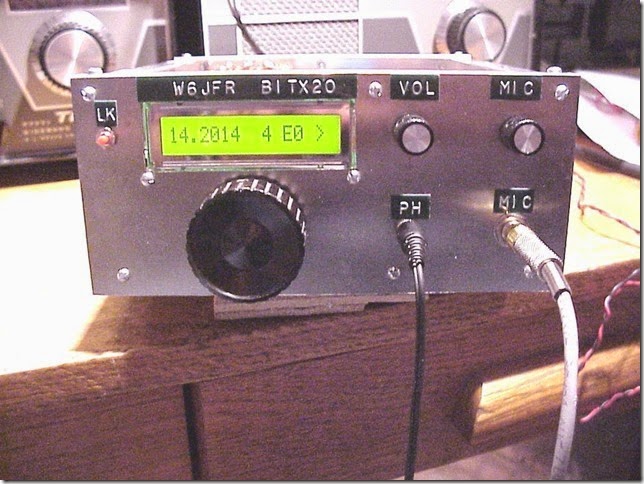
I was finally getting around to reading one of the recent SPRAT’s and saw a photo of your magnificent BITX17. Congratulations! A tip of the hat to Farhan for that very excellent design and it truly is a design that has traveled the world and made a radio available to many who otherwise would not be on the air.
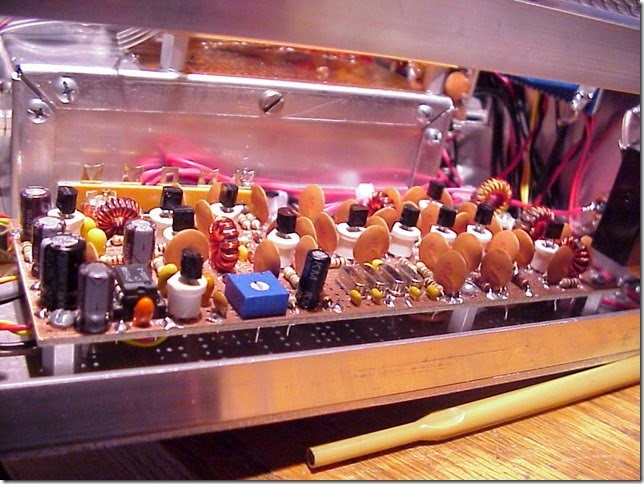
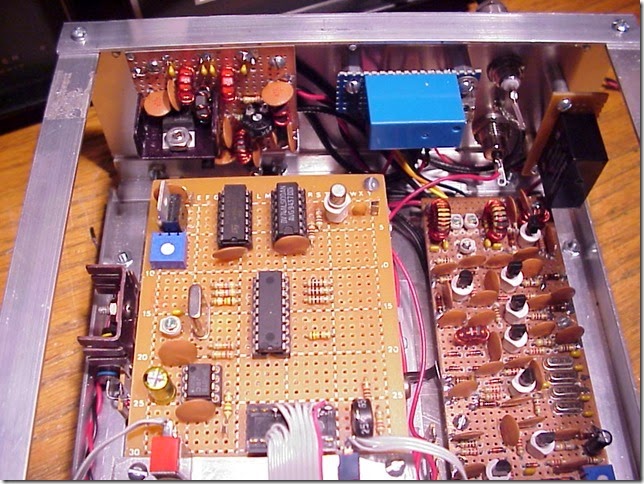
It is a very robust design as I scratch built one in 2005 (or maybe 2006) and just for fun socketed every transistor so I could try various devices. I even had a bag of 2N706’s dating back to the late 1960’s. They all worked except for the carrier oscillator where I just couldn’t get enough swing in the oscillator to correctly place the CIO on the filter slope. That I attribute to the junction capacitance of the 2N706. By far the lowly 2N3904 that I bought for 4 cents each worked the best. Back when I built this I was W6JFR. Adding the EI9GQ frequency stabilizer really added a nice touch to the radio.
I should also tell you that when I built the radio my intent was to uses a piece of single sided copper vector board for the main chassis. It was the weekend and I didn’t realize the piece I had was not big enough for the project. So I took a piece of standard perf board and overlaid that on top of a piece of single sided copper PC board –AND hand drilled all of the holes – I went blind, cross-eyed and had a terrible hangover after consuming 6 beers in a short time span! See the photos below.
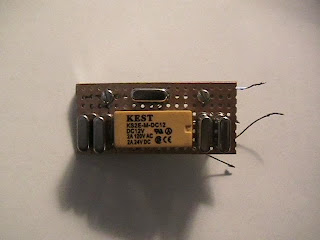
BTW I also built a 17M SSB transceiver using the bilateral amp stage from G4GXO as appeared in the SPRAT 128. That used a 4.9152 MHz IF and a 23 MHz Super VXO. In the case of the VXO I used 11.52 MHz crystals in the VXO and used a diode doubler to put the LO at 23 MHz. With the doubler –you get the bonus of 2X the frequency shift of the Super VXO. I also had made a custom set of crystals and used a small relay to switch those into the circuit and that essentially gave me almost the full SSB Band coverage. You can see that here
Also I have been using a simple bilateral stage consisting of a 2N3906 and 2N3904 and the results have been amazing. The latest work is a follow on to my shirt pocket transceiver and uses SMD components. See attached.
Here are some videos of the latest –which is now a two bander 40 and 20M. (Originally it was 75 and 40M)
Have fun – this is such a wonderful hobby!
73’s
Pete N6QW

Our book: “SolderSmoke — Global Adventures in Wireless Electronics” http://soldersmoke.com/book.htm Our coffee mugs, T-Shirts, bumper stickers: http://www.cafepress.com/SolderSmoke Our Book Store: http://astore.amazon.com/contracross-20

Standard Computer Crystals for 17 Meter SSB VXO and IF Filter

Pete Juliano, N6QW, is an electronic genius. The ideas in his SPRAT article will be of great use to all those who share in Doug DeMaw’s devotion to VXOs and reluctance to spend money. I’m really tempted to go back and re-do my BITX using Pete’s 11.52 MHz computer crystal super-VXO and 4.9152 IF (I could then take my expensive 23.1 MHz crystals and put them back in my Doug DeMaw Barebones Superhet). I also like Pete’s DPDT reed relay crystal switcher too. Three cheers for Pete Juliano, Doug DeMaw, and SPRAT! And thanks to WB9FLW for reminding us of Pete’s articles.

Hi Bill,

Your BITX17 really has me fired up! I came across an interested Super VXO by Pete N6QW for use on 17 Meters.

He uses standard computer xtals (4.9152 MHz for the IF) and (3 – 11.520 MHz freq doubled in the VXO)

This gets you on 18.120 to 18.150 using these two standard xtals.

See Link Below:

http://www.jessystems.com/SPRAT%20Article.pdf

https://www.homebrewradio.us/blog/wp-content/uploads/2013/11/2320MHz20VXO.jpg

Thanks for all your efforts they are much appreciated!!

Best Wishes,

Pete WB9FLW

Our book: “SolderSmoke — Global Adventures in Wireless Electronics” http://soldersmoke.com/book.htm Our coffee mugs, T-Shirts, bumper stickers: http://www.cafepress.com/SolderSmoke Our Book Store: http://astore.amazon.com/contracross-20

Occam’s Microcontroller

Paul, M0XPD, has what I’m sure is a wonderful article on a simple microcontroller-based rig in the current issue of our beloved SPRAT. I look forward to seeing it. And I really like the logo with William of Occam (of razor fame). I have encouraged Paul to take a break from the microcontrollers and build something discrete and analog… like a BITX!

Our book: “SolderSmoke — Global Adventures in Wireless Electronics” http://soldersmoke.com/book.htm Our coffee mugs, T-Shirts, bumper stickers: http://www.cafepress.com/SolderSmoke Our Book Store: http://astore.amazon.com/contracross-20