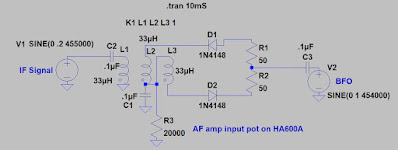
How Does My Singly Balanced, Two-Diode, Single Transformer Product Detector Really Work?

As young James Clerk Maxwell used to say, “What’s the go of it?” and “What’s the particular go of it?”

I studied this circuit carefully when I was using it as a balanced modulator in my DSB rigs. I wrote up my conclusions in my book “SolderSmoke — Global Adventures in Wireless Electronics.”

BALANCED MODULATOR CONFIGURATION:

When I was using it as a balanced modulator, I had the RF “carrier” signal going into L1. This RF signal was 7 dbm, enough to switch the diodes on at voltage peaks. With the “center tap” of L2/L3 grounded for RF, this meant that when the “top” of L2 is negative, the “bottom” of L3 is positive. In this situation BOTH D1 and D2 will turn on and conduct.

When the top of L2 is positive, the bottom of L3 is negative and neither of the diodes is on. Neither conducts.

So we have the RF signal turning the diodes on and off at the frequency of the RF signal.

Audio from the microphone and mic amplifier is sent into the center tap connecting L2 and L3. The level of this audio is kept low, below the point where is could turn on the diodes. The center tap IS grounded for RF by the .1uF capacitor, but it is NOT grounded for AF. That is key to understanding this circuit.

In essence by turning the two diodes on and off at the rate of the RF signal, the audio signal is facing severe non-linearity through the diodes. We could say it is alternately being multiplied by 1 and 0. This non-linearity is what is required for mixing. We therefor get sum and difference products: Sidebands. At this point, Double Sideband.

The way the transformer is set up means the RF carrier signal is balanced out: Even when the two diodes conduct, the top of R1 and the bottom of R2 are of equal and opposite polarity, so there is no carrier signal at the junction of R1 and R2 (they are actually a 100 ohm variable resistor that can be adjusted to make SURE they balance out). So the carrier is suppressed and all that remains are the sidebands: Suppressed Carrier Double Sideband.

PRODUCT DETECTOR CONFIGURATION:

What happens when we use this circuit as a product detector in a receiver? Let’s assume we are working with a 455 kc IF. If you run a 454 kc 7 dbm BFO signal into L1, it will turn the diodes on and off as described above. But you will NOT be able to put the 455 kc IF signal into the center tap of L2/L3 — that center tap is GROUNDED for 455 kc. So you will have to run your IF signal into the resistors, and take the audio output from the center tap of L2/L3. This works. I tried it in my HA-600A. But there is a problem: Envelope detection.

In this arrangement, we are balancing out NOT the 455 kc IF signal, but instead we are balancing out the BFO. We don’t really NEED to balance out the BFO — it can easily be knocked down in the audio amplifiers, and IT is not responsible for the problematic envelope detection. We DO need to balance out the IF signal, because if that gets through we can get simultaneous “envelope detection” and product detection. And believe me, that does not sound good.

So I tried putting the IF signal into L1, and the BFO signal into the resistors (as shown above). I took the audio from the junction of L2/L3. This seemed work better, with envelope detection greatly reduced.

BUT WHAT’S THE GO OF IT?

But how is this circuit mixing in this configuration? The strong BFO signal is still controlling the diodes, BUT, with the BFO signal coming in through the resistors, when the top of R1 is positive the bottom of R2 is ALSO positive. In this situation D1 will conduct but D2 will not. The IF signal is facing a big non-linearity. This will result in sum and difference frequencies. The difference frequency will be audio. But with D1 and D2 turning on and off in a very different way than we saw in the balanced modulator, how does the mixing happen?

I think the answer comes from the summer 1999 issue of SPRAT, the amazing journal of the G-QRP club. Leon Williams, VK2DOB wrote an article entitled “CMOS Mixer Experiments.”

Here is Leon’s 74HC4066 circuit:
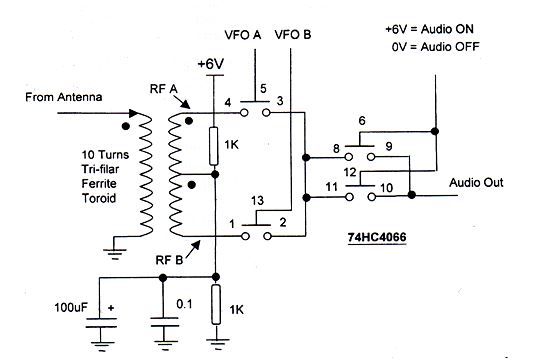
I think those two gates (3,4,5 and 1,2, 13) are the functional equivalent equivalent of the two diodes in our product detector. In Leon’s scheme the VFO is supplying signals of opposite polarity. Ours is providing only one signal, but the fact that the diodes are reversed means that they act just like the gates in Leon’s circuit. The transformer is almost identical to the one we use in the product detector.

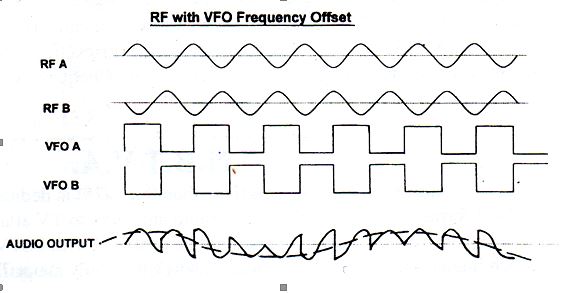
Let’s look at the output from Leon’s circuit:
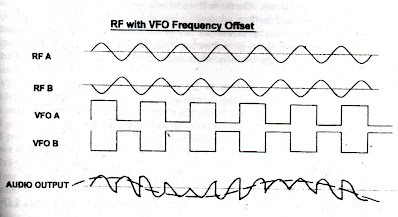
“VFO A” going high is the equivalent of the BFO going to its positive peak and D1 conducting.
“VFO B” going high is the equivalent of the BFO signal to its negative peak and D2 conducting.

Take a ruler, place it vertically across the waveforms and follow the progress at the output as the two signals (RF A and RF B) are alternately let through the gates (or the diodes). You can see the complex wave form that results. The dashed line marked Audio Output shows the difference frequency — the audio. That is what we sent to to the AF amplifiers.

One concern remains:

What happens when the 455 kc IF signal getting to L1 get so strong that IT also starts to turn the diodes on and off? I think this will result in distortion, and we can see this in LT Spice.

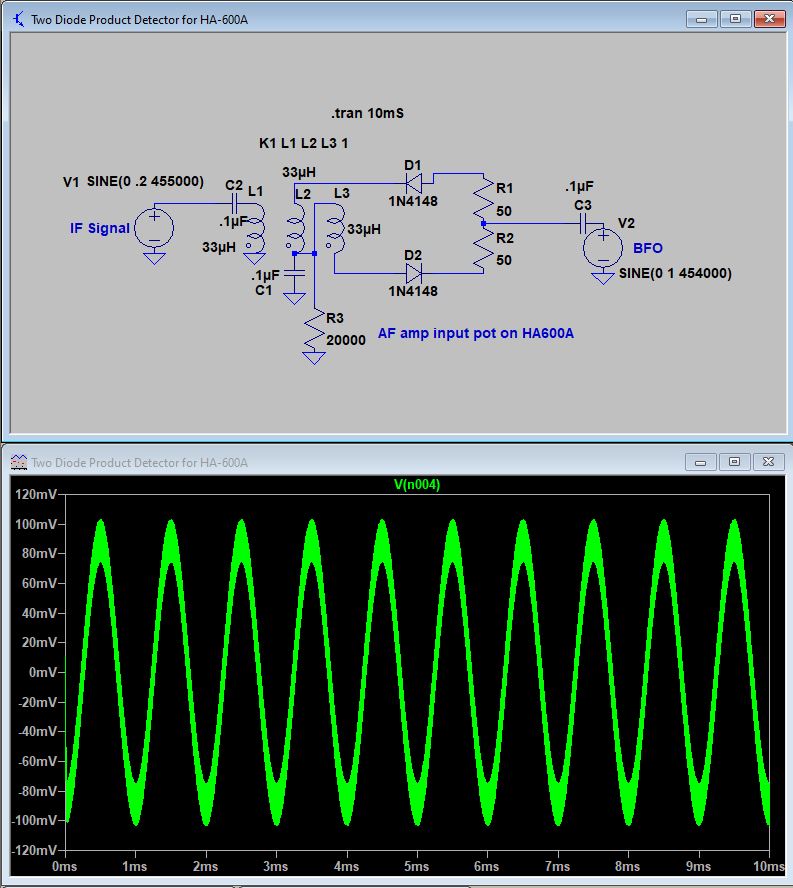
Here is the output waveform when the If signal at L1 is kept below the level that would turn on the diodes:
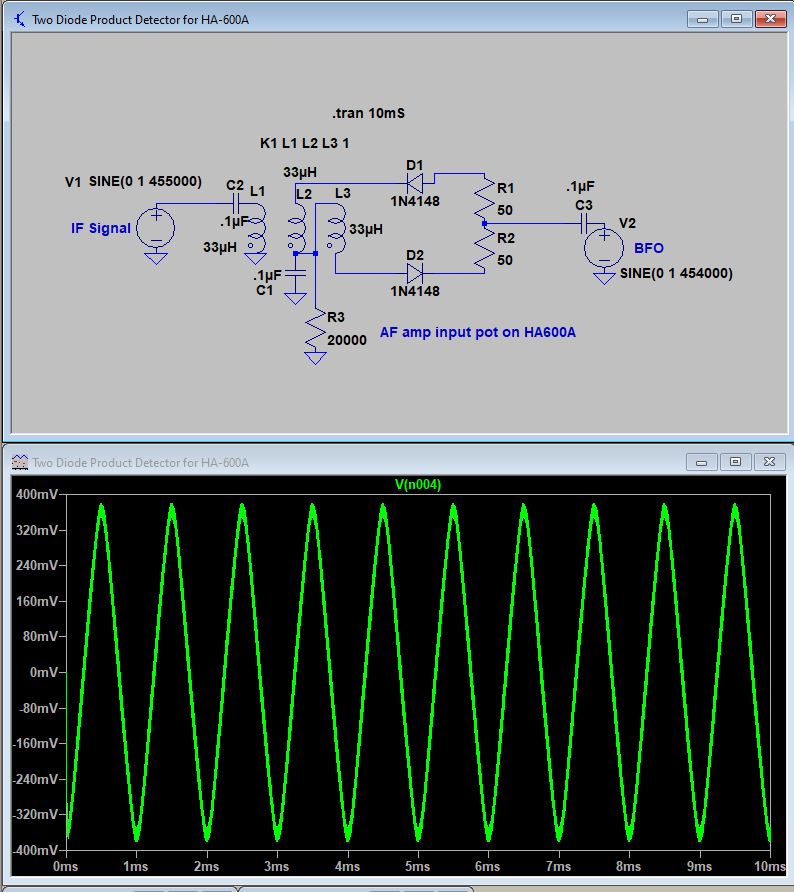
Here you can see it with a much stronger IF signal:

The output waveform becomes more of a sawtooth.

How can I prevent this from happening? I know AGC should help, but the AGC in this receiver doesn’t seem to sufficiently knock down very strong incoming signals.

Does my analysis of these circuits sound right?

Overcoming the Complexity of the Michigan Mighty Mite: Walter’s Sunrise Net Special

From Walter KA4KXX
June 21, 2020

Michigan Mighty-Mite: Why So Complicated?

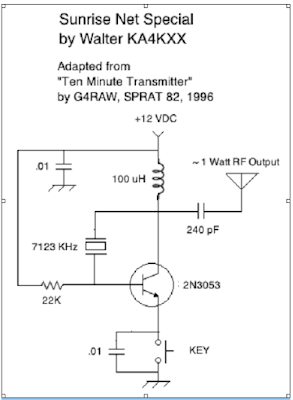
The April 2020 issue of QRP Quarterly magazine featured an article by Bob Rosier K4OCE which included a schematic for a “Ten Minute Transmitter” by G4RAW (SK), which apparently first appeared in SPRAT 82 in 1996.
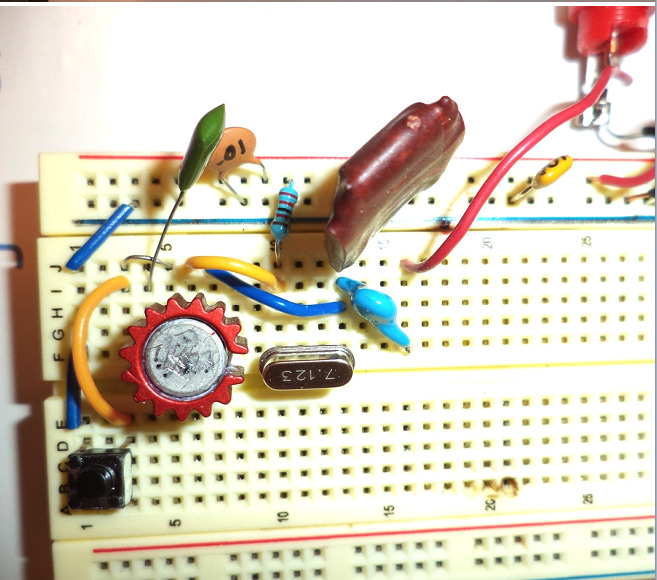
It is even simpler than the Michigan Mighty Mite, so this transmitter can truly be built on a solderless breadboard in about 15 minutes, because a complex coil is not required.
The only tuning needed was for me to establish the correct value of the output series capacitor.
This rig allowed me to check-in to the Sunrise Net (see details in blue text on my QRZ page) today on my very first attempt, and landed me a 549 signal report from 250 miles away.
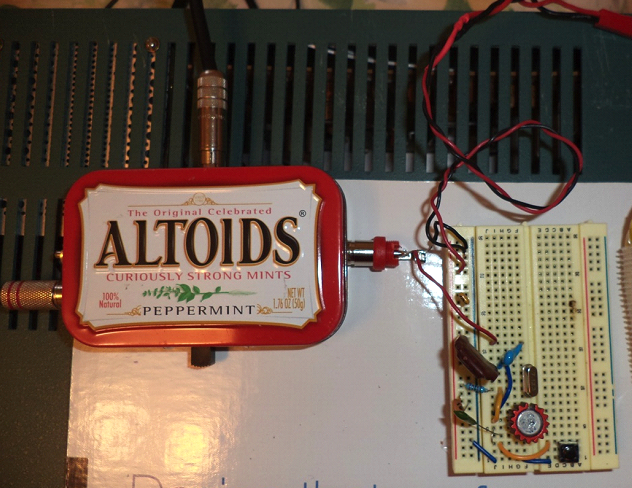
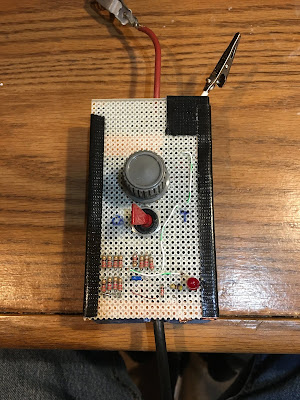
The first photo shows the transmitter connected to a Transmit/Receive Switch mounted in an Altoids box. In the Transmit position the antenna is disconnected from my 1979 Heathkit HR-1680 receiver, which then coincidentally supplies a sidetone at an ideal volume level. That little black pushbutton which can be seen in the second photo serves as my key, and works just fine for a five-minute daily QNI on the Sunrise Net.
Of course, part of the secret is having a crystal exactly on the Net frequency, and I have a few left, free to whomever in the Eastern U.S. is interested in building one of these simple Sunrise Net Special Transmitters and participating in our Net.

SolderSmoke Podcast #223 Field Day, Club Talks, Patreon, NanoVNA, Farhan Video, SPRAT, BIG MAILBAG

SolderSmoke Podcast 223 is available:


27 June 2020

Quarantine Field Day!
Ironically, THIS YEAR we are both participating
Pete’s FD Plan, Bill’s FD plan
Talking to Clubs:
Pete’s talk to the Cedar Valley Iowa Club
Bill’s talk to the Vienna Wireless Society
Pete’s Bench
DDC SDR
Ideas from the Summer SPRAT
Mean Well Voltage Regulator
SHAMELESS COMMERCE DIVISION: PATREON. SS is an SV DELOS WANA-BE!
We got our very first Patreon Patron! Jonathan Magee from the UK! Upper Left on the blog.
Continue to use our site for your Amazon purchases.

Bill’s Bench
NanoVNA
Understanding L Networks
+/- 6kHz Ceramic filter for Q-31
Lobes, Nulls and WSPR
Miscellaneous:
Farhan’s feedback Amplifier Video
British Antarctic Broadcast heard (sort of)
MAILBAG:
Mauro VA6BRO liked the SolderSmoke book. Thanks Mauro
Tryg in Galway Ireland is listening. Hope to get you the signed books Tryg.
Michael N4MJR suggested that I use N2 Corona Quarantine Radio as my phonetics. I dunno…
Ed DD5LP has been helping us get SS rebroadcast on a German SW broadcast station. Stay tuned!
Rogier PA1ZZ in California sent an e-mail about the Don Lee Broadcast System. Thanks Rogier!
Rick KE3IJ Silver Skirt on his 2B also. W3GOO did it. Rick traded his Commodore 64 for the 2B. Yea!
Walter KA4KXX has a simplified circuit for the MMM! From UK
Peter VE1BZI thank us for the tribal knowledge. Dipolo Crilolo
Peter VK2EMU Wee need someone to make the Constructor Crusader badge.
Scott KA9P sent us the Amateur Wireless cover from 1934 with the Constructor Crusader thing.
John GM4OOU Built lockdown rig. we want pictures!
Jerry KI4IO His version of the Sproutie by AA7EE FB
Adam N0ZIB built a MMM
Wouter ZS1KE in South Africa — comparing notes on Drake 2-Bs
Randall KD5RC wants to get started in HB.

The End Fed Half Wave Antenna and EFHW Tuners

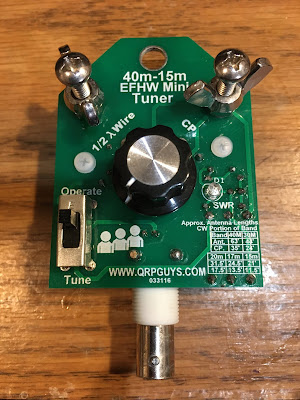
In the SPRAT 179 (Summer 2019) article describing their Peregrino (Pilgrim) transceiver, Joan EA3FXF and Eduardo EA3GHS recommend the use of an End Fed Half Wave (EFHW) antenna. Their circuit incorporates an EFHW tuner and an SWR indicator. As I planned my trip to the Dominican Republic with a uBITX, I had this antenna system idea in mind. I was attracted by the possibility of avoiding having to carry coax with me. And it seemed that an EFHW antenna would be easier to get up in the air than a coax-fed dipole.

When searching for schematics for EFHW tuners I came across the QRPguys tuner kits.

https://qrpguys.com/end-fed-half-wave-sota-antenna-tuner

This looked like just what I needed, so I ordered one. But I placed my order kind of late, and I started to worry that I might not get the tuner kit in time. So I decided to homebrew my own (just in case!)

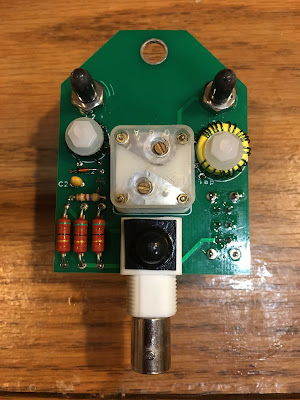
As it turned out, QRPguys got the kit to me in plenty of time. It went together very quickly and is a really useful piece of gear. My homebrew version works fine, but I prefer the QRPguys device.

You can check out the manual here:

https://qrpguys.com/wp-content/uploads/2019/09/efhw_40m_tuner_assy_090119.pdf

The circuits are interesting. The EFHW antennas present an impedance not of 50-70 ohms, but of 3000-5000 ohms. The Peregrino and the the QRPguys circuits use a matching transformer to change the high impedance to 50 ohms. In both circuits polivaricon capacitors are used to tune for resonance. The QRPguys circuit uses an N7VE LED absorption bridge — I found it very satisfying to put the circuit into “tune” mode and then just adjust the capacitor until the LED went out. That means the antenna system is presenting 50 ohms to the transmitter.

SOTA beams has a good explanation of the EFHW antenna here: http://sotabeams.co.uk/efhw/
I did use a counterpoise.


SolderSmoke Podcast #216 Is Available: BITXs, Paesano, Paraset, ET2, Antuino, Mailbag

Bill’s uBITX with HB keys and the mic that used to be the podcast mic!

SolderSmoke Podcast #216 is available

21 December 2019

HAPPY HOLIDAYS TO ALL!

http://soldersmoke.com/soldersmoke216.mp3

Pete’s Bench
Sprat Article
BITX 40 Fun
ZL2BMI Rig
Paraset. Three tubes! Almost an ET-3!

Bill’s Bench
ET-2 Adventure over, Rig on the wall
Final QSO count. 20 3 “random”
Last QSO with AA8OZ
Lessons learned: 100 mW not the problem. Crystal Control cramps your style.
N0WVA regen amazingly effective.
Tried for the Sunrise Net. Walter sent me some crystals.

On to the uBITX.
Accidentally wiped out calibration and BFO settings.
Had to do recalibration and reset BFO.
Learned a lot about the rig.
How they did CW and how they do it now. Shift TX? Or shift RX? Or just shift BFO on RX?
How all the signals end up as upper sideband. Only one BFO freq. Very cool.
TalentCell 12 V Lithium Ion 3 AmpHour battery. Size of a deck of cards.
Inspired by Peregrino — I ordered EFHW Tuner from QRP Guys.
Homebrew Straight Keys

Antuino upgrade
SMT soldering.
Back to Arduino Nano and the IDE.
A very cool tool.
Antuino filter analysis.
Version 6 of uBITX out.

The “Watt Meter” DC power meter. Very useful. 8 bucks. LINK:

https://www.ebay.com/itm/Digital-DC-combo-Meter-LCD-Watt-Power-Volt-Amp-RC-Battery-charging-Analyzer-M/152339793114?fbclid=IwAR0u9SlZi2Dm6zOJyZt4fDTu7w_pjBIEYD_FiNfLymxtQUbMjcNHjfB17P0

SPRAT, balloons and hardcore homebrew hydrogen.

MAILBAG
VK3HN’s AM receiver. I ordered 6kHz 455 kHz filters from Australia.
Dean’s MMM
Peter VK2EMU Hertz not hertz.
Ben KC9DLM LTSpice YouTube Videos
Steve Silverman Electroluminescent Receiver Kit
Lyndon N0LFX back to listening. FB OM
Steve M0KOV built a pill bottle variometer. Did you get the regen going?
Anthony VU3JVX FB HB uBitx.
Allison KB1GMX Great to hear from her

Leif WB9IWT — helped me trouble shoot my uBITX (BFO was low)

Mike EI0CL old buddy from Azores days. Recognized his voice on 20. Great QSO.

SPRAT, the FETer, DLR headphones, and recent QSOs on the ET-2

Yesterday we had QSO #13 on the ET-2. This was with Jim W1PID. In an earlier contact Jim told me I had some chirp. I fiddled with the coupling cap and the bias pot and am now T9! These days, chirp is an endearing, nostalgic problem to have. Thanks for the report and QSOs Jim!

Contact #9 was with Fred K9SO. He is in Wisconsin and QRZ.com put our distance at 633 miles. That is our DX record so far. Not bad for 92 milliwatts to a dipole on 40 meters.

Most of my contacts come as a result of pleas for assistance on DX Summit or the SKCC Sked page. But I did make one “random” contact: Contact #6 with N2VGA. He just heard my CQ and gave me a call. FB.

I checked to see if OM Glen Yingling W2UW — the guy who started all this with his ET-1 — is still around. He became a silent key in 2012. But his ideas live on…

SPRAT 137 (Winter 2008/09) has a great article by QRP hero G3XBM. Roger built a version of the ET-1. His was for 80 meters and he called it the FETer. FB. I was struck by his estimate of the sensitivity of the ET-1 receiver: -100 dbm. I measured the N0WVA receiver (the one that I am using) has having a minimum discernible signal of -93 dbm. Pretty close. We may be at the limit of what you can expect from a single transistor receiver.

SPRAT 137 had something else that really resonated with me. G3YVF had an article on a minimalist rig using only one 6V6 tube. Geoff opened the article with this warning “Don’t try this unless you have a set of balanced armature type DLR ‘phones as they are really sensitive.” I have a collection of old headphones that I picked up at hamfests in London years ago. When building the ET-2, I checked all the old phones for sensitivity. A set marked DLR was the most sensitive. So Geoff’s observation had been independently confirmed. QRP Quarterly had an article comparing the sensitivities of old headphones — we should dig that article up.

SPRAT #137 is a reminder of what a great resource SPRAT — The Journal of the GQRP Club — really is. As we say on SolderSmoke, if you are not a SPRAT subscriber you are just wrong! Here is how to join GQRP and subscribe to SPRAT: http://www.gqrp.com/join.htm

More on the ET-2 : Better Pictures and More Circuit Description. Some Thoughts on Simplicity

So yesterday I made my first contact using my ET-2 rig. Last night I got an e-mail from Gary, the fellow at the other end of that contact:
Evening Bill, N2CQR….Yes I did learn about you from the spot on the DX Summit cluster. I tuned to the freq to see if I could even hear your 80 mW and you were a good real 569 when calling CQ. You built up to a real 589 on the later transmissions. I did not have either of the two pre-amp positions on in the ICOM 756 Pro II. There was not any QRM on the freq either. Your spot indicating the 80 mW is what really got my attention.
My antenna is a 2 element yagi at about 115 ft and it really works great for me.
Thanks for the picture of the great little transmitter. Glad to be your first DX QSO with it. Hi Hi Maybe again soon. My pleasure to work you.
73, Gary, K4MQG

Fort Mill, SC

Farhan commented on yesterday’s post, saying that it was hard to tell (from my pictures) where he rig started and ended. He was right. So this morning I have tried to clean up my bench a bit — I hope these pictures are better.
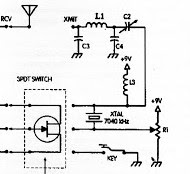
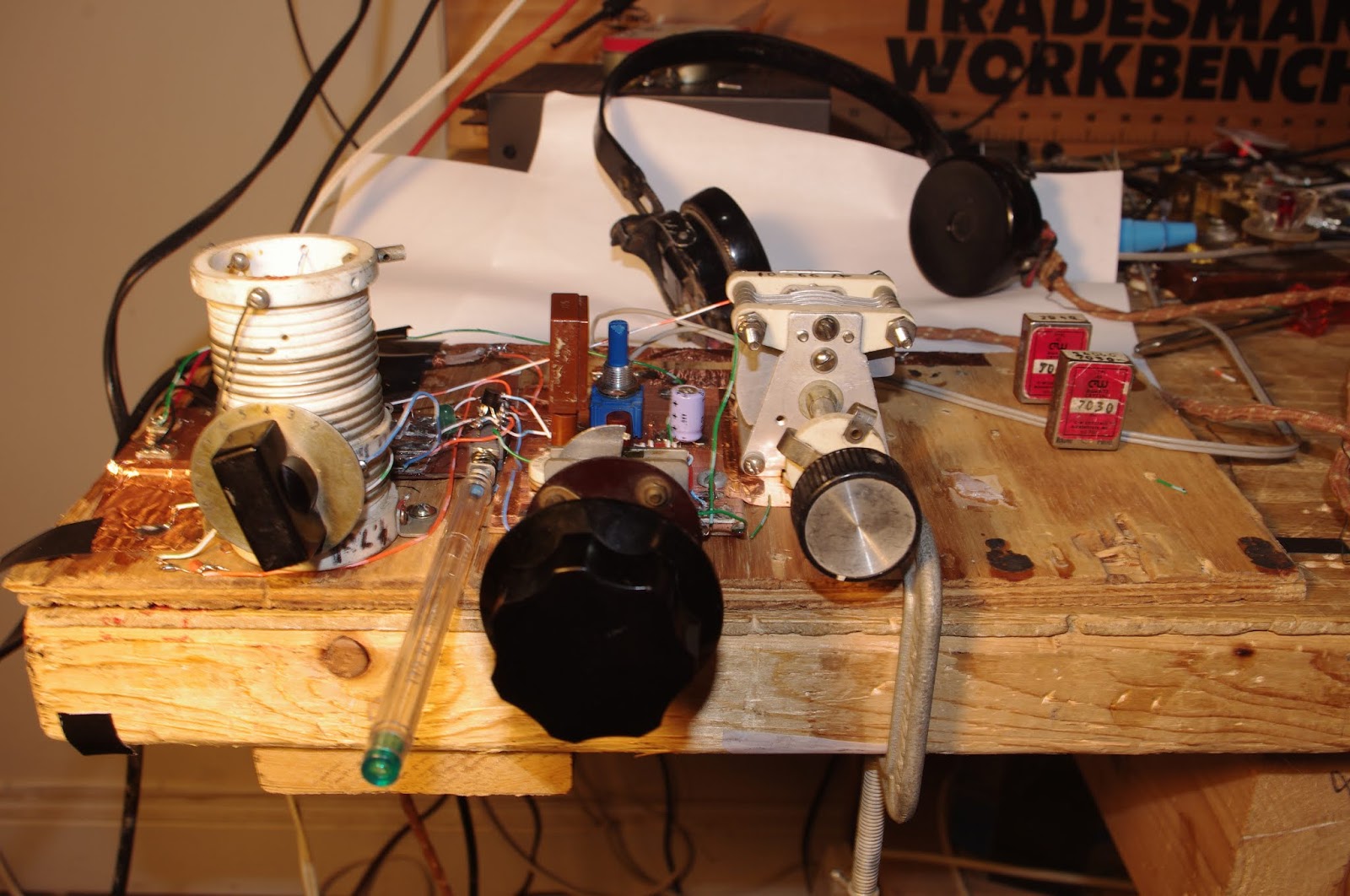
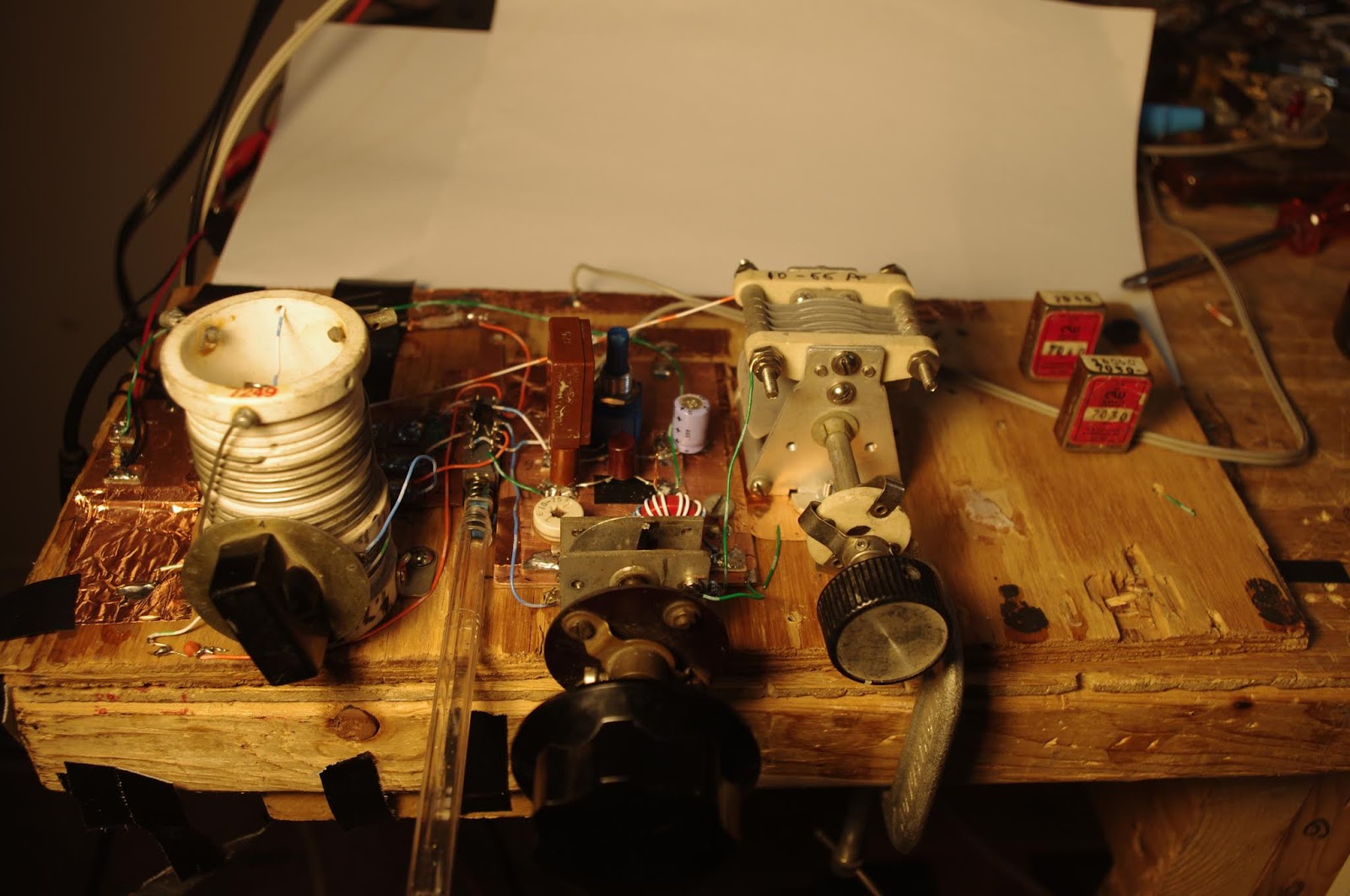
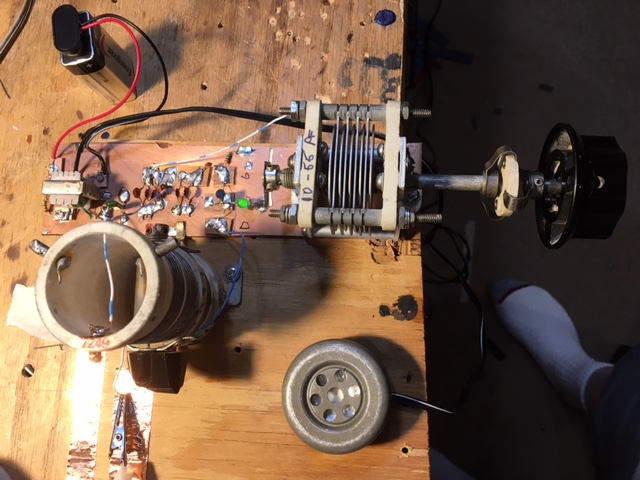
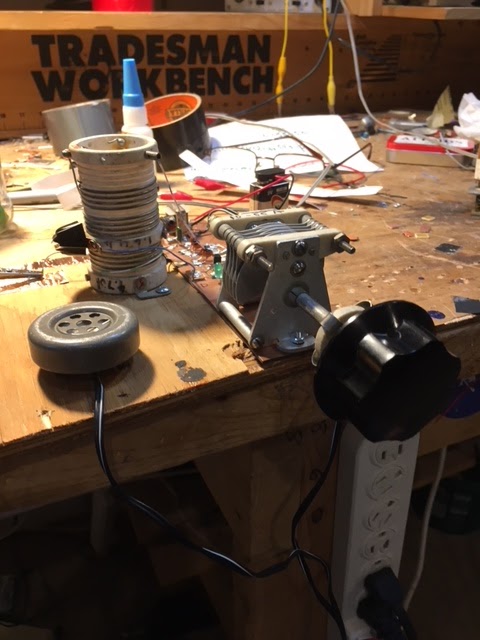
Above you see the whole rig. The transmitter board is right next to the key that Farhan gave me. You can see the 7040 crystal. A C-Clamp holds to the bench the piece of scrap plywood that serves as the base for this rig. Next to the C-Clamp you see the TR switch — the just switches the antenna — both transmitter and receiver are powered at all times. I can hear the transmit signal in the headphones and this serves as my sidetone.
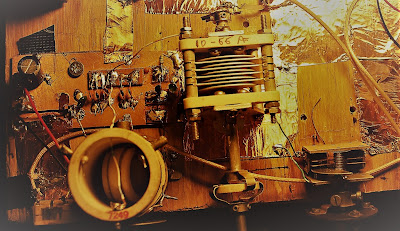
Here is a close-up of the transmitter with the schematic below:

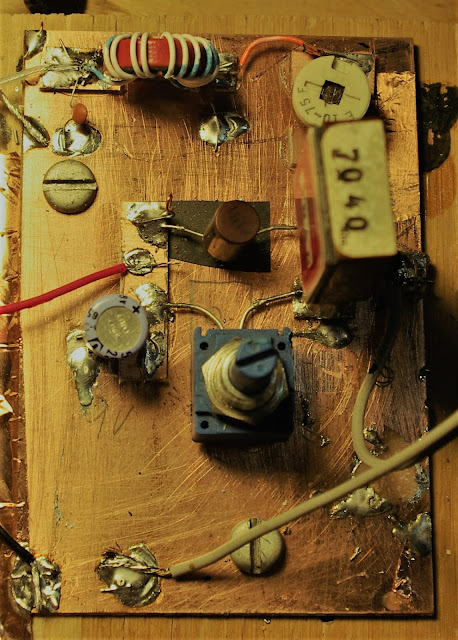
The transmitter is VERY simple. Nine parts, including the low-pass filter. You can barely see the J310 FET to the right of the crystal.

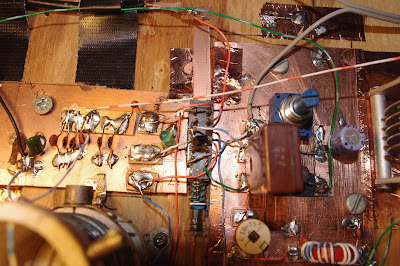
Here is the receiver:

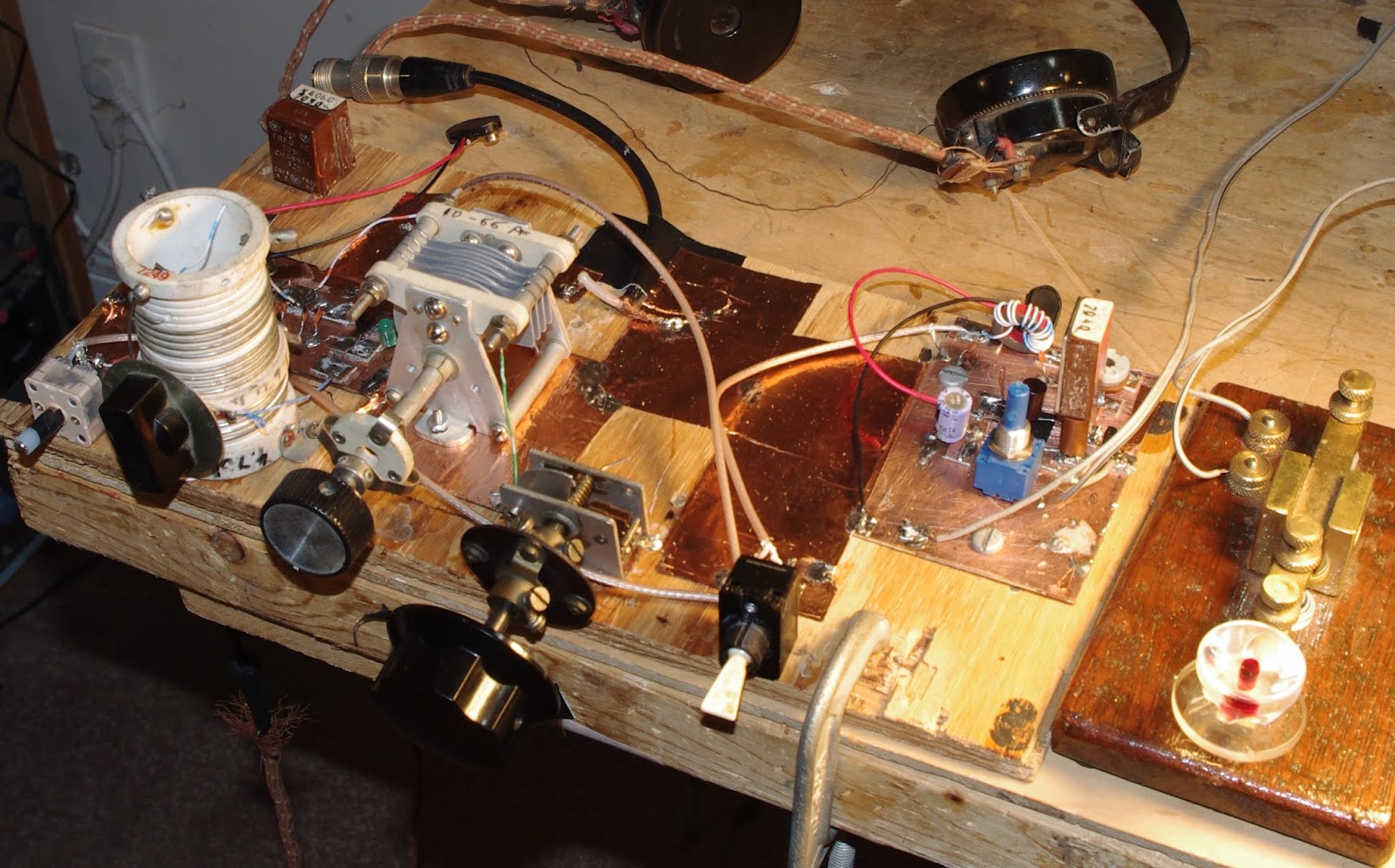
I really like N0WVA’s regen. The green diode in the source circuit is the key. This one does not squeal when you go into excessive regeneration (when you think about it, regens should NOT squeal at audio frequencies — but most do). Also, the green diode dims a bit when you are at the right amount of regeneration. In the picture you can look down the tube of the variometer that Pericles HI8P gave me many years ago. The big variable cap is from the junk box — I think it may be from a Johnson Viking transmitter. Note the long shaft with the insulating connector — this is to reduce the hand capacity effect. On the right you see a smaller cap with just one vane — this is my fine tuning control — with the smaller cap at mid range, I would just set the big capacitor to put the receiver at 7040 — with the smaller cap I could tune +/- 12 kc. I also used an insulating shaft on the smaller cap — the connector for this one is from an old 1930s era regen that I picked up at the Kempton Part rally in London.

Instead of the audio transformer and Radio Shack headphones, I just used some old DLR-1 WWII Headphones. They are very sensitive and work well.

Lots of soul in this new machine: The variometer from Pericles. The WWII headphones. The 1930s era shaft connector. The circuit idea from the Autumn 2001 SPRAT. Farhan’s key.

I recently read on Hack-a-Day of a new FPGA chip that has on it 35 BILLION transistors. I’m sure that thing can produce some fascinating results, but can anyone really understand it, or feel that they really BUILT something that has that kind of chip at its center? On the other hand, I did rely on a lot of modern digi technology in this project: The Reverse Beacon Network reported back that my unanswered CQs were in fact getting out (one as far as Kansas to K9PA). And in the end I had to ask — via the DX Summit Spotting cluster — for someone to listen for me. So I can’t go full Luddite here. And I wouldn’t want to have to use a rig this simple every day. No way. It is just too hard to use. But there is a beauty and a challenge in simplicity. There is some virtue in using just two transistors instead of 35 billion.

Thanks to N0WVA, W2UW, VU2ESE, HI8P, K4MQG, The G-QRP club and their inspirational journal SPRAT, the RBN and the DX Summit.

Single Transistor Transceiver On the Air

I got my version of the ET-1 transceiver working. As I described in previous posts, I first got the transmitter and the receiver working separately, each with their own J310 FET (oh the extravagence!) Then I built a switching arrangement that allowed for just one shared FET and very short leads. I used a 4PDT “push button” switch from an old Ramsey Electronic LC meter. See the last picture for details. I use the tube from a pen to operate the switch (that’s the green thing in the picture).
It is inhaling and exhaling. My 20 mW signal is being picked up on the Reverse Beacon Network, mostly in New England, but today in North Carolina.

No contacts yet. I may have to resort to scheduled contacts. OM Yingling W2UW was operating during much better propagation conditions (2001), so I don’t think I will ever get close to his impressive (23 states!) operating record.

But it has been fun getting this thing going. The N0WVA regen design is one of the best and simplest regens I’ve ever built. It is really nice –hardly demonic at all.

I can run the whole thing off one 9V battery. I think it is a cool looking machine.

Single Transistor Regen Has QSO Potential (Video)

In my previous blog post I’d expressed skepticism about using a single transistor regen on the air. But over the years I’ve learned to give new receivers a chance. They usually don’t work perfectly on the first try. You have to work with them. It is almost as if you have to peak and tweak a lot in order to get them to properly inhale signals from the ether.

That has been the case with this little receiver. I found some silly mistakes in my construction. And I decided to try some more sensitive headphones. I ditched the 1000 to 8 ohm AF transformer. And I added a very small variable cap for fine tuning.

The results are amazing. See video above. It performs as well as most of the direct conversion receivers I’ve built. It is remarkably stable.

I do think I could make contacts with this receiver. I might eventually go the full ET-1 route and try to do it with a single switched FET, but I think my next step will be to built a single transistor crystal controlled transmitter on the same piece of wood, and try to make some contacts with a two-transistor rig.

Another Bout of Minimalist Regen Madness

My success with the Fish Soup 10 QRPp transceiver got me interested in further minimalization. About ten years ago I built a rig presented in SPRAT 108 as the ET-1 by Glen Yingling W2UW. It re-appeared in modified form as the FETer by G3XBM in SPRAT 137.

This rig uses just ONE active device, an MPF-102 FET that is switched via a 3 pole double throw switch from transmit to receive. The transistor is switched. The receiver is a regen and the transmitter is a very simple crystal controlled one stage oscillator. See:
https://soldersmoke.blogspot.com/search?q=ET-1 for info on my ET-1 effort.
The transmitter was the easy part. I don’t think I made any contacts with this thing. That has been kind of bugging me.

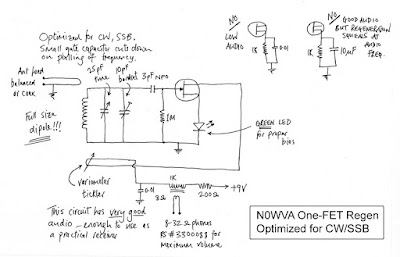
So I tried it again. Again, I had trouble with the receiver. So I looked around for another single FET regen receiver design. I found one on AA7EE’s page. It was designed by N0WVA:
https://aa7ee.wordpress.com/2015/02/07/n0wvas-one-fet-regen-optimized-for-ssbcw-sounds-great/


I’ve had a variometer in my junk box since about 1994. (Given to me by Pericles HI8P. QEPD.) It was time to use it as the coil and ticker for this rig. I liked the green LED in the source, and the promise that this thing would not oscillate at audio frequencies.

I built in on one morning. See pictures. It works. I can hear CW stations. But I think I would have a tough time making contacts with this thing. OM Yingling worked 24 states with his ET-1. Respect.

SolderSmoke Podcast #212 HDR, Boatanchors, SDR, Antuinos, Spurs, QSX, Mailbag

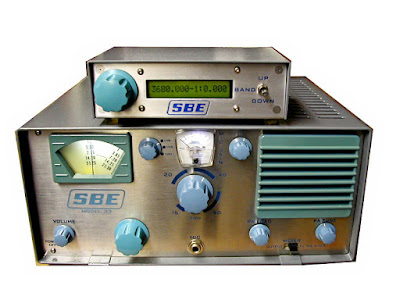
Dale Parfitt W4OP’s SBE-33 with modern digi freq counter

SolderSmoke Podcast #212 is available:

http://soldersmoke.com/soldersmoke212.mp3

22 June 2019

CONGRATULATIONS TO PETE: Licensed 60 years today

Pete Juliano during Field Day, 1959

Sideband Engineers Models 33 and 34 — Thanks Pete!
Hans’s QSX SDR Rig at Dayton-Xenia and FDIM
W8SX FDIM interviews

Pete’s SDR Projects — Update

The Peregrino SSB transceiver in the summer SPRAT

Why no rare earth cell phone speakers in ham projects?

My HDR “waterfall” project

Farhan’s Antuino
Cubesat origins
RF Lab in an box
SWR, PWR, SNA
Superhet receiver with ADE-1 at front, and log IC at the output
Adapters (SMA to BNC) help
DON’T BLOW UP THE INPUT RESISTORS (LIKE I DID!)
My dirty DIGITIA — Denial, then acceptance
FFT
Useful programs: SPURTUNE and ELSIE
A better bandpass filter for the DIGITIA
The importance of a good test set up with Antuino

Manassas Hamfest: WA1UQO, W4WIN, AI4OT

MAILBAG:
KG7SSB
WA3EIB
VK4PG
W3BBO
Jeff Tucker — Who owns Drake 2-B #4215?
KN4BXI
KC5RT
K3ASW

Please Listen for Dave AA7EE’s New “Boris Beacon”

https://aa7ee.wordpress.com/2019/01/03/putting-the-hifer-brs-boris-beacon-on-the-air-finally/

From Dave’s blog:

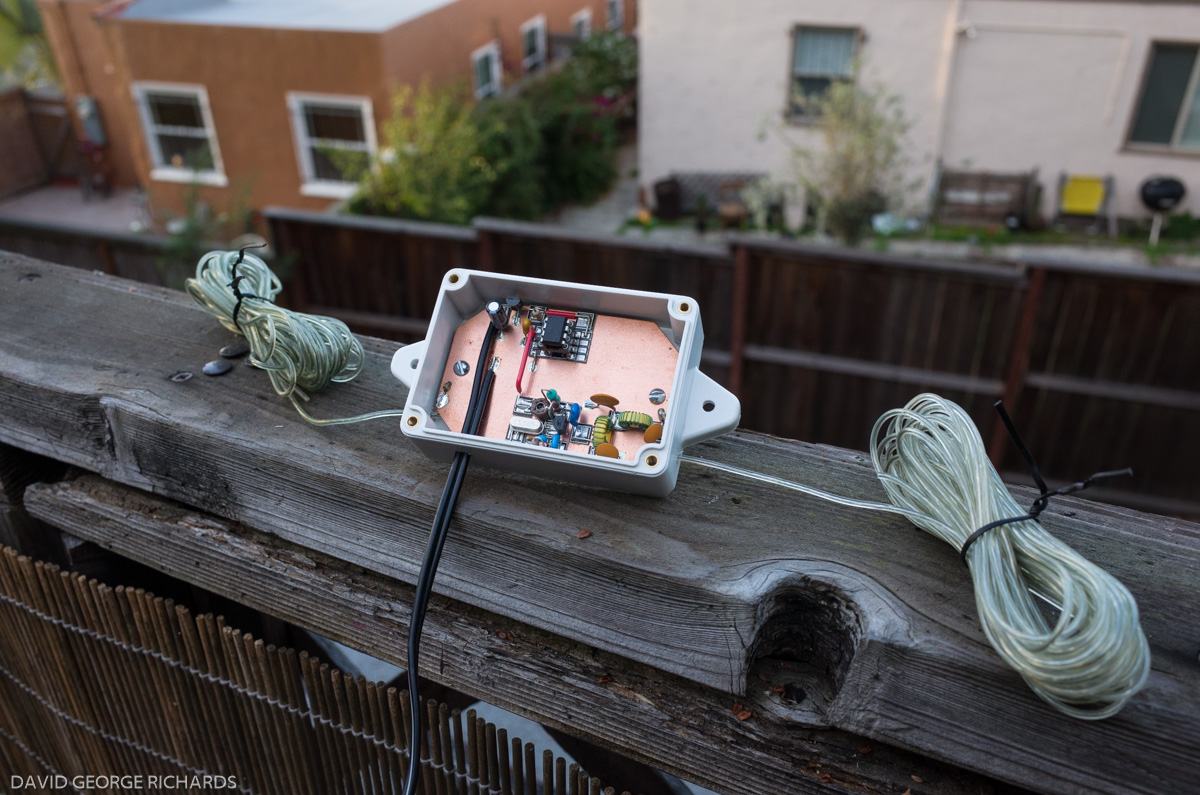
The beacon sends the letters “BRS” at 10wpm, with a break of 3 or 4 seconds between the end of one transmission and the beginning of the next, with a mighty power to the dipole of about 1mW. The frequency is a nominal 13556.9KHz (13.5569MHz), which varies either way by a few tens of Hz, depending on the outside ambient temperature. I will be overjoyed if anyone, anywhere hears it! There is no battery, so it transmits during daylight hours only. It comes on about half an hour after local sunrise, and goes off about half an hour before local sunset. I’ll update this with more accurate information, as I observe the on and off times over the next few days.
—————
AA7EE is in Oakland California. His cat is named SPRAT. Please send him a report (and if possible a recording) if you hear his beacon.


SolderSmoke Podcast #206 — GQRP CONVENTION SPECIAL EDITION

SolderSmoke Podcast #206 is now available:

http://soldersmoke.com/soldersmoke206.mp3

— SolderSmoke resumes after a busy summer.

— We did a portion of #206 via Skype at the GQRP Convention. Thanks to Steve G0FUW for setting this up. A portion of our participation appears at the end of the podcast.

— Pete’s SDR Rig and his new involvement with WSPR and FT-8

— The allure of SDR and the pitfalls of complexity.

— Bill’s 135 foot Doublet, 75 AM, 60 USB and 30 Meter CW.

— Plans to change the IF of Bill’s HRO dial receiver.

— Thinking (again) about sold stateing the HW-101.

— Hans Summers, QCX and QSX rigs.

MAILBAG:

Ralph builds Pete’s LBS receiver. FB!

SolderSmoke Podcast #204 April 1, SPRAT Cover 2, uBITX mania, MAILBAG

SolderSmoke Podcast #204 is available!

http://soldersmoke.com/soldersmoke204.mp3

5 May 2018

April 1 Recap — We thank you for your support!

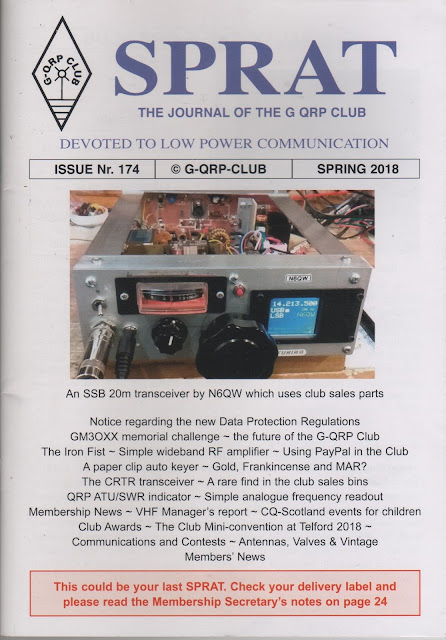
Pete’s Rig on Cover of SPRAT 174

uBITX Mania

uBITX Dual Conversion Design

uBITX Gettng more out of the Arduino/Si5351 combo

uBITX KD8CEC’s amazing software

uBITX Future Possibilities

uBITX On-the-Air Experiences, with CW too!

MAILBAG

KD8CGH’s Hyderabox — THERE ARE TWO!
QSO with N1AW’s cardboard uBITX
DuWayne on QSO TODAY
Jack 5R8SV — Radio Gods NOT Happy
Jack Purdum W8TEE — Thanks OM
Charles AI4OT
Chris KB4PBT 15 inch telescope
John WJ0NF Reading SolderSmoke
Ken W8KTP Ordering a uBITX
Darren KG7KOI Listening
Gary AK4NA New Word: “Cabinetize” FB OM!

“The Thrill That’ll Hit Ya…” AGAIN! Three cheers for Pete, SPRAT, and GQRP

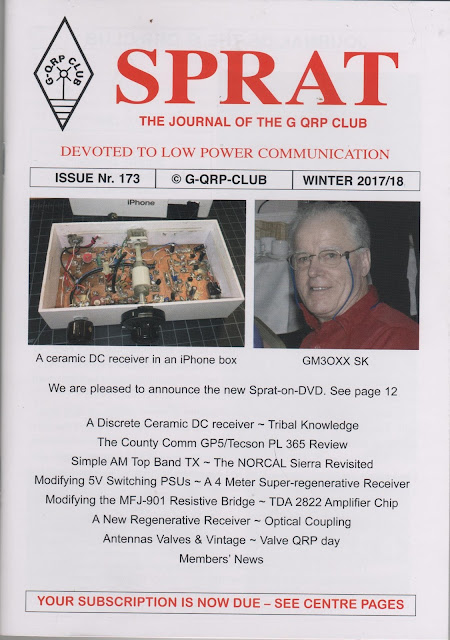
On the cover of issue 173 of our beloved SPRAT magazine they had my little Direct Conversion receiver. We joked on the podcast about the old song by Doctor Hook about getting on the “Cover of the Rolling Stone.” Well, on the cover of issue 174 they have one of Pete’s magnificent creations.

Thanks again to the guys who put so much work into SPRAT magazine. They are now looking for some help. Please subscribe, and check out page 4 of issue 174 for details on the help that GQRP is looking for.

Understanding Switching Mixers (as in the Ceramic DC RX)

W3JDR’s Comment on my post about the DC RX mixer got me thinking. He was right — my explanation of the mixer action wasn’t quite complete, especially as far as switching mixers are concerned. I remembered that I had written about this in the SolderSmoke book. Below you can see the part of the book in which I discuss switching mixers. Realize that the two diodes in F5LVG’s mixer play the same role as the two gates in Leon’s circuit. It will be worth your while to sit down with Leon’s circuit diagram, his frequency chart, and a ruler and really go through this so you can SEE and really understand how the two gates (or switching diodes) generate sum and difference frequencies.

———————–
I guess I still yearned for clarity and intuitive understanding… Time and time again, as I dug into old textbooks and ARRL Handbooks and promising web sites served up by Google, I was disappointed.
Then I found it.
It was in the Summer 1999 issue of SPRAT, the quarterly journal of the G-QRP Club. Leon Williams, VK2DOB, of Australia had written an article entitled “CMOS Mixer Experiments.” In it he wrote, “Generally, mixer theory is explained with the use of complicated maths, but with switching type mixers it can be very intuitive to study them with simple waveform diagrams.”
Eureka! Finally I had found someone else who was dissatisfied with trigonometry, someone else who yearned for the clarity of diagrams. Leon’s article had waveform diagrams that showed, clearly, BOTH sum and difference output frequencies.


Switching mixers apply the same principles used in other kinds of mixers. As the name implies, they switch the mixing device on and off. This is non-linearity in the extreme.
Not all mixers operate this way. In non-switching mixers the device is not switched on and off, instead one of the signals varies the amount of gain or attenuation that the other signal will face. And (as we will see) it does this in a non-linear way. But the basic principles are the same in both switching and non-switching mixers, and as Leon points out, the switching circuits provide an opportunity for an intuitive understanding of how mixers work.

Let’s take a look at Leon’s circuit. On the left we have a signal coming in from the antenna. It goes through a transformer and is then applied to two gate devices. Pins 5 and 13 of these gates determine whether the signals at pins 4 and 1 will be passed on to pins 3 and 2 respectively. Whenever there is a positive signal on gate 5 or on gate 13, signals on those gaps can pass through the device. If there is no positive signal on these gates, no signals pass. Don’t worry about pins 6-12.

RF A is the signal going to pin 4, RF B is the “flip side” of the same signal going to pin 1. VFO A is a square wave Variable Frequency Oscillator signal at Pin 5. It is going from zero to some positive voltage. VFO B is the flip side. It too goes from zero to some positive voltage.
Look at the schematic. Imagine pins 5 and 13 descending to bridge the gaps whenever they are given a positive voltage. That square wave signal from the VFO is going to chop up that signal coming in from the antenna. It is the result of this chopping that gives us the sum and difference frequencies. Take a ruler, place it vertically across the waveforms, and follow the progress of the VFO and RF signals as they mix in the gates. You will see that whenever pin 5 is positive, the RF signal that is on pin 4 at that moment will be passed to the output. The same process takes place on the lower gate. The results show up on the bottom “AUDIO OUTPUT” curve.
Now, count up the number of cycles in the RF, and the number of cycles in the VFO. Take a look at the output. You will find that that long lazy curve traces the overall rise and fall of the output signal. You will notice that its frequency equals RF frequency minus VFO frequency. Count up the number of peaks in the choppy wave form contained within that lazy curve. You will find that that equals RF frequency plus VFO frequency.

Thanks Leon!

SolderSmoke Podcast #202 Cover-Rig, SKN, Pete’s Vector Boards, uBITX, K1BQT rig, MAIL

SolderSmoke Podcast #202 is available:

http://soldersmoke.com/soldersmoke202.mp3

13 Jan 2018

Opening music from Shel Silverstein and Dr. Hook and the Medicine Show.
On the Cover of the Rolling Stone or On the Cover of SPRAT magazine.
Travelogue and Weather Report
— Bill’s trip to the Dominican Republic. SWL on the beach. Return to the ice box.
— Dramatic events in California.

— Reading Chinese Sci Fi with lots of radio in it. “The Three Body Problem” by Cixin Liu

Straight Key Night. IN QRP MODE THANK YOU. With nephew Jeffrey. Annual event — worked Jim W1PID friend of Mike Rainey.

Steve Murphy and Jeff Damm on QSO Today. FB.

Oh your rig is homebrew? “It must be propagation.”

ER Reading about G3UUR

Hams avoiding 60 meters due to 100 watt limit. SAD.

Bill’s Bench: Continuing series on the Ceramic Discrete DC receiver. Described the oscillator and the AF amp. Next we will do the Mixer. The most interesting stage. Nephew John Henry and niece Helena visiting today.

Pete’s bench. uBITX adventures.
The K1BQT IC transceiver.

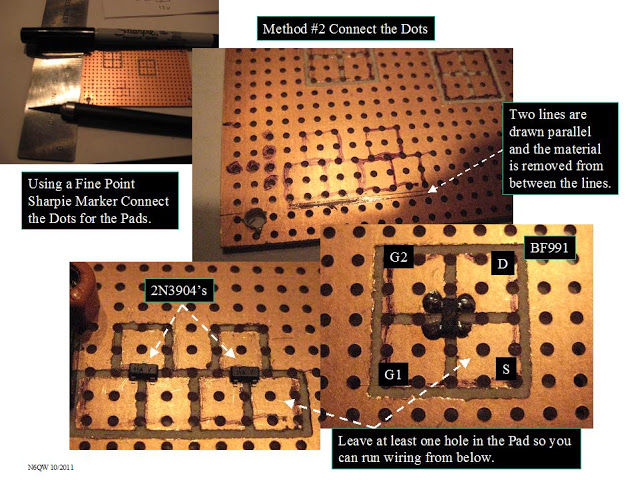
The Vector Board building technique. See http://n6qw.blogspot.com/


MAILBAG
Paul KA5WPL Looking for project with his son. Sawdust. Thanks again Steve Silverman.

Chris Waldrup OM PBJ thanks for the gift

Pete in contact with Sven Johnson
Chuck KE5HPY sent us picture of fashion model with boatanchors in background Grayson recalled 73 magazine covers…

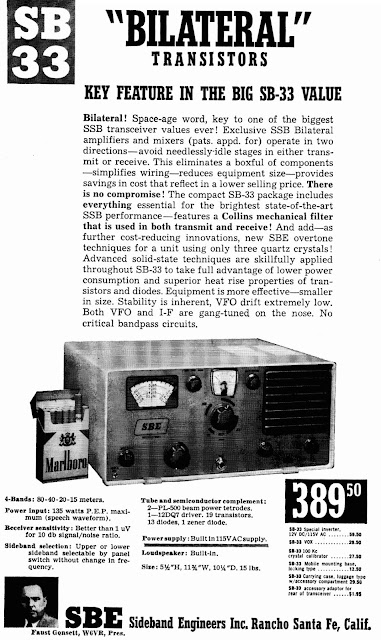
Pete WB9FLW Bilateral SBE-33 ad “with inherent stability” That’s the best kind!
Bruce KK0S experimenting with AF amps for the DC receiver

John KE5ETX Attempting CBLA

Ceramic DC Receiver on the Cover of SPRAT. Happy New Year to All! Straight Key Night.

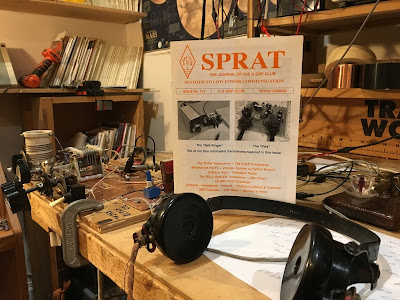
G-QRP very kindly put my little DC Receiver on the cover of issue Nr. 173. (Very sorry to see that GM3OXX has become a Silent Key. )

As we often say on the podcast, if you are not subscribing to this wonderful magazine, you are missing out on a lot of great ideas and circuits. Information on how to join the club and start receiving SPRAT can be found here: http://www.gqrp.com/join.htm It is only 22 bucks!

Reminder: Straight Key Night is upon us. It begins at midnight UTC 1 January. It is a great way to begin the new year. My HT-37 and my Drake 2-B are warming up now (and are helping to keep the shack warm on a very frigid day). HNY to all! 73 Bill


SPRAT — The 007 Connection

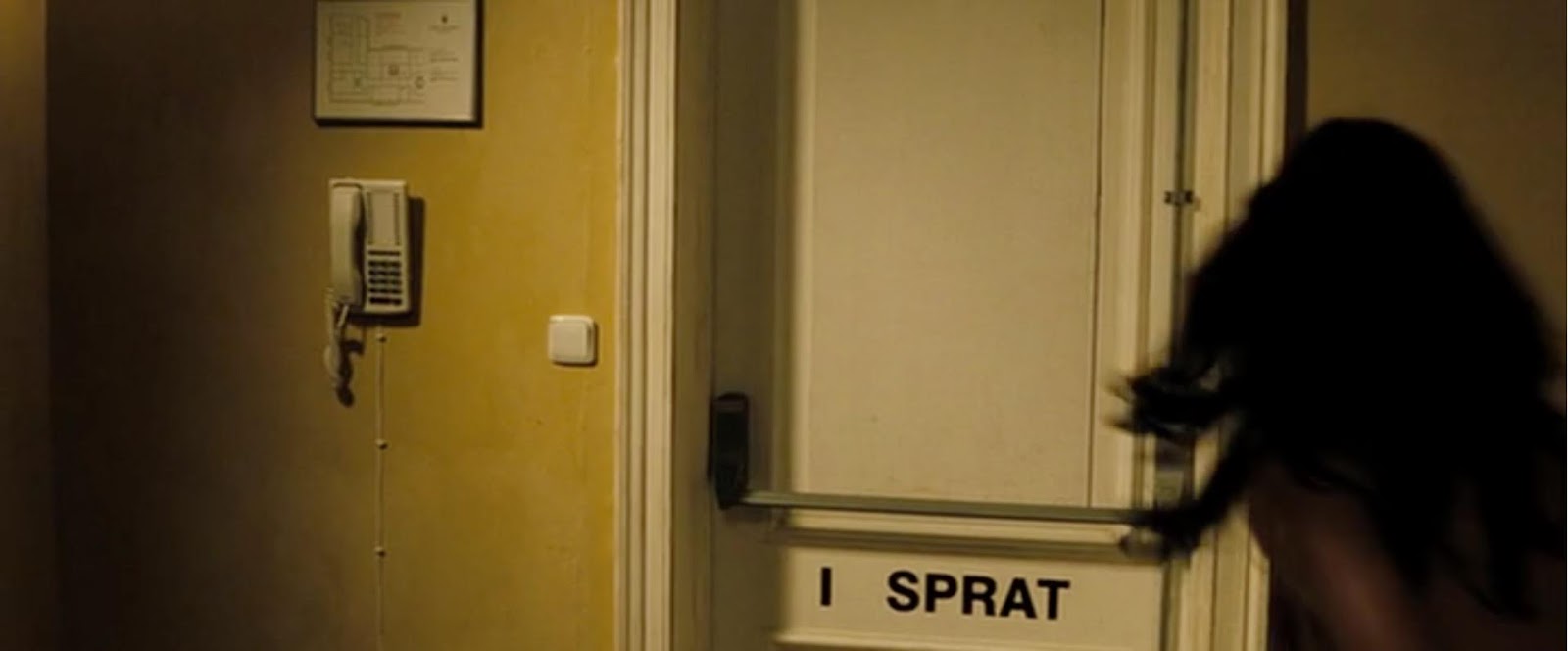
The eagle eye of Brent KD0GLS spotted this frame in the 007 movie “Casino Royale.”
Wow — I just knew those GQRP guys had to be much cooler than they seemed. I guess there were some indications: They do seem to talk quite a bit about “Q”. There is that weird fondness for Parasets. I understand that several of the senior GQRPers drive Aston Martins. And that Dobbs guy — a kindly retired Anglican minister you say? Really? I can just hear him saying it: “Dobbs, George Dobbs.”