Hope this one doesn’t get taken down. Great stuff from Turin, back in the day!
Category: space program
Shep: UHF and Deep Space Communications
 On this one, it takes a while for Shep to get to the radio stuff, but it is worth the wait. Or you could fast forward to around the half-way point (but in doing so you will miss the commercial for Miller High-Life, and Shep’s discussions of Monolopy and the Game of Love).
http://ia310115.us.archive.org/2/items/JeanShepherd1965Pt1/1965_04_15_Radio_Signals.mp3
Apollo 11
I was 10 years-old and totally involved with the mission. Armstrong
was my hero. I kept a scrapbook (still have it). There is an
interesting Italian angle: Collins was born in Rome. His dad was with
the US Embassy. Glad to see Buzz is doing well. There is a great story
in the book Moondust about his dealings with an obnoxious reporter. I
think Buzz handled it perfectly.
Rocket-cam!
I liked this video of the launch of NASA’s new lunar orbiter.
Herschel Space Telescope Opens its Eyes
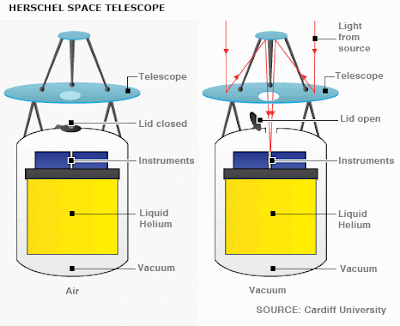 First light for a new telescope is always exciting, and even more so when the ‘scope is in space. Having all the instruments floating in liquid helium makes it all , well, even cooler.
Here is the BBC report:
http://news.bbc.co.uk/2/hi/science/nature/8099105.stm
Atlantis, HST in Front of the Sun
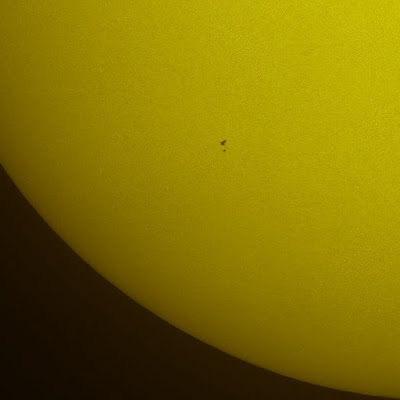
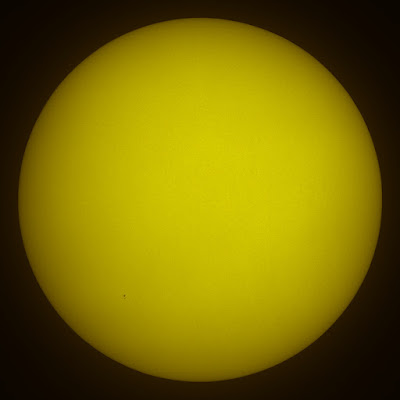 Check out the little black marks in the lower left of old Sol. That’s Shuttle Atlantis and the Hubble Space Telescope (you can see it in more detail below). The picture was taken from Florida by Thierry Legault. He calculated when the spacecraft would be aligned with the sun from his Florida location and took the shot. Well done. More innovative astrophotography at his site: http://www.astrophoto.fr/ Note: Too bad we don’t see any REAL sunspots!
Scary Stuck Bolt on Hubble Space Telescope
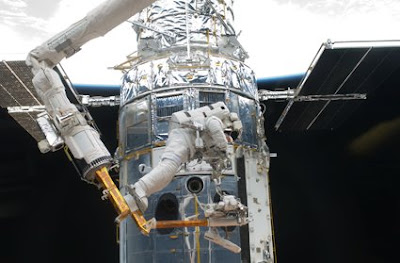 They had a scary moment during yesterday’s space walk. They were trying to get the old camera out. One of the bolts wouldn’t turn. It has been in space for 16 years They kept adding more torque, and they knew they were approaching the point at which the bolt would break, preventing — forever — the replacement of the camera. In what looked like their last attempt, the got it turning. Bravo! The live coverage via NASA’s online TV is really superb. They are using helmet-cams, and you get to see just what they see.
NASA put together a video on the personal stories of the crew members. I think it is a good thing to show kids (Billy has already seen it, Maria is next):
Scary Stuck Bolt on Hubble Space Telescope
 They had a scary moment during yesterday’s space walk. They were trying to get the old camera out. One of the bolts wouldn’t turn. It has been in space for 16 years They kept adding more torque, and they knew they were approaching the point at which the bolt would break, preventing — forever — the replacement of the camera. In what looked like their last attempt, the got it turning. Bravo! The live coverage via NASA’s online TV is really superb. They are using helmet-cams, and you get to see just what they see.
NASA put together a video on the personal stories of the crew members. I think it is a good thing to show kids (Billy has already seen it, Maria is next):
Fixing the Hubble Space Telescope
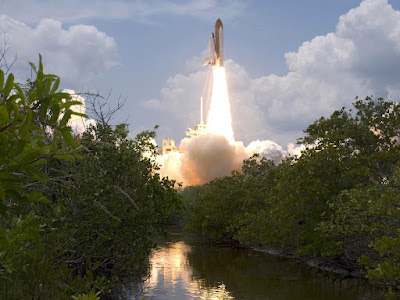 Gentlemen, NASA TV is the place to be this week. They have the Hubble Space Telescope in the payload bay of the Shuttle and soon they will be going outside to do the kinds of repairs that Knack victms can relate to. (Update: I’m watching a space walk live through the helmet-cam of Astronaut Grunsfeld. They are now lubricating some bolts on the doors of the telescope.)
Here is the NASA description of the repairs.
Two of Hubble’s instruments are in need of repair. ACS, which partially stopped working in 2007 due to an electrical short, is the “workhorse camera” responsible for some of Hubble’s most spectacular images. STIS is a spectrograph that sees ultraviolet, visible and near-infrared light, and is known for its ability to hunt black holes. While COS works best with small sources of light, such as stars or quasars, STIS can map out larger objects like galaxies. STIS suffered a power failure in 2004 and was put into hibernation to preserve the possibility of its repair.
Astronauts plan to fix both – a challenging prospect since these repairs are beyond the scope of Hubble’s serviceable design. Hubble’s creators envisioned astronauts swapping out components, not performing delicate surgeries during spacewalks.
An interior electronics box of ACS that supplies power for ACS detectors, contains equipment affected by an electrical short. However, its location makes it inaccessible to astronauts. So instead of trying to reach the problem area, astronauts will attempt to bypass those power-shorted components entirely.
The failed power supply is connected by cables to a series of electronics boards, which are within reach but have no power because of the damaged box. Astronauts will install a new power supply to a handrail on the ACS outer enclosure, remove the electronics boards and install different ones that are compatible with the new power supply, and connect them to the new supply with exterior cables. The arrangement simply cuts the damaged box out of the equation.
Innovative tools for the repairs are designed and developed by Goddard engineers and tested by the astronauts for refinements. STIS needs a new power supply circuit board. The repair would be relatively easy but for the electronics access panel, which was never meant to be opened and is attached to STIS by 111 small screws. The screws are hard to grasp with the astronauts’ gloved hands, and could create problems if they were to escape and float around the electronics. So engineers have created a “fastener capture plate” that fits over the top of the panel. When the astronauts remove the screws, they will be trapped in the plate. Astronauts will then switch out the power supply circuit board and close off the open electronics with a new, simpler panel that attaches easily with two levers.
Amazing NASA site: Audio from Apollo Landings
 Akshay, VA7AAX, sent me a link to a truly amazing site. NASA has pulled together a huge amount of data on all the moon landings, and they have made it very accessible. Included is a LOT of the raw audio of the communication between the spacecraft and ground. They even have the internal communications inside the lunar lander. If you guys are looking for something to put in your MP3 players (in addition to SolderSmoke, of course) this is the place to go. It is also a great site for audio to be played in the shack while building something. It is really inspiring. This morning I listened to the Apollo 11 landing.
I like the live.365 system for the audio — you can listen to it in streaming mode, without waiting for a long download.
Here is the site:
http://www.hq.nasa.gov/alsj/frame.html
Thanks Akshay! Thanks NASA!
The Beacon on the Echo Satellite
W8KHK gave a very nice Christmas present to the AMfone group. Check out the pictures (and descriptions) of the beacon transmitters that went into space on the ECHO satellite in 1960. Echo was the big inflated silver ball — it was nicknamed “the satelloon.” I was struck by how much the exterior of this rig looks like the solar-powered QRSS rig of Paolo, IZ1KXQ.
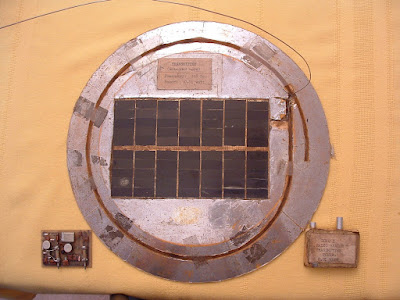 FROM W8KHK’s POST: Here are a few more pictures of the ECHO beacon transmitter. These are identical to the actual flight hardware, used for testing and measurements. They now reside at the W2DU Florida QTH, and while the batteries have long since expired, if the solar cells are illuminated by a 100 watt bulb, or the actual sun, you can receive the transmitted beacon signal at 108 MHz. Low Tech by today’s standards, but in those days it was hard to find transistors that would work above audio frequencies. Photo 21 shows a complete beacon system. To the bottom left is another transmitter, before potting. To the bottom right is another transmitter, potted and ready to be incorporated in the styrofoam “dish” assembly. Photo 22 is a close-up of the two transmitters from photo 21. Photo 23 shows an entire dish assembly, prior to potting in styrofoam. This space project, and many other early space projects from the Astro Electronics Products division of RCA will be chronicled in the soon-to-be-published Reflections III by W2DU.


MERRY CHRISTMAS FROM ROME!