From The Guys Who Found the Nano-Sail Satellite Signal

Howdy Bill, and all the SolderSmokers listening in on the PodCast.

We appreciate the shoutout in #130 about the NanoSail-D excitement .!. Stan – N4PMF and I have been working over the last year or so to re-activate the Amateur Radio Club at NASA’s Marshall Space Flight Center. We both have day jobs in the Huntsville Operations Support Center (HOSC), and routinely interface with the scientists and developers involved with projects such as the International Space Station, Space Shuttle propulsion, and more recently the FastSat program.
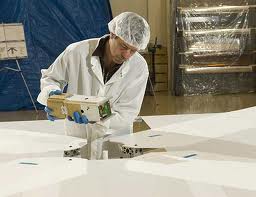
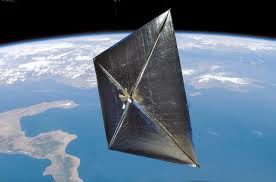
The NanoSail project is actually a smaller satellite that was carried into orbit by the FastSat. This NanoSail vehicle is only about 18 inches long, and a few inches square. No room there for high powered S-Band telemetry transmitters, so it carried a ham licensed 1/2 watt FM transmitter in the 70cm band. Maybe later we can get into more detail about all that if you are interested.

The NanoSail is the first successful deployment of a Solar Sail into earth orbit. The quicker story is that our club (WA4NZD) was started in the early-1970s, and operated Special Events commemmorating Apollo flights to the moon, Skylab missions, and early shuttle launches. Activity kinda dropped off in the mid-1990s, and the club is only now coming back to life. We still have VHF and UHF transcievers and beam antennas on a tower, that are ready to operate – and sometimes we listen in on ISS school contacts, or bounce APRS beacons thru the ARISS digipeater.

We of course got excited back in December when FastSat launched, and the NASA scientists asked if we could help them by listening for the NanoSail when it ejected. Unfortunately, Murphy had snuck on-board, and somehow prevented the smaller satellite from completely ejecting, and it looked like a loss….

Then in January the FastSat telemetry indicated that NanoSail-D may have ‘popped itself out’, and the Principal Investigator Dean Alhorn found Stan and asked if we could take him to the station “NOW” to listen for it. Sure enough, we had the right equipment, ready to go, and he got to hear it for the first time. We even had the AX25 TNC hooked up and it decoded a telemetry burst which allowed them to better estimate when the SolarSail should deploy. Dean was very very excited, and we all enjoyed a bit of the spotlight as Dean made obvious reference in numerous press releases to the role of the MSFC Amateur Radio Club in helping get the word out. The power of ‘crowd-sourced’ science became obvious as they received reports from all around the world. We are lucky to have been ready, willing and able to decode that early telemetry – it sure will help to validate and justify the existence of our little club station at NASA. You can easily find more on the internet, searching for NANOSAIL and WA4NZD.

Again we appreciate the publicity from your Podcast, and look forward to tuning in more often, and possibly sending you more info for your show. Thanks /;^) Alan Sieg – WB5RMG (http://wb5rmg.wordpress.com) Stan Sims – N4PMF MSFC ARC – WA4NZD (http://wa4nzd.wordpress.com)
SolderSmoke Podcast #130

SolderSmoke Podcast #130 is available at
http://soldersmoke.com/soldersmoke130.mp3

Some important trivia questions (answers will be given in the podcast):

— What is the connection between radio amateur (and pioneer radio astronomer) Grote Reber and world famous astronomer Edwin Hubble?

— In the world of radio-controlled helicopters, what is “TBE”?

— In Britain they have radio “rallies,” but at one time they had hamfests.” When did this happen?

— Only one terrain feature on Venus is named for a man. He is man of radio. Who is he?

— What music did Neil Armstrong listen to on his way to the moon?

Plus:
— The Air and Space Museums
— Our music
— The SolderSmoke D-104
— NASA asks for our help
— Telescope repairs
— A BFO for the Trans-O
— Back on Echolink
MAILBAG!

Please send reports on the D-104 audio!

NASA NANO-Sail Found by Hams!

All is well with the Nano-sail spacecraft, and hams apparently helped find it:

“This is tremendous news and the first time NASA has deployed a solar sail in low-Earth orbit,” said Dean Alhorn, NanoSail-D principal investigator. “To get to this point is an incredible accomplishment for our small team and I can’t thank the amateur ham operator community enough for their help in tracking NanoSail-D. Their assistance was invaluable. In particular, the Marshall Amateur Radio Club was the very first to hear the radio beacon. It was exciting!”

The Marshall Amateur Radio Club confirmed deployment of NanoSail-D late Wednesay EST with reception of the 1200bps AX.25 FM beacon on 437.275MHz +/-10kHz Doppler. News Release: 19 January 2011 Huntsville, AL USA The Marshall Amateur Radio Club (@ MSFC) – WA4NZD late Wednesday afternoon confirmed ejection of the NanoSail-D sub-satellite. This loaf-of-bread sized spacecraft was carried to orbit late last year on an Air Force rocket as part of NASA’s FastSat project. This is the first successful deployment of a satellite, launched from a satellite already in orbit .!. The only communication from the NanoSail-D vehicle is via ham radio with 1200 baud FM AX25 beacon packets. The WA4NZD team of N4PMF and WB5RMG, was listening on 437.275 MHz FM with the NanoSail-D Principal Investigator Dean Alhorn at the club station when the beacon was heard and susbequently decoded onto the screen. Please visit http://wa4nzd.wordpress.com/ for pictures and more links to the NanoSail-D project. They are asking for telemetry reception reports from all over the world to help fill in gaps. The battery is expected to last for only three days. Marshall Amateur Radio Club http://wa4nzd.wordpress.com/ NanoSail-D Dashboard http://nanosaild.engr.scu.edu/dashboard.htm NanoSail-D on Twitter http://twitter.com/NanoSailD

Voyager — Still on the air after 33 years

The Baltimore Sun has a really nice article on the Voyager spacecraft, and on the guys who have been keeping them going for the past 33 years. Here’s an excerpt:

You probably have more computing power in your pocket than what NASA’s venerable Voyager spacecraft are carrying to the edge of the solar system. They have working memories a million times smaller than your home computer. They record their scientific data on 8-track tape machines. And they communicate with their aging human inventors back home with a 23-watt whisper. Even so, the twin explorers, now 33 years into their mission, continue to explore new territory as far as 11 billion miles from Earth. And they still make global news. Scientists announced last month that Voyager 1 had outrun the solar wind, the first man-made object to reach the doorstep to interstellar space.
Here’s the link to the article:

http://www.baltimoresun.com/news/maryland/bs-md-voyager-20110117,0,278380,full.story

NASA Needs Our Help!

Kim Newton
256-544-0034
Marshall Space Flight Center, Huntsville, Ala.
Kimberly.D.Newton@nasa.gov
01.19.11

RELEASE
:
11-009


NanoSail-D Ejects: NASA Seeks Amateur Radio Operators’ Aid to Listen for Beacon Signal

HUNTSVILLE, Ala. — Wednesday, Jan. 19 at 11:30 a.m. EST, engineers at Marshall Space Flight Center in Huntsville, Ala., confirmed that the NanoSail-D nanosatellite ejected from Fast Affordable Scientific and Technology Satellite, FASTSAT. The ejection event occurred spontaneously and was identified this morning when engineers at the center analyzed onboard FASTSAT telemetry. The ejection of NanoSail-D also has been confirmed by ground-based satellite tracking assets.

Amateur ham operators are asked to listen for the signal to verify NanoSail-D is operating. This information should be sent to the NanoSail-D dashboard at: http://nanosaild.engr.scu.edu/dashboard.htm. The NanoSail-D beacon signal can be found at 437.270 MHz.

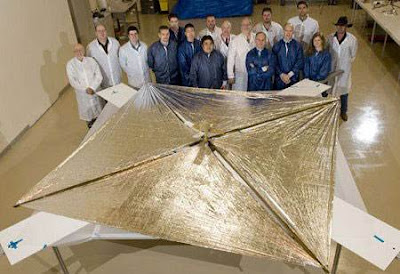
The NanoSail-D science team is hopeful the nanosatellite is healthy and can complete its solar sail mission. After ejection, a timer within NanoSail-D begins a three-day countdown as the satellite orbits the Earth. Once the timer reaches zero, four booms will quickly deploy and the NanoSail-D sail will start to unfold to a 100-square-foot polymer sail. Within five seconds the sail fully unfurls.

“This is great news for our team. We’re anxious to hear the beacon which tells us that NanoSail-D is healthy and operating as planned,” said Dean Alhorn, NanoSail-D principal investigator and aerospace engineer at the Marshall Center. “The science team is hopeful to see that NanoSail-D is operational and will be able to unfurl its solar sail.”

On Dec. 6,, 2010, NASA triggered the planned ejection of NanoSail-D from FASTSAT. At that time, the team confirmed that the door successfully opened and data indicated a successful ejection. Upon further analysis, no evidence of NanoSail-D was identified in low-Earth orbit, leading the team to believe NanoSail-D remained inside FASTSAT.

The FASTSAT mission has continued to operate as planned with the five other scientific experiments operating nominally.

“We knew that the door opened and it was possible that NanoSail-D could eject on its own,” said Mark Boudreaux, FASTSAT project manager at the Marshall Center. “What a pleasant surprise this morning when our flight operations team confirmed that NanoSail-D is now a free flyer.”

If the deployment is successful, NanoSail-D will stay in low-Earth orbit between 70 and 120 days, depending on atmospheric conditions. NanoSail-D is designed to demonstrate deployment of a compact solar sail boom system that could lead to further development of this alternative solar sail propulsion technology and FASTSAT’s ability to eject a nano-satellite from a micro-satellite — while avoiding re-contact with the FASTSAT satellite bus.

Follow the NanoSail-D mission operation on Twitter at:

http://twitter.com/nanosaild

For additional information on the timeline of the NanoSail-D deployment visit:

http://www.nasa.gov/pdf/501204main_NSD2_timeline_sequence.pdf

To learn more about FASTSAT and the NanoSail-D missions visit:

http://www.nasa.gov/mission_pages/smallsats

– end –


text-only version of this release

Listen up for METEORS!

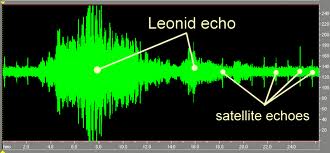
The folks at spaceweather.com have come up with something really cool. We are now in the final phases of the annual Leonids meteor shower. I can’t see many meteors through my light-polluted skies (plus its COLD out there), but Spaceweather Radio has come to the rescue. They currently have on-line the audio feed from a receive station tuned to the freq of the The Air Force Space Surveillance Radar. It transmits 24/7 on 216.98 MHz. It is reported to be on of the most powerful transmitters in the world. You can hear the “pings” caused by the reflections of meteors. I’ve heard several as I typed this post! Be sure to visit the “how we do this page.” I appears that there is ham running the receive station.

Occasionally I hear a longer tone. Could that be the reflection of a Low Earth Orbit satellite going over the site?

Balloons! Space Stations! Aurora!

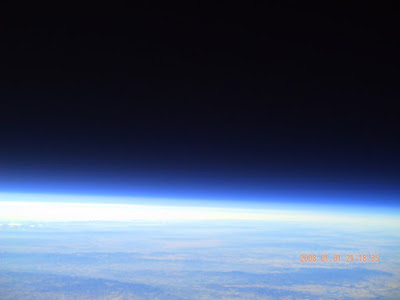
My in-box seemed to have an outer space theme today. First, from Guanajuato, Mexico comes word that the radio club there is planning a second edge-of-space balloon launch. SARSEM ICARUS II is scheduled to go up on 20 November carrying a VHF/UHF repeater. SARSEM ICARUS I was obviously a big success. Check out the picture it took from 29000 meters up (above). Thanks Roberto!

A couple days ago we noted that the International Space Station would be visible over N. America this week. So far we have only one report of a sighting: Jim, AL7RV saw it from Mississippi. This morning Yahoo carried some pictures taken from the crew’s cupola. This one shows some territory dear to our hearts!

Finally, spaceweather.com carried this beautiful aurora shot from Tromso, Norway. It was taken by Ole Christian Salomonsen on November 14. Spaceweather notes that “a solar wind stream has been buffeting the earth’s magnetic field.” This probably explains why Maria and I could hear very few stations on 75 meters last evening. And 75 seemed totally dead yesterday morning.

See the International Space Station THIS WEEK!

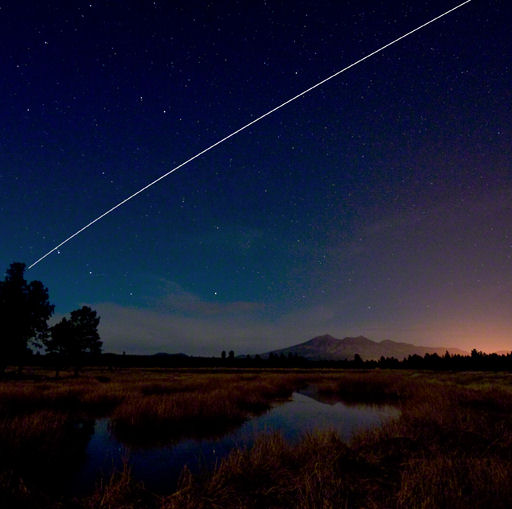
Spaceweather.com showed this beautiful picture of an International Space Station fly-over. It was taken by David Blanchard near Flagstaff, Arizona on Saturday.

The space station will be visible from much of North America in the evening this week. Spaceweather.com has a very handy calculator that will let you know when and where to look. Just plug in your zip code:

http://spaceweather.com/flybys/?PHPSESSID=t18llj67jtfvjsmruu6b7djif5

(There is a global version of the calculator for users outside the U.S.)

Let’s see how many SolderSmoke readers get to see the ISS this week. Please let me know if you see it.

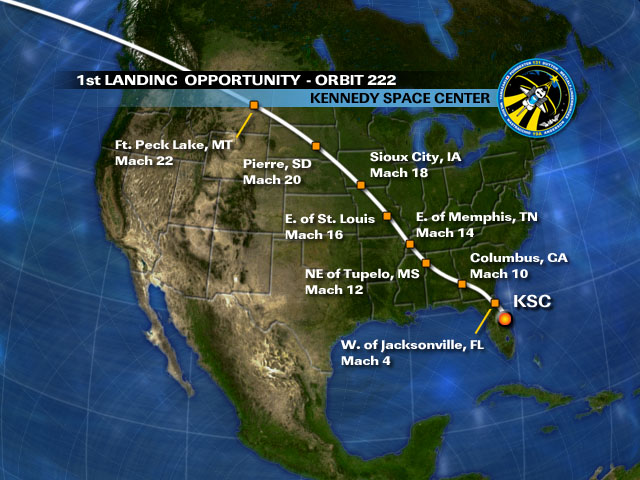
Space Shuttle Over U.S. on Approach to Landing

This is an early Monday morning event. Lots of SolderSmoke fans within visual range of this flight path. (Somebody please alert Jerry, NR5A!) Spaceweather.com reports:

“Landing is scheduled for 8:48 am EDT, and it takes the shuttle about 35 minutes to traverse the path shown above. Observers in the northwestern USA will see the shuttle shortly after 5 am PDT blazing like a meteoritic fireball through the dawn sky. As Discovery makes its way east, it will enter daylight and fade into the bright blue background. If you can’t see the shuttle, however, you might be able to hear it. The shuttle produces a sonic double-boom that reaches the ground about a minute and a half after passing overhead.”

Please let us know if you see or hear it.

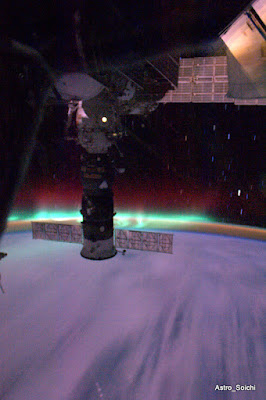
Geo-Magnetic Storm! Aurora as seen from orbit

Batten down the hatches my friends. The solar wind is blowing, and we’re in a geo-magnetic storm. Well, we were anyway, yesterday. Astronaut Soichi took this amazing picture of the resulting aurora.
No WSPR spots of my little signal this morning — I blame it on the storm.
You can see some interesting discussion of the storm conditions on the WSPR live-chat system. Here is a sample of last night’s commentary:

Mars Express Phobos Fly-by (Wednesday)

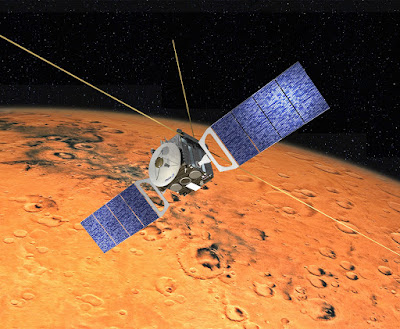
The European Space Agency’s Mars Express probe will be doing the closest ever approach to the Martian moon Phobos. On Wednesday night the spacecraft will come within 67 km of Phobos. They will use a very cool radio technique to gather data about the internal structure of the object (see below).
Mars Express carried the Beagle II lander to the red planet. I was in the UK when they made that brave attempt to put the probe on the surface, and shared in the disappointment when no signals came back. Later, I had the privilege of meeting Beagle II’s creator, Colin Pillinger. Colin gave me signed copies of his wonderful books on Mars.

Here’s some more info on Wednesday’s fly-by (from ESA):

1 March 2010
ESA’s Mars Express will skim the surface of Mars’ largest moon Phobos on Wednesday evening. Passing by at an altitude of 67 km, precise radio tracking will allow researchers to peer inside the mysterious moon.

Mars Express is currently engaged in a series of 12 flybys of Phobos. At each close pass, different instruments are trained towards the mysterious space rock, gaining new information. The closest flyby will take place on 3 March at 21:55 CET (20:55 GMT).

From close range, Mars Express will be pulled ‘off-course’ by the gravitational field of Phobos. This will amount to no more than a few millimetres every second and will not affect the mission in any way. However, to the tracking teams on Earth, it will allow a unique look inside the moon to see how its mass is distributed throughout.

How will the ground teams make these tremendously sensitive measurements? Ironically, they will turn off all data signals from the spacecraft. The only thing that the ground stations will listen out for is the ‘carrier signal’ – the pure radio signal that is normally modulated to carry data.

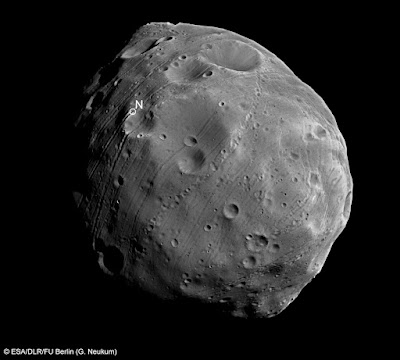
Phobos
Preparing for closest approach to Phobos

With no data on the carrier signal, the only thing that can modulate the signal is any change in its frequency caused by Phobos tugging the spacecraft. The changes will amount to variations of just one part in a trillion, and are a manifestation of the Doppler effect – the same effect that causes an ambulance siren to change pitch as it zooms past.

After the closest flyby, the work is not over. Mars Express will sweep past Phobos a further seven times before the campaign is complete. In addition to the tracking experiment, known as MaRS for Mars Radio Science, the MARSIS radar has already been probing the subsurface of Phobos with radar beams. “We have performed a preliminary processing of the data and the Phobos signature is evident in almost all the data set,” says Andrea Cicchetti, Italian Institute of Physics of Interplanetary Space, Rome, and one of the MARSIS team.

MARSIS completely deployed
The MARSIS radar is already taking data

“All the experiments on Mars Express have something to say about Phobos,” says Olivier Witasse, Mars Express Project Scientist, ESA. This is a bonus for science, considering that none of them were originally designed to study Phobos the moon, only Mars the planet. The science results from these flybys are expected in subsequent weeks or months, when the various teams have had time to analyse the data.

All photos from ESA.

Christmas Greetings from Lunar Orbit

I always liked the last, very inclusive line in Colonel Borman’s 1968 Christmas Eve message.

“Wired” magazine also made note of the important Christmas Eve radio message (1906) from Reginald Fessenden: the very first “phone” transmission. Fessenden himself played the violin (“Oh Holy Night”).

Merry Christmas from Rome! 73 Bill

Ham Monitored Apollo 11 Lunar Transmissions

July 1969. OM Larry Baysinger built a corner reflector (design sketch above) and used it to receive — direct from the lunar surface — the transmissions of Neil Armstrong and Buzz Aldrin. He appears to have been the only amateur in the world to have done this. Knack to the Max! Well done Larry! Very cool.
More details (including recordings) here:
http://www.jefferson.kctcs.edu/observatory/apollo11/

Duct Tape Repair of Lunar Rover

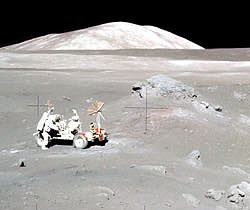
Hey, doesn’t that mountain (“Shorty”) on the moon look a bit like Mount Calvo (the one that Billy and I were climbing last weekend, see below)? But I digress. This is all about Duct tape. Apollo 17. The right rear fender on the moon buggy gets broken. Duct tape to the rescue!
http://science.nasa.gov/headlines/y2008/21apr_ducttape.htm