Category: software
Digital Engineering vs. Analog Engineering
In a book review Thompson makes this observation about the digital-analog divide:
One difference might be that human beings can deal with ambiguity, and computers really can’t. If you’ve done any Python [coding], you make the tiniest mistake, and everything stops immediately. That’s what makes it different even from other forms of engineering. When you are trying to fix a car, if you fail to tighten a bolt on one wheel as tight as it should be, the entire car doesn’t stop working. But with code, an entire app, an entire website can go down from the misplacement of a single bracket. I think that’s the one thing that sometimes scares writers away, because they are more accustomed to working with ambiguity.
https://arstechnica.com/gadgets/2019/04/how-the-new-art-form-of-coding-came-to-shape-our-modern-world/
I am definitely more accustomed to working with ambiguity. All of my rigs are filled with ambiguity.
VU3XVR’s Assembly Language 1K AtTiny-Si5351 VFO
Although Ram VU3XVR’s project is in the digital realm, his barebones approach to the bits and bytes is, for me, very appealing. He takes a Si5351 and runs it with ATtiny13 with only 1k of space. He makes intelligent use of every bit of that space. He reveals his overall approach to rigs when he states in the video that his VFO will NOT have the traditional glowing numeral frequency readout because those bright lights can be so annoying and distracting. I’m with your Ram! Well done OM. Simplicity is a virtue. No more trouble with the Arduino and its fickle IDE. No more agonizing visits to the Si5351 library.
I see lots of applications for this little circuit. Ram mentions beacon transmitters.
He provides details here:
https://vu3xvr.blogspot.com/2018/07/si5351-dds-clock-generator-using.html
Understanding Antenna Directivity — Help from Canada
I am in the process of repairing my beloved 17 meter fishing-pole Moxon. It was taken out of service by the last Nor’easter of the winter. This repair has caused me to review the theory behind antenna directivity. I find there is a lot of “hand waving” in the explanations of how directivity happens: “You put a reflector element next to the antenna. And it REFLECTS!” You are left wondering how that reflection happens.
The Royal Canadian Air Force made a video that does a pretty good job of explaining how the reflector reflects. See above. Thanks Canada!
While we are talking about antennas, I wanted to alert readers to a really nice antenna modeling program that is available for free. It is called 4nec2. You can find it here:
http://www.qsl.net/4nec2/ There is a bit of a learning curve, and I am still climbing it, but I can see how this software would be very useful. It has an optimization feature that runs the antenna through many versions and tells you how to optimize for F/B, gain, SWR, or whatever you want to prioritize.
I have discovered that my Moxon was resonant below the 17 meter band. In other words, the antenna elements were too big. About 3.6% too big according to my calculations. This may be the result of my using insulated wire for the antenna elements. Apparently the MOXGEN software assumes the use of uninsulated wire. I’m thinking that an easy way to deal with this would be to use the frequency 3.6% above my target frequency and then use the dimensions given my the MOXGEN program. Any thoughts on this plan?
What a shame that Cebik’s web sites have all disappeared.
Let’s Give Jason NT7S Some Support!
Most of us are using Jason’s code and his Arduino Si5351 libraries. We now have an opportunity to help him continue to come up with the innovations that keep things moving forward on our workbenches.
Consider becoming a patron. Learn more here:
https://www.patreon.com/NT7S
Thanks for all you do Jason!
Steve N8NM Gets Modular — With Both Hardware and Software
Steve N8NM has an excellent article on his blog about the benefits of modularity. He breaks new ground by extending the concept into the software realm. Check it out:
https://n8nmsteve.blogspot.com/2017/07/sr-16-lets-get-modular.html
Subscribe to Steve’s blog, or link to it. Hopefully this will encourage him to post more great things like this.
My Organic Chip Rig with an LTSpice Schematic
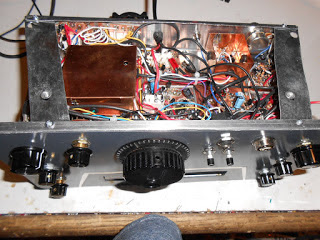
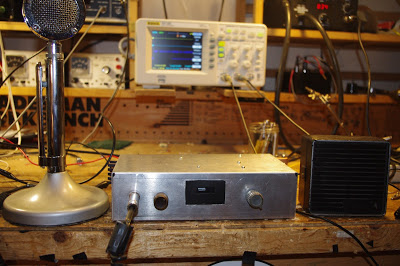
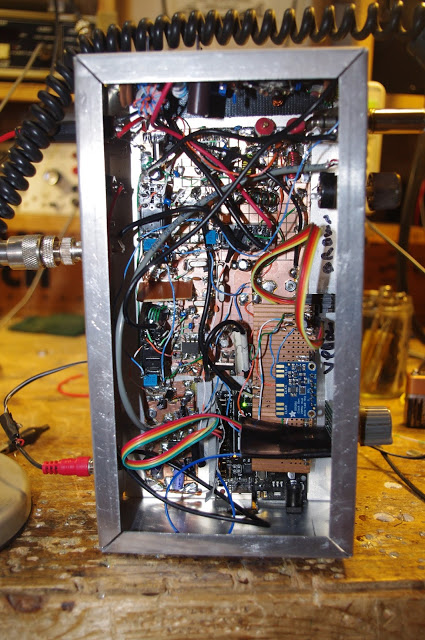
This is a rig that came together through a process of Spontaneous Construction. It started out with an innocent effort to get an Organic Light Emitting Diode display to work with an Si5351/Arduino combination. Then I figured I’d make a superhet receiver with it. Then Pete said I should make it a transceiver.
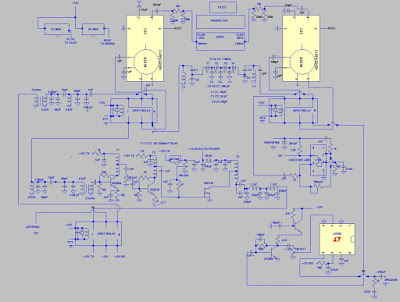
Most of my earlier transceivers so closely followed the schematics of Farhan or others that it didn’t really make sense for me to prepare a new schematic. This one was different. So I decided to prepare a proper schematic. I tried a few of the free-ware CAD or drawing programs, but each of them had a learning curve at the entrance. So I turned to LTSPICE. I have already climbed that learning curve.
The results appear above. Click on the image to make it bigger. I’m sure there are errors in there. And I think some of my parts choices might be less than optimal. But it works well.
The filter was deigned with the help of AADE software.
The idea of using two NE602s with a filter between them came (I think) from the Epiphyte.
The band pass filters were designed with ELSIE software.
The RF power chain is mostly from Farhan’s BITX40 module, with the pre-driver and driver modified for a bit more gain. Farhan’s amp is the most stable power amplifier I have ever used. It hasn’t given me any trouble, even at 20 Watts. Strongly recommended.
The microphone amp is derived from the 741 op amp circuit used in the (in)famous Wee-Willy DSB rig.
The receiver AF amp also comes from Farhan’s BITX40Module.
Please let me know if you spot errors or have suggestions for circuit improvement.
A link to the .asc LTSpice file appears below. Perhaps some brave soul more skilled in LTSpice than I am might want to turn this drawing into an actual simulation. Some of the parts (like the NE602s) have actual simulated components behind the drawings. Others (like the relays and the LM741 and LM386) are just drawings. But go ahead and flesh this thing out. Who knows, it might come to life in the PC and start making QSOs on 40!
Here is the .asc file: http://soldersmoke.com/NE602 Rig.asc
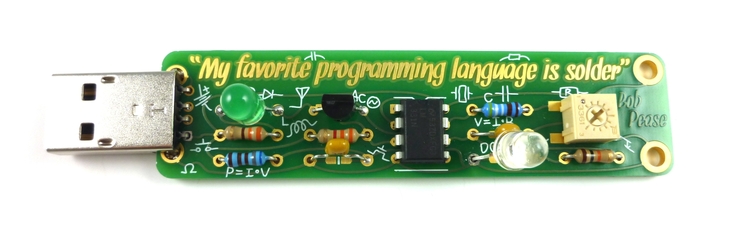
“My Favorite Programming Language is Solder” — Boldport Kits
Look closely at the inscription on that USB stick. Obviously I sympathize. The folks at Boldport have some very interesting ideas and projects. And they operate from a very cool location, just south of the river Thames, not far from my old home in London.
Here is their main site: http://www.boldport.com/blog/2016/2/21/boldport-club-project-1
Here is where you can subscribe to receive a monthly project (with parts!) from them:
https://boldport.cratejoy.com/
As for the solder quote from Bob Pease, this was discussed before on this blog, back in 2011. We were talking about an intereview that had been done with Alan Wolke W2AEW:
I also liked Alan’s response to the question about his favorite software tool: “Gee, solder is soft, can we consider that software? I use a lot of that!” This is very reminiscent of a quote from the legendary Bob Pease (colleague of Jim Williams): “My favorite programming language is solder.” (That quote was sent to me by Steve WA0PWK. Thanks Steve.)
Software Advice From the Brainwagon (Mark, K6HX)
I was really happy to get this encouraging message from Mark, K6HX. Mark is a real wizard — he has been deeply involved in the production of many of Pixar’s wonderful animated films. And his blog — Brainwagon — is always a good read. Mark offers good advice for software and hardware troubleshooting. Thanks Mark!
Hey Bill and Pete:
Just finished listening to your latest SolderSmoke on my commute
yesterday, and thought I’d drop you a line to let you know that I’m
really enjoying the “dynamic duo” format that you’ve adopted. Having
different ideas and different perspectives on the show, but with both
of you showing such great enthusiasm really makes the show a pleasure
to listen to. (Incidently, your audio for this last podcast seemed
much better to me, a couple of episodes seemed to be plagued with much
different levels between Pete, who was booming, and Bill, who
frequently seemed to be quite low. Whatever you did, keep it up!)
As a guy who does mostly computer/software engineering, I’m especially
liking Pete’s continual, good natured prodding of Bill to get with the
program and use more gadgets like the Arduino, the AD9850 and the
Si5351. đŸ™‚ But what’s most valuable to me is when you guys engage
in the back and forth of debugging problems like your recent amplifier
feedback issues. And what I realized (and might come as some comfort
to Bill) is that most of the skills which you guys have developed to
understand and debug radio projects apply equally well to software.
Stop me if this seems familiar:
If you want to learn to program, you do it by programming. Pick a
simple project and try to get it working, then build on your success.
Don’t try to learn it all at once. Making a computer blink an LED is
a good start.
Make use of the resources of the Internet community. Look at what
other people are doing, look at their designs, and enlist their help
when necessary.
Keep notes about what works and doesn’t. Make an archive of all the
code you write. Examples that work can be helpful to create new code
that works.
Don’t just poke the program with a stick, hoping it will work if you
prod it the right way. Develop a theory of why it works, and test
that theory. If the theory is not born out in practice, then don’t
leave that code lying around in your program.
Don’t get too wedded to your idea about why a program may not work.
Test your assumptions, even the ones that you are sure of. Often
those hide the worst bugs.
Think about modularity. Build simple routines/modules that you can
reuse to build bigger programs.
Build on the shoulders of giants: using tested modules of other people
isn’t cheating. But eventually you may need to understand what is
inside these black boxes, so keep working on developing your skills.
Share your enthusiasm with others, via the Internet, Youtube or social media.
——————————————————————————————-
See Bill, you’ve already learned a lot of the lessons you need to be a
programmer, you just learned them all with respect to radios. They
will serve you well if you decide to take the plunge into tinkering
with programming. đŸ™‚
On some of the ham radio related Facebook pages, I’ve been a little
annoyed lately that so many hams seem to lament that “nobody builds
anything anymore”. Ironically, I suspect these are the same sort of
people who decided to pile onto Bill’s amplifier project and skewer
him for its audio quality. If we want more experimentation in ham
radio, we are going to have to tolerate a little more failed (or at
least, not totally successful) experiments. But even beyond that, I
supect that there is quite likely more people (in absolute numbers)
doing homebrew now than in any time in decades. It’s an incredible
golden age for homebrew. We have great books out like EMRFD, great
mailing lists, vendors to sell us amazing parts at incredibly low
prices, and the Internet to share and learn. People like you two are
part of this. What are all these complainers doing to get people to
build stuff?
I have to really thank you, Bill in particular. While I’ve still not
gotten all the way to building my own transceiver, you got me back
into amateur radio, fueled my interest in beacons, QRSS, WSPR and
homebrew in general. And Pete’s approach to radio seems to be the
wedding of electronics and software that I find in sync with my own
ideas. I look forward to doing more projects, and hearing about
yours in the weeks and months to come.
Well done, sirs.
Mark (K6HX)
Our book: “SolderSmoke — Global Adventures in Wireless Electronics” http://soldersmoke.com/book.htm Our coffee mugs, T-Shirts, bumper stickers: http://www.cafepress.com/SolderSmoke Our Book Store: http://astore.amazon.com/contracross-20