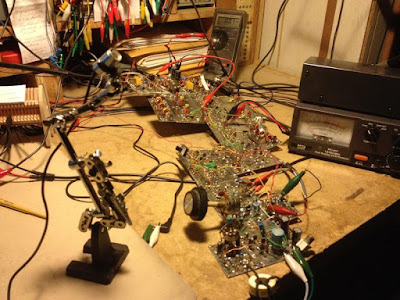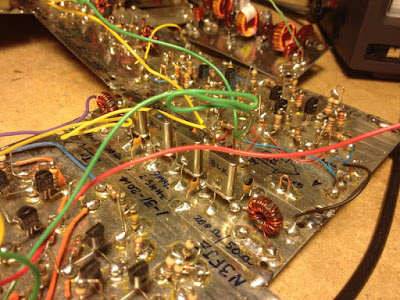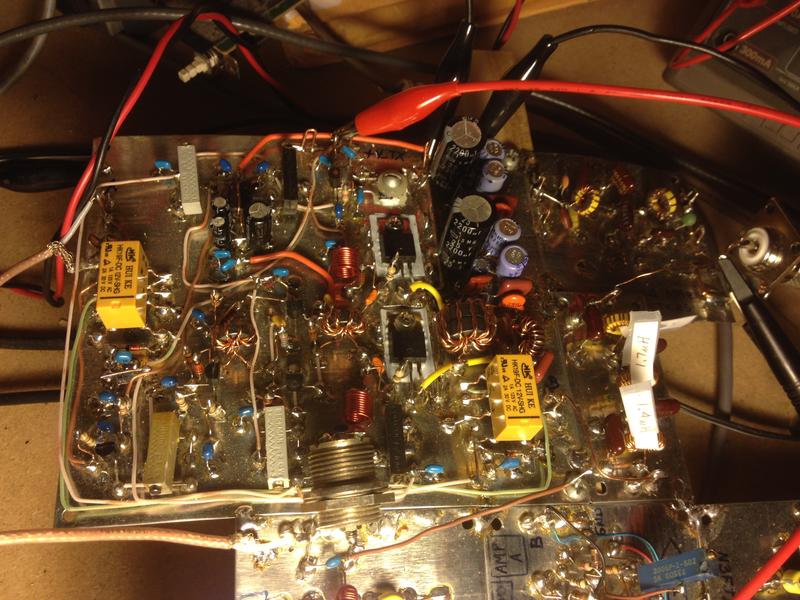
HB2HB! N3FJZ-N2CQR Si5351 and BITX TIAs on Both Sides, with Some LBS and Peter Parker Circuitry Too!

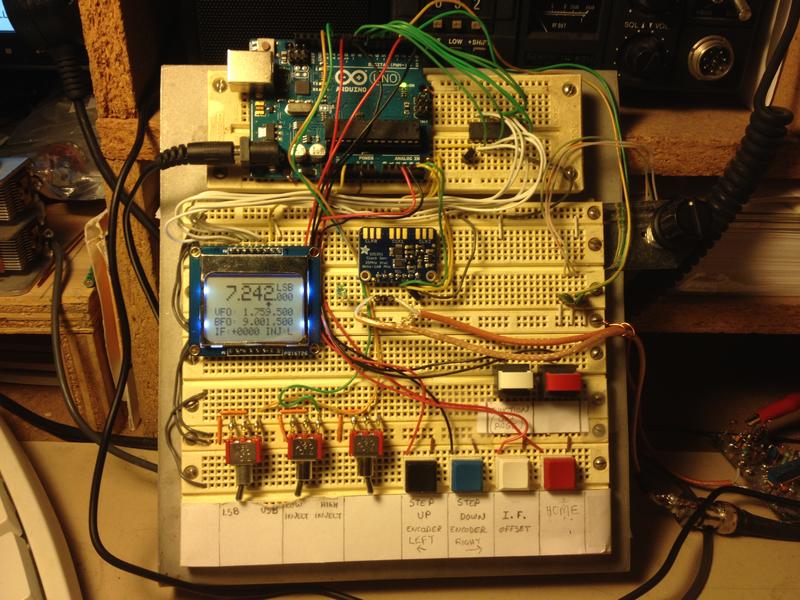
In those dark days of February 2015, when all the members of the SDR ESSB Panoramic Spectral Police were on my case over some imperfections in my 40 meter homebrew SSB signal, Rick, N3FJZ came to my rescue by sending me a great YouTube video of his reception of my new rig. Rick was using a wonderful homebrew Direct Conversion receiver with a really cool PTO. Here is my blog post on Rick and his receiver:

Then, yesterday, I received this e-mail:

Bill, Pete,

I want to share my excitement with you.

After 32 years as a ham, I finally had my first ever HF QSO on October
16, 2015, and on a homebrew rig no less! Oh the Joy of Emission!
It was on 7.242MHz, 8:00 a.m. eastern on the “Woodpecker net”.
– Rig was based on the Bitx, using ZIA bidirectional amps.
– 20 Watts into a 80 meter full-wave loop up at 20 feet.
– 600 ohm homebrew open wire ladder line.
– Balanced antenna coupler inspired by the Annecke and Johnson matchbox
units.
– and most importantly, the Arduino controller software and use of the
Nokia display were derived and inspired from Pete’s “Let’s Build
Something” code presented on his website, and the carrier
oscillator(BFO) & L.O. are generated by an Adafruit SI5351 clock
generator board. Thank you Pete.

See my N3FJZ look-up on QRZ.com for photos of my homebrew rig. I have
also put links to the SolderSmoke blog and to Pete’s web page and blog.

I just want to tell you both that your podcasts, websites, circuit
diagrams and stories were a huge part of my success. They were the
inspiration I needed on many dark days when my amplifiers would
oscillate, and my oscillators would simply smoke. At times I thought I
would never get on the air, but an hour listening to SolderSmoke podcast
would give me the drive venture on. Thank you!

***VERY IMPORTANT!!!!

Bill, during my first QSO, I was getting 5×8 and 5×9 signal reports
(with 20 watts!)from North Carolina, up-state New York, Michigan, and
Indiana, and I know we are only about 50 miles apart (I’m in north
central Maryland), so I believe we could probably achieve a successful
HB2HB contact if you want to try.

If you want to, and have the time, you could join me on the Woodpecker
net any Friday, Saturday or Sunday on 40 meters 7.242MHz 8:00 a.m.
eastern, or we could set-up a prearranged contact on a General class 40
meter frequency of your choosing. Let me know – making an HB2HB
contact with you would mean the world to me.

Pete, I also extend this invitation to you as well, but with only 20
watts on my end, it may be a stretch, but we could try.

Thank you both again for the joy you have given me with your pod-casts.
73
Rick – N3FJZ
……………..
Rick and I got together on 7.288 MHz yesterday evening. It was a really amazing QSO. Rick made a video of it (see above) and I recorded the audio on my side. My old tape recorder didn’t do Rick’s signal justice — it sounded better than this. But here is the full QSO:
Be sure to listen closely at around 21 minutes when Rick describes a software feature that allows him to switch — with the touch of a button — from high side VFO to low side VFO. The BFO frequency also changes to account for the resulting sideband inversion. Very cool.

Rick’s Digital Board

Ricks Rig as it was during our QSO
Crystal Filter

Rick’s Dual HEXFET Power Amplifier
Check out the N3FJZ QRZ.com page for more info.
CONGRATULATIONS TO RICK! 


AK2B’s Beautiful Si5351 Receiver — Just Listen and Watch!

Tom Hall does amazing things with solder and electrons in the heart of New York City. I give him extra credit for doing this on the island of Manhattan because 1) that’s where I’m from and 2) EVERYTHING is more difficult there.

I may have presented this video before. If I didn’t, I should have. And if I did, well, here it is again (I guess my NYC attitude is showing here).

Look at the ease with which Tom switches bands. Fantastic! But even more important, LISTEN to the quality of the reception. Listen as Tom tunes in on strong CW and SSB signals. Do you hear any signs of the dreaded phase noise that is supposed to plague the Si5351 chip? I do not. I think this receiver sounds great.

I don’t know why the Si5351 got such a bad rep for noise. Could it be that some people were testing it with boards other than the Adafruit or NT7S products that we have been using? Could it have been that in the tests the boards weren’t completely installed? (It is important to have the VFO and BFO signal lines properly shielded.) Could it be that in the tests they were using physically adjacent clock outputs from the board? (We use CLK0 and CLK2, skipping CLK1 to avoid the “bleedover” problem that was noted by early users.)

Bryan KV4ZS’s “Let’s Build Something” Direct Conversion Receiver

Bryan:
I think it sounds great! There is nothing really wrong with it — that is what 40 meters sounds like! Sure there is static. And those whistles you hear near the top of the band are the carriers from shortwave broadcast stations. You might have a little hum, but that should disappear once you get it all packaged in a metal box. Congratulations Bryan! You have done something that very few hams have done: You have built a receiver. 73 Bill N2CQR
………………….
Hi Bryan,
First let me congratulate you. That is one fine build and you may actually have absolutely nothing wrong!!!!!! I really must applaud your “squares”. They look like they were made on a CNC machine. Bravo!!!
You are operating the LBS without an RF amplifier and as such you are trying to make up the gain in the audio amp. I would say that the results you are hearing are very consistent with the DCR without an RF amp. Get the RF amps stage working and then run your test –you will find with the RF amp that at the gain setting you have for the video will be room filling. It actually sounds pretty good. You might also try connecting a 1 NF across the audio trimmer pot as that will cut down on the “hiss’ sound.
Concentrate on the RF amp stage and then re-run your test –you will see the difference.
Great build – very nice job.
73’s
Pete N6QW
………………..
Very nice!
Sounds pretty good to me in terms of noise – that’s what a direct conversion receiver sounds like (they tend to be very wide in terms of reception – static is normal… Welcome the world without noise reduction and DSP!!). DCR’s – because they are not run through a narrow IF filter – allow a very broad range of signals to get to the audio stage. So, for example, if you tune that around during a CW contest, you’ll hear a LOT of signals at the same time – versus only one or two at a time, once you have this run through the 4.9152 crystal filter. That’s the nature of the beast.
The 1nf across the audio trimmer definitely will help with reducing the hiss, although I must say my Kenwood receivers all have a similar amount of hiss and I prefer my radios with more, not less, noise (it lets me know what the band conditions are like…). I have noticed on my builds, however, that if you have a very, very high pitch WHINE on the other hand, that tends to be a bad solder joint or bad capacitor somewhere – probably on a capacitor – introducing an offset into your RF someplace it shouldn’t. What that looks like on an oscilloscope is the audio signal will have a large DC offset versus ground – almost always a bad solder joint on a capacitor—or a bad/broken capacitor–somewhere in the audio amplifier. That’s the same problem you get when you try to record audio sometimes from an external source (TV, radio, CD player) on your computer – DC voltage offset on the audio line. Kind of like what you might have heard on a stereo if you ever tried to switch to a channel where the input was hanging open.
Ben
KK6FUT

Unfazed! Fight HISS-teria! Give the Si5351 a Chance.

Thanks to all who have contributed to our discussion of phase noise and the Si5351 chip. Let me throw out some ideas — some technical, others philosophical.


1) We may be worrying about this too much. In all of the homebrew or kit rigs we’ve built over the years, I never recall much concern about the phase noise specs of the LC or crystal oscillator circuit that we were using. What were the phase noise stats on a Heath VF-1? How about the phase noise stats for the little Hartley oscillator in those DC receivers we made? No one even checked. Our rigs usually worked just fine. We would have noticed if they were extremely noisy, but if they were good enough, we left well enough alone. It doesn’t really make much sense for us to now be suddenly very concerned about the phase noise stats of the various DDS and PLL chips that are replacing those LC and crystal circuits, especially when the measurements show that they are usually in the same range as our old familiar oscillators.

2) The perfect can be the enemy of the good, and the “good enough.” We have a long tradition in ham radio of tolerating less-than-perfect or less-than-optimum parts. Remember, the NE-602 has some shortcomings, but we use it. We use it a lot. The IRF-510 wasn’t even designed to be an RF amplifiers, but we have pressed it into service for our PAs.

3) We should be willing to give a new part a try, and we should be pleased if it proves useful. We should be wary of untested claims re the unsuitability of a component. We have to avoid the “works in practice, but not in theory” situation. If something works well, doesn’t create additional QRM, is inexpensive, and fosters experimentation and homebrewing, we should be happy about being able to use it.

4) All electronic components — not just the Si5351! — produce noise. Resistors produce noise. Look at this:
” We can infer… that if we install phase-quiet oscillators in transmitter and receiver, we ought to be able to tune our receiver to a frequency closely adjacent to a very strong signal from the transmitter without encountering anything like phase-noise hiss. Yet, after an exhaustive phase-noise cleanup at transmitting and receiving sites, we test our communication system only to discover that the transmitter still emits broadband hiss! The culprit is transmitted amplifier noise. Just about every modern transmitter or transceiver consists of a high-gain, linear amplifier strip that amplifies the low-level output of oscillators, mixers and phase-locked loops to hundreds of watts or a few kilowatts. Because amplifier circuitry is not perfectly quiet, the output of the transmitter contains noise (hiss) in addition to the amplified signal. Transmitted along with the desired signal, this hiss can degrade the noise floor of nearby receivers-just as transmitted phase noise can. Where does amplifier noise come from? Thermal noise, for one thing. Electronic components operated at temperatures greater than absolute zero generate random electrical noise. This noise is broadband in nature. Greatly amplified in an audio amplifier-or greatly amplified in a radio transmitter, transmitted as broadband radio noise, received and converted to audio-it sounds like hiss. Random variations in electron flow within active amplifier components (transistors and vacuum tubes) are another source of amplifier noise. Transmitted as broadband radio noise, received and converted to audio, it also sounds like hiss.” Source: http://www.robkalmeijer.nl/techniek/electronica/radiotechniek/hambladen/qst/1988/03/page14/index.html

5) It seems that whenever a new technology or part comes along there will be those who issue dire warnings about how we can’t or shouldn’t use it. When transistors came along, there were those who said that hams shouldn’t homebrew with them because — it was argued — without spectrum analyzers we couldn’t possibly come up with spectrally pure signals.

6) We have to be careful lest this obsession with perfection and extremely high tech standards be used as a rationale for not homebrewing, or (much worse) as an argument against homebrew rigs on the ham bands. There is a bit of this going around. Get on 40 meters with rig that drifts a bit or that is not “on frequency” to within 10 Hz and you will find out what I mean.

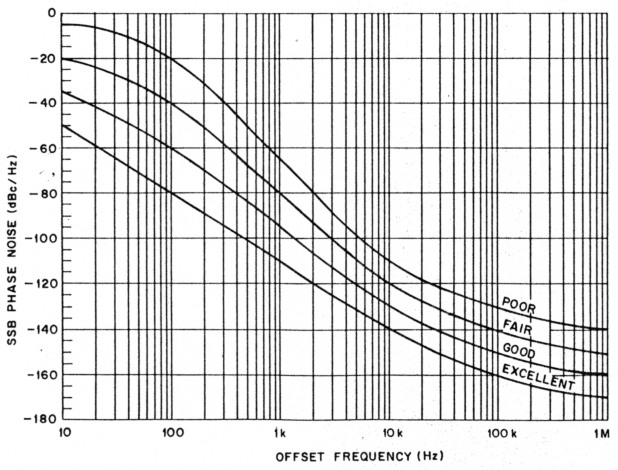
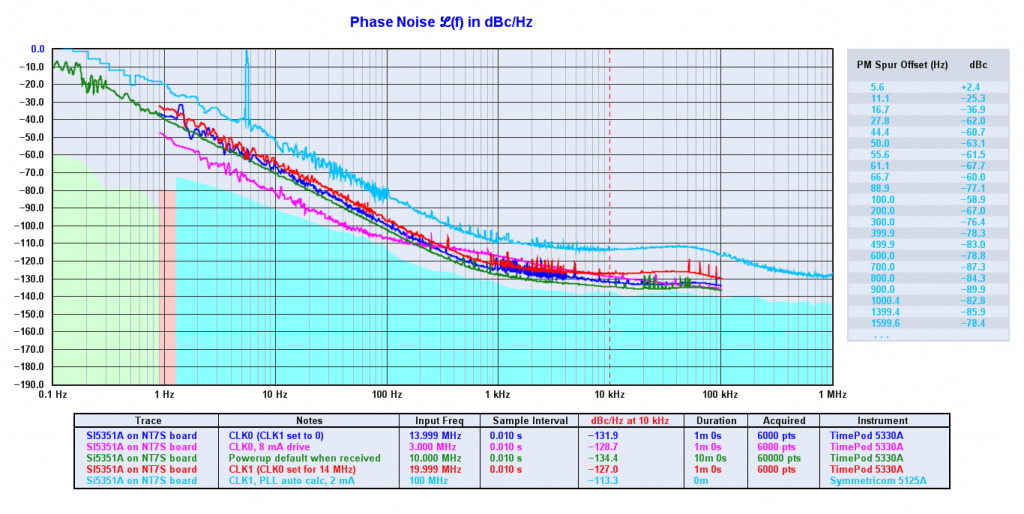
7) The Si5351 is a good part for our purposes. It does something new and VERY useful for us: It can put out BOTH our VFO and BFO frequencies. It makes it much easier for us to change bands and-or switch between USB and LSB. Its phase noise figures are fine. LA3PNA (citing measurements by KE5FX) notes: “The phase noise of the Si5351 is around -130dBc/Hz at 10KHz. This is quite decent, If compared to a Hartley or Collpits you would see little or no difference. Some of my measurements of published free running oscilators show phase noise in the -110dBc/Hz range!”

Fig 5


-130 dBc/Hz at 10 kHz puts this part on the “good” curve of this chart. From (http://www.robkalmeijer.nl/techniek/electronica/radiotechniek/hambladen/qst/1988/03/page14/index.html

We should give this little chip a chance! Give it a try!

Our book: “SolderSmoke — Global Adventures in Wireless Electronics” http://soldersmoke.com/book.htm Our coffee mugs, T-Shirts, bumper stickers: http://www.cafepress.com/SolderSmoke Our Book Store: http://astore.amazon.com/contracross-20

SolderSmoke Podcast #179 SPECIAL TENTH ANNIVERSARY EDITION

SolderSmoke Podcast #179 is available:
22 August 2015
YESTERDAY MARKED 10 YEARS OF THE SOLDERSMOKE PODCAST
— A clip: The first minutes of SolderSmoke #1
— A trip down SolderSmoke memory lane.
— The SolderSmoke lexicon — words and phrases we use (a lot).
BENCH REPORT
— Pete’s antenna project.
— Pete’s new Blog: http://n6qw.blogspot.com
— Bill’s big amplifier problem fixed thanks to Allison KB1GMX.
— Six digit freq readout with an Altoids case.
THE Si5351 PHASE NOISE CONTROVERSY
— ALL oscillators make noise.
— Keeping things in perspective: It is 100 db down!
— Observations and tests from LA3PNA, NT7S, and K0WFS:
— Try it, you’ll like it! The benefits trying things on real rigs.
NEWS
Interviews on “QSO TODAY” with Eric 4Z1UG.
Horrible band conditions.
Looking at Saturn with telescope.
MAILBAG
Another recruit for the CBLA: Paul KA5WPL.
Ron G4GXO on Bell-Thorn and Eden9 SSB rigs.
Rupert G6HVY on Kon Tiki radio and Mr. Spock.
Mikele’s Croation BITX rigs.
Dean AC9JQ’s TIA.
Bryan KV4ZS will build an LBS receiver.
Dave Anderson give Pete good antenna advice.
Steve Smith moves in from the garage.
Pete has built 12 SSB transceivers. Intervention time?

Our book: “SolderSmoke — Global Adventures in Wireless Electronics” http://soldersmoke.com/book.htm Our coffee mugs, T-Shirts, bumper stickers: http://www.cafepress.com/SolderSmoke Our Book Store: http://astore.amazon.com/contracross-20

Going through a phase (on phase noise)

There seems to be a bit of hysteria on the alleged phase noise problems of the Si5351 chip. The library yields some words of wisdom that help keep things in perspective:

ARRL Handbook (2002) page 14.5: “You would be excused for thinking that phase noise is a recent discovery, but all oscillators have always produced it.”

Experimental Methods in RF Design page 4.12 “At first glance, phase noise sounds like a esoteric detail that probably has little impact on practical communications. This is generally true.” (EMRFD does, however, go on to discuss the problems that arise on both receive and transmit from EXCESSIVE phase noise.)

Our old (young!) friend Thomas LA3PNA e-mailed on this subject noting that the Si5351 chip produces less phase noise than many Hartley or Collpits oscillator designs. He provides a link to measurements (far better than mine!) of the noise from the Si5351:

http://nt7s.com/2014/11/si5351a-investigations-part-7/

NT7S puts it this way:

I believe that the plots speak for themselves fairly well. If you compare these results to the receivers in the Sherwood Engineering receiver table, I think you’ll see that the Si5351 acquits itself quite nicely for such an inexpensive part. Personally, I think the Si5351 is eminently usable for many receiver applications, except perhaps the most high-performance. Certainly for the price, it’s going to be extremely hard to beat. I hope this motivates those sitting on the fence to decide if the Si5351 will meet their needs.

Be careful in evaluating statements saying that the Si5351 phase noise is 3-6 db worse than an Si570. This makes it sound like there is a LOT of noise coming out! But again, it is important to keep things in perspective: The noise from one chip might be -156 dbc/Hz while the “worse” chip might be -150 dbc/Hz. That’s still not enough noise to make a lot of noise about.

The ARRL handbook recommended a very simple check for excessive phase noise: Set up a very strong signal in the band of your receiver. Then slowly tune to the signal, listening carefully for any build-up in noise as you approach the signal. I did this, and I didn’t hear any. As for transmit, well, as Pete points out, I think the spectrum police on 40 meters would let us know if our signals were broad or noisy! The ARRL Handbook notes that in a transmitter, “This radiated noise exists in the same proportion to the transmitter power as the phase noise is to the oscillator power…”

Our book: “SolderSmoke — Global Adventures in Wireless Electronics” http://soldersmoke.com/book.htm Our coffee mugs, T-Shirts, bumper stickers: http://www.cafepress.com/SolderSmoke Our Book Store: http://astore.amazon.com/contracross-20

Going through a phase (on phase noise)

There seems to be a bit of hysteria on the alleged phase noise problems of the Si5351 chip. The library yields some words of wisdom that help keep things in perspective:

ARRL Handbook (2002) page 14.5: “You would be excused for thinking that phase noise is a recent discovery, but all oscillators have always produced it.”

Experimental Methods in RF Design page 4.12 “At first glance, phase noise sounds like a esoteric detail that probably has little impact on practical communications. This is generally true.” (EMRFD does, however, go on to discuss the problems that arise on both receive and transmit from EXCESSIVE phase noise.)

Our old (young!) friend Thomas LA3PNA e-mailed on this subject noting that the Si5351 chip produces less phase noise than many Hartley or Collpits oscillator designs. He provides a link to measurements (far better than mine!) of the noise from the Si5351:

http://nt7s.com/2014/11/si5351a-investigations-part-7/

NT7S puts it this way:

I believe that the plots speak for themselves fairly well. If you compare these results to the receivers in the Sherwood Engineering receiver table, I think you’ll see that the Si5351 acquits itself quite nicely for such an inexpensive part. Personally, I think the Si5351 is eminently usable for many receiver applications, except perhaps the most high-performance. Certainly for the price, it’s going to be extremely hard to beat. I hope this motivates those sitting on the fence to decide if the Si5351 will meet their needs.

Be careful in evaluating statements saying that the Si5351 phase noise is 3-6 db worse than an Si570. This makes it sound like there is a LOT of noise coming out! But again, it is important to keep things in perspective: The noise from one chip might be -156 dbc/Hz while the “worse” chip might be -150 dbc/Hz. That’s still not enough noise to make a lot of noise about.

The ARRL handbook recommended a very simple check for excessive phase noise: Set up a very strong signal in the band of your receiver. Then slowly tune to the signal, listening carefully for any build-up in noise as you approach the signal. I did this, and I didn’t hear any. As for transmit, well, as Pete points out, I think the spectrum police on 40 meters would let us know if our signals were broad or noisy! The ARRL Handbook notes that in a transmitter, “This radiated noise exists in the same proportion to the transmitter power as the phase noise is to the oscillator power…”

Our book: “SolderSmoke — Global Adventures in Wireless Electronics” http://soldersmoke.com/book.htm Our coffee mugs, T-Shirts, bumper stickers: http://www.cafepress.com/SolderSmoke Our Book Store: http://astore.amazon.com/contracross-20

Si5351 Phase Noise? A Tale of 3 Oscillators

Si5351 at 16 MHz
There is still a lot of talk about the supposedly horrible phase noise of the Si5351 chip. In a recent episode of a popular (and very good!) podcast about homebrewing, the podcasters talked about this in the context of some megawatt AM shortwave broadcast stations that had oscillator phase noise problems and were wiping out large portions of the HF spectrum. I don’t think those stations were running Si5351s, but the listener was left with the impression that these handy little chips are very noisy with lots of spurs and will inevitably produce horrible dirty, spectrally impure signals.
This has not been our experience. Following Pete’s lead, several of us are using the Si5351 to generate both VFO and BFO signals in our transceivers, with good results. The receivers sound very good and we have not heard complaints of “broad” or “noisy” transmitted signals.
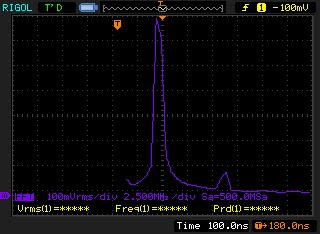
I decided to dig into this a bit. This was also an excuse for me to use the FFT and screen capture features on my Rigol ‘scope.
I now have THREE BITX transceivers in the shack. My BITX17 uses a VXO at round 23 MHz (IF at 5 MHz)/ My BITX20 uses a classic LC VFO running around 3.5 MHz (IF at 11 MHz). Finally, my BITX40 (DIGI-TIA) uses the dreaded and much reviled Si5351 running at around 16 MHz (IF at 9 MHz). I thought that these three rigs would provide a good opportunity to test the scurrilous claims about the Si5351.
As a simple first test, I put my Rigol scope in FFT mode and just put the probe at the VFO Mixer’s LO input. The screenshot above is the FFT for the Si5351. It looks pretty clean to me. The ‘scope is looking at 15 Mhz above and below the VFO signal.


VFO at 3.5 MHz
Next I measured the output of the BITX20 VFO at the same point (input to the VFO mixer). (I had to change the vertical range, but the horizontal was unchanged.) Here you can see the second harmonic (just because at this low freq it is within the freq range setting of the ‘scope). It doesn’t look much different than the Si5351. 


VXO at 23 MHz
Finally, here is the BITX17 VXO at 23 MHz, again at the input to the VFO mixer. It looks remarkably similar to the Si5351, don’t you think?
More on this to come. The ARRL Handbook (2002) has a good discussion on phase noise. I am digging into this and hope to do some more tests. For now, I think we should reserve judgment on the utility (for us) of the Si5351. 


Our book: “SolderSmoke — Global Adventures in Wireless Electronics” http://soldersmoke.com/book.htm Our coffee mugs, T-Shirts, bumper stickers: http://www.cafepress.com/SolderSmoke Our Book Store: http://astore.amazon.com/contracross-20