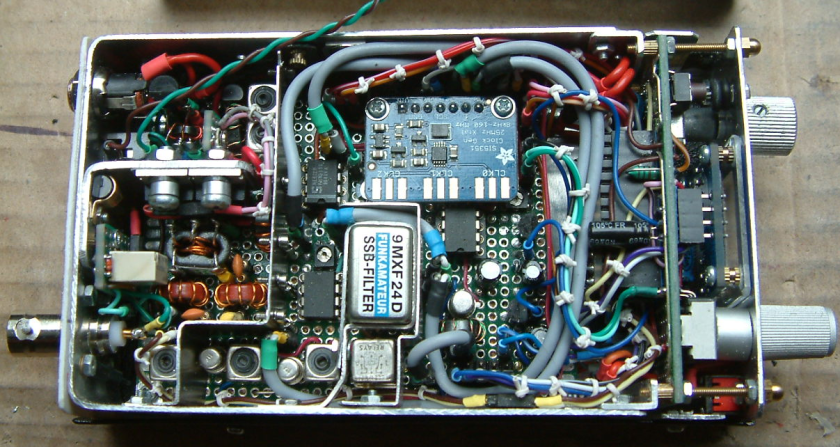
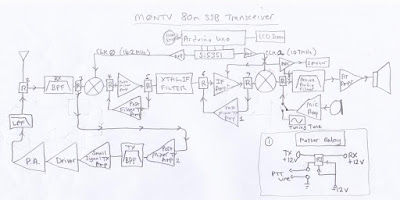
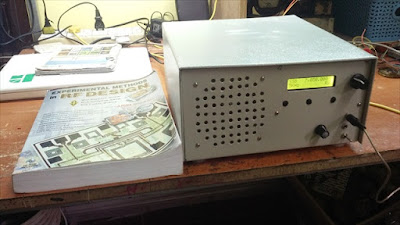
M0NTV’s Latest FB SSB Transceiver

Wow, Nick has a really wonderful rig and has made this great video to explain it.

Elements that I really liked:

— The simple mic and compression. Very nice.
— Termination Insensitive Amps. TIAs Rule!
— Grey Altoid-like boxes.
— Diplexers! Yes!
— Doug DeMaw S-meter.
— No AGC.
— Pentium CPU cooling fan.
— References to EI9GQ (I must get his book!)
— Al Fresco! Good luck with boxing it up Nick.

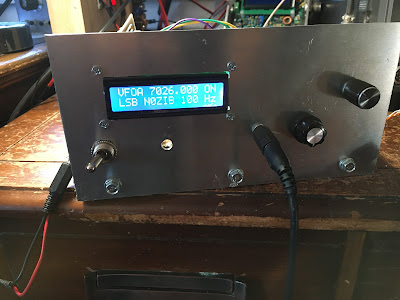
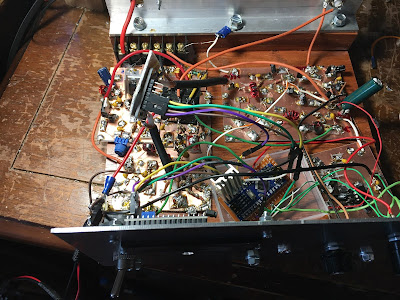
Adam N0ZIB’s Direct Conversion Transceiver

This is obviously very cool, but looking ahead I think Adam should think about adding one more mixer, changing the bias on the TX amps, and adding a mic amp. Boom: A Double Sideband Transceiver.

Pete wrote: When I was in the US Navy and a particular unit did something outstanding – the Command ship would raise the Bravo Zulu Flag for a job well. Don’t know if you can see it there in MO but I have raised the BZ flag to you. Outstanding and congratulations.

Bill and Pete:

Just finished a DC transceiver using Arduino nano, SI5351 (my sincerest apologies, Bill), diode ring mixer and lm386 audio amp. The transmit portion is a two-stage class AB pre-amp (from EMRFD page 2.32), which is driving an IRF510 final (biased at 2.08 volts) from Pete’s design. Output is about 5watts into a CWAZ low pass filter, based on the design from here: https://www.arrl.org/files/file/Technology/tis/info/pdf/9902044.pdf

I’m using a manual TX/RX switch which is doing multiple things. It brings the Nano A1 LOW, offsetting the transmit frequency 600 Hz for CW, grounds the audio input to prevent deafness (learned that one the hard way), and it engages a relay that switches the antenna from the receiver to the transmit, and also turns on the transmitter stages. Keying is through the first stage of the pre-amp.

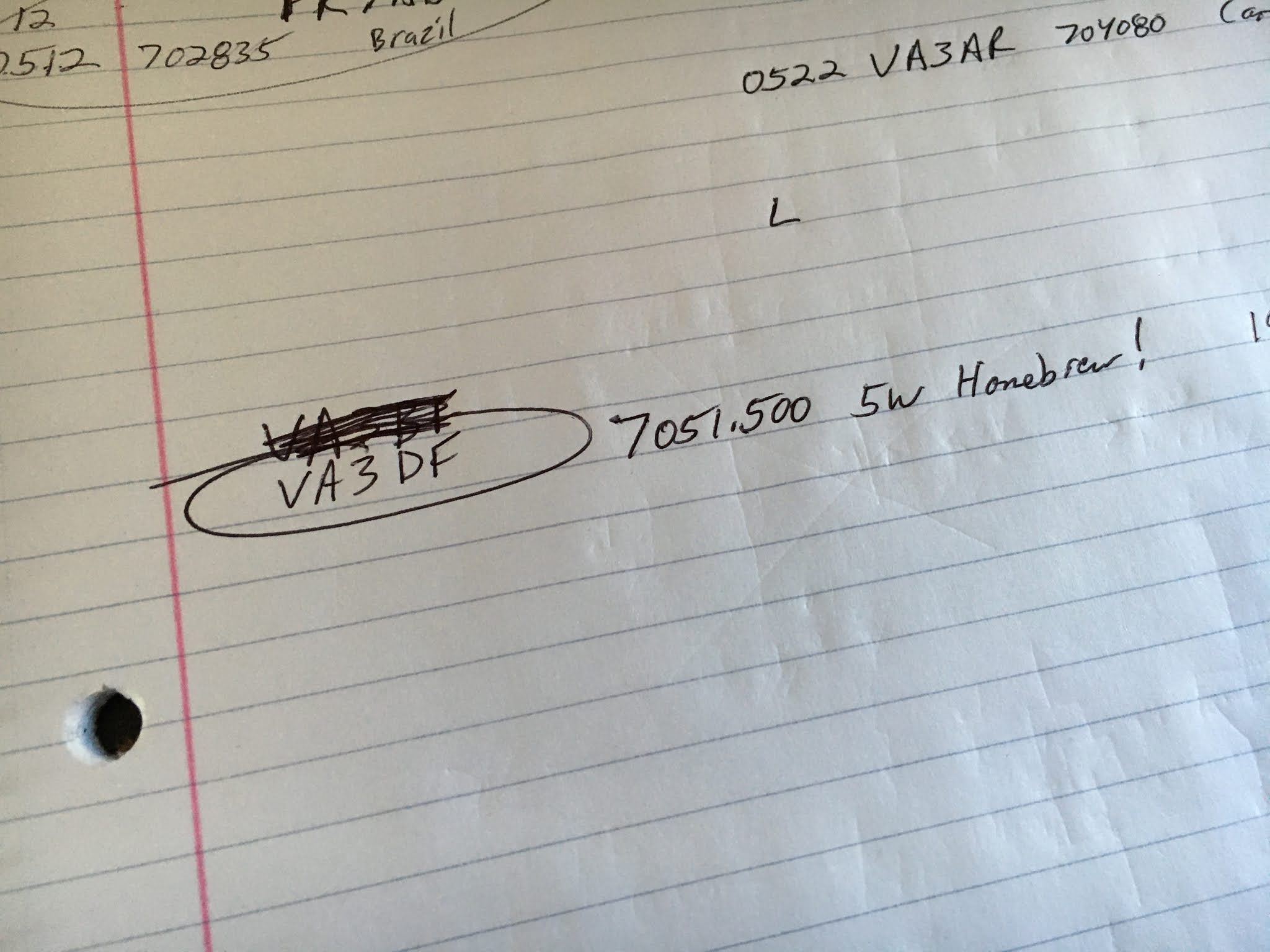
I still have some tidying up to do, and I’m not sure the LPF works so well using two component inductors instead of all toroids, but I finished it today and made my first QSO into Ontario almost 1000 miles away. It’s been great fun!

73,
Adam
N0ZIB
Missouri

Wisdom from AA0ZZ: NO LIBRARIES! ASSEMBLER CODE ONLY! — “Digital Crap” — “No Magic Fruit” What qualifies as a real rig? Si570 vs. Si5351

Bill,

Why do you guys make your Soldersmoke podcasts so darn intriguing such that I can’t listen to them in the background while I’m doing something else? Good grief! I start listening and before long you make me stop and chase down a rabbit hole to find something new that you mentioned that I had no clue was out there. Before long I’m doodling out a new sketch or playing with at a new design for something I really need to experiment with or build “next” or something I need to try. It is taking too much of my time!! J

I’ve been listening to your podcasts for years. Way back, before I knew you and before I knew you were doing these Soldersmoke blogs with Mike, KL7R, and just before he was so tragically killed, I was collaborating with him on a simple frequency counter project using a PIC microcontroller. We were making good progress on a neat design. I later completed the project but always kept his contributions noted as part of the source code.

I’ve been making PIC-based VFOs for years – dating back to about 2000 – aiming them at builders who were looking for something to go along with Rick Campbell’s (KK7B) receivers. Rick is a good friend now, after we met in the Kanga booth at Dayton where we both were demonstrating our stuff. (Bill Kelsey (N8ET) of Kanga, was the “marketer” for my kits as well as Rick’s for many years.) My original VFO kits used a DDS (high-end AD9854) that simultaneously produced I and Q signals which made it perfect for Rick’s phasing gear. Rick is a big supporter of my work but he still kids me about polluting his beautiful analog world with my “digital crap” (copyright KK7B term). When I came out with a newer version VFO using a Silicon Labs Si570 PPLL (I can hear already Pete Juliano groaning) it was a big improvement over the AD9854 in noise/spur reduction. I documented this all in a QEX article in about 2011 and Rick (and Wes Hayward) were very supportive/appreciative of my work.

I have used the Si5351 also and I understand Pete’s point of view. It’s “plenty good” for most amateur projects. However, it remains a fact that the Si570 is a better part and produces a cleaner signal. That’s the reason why the Elecraft KX3 uses a Si570. Granted, the newer Elecraft KX2 uses a Si5351 but it’s most likely because they wanted to preserve battery life (the Si570 uses more power but not nearly as much as the AD9854) and also to reduce the cost. I do understand! I also fully understand the ability of the Si5351 to produce I and Q signals via different channels. I’ve had extensive conversations about this with Hans Summers, at Dayton and online. I use a pair of Flip-Flops on the output of the Si570 instead. My PIC code driving the Si570 is ALL written in ASSEMBLER code. Yep! I’m an EE but have had a career mainly in software development and much of it was writing assembler code. I dare say there aren’t too many gluttons for punishment that do it this way. I do it because I want to understand every line of code don’t want to be dependent on anyone else’s libraries. Every line of code in my VFO’s and Signal Generators is MINE so I know I can debug it and it can’t get changed out from under me. (This problem bit Ashar Farhan hard on the Raduino of his BitX. Tuning clicks appeared because the Si5351 libraries he used changed between the time he tested it and released it. I was really appalled when I dug into this and resolved to NEVER use libraries that I didn’t write myself. Similarly, this also makes me have some distaste for Arduino sketches. I would rather see ALL of the code including the initialization code, the serial routines, etc, rather than having them hidden and get pulled in from Arduino libraries. That’s similar to the reason why Hans Summers didn’t use an Arduino in his QCX. He used the same Atmel microprocessor but developed/debugged it as “C” code with the full Atmel IDE/debugger.

By the way, Pete mentioned the Phaser FT8 transceiver by Dave, K1SWL, in a recent podcast. Dave is a very close friend, even though I haven’t met him in person since about 2000. We Email at least daily and some of it is even about radio. J I did the PIC code for the tiny PIC that controls the Si5351 in the Phaser. Yes, it’s written entirely in Assembler again! I do know how to do it for a Si5351. That Si5351 code is not nearly as much “fun”, though. I know, this will make very little difference to guys who write Arduino “C” code to control it but under the covers it’s a world of difference. It takes me about 15 serial, sequential, math operations to generate the parameters for the Si5351. None of them can be table driven and they all have to be performed sequentially. (This is all hidden in about 5 lines of complex, Arduino “C” code but the operations are all there in the compiled assembler code.) In contrast, my Si570 code is almost all table driven. I just have to do one large (48-bit) division operation at the end to generate the parameters. Yes, that’s a bit of trickery to do in ASM. There are no libraries do this.

I will point out one more advantage of the Si570 in comparison to the Si5351. It has the ability to self-calibrate via software instead of relying on an external frequency standard. In my Si570 app I can read up the exact parameters for the crystal embedded inside the Si570, run my frequency-generating algorithm “backwards” and determine the exact crystal frequency (within tolerances, of course) for that particular Si570. Then I update all the internal tables using that crystal frequency and from then on all generated frequencies are “exact”. I love this! Frequency often moves by about 6 kHz on 40M.

Oh yes, I must mention the difference of home solderability of the si570 vs the Si5351. Those little Si5351 buggers are terribly difficult to solder at home while the Si570 is a breeze. I know, many folks will just buy the AdaFruit Si5351 board and it’s already soldered on but, again, I like to do it all myself. No “magic Fruit” for me.

Now that I retired a couple of years ago and am getting out of the VFO kitting business I can finally build complete rigs instead of just making the next-generation VFO’s for everyone else to use. I recently build a tiny, Direct Conversion rig with a Si570 signal generator (of course) and a diode ring mixer (ADE-1). Look at my web page, www.aa0zz.com to see it, along with my VFO projects that I’ve been building in the past. As you well know, Direct Conversion is fun to build and the sound is astounding; however, they are rather a pain to use! Yes, I did make it qualify as a real rig by making several contacts all over the country. (Wes Hayward gave me the criteria: he told me that I must put any new rig on the air and make at least one contact before it qualifies as a real rig.)

The new rig that’s on my workbench is my own version of a phasing rig, experimenting with a Quadrature Sampling Detector (QSD, sometimes called a “Tayloe” mixer), using some ideas from Rick’s R2 and R2Pro receivers and many innovations of my own. At present my new higher-end Signal Generator works great, the QSD receiver works great (extremely quiet and MDS of -130 dB on 40 meters) and the transmitter is putting out about 16 watts with two RD16HHF1’s in push-pull. You can take away my “QRP-Only-Forever” badge too, not that I’ve ever subscribed to that concept! Still more tweaking to do with the TX but now I’m also working on the “glue” circuitry and the T/R switch. The SigGen, RX and TX are all on separate boards that plug into a base board which has the interconnections between boards and the jacks on the back. I’ve built DOZENS of variations of each of these boards. Fortunately they all fall within the size limit criteria to get them from China at the incredible price of $5 for 10 boards (plus $18 shipping) with about 1 week turnaround. Cost isn’t really an object at this point but it’s more of getting a hardware education that I sadly missed while I concentrated on software for so many years. it’s certainly nice to have willing mentors such as Rick, Wes, Dave (K1SWL), Don (W6JL) and many others to bounce my crazy ideas off. Yes, I’m having a ball!

I was licensed in 1964 but out of radio completely from 1975 to 1995. Do you like the picture of my DX-100 on my web page? My buddy in the 60’s had a Drake 2B and I drooled over it but couldn’t afford one.

Now I must finish this rig before you guys send me down another rabbit hole. Too many fascinating things to think about! I literally have a “priority list” on the my computer’s desktop screen. Every time I come up with a new project idea – something I really want to play with such as a Raspberry Pi, SDR, etc, I pull out the priority list and decide where it fits and what I want to slide down to accommodate it. That’s my reality check!

Take care, Bill. Thanks for taking the time to give us many inspiring thoughts and ideas.

73,

-Craig, AA0ZZ
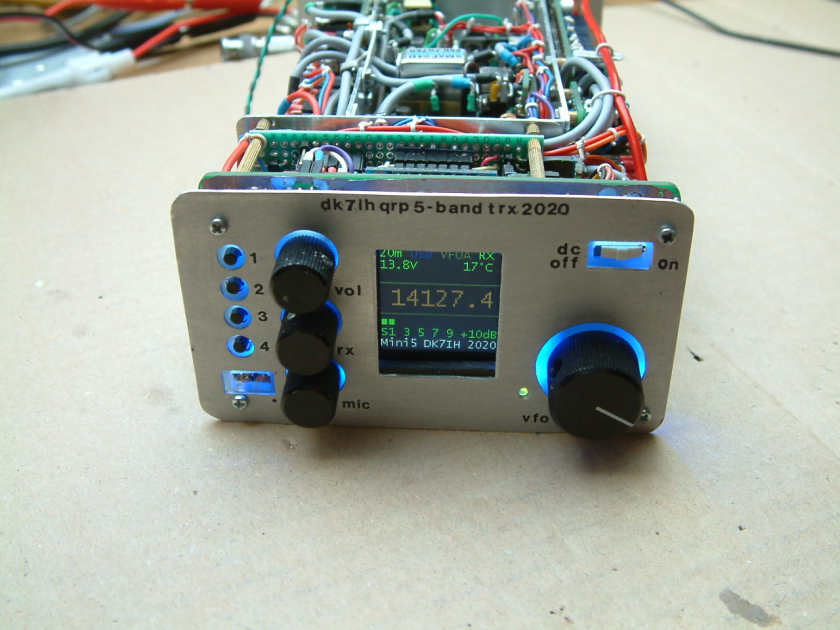
DK7IH Improves his Shirt-Pocket Transceiver

More great stuff from Peter DK7IH. He recently made some improvements to his “Shirt-Pocket SSB Transceiver. On his blog he explains why he made the changes. Note the Si5351 that is in there now. I liked the 1 cm square T/R unit that Peter wrapped in heat shrink tubing. He also provides a really nice description of how to do front panel labeling with a laser printer.


Thanks Peter!

Arduino, Si5351, GPS linked atomic clock, GPS disciplined frequency counter and more…

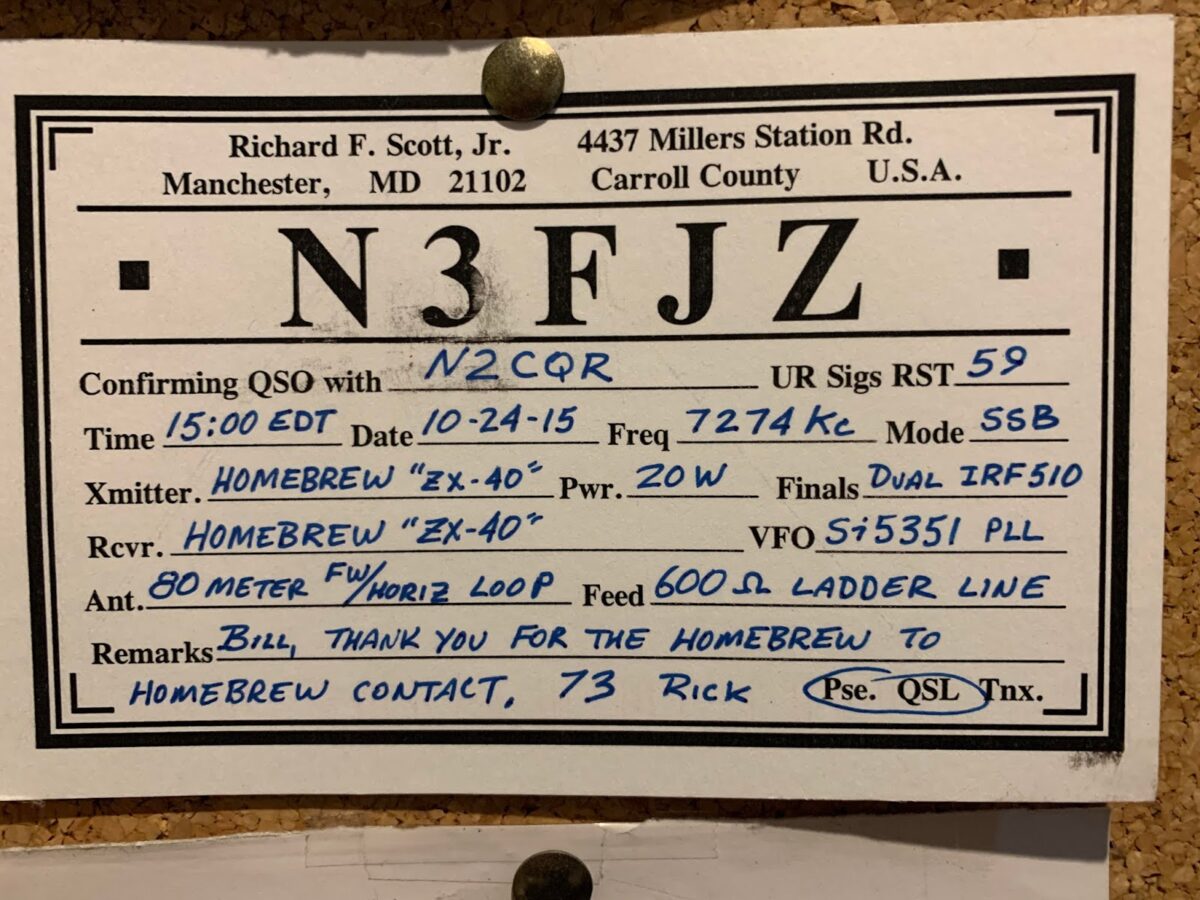
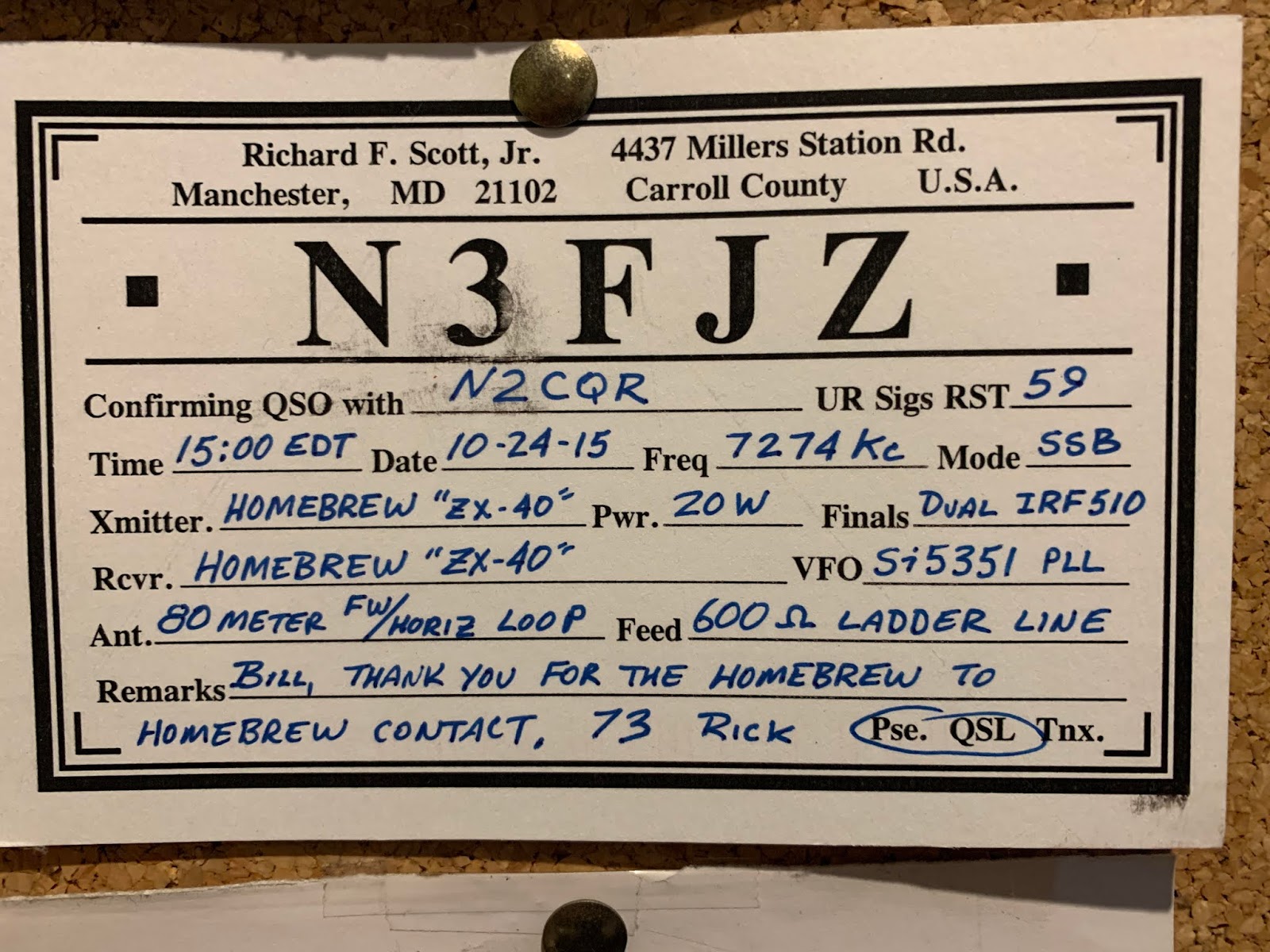
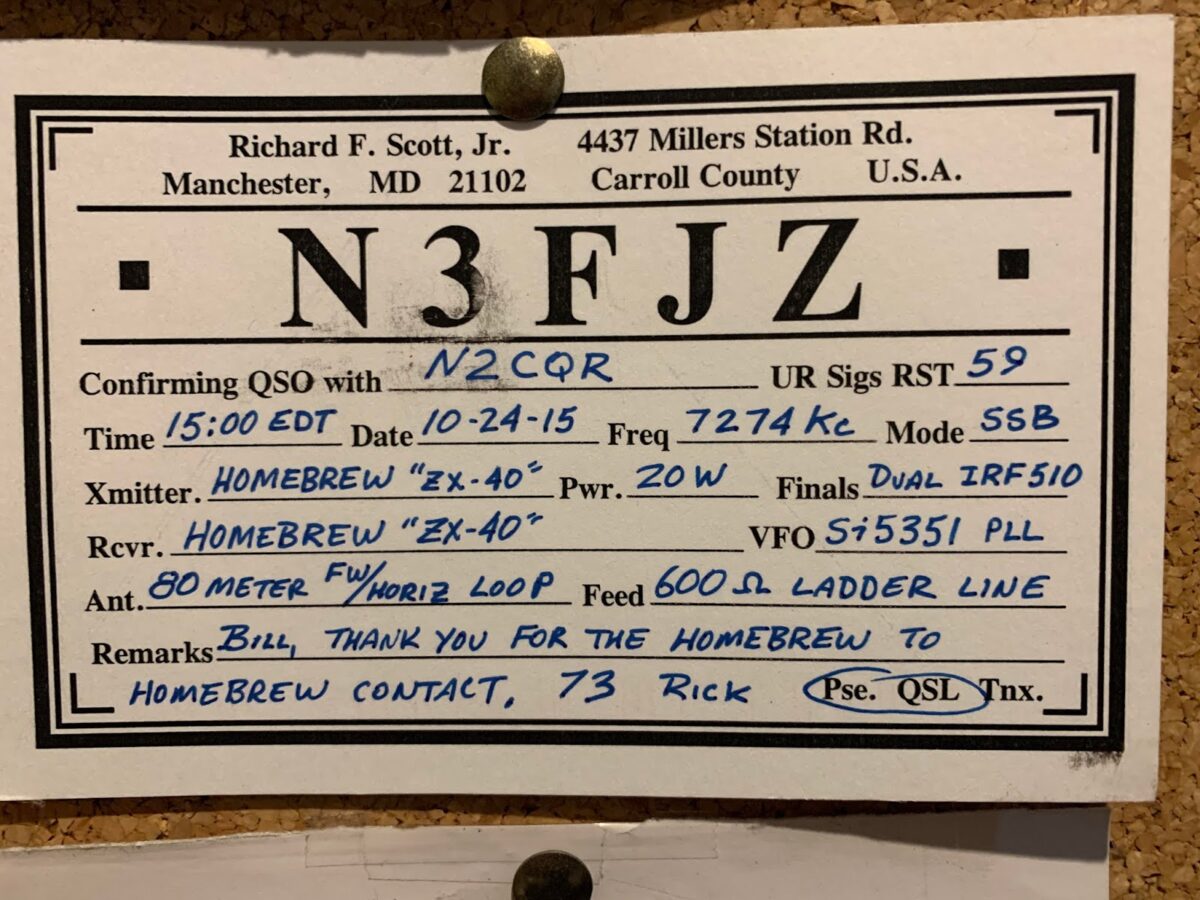
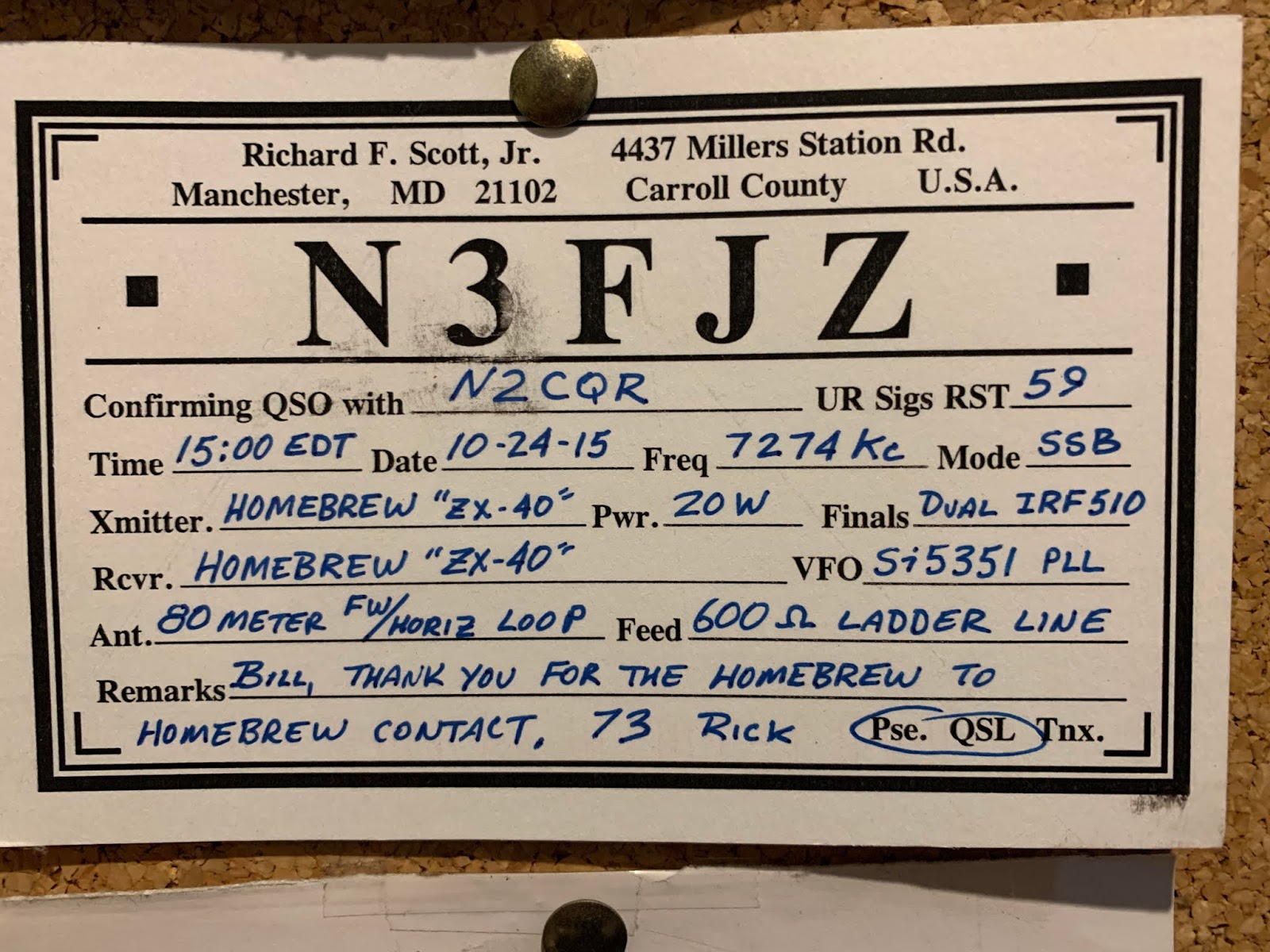
Wow, it has been a while since I first talked to Rick, N3FJZ. Above you can see his QSL card. And here is a link to a SolderSmoke blog post (with videos) that describes our Homebrew to Homebrew contact:

The e-mail below shows that Rick continues to melt solder, bringing into his rigs some very cool technology: atomic clocks, GPS modules, and color displays. That’s a long way from the original PTO Direct Conversion receiver that he first heard me with. FB Rick!
————–

Leif,

I’ve made great progress on my Arduino Mega 2560 based rig controller I call the ZX-Front-Panel. I just finished a feature I always wanted which is a built-in *GPS disciplined frequency counter*. It uses the 1-pulse-per-second timing output from the GPS module to create a frequency counter with atomic-clock accuracy. It’s on the solderless breadboard with the rest of the ZX-Front-Panel right now, and even so, it can count up to 30MHz with no trouble! and it should be able to count up to 100MHz or more if built on a ground plane with a little shielding. The best part about it is that it only required one additional chip (a 74LV8154 32-bit counter $1 from Mouser) in addition to the existing parts already on the ZX-Front-Panel; i.e. the Arduino Mega 2560 ($10), the Ublox NEO-6N GPS module ($15), the display ($25), and the Si5351 PLL RF Oscillator ($8).

Check out my video series covering the ZX-Front-Panel development progress. The first link below will bring up the video page on my website with the latest video at the top, so you’ll have to scroll down a bit to get to the earlier development stages. Check out the rest of the website too for the schematics of my Bitx / TIA inspired rig design (which I call the ZX-SSB-II) that I used an early version of to make my first HF HB2HB contact with Bill (N2CQR) back in 2014 or so (Bill and Pete, via the Soldersmoke podcast, were my inspiration to build my first SSB homebrew rig).

YouTube videos: http://www.remmepark.com/circuit6040/ZX-SSB-II-Front-Panel/ZX-SSB-II-Front-Panel.html#video

Homepage: http://www.remmepark.com/circuit6040/index.html

Dean AC9JQ and I have been communicating via emailing about his progress in building his own copy of the ZX-Front-Panel, and I’m very excited to learn that he might be thinking about producing a future homebrew rig featuring the ZX-Front-Panel as its controller/VFO. The best thing about the ZX_Front-Panel is that ounce you install the sketch into the Arduino Mega, you don’t need to modify the Arduino sketch itself when you build your rig; i.e. the SSB crystal filter’s center frequency (the I.F. frequency), the Si5351’s clock output drive level, the display brightness and contrast, and the Si5351 crystal correction factor (crystal trim) are all configurable, real-time, right from the ZX-Front-Panel’s user interface, and once set, can be saved to the Arduino’s non-volatile EEPROM to be automatically loaded on the next power-up. Also, since it has a GPS module, it features a UTC/Local real-time clock with atomic clock accuracy too.

Anyway that’s all for now, take care Leif.

73 Rick.

Arduino, Si5351, GPS linked atomic clock, GPS disciplined frequency counter and more…

Wow, it has been a while since I first talked to Rick, N3FJZ. Above you can see his QSL card. And here is a link to a SolderSmoke blog post (with videos) that describes our Homebrew to Homebrew contact:

The e-mail below shows that Rick continues to melt solder, bringing into his rigs some very cool technology: atomic clocks, GPS modules, and color displays. That’s a long way from the original PTO Direct Conversion receiver that he first heard me with. FB Rick!
————–

Leif,

I’ve made great progress on my Arduino Mega 2560 based rig controller I call the ZX-Front-Panel. I just finished a feature I always wanted which is a built-in *GPS disciplined frequency counter*. It uses the 1-pulse-per-second timing output from the GPS module to create a frequency counter with atomic-clock accuracy. It’s on the solderless breadboard with the rest of the ZX-Front-Panel right now, and even so, it can count up to 30MHz with no trouble! and it should be able to count up to 100MHz or more if built on a ground plane with a little shielding. The best part about it is that it only required one additional chip (a 74LV8154 32-bit counter $1 from Mouser) in addition to the existing parts already on the ZX-Front-Panel; i.e. the Arduino Mega 2560 ($10), the Ublox NEO-6N GPS module ($15), the display ($25), and the Si5351 PLL RF Oscillator ($8).

Check out my video series covering the ZX-Front-Panel development progress. The first link below will bring up the video page on my website with the latest video at the top, so you’ll have to scroll down a bit to get to the earlier development stages. Check out the rest of the website too for the schematics of my Bitx / TIA inspired rig design (which I call the ZX-SSB-II) that I used an early version of to make my first HF HB2HB contact with Bill (N2CQR) back in 2014 or so (Bill and Pete, via the Soldersmoke podcast, were my inspiration to build my first SSB homebrew rig).

YouTube videos: http://www.remmepark.com/circuit6040/ZX-SSB-II-Front-Panel/ZX-SSB-II-Front-Panel.html#video

Homepage: http://www.remmepark.com/circuit6040/index.html

Dean AC9JQ and I have been communicating via emailing about his progress in building his own copy of the ZX-Front-Panel, and I’m very excited to learn that he might be thinking about producing a future homebrew rig featuring the ZX-Front-Panel as its controller/VFO. The best thing about the ZX_Front-Panel is that ounce you install the sketch into the Arduino Mega, you don’t need to modify the Arduino sketch itself when you build your rig; i.e. the SSB crystal filter’s center frequency (the I.F. frequency), the Si5351’s clock output drive level, the display brightness and contrast, and the Si5351 crystal correction factor (crystal trim) are all configurable, real-time, right from the ZX-Front-Panel’s user interface, and once set, can be saved to the Arduino’s non-volatile EEPROM to be automatically loaded on the next power-up. Also, since it has a GPS module, it features a UTC/Local real-time clock with atomic clock accuracy too.

Anyway that’s all for now, take care Leif.

73 Rick.

Nick M0NTV’s Quarantine Rig: The Bread Bin 80


Hi Bill,


Hope you are keeping well and staying safe.

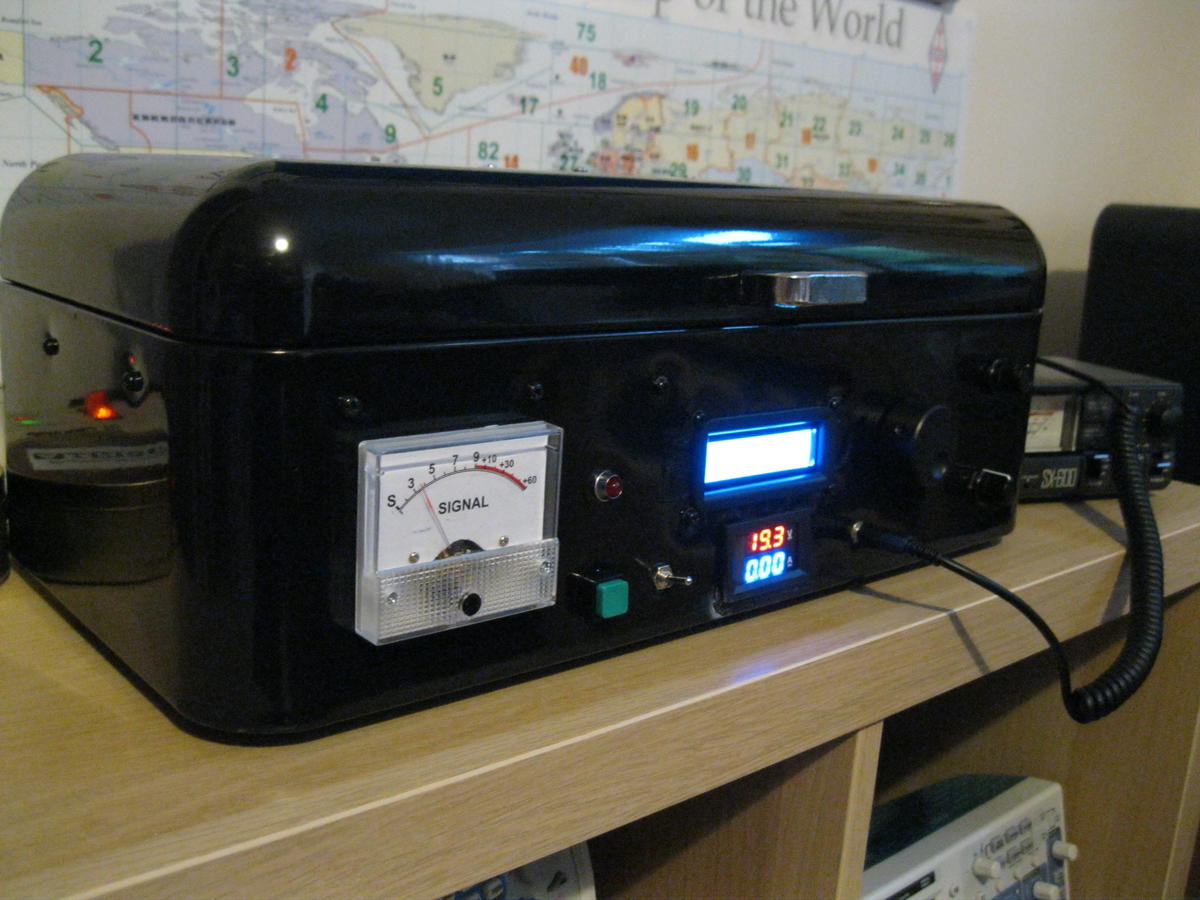
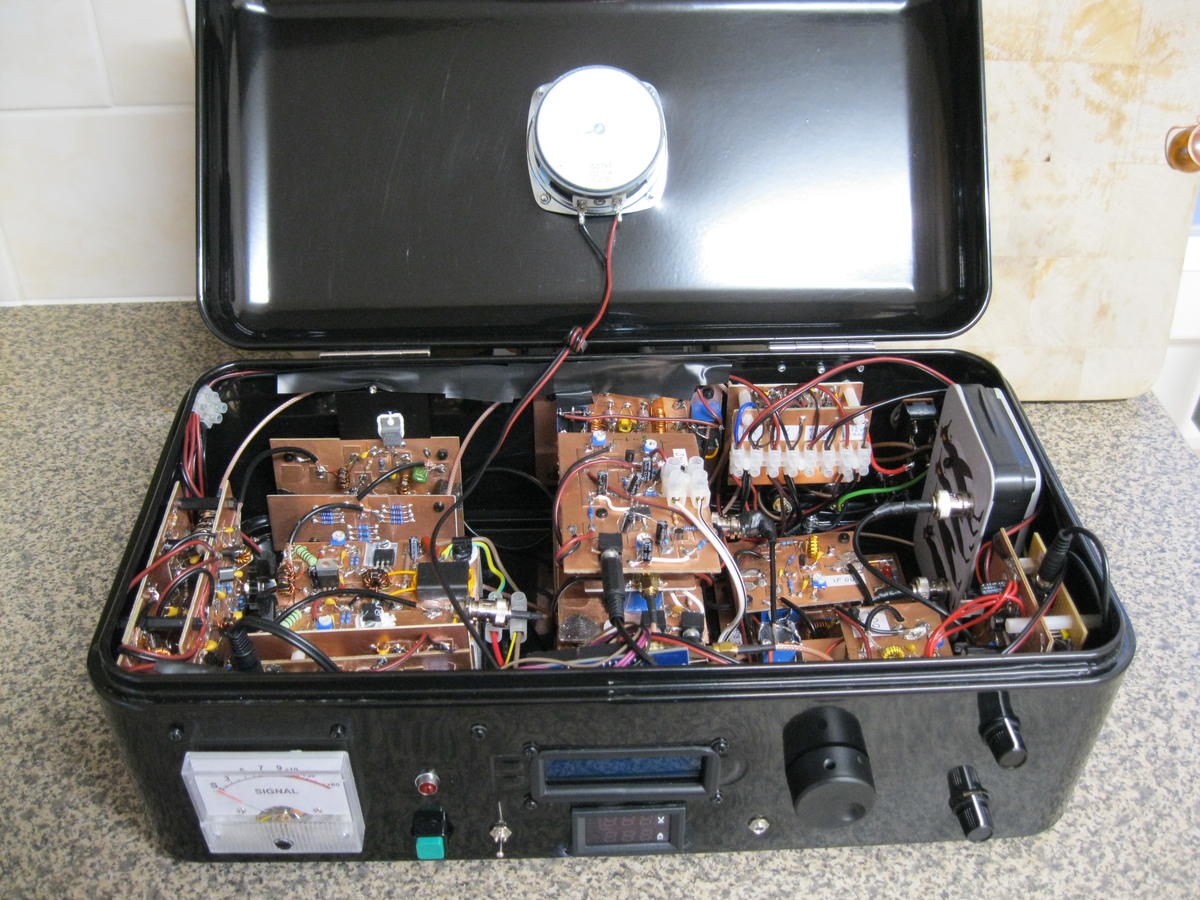
Just thought I’d let you know about a homebrew project I’ve just completed. I call it the Bread Bin 80 – you’ll see why!

It is a single band (80m) SSB transceiver that puts out 25-30W of clean RF. It uses the familiar pairing of Arduino Uno + Si5351 (with 16×2 LCD screen and rotary encoder for tuning). Other than this though it is largely an analogue beast – which I thought you might like!

I made my own double balanced mixers which work really well. But the Si5351 can’t generate the 7 dBm of local oscillator signal to drive them so I then had to build a simple one transistor RF amp for each clock of the Si5351. I even went above and beyond the call of duty and home-brewed my own IF crystal ladder filter (although this was actually a kit).

The rig has a three stage IF cascade amplifier with 2 back to back JFETs in each stage + AGC and analogue S meter. There is something very satisfying about seeing the needle bob about as you are listening. I also put in a switchable analogue audio filter in front of the audio pre-amp which cuts out some of the higher frequency noise on the band.

Overall I’m really pleased with the rig. I’ve been working stations all over the UK and into continental Europe and getting some great reports. Except the one guy (who shall remain nameless) who wasn’t the least impressed that I was working him on a homebrew rig: he was only keen to point out that my antenna must be far too low to give me such an attenuated signal!!! I guess you can’t please everyone.

Anyway, I’ve done a bit of a write up and included some photos (outside and in) on my QRZ page if you are interested:


Thanks for sharing your home brewing story about your short wave receiver on YouTube. I’ve enjoyed following that and seeing it progress. Those little ‘Altoid’ tins are great aren’t they.

Thanks again for all your encouragement through the Soldersmoke podcast. I really enjoy it.

Stay In The Shack!

73 from across the Pond.

Nick

M0NTV
Nick Wood

N5GTF’s FULLY INDOOR Quarantine Receiver and Antenna

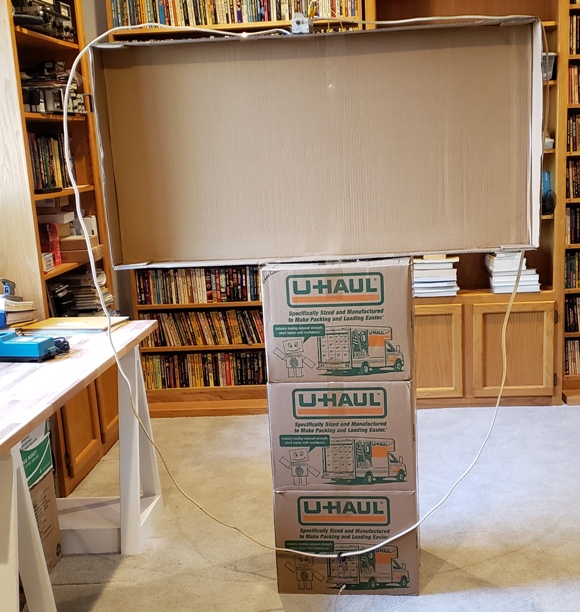
Mike N5GTF deserves special recognition for his truly remarkable SITS (Stay In The Shack) quarantine project. It is not hard to build receivers and transmitters that stay in the shack; Mike went the extra mile by keeping even his antenna inside during lockdown. Well done Mike! But that cardboard frame for the antenna seems to be crying out for some sort of inspirational slogan. Can we get a big “SITS!” in there? 73 Bill

Hi Bill,

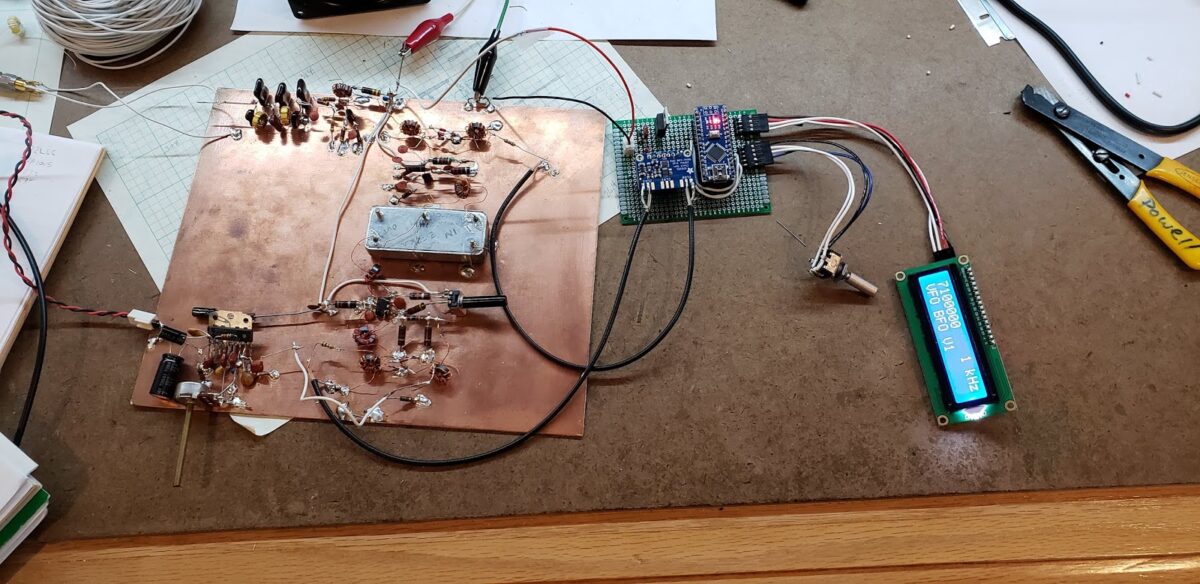
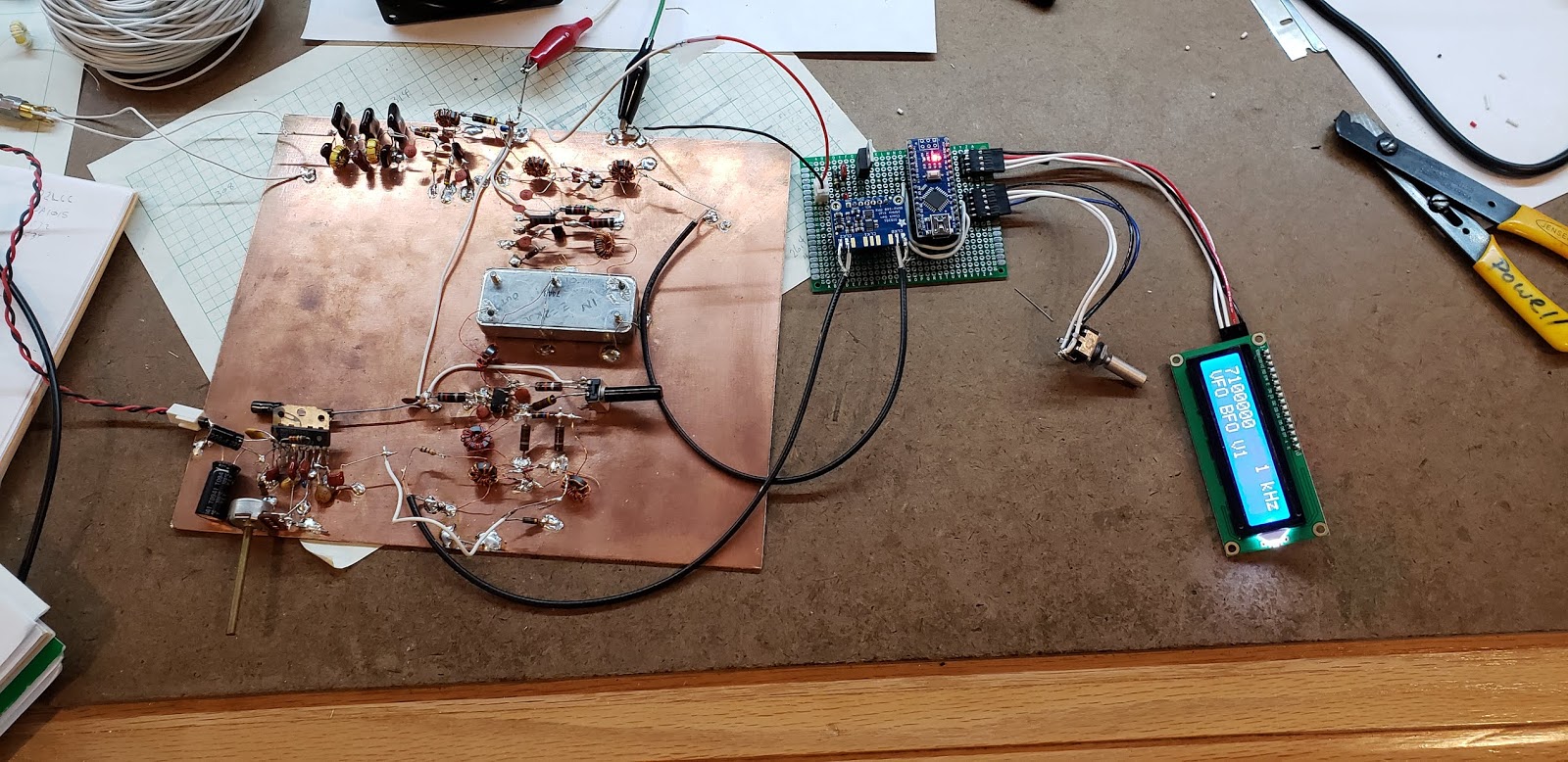
Thought I would share a few photos of what happens when one randomly selects things from the junk box after being inspired by Pete’s recent posts about phasing SSB. It starts with a 10.7MHz crystal filter because it was large and shiny. This will prove to be somewhat inauspicious, but I’d had a pair of them for longer than I can remember… Then there were several ferrite toroids and a handful of swap meet diodes. Instant mixers, (just add enameled wire). A few 2N3904s and an MC1350P, plus a few more toroids (and wire). I’d picked up some TDA1015s awhile back. They have both a power amp and a preamp, so one of those as well. Also, an Arduino and Si5351, because Charlie Morris, ZL2CTM, has been so generous in sharing his knowledge on how to use them. Finally, about 12 feet of 14/2 w/G and a 365pF variable cap for an indoor mag loop.

Not the best reception though not bad considering the antenna’s in the basement with house wiring and metal duct work in the ceiling. The biggest issue is the IF and my choice of LO frequency. I’ve got the LO below the IF and the LO second harmonic falls inside the 40 meter band. Definitely need to fix that and move on to the transmit side.

Visits to both SolderSmoke and Pete’s blog are on my daily agenda. Thanks to you both for the frequent updates of interesting content and for providing a way to get out without going out.

Mike, N5GTF
www.mikesflightdeck.com

An Understandable Chip: The LM386

Over the years I have made my distaste for integrated circuits very clear. I’ve presented them as mysterious little black boxes that don’t really belong in our homebrew rigs, rigs that we are building, after all, because we want to avoid the use of MYSTERIOUS BLACK BOXES.


So, I don’t use voltage regulator chips — I use Zener diodes. I prefer analog LC oscillators to AD9850s or Si5351s. And I have repeatedly built discrete component audio amplifiers when most normal people just put an IC AF amplifier in the circuit.

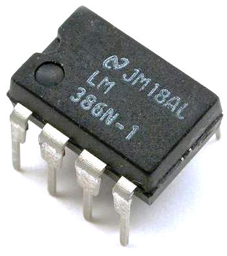
When I built the Q-31 Shortwave AM receiver, I kind of ran out of gas at the end. I wanted to get the receiver going and I didn’t want to build yet another discrete AF amp. So I used an LM386.

I rationalized this deviation from cherished values by noting that the discrete AF amplifier circuitry that I was using was remarkably similar to what exists inside the LM386. So that little chip is just as understandable as my discrete component creations. It wasn’t REALLY a mysterious black box…

Around this time I found a web site that made me feel mush better about all this. It explains very nicely how the little LM386 does such a great job. It really packs a lot of amplification into a very small package. Here is the web site:

https://www.electrosmash.com/lm386-analysis

Shortly after my transgression, Jenny List over at Hack-A-Day posted a nice piece looking at the inner workings of Op-Amps. Who knows, I may seen be using 741 chips too!

Here is the Hack-A-Day piece:

https://hackaday.com/2020/05/09/an-op-amp-from-the-ground-up/

Brace Yourselves: DK7IH’s New Transceiver — The Gimme Five

Lock-down is bad enough, but now we will also have to cope with the feelings of homebrew inadequacy that Peter’s rigs always cause. But look on this as an opportunity for inspiration. Peter once again raises the bar.

This looks like it is the first in a series of blog posts. Just what we need in quarantine. Thanks Peter.

The Si4730 Radio Chip (Luddite Alert!) (video)

I have misgivings about this. Hack-A-Day presents it as a DIY radio project and wonders if this might be the modern equivalent of the crystal radio projects of days-gone-by. But notice that the “build” video focuses mostly on building the box. The electronic “building” of this radio mostly involves plugging in two chips, or two boards with chips. My questions are:

1) When this project is finished, who REALLY built it? You, or the Si4730 manufacturer?

2) After you’ve “built” this thing, would you have the same sense of accomplishment that you get from an analog, discrete component project? Or even from that crystal radio?

Of course, to each his own. This is all for fun. Have fun with the Si4730. But today I’ll be working on my Hallicrafters S-38E.

https://hackaday.com/2020/02/12/all-band-radio-uses-arduino-and-si4730/

VK3HN’s Inspirational AM Receiver (video)

I’m always delighted when I check the SolderSmoke blog and YouTube list (right hand column of the blog) and find a new post from Paul VK3HN. And this morning’s post is especially good.

Paul has built an AM receiver. Above you can see his video. Here is his blog post with details:
https://vk3hn.wordpress.com/2019/12/06/8-band-superhet-am-receiver/

This is the kind of blog post that makes you want to heat up the soldering iron and start searching through the junk box. I’m thinking about putting Paul’s 6 kHz filter in my 40 meter HRO-ish receiver. And I may make use of his AM detector circuit. And maybe I can put that same receiver on 75 and 160… And then there are the SW broadcast bands… See what I mean?

Thanks Paul. 73

SolderSmoke Podcast #210 Boatanchors, Magnetostriction, VFOs, AM, CW, SSB, Mailbag

2 March 2019

SolderSmoke Podcast #210 is available:

http://soldersmoke.com/soldersmoke210.mp3

Alexa, Marie Kondo, berets, and ham radio

Bi-Coastal Boatanchors
BATTLE CRY: The Vintage SSB Preamble! “We are NOT ashamed!”
Bill’s HT37 and Drake 2B
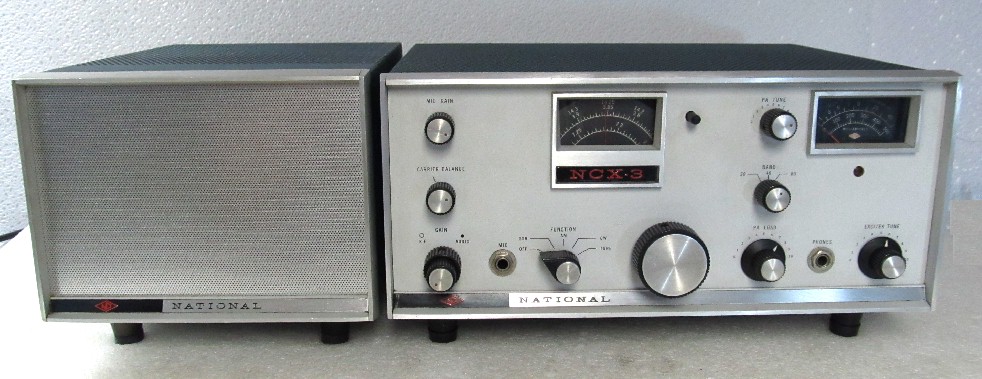
Pete’s National National NCX-3 TRGHS
Mechanical Filters
Magnetostriction
Why did Collins go with mechanical vice crystal filters?
The foam deterioration syndrome in mechanical filters. Sad.
Please send any unwanted Mechanical Filters to Bill.
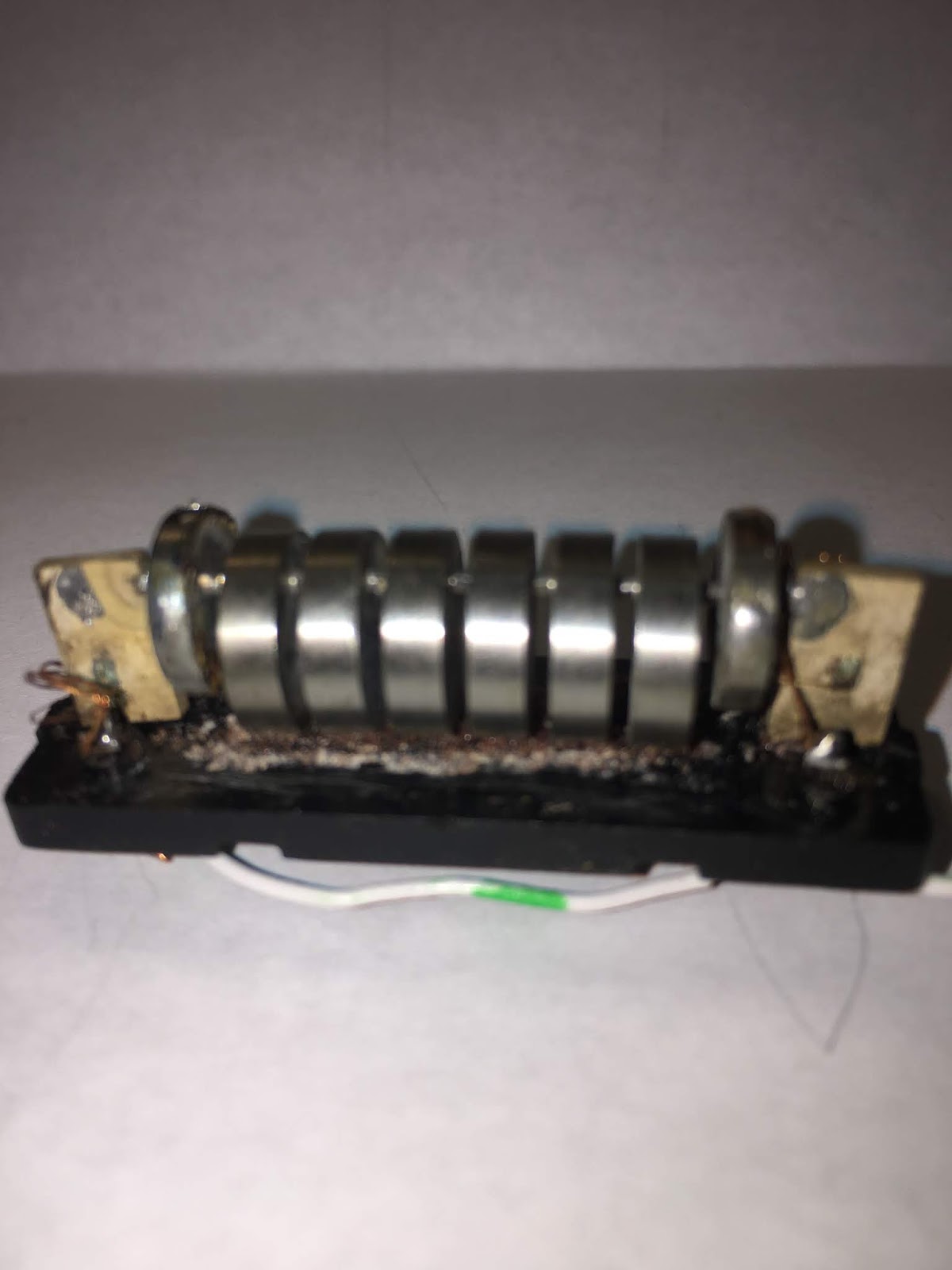
BONUS QUESTION: Look at the filter below. What is different/special about this one?

Pete’s antenna trouble
Pete’s FB amplifier troubleshooting
Recent improvements in the uBITX finals
Pete’s design for a VFO for Bill (and an indoor antenna tuner!)

Bill’s VFO for Pete: HRO dial and gearbox driving a rotary encoder

Guido PE1NNZ puts the QCX on SSB
“The Secret Life of Machines — Radio”
HB HRO dial from DL6WD
WA1QIX’s USB D-104
“The High Frequency Oracle”
DeMaw’s LC filter receiver
Godzilla and Ham Radio
Bill’s poor quality SSTV images from space (what happened?)
Listening to AM on an SSB receiver
Mixed feelings about CW

MAILBAG
M0KOV’s mom took him to the doctor due to THE KNACK.
M0JGH getting married (ALWAYS LISTEN TO PETE!)
Jac’s FB Receiver

What is different/special about this one?

W7RLF Homebrews a Receiver — FB!


Ryan W7RLF has joined the small and elite group of radio amateurs who have homebrewed a receiver. And it is a receiver filled with soul, juju and mojo; the project was inspired by Wes Hayward and Farhan, and used components from Hans Summers. Congratulations Ryan and thanks for all the work you did in documenting your experience.

Who will be the next intrepid ham to join the homebrew receiver club?

Hello Sirs!


This month I read Wes Hayward’s post on the history and heritage of DC receivers in ham radio and it brought a lingering interest to a head. I had to build one. I run the BITX40 and uBITX group on Facebook, and I posted to the other hams there: Which DC receiver should I build? Farhan recommended his DC40. Mind you, I’ve never homebrewed a radio before, so this is all new territory for me.

I did build it, and it does work. It also uses QRP Labs stuff from our friend Hans Summers. This thing has a lot of QRP heritage 🙂 I documented it every step of the way including all of my dumb moves and things I got wrong, and my desire is to inspire others to try homebrewing the way Wes, Farhan, Hans, and you YOU GUYS have inspired me to try it. I am hooked, of course! Here’s a link to my blog to Part 1:


It’s a four part series (unofficially 5 really) with 8000 words to it, and I hope you guys enjoy it and I’d be ticked pink if was worthy of mention on your show. Here’s a video of it too:


73 to you both and I wish you the best!

Ryan Flowers W7RLF

Pete N6QW Rejuvenates the Atlas Twins with an Arduino and an Si5351

Pete Juliano N6QW has turned his attention to the Atlas Twins, a nice single conversion multiband rig. Pete has used an Arduino/Si5351 to replace the analog oscillators in the old Atlas. This improves stability and allows for USB/LSB operation.

Pete very graciously kept the old analog circuitry in the rig, allowing the Atlas to be returned to its pristine analog state at some time in the future. Pete also made some very kind comments about the surprising stability of the original analog oscillator circuitry.

Check out Pete’ site for more details:

http://n6qw.blogspot.com/2018/11/2018-year-of-ssb-transceivers.html

VU3XVR’s Assembly Language 1K AtTiny-Si5351 VFO

Although Ram VU3XVR’s project is in the digital realm, his barebones approach to the bits and bytes is, for me, very appealing. He takes a Si5351 and runs it with ATtiny13 with only 1k of space. He makes intelligent use of every bit of that space. He reveals his overall approach to rigs when he states in the video that his VFO will NOT have the traditional glowing numeral frequency readout because those bright lights can be so annoying and distracting. I’m with your Ram! Well done OM. Simplicity is a virtue. No more trouble with the Arduino and its fickle IDE. No more agonizing visits to the Si5351 library.

I see lots of applications for this little circuit. Ram mentions beacon transmitters.

He provides details here:

https://vu3xvr.blogspot.com/2018/07/si5351-dds-clock-generator-using.html

Hans Summers and his QCX — G0UPL Cracks the Code on Si5351A Quadrature


Pete, Brad WA8WDQ and I were recently e-mailing about our admiration for what Hans G0UPL has achieved with his QCX rig. I cc’d Hans — we got this nice and very informative e-mail. Be sure to click on the link provided by Hans, and from there go to the link to his FDIM proceedings article. I think that article is a real masterpiece — there is a lot of very valuable information in there. For a long time, getting quadrature output from the Si5351 seemed like an impossible dream. But Hans has obviously figured out how to do this, opening the door to much better and simpler single-signal phasing receivers. Thanks Hans!


Hi all


Thanks for the nice feedback on the QCX and the FDIM conference proceedings a article, which I have published on QRP Labs web page along with other Dayton trip miscellany. See


My seminar presentation audio was recorded by Ham Radio Workbench podcast and they will be publishing it on 5th June.

The QCX kit has indeed been unbelievably popular, almost 5,000 kits have been sold since the launch on 21st August. It seems to have itched an itch that needed itching, in the QRP world. Sales continue to be strong and I’m currently preparing another batch of 1000 more.

I’m very proud of my 90-degree quadrature Si5351A and it helped me towards my low cost, high performance target for QCX. Abandoning the 74AC74 saves a part, reduces cost, reduces complexity, reduces board area (and hence more cost) and even seems to provide better performance (higher unwanted sideband rejection when using the Si5351A in quadrature mode). Getting the Si5351A to do this is one of those things which look easy afterwards. But at the time, and faced with SiLabs un-useful documentation, it took an awful lot of headscratching, trial and error!

I’m not sure of the answer to the question about noise figure. Certainly radios such as QCX and the NC2030 which use the QSD architecture seem to have very high sensitivity without an RF amplifier ahead of them. This must indicate a low noise figure.


73 Hans G0UPL