Back to Divide by 4 — Big Improvement in Receiver Performance

Thanks for all the comments and advice. I have come to understand the wisdom of divide by 4 IQ circuits.

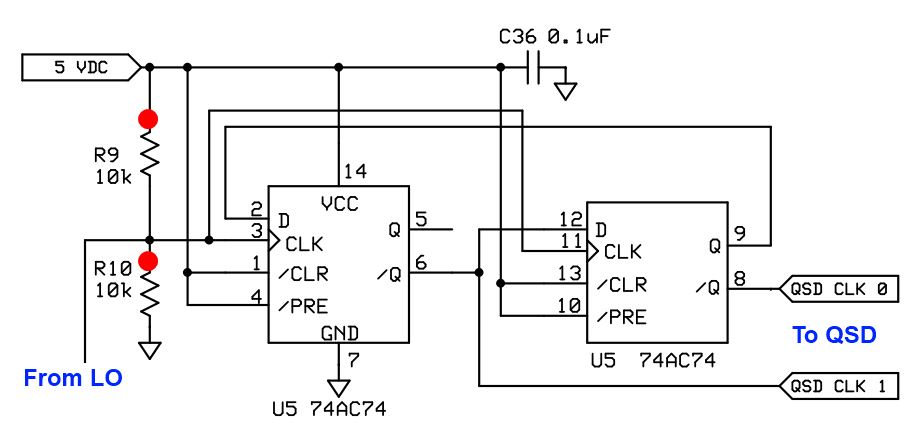
Fortunately it was very easy to convert the divide by two 74AC74 circuit described earlier to a version of the divide by 4 scheme seen above. (From the SDR Ensemble II Receiver: http://www.wb5rvz.com/sdr/ensemble_rx_ii_vhf/04_div.htm)

This change provided a great way to observe 1) the improvement in the output signals from the VFO and 2) the resulting improvement in receiver performance, especially opposite sideband rejection.

Here are some numbers. I was very pleased to discover that my Rigol scope will measure duty cycle and phase difference. Thanks Rigol!

AD9850 Divide by 4 : 7.212 MHz Duty cycle: 48.3 Phase Difference: 87-90 degrees

Si5351 Divide by 2: 7.212 MHz Duty Cycle 49.6 Phase Difference: 83 degrees

Si5351 Divide by 4 7.212 MHz Duty cycle 49 Phase Difference: 85-90 degrees

Additional improvement came when I switched the power supply to the IQ inverters and Flip Flops. I switched from 3.3 to 5 volts:

Si5351 Divide by 4 7.105 MHz Duty Cycle 49.7 Phase Difference: 90 degrees

When I took the VFO box and put it back in the receiver with the divide by 4 scheme and the 5 volt supply I immediately noticed a big difference in performance. It was obvious that opposite sideband rejection was back to what I had had with the AD9850, perhaps better.

I have a quick and dirty method of measuring opposite sideband rejection: I put an RF signal into the antenna connector. I put the ‘scope on the audio output. I tune (on the desired sideband) for 1kHz audio and I measure the output voltage. Then, with the audio gain and RF sig gen output in the same positions, I tune to the opposite sideband, again tuning for 1 kHz, again measuring audio output. With the divide by 4 scheme and the 5 volt supply, the opposite sideband was so weak I had trouble measuring it. I estimate the rejection to be at least 32 db — this is back in the range of what I had with the AD9850, and significantly better than I had with the divide by 2 scheme.

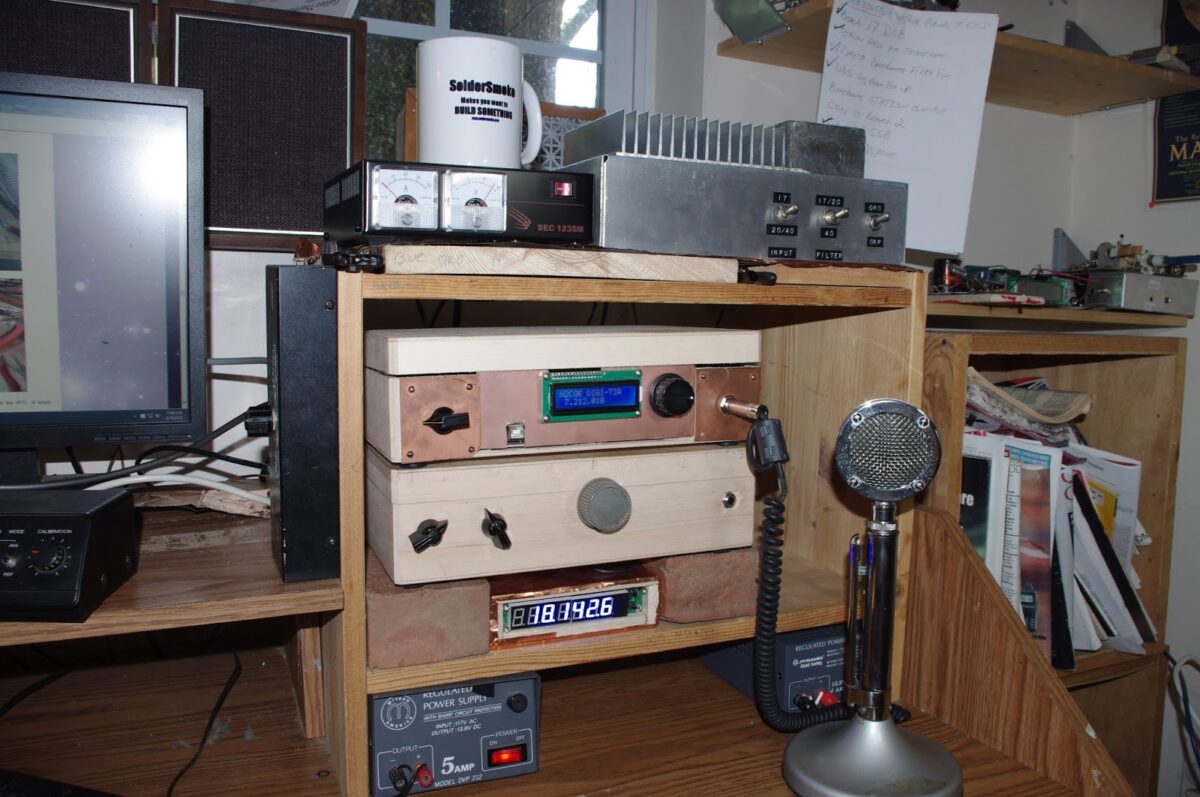
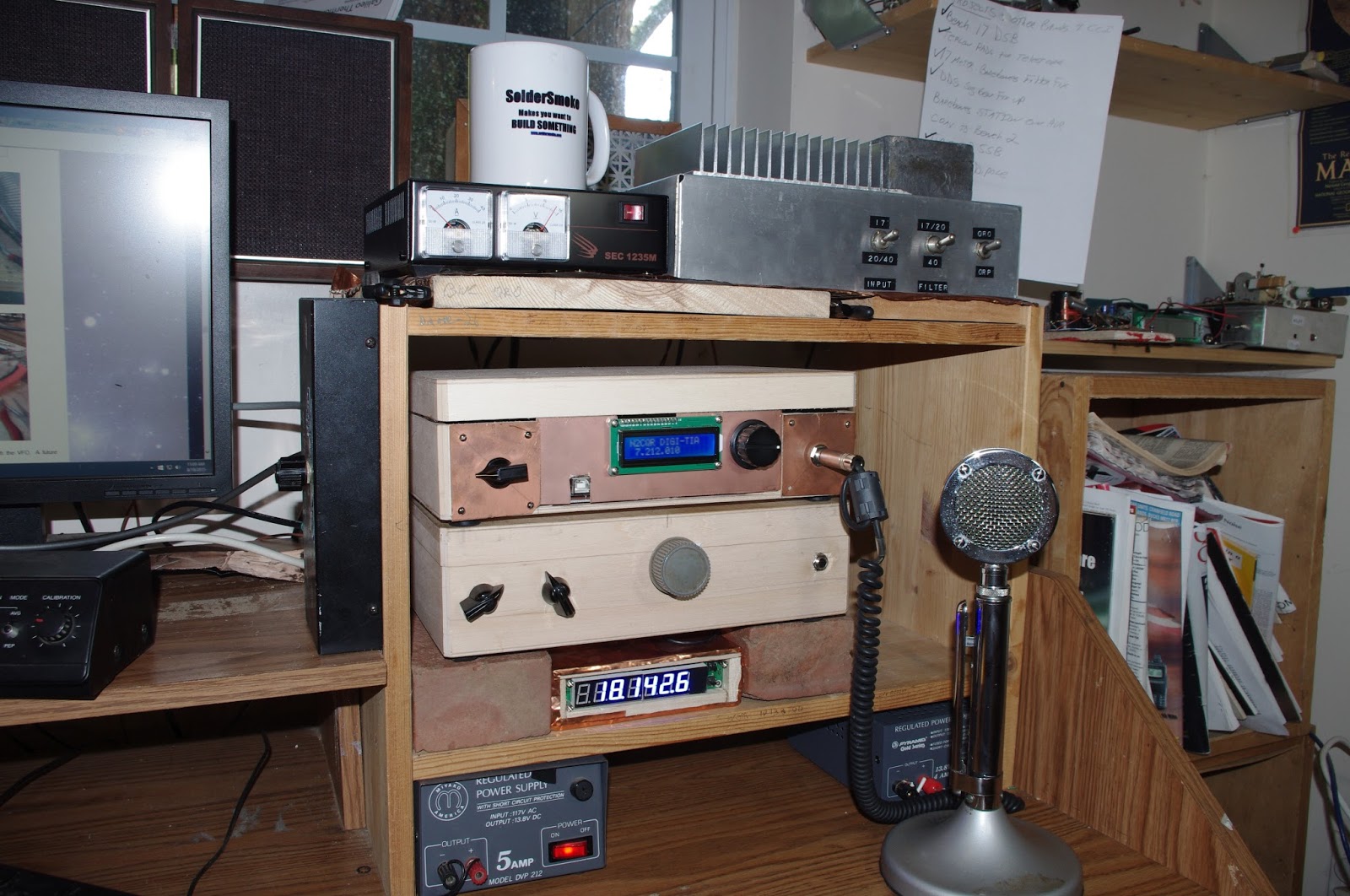
Now I just need to figure out how to get the Si5351 VFO sketch to tune above 42.94 MHz. For some reason it quits at this point, switching down to 2 kHz output, and keeping me on 30 meters and below.

Thanks again to Todd VE7BPO for a lot of help with the hardware and to Tom AK2B for help with the Arduino code.
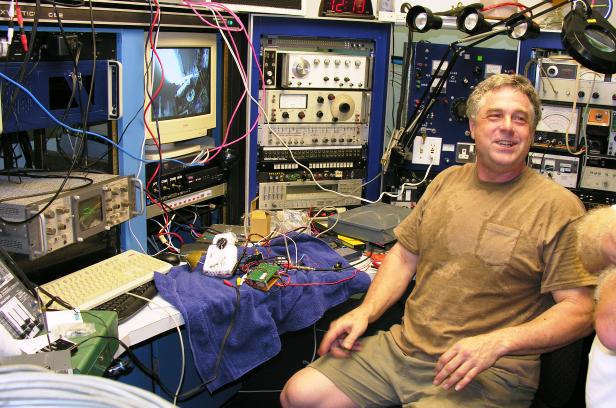
Lee Snook W1DN’s Amazing New Rig

Wow, I feel myself being pulled into the digital vortex. What a cool combination of digital and analog construction! I love that small spectrum ‘scope.

Lee’s rigs and his workshop have been discussed on this blog before:

http://soldersmoke.blogspot.com/2014/11/the-amazing-rigs-of-lee-snook-w1dn.html

New Rig: The FRANKENSTEIN Phasing Receiver

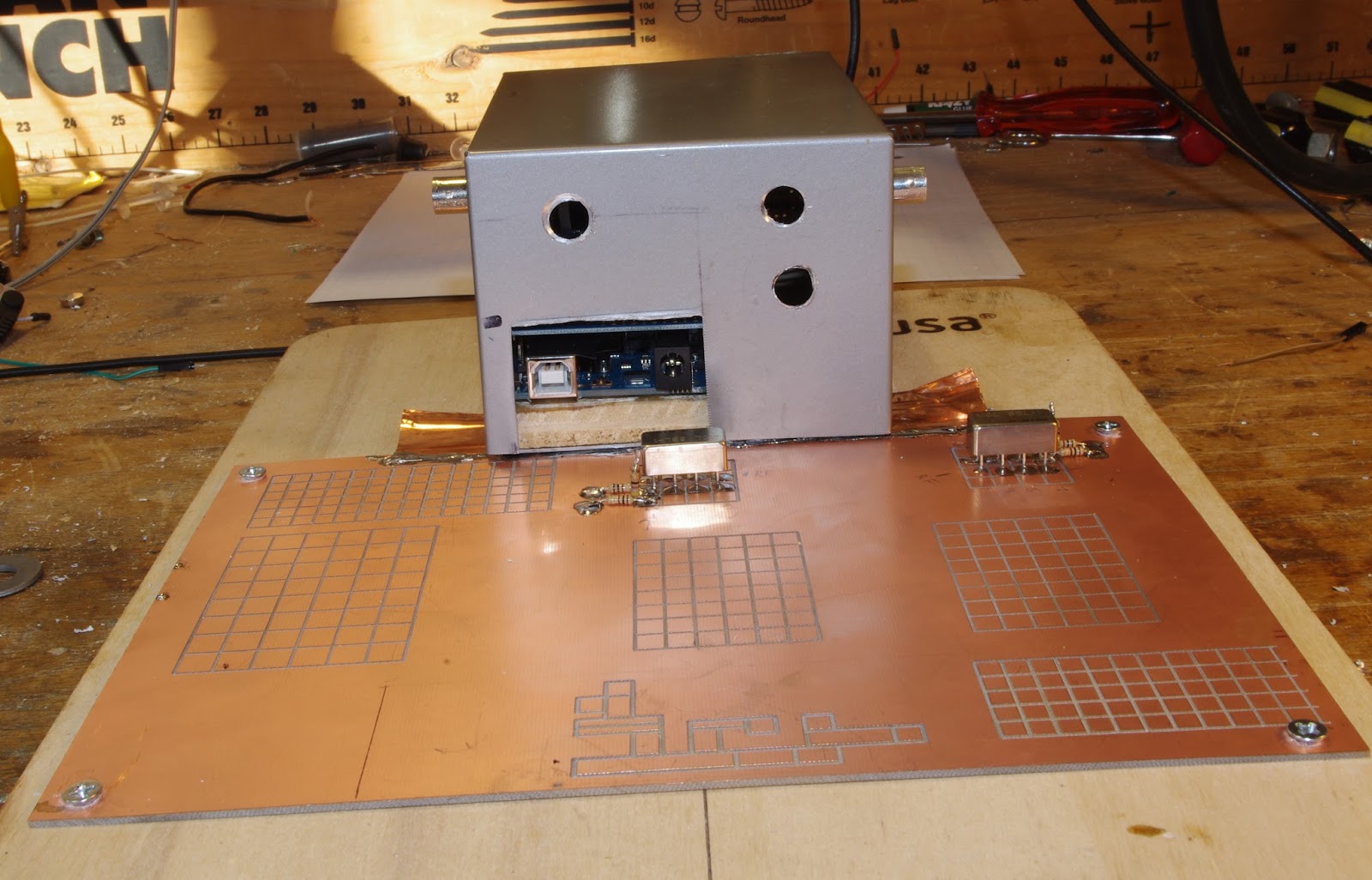
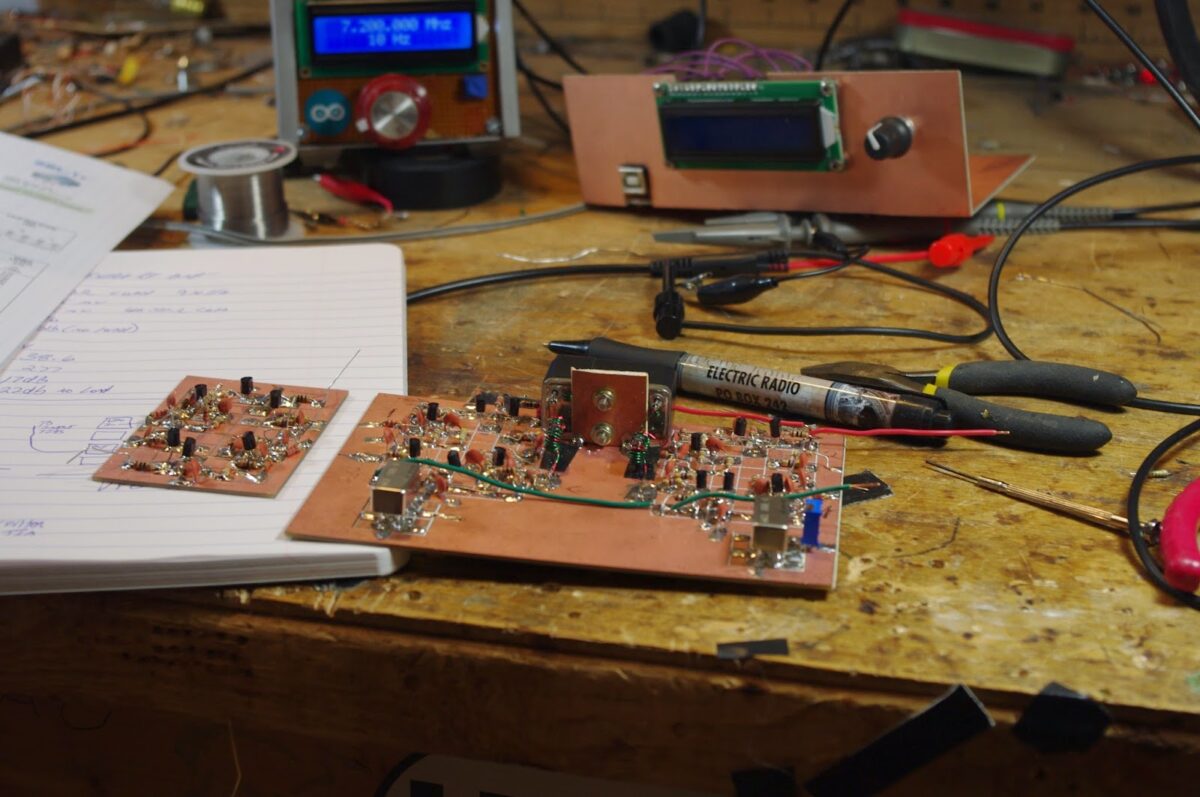
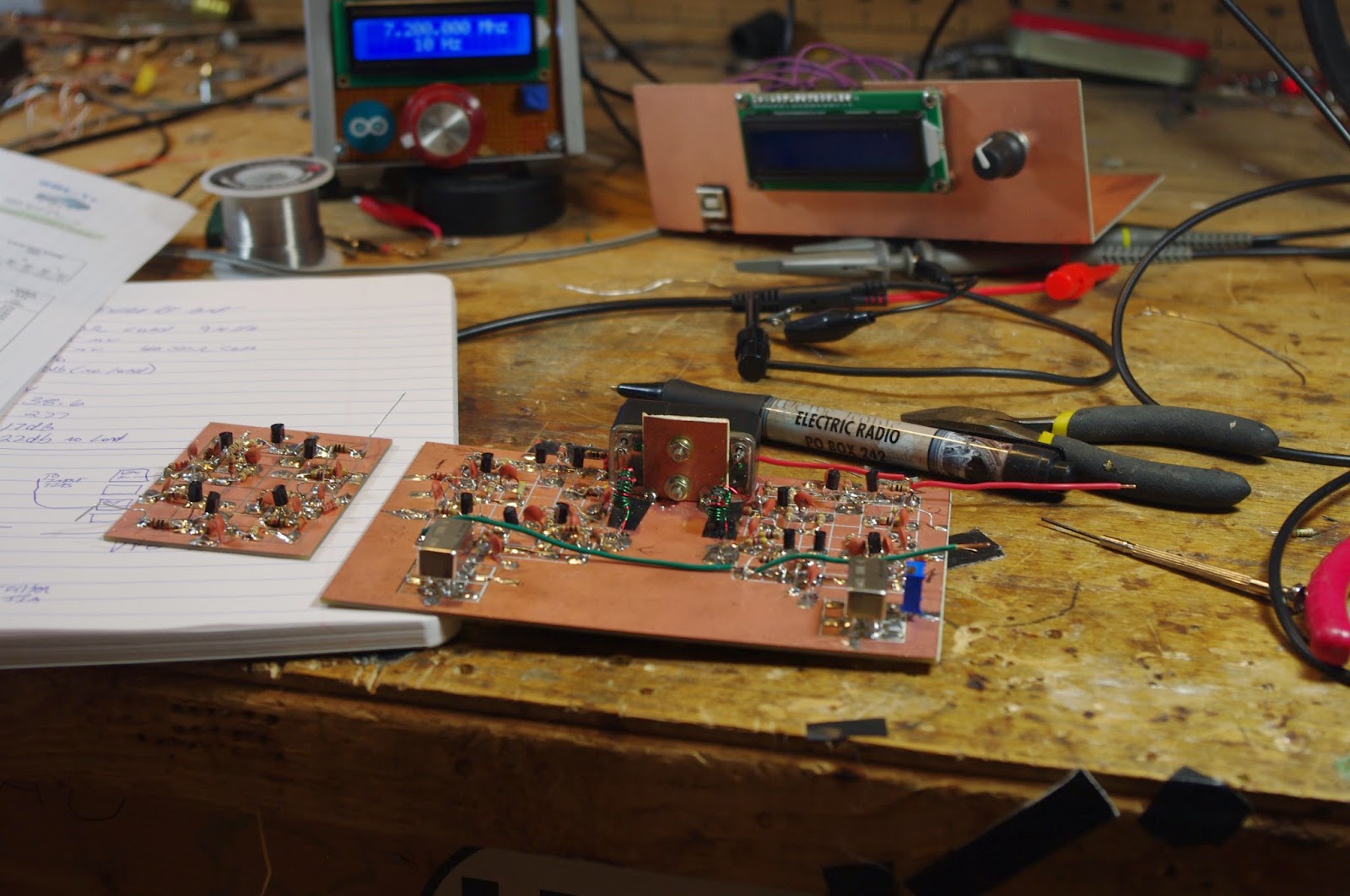
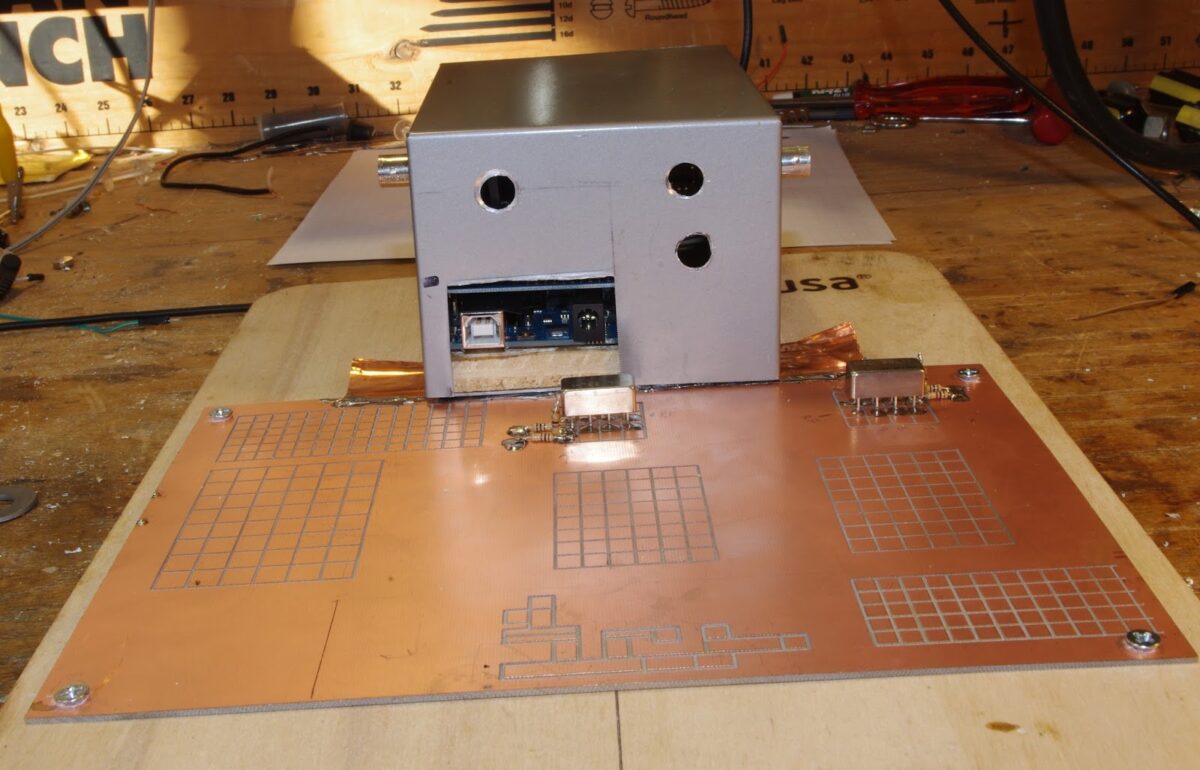
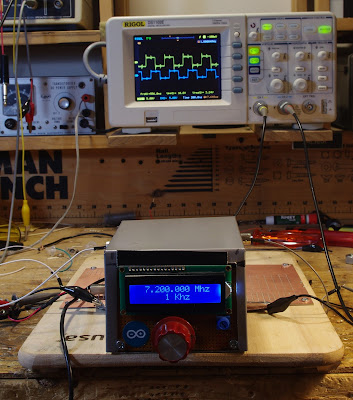
Here is my latest project. I call it The Frankenstein because of the two BNC connectors that come off the side of the DDS oscillator box — they look to me like the bolts on Frankenstein’s neck. The square waves from the DDS LO also seemed to evoke Frank’s bolts. There may be other similarities. We’ll see.

Here is the idea: Phasing, Direct Conversion, Image Rejecting receiver based largely on the R2 design by Rick Campbell KK7B as presented in the January 1993 QST.

I’m using an AD9850 with an M0XPD Kanga board and an Arduino to generate the quadrature LO signals (you can see the square waves on the ‘scope in the background). I’m using the software of Richard AD7C; this, combined with the divide-by-4 scheme on the Kanga board, puts the upper limit of reception at 7.3 MHz. That’s OK for now.

When I first fired up my AD9850 box I was dismayed to find that the square wave quadrature output was no longer there. I was about to give up and get anther shield board, but this kind of surrender bothered me. So I started troubleshooting and isolated the problem to the /4 chips. My soldering of the surface mount chips was, well, a bit dodgy, so I changed to a tiny soldering tip and reheated all those tiny little pads. Hooray! I fixed it.

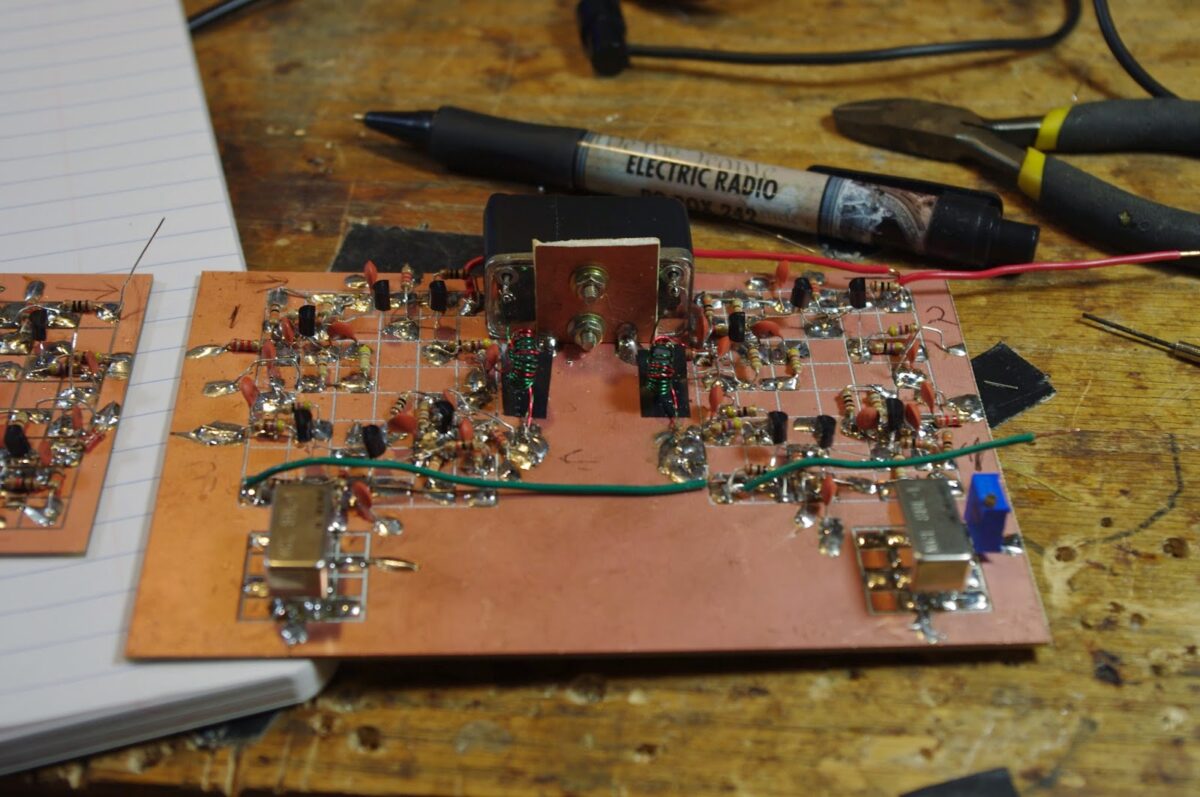
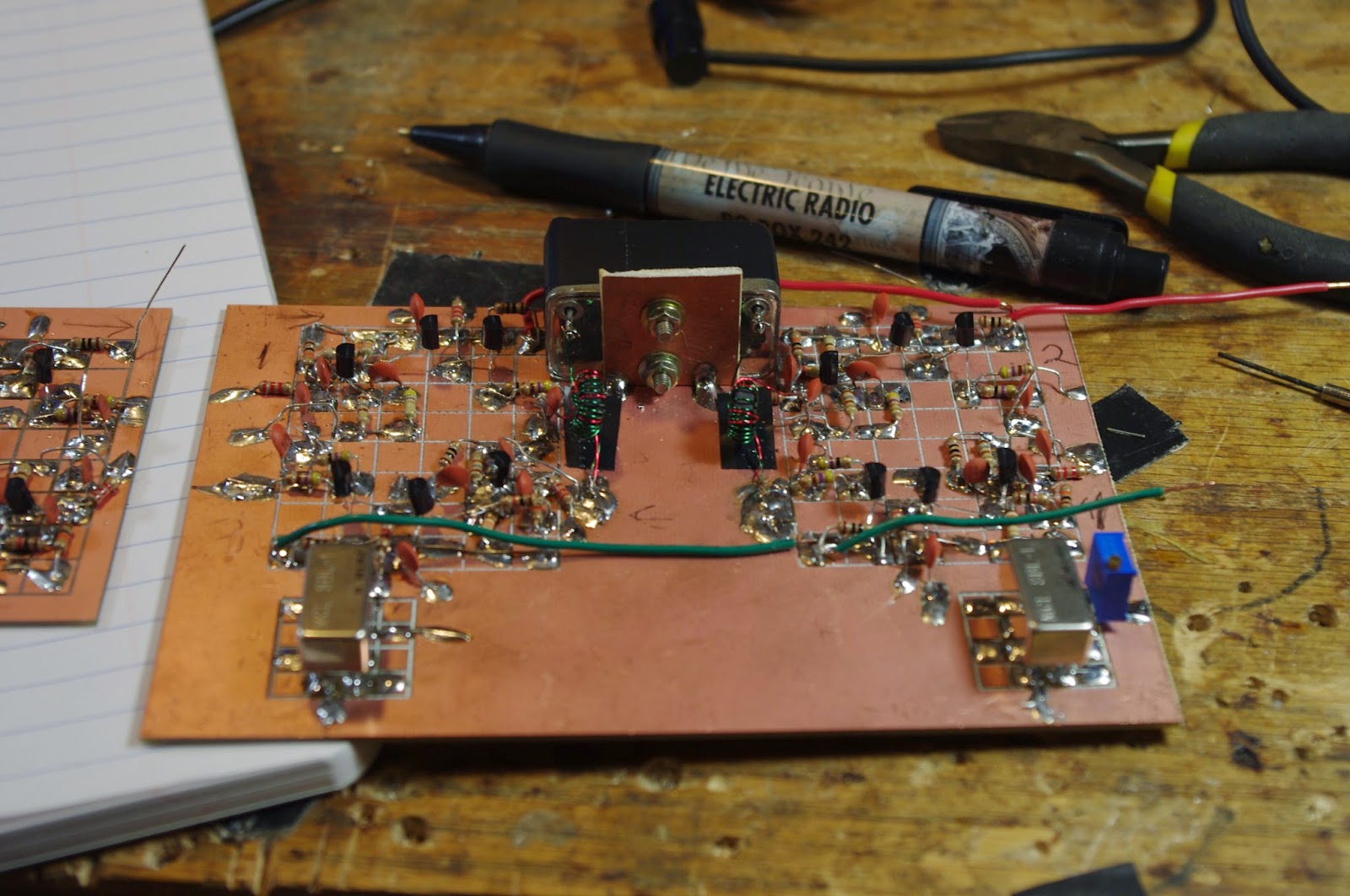
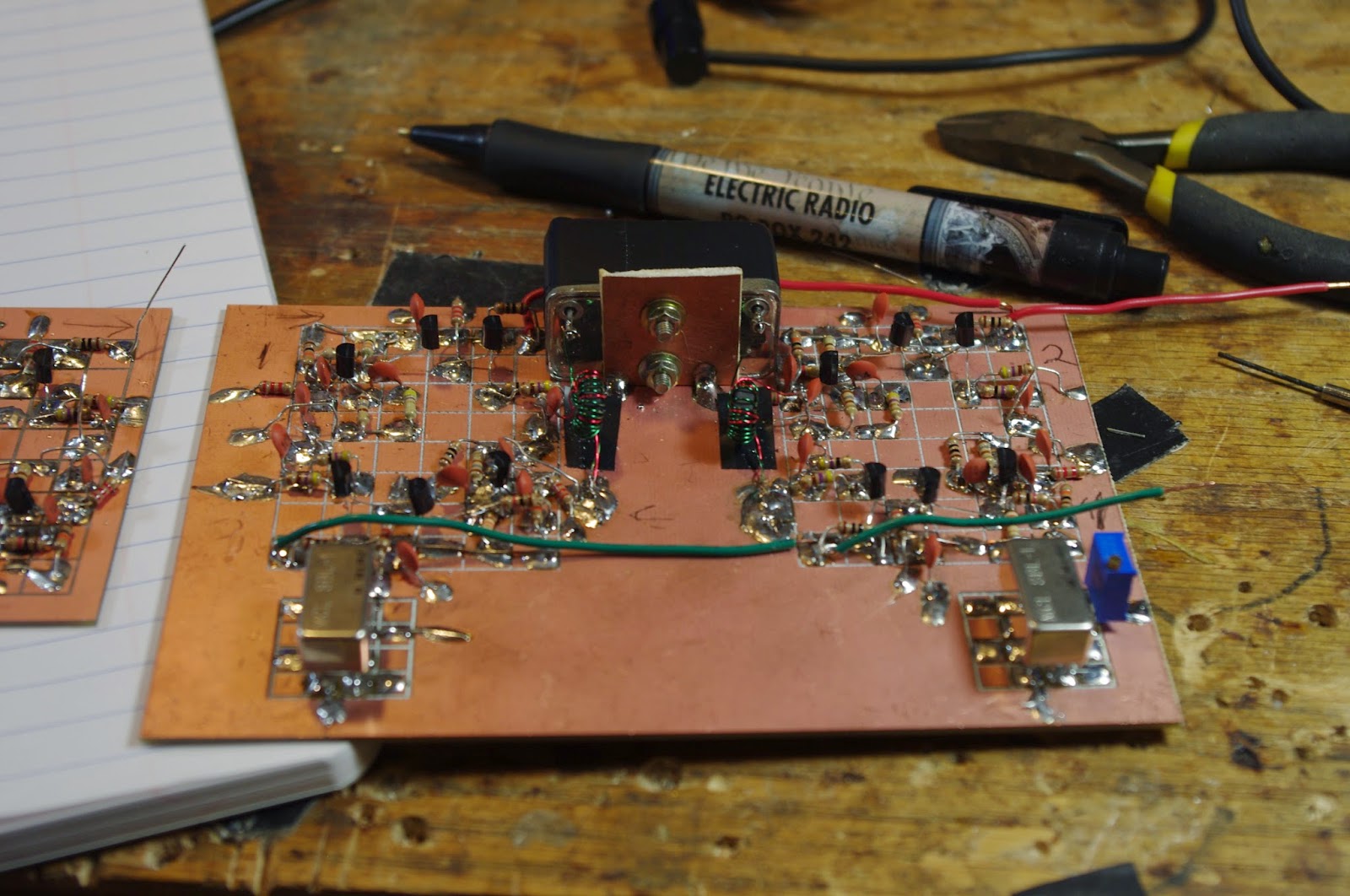
The receiver will be built mostly on a PC board that Pete made for me back when he was trying to convince me to build a fourth BITX receiver. I am pleased to put the board to use. See below.

Yesterday I soldered on the two SBL-1 mixers that will form the heart of this receiver. I realized that the very robust quadrature square waves from the Kanga board might be robust enough to fry the sensitive little SBL-1s. Sure enough, I measured about 17 dbm coming out of the Kanga board. I threw together two roughly 10 db resistive pads. These should prevent the SBL-1s from releasing their smoke.

I hope this receiver will be four receivers in one:

1) Standard DC receiver.

2) Binaural Receiver! Groovy, stereo CW that floats around in your head, man!

3) I-Q receiver that can be fed into the sound card of the computer for DSP, panoramic display, etc. I promise not use it to find fault with the signals of homebrew SSB rigs.

4) SSB image rejecting receiver for easy, Direct Conversion SSB listening without the burden of having to listen to the other side of zero beat.

There is already a lot of soul in this new machine: Kanga board with the design my Paul M0XPD, PC board made on Pete’s $250,000 CNC machine, and all of it on an actual breadboard (from Italy, I think).

Rick Campbell and Peter Parker have commented on the allure of phasing rigs. There is something very attractive about them. There is a cleverness in the way this design exploits the phase relationships between sidebands to allow us to null out the unwanted side of zero beat. It took me a while to really understand how this is done — once I understood it, I really wanted to build a rig that would make use of this principle.

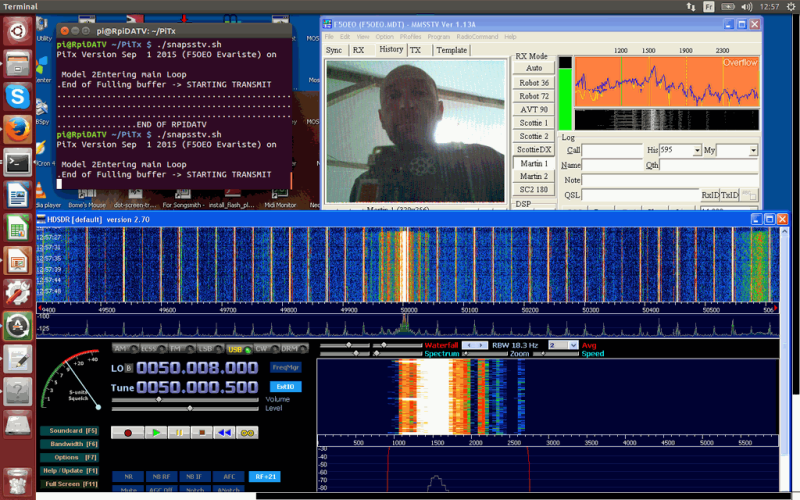
Nightmare Turns Real: “Rig Here is a Raspberry Pi OM, and I’m listening to you with my Dongle…”

As with many other nightmarish things, this one was launched at the world on Halloween. It all seems a bit flaky, but we knew this was coming. Don’t complain to me about the lack of low-pass filters, SSB testing on 7.000 MHz, or the rather nebulous identity of the creator…. I’m just the messenger here. And remember that I am a HARDWARE Defined Radio, Discrete Component, “Menus are for Restaurants” and (now) “Pi’s are for eating” kind of ham.
Here it is:


Homebrew Computers — REALLY Homebrew Computers


Hackaday has an article today that is, for me, very timely. In our last podcast, Pete and I were discussing the meaning of the word “homebrew” in the world of Software Defined Radio. As always, Pete was closer to the cutting edge, while I remain mired in Ludite (one D please!) curmudgeonism, committed to RADICAL FUNDAMENTALIST HOMEBREWING. No chips and no menus for me please.

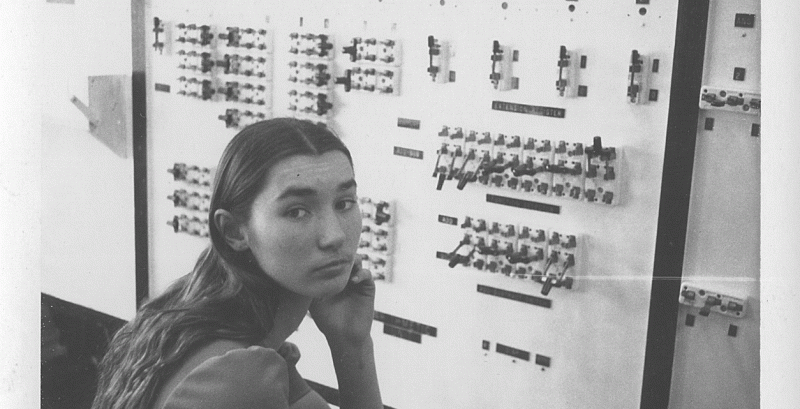
Today, the Hackaday guys came to my rescue with a blast from the past. Homebrew computers! Not that simple “buy a mo-bo and plug in some boards” stuff. No, REAL homebrew, so HB that they even made their own components. 1968. I can dig it! I should have gone down this road. I had the C.L. Stong book “The Amateur Scientist” IN MY HANDS. It had some great articles about relay-based computers. I could have been rich!

http://hackaday.com/2015/10/19/diy-computer-1968-style/

HB2HB — Homebrew Rigs on Both Sides of the Contact


As I’ve been saying on the podcast, contacts in which both operators are using homebrew gear are increasingly rare, especially on SSB, and especially, it seems, in the USA. So let’s chronicle these rare events. I’ve started a Label here on the blog called HB2HB. Send me reports of good HB2HB contacts — recent or past — and I’ll try to get them onto the blog.

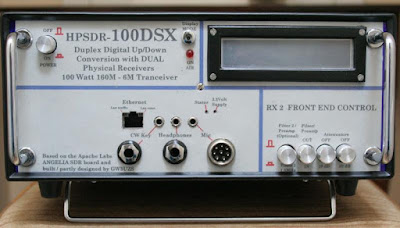
I’ve already described my recent QSO with Pete, N6QW. My second HB2HB from this location took place on 12 October 2015. I talked to Jeff GW3UZS in Cardiff, Wales on 17 meters. I was using my trusty BITX17. Jeff was running a much more sophisticated homebrew rig — see above. More details on Jeff’s beautiful rigs are on his QRZ.com page”

https://www.qrz.com/db/GW3UZS

So send in HB2HB reports. These contacts are almost in “endangered species” category — they deserve to be preserved!

Sparks from Ron Sparks: The Grand Pooh Bah and Gilbert and Sullivan; SDR, Ned Ludd and Blaise Pascal

Hi Bill,
Thanks very much for the mention in your tenth anniversary podcast! It is great to know I am embedded in internet history even though I am not that important.
I enjoyed listening to you and Pete on the recent Soldersmoke Podcast. I really got a kick out of the various discussions and thought I would weigh in. I am sure you have heard someone say “Well actually…”, so here are a few from me

  • Grand Pooh-Bah is, as you say, a Flintstones character, but it is not the the origin of the term. It actually goes back bit more than a century. The original character was named Pooh-Bah and was Lord High of nearly everything. He appeared in The Mikado by Gilbert and Sullivan in 1885.
  • There really are a fair number of non-software experiments that can be done with SDR. My first SDR was a set of boards assembled by Gerald when he was first starting Flexradio in 2002. His plans were very much homebrew and were published in QEX July/Aug 2002. My second SDR was a homebrew kit put together by Tony Parks, KB9YIG in 2005. He still sells SDR kits as fivedash.com. All this is very much home brew and does not rely on obscure hardware blobs. Have a look at the schematic for the current softrock at Ensemble II Schematic.pdf. It only uses “jellybean ICs”.
  • According to the Smithsonian magazine, “Despite their modern reputation, the original Luddites were neither opposed to technology nor inept at using it…A seemingly endless war against Napoleon’s France had brought ‘the hard pinch of poverty,’ wrote Yorkshire historian Frank Peel, to homes ‘where it had hitherto been a stranger.’ Food was scarce and rapidly becoming more costly. Then, on March 11, 1811, in Nottingham, a textile manufacturing center, British troops broke up a crowd of protesters demanding more work and better wages.” It was only later that they became associated with resenting the machinery.

I am also enjoying your discussion of the changes to our technology and how it affects hams and other technical people. I came into electronics as a young boy and at that time transistors were just beginning to displace tubes as a dominant force. I definitely remember the older techs saying, “These new transistor things are just sand-in-a-can; how can anyone know how a circuit operates with them.”

About 12 years later when I was in college I heard exactly the same comment as “jellybean” Integrated Circuits (7400 and 4000) began to displace discrete transistors. There was much musing about how the future would be one of just plugging ICs together and no design talent would be needed or developed.
Fast forward another 20 years and the microprocessor moved from Primary CPU, to cheap CPU, to PICs and Atmels. Here came the same comment lamenting the loss of ICs that “we could understand” and “no more electronics is needed, just hook the blocks and write the software.”

Now about 10 years from then we are seeing complete transmitter and receiver modules, zigbee, wifi, and many other Adafruit style drop-in modules. I figure it is about time to hear that old saying once again. You and Pete need to be careful as you dance about it, don’t fall into the trap !

So in the immortal words of Blaise Pascal in 1657, “I have only made this letter longer because I have not had the time to make it shorter.”
Keep up the good work and great podcast!

73 de AG5RS, Ron

SatNOGS: 3D Printed Az-El Rotators! Ray-Gun PVC Helical Antennas! Arduinos! Dongle Receivers!

Wow, this project is very appealing. Finally, a 3D printer project that seems truly useful. They are using one of the Dongle receivers we’ve been playing with, and, of course, Arduinos. You could really geek-out with this stuff. Check out the hardware side of this effort here:
https://satnogs.org/documentation/hardware/

SolderSmoke Podcast #180 Pete’s Beam, Simple-ceiver, 2-B, Noodling, Homebrew and SDR?, “The Martian”, Mailbag

SolderSmoke Podcast #180 is available:

http://soldersmoke.com/soldersmoke180.mp3

19 September 2015

PROJECT REPORT:
Pete’s Antenna Project: The Joy of Rotation!
Simple-ceiver
Bill fixes Digi-Tia (after breaking it)
Shack Configured for Winter (DX-100)
Working (a little) on the Drake 2-B

SolderSmoke words we forgot to mention:
Noodling
The Radio Gods
The Radio Art
The Grand Poobah
Magic Smoke
Lud(d)ite Curmudgeonism

SDR and the Homebrewer

“QSO Today” Interviews
Lady Ada interviews Paul Horowitz of “Art of Electronics”

SHAMELESS COMMERCE: Book still free!
Start your Amazon purchases at our blog page.

Book Review: “The Martian”

Great QSOs with W5NDS and AE5RM

MAILBAG

Inspiring Stuff on “QSO Today”

Eric 4Z1UG is doing some really great interviews on his “QSO Today” podcast. I found the last three to be especially informative and inspirational.

Chuck Adams K7QO dispensed a lot of useful information about Muppet boards and construction techniques, but more importantly he put out a lot of wisdom about the hobby, especially on the importance of teaching and sharing knowledge.

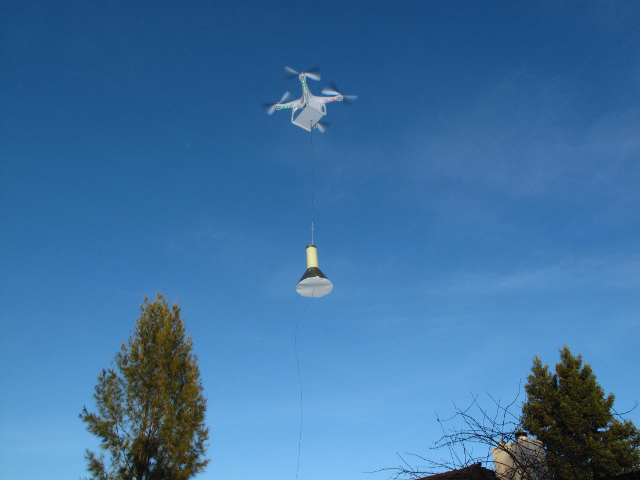
The interview with Glenn Elmore N6GN presented many interesting technical ideas, including using WSPR on VHF and UHF, and using aircraft reflections as a Sporadic-E like propagation mode. He also mentioned “wing vortex” propagation. Glenn talked about how to use a drone and a special light-weight transmission line to get your VHF/UHF (or cell phone) antenna above the trees. (See above).

I found the conversation with Gerald Youngblood K5SDR both fascinating and a bit worrisome. Gerald is obviously a great guy, and he does a wonderful job of describing the technology behind SDR radios, linking it to the phasing techniques that hams have been using since the dawn of single sideband. He makes a strong case for the new SDR rigs, noting the absence of receiver-produced noise, the advantage of band-wide visual waterfall displays (even while noting that they tend to “make every ham an Official Observer”), and “brick wall filters that don’t ring.” But I got and uneasy feeling when he referred to non-SDR rigs as “legacy rigs.” I found myself wondering how long it will be before all our rigs are required to be noise-less and all our filters skirt-less. Will there come a time when our beloved legacy rigs will be deemed unacceptable? (You can already hear this sentiment on the bands.) And how much room is there in this SDR world for the kind of homebrewing we do? ( I know, I know. I admit to feeling the presence of Ned Lud as I type these words.)

Great job Eric! And thanks to all the interviewees. We look forward to the interview with Pete N6QW.

Eric’s QSO Today podcast can be found here: http://www.qsotoday.com/

Our book: “SolderSmoke — Global Adventures in Wireless Electronics” http://soldersmoke.com/book.htm Our coffee mugs, T-Shirts, bumper stickers: http://www.cafepress.com/SolderSmoke Our Book Store: http://astore.amazon.com/contracross-20

Dongle Update — Dongles, FUNcubes, Meteors, QRP, and SPRAT

Hi Bill, Pete,

Ken Marshall G4IIB here the guy that wrote the SDR Primer in Sprat 162. I have been listening to your excellent podcasts. You guys cover a lot of ground in the May issue and touched on to the SDR dongle, its potential for future developments etc. I noted that you where going to buy another to cover VHF. Well if it ain’t too late consider this New version by Newsky they are already getting difficult to get a hold of and are only available in the USA. It uses an R820T2 tuner (better LNA) an upgraded and stable crystal oscillator, a reinforced antenna coax and socket. The one I managed to get hold of also had a modified PCB with solder pads for the the Q channel (pins 4&5) to connect the toroid. Incredable at 22 of your Bucks. See the pictures and read all about it on amazon.com.

http://www.amazon.com/gp/product/B00QFCNNV0/ref=as_li_tl?ie=UTF8&camp=1789&creative=390957&creativeASIN=B00QFCNNV0&linkCode=as2&tag=rsv0f-20&linkId=VNHED72IVHA5O2KT

All we need is for them to slot a 12 or 16 bit ADC in and we could have a truly great SDR receiver.

I noticed in your podcast you mentioned radio astronomy and satellite reception. Ironicaly back in 2013 this is how I started with SDR dongles. I read an aticle on the web on meteor scatter and started experementing with a dongle. Meteor scatter hunting is a bit like watching paint dry unless there is a known storm. So this led me on to the Funcube satellites. The signals from which although QRP 200mW are very stong and you can receive them on almost any antenna. The funcube dashboard software is available for free from AMSAT and alows you to download telemetry. You can also listen to amateur SSB an CW transmissions. There are lots of satellite tracking software available too. This then led onto weather satelite picture reception I built a 4 ele turnstile antenna for this but I found that I needed an LNA for reception at my location. I then started to listen to the amateur bands. Like you Bill I became interested in radio at the age of 11 and got licensed in the early 70’s but work commitments meant I had a 30 year absence from Ham Radio until I stumbled on these SDR Dongles. They got me back into the hobby and I joined the GQRP Club. I noticed that almost no one in the QRP fraternity was talking about RTL SDR hence I started writing the Primer and submitted it to George in late 2014 for publication in Sprat. As you know it appeared in the Spring Sprat and seems to have generated lots and lots of interest in the QRP community. I am delighted by this response and look forward to lots more interesting articles and podcasts. Have fun with your dongle.

Ken G4IIB

PS I wrote another article on getting these dongles to work under Linux. Linux uses completely different architecture so that the software used is completely different to windows. I notice that the software I use for Linux is also available on Mac OS which uses similar architecture (UNIX) so in theory it should also work on a Mac. Quite a few people have expressed an interest in getting a dongle to work on a Mac. As I do not poses a Mac I have not tried this out.

Funcube Dashboard

Our book: “SolderSmoke — Global Adventures in Wireless Electronics” http://soldersmoke.com/book.htm Our coffee mugs, T-Shirts, bumper stickers: http://www.cafepress.com/SolderSmoke Our Book Store: http://astore.amazon.com/contracross-20

Back with the Sats: Catching Cubes with a Dongle

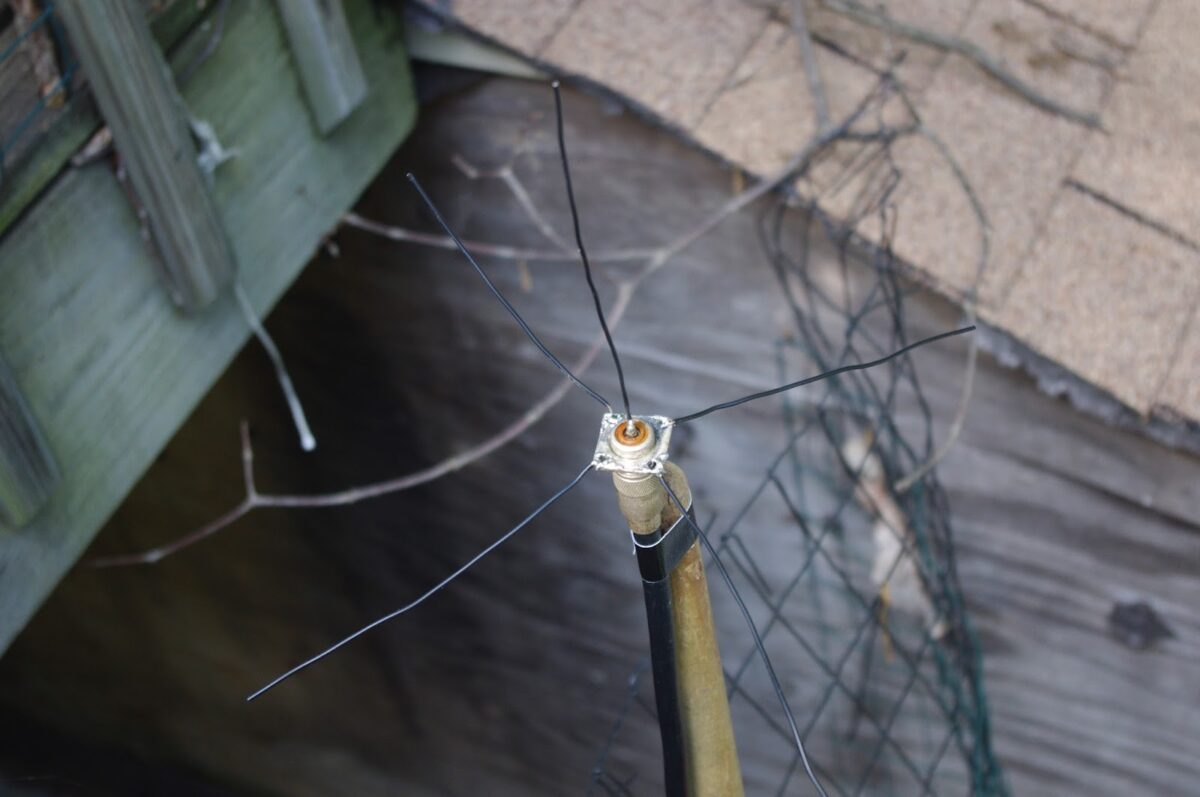
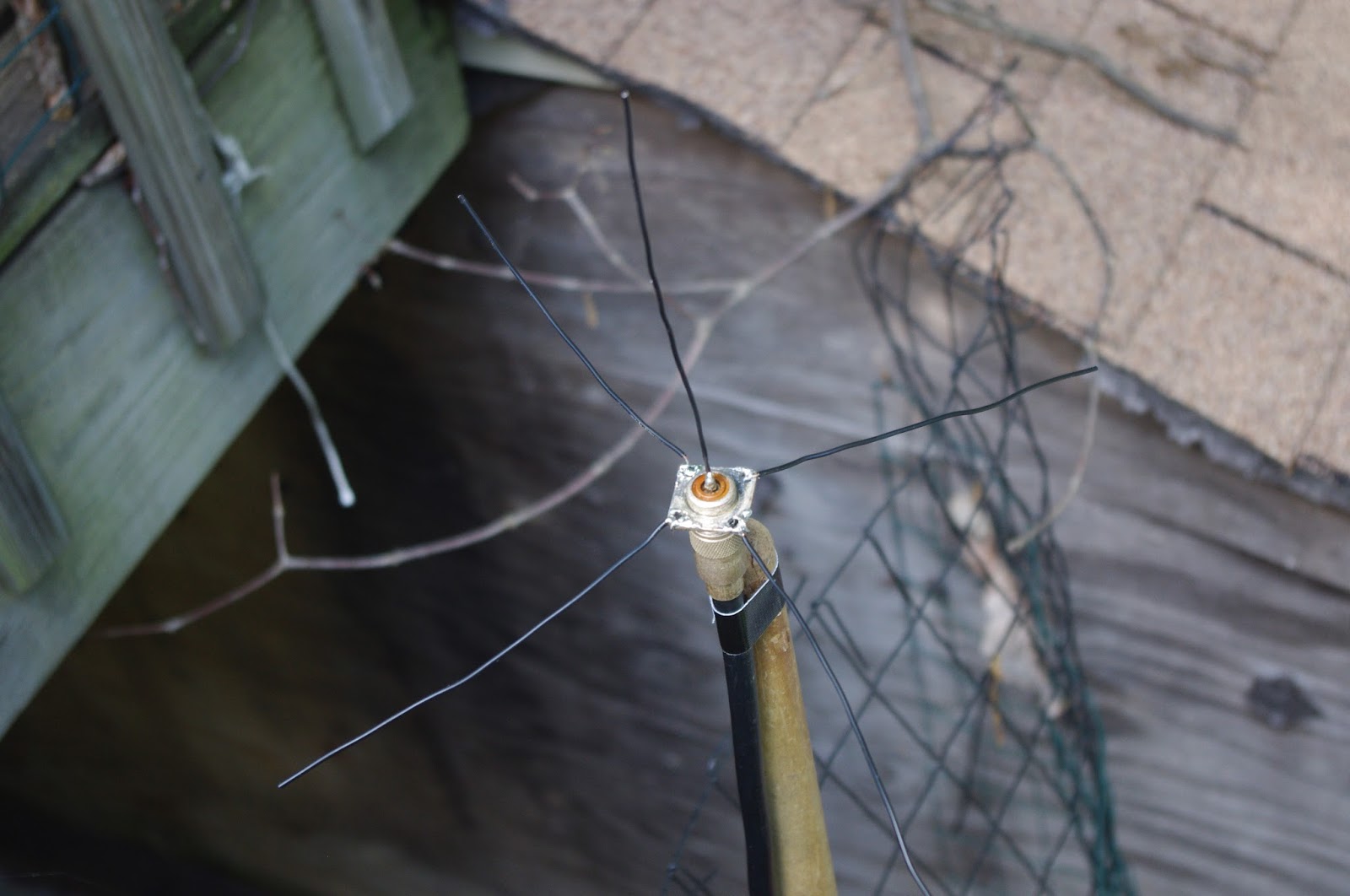
I’ve been playing around with a little $13 DVB-T SDR Dongle receiver. These devices normally tune 24 MHz to 1.7 GHz, but I modified the first one I had so that it would tune the HF bands. Pete then sent me another one, which I vowed to keep unmodified, thinking that it would be fun to use it to listen to the many small Cube-Sats that are up there. Most have downlinks (and Morse Code beacons) in the 470 MHz range. I whipped together a simple ground-plane antenna for this band (One 6 inch copper wire as the receive element with 4 five inch groundplane elements).


I then went to the “Heavens Above” website, plugged in my location, and clicked on “Amateur satellites.” This gave me a very accurate schedule of satellite passes. I started listening.


First I heard (and saw in the HDSDR waterfall) the CW beacon of the Prism satellite at 7:05 am EDT today. Prism is from the University of Tokyo and was launched from Japan.

Then Cubesat XI-V at 0711 EDT.

Cubesat XI-IV was heard at 0813 EDT. The Cubesats are from Japan and were launched from Russia.

ITUsPAT was heard at 1422 EDT. The I is for “Istanbul”

Finally, I monitored a pass of the Japanese FO-29 satellite aka JAS-2 at 1611. Wow, this was like old times on the RS-10 and RS-12 satellites. Lots of CW and SSB stations in the downlink passband. Lots of fun.

At 470 MHz the Doppler shift of a low-earth orbit satellite is quite noticeable, and helps confirm that you are in fact receiving sigs from an orbiting device.

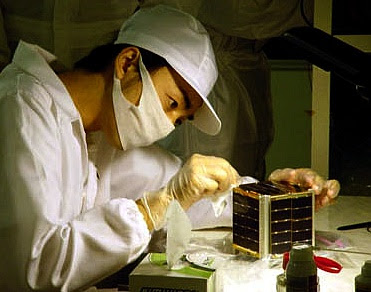
I thought it was pretty cool to take a $13 DVB-T Dongle, connect it to a small, copper-wire antenna, and use it all to receive signals from some 4″x4″x4″ cubes in orbit of the Earth.

Our book: “SolderSmoke — Global Adventures in Wireless Electronics” http://soldersmoke.com/book.htm Our coffee mugs, T-Shirts, bumper stickers: http://www.cafepress.com/SolderSmoke Our Book Store: http://astore.amazon.com/contracross-20

SolderSmoke Podcast 176: Knack-Related Conditions: Termination Insensitivity, Sideband Inversion, Dongle Modification, Area 5351 Conspiracy Disorder

SolderSmoke Podcast #176 is available! (And it is GOOD!)

http://soldersmoke.com/soldersmoke176.mp3

16 May 2015

Bench Update:
Pete releases some magic (amplifier) smoke
Pete’s new termination-insensitive transceiver makes first contact
Bill goes Yaesu (well, just a filter)
Juliano Mill-Pad boards
Termination Insensitivity is not a personality disorder!
Flip those Bilat Boards! Pete’s cool technique for bilat building
Bill’s project notebook and stage testing
Installing the W6JFR EMRFD SBL-1 Bal-Mod Mod

AREA 5351: Myths, Urban Legends, and Conspiracy Theories about the Si5351

A Rule of Thumb for Sideband Inversion

Dongle Madness and the Dangers of Dongle Modification
What is a dongle?
24 Mhz to 1.7 GHz right out of the box
Modification for 0-29 MHz
Tapping the IF of a Drake 2-B
Getting another one for VHF-UHF
Dongling Meteors, Satellites and Airplanes

SPRAT cover AD9850 in 1988! Three cheers for SPRAT (and QQ and QST).

Elecraft’s new Rig

Our book: “SolderSmoke — Global Adventures in Wireless Electronics” http://soldersmoke.com/book.htm Our coffee mugs, T-Shirts, bumper stickers: http://www.cafepress.com/SolderSmoke Our Book Store: http://astore.amazon.com/contracross-20

SolderSmoke Podcast 176: Knack-Related Conditions: Termination Insensitivity, Sideband Inversion, Dongle Modification, Area 5351 Conspiracy Disorder

SolderSmoke Podcast #176 is available! (And it is GOOD!)

http://soldersmoke.com/soldersmoke176.mp3

16 May 2015

Bench Update:
Pete releases some magic (amplifier) smoke
Pete’s new termination-insensitive transceiver makes first contact
Bill goes Yaesu (well, just a filter)
Juliano Mill-Pad boards
Termination Insensitivity is not a personality disorder!
Flip those Bilat Boards! Pete’s cool technique for bilat building
Bill’s project notebook and stage testing
Installing the W6JFR EMRFD SBL-1 Bal-Mod Mod

AREA 5351: Myths, Urban Legends, and Conspiracy Theories about the Si5351

A Rule of Thumb for Sideband Inversion

Dongle Madness and the Dangers of Dongle Modification
What is a dongle?
24 Mhz to 1.7 GHz right out of the box
Modification for 0-29 MHz
Tapping the IF of a Drake 2-B
Getting another one for VHF-UHF
Dongling Meteors, Satellites and Airplanes

SPRAT cover AD9850 in 1988! Three cheers for SPRAT (and QQ and QST).

Elecraft’s new Rig

Our book: “SolderSmoke — Global Adventures in Wireless Electronics” http://soldersmoke.com/book.htm Our coffee mugs, T-Shirts, bumper stickers: http://www.cafepress.com/SolderSmoke Our Book Store: http://astore.amazon.com/contracross-20

Drake Dongle Derring-Do — 2B goes SDR (video)

Here I take my Drake 2B — arguably the quintessential Hardware Defined Radio — and connect its first Intermediate Frequency circuitry to an RTL-SDR Dongle, allowing me to digitally process, filter, and display (panoramically!) the signals being inhaled by the ancient receiver. Another cool tech twist: To get at the 455 kHz IF signal I use the “Q-Multiplier” jack on the back of the receiver. This connector was put there to allow for the use of a selectivity enhancing regenerative stage. So I’m using that connector for a similar purpose, but using technology that wasn’t even being dreamed about when that Drake 2-B was being designed in 1961.

Our book: “SolderSmoke — Global Adventures in Wireless Electronics” http://soldersmoke.com/book.htm Our coffee mugs, T-Shirts, bumper stickers: http://www.cafepress.com/SolderSmoke Our Book Store: http://astore.amazon.com/contracross-20

SDR Dongle Modified for HF. Watch it work on 40 meters (VIDEO)

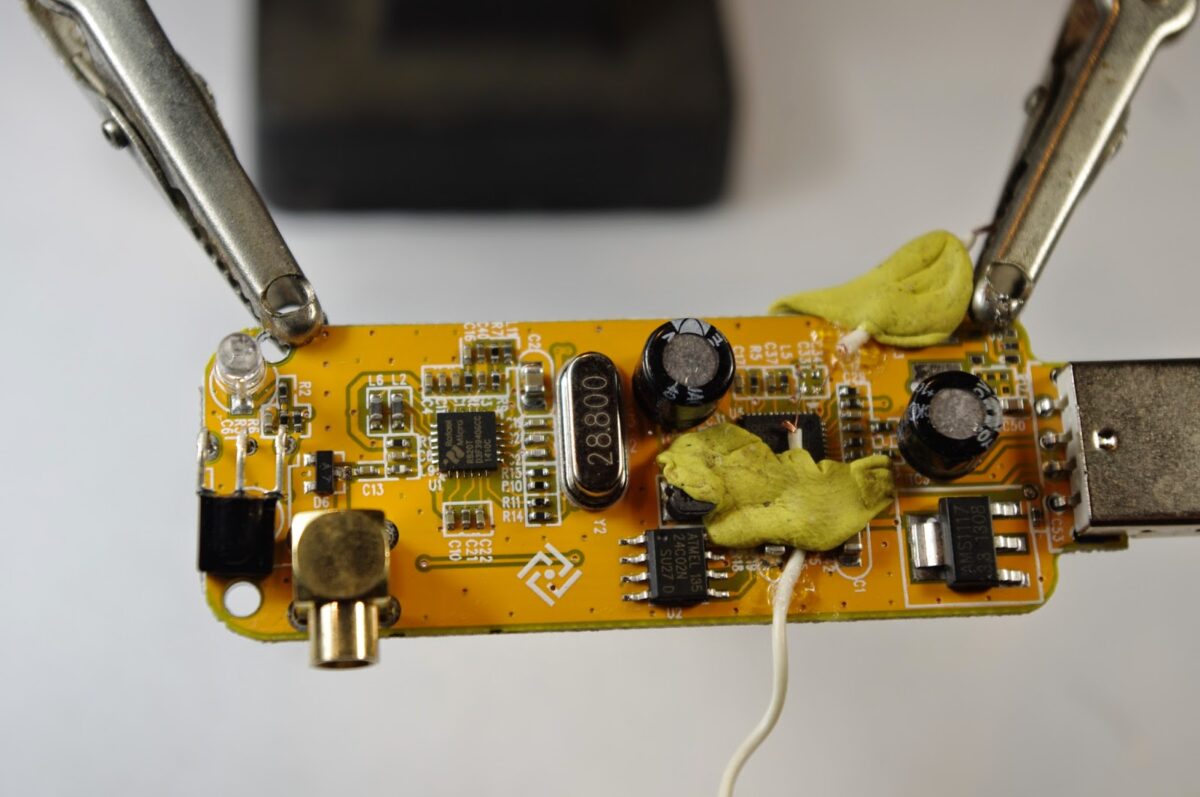
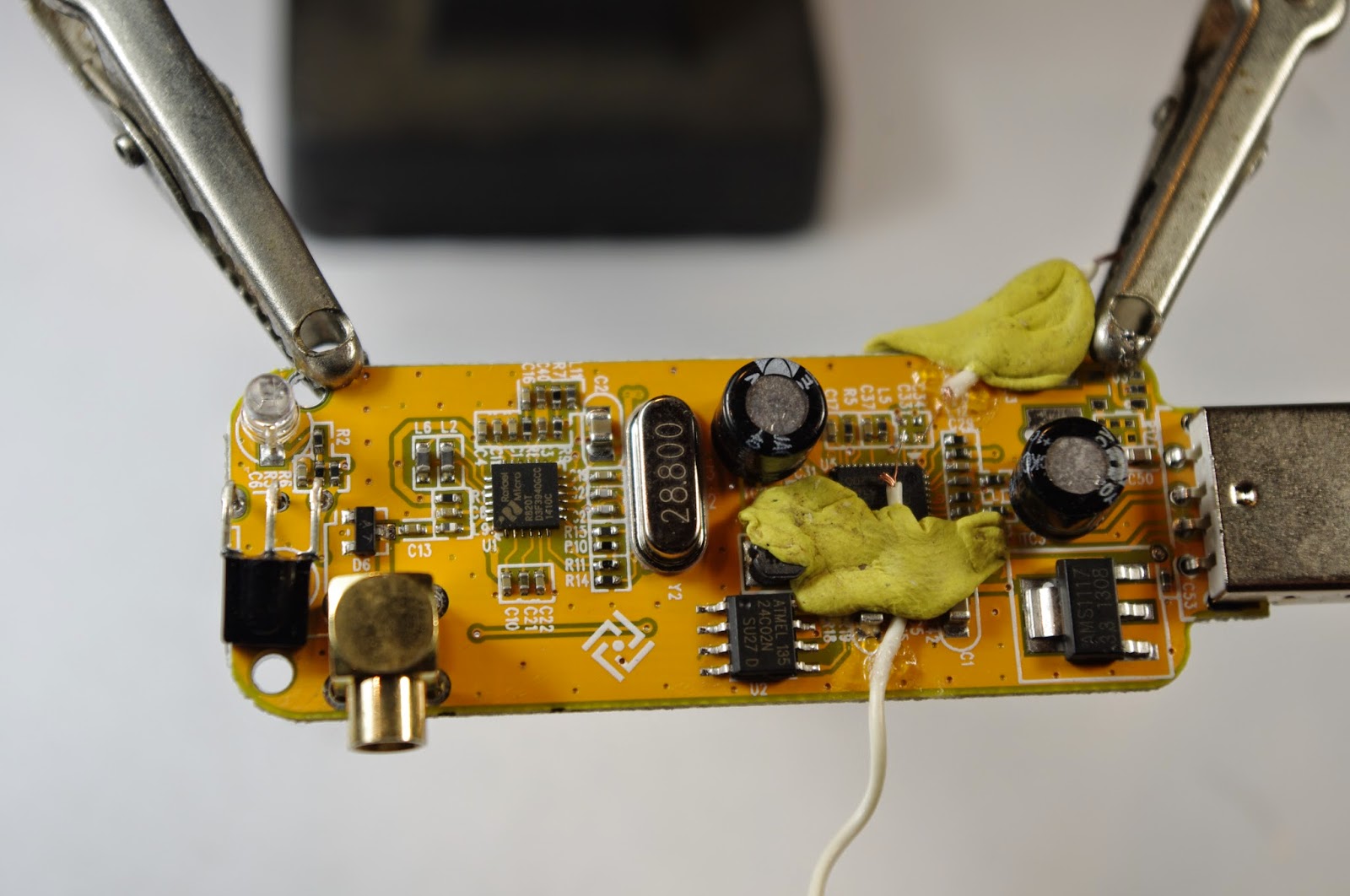
With SPRAT 162 by my side, armed with an FT37-43 trifilar wound transformer, I popped open the RTL-SDR dongle. I had hopes of being able to solder two tiny wires to the unused input pins (3 and 4) but I quickly realized that I was NOT going to be able to do that — they are far too small for me to work on. So I did what Ken Marshall G4IIB did: I took out the SMT caps going to pins 1 and 2 and soldered two small wires there. This will limit this dongle to HF only — if I want VHF/UHF I’ll just spend another $13 dollars! You can see the results in the video above.

I used the yellow stuff to hold the wires in place. It was later removed.

Tony Fishpool did a neater job. See his work here:
https://dl.dropboxusercontent.com/u/1987387/Even_more_on_using_the_RTL2832U_Dongle.pdf

Our book: “SolderSmoke — Global Adventures in Wireless Electronics” http://soldersmoke.com/book.htm Our coffee mugs, T-Shirts, bumper stickers: http://www.cafepress.com/SolderSmoke Our Book Store: http://astore.amazon.com/contracross-20

“Dongle” USB SDR Receiver $13 (VIDEO)


I was recently commenting to Pete that I could use some gear that would give me a better means of checking the bandwidth of my transmissions. Pete. pointed to the latest issue of our much-loved SPAT magazine. Indeed on SPRAT 165 (Spring 2015) there is an article by Ken Marshall G4IIB on how use the RTL2832u R820T DVB-T “dongle” (USB stick) as an SDR receiver. I sent 13 dollars to Amazon. The device arrived yesterday. I followed Ken’s instructions and soon I had the little device inhaling on 12 meters. It is really amazing. Lots of technology in a little box the size of your thumb! I use it with the free HDSDR software and have been listening to 12 and 10 CW and SSB. See the video above. Tomorrow I will attempt Ken’s mod that will open up the other HF bands. Then I will be able to put to use a second SPRAT article about this device : Also in SPRAT 165 Tony Fishpool G4WIF describes how to use this device as a rudimentary indicating instrument for bandwidth measurements.

Great stuff. Get yourself one of these devices. You will in effect be getting an all-band all-mode computer controlled receiver for $13 !!!!!!!!!!!!!!

I got this one:

http://www.amazon.com/gp/product/B00D3GRU24/ref=oh_aui_detailpage_o00_s00?ie=UTF8&psc=1

Thanks Ken, thanks Tony.


Our book: “SolderSmoke — Global Adventures in Wireless Electronics” http://soldersmoke.com/book.htm Our coffee mugs, T-Shirts, bumper stickers: http://www.cafepress.com/SolderSmoke Our Book Store: http://astore.amazon.com/contracross-20

Teensy SDR Update (video)

I know this will have some of you thinking that I have been kidnapped or drugged or brain-washed (by N6QW!) or something, but the truth is I’m just being drawn in by that fascinating little color screen. This is the beautiful work of Rich, VE3MKC. He has also updated his blog and provided a very nice diagram and written description of all the I and Q action: http://rheslip.blogspot.ca/ Thanks Rich!

Our book: “SolderSmoke — Global Adventures in Wireless Electronics” http://soldersmoke.com/book.htm Our coffee mugs, T-Shirts, bumper stickers: http://www.cafepress.com/SolderSmoke Our Book Store: http://astore.amazon.com/contracross-20

REALLY AMAZING! The Portable SDR Project! 42 Hours Left To Save It!

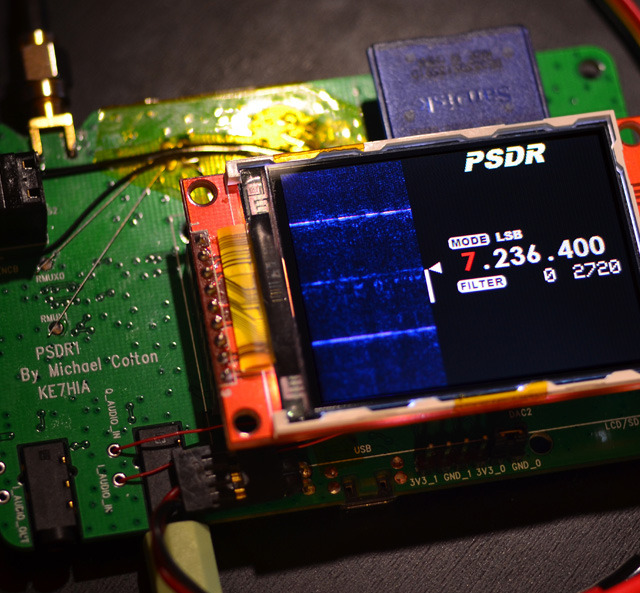
Holy cow! Look at that rig. The whole HF spectrum. AM, CW, SSB, Digital Modes, Waterfall display, GPS. It may even have a Vector Network Analyzer! (Deep breaths Pete Juliano, deep breaths!)

Michael KE7HIA is trying to get this project going via a Kickstarter campaign. He needs to get to $60,000 He currently has about $47,000 pledged. There are only 42 hours to go:

https://www.kickstarter.com/projects/1703258614/psdr-pocket-hf-sdr-transceiver-with-vna-and-gps

Wow, this rig would have been great for my Double A DR DX-pedition!

Features:

  • Coverage from 0 to 35MHz
  • Waterfall display that lets you see radio signals
  • Receives AM, USB (Upper Side Band), LSB (Lower Side Band), and Morse code (CW)
  • Modulates USB and LSB signals
  • Variable bandpass filter

Hardware:

  • Powerful ARM processor
  • Color LCD display
  • Dual DDS frequency Synthesizers
  • Quadrature Sampling Detector & Exciter
  • Digitally controllable instrumentation amplifiers
  • Morse Code key (the “Giblet” on the bottom right corner of the enclosure)
  • Magnitude & Phase measurement chip (for VNA and antenna analysis functions) with Impedance Bridge
  • Dual SMA connectors, smartphone style earphone/microphone connector, and USB port
  • GPS
  • Built in Microphone and Speaker
  • Internal Lithium Polymer battery with charger and high efficiency switching regulator
  • MicroSD slot
  • Pads for grabbing raw I/Q signals, both in and out.

Things it will be able to do with your help:

I designed the hardware to be capable of the following, but I can’t write all the software myself. Please note that I can’t guarantee when or if these functions will be added, or that they will work as desired.

  • Work as a full Vector Network Analyzer (VNA)
  • Work as a spectrum analyzer
  • Cover more modes, including digital modes and image modes
  • Work as an emergency location beacon
  • Antenna Analyzer
  • Frequency Synthesizer
  • Media player
  • E Reader / Picture viewer
  • Have improved audio
  • GPS Mapping navigation device
  • High end ARM development board
  • USB control of any features, including the possibility to operate the PSDR remotely. The USB port supports USB On-the-Go, making it possible to connect keyboards or other devices. Firmware updates will also be possible over USB.

Our book: “SolderSmoke — Global Adventures in Wireless Electronics” http://soldersmoke.com/book.htm Our coffee mugs, T-Shirts, bumper stickers: http://www.cafepress.com/SolderSmoke Our Book Store: http://astore.amazon.com/contracross-20

VE3MKC’s Teensy Si5351 SDR Receiver with a Tiny Color Screen (video)


From: Rich
To: “soldersmoke@yahoo.com”
Sent: Thursday, January 22, 2015 9:22 AM
Subject: Cheap, open source Arduino SDR project
Bill

First, thanks for Soldersmoke and all you do for us QRP hackers around the world. I’m a big fan!
I’ve detected you are getting sucked into the world of microcontrollers of late. I know you are not really that excited about SDR but this is a radio that combines Arduino, the currently popular SI5351 and a Softrock to make a very functional SDR. I started this project last year which uses the fabulous Teensy 3.1 and companion audio shield. I recently packaged it all up and it looks like a QRP radio now. Still doesn’t transmit but as I like to say thats “just a small matter of software”.
There are several posts about it on my blog. The most recent:
There’s a link to a video and a link to the code in that post.
Rock on Bill!
73, Rich Heslip
VE3MKC


Sent: Friday, January 23, 2015 4:09 AM
To:
Subject: Re: Cheap, open source Arduino SDR project

Wow Rich that is really beautiful. Amazing! I am also sending this to Pete Juliano, but I was at first hesitant about this because I feared that your combination of Si5351 and TFT display might be TOO exciting for him. Deep breaths Pete…
73 and Thanks, Bill


From: jessystems@verizon.net
To: soldersmoke@yahoo.com;
Subject: Re: Cheap, open source Arduino SDR project
Date: Fri, 23 Jan 2015 06:03:40 -0800

Hi Rich & Bill,
Wow –really exciting project Rich! Congratulations and Bravo!
This is so exciting, for all hams, as this just shows the power of the available low cost technology that is now on the market. Your project is really tempting as I have a V6.2 15M softrock sitting in a box (somewhere). I was somewhat put off with the Power SDR as the opposite sideband rejection is not too good –it is clear you have cracked that nut.
Thanks for sharing Rich and yes Bill I am taking very deep breaths.
73’s
Pete N6QW

Our book: “SolderSmoke — Global Adventures in Wireless Electronics” http://soldersmoke.com/book.htm Our coffee mugs, T-Shirts, bumper stickers: http://www.cafepress.com/SolderSmoke Our Book Store: http://astore.amazon.com/contracross-20