SolderSmoke Podcast #241 Mars, Direct Conversion, PTOs and Glue Sticks, Anniversary of the BITX20, Multus Proficio SDR, Boatanchor Station, MAILBAG

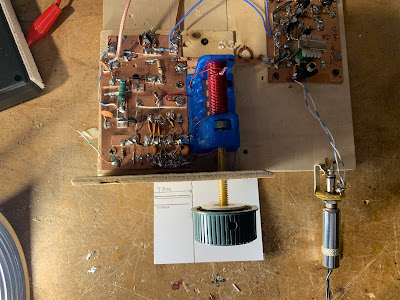
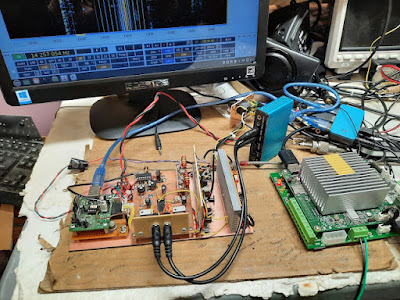
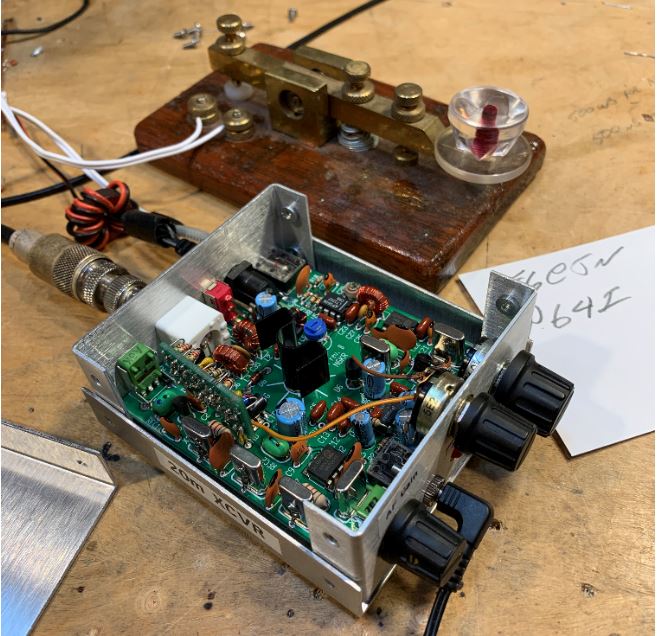
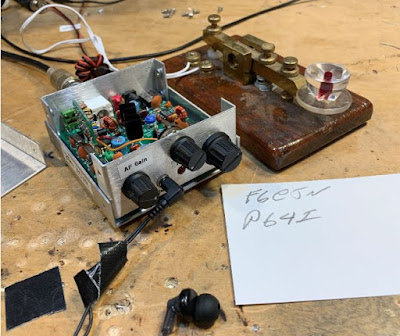
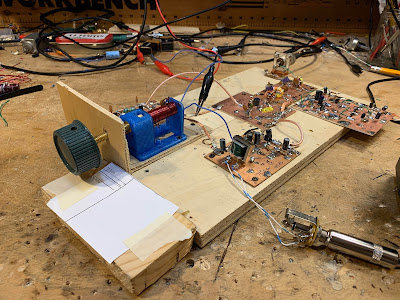
The board I use to test DC RX circuits

SolderSmoke Podcast #241 is available

Audio (podcast): http://soldersmoke.com/soldersmoke241.mp3

Video (YouTube): (215) SolderSmoke Podcast #241 October 28, 2022 – YouTube

Introduction:

Back on Mars. Opposition approaching. I have a Mars filter. And (like T.O.M.) a Mars globe.

N2CQR DXCC done

SolderSmoke in the WayBack Machine

Sticker news

PARTS CANDY — Don’t Scrimp with a Crimp!

Bill’s Bench

School DC RX projects — in Hyderabad and Northern Virginia.

Direct Conversion Receivers — Keeping it Simple, Learning a Lot. A step beyond the Michigan Mighty Mite. Do we really need 100db? Do we really need to shield VFOs? Farhan’s super-simple and stable Colpitts PTO. Audio amps, 1000-8 transformers and rolling your own LM386

PTOs and Glue Stick PTOs. Paul Clark WA1MAC. Brass vs. Steel bolts. #20 thread vs. #28 thread. Backlash Blues. The best Glue Sticks.

2 meters and the VWS. Bill has a Baofeng.

SHAMELESS COMMERCE: MOSTLY DIY RF

Pete’s Bench

20th Anniversary of the BITX20 Pete’s early BITX rigs.

Computer Woes

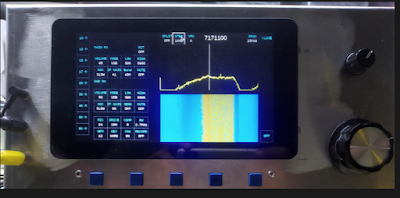
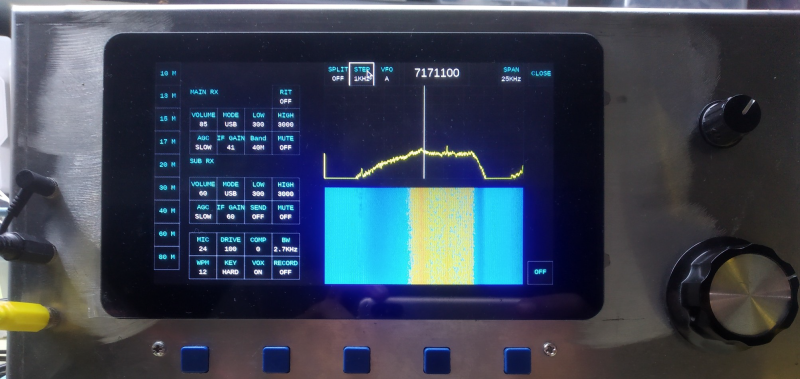
The Multus Proficio SDR rig

Simple SSB in China BA7LNN

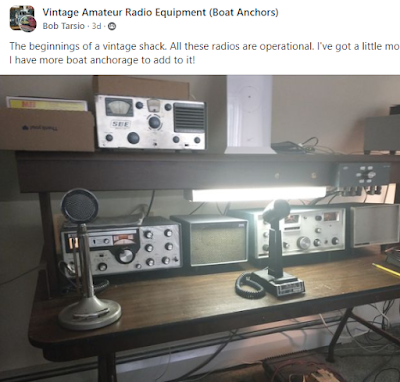
Things of beauty: Tempo One, NCX-3 and a SBE-33

MAILBAG

— NS7V is listening.

— Graham G3MFJ sent SPRAT on a stick.

— Nick M0NTV FB Glue Stick and 17 Shelf videos.

— Dino KL0S HP8640 Junior

— Mark AA7TA Read the SolderSmoke Book

— Steve EI5DD Connaught (Ireland) Regional News

— Dave K8WPE Planting the seeds of ham radio interest

— Peter VK3YE Ruler idea on PTO frequency readout

— Michael AG5VG Glue Stick PTO

— Tobias A polymath with UK and Italy connections. And cool tattoos.

— Alain F4EIT French DC receiver

— Michael S. was in USMC, working on PCM/TDM gear

— Alan Yates writes up Amazon transformer problem

— Todd VE7BPO, Dale W4OP, Wes W7ZOI

— Farhan VU2ESE sent me an sBITX

— Todd K7TFC The Revenge of Analog

— Jim Olds Building QRP HB gear
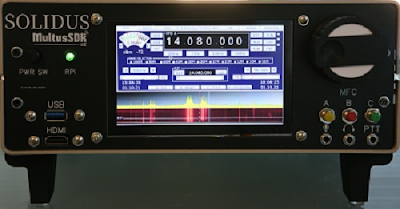

The Multus SDR rig Pete discussed

The older rigs Pete mentioned


My version of DC RX that Farhan is working on

My PTO with VK3YE’s ruler frequency readout


SDR on a Breadboard — But Isn’t This an Old-Fashioned Fantasy?

Nice video, but I’m afraid it is a bit of an old-fashioned fantasy. It would be nice to think that our beloved analog mixers and direct conversion receivers still have a place in the SDR world. That may have been true a few years ago when we were using soundcard-based SDRs. But today we just put an Analog to Digital Converter at the antenna, do “Direct Sampling,” create a digital stream, and sent it to the CPU for processing, right?

Sometimes we think that we can show younger people how our older tech (Direct Conversion receivers) is STILL relevant in the age of SDR radio. But I can just hear them scoffing at this notion, pointing out that I,Q-to-soundcard front ends have gone the way of the dinosaurs, and all we need now is an ADC and a CPU.

But hey, I am an HDR guy. Am I missing something here?

Would this Really Be Homebrew?

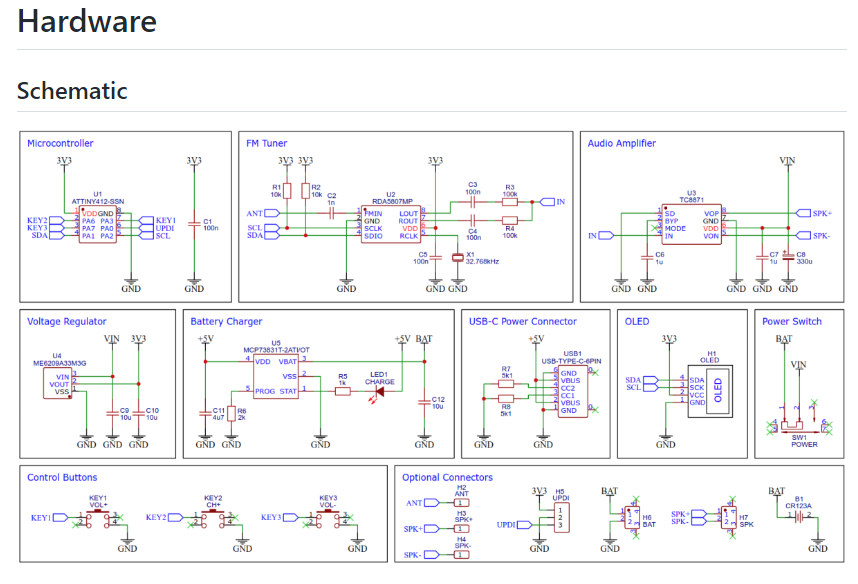
Hack-A-Day has an interesting post about an FM Broadcast radio project. I took a look. The Github page has the schematics for the hardware. For me, the thing is, there is just not a lot there. It is a bunch of chips. The FM Tuner IC is the heart of the project. With that one you have to dig down to see that it is a digital processing chip:

All of the action — all of the magic of radio — is locked inside those little SMD chips. I suppose if you were skilled enough to write the software or to significantly modify it, you’d get closer to the experience of homebrew radio, but very few of us have those kinds of skills — we just download the software, then struggle to get it into the chips.

And sure, you could struggle to solder those chips to a PC board, but really, why bother when 99% of the components are already inside the chips? You should just buy a board with the chips on them and with the software already loaded. There you have it: the store-bought appliance is really, really close to the supposedly homebrew receiver.

But hey, to each his own. This is a hobby and it is all for fun. I just think I have more fun with old-style, analog, discrete component HDRs. YMMV.

SolderSmoke Podcast #238 — SolderSmoke Shack South, Cycle 25, Chiquita Banana Radio, RCA, HQ-100, Mate Mighty Midget, Sony SWL RX , Mailbag

SolderSmoke Podcast #238 is available: http://soldersmoke.com/soldersmoke238.mp3

TRAVELOGUE:

Cathartic decluttering: Bill preparing for future winter travel to Dominican Republic. Will build SolderSmoke Shack South. Dividing everything up: Rigs, parts, tools, supplies, antennas, test gear. Everything.

OUR SPONSOR: Parts Candy.
https://www.ebay.com/usr/partscandy Premium quality test leads! Hand cut, hand crimped, hand soldered, these will become your new favorite test leads GUARANTEED!

PETE’S BENCH:

— Cycle 25 better? – Out here on the left coast – it is not evident
— Chiquita Banana and the US Navy in early ‘wireless” operations. Why RCA was created by the US Navy in 1919.
— Update on the MAX2870 –someone has written the code to make it work with the Raspberry Pi and the QUISK SDR software
— Field Day prep

SHAMELESS COMMERCE DIVISION:
Bill needs your help:
— Please watch his YouTube videos. The longer the better! Success based on hours watched. Great to have on while you are working in the shack. Just go to YouTube and search for the SolderSmoke channel. Or: SolderSmoke – YouTube
— Please put links to the SolderSmoke blog on your websites and blogs.
— How to USE the SolderSmoke Blog: Propagation, shopping, other sites…
— Please put comments under the articles on the SolderSmoke blog. We like comments and dialogue.

BILL’S BENCH:

— Repair of the Sony ICF SW1 shortwave receiver. Bad electrolytics. Number Station receiving device?
— HQ-100 Q-Multiplier. BFO Switch. AVC. Noise Limiter limitations. Dave K8WPE: Old Radio Lessons.
— MMMRX: Detector circuit. Alignment. Muting. On the air (40 AM with DX-100)

MAILBAG:

— Bob Crane W8SX — Great interviews at FDIM. On the SolderSmoke Blog. Thanks Bob!
— Dave Bamford W2DAB — Stickers on the Upper East Side of Manhattan. FB Dave!
— Farhan VU2ESE: LADPAC software now available through W7ZOI’ site.
— Lex PH2LB: Stickers in a Netherlands pub.
— Dave K8WPE Michigan Mighty Mite links. Old Smoke idea. On the SolderSmoke blog.
— Rich WB4TLM was in the electronics class of CF Rockey W9SCH. FB.
— Dean KK4DAS Working on his dad’s HQ-170A. VWS maker group on mixers.
— Grayson KJ7UM — Mixology article in ER.
— Pete Eaton — Farhan’s new analog rig: Daylight again! Standby for more info from Farhan.
— Will KI4POV New HB Al Fresco single conversion superhet. FB.
— Alvin N5VZH. Shep’s “I Libertine.” Yes. I laughed, I cried, It changed me.
— Chuck KF8TI. Mr. Wizard!
— Steve N8NM on the mend after some routine maintenance.
— Ben AB4EN is listening and likes the podcast — Thanks Ben.

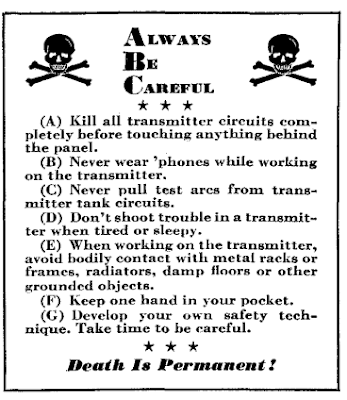
May 1939 QST


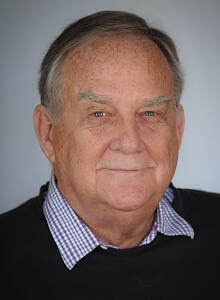
SolderSmoke FDIM Interview: Jack Purdum W8TEE on the Challenges of Decoding CW by Software

In his interview with SolderSmoke correspondent Bob Crane, Jack Purdum made some very interesting comments about the challenges of decoding CW with software. He notes that W1AW’s code practice CW is perfect, but that below 18 wpm, they deliberately insert a “Farnsworth Delay” that increases the spacing between words — this complicates automatic CW decoding.

Jack also talked about the distinctiveness of different CW operators. Jack noted that W1AW has no real “fist” in this sense: “It has the personality of a stick!”

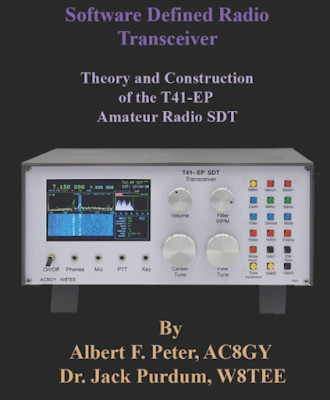
Jack mentioned that Pete Juliano had been reading book on SDR radios that Jack and Al Peter recently published: https://www.amazon.com/Software-Defined-Radio-Transceiver-Construction/dp/B09WYP1ST8/ref=sr_1_1?crid=2KPYAMPOW5P6J&keywords=DR.+Jack+Purdum&qid=1654598559&sprefix=dr.+jack+purdum%2Caps%2C40&sr=8-1

Here is our correspondent Bob Crane’s interview at FDIM 2022 with Jack Purdum: http://soldersmoke.com/2022 W8TEE.mp3

Thanks Bob. Thanks Jack.

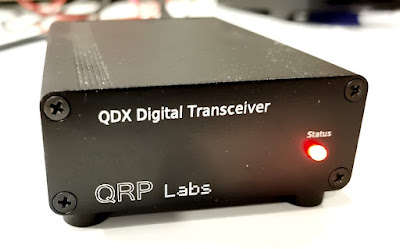
SolderSmoke FDIM Interviews: Hans Summers G0UPL Talks about the QDX and His New Balloon Tracker

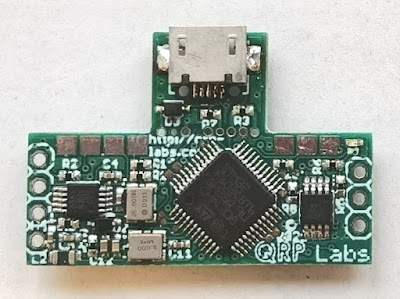
Thanks to Bob Crane W8SX for getting us this wonderful interview with Hans G0UPL. Its really amazing to hear Hans talk about how many QDX rigs and Baloon Trackers have been sold by QRP Labs, and how quickly they sell. Really great. Hans’s comments on the realities of the parts shortage was also very interesting.

Listen here (about 7 minutes): http://soldersmoke.com/2022 G0UPL.mp3

U4B Balloon Tracker

SolderSmoke FDIM Interview with Farhan VU2ESE — The sBITX is Coming!

Bob Crane W8SX — our correspondent in Dayton/Xenia — once again collected interview with FDIM presenters. Thanks Bob! Here is his talk with our friend Farhan:

http://soldersmoke.com/2022 VU2ESE.mp3

Here is a great post on the sBITX (May 30, 2022) from Farhan’s web site:

https://www.vu2ese.com/index.php/category/uncategorized/

Here is Farhan’s amazing presentation on the sBITX at the 2021 FDIM:

https://soldersmoke.blogspot.com/2021/11/farhans-amazing-knack-story-from.html

SolderSmoke Podcast #237 is available: TV Show! No! W9YEI’s 1939 TV. 1712 Rig. HQ-100. New SDR Rig and Book. JF3HZB’s VFO Digital Dial. FIELD DAY! PSSST. MAILBAG


SolderSmoke podcast #237 is available: http://soldersmoke.com/soldersmoke237.mp3

Travelogue — New York City! Stickers!
And about that trip to Los Angeles for the SolderSmoke Cable TV show…

Well, it fit in well with SolderSmoke’s UNFORGETTABLE appearance on the Oprah book club.
And TechieTatts? Daughter worried about listeners rushing to get tattoos — A risk we were willing to take.

https://in.pinterest.com/padmakumar10/techie-tatts/

This episode is sponsored by PartsCandy. GREAT test leads: https://www.ebay.com/usr/partscandy

Bill’s Bench

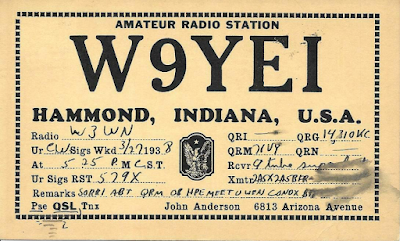
Tracking down Johnny Anderson’s 1939 or 1940 homebrew TV receiver.

https://soldersmoke.blogspot.com/search?q=Anderson
Working with Joh DL6ID.
Jean Shepherd’s January 1973 description.
FlickLives web site and Steve Glazer W2SG have lots of info on Shep and his friends.
Internet allows us to look at TV articles that were being published.
We’ve concluded: Probably 1939 or 1940, using an RCA 913 1 inch CRT tube.

Lots of ideas from IRE Journal, QST, and Gernsback magazines.
Quite an achievement! Amazing how much pre-war TV progress there was.

17-12 rig
All boxed up and working DX!
Figured out how to display both 17 and 12 on the same LED. https://www.youtube.com/watch?v=kAmmFZyFu8w
Drain protector for speaker cover. Copper tape to cover horrible cabinet making.
I think I need a Hex Beam.

Hammarlund HQ-100
Needed some maintenance.
I started to look more closely at it.
Got the Q-Multiplier to work — it really adds a lot on CW.
Makes me feel guilty about all the QF-1s…
Using the 100kc calibrator with a 455 kc crystal as a BFO,
keeping Q multiplier below oscillation point.
Moved the BFO switch to the front panel. Helps a lot.
Need to fix the S-meter AVC circuitry.
Much more sturdy than the S-38E.
S-38E 1957-61 $54.95 5 tubes. AC/DC.
HQ-100 1956-60 $169 10 or 11 tubes. Power supply, regulator.
You get what you pay for.

Pete’s Bench

Jack Purdum and Al Peter’s new SDR rig and book (featured on the SS blog Amazon ad).
JF3HZB’s beautiful digi VFO.
Backpack antenna for Field Day?
Pipsqueak Disaster — Too simple?
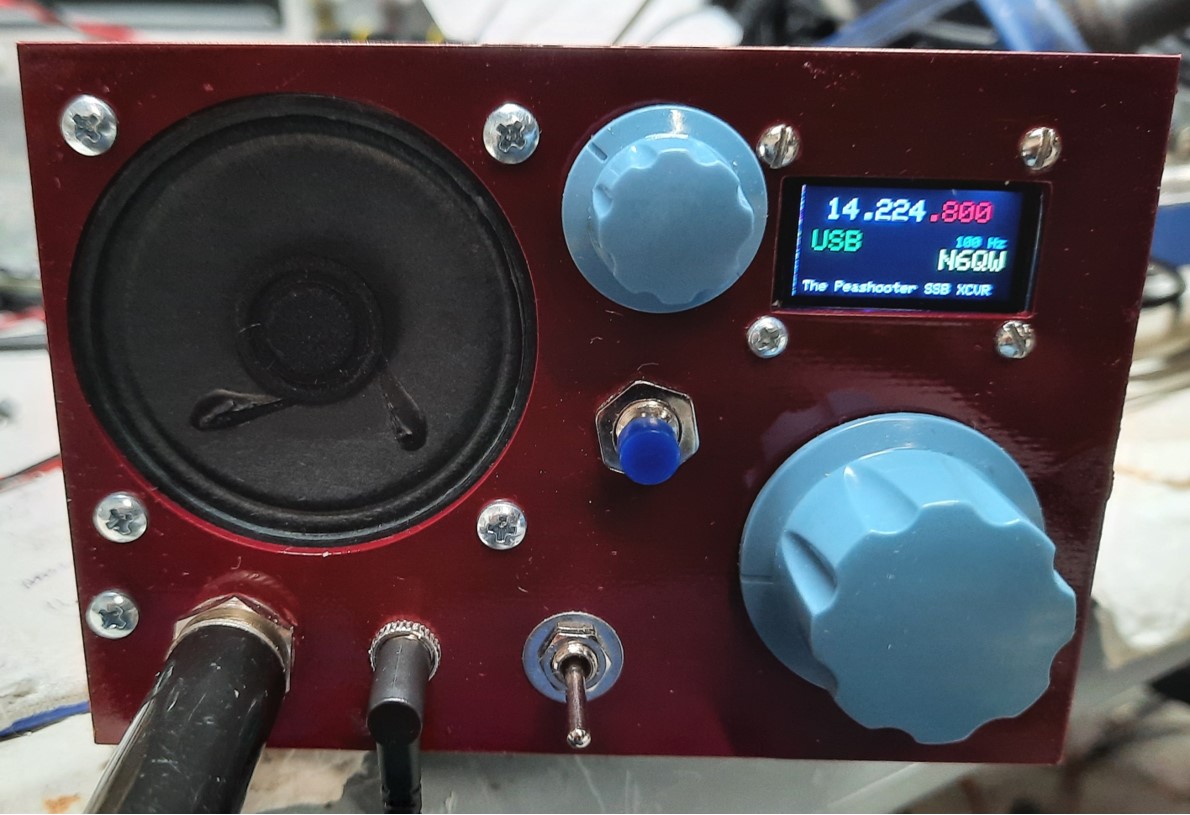
Peashooter Eye Candy.
Build Something Different.

MAILBAG

James W0JKG CBLA — Others are building MMM too!
SM4WWG // Jörgen Wonderful message. Joined GQRP. No longer “wrong.”
Dennis WC8C Libraries for Max2870 board.
Jack NG2E Progress on the Right to Repair movement.
Jim K9JM Someone cutting into our business with Solder candles!
Chuck WB9KZY Correctly identified the location of the IBEW sticker. As did Dan Random.
Dave Bamford (who lives nearby) suitably impressed.
Farhan wrote to us about a video on Don Lancaster. Homebrew keyboards! Yea!
Dean KK4DAS QRP to the Field. HB2HB 40 SSB QRP I feel virtuous.
Todd K7TFC likes my ingenious use of the drain screen as the speaker protector on the 17-12 rig.
Todd had good thoughts on granular approach to homebrewing as seen in the Don Lancaster video.
Lex PH2LB HORRIFIED by my reverse polarity protection circuit. This is a touchy subject! (as is WD-40!)
Rogier PA1ZZ sending great info on SWL and numbers stations.
Jesse N5JHH — The guy who made the IBEW stickers — Liked the NYC stickers.
Steve N8NM has a new antenna article on his blog: https://n8nmsteve.blogspot.com/
Randy AB9GO Agrees — Can’t GIVE old ‘scopes away.
Dino SV1IRG Liked the 17-12 rig videos.
Steve Hartley G0FUW Murphy’s Law of Enclosures.
Ralph AB1OP FB on the 17-12 Rig.
Roberto XE1GXG –Our correspondent in Guadalajara. Petulant, irritable people on the computer scene.

Have some gear looking for a good home: Tek 465 ‘scope from Jim AL7R W8NSA. SBE Transceivers. Windsor Signal Generator. Let me know if you are interested and can either pick up or arrange shipping.


John Anderson W9YEI Homebrew Hero

Dennis WC8C’s FB Homebrew 6 Meter Rig — Any Ideas or Suggestions?

Dennis WC8C is the event coordinator for the radio club in Michigan that I recently spoke with. He mentioned to me that he was working on a homebrew 6 meter rig. FB Dennis. I see lots of tribal wisdom in your approach, especially in your decision to do this in a stage-by-stage modular form.
Dennis’s rig is obviously a work in progress, so if anyone out there has any helpful hints (especially on the carrier suppression and on the testing for spurs and splatter) please share them with him via e-mail or blog post.

The files on Dennis’s rig are on GITHUB: https://github.com/soligen2010/6_Meter_Transceiver

Thanks Dennis!
—————-

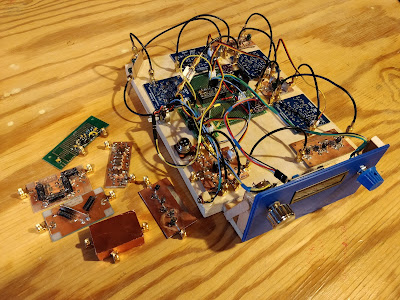
This is my 6 Meter homebrew transceiver, currently work in progress. It is a single conversion super –heterodyne design. I constructed each stage independently with SMA connectors. This is so I can re-make sections as needed, and will allow me in the future to swap sections to experiment with alternate designs. The VFO and BFO are controlled using a SI5351 with an Arduino micro controller. I currently have separate SI5351 modules for VFO and BFO because I suspected issues with cross-talk. These issues may not actually be real, so once I am happy with the performance, I will test again with just one module to see if it is OK. The Power Amp is still on the to-do list, so output is well under 0 DBm

The Blue boards were designed by me and ordered on-line. The other boards I etched myself. Construction is mostly surface mount because I find it easier than drilling all the holes. SMD components are mostly 805 and 1206 size. Transistors are SOT23.

The Band Pass filter is a 5 coil design made with air-core inductors.

3 bi-directional termination insensitive (TIA) amps are used (blue boards). Total RX gain is about 44db. Total TX gain is about 16db. Each board has its own independent RX/TX switching circuitry (mosfet based) and is fed with +12.5, GND, and RX/TX logic signal from the Arduino (3V logic and up will work)

The Mixer and modulator are both Diode Ring mixers.

The 12 MHz SSB filter is a crystal ladder filter similar to the one used in the uBitx.

The Mic and audio pre-amp (also a blue board) is made on a modified TIA amp board. I had 10 of these boards made, and the needed circuitry was largely the same, so I modified the board with a rotary tool and jumpers.

The Audio amp is a PAM8403 module and drives a headset. I did make some modifications to the module so it runs in-spec and to eliminate the power on audio pop.

The challenges I have been having are mostly related to spurs, splatter, carrier suppression and TX audio quality. I have been gradually tweaking these things to improve operation before I start on a power amp. My IF is 12 MHZ, and I was using the LSB side of the crystal filter because it is sharper (VFO 62 – 66 MHz) but have recently changed over to the USB side of the filter (VFO 38 – 42 MHz). This eliminated the spurs I was seeing near the pass band. I still need to make some adjustments to the crystal filter as it is too broad.

I still have some splatter and audio quality seems low, but I am starting to doubt my test setup. I see the splatter on the RTL SDR, but I don’t see it on the Tiny SA. The spatter happens at ~160 KHz intervals. I am hoping to find someone local with a better spectrum analyzer to help me verify if it is the rig or my SDR dongle/test setup.

The modules to the side of the picture are my rejects/experiments. The one covered in copper shows how I eventually will shield all the modules. I 3D printed a cover for the board, when wrapped it with copper tape, soldered to the bottom ground plane. The one shown is a diode ring modulator. For some unknown reason the carrier suppression is rather poor. I had previously made a junk-box modulator that had much better carrier suppression. I don’t know why it is better than the one I more carefully made for the radio, but until I figure it out, I am using the junk box version. The junk box modulator uses unmatched schottkey diodes, whereas the “final” one uses a 4 diode SMD package because I wanted them matched – I thought this would be better, but maybe not.

Pete’s Eclectic Approach to the Pea Shooter, San Jian counters on Analog VFOs, Non-Restaurant Menus

I liked Pete’s comments on the various (analog, digital, mixed) approaches to homebrew:

http://n6qw.blogspot.com/2022/02/2022-return-to-peashooter-build.html

http://n6qw.blogspot.com/2022/02/2022-peashooter-20m-compact-ssb.html

I too have San Jian digital counters watching the stability of analog VFOs (DX-100, HQ-100, Mythbuster).

Variety is the spice of life!

I also liked Pete’s comment about the fellow who does on-the-air menu counseling for FTDX-3000 owners. I sometimes run into guys on the air who want to do something similar with my simple homebrew rigs. They start by making comments about my audio — they will usually say it is “too high” or something like that. Especially when I’m using the separate transmitter and receiver (which have to be “netted” imprecisely by ear), I have to explain that maybe resort to their RIT control would help. If they persist, I sometimes have to tell them that how my rig sounds depends A LOT on the placement of the carrier oscillator relative to the passband of the crystal filter (most recently, the filter from the 1963 Swan 240). Most of them have never had to do that kind of adjustment, so the “technical discussion” usually ends at that point, with my interlocutor saying 73, and presumably moving on to someone whose rig has menus to fiddle with. (Recently heard audio techno term: “massaging the codec.”)

To each his own!

Looking at the Galaxy’s Spiral Arms with a Dongle, a Raspberry Pi,and a Homebrew Antenna

I told Farhan that the world NEEDS a homebrew Raspberry Pi observatory at Lamakaan in Hyderabad. They are on it.

This looks very do-able. And fun. And UHF. And SDR. And Raspberry Pi.
I’d like to build one too. I was encouraged by the video demo — it was done in Alexandria, Virginia, very close to where I live.
A while back I was lamenting to Dean that I reluctantly threw away a DISH or DIRECT TV satellite TV antenna. I worried that I had discarded something that would have been useful for radio astronomy. Turns out I didn’t need it. This video and the associated .pdf shows how to look at the galaxy with a simple homebrew (Home Depot!) horn.
Thanks to Thomas K4SWL of the SWLing Post for alerting us to this.

Hack-a-Day: Has DIY become Click-and-Buy?

https://hackaday.com/2021/12/11/has-diy-become-click-and-buy/


Hack-A-Day today asks about the boundaries between DIY construction and the use of purchased, completed electronic components. This is closely related to our long-standing discussion of what really constitutes “homebrew.”


Is it really homebrew if you buy a bunch of already-stuffed PC boards and connect them together?

Is it really a homebrew receiver if 90% of the components are inside one chip?

Is it really homebrew if most of the signal processing is done in your computer (that you definitely did not build)?

The comments below the article are interesting. There we see some of the same arguments used by ham radio operators who are more inclined toward click-and-buy. They argue that since none of us are making our own resistors and transistors, we are ALL therefore click-and-buy people, so we should just get over it and pull out the credit cards. Some commenters carry this to extremes and ask if the real homebrewers are out there mining the copper for their wires.

The debate seems to spill over into the software area: One person asks if it is really DIY if you are using software libraries that contain code written by someone else. Or to be truly DIY should you write all of your own code in assembly language?

There is one very insightful comment about hams who are inclined to disparage the homebrewing that they did in their youth. We often hear this: “Oh, I used to build my own gear, but now-a-days I just buy commercial transceivers — they are so much better.” As if homebrewing was a folly of youth, something that they grew out of (and up from) as they became able to afford the latest ham radio appliances. As if homebreweing were a regrettable thing that was done only out of necessity. This is, I think, sad.

I think I’m a lot closer to the traditional concept of DIY than I am to click-and-buy. I still prefer LC oscillators to Si5351/Arduino combos. I prefer traditional filter rigs to SDR rigs. And I prefer to make my own crystal filters. I don’t like to use ICs unless I really understand what is going on inside them (so I can be comfortable with an NE602 or an LM386, but I’m not comfortable with a CPU chip that may have millions of transistors in it). But I am not homebrewing my own transistors nor am I mining copper.

What do you folks think about this?

Farhan’s Amazing Knack Story: From a Boyhood SW Receiver to the Design of the sBITX SDR

The presentation starts at about the 4 minute point.

I think if I were only allowed to watch one YouTube video in the next year, I’d make it this one.

In this amazing RSGB video, Ashhar Farhan VU2ESE takes us back to his earliest days as a radio amateur. He tells us about his very early desire to build radios, his early projects, and his personal evolution as a designer and builder, from a simple DC receiver, to the BITX, the Minima, the uBITX and now the hybrid HDR/SDR sBITX.

There is a lot of homebrew wisdom and tribal knowledge in this video. And we learn so many hitherto unknown details about the rigs that have become so important to us:

— Farhan had the EMRFD book with him on the famous flight from Sweden to India during which the BITX was designed.

— We learn about the origins of the BITX oscillator circuits, and that the VFO and BFO are essentially the same.

— I was really pleased that Farhan included a picture of my HB BITX17 rig in his presentation.

— Farhan discusses the difficulties he faced in obtaining needed parts in India.

— We actually see the nylon washers that Farhan used in the original BITX.

— Farhan discusses his early system for measuring coil inductance.

— In addition the huge contribution of EMRFD, Farhan talks about how he was helped by Pat Hawker G3VA’s writing, and the ARRL’s SSB Handbook.

— Farhkan talks about his Tex 465 ‘scope and his building of a Spectrum Analyzer.

— We see his evolution to dual conversion. We see the conceptual birth of the Minima and the birth (thanks Wes!) of the TIA amps. I didn’t know about the HF-1. Then Farhan designed the uBITX and now the sBITX.

— Farhan talks about his practice of taking the pictures of new rigs with the new rig sitting atop the book that was most important in its design and construction. FB.

— I was really blown away by Farhan’s presentation of how the uBITX advertisement was inspired by and in many ways based on the Heathkit ad for an HW-101. Amazing.

— I learned a lot from Farhan’s discussion of SDR theory. I pledge to spend more time with this. I really like Farhan’s hybrid HDR/SDR approach.

— But I have a question: Farhan seems to say that we’d need a big expensive GOOGL computer to do the direct sampling HF SDR. But doesn’t the little RTL-SDR do just that? Without a GOOGL?

— Great to see Wes’s AFTIA being used in the sBITX.

— Really cool that Farhan has his mind on VHF transverters when designing the sBITX. I liked use of the TCXO module to free up one of the Si5351 clock outputs. FB. And great to include an idea from Hans in this rig.

Thanks very much to Farhan (who stayed up until 3 am to do this!) and to the RSGB for hosting.

Mythbuster Video #15 The Mythbuster Signal As Seen in the NA5B WebSDR

Mehmet NA5B has an excellent WedSDR receiver in Washington D.C., about 9 miles east of me. I often use it to check my signal quality. I think this video shows that the 10 pole crystal filter is working and is producing a signal with very sharp drop-off outside the 2.7 kHz passband. You should focus your attention to the passband (yellow vertical lines) near 3895 kHz. That’s me.

Once, when I was describing my 40 meter DIGI-TIA to an SDR guy, he seemed surprised that I was using a — gasp — crystal filter. “Your skirts must be atrocious!” he said. My HDR sensibilities were deeply offended.

I had hoped that the 10 pole crystal filter would produce skirts so nearly vertical as to make my signal indistinguishable (in the waterfalls) from the SDR signals. At least at this low signal level, it appears to be working.

Video: Rob Sherwood NC0B on Transceiver (and Especially Transmitter) Performance

Rob Sherwood NC0B is one of the real authorities on receiver performance. Many of us have relied on his ratings of commercial receivers for many years. His recent presentation to the Madison DX Club has a lot of really interesting information. There is also, I think, some stuff that homebrewers will find distressing.

Just some things that I noticed:

— Rob mentioned a move back to 9 MHz IF filters and a move away from dual-conversion rigs with a high IF. He also mentioned the combination of a 9 MHz IF and a 5 MHz VFO as a way of easily getting on both 75 and 20 meters.

— Rob discussed phase noise from synthesizers, a topic we discussed at length (some would say ad nauseum!) a year or so ago.

— Rob really praised the “Pure Signal” system of one of the SDR manufacturers. He showed the completely rectangular waterfall display of a Pure Signal transmitter. I’m afraid that simple crystal rigs might never live up to this standard. An embrace of this high standard could discourage the construction of simpler, HDR rigs. We should not let the perfect be the enemy of the good!

— We often hear SSB ops complaining that some other SSB op is “splattering all over the band.” It often turns out that what is really happening is that a clean SSB signal is just overloading the receiver of an operator who does not know how to turn off his pre-amp or turn on an attenuator. Rob shows us how to really know if the problem is in fact at the other end: He looks at key clicks from two different CW signals on 160 meters. Both are at roughly the same level in his receiver But one is clicking all over the place while the other is not. With this kind of comparative info, we can be sure that the problem is the transmitting station’s fault.

— In discussing when to turn on the pre-amp (or the attenuator) Rob revives the old practice of just listening to the band noise. If you can hear the band noise when you switch from dummy load to receive antenna, you have enough RF gain. Adding more will only make things worse.

— There was an interesting question about how to evaluate the performance of receivers when there are many signals inside the receiver’s passband. This is the case with FT-8. Rob said this situation needs more research.

I don’t mean to be critical here — Rob is the guy who evaluated commercial rigs. And he is a contester. So his presentation is, of necessity, going to have a very “appliance operator” orientation. There seems to be an assumption that the only “rigs” that modern hams can use are commercial products. At one point Rob admits that most hams just can’t repair these rigs. There is much for homebrewers to learn from experts like Rob, but presentations like this also remind us of what a tiny minority we really are, and how most hams have moved completely away from the old ham tradition of building our own rigs.

Thanks to Rob Sherwood and the Madison DX Club. And thanks to EI7GL for alerting us to this important presentation.

Farhan’s sBITX — Combining SDR with the Traditional Superhet

Here is Farhan’s amazing presentation to the virtual 2021 FDIM event. There is a lot of tribal knowledge in this video. Lots of old and new technology. I was especially intrigued by Chris Trask’s Kiss mixer. Farhan’s discussion of simple Arduino-based speech equalization and compression made me think that I have work to do in this area. And of course, Farhan’s whole discussion of how to bring SDR into — literally into — the circuitry of a uBITX is really cool and very educational.

SolderSmoke Podcast #230 is available! Apr 1, Mars, Group Build, SDR, SSB, Mich Mighty Mites, Mailbag

SolderSmoke Podcast #230 is available for download

http://soldersmoke.com/soldersmoke230.mp3

N2CQR was down for maintenance
A few words about April 1
China lands on Mars
Brood X Cicadas arriving in NOVA

Pete’s Bench
The Dentron Project
The Spillsbury Tindall SBX-11A
KK4DAS and the Simple SSB Group Build
TenTec mods
Shack Mystery solved. Maybe
Changing the channels at age 9

Bill’s Bench
Why LSB below 10 MHz? The “SSB Legend” Rig
WU2D RTL-Dongle Up converter
Understanding the Gilbert (Jones) Cell
SDRSmart RTL-SDR.com V3 Dongle
VK3HN and 2 meter SSB
Jack NG2E, MMM and the 10 minute transmitter
KD4EBM sends me SST by Wayne Burdick. DX!
A new computer

Mailbag:
MM0ACN
VK2EMU
N5VZH
VE3KZJ
HS0ZLQ
AD0JJ
VK8MC
KK0S
VE3VVH
KB3SII
WA9WFA
M0NTV
W2DAB


60 Minutes Story on Mars Ingenuity Helicopter:

A Satellite Ground Station (Receiver) Made from Junk

Very cool. This guy (who brew up on an island in Alaska) really knows how to use aluminum tape and the junk that fills most workshops. I like his use of the security camera mount as an az-el antenna rotator.

I foolishly discarded a Direct TV dish. I could have been receiving GOES images by now!

Just last week I got the same RTL-SDR.com V3 dongle that he is using. Very FB. It does HF direct sampling with no hardware mods and no upconverter.

More from the builder, Gabe Emerson (KL1FI):


“Analog Man in a Digital World” by OM Joe Walsh (music video)

After seeing my last post about SDR, the dongle, the Android tablet, and the Bluetooth mouse, Bob Keller grew concerned about my, uh, stability. Here is our e-mail exchange.

Bill,

Have you had a comprehensive medical evaluation recently? All this digital activity from an erstwhile analog man is a concerning symptom.

I suggest listening to the following number at least once each day until you have the chance to get checked out:

— 73 de KY3R,
Bob Keller


Bob:

I know. It really is quite disturbing. I’ve been getting a lot of “welcome to the dark side” messages!!!

I am now trying to get back in the good graces of The Radio Gods. Today I fired up the Fish Soup 10 and made two CW SKCC contacts on 40 meters. I feel better already.

Thanks for the song from OM Walsh. I had heard it before but it is more meaningful to me now. I will put it on the blog. Others may need help too.

Thanks for caring Bob.

73

Bill