Join the discussion – SolderSmoke Discord Server:
Documentation on Hackaday:
https://hackaday.io/project/
SolderSmoke YouTube channel:
SolderSmoke Daily News — Ham Radio Blog
Serving the worldwide community of radio-electronic homebrewers. Providing blog support to the SolderSmoke podcast: http://soldersmoke.com
Join the discussion – SolderSmoke Discord Server:
Documentation on Hackaday:
https://hackaday.io/project/
SolderSmoke YouTube channel:
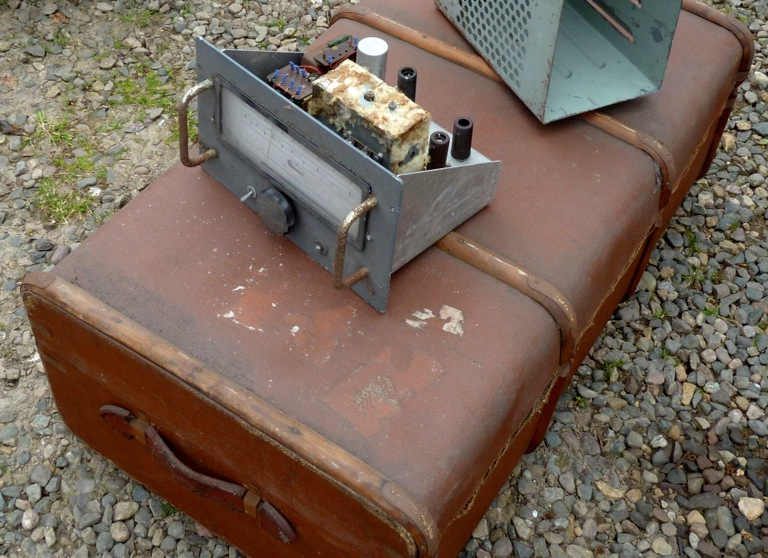
Today’s aparatus (above). Chamber is larger and I left the bottom sealed. It sits directly atop a chunk of dry ice. The spongeat the top is soaked in alcohol.
There is a LOT of soul in this new rig. Here is a partial list of contributors:
— Overall BITX design: Farhan VU2ESE
— Termination Insensitive Amplifiers (TIA): Wes Hayward W7ZOI and Bob Kopski K3NHI.
— TIA boards from Todd K7TFC
— ASK-1 Mixer from Armand WA1UQO
— VFO design parameters from Joe Carr K4IPV (SK)
— VFO stability ideas from Frank Harris K0IYE and Mike Murphy WU2D.
— HT-37 Tuning Capacitor bought from e-bay at suggestion of Pete Juliano N6QW.
— Pine board base of the rig: Frank Jones (SK) W6AJF’s preferred building technique.
— DTC Band-Pass filter circuits from Han Summers G0UPL.
— Low pass filter values from G-QRP web site.
— Idea of using RD06HHT instead of IRF-510 in the final: Pete Juliano
— Heat sink from Chris KD4PBJ
— Trifilar Toroids used in many places from Farhan VU2ESE.
Thanks to all. 73 Bill
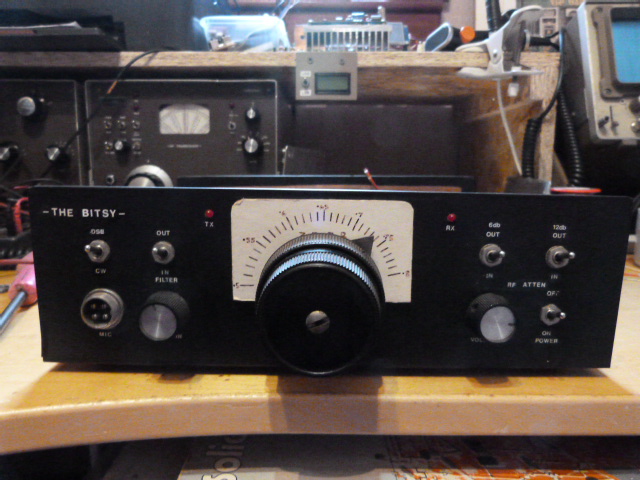
This is such a beautiful project: it involves DSB, homebrew, troubleshooting, George Dobbs, SSDRA, J310s, a box kite, and ham radio nostalgia. I was struck by how similar the Bitsy looks to some of my own DSB creations (but the Bitsy is nicer). I’m really pleased to find a DSB project coming out of the UK — when I was there, DSB was kind of frowned upon by spectrum preservation zealots. I say there is plenty of room for the very few homebrew DSB rigs that will ever grace the airwaves with their presence. Thanks John. Have fun with all your projects. 73 Bill
Hi Bill
In the early 80’s I built and experimented with Direct Conversion Receivers and had a lot of fun with them. I came across a 40M DC cw transceiver by the late Rev. George Dobbs in a Practical Wireless magazine and decided to build it. Whether I was just lucky I’m not sure but it worked first time and I had several cw contacts with it. It was called “The PW Severn”. I then discovered DSB and looked into modifying the wee rig. I gave George a phone, no internet in those days, and explained what I was proposing to do and if there was any advice he could offer. His reply was , “it should work so try it and see, any problems get back to me”. It worked and I had a lot of fun with it. I used to take it portable and with a box kite to support a long wire and worked all over Europe.
It was after reading and learning about circuits and home brewing I wondered if I could design and build a DSB transceiver of my own. I had plenty of articles and most importantly a copy of Solid State Design, now well thumbed.
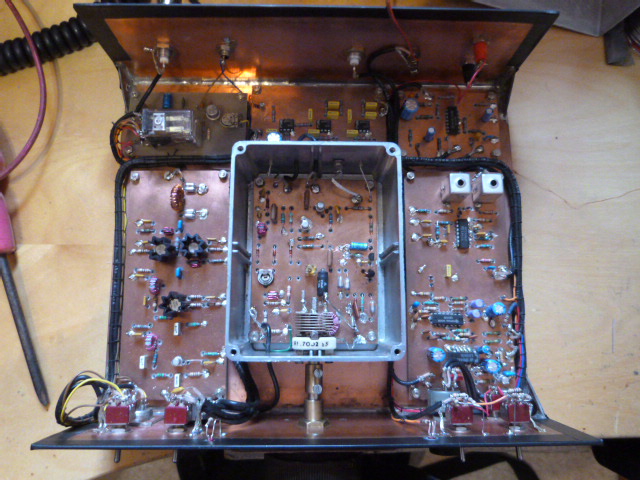
So the “Bitsy” was born. It is an 80M DSB transceiver. The PA produces about 2 watts. I took what I thought was the best for each module and built it using six circuit boards which I designed and etched myself. Nowadays I use the Manhattan method for one of circuits. It is much easier and quicker.
Like most home brew projects, the fun is in the building and the wee rig lived in a box for several years. Probably over 30. My doesn’t time fly. I came across it again while looking through my boxes and decided to give it an airing. Expecting it to work on power up I was quite shocked when it produced nothing on both receive and transmit. After staring at it for a couple of minutes I unscrewed the lid and studied the wiring for a dry joint. Nothing so I switched on my Digital Multimeter and Oscilloscope. I soon found out that the output from the VFO was missing. The VFO uses one FET and two PNP Transistors for the buffers. The scope soon proved that the FET was faulty. I used an MPF102. These are hard to get so I replaced it with a J310. While I had the VFO out I also replaced the 9.1v zener diode, which provides a regulated voltage for the FET, with a 78L05 connecting the centre pin via a 580ohm resistor to earth. This gives me a 9.3v regulated supply for the oscillator. It is now back in full working condition.
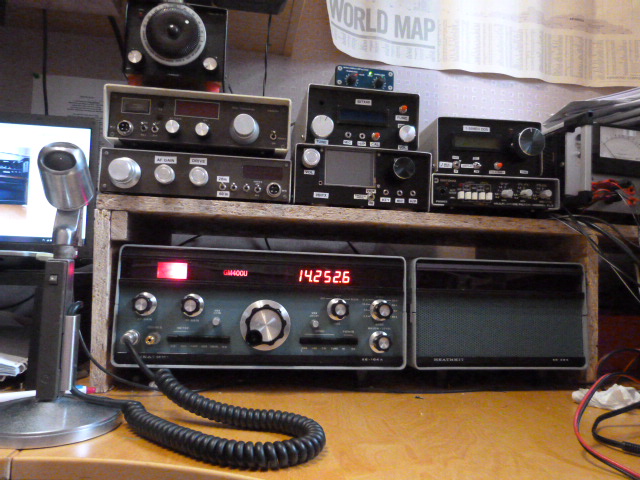
With the Covid 19 epidemic I, like a lot of the Amateur Radio fraternity, am spending a lot of time in the shack and looking for new projects. I am buying back my old FT200 which was my first rig. An old friend and lapsed amateur has still got it and agreed to sell it back to me. It is still in a good condition for being nearly 50 years old and just needs some TLC. When it is finished it will take pride of place beside my restored Heathkit SB104A. And they say nostalgia is not what it used to be!!
John Forsyth
GM4OOU
![]() |
|
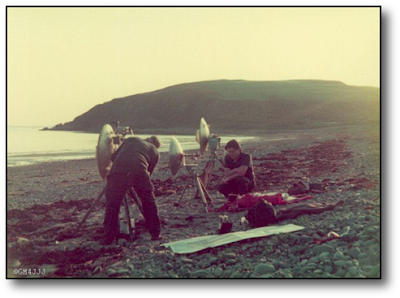
Sunset at Luce Bay Scotland, 3cm GM3DXJ, GM3OXX and GM8HEY dishes being set up. Photo GM8HEY (GM4JJJ). 322 km QSO to Wales. 10mW GUNNS WBFM.
|
On the G-QRP list guys have been talking about the Peregrino. This is a nice little homebrew rig out of Spain. Peregrino = Pilgrim and usually refers to people who are hiking along the Trail of Santiago that runs through the North of Spain to Santiago de Compostela.
I’m normally averse to chips, but this little rig uses two very understandable NE602s and an equally understandable LM386. It has a homebrew crystal filter. I like it.
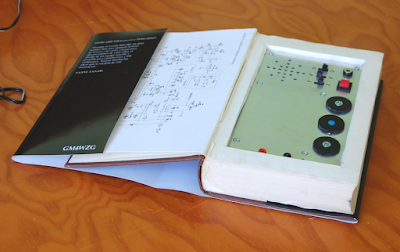
GM4WZG came up with a really wonderful enclosure for his rig. This reminded me of the time I put a QRSS transmitter inside a copy of “The DaVinci Code.”
The Spanish guys have a nice site that describes the rig. Google Translate should help, but even without it you can get most of the info you need from the schematic, chart, and foto gallery. Check it out: http://ea3ghs.qrp.cat/peregrino.html
Enhorabuena!
Bill,
Just listened to the latest SolderSmoke podcast where you asked why is it that an RF amplifier may be required on the higher bands but not on 40m and 80m for example.
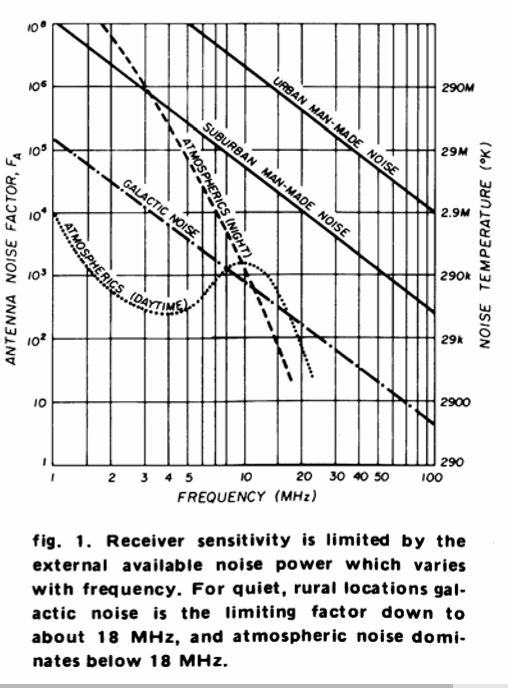
At high frequencies the atmospheric and ionospheric noise levels are lower, so if noise figure of the receiver is reduced it will improve the signal to noise ratio you get from the receiver. Adding gain -after- the mixer will not improve the noise figure of the receiver as it will be limited by the noise figure of the mixer. You need an RF amplifier which will itself have a lower noise figure than a mixer (certainly a passive mixer), to lower the total noise figure of the receiver to take advantage of the lower effective antenna noise temperature at higher frequencies.
This becomes very important at VHF and above, where antenna noise levels are much lower than at HF.
So, it isn’t so much the overall gain of the receiver that is important with weak signal work, but the overall receiver noise figure which is determined to the largest degree by the first stage of the receiver.
There are spreadsheets available that will easily calculate the noise figure of cascaded receiver stages knowing the individual stage gains and noise figures.
One also has to be careful with the gain distribution throughout a receiver, if you have too much gain early on in an effort to improve the noise figure overall, you may overload the subsequent stages producing IMD with multiple strong signals. So there is a compromise to be met between noise figure and strong signal performance.
Going back to VHF and above if you have an antenna fed by coax with some appreciable loss then improving the receiver RF stage noise figure is not the best way to go because you are amplifying the signal after the loss the of the coax. What you need to do in those circumstances is to use a low noise masthead RF preamplifier which will give you gain and establish the noise figure of the receiver before the loss of the coax. Again there are spreadsheets to help with these calculations.
At VHF where an antenna is pointed at the horizon, the antenna sees the noise from the ground on the noise from the sky. As we elevate an antenna for EME or satellite working, then the effect of the ground noise should reduce (there will always be some due to side lobes) and then the receiver can benefit from even lower noise figure as the effective antenna noise temperature is now mostly determined by sky noise which at UHF is much lower than ground noise.
These last two days I have been able to see and hear the sun noise on my 2m receiver as the sun set on my single 10 element yagi pointed at the horizon. Using WSJT’s noise level scale I could see it measure 12dB noise level and then once the sun set it dropped back to about 3dB noise indicated, most of that being local QRN from an antenna sidelobe from my neighbour’s house and his electronic devices which put out quite a bit of wideband noise on the band. (about 8dB above the lowest background level I can normally detect).
To summarise, at LF where noise is high you don’t gain anything by having a low noise figure receiver, and you actually lose out if you have too much gain early on as it will degrade strong signal handling.
At HF as manmade, atmospheric and galactic noise levels are lower, you can benefit from lower receiver noise figure and the way to lower your noise figure is to use lower noise amplifiers in the early stages of the receiver. Adding gain in later stages does not reduce the noise figure overall as the noise figure is largely determined by the first stage or stages.
At VHF using even lower noise figure devices in the RF stage will improve signal to noise.
Here is a practical test you can carry out. Switch between a dummy load and your antenna. If the background noise level increases when you switch to the antenna, then your receiver is sensitive enough, lower noise figure in the receiver isn’t going to help. If it doesn’t increase then you have scope for improving the sensitivity of the receiver by reducing the noise figure of the receiver as you are no longer limited by antenna noise.
Incidentally it is good to have a preamplifier that can be switched in an out of circuit so that you can reduce the noise figure when conditions allow ( low noise atmospheric noise levels for example), but switch it out if noise levels are high and signals are strong so that receiver overload and IMD don’t occur. You can do something similar with an input attenuator to reduce strong signals where necessary.
I don’t have a link here to the graph of manmade, atmospheric and cosmic noise levels versus frequency, but once you see one it becomes obvious why low noise figure receivers are not required at LF and MF generally.
73 from David GM4JJJ
I don’t have a link here to the graph of manmade, atmospheric and cosmic noise levels versus frequency, but once you see one it becomes obvious why low noise figure receivers are not required at LF and MF generally.
73 from David GM4JJJ


I thought you/others might be interested in how I got into radio/electronics and how I feel I may have the ‘Knack’.
The above reference reminded me of some experiments I carried out in 1967 as a schoolboy. There were no ready sources of parts locally for me.. I lived in a rural area so the nearest electronics parts shop was 50 miles away so it was all done by letter and mail order.
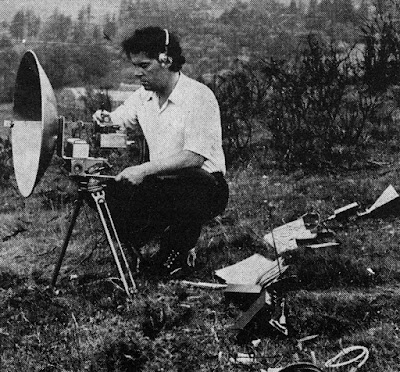
My first audio link was driven by a tube broadcast receiver with a 3 volt torch bulb connected instead of the loudspeaker. (I hadn’t heard of impedance matching!) This flickered nicely on speech/music peaks. The bulb was positioned at the focal point of a parabolic car headlamp reflector from a scrap car. I now had a beam of light with audio on it.
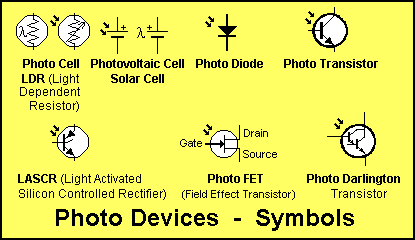
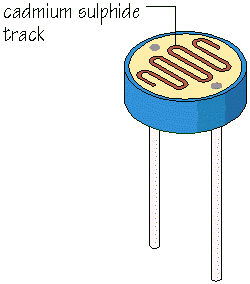
Next step was the receive side…I didnt have access to a photo cell but had a Cadmium Sulphide photo resistor. Connecting a pair of low impedance headphone in series with this cell and a 1.5 volt battery gave me recognisable audio when the cell was in the beam…no amplifier needed!
Next step was greater range…this was achieved with a 6 inch shaving mirror to focus the beam onto the photo resistor. This gave me the length of the street (100 yards when it was dark outside )with the flickering beam shone out of my schoolboy bedroom window resulting in puzzled looks from passers by.
Next problem was the frequency response.. all bass and no treble. Some research indicated that the photo resistor had a slow response so that was part of the problem but I had a hunch… How fast does a filament bulb react to audio? Biasing the bulb with a 1.5 volt cell so that it glowed dimly with no audio improved the audio response greatly.
So what got me into radio…my father was a Chief Radio Officer in the Merchant Navy during WWII and my schoolboy bedtime reading (the only technical stuff I could find ) was his textbook …the 1939 edition of the Admiralty Handbook of Wireless Telegraphy. Capacitors were called condensers and they were measured in ‘jars’!
That was the start of a career. I’ve now moved through testing international telephone exchanges, installing 2 way radio for the whole of Scotland for British Rail (paid for my hobby!) and finally 32 years in IBM writing manufacturing test software from the original IBM PC to Thinkpads.
Now retired I am active on WSPR and am writing Android apps to keep my brain in gear.
I just can’t leave this stuff alone!
Hope this of interest/amusement.
73s
Neil Roberson GM8EUG

David GM4JJJ was the fellow who sent us the video of early Scottish moonbounce ops. This morning he sent me a tale of woe involving some transverters and several BASTA! moments. I will spare you all the painful details, but I really liked this paragraph about David’s use of sigs from a French space surveillance radar:
… While the transverter for 144 MHz was being tested out into my new homebuilt antenna I tried receiving the French space surveillance GRAVES RADAR on 143.050 MHz. It is easily detected here in Scotland via meteor scatter. It is also so strong that passing space hardware like the ISS reflect the RADAR and can also be detected, showing up on FFT displays with their rapid Doppler shift. GRAVES is also easily detected by moonbounce, I could see it and hear it on my single 10 element yagi pointed at the horizon without a preamp. Even when the moon was at 15 degrees elevation here, and even higher in France the signal was strong enough to be picked up in one of the lobes of my antenna. You can actually see what the vertical pattern of the antenna looks like as the moon rises through the peaks and nulls of the antenna in conjunction with the constructive and destructive interference patterns caused by ground reflections and the direct path to the moon.
Our book: “SolderSmoke — Global Adventures in Wireless Electronics” http://soldersmoke.com/book.htm Our coffee mugs, T-Shirts, bumper stickers: http://www.cafepress.com/SolderSmoke Our Book Store: http://astore.amazon.com/contracross-20
Somehow this seems appropriate for Pi Day (3-14). I guess it is because the antenna is circular.
Thanks to David GM4JJJ for sending this to us. There is no audio. Kind of fun to watch the lads struggle with the big antenna while wearing coats and ties!
David writes:
Bill, I really enjoy SolderSmoke podcasts etc, I am returning to ham radio after about a decade, got the bug again….
Our book: “SolderSmoke — Global Adventures in Wireless Electronics” http://soldersmoke.com/book.htm Our coffee mugs, T-Shirts, bumper stickers: http://www.cafepress.com/SolderSmoke Our Book Store: http://astore.amazon.com/contracross-20
A nasty Coronal Mass Ejection hit our magnetic field at around 0600 UTC today. The HF bands are now in poor shape. What better time to visit a really impressive workshop in Scotland?
Ian has an interesting site: http://www.ianjohnston.com/
Our book: “SolderSmoke — Global Adventures in Wireless Electronics” http://soldersmoke.com/book.htm Our coffee mugs, T-Shirts, bumper stickers: http://www.cafepress.com/SolderSmoke Our Book Store: http://astore.amazon.com/contracross-20