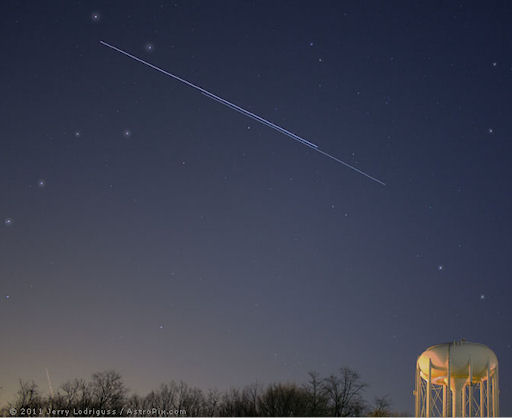
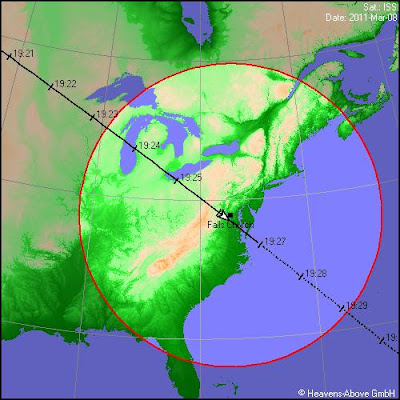
 The two spacecraft are un-docked but orbiting close together. There is a good visible pass over Canada and the U.S. this evening (see above — all times EST). Go to http://spaceweather.com/flybys/ to get the times for your location. Hurry, I think the Shuttle comes home tomorrow.
Category: satellites
SolderSmoke Podcast #131
 SolderSmoke Podcast #131
http://www.soldersmoke.com/soldersmoke131.mp3
28 February 2011
–Winterfest!
–UK nostalgia: “King’s Speech” saves British Regen
–Dark Cloud, Silver Lining: ice storm gets us back on the air
–40 meter phone (AM and SSB)
–K2ZA interview: John Zaruba’s DX-100
–OUR NEW SPONSOR: SIERRA RADIO SYSTEMS
–SolderSmoke audio woes: interference! Lollipop ditched.
–Buzz Aldrin’s lunar seismograph
–Watching the space station fly over Virginia
–Twain, Tesla, Edison and Halley’s Comet
–Capuccio on Drugs
–MAILBAG
Watching the International Space Station Fly Over
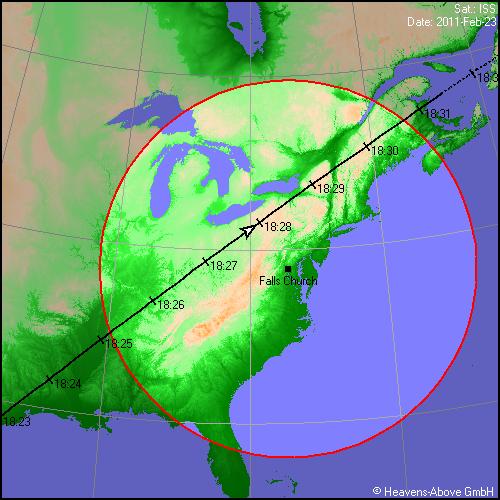 Thanks to a tip from spaceweather.com, Billy, Maria and I were in position to watch the International Space Station fly over the Washington area on the evening of 23 February. The map above (from heavensabove.com) shows the pass we saw. All times are local. Maria spotted it first. She seems to have a talent for this — she last spotted the ISS six years ago (at age 4!) from the streets of Central London.
This was a very nice pass to watch. We were in twilight. We first saw the spacecraft as it flew past Jupiter’s position in the sky. It was red at first, then turned bright white.
This time we felt a special connection to the ISS because the twin brother of Astronaut Mark Kelly is currently on board. We all met Mark (and his wife Gabrielle) when they came to London. Mark will be heading up to ISS himself in April. Godspeed to Mark and to his brother. And we’re all hoping for the best for Gabrielle. They are very nice people.
Space Station and Nano-Sail D Visible This Week (From North America)
 The folks at spaceweather.com report that the International Space Station AND the Nano-Sail D satellite will be visible from North America this week. They provide a very handy on-line tool that lets you know when and where to look:
http://spaceweather.com/flybys/?PHPSESSID=iem8ec1ep115mnga8hjhh5p8p0
Here is an amazing image taken by an amateur astronomer in Florida: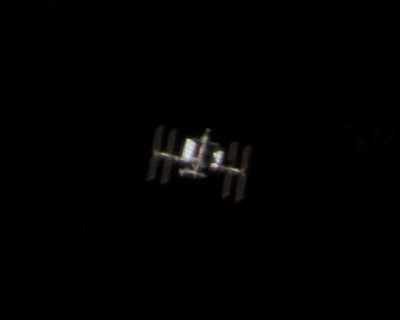
ARISSat-1 to Deploy Next Week
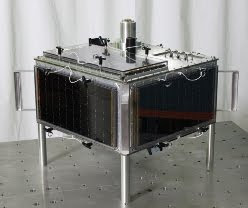 This project has me digging through the boxes, looking for my 2 meter gear. This looks like fun! From AMSAT:
ARISSat-1 is a microsat developed as a follow-on to the SuitSat-1 project. The satellite was launched to the ISS on January 28th, 2011, with deployment during an EVA (spacewalk) on February 16, 2011.
The satellite will downlink live SSTV images from four onboard cameras, live telemetry and messages on the CW, FM voice, and BPSK downlinks, as well as provide a 16kHz wide transponder for two-way contacts. All the uplinks and downlinks are based on software defined radio systems.
Telemetry will include spacecraft subsystem information, as well as data from the Kursk State University experiment. This experiment will sample the change in vacuum as the satellite slowly re-enters the atmosphere.
|
||||||||||||||||||||||||||||||||||||||||
|
|
||||||||||||||||||||||||||||||||||||||||
And for those of you looking for a bit of competition, there is a tech challenge:
AMSAT-UK has announced a ARISSat-1 reception challenge with a FUN reward. The different categories cover those with or without a FUNcube SDR dongle.
ARISSat-1 is scheduled for deployment from the ISS next Wednesday Feb 16 – it has a composite VHF downlink that will easily fit into the FUNcube Dongle receive spectrum.
The telemetry is 1 kbit BPSK and can, of course, also be received with a normal SSB 2-metre receiver.
The expected signal levels from ARISSat should be similar to those we expect from FUNcube itself (and also eventually from UKube) and the team are keen to discover what will be the minimum and best type of antennas for schools to use with a FCD. Therefore user experience with the ARISSat signals will be very valuable in making this determination.
To encourage everyone to receive ARISSat signals we are offering a FUN reward for listeners!
There are a number of categories for this challenge – they include:
1+ The first FCD user, from each continent, who can post a spectrum recording of the received signal together with evidence of decoding the data using the ARISSat software and of sending it to the ARISSat data warehouse .
2+ The first non-FCD user, from each continent, who can provide evidence of having decoded the signals and of sending it to the ARISSat data warehouse.
3+ The listener, using a FCD or not, who can demonstrate satisfactory reception of the telemetry in the same ways as described above, using the “smallest” possible receive antenna. The actual closing date for this part of the challenge will be announced later.
4+ All other entrants who can demonstrate that they have been having FUN!
Please submit your “entries”, including your location, station details (including FCD serial number where applicable), postal address and reports to g0auk@amsat.org
Good luck,
ARISSAT-1
http://www.arissat1.org/
You can join the FUNcube Yahoo Group at
http://groups.yahoo.com/group/FUNcube/
Twitter: http://www.twitter.com/FUNcubeUK
Facebook: http://www.facebook.com/ just lookup FUNcube
FUNcube SDR Dongle
http://www.FUNcubeDongle.com/
From The Guys Who Found the Nano-Sail Satellite Signal
 Howdy Bill, and all the SolderSmokers listening in on the PodCast.
We appreciate the shoutout in #130 about the NanoSail-D excitement .!. Stan – N4PMF and I have been working over the last year or so to re-activate the Amateur Radio Club at NASA’s Marshall Space Flight Center. We both have day jobs in the Huntsville Operations Support Center (HOSC), and routinely interface with the scientists and developers involved with projects such as the International Space Station, Space Shuttle propulsion, and more recently the FastSat program.
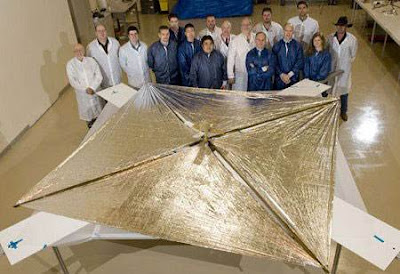
 The NanoSail project is actually a smaller satellite that was carried into orbit by the FastSat. This NanoSail vehicle is only about 18 inches long, and a few inches square. No room there for high powered S-Band telemetry transmitters, so it carried a ham licensed 1/2 watt FM transmitter in the 70cm band. Maybe later we can get into more detail about all that if you are interested.
The NanoSail is the first successful deployment of a Solar Sail into earth orbit. The quicker story is that our club (WA4NZD) was started in the early-1970s, and operated Special Events commemmorating Apollo flights to the moon, Skylab missions, and early shuttle launches. Activity kinda dropped off in the mid-1990s, and the club is only now coming back to life. We still have VHF and UHF transcievers and beam antennas on a tower, that are ready to operate – and sometimes we listen in on ISS school contacts, or bounce APRS beacons thru the ARISS digipeater.
We of course got excited back in December when FastSat launched, and the NASA scientists asked if we could help them by listening for the NanoSail when it ejected. Unfortunately, Murphy had snuck on-board, and somehow prevented the smaller satellite from completely ejecting, and it looked like a loss….
 Then in January the FastSat telemetry indicated that NanoSail-D may have ‘popped itself out’, and the Principal Investigator Dean Alhorn found Stan and asked if we could take him to the station “NOW” to listen for it. Sure enough, we had the right equipment, ready to go, and he got to hear it for the first time. We even had the AX25 TNC hooked up and it decoded a telemetry burst which allowed them to better estimate when the SolarSail should deploy. Dean was very very excited, and we all enjoyed a bit of the spotlight as Dean made obvious reference in numerous press releases to the role of the MSFC Amateur Radio Club in helping get the word out. The power of ‘crowd-sourced’ science became obvious as they received reports from all around the world. We are lucky to have been ready, willing and able to decode that early telemetry – it sure will help to validate and justify the existence of our little club station at NASA. You can easily find more on the internet, searching for NANOSAIL and WA4NZD.
Again we appreciate the publicity from your Podcast, and look forward to tuning in more often, and possibly sending you more info for your show. Thanks /;^) Alan Sieg – WB5RMG (http://wb5rmg.wordpress.com) Stan Sims – N4PMF MSFC ARC – WA4NZD (http://wa4nzd.wordpress.com)
NASA NANO-Sail Found by Hams!
All is well with the Nano-sail spacecraft, and hams apparently helped find it:
“This is tremendous news and the first time NASA has deployed a solar sail in low-Earth orbit,” said Dean Alhorn, NanoSail-D principal investigator. “To get to this point is an incredible accomplishment for our small team and I can’t thank the amateur ham operator community enough for their help in tracking NanoSail-D. Their assistance was invaluable. In particular, the Marshall Amateur Radio Club was the very first to hear the radio beacon. It was exciting!”
The Marshall Amateur Radio Club confirmed deployment of NanoSail-D late Wednesay EST with reception of the 1200bps AX.25 FM beacon on 437.275MHz +/-10kHz Doppler. News Release: 19 January 2011 Huntsville, AL USA The Marshall Amateur Radio Club (@ MSFC) – WA4NZD late Wednesday afternoon confirmed ejection of the NanoSail-D sub-satellite. This loaf-of-bread sized spacecraft was carried to orbit late last year on an Air Force rocket as part of NASA’s FastSat project. This is the first successful deployment of a satellite, launched from a satellite already in orbit .!. The only communication from the NanoSail-D vehicle is via ham radio with 1200 baud FM AX25 beacon packets. The WA4NZD team of N4PMF and WB5RMG, was listening on 437.275 MHz FM with the NanoSail-D Principal Investigator Dean Alhorn at the club station when the beacon was heard and susbequently decoded onto the screen. Please visit http://wa4nzd.wordpress.com/ for pictures and more links to the NanoSail-D project. They are asking for telemetry reception reports from all over the world to help fill in gaps. The battery is expected to last for only three days. Marshall Amateur Radio Club http://wa4nzd.wordpress.com/ NanoSail-D Dashboard http://nanosaild.engr.scu.edu/dashboard.htm NanoSail-D on Twitter http://twitter.com/NanoSailD
Voyager — Still on the air after 33 years
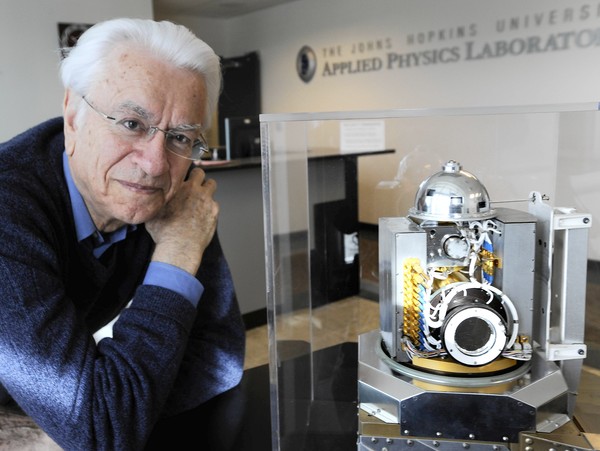 The Baltimore Sun has a really nice article on the Voyager spacecraft, and on the guys who have been keeping them going for the past 33 years. Here’s an excerpt:
You probably have more computing power in your pocket than what NASA’s venerable Voyager spacecraft are carrying to the edge of the solar system. They have working memories a million times smaller than your home computer. They record their scientific data on 8-track tape machines. And they communicate with their aging human inventors back home with a 23-watt whisper. Even so, the twin explorers, now 33 years into their mission, continue to explore new territory as far as 11 billion miles from Earth. And they still make global news. Scientists announced last month that Voyager 1 had outrun the solar wind, the first man-made object to reach the doorstep to interstellar space.
Here’s the link to the article:
http://www.baltimoresun.com/news/maryland/bs-md-voyager-20110117,0,278380,full.story
NASA Needs Our Help!
01.19.11
RELEASE
:
11-009
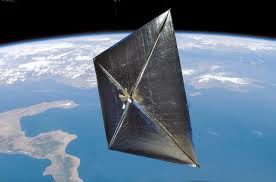
NanoSail-D Ejects: NASA Seeks Amateur Radio Operators’ Aid to Listen for Beacon Signal
HUNTSVILLE, Ala. — Wednesday, Jan. 19 at 11:30 a.m. EST, engineers at Marshall Space Flight Center in Huntsville, Ala., confirmed that the NanoSail-D nanosatellite ejected from Fast Affordable Scientific and Technology Satellite, FASTSAT. The ejection event occurred spontaneously and was identified this morning when engineers at the center analyzed onboard FASTSAT telemetry. The ejection of NanoSail-D also has been confirmed by ground-based satellite tracking assets.
Amateur ham operators are asked to listen for the signal to verify NanoSail-D is operating. This information should be sent to the NanoSail-D dashboard at: http://nanosaild.engr.scu.edu/dashboard.htm. The NanoSail-D beacon signal can be found at 437.270 MHz.
The NanoSail-D science team is hopeful the nanosatellite is healthy and can complete its solar sail mission. After ejection, a timer within NanoSail-D begins a three-day countdown as the satellite orbits the Earth. Once the timer reaches zero, four booms will quickly deploy and the NanoSail-D sail will start to unfold to a 100-square-foot polymer sail. Within five seconds the sail fully unfurls.
“This is great news for our team. We’re anxious to hear the beacon which tells us that NanoSail-D is healthy and operating as planned,” said Dean Alhorn, NanoSail-D principal investigator and aerospace engineer at the Marshall Center. “The science team is hopeful to see that NanoSail-D is operational and will be able to unfurl its solar sail.”
On Dec. 6,, 2010, NASA triggered the planned ejection of NanoSail-D from FASTSAT. At that time, the team confirmed that the door successfully opened and data indicated a successful ejection. Upon further analysis, no evidence of NanoSail-D was identified in low-Earth orbit, leading the team to believe NanoSail-D remained inside FASTSAT.
The FASTSAT mission has continued to operate as planned with the five other scientific experiments operating nominally.
“We knew that the door opened and it was possible that NanoSail-D could eject on its own,” said Mark Boudreaux, FASTSAT project manager at the Marshall Center. “What a pleasant surprise this morning when our flight operations team confirmed that NanoSail-D is now a free flyer.”
If the deployment is successful, NanoSail-D will stay in low-Earth orbit between 70 and 120 days, depending on atmospheric conditions. NanoSail-D is designed to demonstrate deployment of a compact solar sail boom system that could lead to further development of this alternative solar sail propulsion technology and FASTSAT’s ability to eject a nano-satellite from a micro-satellite — while avoiding re-contact with the FASTSAT satellite bus.
Follow the NanoSail-D mission operation on Twitter at:
For additional information on the timeline of the NanoSail-D deployment visit:
To learn more about FASTSAT and the NanoSail-D missions visit:
– end –
text-only version of this release
Listen up for METEORS!
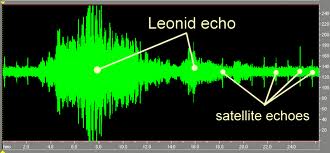 The folks at spaceweather.com have come up with something really cool. We are now in the final phases of the annual Leonids meteor shower. I can’t see many meteors through my light-polluted skies (plus its COLD out there), but Spaceweather Radio has come to the rescue. They currently have on-line the audio feed from a receive station tuned to the freq of the The Air Force Space Surveillance Radar. It transmits 24/7 on 216.98 MHz. It is reported to be on of the most powerful transmitters in the world. You can hear the “pings” caused by the reflections of meteors. I’ve heard several as I typed this post! Be sure to visit the “how we do this page.” I appears that there is ham running the receive station.
Occasionally I hear a longer tone. Could that be the reflection of a Low Earth Orbit satellite going over the site?
Balloons! Space Stations! Aurora!
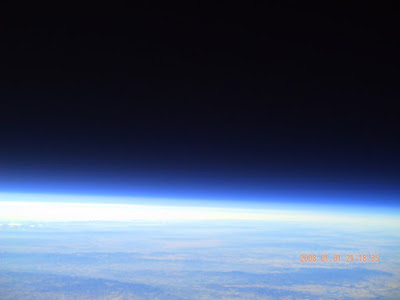 My in-box seemed to have an outer space theme today. First, from Guanajuato, Mexico comes word that the radio club there is planning a second edge-of-space balloon launch. SARSEM ICARUS II is scheduled to go up on 20 November carrying a VHF/UHF repeater. SARSEM ICARUS I was obviously a big success. Check out the picture it took from 29000 meters up (above). Thanks Roberto!
 A couple days ago we noted that the International Space Station would be visible over N. America this week. So far we have only one report of a sighting: Jim, AL7RV saw it from Mississippi. This morning Yahoo carried some pictures taken from the crew’s cupola. This one shows some territory dear to our hearts!
 Finally, spaceweather.com carried this beautiful aurora shot from Tromso, Norway. It was taken by Ole Christian Salomonsen on November 14. Spaceweather notes that “a solar wind stream has been buffeting the earth’s magnetic field.” This probably explains why Maria and I could hear very few stations on 75 meters last evening. And 75 seemed totally dead yesterday morning.
See the International Space Station THIS WEEK!
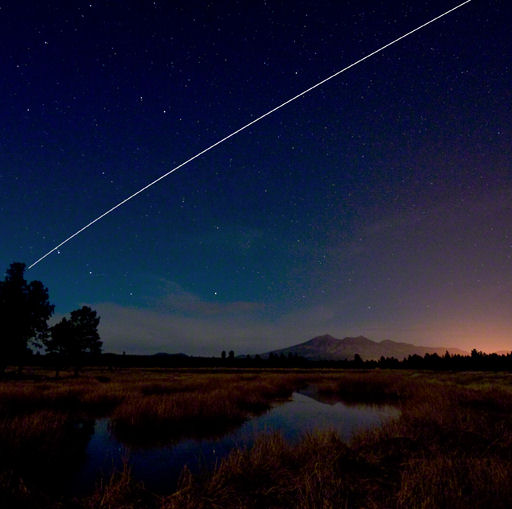 Spaceweather.com showed this beautiful picture of an International Space Station fly-over. It was taken by David Blanchard near Flagstaff, Arizona on Saturday.
The space station will be visible from much of North America in the evening this week. Spaceweather.com has a very handy calculator that will let you know when and where to look. Just plug in your zip code:
http://spaceweather.com/flybys/?PHPSESSID=t18llj67jtfvjsmruu6b7djif5
(There is a global version of the calculator for users outside the U.S.)
Let’s see how many SolderSmoke readers get to see the ISS this week. Please let me know if you see it.
Spotting the X-37B Mystery Space Plane
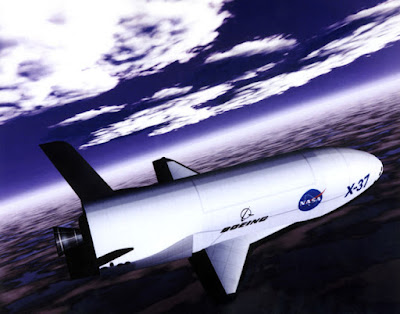 I thought it was kind of cool that the amateur satellite spotting community has been able to locate and determine the orbit of the X-37B. Heavens Above will tell you where and when to look for it. Space Weather has some nice images and videos. It is all a bit reminiscent of The Kettering Group. Go Space Sleuths!
Mars Express Phobos Fly-by (Wednesday)
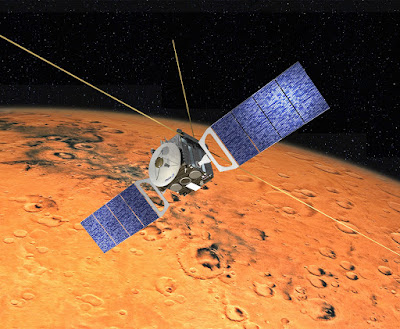 The European Space Agency’s Mars Express probe will be doing the closest ever approach to the Martian moon Phobos. On Wednesday night the spacecraft will come within 67 km of Phobos. They will use a very cool radio technique to gather data about the internal structure of the object (see below).
Mars Express carried the Beagle II lander to the red planet. I was in the UK when they made that brave attempt to put the probe on the surface, and shared in the disappointment when no signals came back. Later, I had the privilege of meeting Beagle II’s creator, Colin Pillinger. Colin gave me signed copies of his wonderful books on Mars.
Here’s some more info on Wednesday’s fly-by (from ESA):
1 March 2010
ESA’s Mars Express will skim the surface of Mars’ largest moon Phobos on Wednesday evening. Passing by at an altitude of 67 km, precise radio tracking will allow researchers to peer inside the mysterious moon.
Mars Express is currently engaged in a series of 12 flybys of Phobos. At each close pass, different instruments are trained towards the mysterious space rock, gaining new information. The closest flyby will take place on 3 March at 21:55 CET (20:55 GMT).
From close range, Mars Express will be pulled ‘off-course’ by the gravitational field of Phobos. This will amount to no more than a few millimetres every second and will not affect the mission in any way. However, to the tracking teams on Earth, it will allow a unique look inside the moon to see how its mass is distributed throughout.
How will the ground teams make these tremendously sensitive measurements? Ironically, they will turn off all data signals from the spacecraft. The only thing that the ground stations will listen out for is the ‘carrier signal’ – the pure radio signal that is normally modulated to carry data.
 |
 |
|
Preparing for closest approach to Phobos
|
With no data on the carrier signal, the only thing that can modulate the signal is any change in its frequency caused by Phobos tugging the spacecraft. The changes will amount to variations of just one part in a trillion, and are a manifestation of the Doppler effect – the same effect that causes an ambulance siren to change pitch as it zooms past.
After the closest flyby, the work is not over. Mars Express will sweep past Phobos a further seven times before the campaign is complete. In addition to the tracking experiment, known as MaRS for Mars Radio Science, the MARSIS radar has already been probing the subsurface of Phobos with radar beams. “We have performed a preliminary processing of the data and the Phobos signature is evident in almost all the data set,” says Andrea Cicchetti, Italian Institute of Physics of Interplanetary Space, Rome, and one of the MARSIS team.
 |
|
|
The MARSIS radar is already taking data
|
“All the experiments on Mars Express have something to say about Phobos,” says Olivier Witasse, Mars Express Project Scientist, ESA. This is a bonus for science, considering that none of them were originally designed to study Phobos the moon, only Mars the planet. The science results from these flybys are expected in subsequent weeks or months, when the various teams have had time to analyse the data.
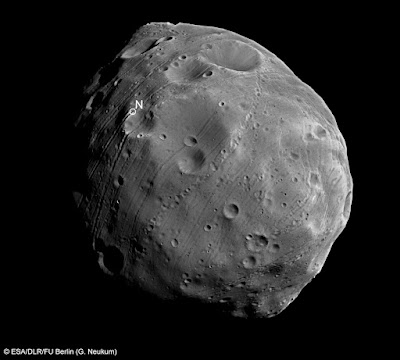 All photos from ESA.
Chinese HAMSAT HO-68
PA3GUO put together this nice video. Check out the large footprint of this relatively high-orbit satellite.
Mark, K6HX, has a nice recording of SSB QSOs through the satellite: K6HX HO-68
New Chinese ham satellite in orbit
 This makes me want to pull out the UHF gear!
http://www.camsat.cn/index.php?option=com_content&view=article&id=56&Itemid=67
Knack on a Bike: Steve Roberts Video
Oh man, this is great! The Winebikko! Gizmology! He even had an Oscar 13 satellite station on the bike. You guys are gonna love this:
Pico-Sats, Texas, Dubai, Balloons


Our man in Dubai, Ron Sparks, AG5RS, sent in this very interesting report on the very small satellites. Obviously lots of QRP relevance here:
Hi Bill,
I am attaching some news you may find interesting. If you remember last year I did an echolink => IRLP => 2m linkup to make QSLs on the Balloon Launch (BLT-24). Besides the usual repeater and video gear, we also had an interesting “hitchhiker” on the payload.
It was the functional engineering model of the BEVO-1 picosat. You can see pictures of the model and the balloon payload here:
http://www.w5acm.net/b24.html
This unit sent beacon information during the balloon launch and we tested it environmentally by doing so. Data on the sat itself is at:
http://www.utexas.edu/news/
A sister satellite was being prepared by my alma mater, Texas A&M, who then docked their sat with the UT sat and put them on the Shuttle mission STS-127. Photos are here:
http://www.ne.jp/asahi/
All of this is part of NASAs DRAGONsat program. This is a new GPS system being developed by NASA.
I know that the satellite stuff is a little “far afield” for Soldersmoke, but you might find the connection to the Houston balloon community interesting. Those of us who get together and annually launch the balloon are without question Soldersmoke-ers with chronic cases of “the knack”. It is fun for me to see that actually be useful toward a next generation replacement for GPS satellites.
All the best.
73 from Dubai, Ron AG5RS and A65BQ
Space Hackers Video: IT’S BACK!!!!!
Hope this one doesn’t get taken down. Great stuff from Turin, back in the day!
Heavens Above
 So I’m sitting there at 5:30 am talking on Echolink to Jerry, NR5A, in South Dakota about his ailing Pixie soon-to-be QRSS transmitter. All the talk about getting on the air and emitting signals causes me to get the urge to fix my antenna.
On Monday, I’d noticed (via Blackberry) that my signal had disappeared from ON5EX’s grabber. I could see a signal close to where I usually am, but it looked a bit different. On closer inspection I saw that EA6FNF had fired up a very nice 50 mw DFCW beacon on around 10140060 Hz. My signal was gone. When I got home I discovered a broken antenna wire. Once again, ON5EX and the internet had, in effect, relayed telemetry about the status of my QRSS system.
Fortunately I could fix this from the window — no roof work was required. Skies were fairly clear on Wednesday morning, and as I looked up across the Janiculum Hill at Rome’s pre-dawn sky, I saw a satellite going over from North to South. Of course, I wanted to know what I was looking at, so I turned to Chris Peat’s very useful web site, Heavens Above. Very quickly, I was able to find out that it was either the Russian Okean O Rocket, or something called RADCAT.
Check out Heavens Above. Lots of great info on astronomy, satellites, and ham radio spacecraft:
http://www.heavens-above.com/
The antenna was quickly fixed. I should be back on the Belgian grabber now. It was a good ham radio morning in Rome. Thanks Jerry. Thanks Chris Peat.