SolderSmoke Podcast #136

http://soldersmoke.com/soldersmoke136.mp3
August 7, 2011
Travelogue: New York City
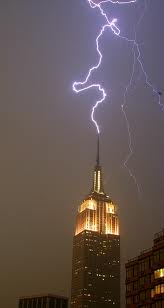
A Stroke of Luck: Lightning strikes Rome HB DC DSB WSPR rig
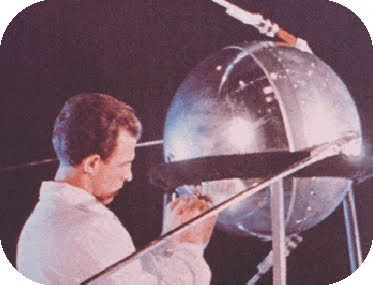
It’s an IGY thing: Recreating the Sputnik Transmitter
ArisSAT-1 deployed. Audio Clip (Can anyone decode the SSTV in this clip?)
Summertime SPRAT — ZL2BMI rig and the mysteries of the ‘602
A writer for “The New Yorker” builds a radio
June Smithsonian Magazine has a lot of Knack
Electric Radio on AM selectivity, Japanese, and the sibilant S problem
Gathering Drake 2-B Serial numbers for use with German Tank Equation
Amazon breaks into oscillation on “Atoms to Ampere” prices
MAILBAG

Our book: “SolderSmoke — Global Adventures in Wireless Electronics”http://soldersmoke.com/book.htmOur coffee mugs, T-Shirts, bumper stickers: http://www.cafepress.com/SolderSmokeOur Book Store: http://astore.amazon.com/contracross-20

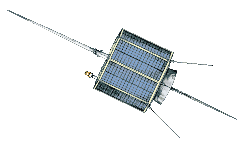
ARISSat Deployed

I just got back from a vacation trip to New York City (amazing place!) and found out that yesterday Russian cosmonauts launched the ARISSat amateur radio satellite. This one looks like lot of fun. It has a two meter downlink. I’ll be doing some listening, and my try to get some of the SSTV signals.

Uh oh…. Just read a post from Mark over on Brainwagon reporting on some problems with the deployment:
http://brainwagon.org/2011/08/03/arissat-1-is-off-to-a-bumpy-start/

Details on how to use the satellite can be found here:
http://www.amsat.org/amsat-new/ARISSat/ARISSatHowTo.php

……………………………………..

Our book: “SolderSmoke — Global Adventures in Wireless Electronics”http://soldersmoke.com/book.htmOur coffee mugs, T-Shirts, bumper stickers: http://www.cafepress.com/SolderSmokeOur Book Store: http://astore.amazon.com/contracross-20

Royal Order of the Sputnik Clone Chasers

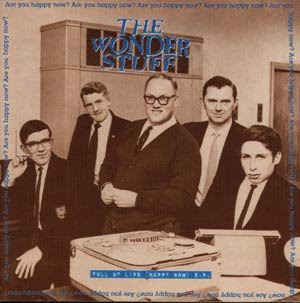
Kettering Group, UK


From the Chief Designer (AA1TJ):

Fellas,

I came across an online blurb for the recent book, Sputnik: The Shock of the Century, by Paul Dickson; a worthwhile read, judging from the introduction and first chapter.

http://www.sputnikbook.net/intro.php

“Someone brought out a shortwave radio, and soon a beeping noise filled the room. A Russian scientist, Anatoli Blagonravov, confirmed it was Sputnik. “That is the voice,” he said dramatically. “I recognize it.” John Townsend Jr., one of the scientists at the party, recalled watching Blagonravov: “I knew him quite well, and I could tell that he was a little surprised and quite proud. My reaction was ‘Damn!'”

And so an abstraction now had a voice. It also had a name – Sputnik.

Many of those at the party adjourned to the Soviet Embassy’s rooftop, attempting to view Sputnik with the naked eye. Several of the American scientists drifted over to the American IGY headquarters in Washington, where they began speculating on what impact the satellite would have. They feared that the American people would be disappointed.

It also dawned on them that they had better start tracking the satellite’s orbit. They got in touch with the American Radio Relay League in West Hartford, Connecticut, asking its 70,000 members-all “ham” radio operators-to lend a hand and help track the Sputnik. In less than twenty-four hours, reports on the satellite were coming back to the National Science Foundation, where a temporary control room had been established. Eventually, these hams and other amateur and professional trackers would consider themselves part of a great international fellowship known as ROOSCH, or the Royal Order of Sputnik Chasers.”

That’s right guys…ROOSCH…the Royal Order of Sputnik Chasers. And to think that fifty four years later a second great international fellowship would rise from the ashes…ROOSCCH, or the Royal Order of Sputnik Clone Chasers! ;o)

(BTW, October 4, 1957 is an important date in American history for a second reason. On that evening the first episode of Leave it to Beaver made its debut.)

………………………………………..

I thought we should also at this point remember the intrepid lads of the Kettering Group, pictured above. (Some of those dudes look like they would have been right at home in “Leave it to Beaver.”) For more info on their amazing Sputnik adventures go here:
http://www.svengrahn.pp.se/trackind/getstart/oldcyts.htm
and here
http://www.svengrahn.pp.se/trackind/trackin1.htm#KEttrack


Check out “SolderSmoke — Global Adventures in Wireless Electronics”
http://soldersmoke.com/book.htm

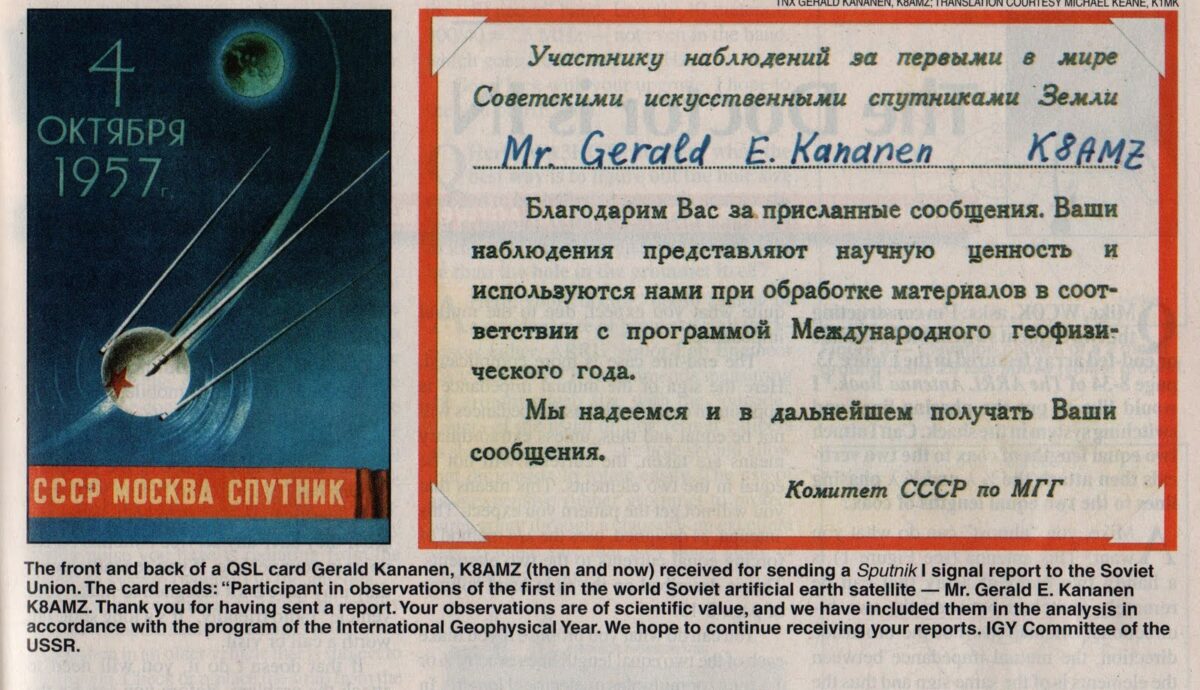
Sputnik QSL from the Soviet IGY Committee

I like the reminder of Sputnik’s IGY connection. This is from an article by John Foley. W7ETS, in the October 2007 issue of QST. Be sure to read the translation in the caption.

Yesterday Billy and I were at the Smithsonian Air and Space Museum’s Dulles Airport center. (We volunteer to take visiting relatives to the airport IF we get to go to the Smithsonian afterwards.) We checked for Sputniks. Nyet. I think they have one on display in the main Air and Space building.

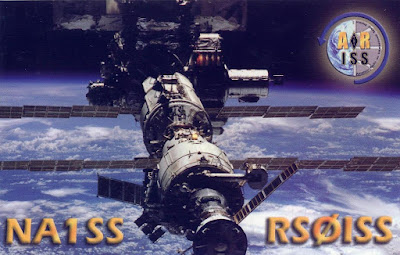
I was thinking that listening to a signal from a spacecraft should be part of the Sputnik event. The packet 2-meter signals from the International Space Station are probably the easiest to receive these days.

Check out “SolderSmoke — Global Adventures in Wireless Electronics”http://soldersmoke.com/book.htm

Sputnik Madness! But was it CW? or AM?

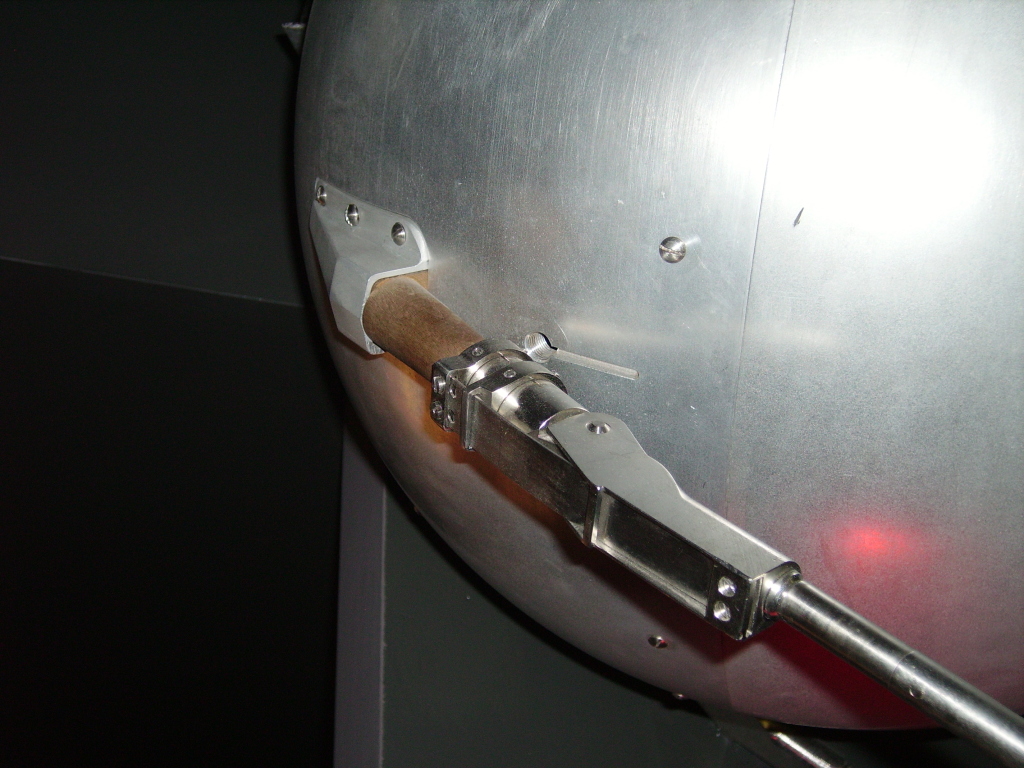
Our worldwide team of Sputnik enthusiasts continues to seek out the elusive schematic diagram of the spacecraft’s 20 MHz transmitter. American, Cuban, Russian and German radio amateurs are involved. Recently Bruce, KK0S, visited the Kansas Cosmosphere in an effort to get a look at the innards of Sputnik’s “flight spare.” The picture above is his — it shows the Sputnik antenna connection. (More pictures from Kansas here: http://s747.photobucket.com/albums/xx120/trader_vic/Kansas%20Cosmosphere/)
There was bad news and good news from the visit: The bad news was that the spacecraft on display was a hollow sphere. The good news is that the internal parts –including the transmitter — might be in storage someplace, just waiting for our reverse engineering. Stay tuned (to 20 MHz!).

Speaking of which, I have a question: OK so the crafty Soviets picked 20.oo5 MHz for some good reasons: Being so close to the WWV freq, it would be easy for hams and SWLs to find it with precision. In the November/December 2007 issue of “Break In” (from NZ — thanks Jonathan-san!) ZL3DW notes that this frequency selection would allow a receiver set to exactly 20 MHz to “produce an audio tone plus or minus the Doppler shift without ever going through zero beat.” But zero beat with what? Most of the receivers out there would not have had BFOs, right? So the Soviets wouldn’t have been using ordinary CW, right? Were they using AM, with the beeps produced by an audio oscillator modulating the carrier?

Here is a update from our Chief Designer, Comrade Mike, AA1TJ:

I currently have a prototype for a simple “Sputniker” transmitter on the bench using a 1sh29b in the oscillator and a 1p24b working as the PA. As in the original, the input DC PA power is 1watt. The crystal-controlled oscillator uses an inexpensive ESS 21.060kHz xtal. So far, all systems are GO.

BTW, here’s an example of how inexpensively these lovely little tubes may be purchased. Oleg, RV3GM, and his pals might be able to do even better.

Although there are only so many ways one can build a two-tube, crystal-controlled MOPA transmitter, we’d still very much like to nail down the original transmitter circuitry. Bruce, KK0S and Peter, DL2FI are following up leads to that end.

Once we’re a bit further along I’m hoping that someone will step-up to produce a kit. Actually, last evening someone raised their hand to ask if a kit were already available.

Dasvidania,
Mike, AA1TJ

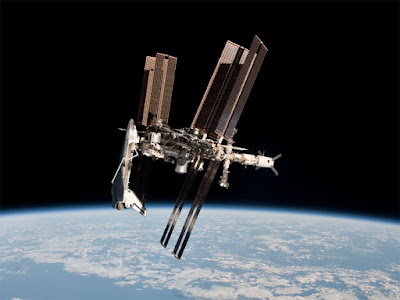
Beautiful Shuttle-ISS Shot

What a beautiful shot. It was taken on May 23 by Italian astronaut Paulo Nespoli from a Soyuz spacecraft. Bravo Paulo! Bella figura!

For a better (high res) view and more details, go here:
http://news.discovery.com/space/big-pic-shuttle-endeavour-docked-space-station-110607.html

The digipeater on the ISS has been picking up my little 2 meter APRS sigs and sending them back down.

Searching for the Sputnik Schematic

Mike, AA1TJ, has launched (!) yet another intriguing project. See below. In an effort to come up with the actual Sputnik schematic, I have thrown down the geek gauntlet to our fellow nerds at sci.space.history:

Greetings Space Historians!
We are a group of radio amateurs and we probably rival you in our
technical geeky-ness. We are now involved in an effort to re-create
and put on the airwaves replicas of the 20 MHz transmitters used in
Sputnik 1. (We will use the amateur radio 21 MHz band).
We are trying to find a schematic diagram for the transmitter. Can
you help us? Thanks.

————————
Gentlemen,

Arnie, CO2KK, told me last night that as a 15 year-old boy he’d made
it into the newspaper by picking up Sputnik’s signal on his Hammarland
Super-Pro receiver.

Don Mitchell – a physicist now retired from the Bell Labs – also wrote
last evening to ask if I knew of a schematic diagram for the two
transmitters used on Sputnik-1. Mr. Mitchell maintains an informative
web site on the topic of Sputnik. Here, for example, is the link to
his page on the first of the series of “Travellers” to be lofted into
orbit in late 1957 into 1958.

http://www.mentallandscape.com/S_Sputnik1.htm

To the best of my knowledge the schematic for what may be the most
famous QRPp transmitter has never been published. It’s a shame,
particularly as it would have been great fun to build an approximate
replica for use on the ham bands

However, I woke up this morning wondering why should we allow the lack
of an original schematic to stop us when there’s plenty of descriptive
evidence available? “Spaceflight Magazine,” for example, published a
wonderful article on the 50th anniversary of Sputnik. The story was
pieced together from original documents over a period of 20 years. You
may read the article here

http://faculty.fordham.edu/siddiqi/writings/siddiqi_sputnik_history_2007.pdf

“The two D-200 type radio transmitters operated on frequencies of
20.005 and 40.003 megacycles at wavelengths of 15 and 7.5 m. These
transmitters (which obviously used vacuum tubes) each had a power
intake of 1 watt and provided the famous “beep-beep-beep” sound to
Sputnik. The signals on both the frequencies were spurts lasting 0.2
to 0.6 seconds, and carried information on the pressure and
temperature inside the satellite; one set would transmit during the
“pauses” of the other.”

“Despite objections from just about everyone, Gringauz insisted that
PS-1 carry a high frequency transmitter (the 20.005 MHz transmitter
operating in the decameter waveband) in addition to the VHF
transmitter (which had been commonly used on Soviet ballistic
missiles). …In the end, Gringauz won over his opponents, partly
because everyone agreed that a high frequency
transmitter would ensure that the radio transmissions would be heard
around the world. The transmitter hardware was built by one
of Gringauz’ youngest engineers, Vyacheslav Lappo…”

>From other sources we know the transmitter used vacuum tubes rather
than transistors. This site mentions that when the received signal
level
was quite strong, the presence of a back-wave while the other
transmitter was keyed could be noted.

http://www.amsat.org/amsat/features/sounds/firstsat.html

The RF oscillator, at a minimum, must have been free-running. So,
we’re talking a vacuum tube crystal-controlled oscillator and a PA
having an input power of 1 watt. They may have used a PA driver stage,
or perhaps a frequency multiplier stage. If they did use a multiplier
then it must have been allowed to free-run as well. But given the
battery drain considerations, I would have done my best to reduce the
number of vacuum tube heaters, or filaments to a minimum. As such, I
think there’s a fairly good chance this was a simple, MOPA design
(oscillator-> PA).

I found what might be a photograph of the transmitter on page 26 of
the December 1957 issue of the Soviet “Radio Magazine.” Perhaps our
Russian speaking group members can confirm this and provide us with
other clues appearing in the article text? The magazine can be
downloaded at

http://publ.lib.ru/ARCHIVES/R/”Radio”/

Click-on ”Radio”,1957,N12.[djv].zip. The “zipped” December issue
appears in DJVU format. Don’t miss the nice Sputnik cover art.

This re-post talks about the center-fed Vee dipole used (the 15m
transmitter used the 5.8meter dipole) among other things.

http://hamradio.mybb.ru/viewtopic.php?id=625

Getting to get the point, this morning I woke up thinking about how
plentiful vintage Russian military tubes are these days. Remember how
inexpensive US military surplus used to be? That’s how it is right now
with Russian components (and the characteristics of some of these
tubes are simply amazing). All I can say is get ’em while they’re hot,
as it surely won’t last forever.

It also came to me that Expanded Spectrum Systems sells an HC49
crystal cut for 21060kHz for two and a half-bucks each.

Finally, I remarked to myself that propagation-wise, 15m may well be
open for business come the 54th anniversary of the launch of Sputnik-1
next October the 4th.

You’ve probably guessed by now what I’m going to propose. We have
plenty of time to throw together a simple 15m CW vacuum-tube
transmitter having an input power of 1w or less. We could use any
tubes that we like but I’m going to build mine using 1950’s vintage
ex-Soviet devices. I plan to power mine with one or two of those
ubiquitous 12V sealed-lead-acid batteries. I’ll VXO my crystal and
I’ll let it free-run during transmit; both for historical reasons and
to improve the signal quality.

Perhaps some of the antenna gurus here would lend a hand by modeling
and testing something akin to the original 70 degree Vee dipole? Would
this be a practical antenna?

I propose that beginning on “Sputnik Day” we launch our 1 watt Sputnik
clones on 15m CW. Instead of calling CQ, our call could be along the
lines of “Beep_Beep_Beep_Beep_Beep_Beep de AA1TJ”. In other words, six
letter E’s followed by our call sign. Given that I can barely organize
the socks in my underwear drawer, perhaps someone skilled at
organizing events would take up the cause?

One more thing. Poking around on Google last night, I was struck by
how many people remarked that the experience of Sputnik had changed
their lives. Some decided to become engineers, scientists or amateur
radio operators. I didn’t know it at the time, but Sputnik changed the
way that I was educated. Not only did this little QRPp transmitter
make a tremendous impact on the world, but radio amateurs were front
and center. It seems appropriate that we should commemorate this
extraordinary day in the history of QRPp.

http://www.youtube.com/watch?v=CHaJDuq6tBM

(they were seeing the orbiting booster stage rather than the satellite)

Sputnik Mania…the complete film in two parts (warning…contains
some political “button-pushing”)Greetings Space Historians!
We are a group of radio amateurs and we probably rival you in our
technical geeky-ness. We are now involved in an effort to re-create
and put on the airwaves replicas of the 20 MHz transmitters used in
Sputnik 1. (We will use the amateur radio 21 MHz band).
We are trying to find a schematic diagram for the transmitter. Can
you help us? Thanks.

http://www.youtube.com/watch?v=8jI5RBRWIOE

If I happen to learn more about the original transmitter I’ll be sure
and post it on my blog or web site. I found particularly interesting
the fact that WWV interrupted some of their 20MHz transmissions in
order to accommodate Sputnik’s signal; a gentlemanly thing to do

As for the possibility of an event along these line, any comments or
discussion is most welcome. I plan to make a start on my little
Sputnik sender upon my return from vacation in July.
Greetings Space Historians!
We are a group of radio amateurs and we probably rival you in our
technical geeky-ness. We are now involved in an effort to re-create
and put on the airwaves replicas of the 20 MHz transmitters used in
Sputnik 1. (We will use the amateur radio 21 MHz band).
We are trying to find a schematic diagram for the transmitter. Can
you help us? Thanks.

Ha…I just received several fairly good-quality color photos of the
original Sputnik transmitters! At first glance it looks as though they
used two subminiature pencil tubes! The quartz crystal looks very
similar to our HC-18/u package. The RF portion is very simple in
appearance. In fact, it reminds me of something you’d find in a 1950’s
ARRL Mobile Radio Manual! ;o)

The fellow who sent these apparently has a contact with one of the
original Sputnik (non-electronic) hardware designers; who is said to
be “still very much alive.” My contact is going to make an inquiry
with his Russian contact about the transmitter.

Very cool…

73/72,
Mike, AA1TJ
SolderSmoke Podcast #134


http://soldersmoke.com/soldersmoke134.mp3

May 15, 2011
New “Ikea” microphone
NOVA QRP Club

WSPR T/Rouble resolved
Finishing up Rome WSPR rig
Easy-Peasy on Asus eee-PC

Space Station Packet Beacon
Boatanchor News: DX-100, HT-37, “CQR” anchors, 75 meter antenna Drake 2-B history interview by W8SX
Lew McCoy and Ernest Hemingway
Ade Weiss, QRPoetry and Ade’s new book
Regen theory

MAILBAG (with a focus on New Zealand)

AMSAT OSCAR 7 — No Batteries, Running Directly From Solar Panels

From the AMSAT site:

AMSAT-OSCAR 7 was launched November 15, 1974 by a Delta 2310 launcher from Vandenberg Air Force Base, Lompoc, California. AO-7 was launched piggyback with ITOS-G (NOAA 4) and the Spanish INTASAT. Built by a multi-national (German, Canadian, United States, and Australian) team of radio amateurs under the direction of AMSAT-NA. It carried Mode A (145.850-950 MHz uplink and 29.400-500 MHz downlink) and Mode B (432.180-120 MHz uplink and 145.920-980 MHz downlink (inverted)) linear transponders and 29.500 and 145.700 MHz beacons. The 2304.1 MHz was never turned on because of international treaty constraints.

In mid 1981 AO-7 ceased operation due to battery failures. It was thought at that time that the batteries had shorted. However on June 21, 2002, at least one of the shorted batteries went open-circuit, allowing the satellite to waken whenever it is in sunlight, and randomly begin operation in one of 4 modes.

According to the log at planetemily.com/ao7/ao7log.php, this old warrior is still supporting transponder action in mode A and mode B as recently as 9/10/09, and on a regular basis, whenever it is in sunlight.

When the satellite is in sunlight for extended periods of time, the 24-hour timer still switches the bird between modes A and B. Listen for the corresponding beacon to determine which mode the satellite is currently operating in, or refer to the above mentioned web page to see what mode has recently supported QSO\’s as the best estimate of what is the current mode of operation.

Please remember, there are no (functional) batteries, so the satellite\’s power input is limited to whatever output can be generated by the ancient solar panels. Use the least uplink power possible to minimize your downlink power usage, and maximize the number of simultaneous QSO\’s supported in the passband. There are other operating tips at:http://www.planetemily.com/ao7/usage.php
Linear transponder birds are a scarce commodity these days, so please use AO-7 responsibly, but please DO enjoy her!

SolderSMOKE APRS symbol

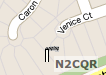
I’ve been setting up my satellite APRS station. This weekend I finally got the UI-view software running. I had to pick an icon — this would be the symbol that would show up on the mapping software. In the Azores I had a nice little island with a palm tree. Here in Virginia, well, as I scrolled through the options, suddenly I saw something that seemed appropriate. The coordinates are a bit off, but that, my friends, is a smoke stack emitting 60/40 fumes.

Messages (for me!) from space station

Mark KB1GVR

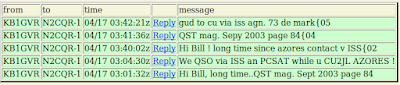
When I started receiving packets via the International Space Station earlier this month, I noticed a familiar call: KB1GVR. He was one of the few North American stations who could pick up my packet beacons via PCSAT — he would then relay them to the internet. This month, when I sent my sigs through the ISS, OM GVR spotted them, and sent reply messages to me via the packet system. I didn’t get them via the satellite — they came to me via the “Stations Heard Via ISS” web site. But still, it was fun to run into an old friend via the space station.

SolderSmoke Podcast #133

http://soldersmoke.com/soldersmoke133.mp3

April 19, 2011

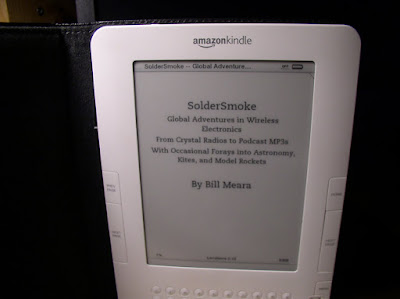
— KindleSmoke
— Amazon’s Whispernet (not to be confused with WSPRnet)
— April 1 and the Perils of Plausibility
— The difference (significant!) between Cream of Tartar and Tartar Sauce
— A short Italian lesson
— Polyakov QRSS
— Snort Rosin’s Mighty Mite (NOTE: NO FILTER!)
— Fly Fishing in Space: 2 Meter Packet Beacons and the International Space Station
— Upside-down Amplifier
— Rock and Roll and Ham Radio: The Bob Heil Story
— The Shuttle Discovery Lands in Northern Virginia
— MAILBAG

Check out the new Ikea Microphone!

Space Beacon Success (and failure)

On the Yuri Gagarin anniversary day, I listened for the FM voice beacon from the ARISS-1 satellite on the space shuttle. Nothing heard here. But I was listening near the end of the period scheduled for the transmission, so I may have missed it, or the batteries may have drained.

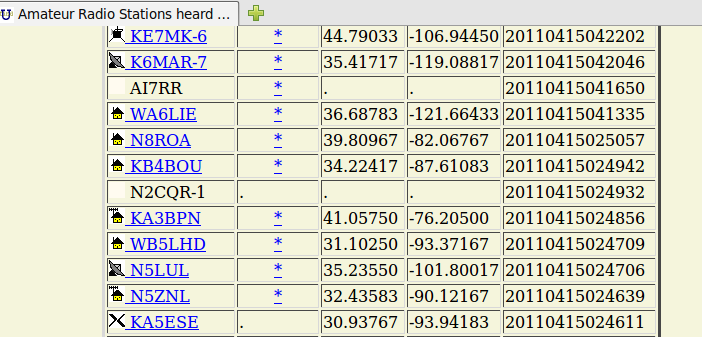
But this morning I finally got confirmation that at least one of my packets made it through the Space Station’s digipeater. The image above is from the “Stations Heard via ISS” web site. Obviously I need to do something to the position (Lat/Long) info in my packet so that I can show up on the APRS maps. Perhaps my symbol should be the SolderSmoke logo…

Beacons from Space! Yuri Gagarin Anniversary


SB SPACE @ ARL $ARLS005
ARLS005 ARISSat-1 On the Air for Gagarin Anniversary

ZCZC AS05
QST de W1AW
Space Bulletin 005 ARLS005
From ARRL Headquarters
Newington, CT April 8, 2011
To all radio amateurs

SB SPACE ARL ARLS005
ARLS005 ARISSat-1 On the Air for Gagarin Anniversary

To celebrate the 50th anniversary of the first human spaceflight by
cosmonaut Yuri Gagarin, the ARISSat-1 satellite aboard the
International Space Station will be on the air using the station’s
external antenna. Transmissions will begin on Monday, April 11, at
14:30 UTC and continue until 10:30 UTC on April 13.

To preserve the satellite’s battery, transmissions will cycle on and
off. ARISSat-1 will transmit for 40 to 60 seconds, and then remain
silent for 2 minutes.

The FM transmissions on 145.950 MHz will alternate between a voice
ID, telemetry values, SSTV images and audio greetings in 15
different languages. One of the transmissions will contain audio of
a conversation between Gagarin and ground controllers that was
recorded during the historic flight.

A CW beacon will be heard on 145.919 MHz cycling between the
ARISSat-1 call sign, telemetry and call signs of individuals
involved in the ARISS program.

BPSK-1000 telemetry transmissions will also take place on 145.920
MHz SSB using the new 1kBPSK protocol developed by Phil Karn, KA9Q.

AMSAT will issue commemorative certificates to listeners who receive
the ARISSat-1 transmissions. Reports can be e-mailed to
Gagarin@arissat1.org or yuri@arrisat1.org. Include your name, call
sign, a description of what you heard and the UTC time you heard it.
Recording the battery voltage telemetry values and the UTC time you
received them will be especially helpful.

You can determine when the International Space Station will be
passing overhead by using the AMSAT-NA online pass prediction tool
at, http://www.amsat.org/amsat-new/tools/predict/.
NNNN
/EX

Beacons from Space! Yuri Gagarin Anniversary


SB SPACE @ ARL $ARLS005
ARLS005 ARISSat-1 On the Air for Gagarin Anniversary

ZCZC AS05
QST de W1AW
Space Bulletin 005 ARLS005
From ARRL Headquarters
Newington, CT April 8, 2011
To all radio amateurs

SB SPACE ARL ARLS005
ARLS005 ARISSat-1 On the Air for Gagarin Anniversary

To celebrate the 50th anniversary of the first human spaceflight by
cosmonaut Yuri Gagarin, the ARISSat-1 satellite aboard the
International Space Station will be on the air using the station’s
external antenna. Transmissions will begin on Monday, April 11, at
14:30 UTC and continue until 10:30 UTC on April 13.

To preserve the satellite’s battery, transmissions will cycle on and
off. ARISSat-1 will transmit for 40 to 60 seconds, and then remain
silent for 2 minutes.

The FM transmissions on 145.950 MHz will alternate between a voice
ID, telemetry values, SSTV images and audio greetings in 15
different languages. One of the transmissions will contain audio of
a conversation between Gagarin and ground controllers that was
recorded during the historic flight.

A CW beacon will be heard on 145.919 MHz cycling between the
ARISSat-1 call sign, telemetry and call signs of individuals
involved in the ARISS program.

BPSK-1000 telemetry transmissions will also take place on 145.920
MHz SSB using the new 1kBPSK protocol developed by Phil Karn, KA9Q.

AMSAT will issue commemorative certificates to listeners who receive
the ARISSat-1 transmissions. Reports can be e-mailed to
Gagarin@arissat1.org or yuri@arrisat1.org. Include your name, call
sign, a description of what you heard and the UTC time you heard it.
Recording the battery voltage telemetry values and the UTC time you
received them will be especially helpful.

You can determine when the International Space Station will be
passing overhead by using the AMSAT-NA online pass prediction tool
at, http://www.amsat.org/amsat-new/tools/predict/.
NNNN
/EX

PACKET MYSTERY FROM SPAAAAACE!

OK guys, please reach back into your memories, back to the late 80’s, back to those sad days before the internet, back to the days of TNCs and packet BBSs and all that. I need some help.

I have my little 2 meter packet station running. I’m sending out beacon packets on 145.825 MHz, the freq of the International Space Station. (Is PC-SAT still on that freq also?)

Every morning I go to the old 1994 Satellite Pro computer (thanks to ZL3KE!) and type in mheard to see the list of stations picked up during the most recent passes of the space station. Every day there are several, each with an asterisk indicating that the packets were digipeated, and on this freq the digipeating is done in space.

Here’s my question: Two days ago, MY OWN CALLSIGN showed up in the MHEARD list. (Cue ominous music) BUT WITHOUT THE ASTERISK! If I had seen the asterisk, I would have thought that my own packets were being digipeated by the ISS station and coming back at me. But why no asterisk? Long Delayed Echo? Klingons? My misunderstanding of packet technology?

SolderSmoke Podcast #132


http://soldersmoke.com/soldersmoke132.mp3

April 1, 2011
Fickle Finger of Fate: Lamp falls on QRSS Crystal
Another heroic computer repair
Sleuthing for RFI with Crystal Radios and Peter Frampton
The seductive allure of the British Regen
Watching the Space Station and the Space Shuttle
Packets from SPAAAACE
Don Vorgaard and the birth of SSB (and DSB!)
Electric Radio Magazine
SPRAT and the ZL2BMI DSB Rig
Jerri Elsworth’s 555 contest (Did I win?)
73 Magazine
QSO with Mike Bryce WB8VGE
Knack Job Opportunities at Make and Hack-a-Day
Chemical Tailoring of Crystal Mic Audio Response
Pi Day!
Sling Shots, Fishing Poles, and Antenna Launchings
MAILBAG!

SolderSmoke Podcast #132


http://soldersmoke.com/soldersmoke132.mp3

April 1, 2011
Fickle Finger of Fate: Lamp falls on QRSS Crystal
Another heroic computer repair
Sleuthing for RFI with Crystal Radios and Peter Frampton
The seductive allure of the British Regen
Watching the Space Station and the Space Shuttle
Packets from SPAAAACE
Don Vorgaard and the birth of SSB (and DSB!)
Electric Radio Magazine
SPRAT and the ZL2BMI DSB Rig
Jerri Elsworth’s 555 contest (Did I win?)
73 Magazine
QSO with Mike Bryce WB8VGE
Knack Job Opportunities at Make and Hack-a-Day
Chemical Tailoring of Crystal Mic Audio Response
Pi Day!
Sling Shots, Fishing Poles, and Antenna Launchings
MAILBAG!

Back to the Future: Packets from the Space Station

Readers will have noticed that I have an affinity for beacons. All kinds of beacons: WSPR, QRSS, 10 meter CW… (Tony Fishpool says I have broadcaster tendencies.)

My favorite was a VHF Digital Satellite beacon. Out in the Azores, I had my old Kantronics KPC-3 Terminal Node Controller hooked up to a 286 computer and a Realistic HTX-202 HandiTalkie. Antenna was a ground-plane made from a coat-hanger. My rig would burp out packets all day long, and occasionally either PC SAT or the International Space Station would fly over and relay my signal to stations on the European continent or, sometimes, on the east coast of North America. I had APRS data in my packet, including a nice little island with a palm tree icon which would show up on the on-line APRS maps.

Well, after watching the Space Station (and the Shuttle discovery) fly over a few weeks ago, I got the urge to get back into the outer space packet game. Last weekend I dug out the old HT and KPC-3. I even found the cables. For the computer I put to work the OLD Toshiba Satellite Pro (appropriate, eh?) that Kevin, ZL3KE, had helped me revive.

Yesterday before going to work I noticed that there would be a nice pass of the Space Station at around 0750 local. I took a little mag mount antenna and left it on the ground in the backyard. I tuned the HT to 145.825 MHz and fired up the Windows 3.1 terminal program on the Toshiba.

When I returned 10 hours later… SUCCESS! Lots of space packets on the screen: KB1GVR, W1TMS, W1CGT, W1GSH, VE2TMW…

So far I’m only receiving, but soon I hope to be sending
PACKETS TO SPAAAAAACE!

Shuttle and Space Station (and Sunspot)

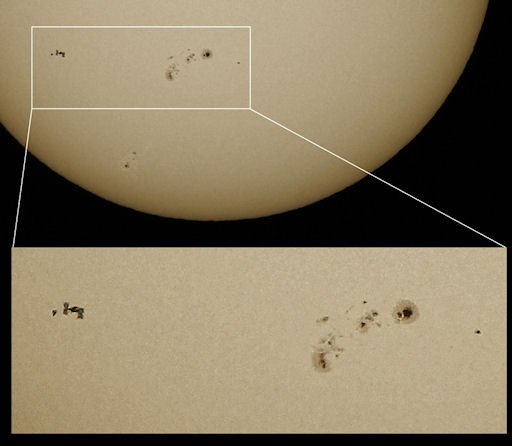
Check it out! The ISS and the Shuttle Discovery captured by an amateur astro-photographer as they passed in front of the sun, with major sunspots nearby! Catalin Fus of Krakow, Poland, had his solar-filtered telescope trained on sunspot 1166 on March 7 and recorded this amazing conjunction. Thanks Catlin and thanks to spaceweather.com.

I had the whole family out in the front yard after dinner last night. ISS and the Shuttle made spectacular pass over the Washington DC area. We saw both rise up from the Northwest and then blink out after passing overhead. The shuttle (I think) was about one minute behind ISS.