A Surprisingly Good Movie from the Late 1960s: “The Ham’s Wide World” (Video)

I found this movie to be surprisingly good. Narrated by Arthur Godfrey, it features Barry Goldwater, and a lot of other hams. There is a homebrewer too! Lots of old rigs we know and love: a Drake 2-B, a couple of Galaxy Vs, a Benton Harbor lunchbox, Heathkit SB-series rigs, many Swans, and was that an HQ-170 that I saw in there? There are also many cool antennas, including a 15 meter quad set up by a bunch of Southern California teenagers.

Near the end, when they visit ARRL Headquarters, we briefly see none-other-than Doug DeMaw, W1FB! FB!

Please take a look at this video and post comments about the rigs, antennas, and radio amateurs that you see in the film.

Thoughts on Homebrew, Makers, DIY, and Hams — from Lex PH2LB

Sometimes we get a comment that is so good that we elevate it to the main blog page. That was the case with Lex PH2LB’s comment on the blog post of Owen Duffy (yesterday).

———————-

When I started the hobby, it arose out of technological curiosity, the interest in understanding things and the will to make things myself (designing myself was not my main goal). It doesn’t matter to me whether it is 100% DIY or a kit (such as Heathkit, Elecraft, QRP-Labs etc) which is modified or not after construction. Just having fun with the hobby and pushing boundaries. And yes I also have some off-the-shelf transceivers (I’m super happy with my FT817ND) and my QO-100 uplink is also a kit (which is then already soldered a little more than average). As far as new tools are concerned: here at home are 2 types of 3D printers, various tools for SMT assembly, and I have a nice workshop equipped with tools and equipment for metal / plastic / wood processing. And every day I try to learn something new, because I stand by the IBEW moto : If you know stuff, you can do stuff.

Am I a maker then? I wouldn’t call myself that. Just like I don’t call myself a hacker because I’m quite handy with computers, technology and have certain skills. I’m just a hobbyist who wants to do and make things after work.

———————
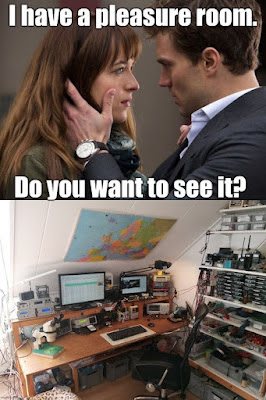
Lex is a true member of the International Brotherhood. He is the one who took our beloved stickers onto the European continent and into a Netherlands pub. He is the one who — unforgettably — saw the parallels between ham shacks and the “pleasure room” of “50 Shades of Gray” (See below — apropos of his current message, we labeled his meme “50 Shades of Homebrew”) For more on Lex see: https://soldersmoke.blogspot.com/search?q=PH2LB

Lex’s web site (Shack on the Internet): https://www.ph2lb.nl/blog/index.php?page=hamradio

Thanks Lex!


WD-40, a Hard Drive, a Coat-Hanger Antenna, Dumpster Diving, and Amateur Radio Satellites from the Azores


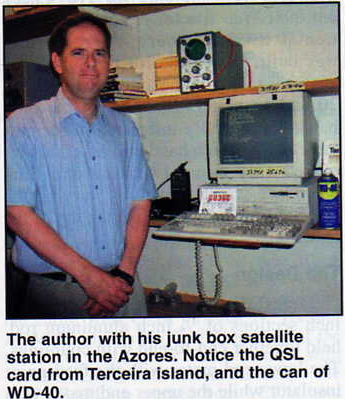
Last month I was talking to Ira VP2EIH on my new 1712 SSB rig. Ira is interested in satellites. Talking to him caused me to dig up some old material about satellite operations. Here is a 2003 QST article about working the satellites from the Azores:

Regarding the usefulness of WD-40, during my time in the Azores John EI7BA once told me that WD-40 is, “the Pope’s pee!” Apparently that is high praise in Ireland. It is indeed good stuff.

Messias CU2BJ is a Silent Key. I hope Ray CU3GC, WL7CDK is doing well.

The Lamakaan Annual Radio Convention Starts Today!

The Lamakaan Amateur Radio Club’s annual convention begins today in Hyderabad, India. This is Farhan’s club so it is sure to be a great event. Presentations are being live streamed on YouTube and on the QO100 geostationary satellite.

Here is the link to the convention: http://www.larc.in/larc4/

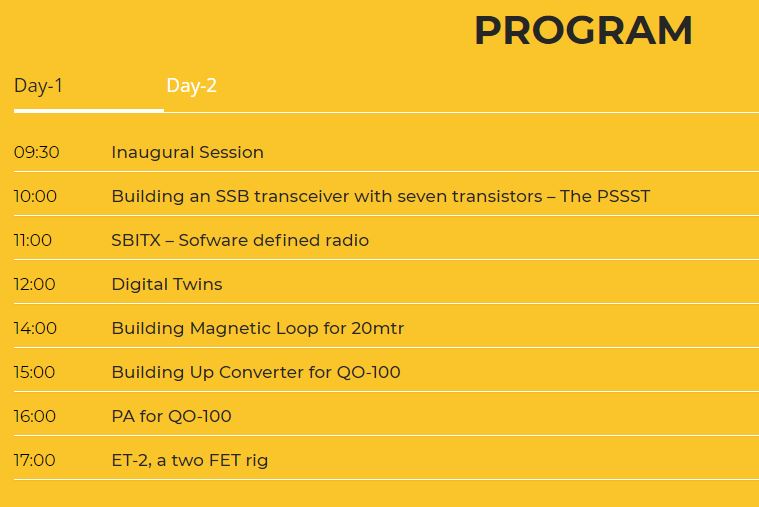
Pete N6QW will be the first presenter and will talk about his new PSSST Rig. He will be speaking at 0430 UTC Saturday 11 December. That is 11:30 pm on Friday, December 10 on the East Coast of North America.

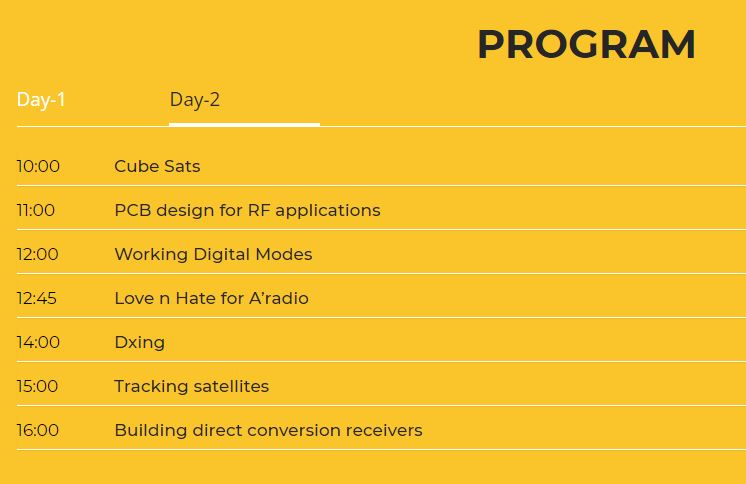
I will be speaking at 1130 UTC on Sunday December 12. That is 0630 Saturday 11 December EST. I’ll be talking about the Mythbuster rig and about the ET-2.

Here is the schedule.

Here’s a time zone converter: https://www.timeanddate.com/worldclock/converter.html?iso=20211211T043000&p1=505&p2=250&p3=137

Here is the Lamakaan Club’s YouTube Live Channel. https://www.youtube.com/watch?v=cRznKwGgvDo

I don’t know how we might be able to watch or listen via the QO100 satellite. The U.S. is not in the footprint of this bird. But there is a good WEBSDR receiver run by BATC and AMSAT DL: https://eshail.batc.org.uk/

JPL, Mars Helicopter, Cube Sats, Ham Radio and more: N5BF talks to Eric Guth 4Z1UG


This morning Eric Guth has a really interesting interview on his QSO Today podcast.

Courtney Duncan N5BF had a full career at JPL and is the current president of the San Bernardino Microwave Society. There is a lot of interesting stuff in this interview, much of it about space exploration. Courtney tells us about how experience with re-purposing radio gear came in handy at JPL. For example, the helicopter that they have been flying on Mars has a very cheap and light off-the-shelf Zigbee transceiver. He also talks about the origins of the Cube Sats.

Here is Eric’s page on this interview, with useful show notes:

https://www.qsotoday.com/podcasts/n5bf

I like to listen to Eric’s shows on YouTube — here is the YouTube recording of the N5BF interview:

https://www.youtube.com/watch?v=Fbr4jE11vfg

Here is N5BF’s ham radio web site:

http://cbduncan.duncanheights.com/HamRadio/HamRadio.html

Here is the club page of the San Bernardino Microwave Society:

http://www.ham-radio.com/sbms/

Thanks to Eric and Courtney!

Buy a Real Sputnik Satellite! Let’s Put Sputnik Back in Orbit!

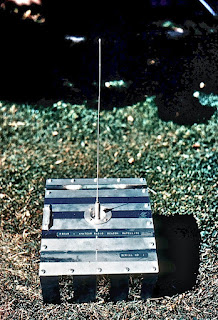
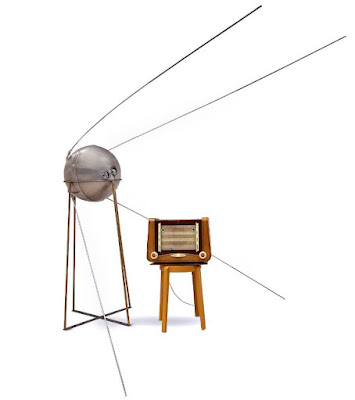
Only 85,000 Euros (that’s the opening bid). But hey, it comes with the receiver pictured on the right. I guess that’s so you can listen to the beeps.

Here’s the description:

—————

Laboratory Test Model of “Sputnik 1 EMC/EMI”, 1957
1:1 scale test model of the satellite “Sputnik-1”, serial no. “0K6-1/004/1957”, with built-in transmitter (including modern 12-volt power supply), polished stainless-steel sphere, consisting of two threaded hemispheres of approx. 23 in. diameter with two pairs of antennae of 95 in. and 105 in. at an angle of 35 degrees to the axis, on stand with O-ring, stand approx. 59 in. high, stand and model together approx. 79 in. high, accompanied by a Tesla Maj 620A radio receiver, manufactured in Prague c. 1956, restored working condition, including replacement of the silver-zinc battery with a modern alternative and a new metal casing for the electronic transmitter. Note: Built at the Experimental Design Bureau-1 (OK?-1/OKB-1) factory, also known as S.P. Korolev Rocket and Space Corporation Energia, Koroljow, Soviet Union, in 1957, shortly before the launch of Sputnik-1. – An impressive artefact from the dawn of the space age, of which few models are known. – Provenance: From the collection of Dr. Frank Malina, USA/CSSR.

Start Price: EUR 85.000

—————————

I’m a bit suspicious of the “modern 12-volt power supply,” the “modern alternative” battery and the “new metal casing for the electronic transmitter.”

Here’s the link to the auction:

https://www.the-saleroom.com/en-gb/auction-catalogues/auction-team-breker/catalogue-id-breker10030/lot-9c87007d-f0ff-4414-9663-adc200690819

Here’s my suggestion: Musk or Bezos or Branson should buy this thing, fix it up a bit, and put it back in orbit. So we can listen to it again. I know a version of this was done back in 1997. But I think we should do it again, this time with the actual test model.

Here are the earlier SolderSmoke blog posts about Sputnik and Sputnik-related projects:

https://soldersmoke.blogspot.com/search?q=Sputnik

Steve Silverman sent the auction posting to me. Thanks Steve.

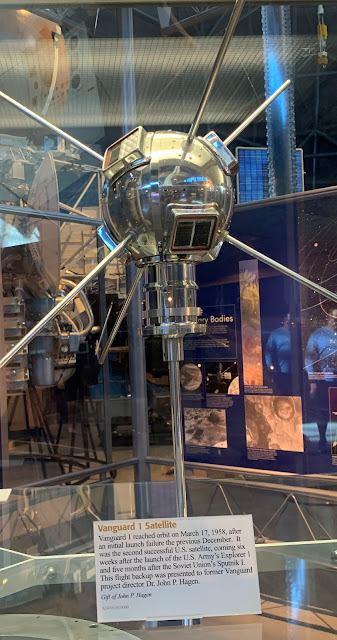
It just so happens that earlier in the week I was out at the Air and Space Museum facility near Dulles Airport, where I saw this flight backup of the Vanguard satellite:
Homebrew Tiny Space Telescopes from the Netherlands

It is good every once in a while to step back from our electronic work benches and take a look at what other kinds of builders are making. Hack-A-Day led me to this wonderful video from Holland. There is great background information on telescopes, but the really great part is the interview with the Dutch fellow who is actually making — in his home workshop — these tiny telescopes. Icing on the cake: One of them will be used in a student Cube-Sat project in Oregon.

Be sure to stay to the end for an intriguing presentation by Dr. Liam Fullersheit.

A Satellite Ground Station (Receiver) Made from Junk

Very cool. This guy (who brew up on an island in Alaska) really knows how to use aluminum tape and the junk that fills most workshops. I like his use of the security camera mount as an az-el antenna rotator.

I foolishly discarded a Direct TV dish. I could have been receiving GOES images by now!

Just last week I got the same RTL-SDR.com V3 dongle that he is using. Very FB. It does HF direct sampling with no hardware mods and no upconverter.

More from the builder, Gabe Emerson (KL1FI):


Jean Shepherd Works Through a Satellite in a School

Ah, 1975. Obviously a very different time… I’m not sure if Shep would fit in well in the classrooms of today. There was bit of Rodney Dangerfield in his demeanor — that would likely cause some trouble.
But this clip was fun. Shep was right on target when he talked about how getting your ham license used to mean that you’d “mastered a technical art.”

The OSCAR satellite they were using was 2 meters up and 10 meters down. There was a Heathkit HF transceiver with a transverter. And a Simpson multimeter. That mic was a Turner +3

Thanks to Steven Walters for alerting us to this.

EXCELSIOR!

Listening in on the Deep Space Network

Not long ago we took the DISH satellite antenna off our roof. For a while I resisted pleas to put the big thing on the curb for pickup. I fantasized about using it for radio astronomy. In the end, I threw it away. I do have VHF/UHF aspirations, but being able to use that dish just seemed to be something in my distant future (if ever!).

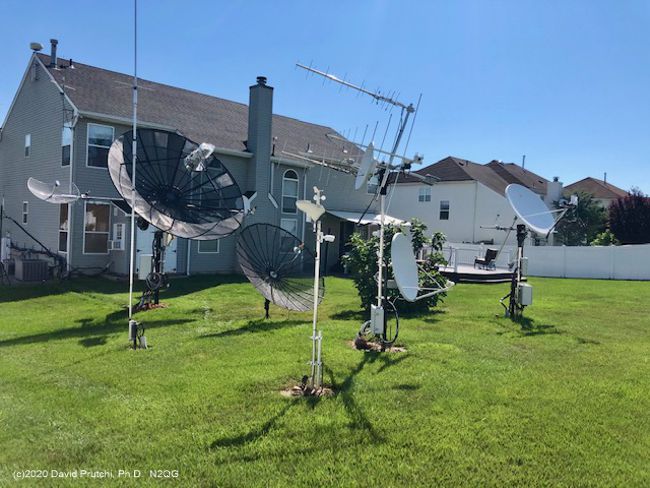
But check out what David N2QG is doing with his dishes: He is listening to very distant spacecraft normally picked up only by NASA’s Deep space network. Very cool. Truly inspirational.

Here are the links:

http://www.prutchi.com/2020/10/15/recap-of-x-band-dsn-activities-and-plans-for-the-future/

http://www.prutchi.com/wp-content/uploads/2020/10/DSN_Lessons-_Learned_N2QG.pdf

Very Cool Vosworx AZ-EL Satellite Tracker

When I was in the Dominican Republic working the RS satellites, MIR and the Space Shuttle, I didn’t have an elevation rotator. I could only move the antenna in the azimuth plane. So I just aimed it about 45 degrees above the horizon, spun it around, and hoped for the best. I also had no computer control of the azimuth heading — I’d just watch the location of the satellite on my computer screen and operate the rotator control manually.

This device is a big improvement.

OSCAR 100 Geosynchronous Satellite Video


I guess the title for this post could also be “How the Other Half Lives.” I’m sure at least a few of you will be thinking about building an OSCAR 100 station after watching this video. But if you are in North or South America (with the exception of the Eastern tip of Brazil), forget about it. OSCAR 100 is geostationary over the other side of the planet. And amateurs have no equivalent on this side of the world. But we can listen in using the Web SDRs.

A couple of interesting bits from this recording. You can hear G7BTP’s coming back from the satellite with a bit of a delay — he is obviously monitoring the downlink when he is transmitting. DL8FBH says that he doesn’t have a receive system of his own — he is using a WEB SDR station (as I was) for the receiver.

Homebrew Az-El Satellite Antennas from the Philippines and Australia

https://nightskyinfocus.com/2020/05/18/diy-satellite-tracker/

DU1AU is way ahead of where I was when I was working with Low Earth Orbit satellites. I just aimed the antenna about 45 degrees up from the horizon, and spun it around with a TV rotator with me –not the computer — as the controllers of the rotator. In essence I did the AZ manually and completely ignored the EL. This design moves the antenna in Azimuth and Elevation, and has the computer control the movements via an Arduino. FB.

DU1AU points to the work of VK3FOWL and VK3YSP. Their site has very detailed info on how to build several versions of this kind of Az-El rotator:

https://www.sarcnet.org/rotator-mk1.html

This Az-El project represents a great opportunity to move beyond hand-held satellite antennas, and beyond my Az-only manual approach. It also give us a way to bring some real homebrewing into a part of ham radio that has come to be dominated by commercial equipment. There are some Arduinos and some lines of code, some motors and some metal work. Great stuff!


Farhan Visits Northern Virginia and SolderSmoke HQ

Our good friend Farhan came to Northern Virginia last week for the 50th Anniversary Symposium of AMSAT. We were really delighted that he also came to SolderSmoke HQ. Elisa and I gave him a lightning tour of Washington DC (including a quick visit to The Air and Space museum) and then we headed back to the shack from some radio work.
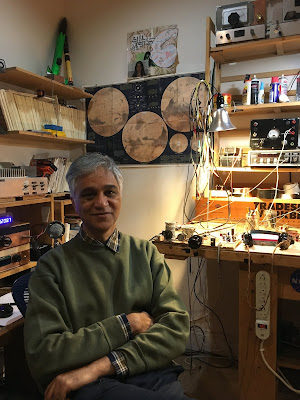
In the picture above you can see my BITX-20 (that Farhan designed) off his right shoulder. Off his left shoulder you sits my ET-2 rig. I really wanted to show Farhan how well the N0WVA regen performs — he was impressed, especially when we started listening to SSB contacts. It was really amazing that we were doing this with just one J-310 FET. This was great fun. Farhan tells me that he will soon take up the “two transistor challenge.”
When he was here in 2017, I tried to demonstrate my version of Rick Campbell’s R2 Direct Conversion receiver. Unfortunately, when I tried to show off the “single signal” capability that is the whole purpose for this receiver, it was NOT producing a single signal output — you could hear the signal on both sides of zero beat. One of the small AF chokes I had used had gone open, knocking our one of the two DC receivers. This time I had the problem fixed and single signal reception was successfully demonstrated.
Farhan brought me two pieces of test gear that I have needed for a long time: A step attenuator and a two tone generator. Paired with his Antuino, these devices will bring about a big increase in capability on my bench.
It was really great to have Farhan in the shack. We had a great time talking about ham radio and homebrewing. Elisa and I both really enjoyed hearing from Farhan about his travels and about his life in India. We are all really lucky to be in the same hobby as Ashhar Farhan. Thanks for the visit Farhan.
Here is a quick video of Farhan tuning the BITX 20.