
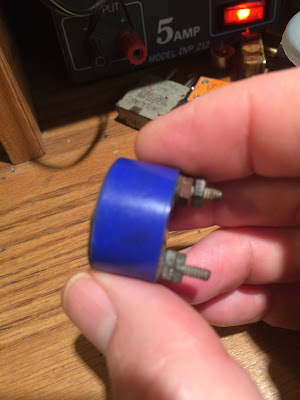
I feel a moral obligation to put these projects on the blog every time I see one. It just seems like the right thing to do. Great work on the Pilotron. Great workshop video also.
Category: radio history
Oliver Heaviside
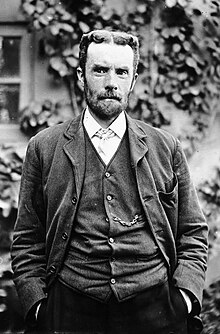
In the last SolderSmoke podcast we took a look at some of the giants of radio. Here is one fellow we missed: Oliver Heaviside. Hackaday has an interesting profile of him:
https://hackaday.com/2018/10/30/oliver-heaviside-rags-to-recognition-to-madness/#more-330784
Like many of the giants we looked at, Oliver definitely had his problems, and didn’t end well. But he deserves a lot of respect and credit for his many innovations and discoveries. I didn’t know that he is the one responsible for those 88 mH coils in my junk box.
SolderSmoke Podcast #207 — 15 mtrs, 60 mtrs, Giants of Radio, Cubesats, Pete’s rigs, SDR MAILBAG
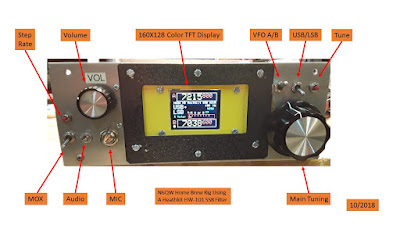
SolderSmoke Podcast #207 is available:
http://soldersmoke.com/soldersmoke207.mp3
— Giants of Radio
— Pete on 15 Meters
— Bill on 60 Meters with the uBITX
— Pete’s Sudden and Heath Filter Transceivers
— Cubesats to orbit! To the moon! And to Mars!
— Bill rebuilds his 2 meter “Ray-Gun” Quad (for Farhan’s Cubesat)
— Homebrewing Variable caps and stockpiling NP0
— My “by ear” Minimal Discernible Signal Technique
— Thoughts on Direct Sampling SDR and the Radio Art
MAILBAG
— A request for feedback from GQRP
— G4WIF reports G3ROO on UK TV with spysets
— VU3XVR builds FB rig from EMRFD
— M0KOV Charter member of the 3 Scratch-built BITX club
–KD4PBJ’s PTO Turtle DC Receiver
— AB1OP builds Pete’s LBS receiver and gives us a new acronym: SITB
— KD4EBM — Thanks for the scanner Bob!
— A possible sponsor from California…
— Pete’s dream neighborhood…
EF Johnson’s 50th Anniversary Speech. Very nice radio history
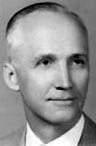
Thanks to W0VLZ for this wonderful 13 minute recording of Edgar F Johnson’s 50th Anniversary speech. There is a lot of great radio history in this speech. Highly recommended.
Just click here to listen:
https://www.prismnet.com/~nielw/EFJohnson/EFJ50thTalk.wav
EF Johnson’s hometown bio:
http://www.wasecaalums.com/public/389.cfm
Tom Swift had The Knack
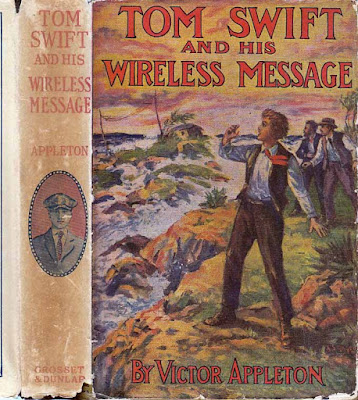
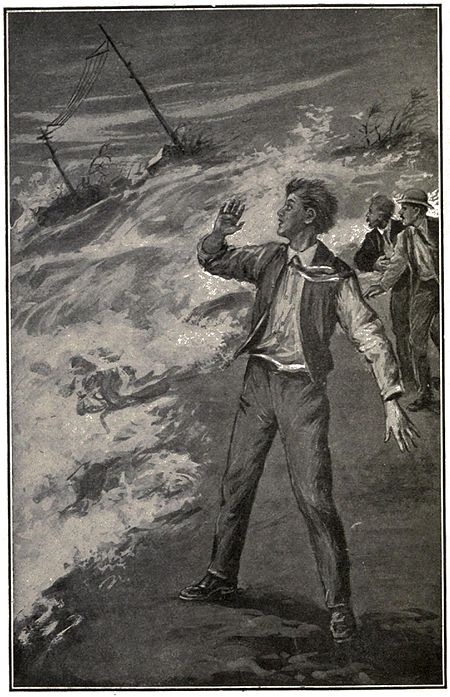
Thanks to Richard for alerting us this important piece of Knack history. Not bad for 1910. You can see Tom’s shack and antenna in the cover image (above). I don’t think he was going for a fan dipole. He built the kind of multi-wire antenna that was in fashion in the early days of radio.
The full text of the book is avaialble free on-line. The radio fun begins in Chapter 20:
Bless my door knob, this was a lot of fun!
Bill,
I am certain I missed the origin of “the knack” as used on your blog. I, wonder, however, if in your youth you read Tom Swift novels? Although now they seem somewhat politically incorrect, I feel that the word may have, for our purposes, evolved there.
In the first novel, “Tom Swift and His Motor-Cycle” (sic) Tom repairs a butter churn’s “system of cogs and handles.” When praised for his abilities he declares, “It’s just a knack.” Stick with me.
In a later novel, written around 1910, “Tom Swift and His Wireless Message” Tom is shipwrecked on an ebbing volcanic island. He saves the day by constructing a transmitter and receiver from the wreckage of his plane, even though he “did not have the magnets, carbons, coherers and needles” needed. He strings “ wires from the top of the dead treed, to a smaller one, some distance away, using five wires, set parallel, and attached to a wooden spreader, or stay. (Fan dipole?) The wires were then run to the dynamo, and the receiving coil, and the necessary ground wires were installed.” Then,”once the impulses, or electric currents, are sent out into space, all that is necessary to do is to break, or interrupt them at certain intervals to make dots, dated and spaces.” He sent “C.Q.D. (come quick—danger) even though a “new code has been instituted for them, but I am going to rely on the old one, as, in this part of the world, the new one may not be so well understood.” Needless to say, a ship hears, responds and rescues the crew.
That”s “the knack”, alright!
Never give up, and 73.
Richard, KD0NPM
Youngest Homebrew Hero: 17 year-old Sam Zeelof Makes His Own Integrated Circuits
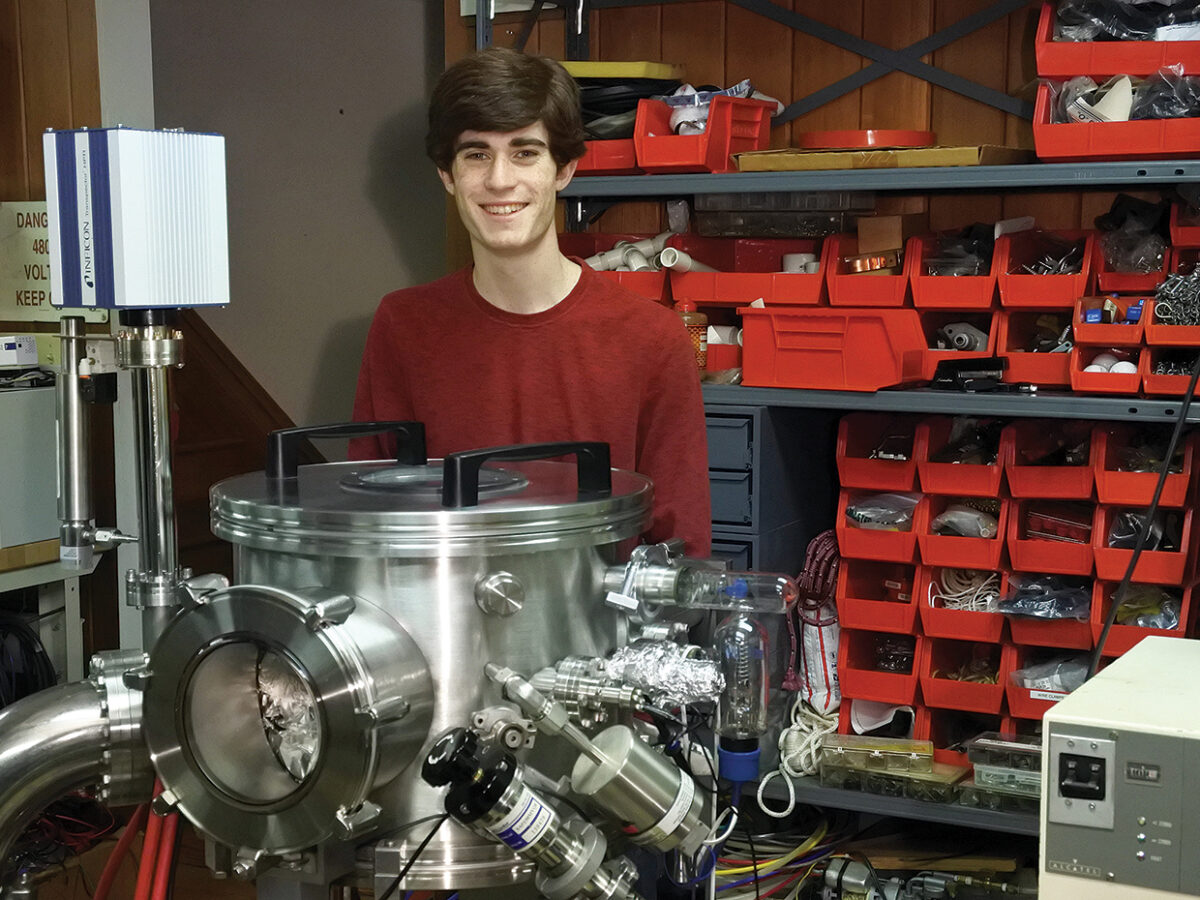
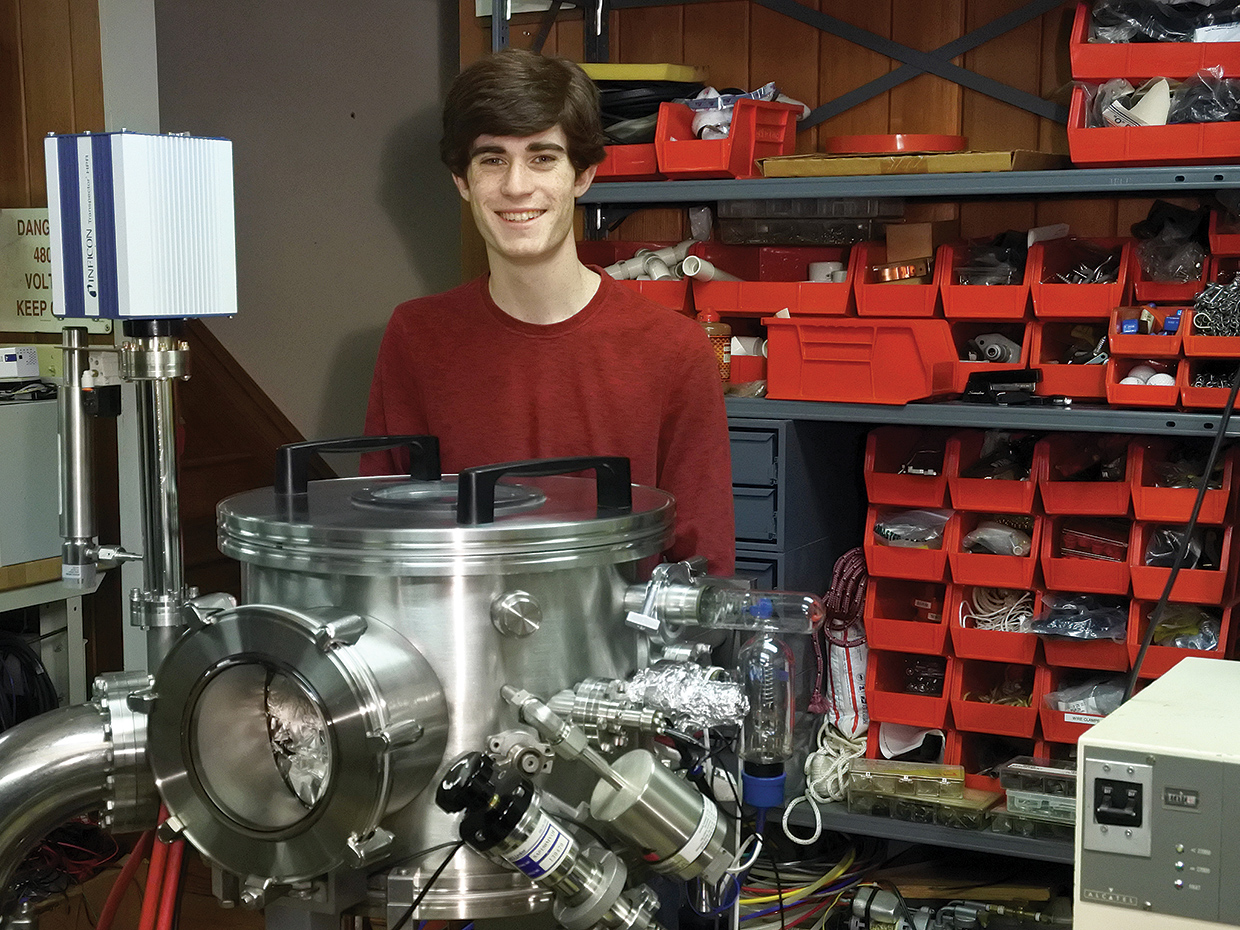
Seventeen year-old Sam Zeelof, KD2ENL, is making his own integrated circuits in his garage.
Wow. This makes me think about another seventeen year-old — the fellow who appears on pages 63-64 of Cliff DeSoto’s “200 Meters and Down.” (I have the story on page 81 of “SolderSmoke — Global Adventures in Wireless Electronics.”) In the early days of radio that kid amazed us by making his own vacuum tubes. Sam Zeelof is clearly following in that tradition.
No “mysterious black boxes” for Sam! No “appliance chips” for him! FB OM.
This is really amazing. Here are the links:
https://spectrum.ieee.org/semiconductors/devices/the-high-school-student-whos-building-his-own-integrated-circuits
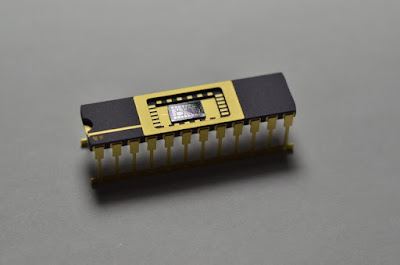 |
| One of Sam’s chips |
Thanks to Bruce KC1FSZ for alerting us to this amazing work.
AMAZING 1999 Video on the Invention of the Transistor at “Hell’s Bells Laboratory”
Thanks to Armand WA1UQO for alerting me to this. I really liked the book — “Crystal Fire” — that this 1999 video is loosely based on. I’m also a fan of the narrator, Ira Flatow, whose melodious voice is heard each week on NPR’s excellent “Science Friday” radio show.
A few observations and thoughts on the video:
— I liked the irreverant Calypso song “Hell’s Bells Laboratory.” It looks like those folks had a lot of fun. And wow, Shockly’s secretary was named Betty Sparks. TRGHS.
— I have the same big Variac on my bench. And I have one of those “third hand” devices.
— I’d like to build my own replica of the point contact device with the triangular piece of lucite and the gold foil.
— While Shockley seems to be the real bad guy in this story (he seems to have all the bad characteristics of David Sarnoff, Lee DeForest, and Steve Jobs), I liked the his use of “physical intuition” to understand devices and the problems they were meant to solve.
— The image of the two Japanese founders of Sony working in the late 1940’s in a bombed out department store was very powerful.
— Although I came on the scence a bit later, I WAS one of those kids who used a transistor radio and an earphone to surreptitiously listen to rock-and-roll music.
— “More transistors are made each year than raindrops fall on California.” Hmmm….
More info here: http://www.pbs.org/transistor/
Extra interviews: http://www.pbs.org/transistor/tv/index.html
The Ham-Radio Thermatron Roots of Silicon Valley
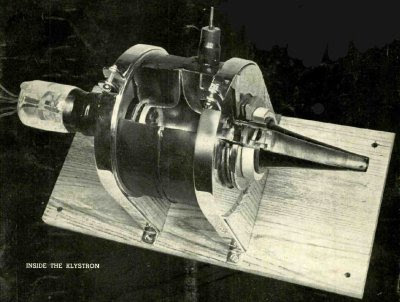
Hack-A-Day had an excellent piece on tubes and Silicon Valley this week. Makes me want to get the book “Secret History of Silicon Valley.”
https://hackaday.com/2017/11/02/silicon-valley-was-built-on-tubes-of-glass/
Note above the Klystron prototype mounted on a wooden board. These guys clearly had THE KNACK.
The First “Transistor Radio”
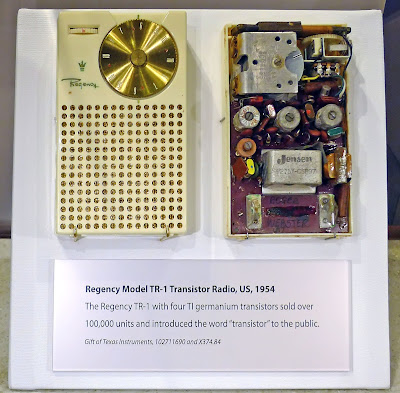
I’m a few days behind on this. On October 18 Bob Crane pointed out that Garrison Keillor marked the anniversary of the broadcast band “transistor radio.” I had mine (a 1970s version), and it did indeed allow me to listen to that seditious rock music without parental interference. Looking around the shack, I still have items in use that have “Transistorized” as part of their product name (like my Lafayette Radio Electronics Transistorized DC Power Supply.”
Garrison (on October 18, 2017):
Transistors were a big breakthrough in electronics — a new way to amplify signals. They replaced vacuum tubes, which were fragile, slow to warm up, and unreliable. During World War II, there was a big funding push to try to update vacuum tubes, since they were used in radio-controlled bombs but didn’t work very well. A team of scientists at Bell Laboratories invented the first transistor technology in 1947. But the announcement didn’t make much of an impact because transistors had limited use for everyday consumers — they were used mainly in military technology, telephone switching equipment, and hearing aids.
Several companies bought licenses from Bell, including Texas Instruments, who was bent on being the first to market with a transistor radio. Radios were mostly big, bulky devices that stayed in one place — usually in the living room — while the whole family gathered around to listen to programming. There were some portable radios made with vacuum tubes, but they were about the size of lunch boxes, they used heavy nonrechargeable batteries, they took a long time to start working while the tubes warmed up, and they were fragile. Texas Instruments was determined to create a radio that was small and portable, and to get it out for the Christmas shopping season. They produced the transistors, and they partnered with the Regency Division of Industrial Development Engineering Associates, who manufactured the actual radios. Their new radio, the Regency TR-1, turned on immediately, weighed half a pound, and could fit in your pocket. It cost $49.95, and more than 100,000 were sold.
Texas Instruments went on to pursue other projects, but a Japanese company called Tokyo Tsushin Kogyo decided to make transistor radios their main enterprise. They were concerned that their name was too difficult for an American audience to pronounce, so they decided to rebrand themselves with something simpler. They looked up the Latin word for sound, which was sonus. And they liked the term sonny boys — English slang that was used in Japan for exceptionally bright, promising boys. And so the company Sony was born. Soon transistor radios were cheap and prevalent.
With transistor radios, teenagers were able to listen to music out of their parents’ earshot. This made possible the explosion of a new genre of American music: rock and roll.
SolderSmoke Podcast #200! 17, Knack Nobel, QCX, 630, UHF, Fessenden, TROUBLESHOOTING
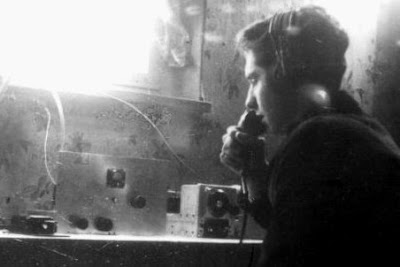 |
| DL3AO 1950 |
SolderSmoke Podcast #200 — TWO HUNDRED!!!!– Is available
http://soldersmoke.com/soldersmoke200.mp3
— Old friends on 17 meters.
— Another Knack Nobel in Physics.
— Hans Summers’ QCX transceiver: $50 IS THE NEW 10 GRAND!
— New Bands! 630 and 2200 Meters. BIG ANTENNAS!
— Nuke Powered QRP. No joke!
— The Challenge of UHF. Not for the faint of heart.
— Reginald Fessenden, Father of Phone.
PETE’S BENCH REPORT: The New Simple-ceiver. Soon to be a Transceiver.
BILL’s BENCH REPORT: Discrete, Direct Conversion, Ceramic Receiver in iPhone Box.
THE EDUCATIONAL PORTION OF TODAY’s PROGRAM:
HOW TO TROUBLESHOOT A HOMEBREW RECEIVER.
MAILBAG.
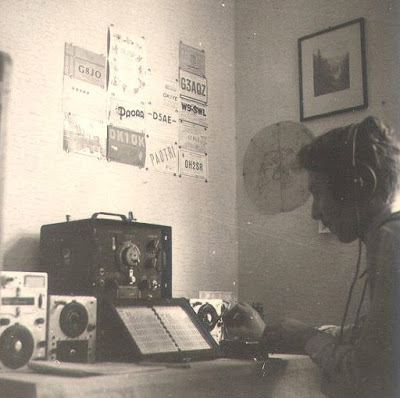 |
| DL3AO 1950 |
SolderSmoke Podcast #200! 17, Knack Nobel, QCX, 630, UHF, Fessenden, TROUBLESHOOTING
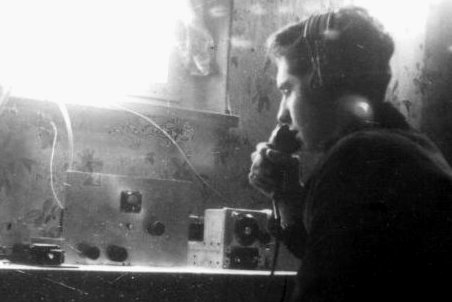 |
| DL3AO 1950 |
SolderSmoke Podcast #200 — TWO HUNDRED!!!!– Is available
http://soldersmoke.com/soldersmoke200.mp3
— Old friends on 17 meters.
— Another Knack Nobel in Physics.
— Hans Summers’ QCX transceiver: $50 IS THE NEW 10 GRAND!
— New Bands! 630 and 2200 Meters. BIG ANTENNAS!
— Nuke Powered QRP. No joke!
— The Challenge of UHF. Not for the faint of heart.
— Reginald Fessenden, Father of Phone.
PETE’S BENCH REPORT: The New Simple-ceiver. Soon to be a Transceiver.
BILL’s BENCH REPORT: Discrete, Direct Conversion, Ceramic Receiver in iPhone Box.
THE EDUCATIONAL PORTION OF TODAY’s PROGRAM:
HOW TO TROUBLESHOOT A HOMEBREW RECEIVER.
MAILBAG.
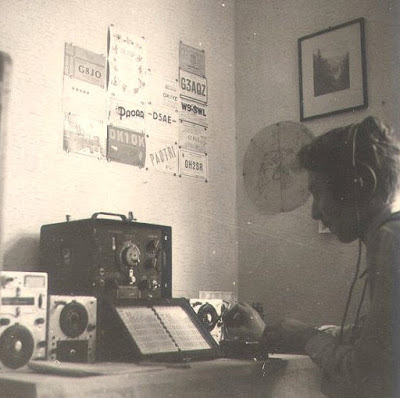 |
| DL3AO 1950 |
Hallicrafters and the Romantic Life of Private Hogarth
The world of the SolderSmoke podcast and blog are — and will remain — G rated. But occassionally our discussion of ham radio technology causes us to bump up against some racy topics. This happens VERY rarely, and that rarity probably says something about ham radio. We have noted the alleged attractive power of Pete Juliano’s French beret. There was that April 1 story about the new SolderSmoke cologne (“chicks dig it!”). Jean Shepherd was a man of the world — our discussions of him sometimes bring us a bit closer to the prurient boundary line. We occassionally mention the lifestyle of the Dos Equis man. But mostly, we stick to the circuitry.
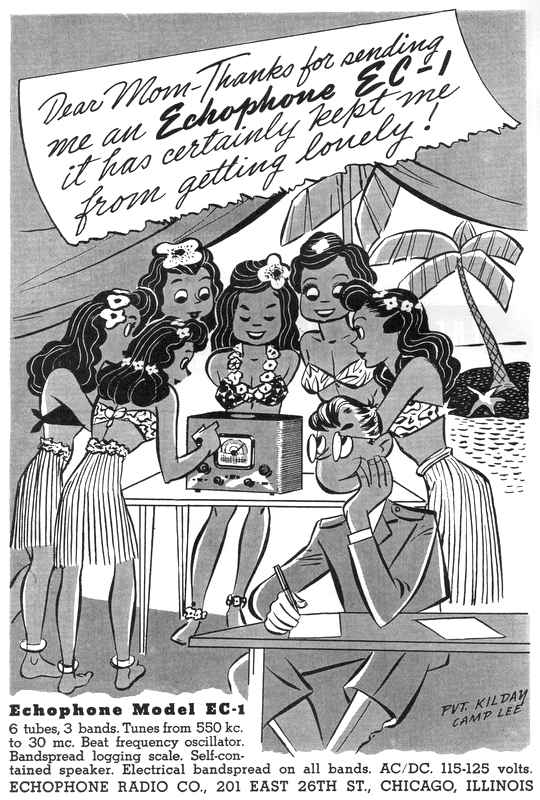
This morning I came across a character that I hadn’t been aware of: Private (later Corporal) Hogarth. He was the theme of a series of ads run by the Hallicrafters Company during World War II. They were trying to sell their EC-1 broadcast receiver (essentially an All American Five). Their advertising theme was, essentially, “chicks dig it.”
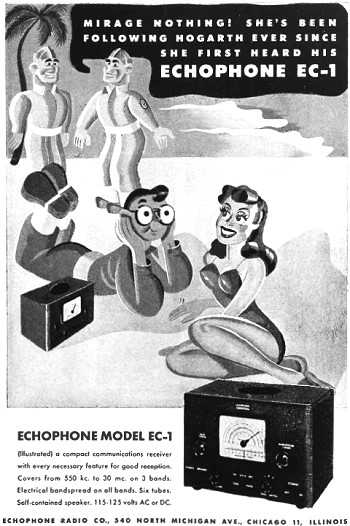
More of this here: http://www.geojohn.org/Radios/MyRadios/EC1/EC1.html
Don’t blame me. I blame Hallicrafters.
Yellow Fever! The Cold War Origins of Juliello
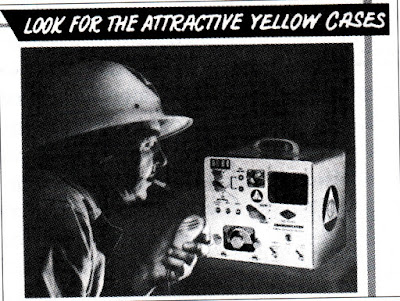
How could you miss them? That yellow was bright! Apparently you needed high visibility to cope with the looming danger of nuclear annihilation. The operator in the ad is obviously calm in the face of Armageddon — note the cigarette dangling from his lips. In this 1956 Gonset ad we can see the inspiration behind what — many decades later — has emerged as the avant-garde ham radio color scheme known as Juliello. The roots of this aesthetic are clearly not in the psychedelic “Mellow Yellow” hippie era. No, this color has harder, more flinty origins.
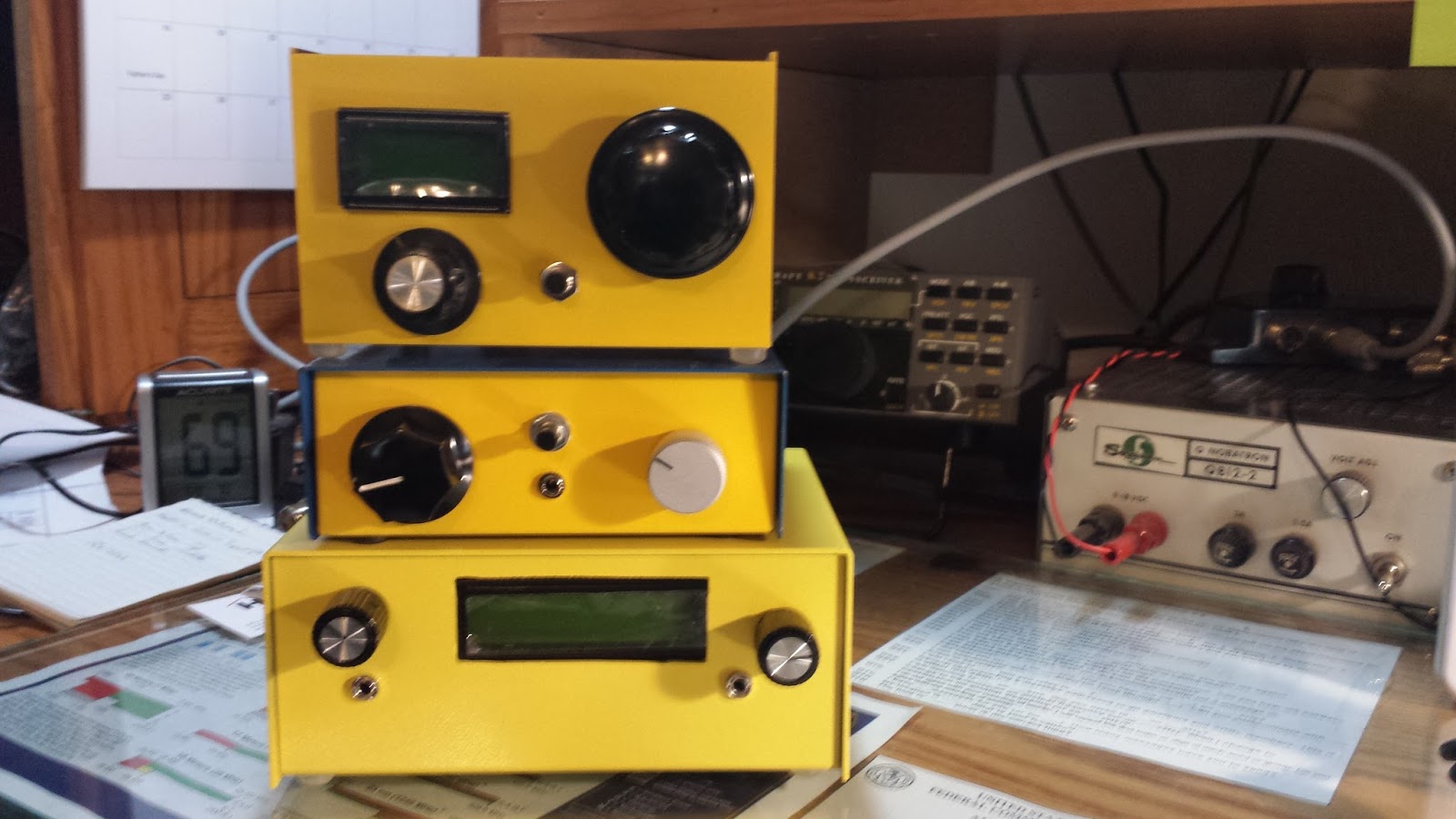
Pete Juliano is not the only one to embrace this look. Podcast #198 elicited this response from our friend Armand WA1UQO:
Pete:
Don’t let that Meara guy give you a hard time over the yellow Rigs. The last three of mine have been yellow and I’m happy to see I’m not the only one with good taste. In the picture they are from top to bottom a 30M One Watter, a 20M One Watter and of course the BITX 40. The 20M does have a Juliano Blue cover though to give it an extra bit of class! As always, enjoyed the podcast.
Bill, see you at Berryville?
73, Armand WA1UQO

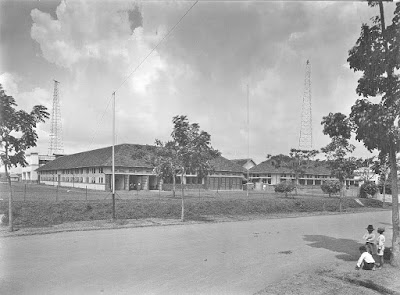
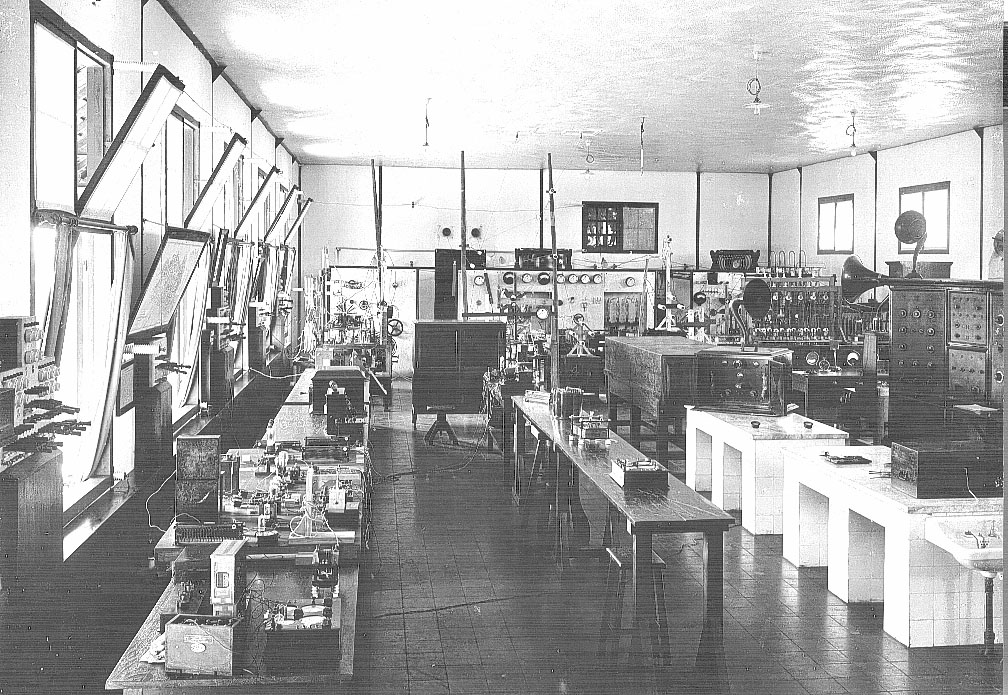
The Radio Laboratory at Bandung, Java — SSB in 1927
Anton PA0AST alerted me to this important piece of radio history:
The first phone radio between Indonesia , the city of Bandung ( Dayeuh Kolot, Jalan Radio 1 ), and Holland , Radio Kootwijk were made in SSB already in 1927… Before that time they had only a CW 1 Mega Watt spark transmitter in Malabar.
One of the receivers still exists in a museum in Amsterdam (cdvandt ). It is 3 meters in length and 2 meter in height…. All made with plug-able units with 1 tube inside .
The transmitter was 10 kW. Ua was 6kV was made by dynamotors. Transmitting Tubes locally made by craftsman in a workshop. Both buildings as well in Bandung and in Kootwijk still exists .
Anton
The old images come from:
http://www.cdvandt.org/bandung-lab-kwk.htm
At the other end was Radio Kootwijk in Holland.
Before you jump to the English version of the page, be sure to check out the Drone video of the site, and the audio file of the Morse transmissions:
http://radiokootwijk.nu/ Thanks to PA0JWU for the wonderful site.
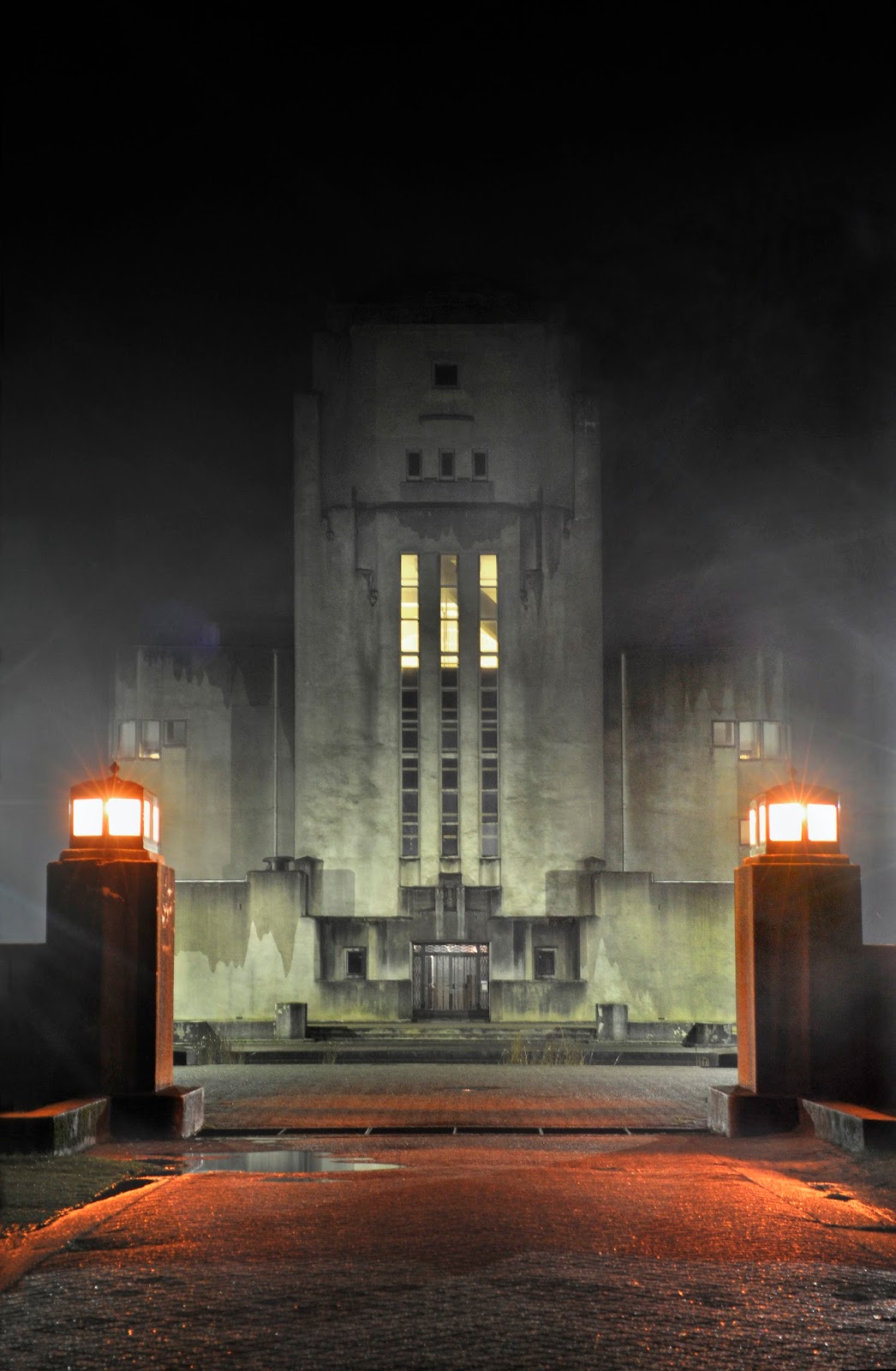
Quite an impressive shack! My favorite part is the note indicating that local residents cleaned out the cooling pool and used it for swimming each summer.
Les Moxon, G6XN
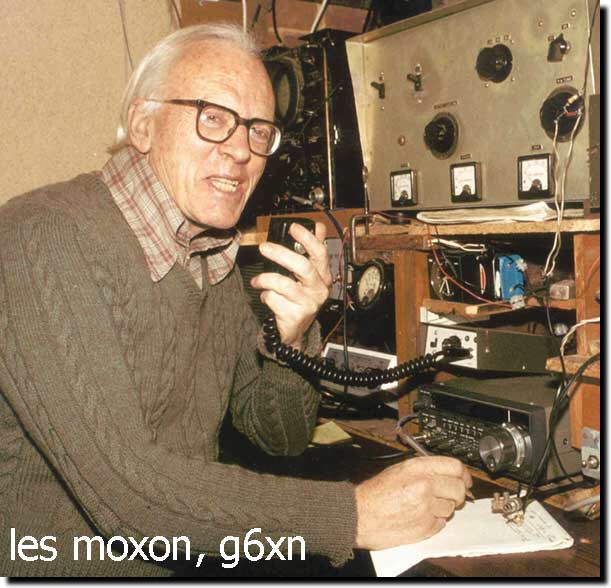
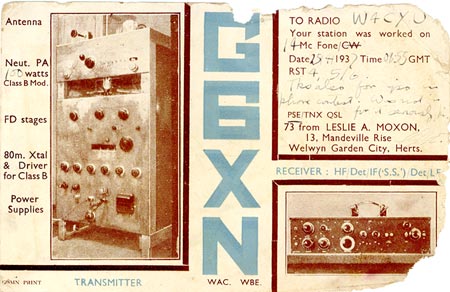
I was on 40 SB tonight talking to Don KC5YR. He is the creator of the web site known as the Moxon Antenna Project: http://www.moxonantennaproject.com/ That site had this great picture of OM Les Moxon, inventor of the wonderful antenna that bears his name. I also found this old QSL card that shows some of Les’s homebrew gear. Les has been a Silent Key for many years now, but his legacy lives on.
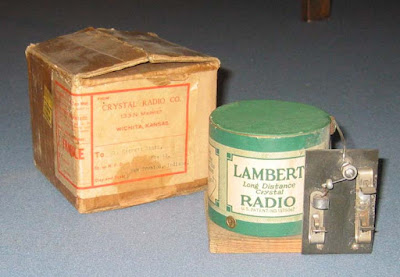
The Leon Lambert Crystal Radio
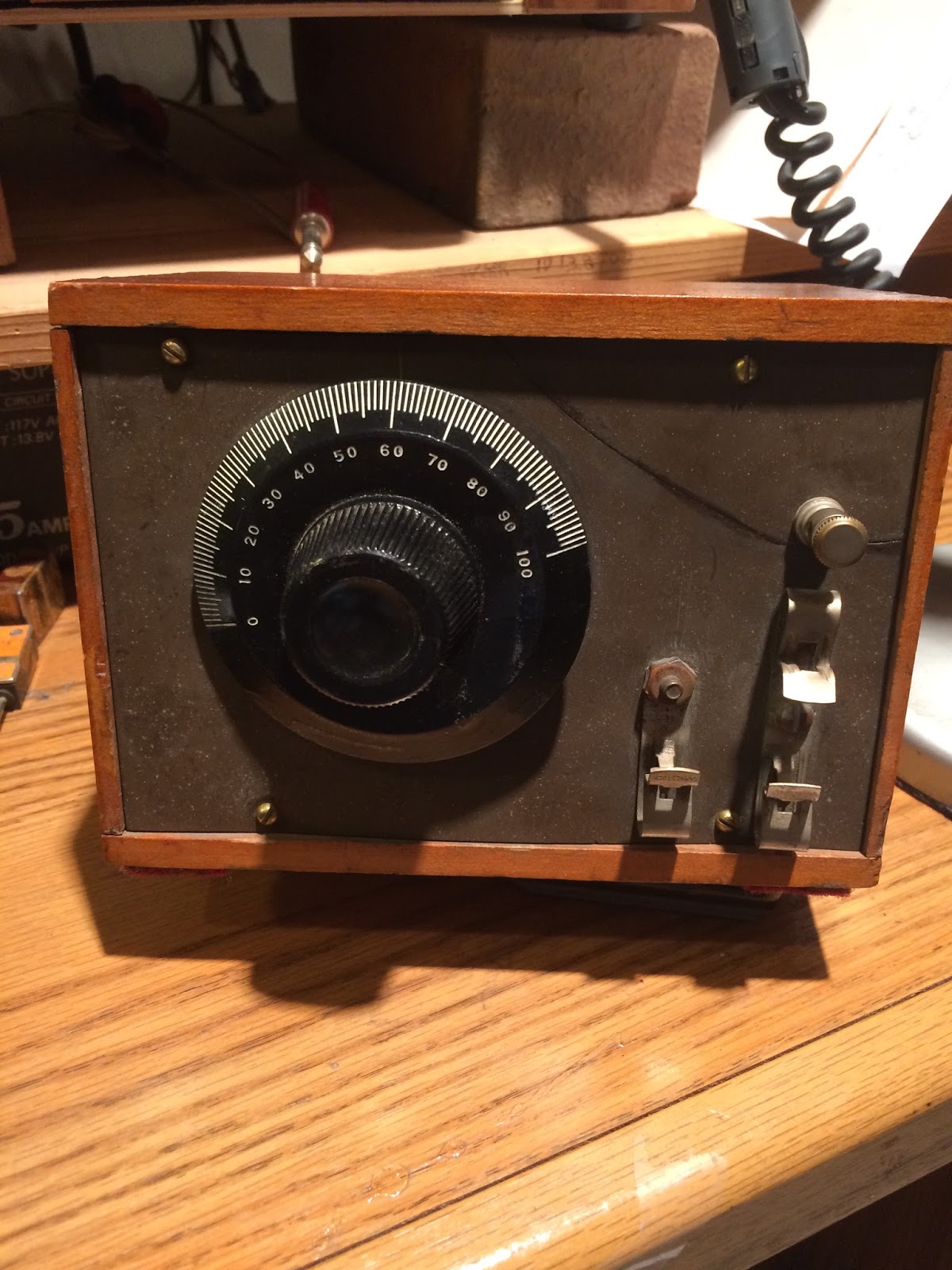
Above you see another gem from the Manassas hamfest. I didn’t know what this was. And I don’t think the seller knew what it was either. I think I gave him 5 bucks for it (as it turns out that is close to the original 1925 price). It was only in the course of looking up yesterday’s Philmore Fixed Crystal Detector that I happened to spot a picture of this thing.
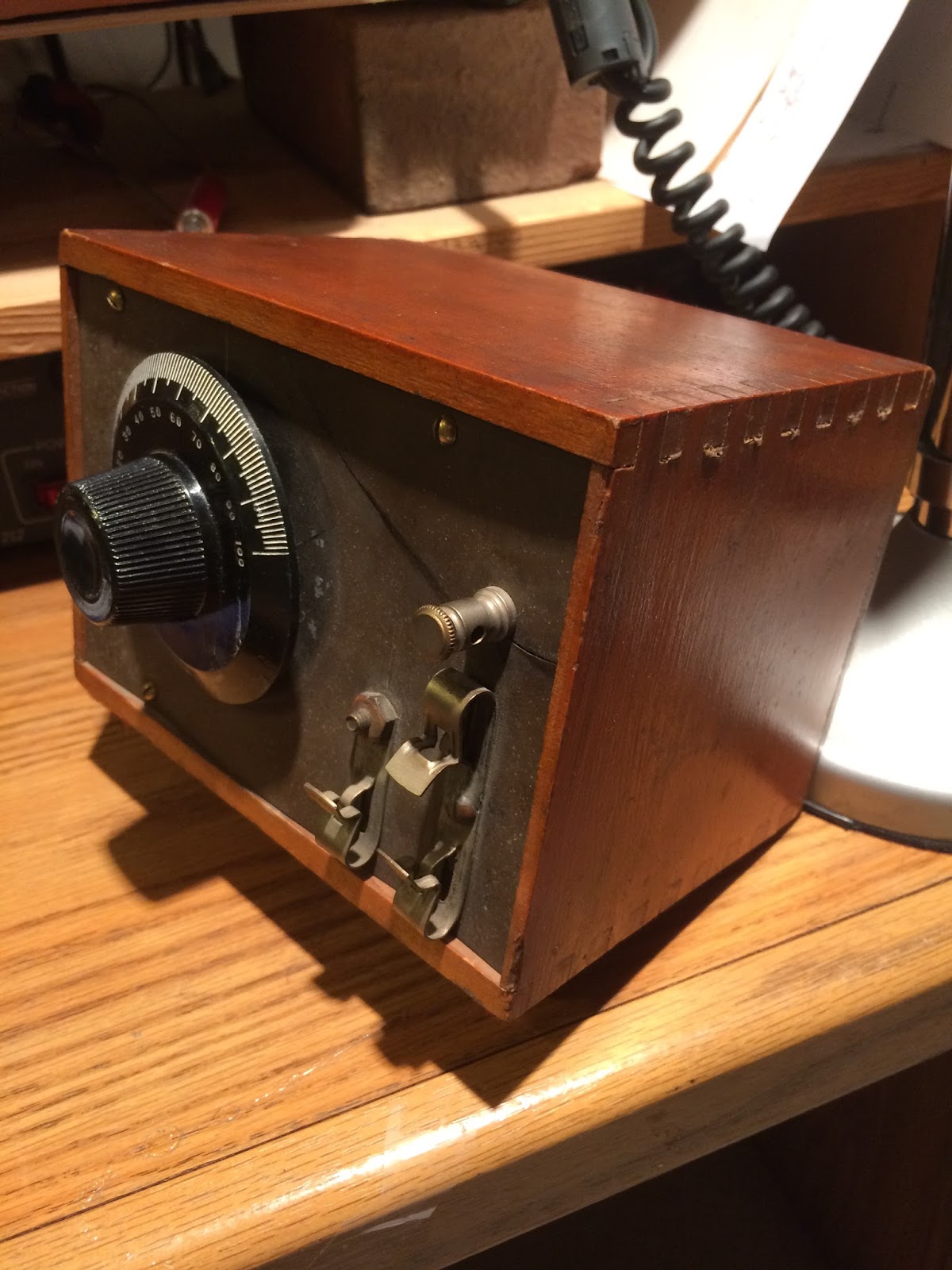
There is not much to it. That nice dial is mechanically connected to a sweeper arm that runs along a big coil. The galena and cats whisker were apparently held in place by the Fahenstock clips on the front. Leon Lambert made these things in Witchita Kansas around 1924. He started making them without the fancy wooden box, but one report says he found a good source for the enclosures:
In 2004 Dale Davenport wrote:
Leon Lambert’s crystal sets show up maybe as or more often than most other brands from that time period apparently, particularly in the Midwest, There are quite a few variations though: some have a little metal tag tacked on, usually on top front center, some do not have a tag at all. Detectors vary some as well and I’ve seen them with Erla fixed detectors. One thing is more or less constant it seems, and that is the little wooden boxes they are mounted in. I cannot verify the story other than from observations, but was told quite a number of years ago that the boxes the Lambert sets are mounted in were used to ship sticks of chalk, packed in saw dust, to schools. Lambert supposedly had a deal with someone with the local school system to acquire these as they were emptied. I have owned one example, and have seen other examples of these sets that show some pressure marks on the flat sides, near the corners, where they apparently were packed in bundles, and the strapping tape used to secure the bundles left an impression. This seems to indicate that the story might be true and they might be leftover marks from the box’s days as a chalk shipping box.Has anyone else heard the story or can anyone else offer more details on this theory? From: http://www.antiqueradios.com/forums/viewtopic.php?t=36735
Here’s a picture of the unboxed version — you can see here where the galena went:
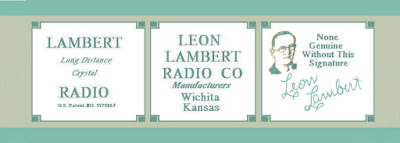
And here we see Leon himself:
The Philmore Fixed Crystal Detector
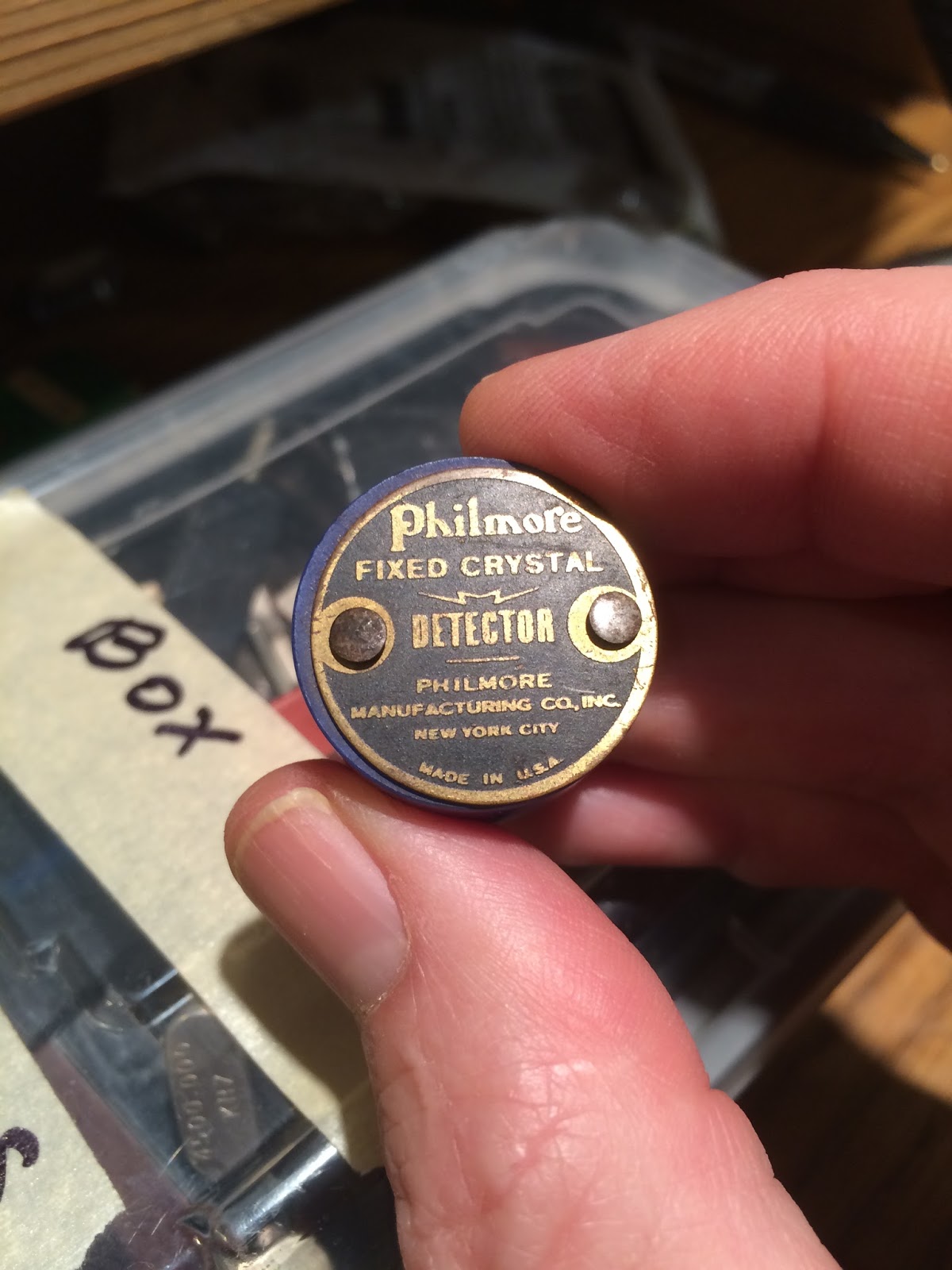
I was at the Manassas, Virginia hamfest on Sunday. An old timer had a box of crystals for sale. It was obviously the kind of “box of rocks” that many of us have in the shack. There was a very wide variety of crystal packages in there, perhaps the widest range of possible styles. In among the modern computer crystals and WW II FT243s, I found one from the earliest days of broadcast radio. The Philmore Fixed Crystal Detector is really just a chunk of galena with a phosphor bronze cat whisker held in place by a spring. Philmore apparently went ahead and found a “sweet spot” for you.
N2HTT was working with on of these last year: https://n2htt.net/2016/01/17/a-complete-digression/
Of course, I liked the New York City connection.
I will see if this old thing still inhales.
The Transistor! 1953 Bell System Film — Great Stuff!
Thermatron fans beware! There is some trash talking of tubes in this 1953 Bell film. But there is also a lot of recognition of the contribution made by our beloved valves. I especially liked the report on the historic 1915 phone transmissions from Arlington, Virginia. ( I drive past the transmitter site every work day). FIVE HUNDRED TUBES combined to send the human voice from Arlington to both the Eiffel Tower and to Pearl Harbor, Hawaii. FB OM! 59!
I was disappointed, however, that this film failed to recognize another momentous 1953 achievement in sold state electronics: In that year, 11 year-old Pete Juliano built his first solid state amplifier — an audio amp using a CK722 transistor. Read about it here: http://soldersmoke.blogspot.com/2015/03/pete-juliano-homebrwing-with.html
The fact that Pete was homebrewing solid state circuits at the time that this film was made is a reminder of the vast experience that he has, and of how much technological progress we have made in such a short period of time.
Homebrew History is Made: Farhan @ W7ZOI
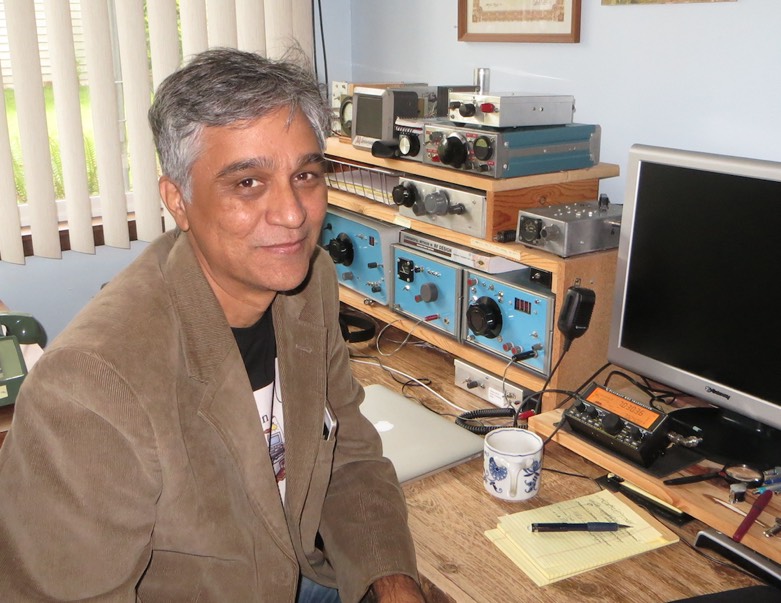
Thanks to Wes W7ZOI for sending me the link to his page describing the visit of our friend Farhan. I think this visit was a historic gathering of homebrew heroes and their groundbreaking rigs. Read all about it here: http://w7zoi.net/Farhan-visit.html
Please help me convince Farhan to visit SolderSmoke HQ before returning to India! Send him (or me) e-mails, texts, tweets, or just post messages of support below this post.
Stepping Inside an AM Transmitter (video)
Very cool video. We have visited VE7ZWZ’s amazing shack before. This time he takes us inside a BIG commercial AM transmitter that he has modified for use on the amateur bands.
I know that he had the plate voltage turned off, but I still felt myself cringing when he reached up to touch the plate connectors on those enormous thermatrons. The filaments were on, adding to my unease. Dude, don’t do that! And if you are standing INSIDE the transmitter, keeping one hand behind your back might not be as beneficial as it normally would be.
His comments on his VFO were interesting. I was kind of disappointed that he went with a varactor circuit. A varactor? Amidst all those bread slicer variable caps? It just doesn’t seem right. (And BTW they are bread slicers, NOT “potato slicers.”) But I kind of liked the heater–thermistor–insulation set up that keeps the VFO at constant temperature.
I thought it was interesting that these transmitters were kept on, with the tubes glowing for years at a time.
Thanks Mr. Carlson, for another great video!